This contribution to the symposium focuses on implicit bias, microaggression, and bullying. These forms of conduct are oppressive and have their most egregious effects on scholars who might be said to be on the “margins”Footnote 1 of the discipline, including racial and ethnic minorities; women of all races and ethnicities; the LGBTQ+ identified; (especially new) immigrants; individuals living with disabilities; and others whose identities are despised or devalorized by many members of dominant social groups.Footnote 2 The analysis draws on extant research and an exploratory study that includes a surveyFootnote 3 and elite interviews conducted during the summer and early fall of 2021.Footnote 4
This study asks whether and to what extent there is a systemic problem of implicit bias, microaggression, and bullying that political science scholars must negotiate. To be sure, extant studies have addressed related questions. Mershon and Walsh (Reference Mershon and Walsh2015, 459) have reported that “pervasive stereotypes are perpetuated by the attitudes and practices of both women and men, who reward those who hew most closely to white, heterosexual, masculine, and middle-class norms.” Hesli Claypool and Mershon (Reference Hesli Claypool and Mershon2016) explored the relationship between the degree of departmental diversity and the friendliness, collegiality, and productivity of the associated faculty. A 2017 American Political Science Association (APSA) survey indicated that approximately one third of respondents had experienced some form of harassment during the previous four APSA Annual Meetings (Sapiro and Campbell Reference Sapiro and Campbell2018). Our study, based on a national survey and elite interviews, broadened the investigation beyond the annual meetings to cover the climate and context within departments. It also deepened the inquiry by reporting the testimony of individuals who accepted the survey’s invitation to provide detailed narratives in open-ended replies.
UNDERSTANDING THE TERMS
“Implicit bias,” also known as unconscious bias, is ubiquitous in society. It permeates our social interactions and practices, such as sentencing, preschool suspensions, corporate leadership, the homes we buy, the way we treat our neighbors, and the people we hire (Eberhardt Reference Eberhardt2019; also see Brownstein Reference Brownstein2019; Lane Reference Lane2017).
The term “microaggression,” coined by Chester Pierce (Spencer Reference Spencer2017), was popularized in the work of Derald Wing Sue (Reference Sue2010; see also Sue et al. Reference Sue, Capodilupo, Torino, Bucceri, Aisha, Nadal and Esquilin2007, Reference Sue, Nadal, Capodilupo, Lin, Torino and Rivera2008). For Delgado and Stefancic (Reference Delgado and Stefancic2017, 2; see also The Microaggressions Project), microaggressions “can be thought of as small acts of racism…welling up from the assumptions about racial matters most of us absorb…in the United States.” Such conduct might be interpreted as innocuous by some scholars but nonetheless is experienced as a form of oppression by those who are subjected to it. Examples include telling an Asian American person that they speak English very well and assuming that it is a compliment; and asking a brown person probing questions about where “they really are from” after they have said that they are “from Los Angeles.” However, not all scholars believe that the term has significant analytic value (Campbell and Manning Reference Campbell and Manning2018; Haidt Reference Haidt2017; Harris Reference Harris2008). For critics of the term, areas of contention include the extent to which the intention of the aggressor should matter and whether only oppressed groups can be subject to microaggression.
Like implicit bias and microaggression, “bullying” also is a frequent occurrence in the workplace (Randall Reference Randall1997, esp. chap. 1; Kasperkevic Reference Kasperkevic2014). Bullying can take many forms, including aggression, intimidation, emotional abuse, incivility, social undermining, harassment, and victimization (Cortina et al. Reference Cortina, Magley, Williams and Langhout2001; Einarsen et al. Reference Einarsen, Hoel, Zapf, Cooper, Einarsen, Hoel, Zapf and Cooper2011; Nielsen, Glasø, and Einarsen Reference Nielsen, Glasø and Einarsen2017; Olweus Bullying Prevention Program 2019; also see Olweus Reference Olweus, Jimerson, Swearer and Espelage2010). An early discussion of the phenomenon appears in Carroll M. Brodsky’s The Harassed Worker, which described five types of harassment: sexual harassment, scapegoating, name-calling, physical abuse, and work pressure (Einarsen et al. Reference Einarsen, Hoel, Zapf, Cooper, Einarsen, Hoel, Zapf and Cooper2011, 6). Another phenomenon related to bullying is “rankism,” in which individuals use their senior rank or superiority to harass others (Fuller Reference Fuller2006).
METHODS
We take seriously Shapiro’s (Reference Shapiro2002, 598) cautionary insight that our questions should drive our methods and not the other way around. We also believe that an inquiry of the type we conducted warranted a mixed-methods approach. Consequently, we decided to combine qualitative and quantitative research by triangulating (Patton Reference Patton1999) the data we intended to collect through both elite interviewsFootnote 5 and a national survey. Data collection took place during August and September 2021.
For the interviews, two key informantsFootnote 6 were selected for their expertise on the subject of our inquiry. The interviews were “semi-structured” (Thomas Reference Thomas2017, 198–99). An interview protocol guided us through parts of our conversations; however, the interviewees led the conversations in other parts. Each interview lasted from 30 to 45 minutes.
We administered the survey from August 1 to August 31, 2021. It was created using Qualtrics, which can generate an anonymous link that can be forwarded via email or distributed on social media. Our hope was that political scientists from across the country would be in our potential respondent pool. Therefore, we reached out to respondents using a combination of convenience and snowball sampling strategies (Thomas Reference Thomas2017) that included personal connections and APSA’s membership.
On August 1, 2021, the survey was sent to 55 chairs of the 2020 APSA Annual Meeting divisions with a request to circulate it within their division. Originally, we intended the survey to close on August 21, 2021. However, on August 19, we sent a follow-up email extending the closing date to August 31.
We do not know how many division chairs circulated the survey to their division, but we hope that it was received by at least one third of APSA’s membership. One coauthor of this article also sent the survey to a personal network of colleagues (77 recipients) with the same request for circulation.
We received a total of 83 responses, which is significantly lower than what we had hoped for—but also not entirely unexpected given that the survey went out (1) during the summer term, when most faculty members are away from work; and (2) in the height of what has been called “COVID-19 fatigue.”
We made a deliberate decision to not ask questions in the survey related to demographic information such as race, gender identity, sex, sexual orientation, ability status, age, national or ethnic origin, and institutional affiliation. This was to reduce the potential threat of exposure that respondents might experience, given the nature of the questions in the survey. However, we now realize that the study could have been more richly detailed if we had collected this demographic information.
FINDINGS
The survey asked respondents about their experiences witnessing implicit bias, microaggression, and bullying targeted toward others at professional meetings as well as at the departmental level. It also asked respondents about their own experiences with such phenomena in these settings (Ghosh and Wang Reference Ghosh and Wang2022).
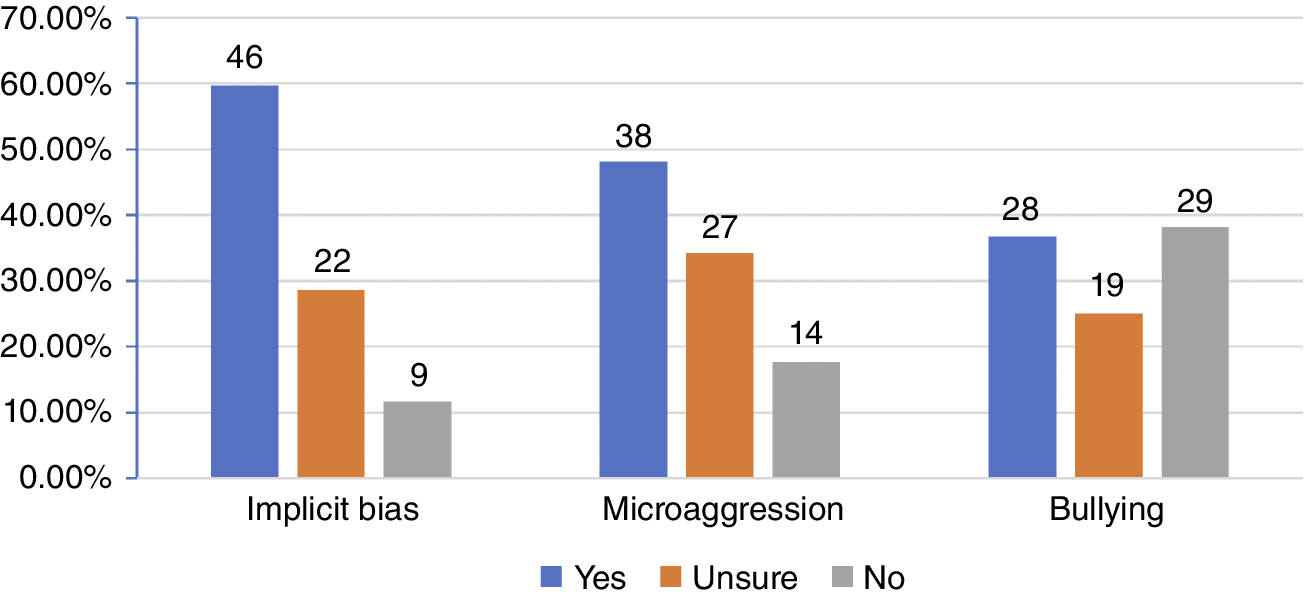
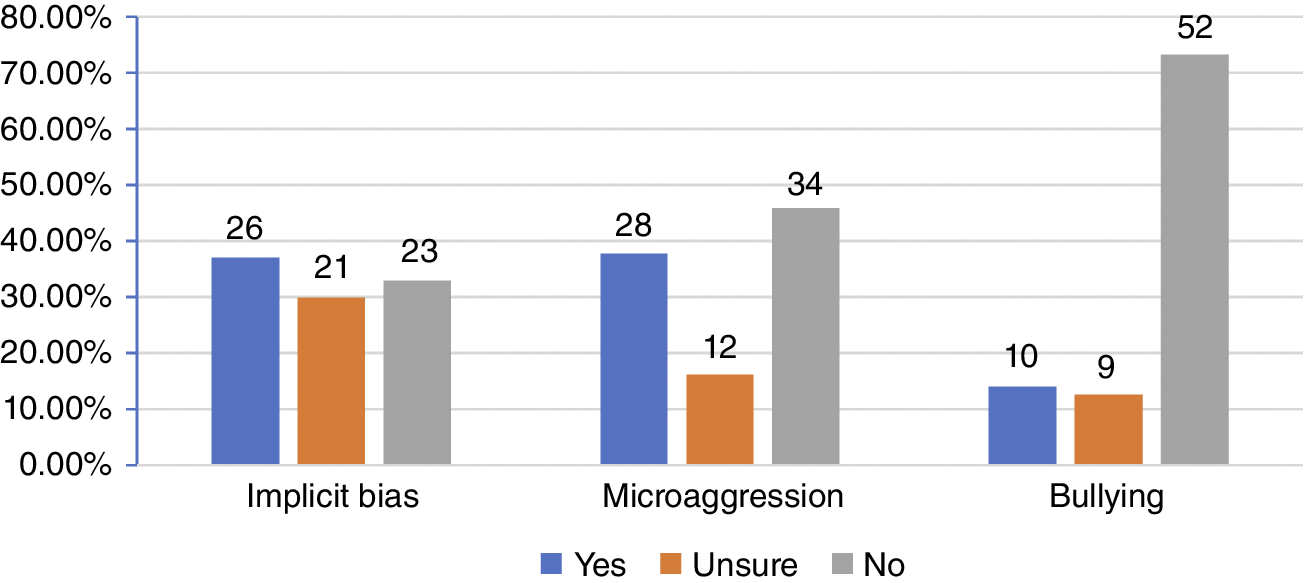
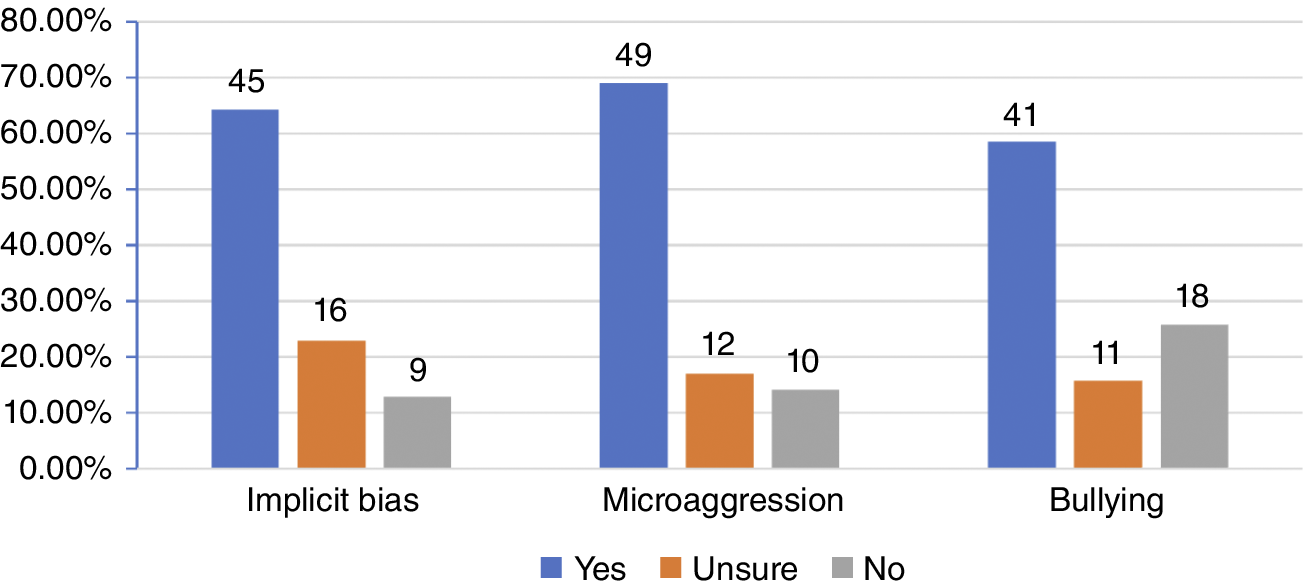
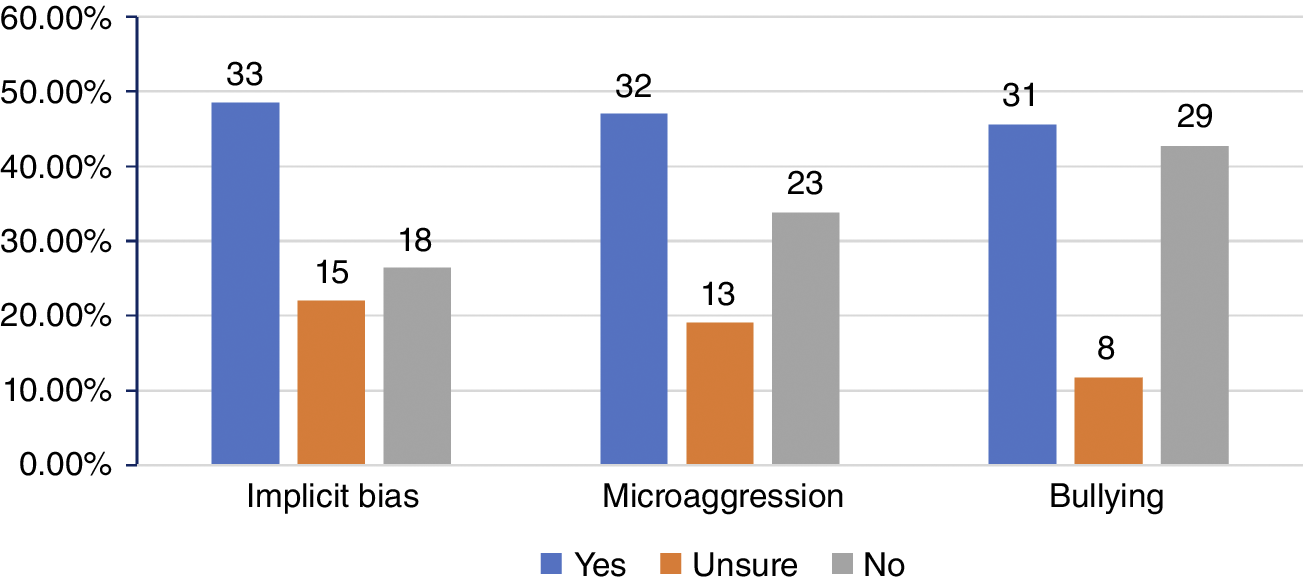
Most of our respondents reported “very high” or “high” levels of familiarity with the terms: implicit bias (92.21%), microaggression (86.07%), and bullying (96.2%). A close review of the survey results yields several broad patterns. On the one hand, generally, respondents were able to preserve the distinction between self and others. On the other hand, several respondents were less willing or able to disaggregate their descriptions of their experiences at professional meetings and at the departmental level. Several respondents were unable or unwilling to distinguish among implicit bias, microaggression, and bullying; they sometimes reported examples in two or three categories when asked about only one. However, none of the patterns observed compromised the integrity of the data collected. Figures 1–4 present the most relevant data. The categories of behavior are listed in reverse order of the blatancy of conduct.
Witnessing Treatment of Others at a Professional Meeting
Percentages and raw numbers of respondents who reported witnessing colleagues being subjected to implicit bias, microaggression, and bullying at professional meetings.

Own Experience at a Professional Meeting
Percentages and raw numbers of respondents who reported being subjected to implicit bias, microaggression, and bullying at professional meetings.

Witnessing Treatment of Others in a Department with Which One Is Familiar
Percentages and raw numbers of respondents who reported witnessing colleagues being subjected to implicit bias, microaggression, and bullying in political science departments with which they are familiar.

Own Experience in a Department with Which One Is Affiliated
Percentages and raw numbers of respondents who reported being subjected to implicit bias, microaggression, and bullying in a political science department with which they have been affiliated. Two respondents (2.94%) chose the “other” option for this question.

Several patterns deserve special attention. First, as indicated in figures 1–4, the percentage of responses that involve witnessing implicit bias, microaggression, and bullying—at both professional meetings and in departments—is considerably higher than the percentage related to personal experience with these forms of conduct. This indicates that, as we had hoped, we drew responses from a much wider range of respondents than those in marginalized groups who routinely suffer the most.
Second, the figures also suggest that political scientists in general appear to be less likely to engage in the more blatant forms of discrimination (i.e., microaggression and bullying) at professional meetings than at the departmental level. The prevalence of bullying at the departmental level is quite striking. Although such conduct is witnessed or experienced much less often at professional meetings than implicit bias and microaggression, it is not far behind the other two at the department level. One explanation might be that the respondents try to maintain a veneer of civility at professional meetings; more so than in their own departments. However, this leads us to ask: If self-vigilance is a quality that scholars can exercise as they wish, why do they not elect to do so in their departments?
Professional Meetings
Among the 33 respondents who said “yes” to witnessing implicit bias, microaggression, and bullying at professional meetings, 27 cited the APSA Annual Meeting when asked to describe or identify the meeting. An overwhelming number used write-in options to describe witnessing or experiencing pervasive sexism at professional meetings. Examples include women being addressed by a title that is lower than their actual rank; interrupted more than men; subjected to hostile questioning; sexually harassed; infantilized; and disrespected.
Other respondents described accent discrimination, a dismissive attitude toward scholars of color, and various types of prejudice against working-class people. Examples given of bias included assumptions that an underrepresented minority (URM) scholar must invariably “work on URM-related research” as well as public discussions undermining the validity of subfields such as race, ethnicity, and politics; feminist theory; political theory; and sexuality and politics.
Departments
These same trends occur at the departmental level. One respondent wrote about a department chair who controls the agenda, pursuing topics that contain implicit bias. Another reported on colleagues refusing to use “they” as a pronoun. One scholar of color described the following scenario: “Imagine a department in NYC that has gone out of its way for decades to make sure the department was only (and then majority) white men.” Other respondents reported on anti-Semitism, anti-Black bias, anti-Asian bias, and other forms of racism; sexism ranging from comments about women’s attire to grade deflation as retaliation against nonreciprocity of sexual advances; a pervasive departmental culture of senior colleagues demeaning and berating junior colleagues; and, at least in one instance, arbitrary and capricious unsubstantiated accusations and harassment.
Other respondents reported on anti-Semitism, anti-Black bias, anti-Asian bias, and other forms of racism; sexism ranging from comments about women’s attire to grade deflation as retaliation against nonreciprocity of sexual advances; a pervasive departmental culture of senior colleagues demeaning and berating junior colleagues; and, at least in one instance, arbitrary and capricious unsubstantiated accusations and harassment.
One respondent wrote of a tacit assumption at meetings that men would “use parental leave to work toward tenure” and that “women on parental leave might fall behind.” Another mentioned a female chancellor who would not promote women into leadership roles. Graduate students wrote of being asked to “go back [to Pakistan]”; being told that their subfield was not “really” political science; facing retaliatory action from faculty for requesting inclusion of URMs in the accepted pool of graduate students; and being bullied into “keeping certain faculty members on or off their thesis/dissertation committee.”
Other respondents wrote of threats of tenure denial; failing grades on comprehensive exams as retaliation for perceived insubordination; discrimination against regional and religious backgrounds; a pervasive culture of comments about class, immigration status, gender identity, sexual orientation, and parental status; explicitly homophobic conduct; reluctance about hiring nonwhite candidates; use of offensive sexual and cultural stereotypes; ethnocentrism; racism; and ableism. Several respondents stated that there were too many of these instances to describe. They also wrote about coping mechanisms such as choosing their battles and “whistling Vivaldi.” One respondent lamented a culture of silence in which senior faculty members refused to speak up against inequities even though they could do so easily.
These examples highlight the hostile and degrading environments that marginalized individuals (in particular) frequently find themselves in—and also provides a glimpse of the tenacity and courage that they routinely display in their everyday life. Data from our elite interviews yielded insights similar to those catalogued above.Footnote 7 One interviewee remembers an APSA “#metoo in political science” workshop that she attended: “I left that workshop…in shock [to find out] the extent [to which the women attendees]…were being physically harassed.” Her own political science department, she recalled, had to conduct a gender audit.
Another interviewee, a female scholar of color, recalled an incident from graduate school in which a male peer in an overwhelmingly male-dominated seminar casually remarked that Theda Skocpol had been included on the syllabus “because she was a woman.” She also spoke about her self-recognition of her own privilege as well as her relatively high level of self-esteem. This combination of attributes frequently enabled her to stand up to and resist unfair demands on her time and other forms of discrimination (e.g., the imposition of disproportionate service burdens). Nevertheless, she also spoke about the fact that women of color, particularly Black women, are more likely to experience unduly abrasive conduct. As she described it, she has not seen “too many white men give white women the ‘smackdown.’” Moreover, this respondent observed that when these insults do happen, white women frequently allow themselves the luxury of crying publicly. Women of color, however, as a routine matter, must fight yet another internal battle to prevent themselves from shedding tears in public. She said, with gut-punching conviction: “You ain’t goin’ see me cry!”
CONCLUDING REMARKS
Some respondents admitted having their own implicit biases or spoke of the remorse that they experienced when realizing that they had them. Others reported on their colleagues’ remorse about their own conduct and their readiness to make course corrections.
It is true that many of these types of behavior and attitudes emanate from male colleagues; however, women sometimes exhibit sexist conduct as well. One respondent recalled a female faculty member sending an email to “all of the men in the department (and only the men) about cleaning the microwave.” Another shared their view that phrases such as “mansplaining” and “old white guys” are both demeaning as well as “common parlance in our discipline.”
It is appropriate, we think, to conclude with the following excerpt from a response that offers a particularly thought-provoking critique:
American political scientists really are a parochial, backward bunch. Not sure what purpose revisiting all these incidents serves but if you didn’t know how problematic the discipline was before, you really should just talk to any minority scholar about their time in top departments….Maybe next time, target the powers that be in the discipline and ask why they engage in policing, shaming, and shunning minority scholars? Or just ask them how many Black or Brown scholars they’ve advised, collaborated with or, hell, had dinner with in the past year? Probably better than this approach that seems to promise reform if we offer testimony about how we survive in this hostile space.
We want to underscore the importance of this response by asking: Why has so little happened in correcting these widespread phenomena? What has stood in the way of reform? The ethical action for APSA at this juncture, we believe, is to investigate not only whether but why an apparent culture of apathy surrounding these issues persists. APSA should create a mechanism that facilitates, encourages, and incentivizes department chairs and other leaders in the discipline to report on and act against these forms of conduct, as well as hold department chairs and leaders accountable when they do not comply.
DATA AVAILABILITY STATEMENT
Research documentation and data that support the findings of this study are openly available at the PS: Political Science & Politics Harvard Dataverse at https://doi.org/10.7910/DVN/Y9X48I.
CONFLICTS OF INTEREST
The authors declare that there are no ethical issues or conflicts of interest in this research.