A decade ago, we were among the scholars in political science who proudly associated ourselves with the Perestroika movement and its calls for greater respect for a range of productive methods, more substantively significant political research, and a more internally democratic profession. We retain those commitments. But Perestroikans have failed to focus on some broader trends in political science and the modern American academy that pose threats that are arguably still deeper, still more unjust, and still harder to overcome. In regard to what political scientists do that this society values most—teaching—we have a significant and growing equity deficit in the discipline.
The source of these problems is twofold. First, in political science, as much or more than in most other disciplines, tenured faculty at top research institutions are teaching less, even as tuition at those institutions continues to cost more. Second, at the same time, faculty members at many other institutions are teaching more, while their pay, tenure, and other benefits are becoming less substantial and secure.
To its credit, the APSA has begun to give greater emphasis to teaching, notably in its creation of the Teaching and Learning Conference. However, the APSA has, in general, been slow to respond to the institutional demographics of our profession. Roughly 45% of APSA members teach in BA or MA institutions. The association should be assisting those faculty members through services such as travel funds to conferences and site visits to provide mentoring in publishing, teaching technology, and grant writing. Instead, scholars at such colleges and universities have become more isolated from national professional networks, and they remain severely underrepresented in the leadership of the discipline's professional associations, despite the goodwill of most of the full-time staff of those bodies.
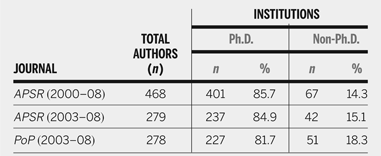
The data on the distribution of professional rewards (e.g., journal and book publications, leadership at APSA and regional council levels) demonstrate an equity gap between the numbers of faculty in BA/MA institutions and faculty in Ph.D. institutions (see table 1). In the staffing and conduct of governing institutions, major journals, and most collective programs, the APSA and other political science associations continue to be dominated by and largely responsive to the wants and needs of the tenured faculty at research universities, sometimes at the literal expense of all others.
Articles Published in APSR and PoP by Scholars of Ph.D. and Non-Ph.D. Institutions

Note. APSR = American Political Science Review; PoP = Perspectives on Politics. These data were presented to the APSA Council in April 2009 and resulted in a decision to track publication rates by institutional type for all APSA publications. Study conducted by J. Scott for J. Johnson while serving on the editorial board of PoP. Data analysis by Nurlan Jumaliev, MPA student at Eastern Michigan University.
The statistics on the broader trends generating these conditions are stunning. According to the New York Times, in 1960, 75% of college instructors nationwide were full-time tenured or tenure-track professors. Today, only 27% are. The rest are graduate students or adjuncts (Stainburn Reference Stainburn2010). Meanwhile, the value of federal Pell grants in relation to college tuition has shrunk. In 1980, the average four-year university cost $2,551 a year, and Pell grants provided students with $1,750 a year, almost 70% of the cost. Since then, costs at public universities have risen almost 500%, and Pell grants, which have increased at a much slower rate, now cover only 33% of the annual cost of public institutions (Carey Reference Carey2010). Private universities are, of course, on average, pricier still. Many of the best have increasingly felt compelled to compete for top research scholars by adopting reduced teaching loads. For those institutions on semester systems, two-two loads are now giving way to two-one; for those on quarter systems, two quarters may now be teaching-free. The adjuncts and graduate students who fill the gaps often do fine jobs, but they are not the people whom those paying tuition dollars or endowing funds usually expect to see doing the bulk of the teaching. In tight financial times, these trends raise doubts about whether the levels of support to which many top research universities have been accustomed can long endure.
For the many public institutions offering BA and MA programs, financial woes are already acute and are only compounding the extra burdens that political scientists and other faculty face. Most of these faculty hold doctorates from top universities and are dedicated to both research and teaching. Most teach three or four courses every term, not every year, with little if any money provided for research or travel. Women and minority scholars remain disproportionately clustered in these ranks. Perhaps not surprisingly, the scholars who bear these additional teaching burdens while receiving few research resources have long been severely underrepresented in the APSA's journals, a trend that has been ameliorated but hardly eliminated in recent years.
Collectively, these conditions point to a future in which scholar-teachers in both political science and other disciplines may be on their way to extinction. Faculty in collective bargaining situations are increasingly facing pressure from administrations to abandon the tenure system and move to a system of contract hiring for their heavy teaching loads at the price of continuing benefits packages. By the mid-twenty-first century, the United States may have a number of purely research institutions with tenured faculty and no students, and some universities that offer expensive courses with the understanding that their top researchers never teach them. The bulk of teaching will be done, there and at “teaching-only” institutions, by untenured instructors with both research and teaching aspirations, but no real opportunity to combine them.
That future strikes us as terrible for most scholarly disciplines—but far worse for political science. The core mission of our profession is to raise important, challenging questions about politics and to pursue answers to them rigorously and fearlessly. The greatest danger for our profession is that we will bend our work to the will of the professionally and politically powerful. It is detrimental for researchers of politics to be insulated from the kind of questioning—both uninformed and informed—that we encounter in teaching. It is still worse for teachers of politics to be denied both practical opportunities to engage in systematic questioning through research and the resources, status, and rights that can protect them when they include unpopular perspectives about politics in their teaching. The Perestroika movement fell short in not raising these issues. The voices of the movement largely belonged to those faculty and graduate students in Ph.D. institutions who were concerned with opportunities for different kinds of research, not with the imbalances in responsibilities, recognition, and support that persist, despite the institutional demographics in the discipline. The profession of political science—and, indeed, American higher education—may well be in peril if we do not address these issues now.