Introduction
Typically, courses on policy formulation, policy adoption, and the
dynamics of decision-making first introduce students to the rational
comprehensive method, bounded rationality, and incrementalism. Such
courses might also discuss factors that influence decision-makers, such
as interest group lobbyists, constituents, etc. Lectures could even
introduce students to risk and risk taking as well as theories of
attention and search. However, seldom are students in such courses
actively involved in the decision making inherent in the policy process.
Use of simulation within a policy course forces students to become
active participants in the decision-making process while re-enforcing
lecture on the theories of policy formulation and decision-making. It
provides students with a chance to partake in a hypothetical
decision-making process, weigh complex alternatives, argue over values,
and finally to critically examine their own participation in the
process.
The purpose of the exercise is not to test any one theory of the
policy-making process but rather to provide students with the experience
of making a policy decision so as to better assess and evaluate theories
of policy-making. However, depending on the strategies utilized by
students during the simulation, elements of several theories such as
bounded rationality and incrementalism should become evident during the
exercise. When the exercise is complete, the instructor can draw on
examples from the simulation to illustrate particular elements of a
given theory; such personal accounts are of greater value to students
than examples from state and national policy makers. The following is a
description of such a policy-making simulation and an evaluation of its
pedagogical utility.
The Exercise1 The simulation
presented here has been modified to account for problems
encountered during the simulation's initial runs.
The purpose of the assignment is to provide insight into the policymaking
process, particularly decision-making (policy adoption), but also policy
formulation. The exercise is designed to expose students to the decision
making process—one characterized by limited information and time (as
imposed by the instructor). The simulation should be scheduled over
three to four class periods: 30 to 45 minutes per class (up to the
discretion of the instructor). Students are told that “You are policy
makers in The City, USA. The students are then informed that the current
agenda item before the City Council is the following issue: In and
around The City University (TCU—not to be confused with Texas Christian
University) an increasing amount of traffic congestion has led to
serious parking problems. A serious shortage of parking spaces on campus
has forced students to park in no parking zones and in the parking lots
of local businesses. The students, as members of the City Council, meet
to determine a solution to this problem.
Given the preceding scenario, students are instructed to do the
following: 1) develop several alternatives to solve this problem (the
students are also informed that, for the purposes of the simulation,
proposing to do nothing is not an option, although that certainly
may be the end result); 2) narrow down the number of
alternatives through compromise and debate to two options; and 3) adopt
(or block adoption of) one out of the two policy alternatives.
The scenario of a “simple” parking problem provides a number of
attractions. First, it is an issue that is familiar and dear to most
students. Second, the issue is relatively uncomplicated, but allows for
the manipulation of quantitative cost-benefit data. Third, it seems to
be a problem that might have a “technical” solution, yet, often
unexpectedly to students, questions of equity, environmental impact, and
political strategies, to name but a few, come into play. In other words,
the scenario provides the dual benefits of allowing students to
experience a situation not only of rational choice, but also of value
choice.
Students are Provided with the Following Information
From The City's Office of the Financial Analyst
The TCU campus is already suffering a deficit of approximately 755
parking places for its 30,000 full and part-time students, given the
number of students on campus during peak hours (an average of 19,000
students on campus between 9:00 AM and 1:00 PM—18,245 available
parking spaces). It is expected that this shortage will grow to
1,250 parking places over the next five years if nothing is done
(100 per year) given the current and projected enrollment. The
amount of available land on or immediately adjacent to The City
University would allow for the construction of no more than 300
parking spaces (900 if a parking garage is constructed). Undeveloped
city land located between one and two miles from the university, if
devoted solely to parking lots, could provide an additional 500
spaces—2,500 if parking garages are constructed. (The City is
currently considering selling this land to private developers due to
increases in the value of the property (valued at $1,000,000.)) If
this land is used for parking purposes, public shuttles/buses would
be needed to transport students from the outside parking lots to TCU
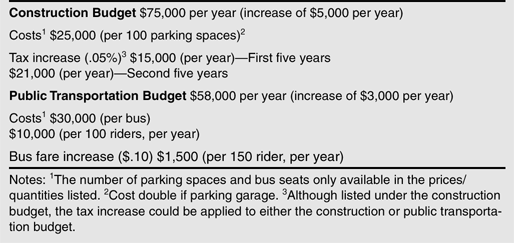
(costs below). The cost of construction is estimated at $25,000 per
100 parking spaces (the cost is double if a parking garage). The
cost is expected to increase by an estimated 5% for each year any
project is delayed. The estimated building time for a 300-space
parking lot is six months and one month for each additional 100
spaces (double the time for parking garages).
The City's public transportation system is currently unable to
accommodate an increase in riders, particularly on those routes in
and around TCU. If off-campus land is developed, an additional two
to three buses would be needed immediately. For the public
transportation system to accommodate additional riders it would cost
The City $10,000 per 100 riders, per year to cover labor and
maintenance. This does not include the initial investment of $30,000
per bus: each bus seating 50. (Note to students: The number of
parking spaces and/or bus seats is available only in the
prices/quantities as listed. See Table
1)
The available annual budget for construction of things such as
parking lots is $75,000 per year, with an estimated increase of
$5,000 per year over the next 10 years. Based on current and
projected revenue, the available annual budget for public
transportation is $58,000 per year with an estimated increase of
$3,000 per year over the next 10 years. The City can only increase
taxes, due to mandated tax limitations, for either type of project,
without voter approval, by.05% every five years, (which is equal to
about $15,000 per year for the first five years and about $21,000
for the second five years) but most get voter approval regarding
what projects to apply the additional tax revenue. It can be assumed
that you could get voter approval to apply the additional revenue
for either construction or public transportation but not both. The
City can, with voter approval, raise taxes by as much as 2% every 10
years but local citizens have been reluctant to support tax
increases.
Student parking fees are currently $100 per student, of which 40%
goes into the budget for future parking lot construction. Given the
shortage, The City University sells parking permits (20,000) that
are approximately equal to the number of spaces. It is assumed that
new revenue cannot be expected until more parking is available and
as such new revenue from available new parking would not apply until
the year after construction. It is also estimated that The City can
also raise bus fares by as much as $.10 without a decline in riders
(Bus fares are currently $1). There are approximately 5,000 riders
that currently utilize bus routes going to and from the university
(about $5,000 per year to the public transportation budget). Each
additional 150 riders per year would lead to an increase in bus
revenue of $1,500 per year in addition to the amount listed
above.
The instructor may provide any other information that he/she deems
important. The information should be presented as described above
and the students instructed to each formulate a policy alternative
based on the preceding scenario. By only providing necessary
instructions, the instructor minimizes the chances of influencing
how each student organizes the information and formulates their own
individual policy alternative. In other words, it allows students to
organize the data as they see fit, whether a student desires to base
their policy alternative on cost-benefit analysis, ideological bias,
or current policy preferences.
The Assignment
Each student is responsible for keeping a written record of the entire
process, beginning with his or her policy proposal. The proposal is to
be based on the above information (encourage them to be creative), their
own political views, etc. Each student should also provide an
ideological and/or pragmatic justification for their proposal, in other
words, why do they think The City Council should undertake what they
propose. Students present these proposals and include in their record a
summary of the process and the debates that take place in
which the number of alternatives is narrowed down.
In particular, students should focus on their part in the process, as
well as the influence (or lack of influence) of any outside forces on
the decisions made. One of the instructor's roles in the process is to
play the part of outside forces such as lobbyists, business interests,
etc. For example, the instructor can notify individual council members
about how their constituents feel about the issue or whether or not
environmental or business interests are lobbying for or against a
particular solution. Students can then comment on how these outside
pressures influenced, or did not influence, their decision-making and
why.
After two to three rounds, the number of proposals is narrowed down to
two policy alternatives. The students, prior to the final vote on the
two alternatives, write up their opinion of the two proposed
alternatives. This should include whether the student thinks either of
the two (or neither) policy alternatives will work and why. This
discussion could also include ideological as well as pragmatic reasons
for the student's support or lack of support of the proposals. The
students present their arguments and the final vote is taken. After the
final vote, the instructor should lead a discussion focusing on what the
students observed and learned from the simulation. Based on the
discussion of the process and the circumstances of the final vote, the
students will include in their record:
- 1) How he or
she voted (the instructor breaks any ties on the final vote and
will vote “NO” on any proposal);
- 2) The overall
results of the vote;
- 3) Which theoretical model the
student thinks best depicts the policy process as experienced in
this simulation; and
- 4) Lastly, the student's
perception of the process and evaluation of the strengths and
weaknesses of the policy-making process as simulated in this
exercise.
The assignment can be graded based, for example, on student participation
and on their ability to critically evaluate theories of policy-making.
The simulation exercise is also quite useful for the instructor to gauge
how well students understand theories of policy formulation and
adoption. Instructors can draw on the simulation and incorporate the
students’ experience into lecture. This allows the instructor the added
benefit of revisiting those aspects of theories that students are having
difficulty with or still do not understand.
The Experience of the Simulation and Concluding Remarks
The entire class of 10 students participated in this simulation's initial
run. Proposals presented during the first part could be grouped into two
types. The first proposal, varying only in the construction schedule,
focused exclusively on building parking lots. The second proposal
contained some combination of parking lot construction and expansion of
public transportation varying only in the amount of emphasis placed on
the amount of public transportation. Some of the proposals were examples
of rational choice while others were more incremental in approach. All
of the proposals were very well thought out; some included intricate
cost-benefit analyses. Others were more ideological, particularly those
emphasizing public transportation.
It took little time to reduce the number of alternatives to two main
policy alternatives—one of each of the types of proposals discussed
above. A policy alternative focusing exclusively on building parking
lots was initially more popular. The debate prior to the final vote
ranged from fiscal to value issues. Some believed the solution was quite
simply: build the lots. Other students contended that this would
increase traffic congestion and that there should be more emphasis on
public transportation. Others then wondered, “who gets to use these
lots?” Are freshmen and commuter students to be delegated to the lots
farthest from campus? Are seniors, graduate students, and faculty going
to get to park in the lots of their choice? Should the distribution of
parking lots be on a first come, first serve basis?
It was a rather heated debate. The students noted that they did not
expect values and differing interpretations of equity to play such a
large role in a decision dealing with a parking problem. The final vote
was split five votes in favor of each proposal (plus, as noted above, my
“No” vote for each proposal). So, due to the defeat of both proposals,
the final decision was to do nothing. A number of students were unhappy
about this decision and wanted to try the simulation again, but, as part
of the simulation, they were informed that the City Council had other
pressing business and it was time to move on to other agenda items.
This exercise provides students with insight into theories of policy
formulation and decision making by providing them with a situation by
which they could examine their own style of decision-making as well as
that of others. In essence, students were put in a situation where they
experienced what it was like to formulate and adopt policy. Through this
experience, students were better able to understand how problem
definition and the strategies they utilized to approach the problem
influenced how they attempted to solve the problem. The importance of
values in the policy process, even in an issue that students considered
quite value-free, was also brought to their attention.
Most of the students found this to be a useful exercise, and some felt
that this exercise was one of the best learning experiences they had
ever had, because they were learning by doing. All of the students
believed that they had a better understanding of policy formulation and
adoption as discussed in lecture because of the simulation. Lecture
provided the theoretical foundation by which students could critically
evaluate themselves, the actions of their fellow students that took
place during the simulation, and the theories themselves. The discussion
at the end of the simulation then allowed the class to reflect on what
was learned about policy formulation and decision making and the
strengths and weaknesses of theories of decision making.
I would like to thank PS's anonymous reviewers. Their useful comments
made this exercise more beneficial to both instructors and students than
it was in its original form.