Positive turnout rates in the United States and elsewhere are widely
considered “an embarrassing limitation of the economic approach to politics”
because, for any one voter, “the costs of casting a ballot in any large
election are almost always greater than the potential benefits, which are
dependent on the unlikely occurrence of casting the winning or tie vote in
an election” (Knack 1992, 133). Green and Shapiro
(1994), whose scathing critique of the
rational choice field centers on the work of Anthony Downs (1957), trenchantly put it: “Rational choice
theorists have trotted out an astonishing variety of conjectures about the
costs and benefits of voting, in the process generating an enormous
literature, possibly larger in terms of academic citations and sheer
bibliographic length than any other rational choice literature in American
politics” (47–48), yet they still have no answer as to why people vote when,
according to their arguments, reason says they ought not.1
There have been various attempts at reworking the calculus
to solve the paradox (Riker and Ordeshook
1968; Ferejohn and Fiorina
1974), but these attempts are widely seen as having fallen
short of the prize—leading some to have lost faith, e.g., Aldrich
(1993) asserted that the economic
approach just is not going to work with turnout. Green and Shapiro
sarcastically refer to this retreat as a “peace with honor” solution
(1994, 58). For a strongly contrary
point of view to that of Green and Shapiro, see Hanks and Grofman
(1998); Grofman (1996); cf. Grofman (2004).
Grofman (
1993),
paraphrasing Morris Fiorina, has referred to the failure of rational choice
theory to explain turnout as the “paradox that ate rational choice.”
2 Of course, in fairness, rational choice
theory is not the only theory that turnout might have been said to
have eaten. For example, survey-based studies of turnout have long
associated a respondent's education level with their likelihood of
casting a ballot (Verba and Nie 1972;
Verba, Schlozman, and Brady 1995). Yet
education levels have risen in the U.S. (and worldwide) while
turnout has generally decreased.
We disagree. Our rejoinder is a simple one. Downs was right. You shouldn't
vote. And, as more people come to recognize that fact, they'll stop.
Our proof proceeds in four parts. First we demonstrate that Downs is rising
in importance in the academic literature on voting and turnout relative to
classic works emphasizing civic duty (Berelson et al.
1954; Almond and Verba 1963) or
partisan attachments (Campbell et al. 1960).
Second, we demonstrate that the rise in Downs' influence relative to these
other works is accompanied by a general decline in voting in the U.S., with
the increased turnout in the 2004 election an easily explainable minor blip.
Third, we provide limited but suggestive evidence that those who presumably
know Downs best and are most likely to find his arguments
credible—economists—are much less likely to vote than their level of
education might predict. Finally, we account for the fact that people still
vote by providing compelling evidence that most people have never heard of
Downs, and thus are unlikely to be familiar with the ideas that made him
“famous” (sic!).
(1) Downs is a Rising Star
That Downs is a rising star in academia is undisputed. Still, evidence
never hurts. For the period 1956 through 2004, Figure
1 (adapted and extended from Wattenberg
1991) shows citations to Downs (1957) in comparison with citations to those of other classic
books on voting and political participation.3
Data are taken from the Social Sciences Citation Index
(SSCI).
Voting by Citation: The Dominance of Downs
(2) As Downs Goes Up, U.S. Turnout Goes Down
In a little-known 1980 article4
Brunk's
article averages less than one citation per year.
that
inspired the present work, Brunk (
1980)
reported results of a quasi-experimental study in which he discussed
Downs' model with his undergraduate classes and checked to see if their
willingness to vote had subsequently decreased.
5 An initial survey of student attitudes was done near the
start of the semester.
His findings are clear: “An
introduction to rational participation has a major impact on the
attitudes of individuals towards elections. As a result of discussing a
model of participation a month earlier, the number of individuals who
indicated that they would vote in various contests decreased. Interest
in the outcome of an election was no longer sufficient to insure voting”
(561–562). While his study was limited to the college classroom, Brunk
hypothesized that his results would generalize. “If rational
participation were routinely discussed, Individuals would be better able
to maximize their personal utility. They would do so by choosing not to
vote in many elections. This would result in an accelerated decline of
voter turnout” (561).
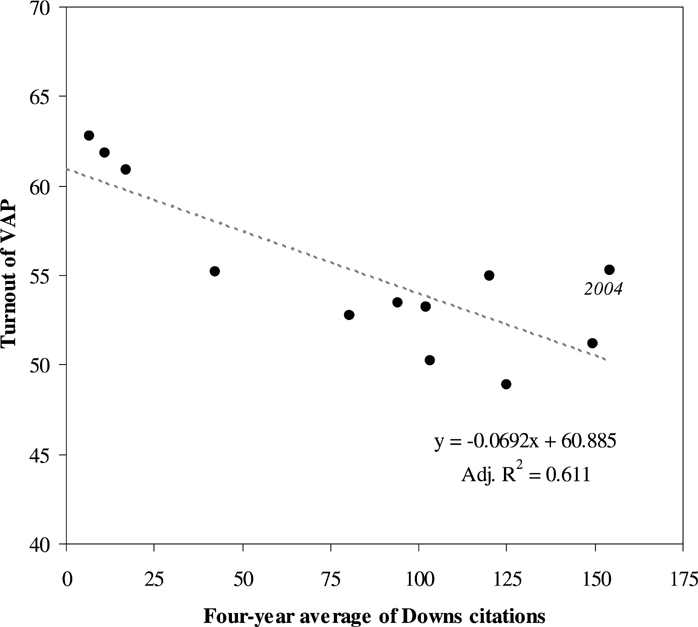
Turnout in the United States has indeed been in decline from its high
point of 63% of the voting age population (VAP) in the 1960 presidential
election to a low in 1996 of 49%. The patterns of change correlate well
with citations to Downs, as shown in Figure 2.
Explaining 61% of the variance in voter turnout during the 40-year
period, the average number of citations of Downs (1957) in the four-year period preceding a presidential
election is perhaps the most impressive single predictor of change in
turnout identified to date.6
Perhaps the
next best single predictor already in the literature is the
square root of the number of federal, state, and local laws
overturned by the Supreme Court (Klinkner
1993). The Klinker time series, involving a longer
timeline (1840–1988) than our work, achieves a very respectable
adjusted R2 of 49.5%. (Of course, correlation is not
causation—but when has that caveat ever prevented regression
results from appearing in print?)
It would thus seem
that, as more people read Downs, more people get the message.
7 Of course, we do have to be careful with
our operationalization of the independent variable. That an
academic cites Downs doesn't necessarily mean that he or she has
read him.
Downs and the Decline of U.S. Voter Turnout, 1960–2004
Although the slight increase in turnout in 2004 as compared to 2000 may
seem an anomaly, it is easy to explain within the Downsian
framework.8
Excluding 2004, the
regression line shifts to y = −0.0848x + 61.626 with an
R2 of 77.5%.
Downs predicts higher
turnout in elections where the possibility that any individual's vote
could be decisive increases. Following the 2000 election, where
essentially the margin of victory was zero, and with polls indicating
similar closeness between Bush and Kerry in 2004, some of those who had
closely read Downs may have realized that this might be one of those
rare elections where their vote could actually matter.
9 The 2000 election complicates the calculus of
voting slightly because it is now evident that the margin of
error for counting votes in the United States is significantly
larger than one vote. Thus, no presidential election, using the
current voting equipment, can ever realistically be decided by
one vote; unless, of course, the only votes that count are those
of the nine Supreme Court justices.
We expect this
effect will wane significantly in 2008 as the memories of 2000 continue
to fade, especially since the margin of victory in the 2004 presidential
election returned to more “normal” proportions.
Moreover, there is another intriguing argument as to why presidential
turnout may have been higher in 2004 than in 2000. Downs (1957) was out of print in 2001 and, while it did
come back into print before the 2004 election, it was only in the form
of a reprint that cost $47.00. The higher cost of his book may have
deterred some voters from learning about the Downsian cost-benefit
analysis of turnout. Indeed, exactly as Downs (an economist) might have
expected, as we report below, purchases of An Economic Theory of
Democracy did fall off with this price increase.
We can provide further evidence of Downsian impact by looking at turnout
levels among political scientists as compared to economists. Economists
are those likely to be most exposed to Downsian views and most likely to
find them credible. Frank, Gilovich, and Regan (1993) have found some evidence of more rational,
self-interested behavior among those studying to be economists. We take
this one step further and compare the voter turnout rates for a selected
set of economists and political scientists. Our key hypothesis is that
economists will vote at lower levels than political scientists; but we
also expect that, in departments exposed to Downsian ideas, even
political scientists will have a turnout less than 100%.
Using official voter history data collected by Gray (2003) from registrars of voters in Los Angeles and Orange
counties (California) we analyze the voting behavior of permanent
faculty members in the economics and political science departments at
three Ph.D.-granting institutions, the University of California, Irvine,
the University of California, Los Angeles, and the California Institute
of Technology.10
We exclude visiting
faculty, adjuncts, instructors, and professors emeritus not
currently teaching as they may not be permanent or current
residents. We searched for each faculty member in the entire
registration and history files. We also reviewed each faculty
members' publicly available biography and/or curriculum vitae to
evaluate the voting eligibility of those who were not registered
to vote—removing those who either explicitly indicate that they
are non-citizens or those with any indication that they may not
be a citizen (degrees from universities abroad). CVs were also
used to gauge when these professors were present in southern
California (time and place of appointments). Additionally, we
include seven other economists and political scientists located
at other graduate-degree-granting universities within the Los
Angeles and Orange County area who presented papers at the
Public Choice Society annual meetings in either 2004 or 2005.
This provides an N of more than 110 potential voters for each
election.
We look at turnout data for three different
types of elections: the 2003 special state election that led to Arnold
Schwarzenegger replacing Gov. Gray Davis, and general elections in 2000
(a presidential election year) and in 2002 (a mid-term election year).
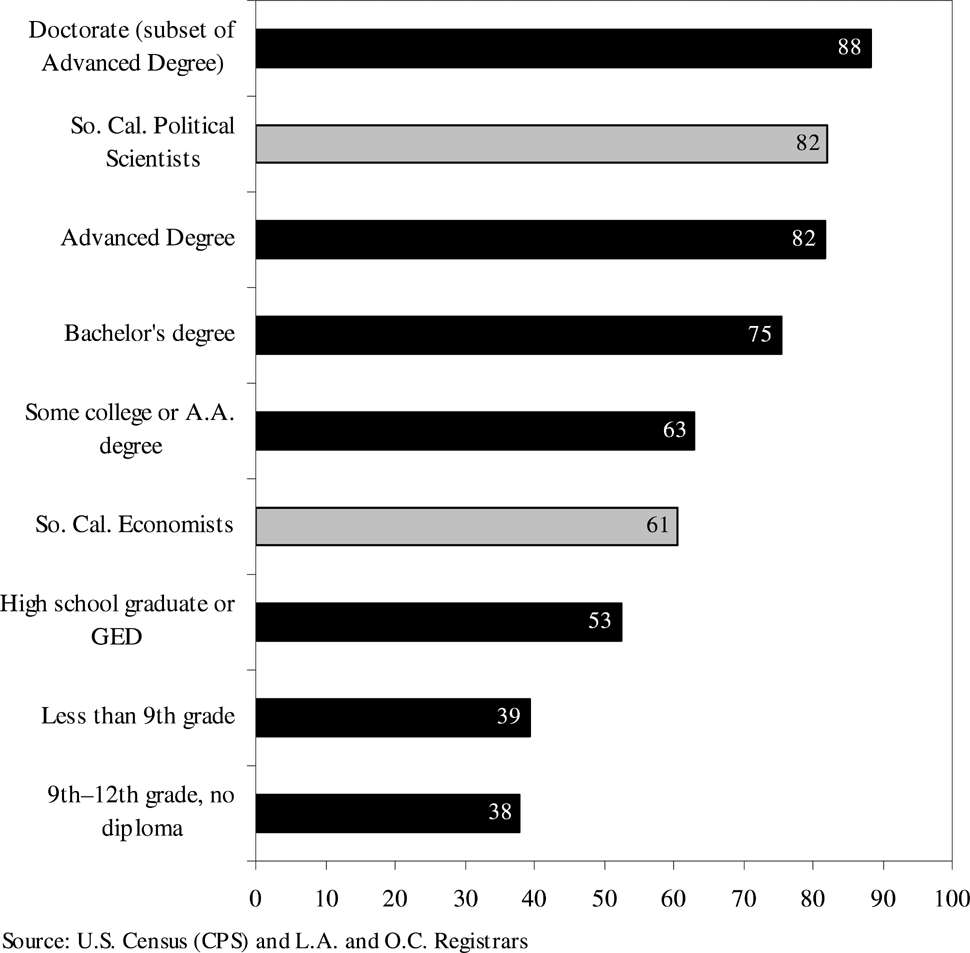
In each of the three elections, turnout among economists was lower than
that among political scientists. For economists, the turnout values (as
a proportion of potential eligible voters) for 2000, 2002, and 2003 were
61%, 50%, and 70%, respectively; while, for political scientists, the
corresponding turnout figures were 82%, 66%, and 80%. Only in the recall
election was turnout among political scientists not at least 20
percentage points higher than that among economists. And, we can readily
explain that narrowed gap once we recognize that (a) this special
plurality-based election included a field of 135 candidates and was
expected to be relatively close and (b) the University of
California faculties were, in essence, selecting their boss.
In these elections turnout among economists is well below what we would
expect among individuals of their education level.11
Moreover, the difference in turnout levels between
economists and political scientists was contrary to what we
would expect from party affiliation. Democrats vote at lower
rates than Republicans, but the economists in our sample were
more likely to be registered as Republicans than were the
political scientists in our sample (26% versus 11%). One in ten
economists was registered under a “third party” (Libertarian,
Green, or American Independent) whereas no political scientists
were. Economists were less likely to be registered as Democrats
(49% versus 73%). About 15% of political scientists and
economists each decline to state a party affiliation.
As we see from
Figure 3,
12 The data in Figure 3 is taken
from Current Population Survey (CPS) estimates. Although survey
respondents in general are slightly more likely to indicate
voting, of all the polls measuring turnout, the CPS has the
smallest problem of over-reports. McDonald and Popkin (2001) estimate that 55.6% of the voting
eligible population (VEP) cast ballots in 2000 and the Census
CPS for this election estimates 60% participation (over-report
of 4.4 percentage points). Even if one subtracts 4.4 percentage
points to each of the CPS totals in Figure
3, the economists are only about as likely to vote as
an American with an associate's degree or some college.
reporting data for the 2000 election,
economists teaching at elite
southern California institutions of higher education have turnout
levels comparable to what we would expect of junior college
graduates.
Turnout in 2000: Southern Cal. Political Scientists and
Economists as Compared to the Citizens in General at Various
Levels of Education
However, we can at best give only two cheers for the political
involvement of the political scientists in our sample. Southern
California political scientists with Ph.D.s teaching at elite
institutions do not vote at rates higher rather than others with
doctorates. Either a career focused on the study of politics does not
motivate greater political participation (or may even inhibit it, thanks
to the greater knowledge of the true nature of political
competition),13
Cf. the famous quote
about “making sausages.”
or we are observing
contamination effects from the presence of rational choice scholars at
these institutions.
14 The three Southern
California universities that make up the bulk of our data are
each ones where we might expect rational choice ideas to have
had some impact on the political science faculty, since each has
a significant concentration of modelers and game theorists in
political science, and a graduate focus in at least one area
related to rational choice modeling. Moreover, each of these
universities includes at least one faculty member who has made
significant contributions specifically on the issue of turnout.
Unfortunately, our small sample size does not allow us to
meaningfully compare the turnout rates of the political
scientists in our sample who have rational choice leanings with
the turnout levels of their peers who lack such
inclinations.
(3) Explaining the Limited Impact of Downs
While we have clearly established the impact of Downsian ideas both on
the general electorate and among economists, two important questions
remain. First, why have rational choice ideas not yet driven turnout
nearer zero?15
We use “near zero” turnout
in reference to game theoretic models (Ledyard 1984; Palfrey and
Rosenthal 1983) that postulate small positive turnout
rates when voters are acting strategically. In particular, if
nobody else was voting then you really could be the pivotal
voter!
And second, when, if ever, might we expect to
see this occur?
The first question has an obvious answer. While Downs may be a “best
seller” as academic tomes go, in the real world that doesn't mean much.
An Economic Theory of Democracy has been in and out of
print in recent years. Even taking account of used book sales it ranked
as only 81,242 on the Amazon.com sales rankings in 2001. And, after it
went out of print and was reprinted with a new price of $47, its rank
slipped to 225,075 in 2005.16
As noted
above, this drop in sales may in part explain the slight
increase in turnout in 2004 compared to 2000. But we, perhaps,
should not make too much of a blip in a time trend. Visual
inspection of the regression line in Figure
2 reveals six elections which fall below the line and
six which are above it, including 2004.
Thus, the
Downsian penetration of the market has been far from strong.
Hence, few citizens are acquainted with Downs' compelling arguments
against wasting your time voting. Thus, it's not at all surprising that
so many are still voting.17
And, of
course, there is another possible explanation we might suggest:
Keynes long ago noted that everyone is the slave to some dead
economist. But Downs is still alive. (One of us (Wuffle) has
characterized this as the Paradox of the long-lived
economist: “If an economist lived long enough to see
the impact of his/her work—s/he wouldn't.”)
Moreover,
as Ledyard notes, the self-evident rationality of abstention must
compete with “political activists” who, in his apt phrasing, “operate to
interfere with the natural forces” (
1984, 37).
We might expect that only until Downs becomes as widely known and
popular as some of these political activists such as, for example, Sean
“P. Diddy” Combs and his “Vote or Die” campaign of 2004, could we expect
turnout to decrease more substantially.
18 Yet, even some of the celebrity turnout activists in
southern California have had trouble motivating themselves for
every election. For example, a well-known actress and producer
who starred in a documentary film for MTV in 2004 specifically
designed to increase participation among young people had not
cast a ballot in either the 2003 recall or the 2002 general
election. Similarly, a young heartthrob actor (a former
Bostonian now living in Los Angeles) described his get out the
youth vote campaigning with John Kerry as “a once in a lifetime
experience” (quoted in Rosen
2004)—which is similar to his voting history between
November 2000 and October 2003, since he only cast a ballot in
the 2002 general election.
Conclusion
The influence of Downs is undeniable on those who know him best. If the
positive time trend in citations to Downs continues then, absent another
pipsqueaker like 2000, we should look forward to a continuing very slow
decline in average levels of turnout in U.S. elections.19
Heckleman and Whaples (2003) trace the close parallels between the views of
randomly chosen economists and those of Public Choice scholars
in both economics and political science. Hence, one obvious way
we might do even better at lowering turnout than having them
read Downs, would be to persuade more Americans to study
economics. (Still we must be careful about the direction of
causality. The distinguished European Public Choice economist
Bruno Frey recently conducted a study showing that business
students gave less money to charity than other students. But,
that study also showed that their behavior “is not due to their
education in economics. Rather, persons choosing to study
business are less inclined to help others even before they have
been subject to any economics teaching” (Frey
2005).)
Author Bios
Mark M. Gray is a research assistant professor at Georgetown University's
Center for Applied Research in the Apostolate. His research focuses on
studies of voter turnout, aspects of Catholic political attitudes and
behavior, and comparative studies of elections, globalization, and
trade.
A Wuffle is associate to professor at the University of California,
Irvine (recently promoted from assistant to professor). He is a
mathematical muddler, specializing in metrical gibber, muddles of
cognitive blintz, applications of macaroni chain theory, the life and
works of Mo Fiorina and Edgar Rice Burroughs, and the
epistemioincological development and literary exposition of the
Wuffeauldian paradigm of post-rational research. He has authored over a
dozen articles in refereed journals, some under a pseudonym.