




No CrossRef data available.
Extract
House and Senate Budgetary Committees are set to soon unveilallocations for 13 appropriations subcommittees for thediscretionary portion of federal spending. In an election year, andwith the national debt reaching previously unfathomed depths,experts do not expect much in the way of non-defense discretionaryspending. In the House, presumably any proposed increases will haveto be hashed out, perhaps leaving the National Endowment for theArts (NEA) and the National Endowment for the Humanities (NEH) outin the cold. Experts expect that if the NEA and NEH are left outthat increases will be proposed on the floor for the agencies.Congress is looking for myriad solutions to quickly appropriatefunds for FY2005. Among these are potential proposal is one topresent an early, full omnibus bill and one to group the 13appropriation bills into three or four “mini-omnibus” bills.Proposals akin to that offered this year for NEH funding wouldappear much more difficult to secure this year.
Information
- Type
- Association News
- Information
- Copyright
- © 2004 by the American Political Science Association
Non-Defense Discretionary Spending Increases Unlikely
House and Senate Budgetary Committees are set to soon unveil allocations for 13 appropriations subcommittees for the discretionary portion of federal spending. In an election year, and with the national debt reaching previously unfathomed depths, experts do not expect much in the way of non-defense discretionary spending. In the House, presumably any proposed increases will have to be hashed out, perhaps leaving the National Endowment for the Arts (NEA) and the National Endowment for the Humanities (NEH) out in the cold. Experts expect that if the NEA and NEH are left out that increases will be proposed on the floor for the agencies. Congress is looking for myriad solutions to quickly appropriate funds for FY2005. Among these are potential proposal is one to present an early, full omnibus bill and one to group the 13 appropriation bills into three or four “mini-omnibus” bills. Proposals akin to that offered this year for NEH funding would appear much more difficult to secure this year.
Bush Announces, Congress Questions Archivist Choice
On April 8, President Bush announced his intention to nominate Allen Weinstein to replace John W. Carlin as Archivist of the United States. The announcement brought near-immediate concern from the National Coalition of History (NCH) and from Senators on the Senate Governmental Affairs Committee. Senators Susan M. Collins (Chair) and Joseph I. Lieberman (Ranking Member) drafted a letter formally requesting that the Senate “initiate the process of formal consultation with members of our [history and archives] community.” This letter was accompanied by two papers-the first outlaying detailed questions that ought to be asked of the nominee, the second detailing selection criteria for the Archivist position. The papers were prepared jointly by the Society of American Archivists, the National Association of Government Archives and Records Administrators, and the Council of State Historical Records Coordinators.
The papers stated that these organizations, not the president, should provide nominations for this position and that this process must conform to legal requirements. The nomination of Dr. Weinstein was made without consultation “with professional organizations of archivists or historians.” The paper then called for “an open and transparent process for selecting, nominating, and confirming the next Archivist of the United States” and seeks “the reasons why the Archivist [John Carlin] is being replaced.”
Government Secrecy Classification on the Rise
An annual report to the president by the Information Security Oversight Office (ISOO) highlights a marked increase in national security secrecy last year. FY2003 (14,228,020 classified documents) saw an increase of 25% of executive branch agency classification from FY2002 (11,271,618 classified documents). According to Steve Aftergood of the Federation of American Scientists, a group that monitors government secrecy activities, “The report confirms what many people have suspected: that the volume of official secrecy is expanding.” A copy of the ISOO annual report for FY2003 is available at <www.fas.org/sgp/isoo/2003rpt.pdf>.
Sources for this column include the National Coordinating Committee for the Promotion of History's NCC Washington Update, the Chronicle of Higher Education, and the Consortium of Social Science Associations' Washington Update.
ONLINE
Your best resource for 2004 APSA Annual Meeting information is APSANet. Log on to find all the necessary meeting details, including:
- meeting preregistration. register securely online.
- hotel reservations. reserve your room with the online ITS system.
- airline reservations. the Association's official travel agency, ITS, offers online reservations.
- child care. sign up for KiddieCorp.
- PROceedings. access Annual Meeting papers for 2004 (beginning in August).
- dining guide. River North to the West Loop. Discover all of Chicago's dining hot spots.
- preliminary program. find out who, what, and when. the online preliminary program is the most up-to-date and detailed option for information on panels, meetings, and receptions in Chicago.
National Capital Area Political Science Association Honors Patricia S. Florestano
Members of the National Capital Area Political Science Association (NCAPSA) gathered May 13, 2004, at the Washington, D.C. campus of Johns Hopkins University for their annual meeting. The event featured a panel on “Careers in Political Science: Academic and Applied Opportunities” which discussed several key issues related to finding political science jobs in and out of academe. Referencing their own professional experiences, panelists offered numerous pointers on the various aspects of the job search, particularly stressing to the graduate students in the audience the importance of a strong “job talk.” The panelists included: Ben Ginsberg, Johns Hopkins University; John Samples, Cato Institute; Lee Sigelman, George Washington University; and Pam Winston, Mathematica Policy Research.
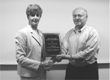
At the meeting, the 2004 NCAPSA Pi Sigma Alpha Award was presented to Patricia S. Florestano in recognition of her public service as a political scientist. Florestano, a former professor of government at the University of Baltimore, is currently a member of the Board of Regents at the University of Maryland and chair of its Education Policy Committee. The author of numerous works in the fields of public administration and public policy, she is former secretary of higher education for the State of Maryland (1995-2000).
At the annual business meeting, Michael Baer of the American Council on Education was elected president for 2004-2005. Michael Fauntroy, George Mason University, and Pam Winston, Mathematica Policy Research were elected to one-year terms as vice presidents. Linda Lopez of APSA was reappointed Secretary/Treasurer and the following council members were named: David Balducchi, Department of Labor (3 years); Walter Beach, Helen Dwight Reid Educational Foundation (1 year); Susan Hammond, American University (2 years); Shiela Harmon-Martin, University of District of Columbia (3 years); John White, Catholic University (2 years); Priscilla Regan, George Mason University (3 years); Linda Williams, University of Maryland (2 years); Howard Silver, Washington College (3 years); Lee Sigelman, George Washington University (3 years); John Tambornino, Johns Hopkins University (2 years); Shirley Anne Warshaw, Gettysburg College (1 year); Clyde Wilcox, Georgetown University (1 year).

2003-2004 NCAPSA President Ben Ginsberg (r) of Johns Hopkins University presents the 2004 Pi Sigma Alpha Award to Patricia S. Florestano. Photo courtesy of Jo Freeman.

2003-2004 NCAPSA President Ben Ginsberg (r) of Johns Hopkins University presents the 2004 Pi Sigma Alpha Award to Patricia S. Florestano. Photo courtesy of Jo Freeman.
 You have Access