Introduction
Twenty years ago, a large prevalence study reported that 12% of patients with visual impairment experienced visual hallucinations: the Charles Bonnet syndrome (Teunisse et al. Reference Teunisse, Cruysberg, Hoefnagels, Verbeek and Zitman1996). This finding supported the hypothesized association between impaired sensory perception and the tendency to hallucinate. Several decades before, studies that induced sensory deprivation already noted this association, as they found high prevalence rates of hallucinations during periods of deprivation, especially in the visual modality (Bexton et al. Reference Bexton, Heron and Scott1954; Smith, Reference Smith1962). This raises the question whether the association between decreased perceptual input and an increased tendency to hallucinate would also apply to the auditory domain.
Hearing impairment affects around 500 million people worldwide (Stevens et al. Reference Stevens, Flaxman, Brunskill, Mascarenhas, Mathers and Finucane2013), largely surpassing the global prevalence of visual impairment (World Health Organization, 2014). In addition, impaired hearing on average commences at a younger age, as it affects both adults and children (World Health Organization, 2014, 2015). Investigating whether hearing impairment is associated with auditory hallucinations may contribute to further understanding of the underlying pathogenesis. This is especially relevant since auditory hallucinations can be highly invalidating in many patients with psychiatric and neurological disorders, and current treatment options still fall short in many cases (Larøi et al. Reference Larøi, Sommer, Blom, Fernyhough, Ffytche, Hugdahl, Johns, McCarthy-Jones, Preti, Raballo, Slotema, Stephane and Waters2012; Mccarthy-Jones et al. Reference Mccarthy-Jones, Thomas, Strauss, Dodgson, Jones, Woods, Brewin, Hayward, Stephane, Barton, Kingdon and Sommer2014). If hearing impairment is indeed associated with auditory hallucinations, treatments to improve hearing may decrease hallucinations in affected patients.
So far, few studies have reported on the presence of auditory hallucinations in hearing-impaired populations. Those that did included small samples and applied definitions of auditory hallucinations that were either too restrictive (Teunisse & Olde Rikkert, Reference Teunisse and Olde Rikkert2012) or too extensive (Cole et al. Reference Cole, Dowson, Dendukuri and Belzile2002). Unsurprisingly, prevalence rates of auditory hallucinations reported in these samples varied widely, with rates of 3.5 (Teunisse & Olde Rikkert, Reference Teunisse and Olde Rikkert2012) and 32.8% (Cole et al. Reference Cole, Dowson, Dendukuri and Belzile2002). In a recent meta-analysis of several population-based studies, we reported a positive association between hallucinations and impaired hearing (Linszen et al. Reference Linszen, Brouwer, Heringa and Sommer2016). Updating our search and analysis showed a similar association (Subramaniam et al. Reference Subramaniam, Abdin, Vaingankar, Picco, Shahwan and Jeyagurunathan2016; Robles Bayon et al. Reference Robles Bayon, Tirapu de Sagrario and Gude Sampedro2017). However, most included studies used subjective or retrospective measures of hearing impairment, and either exclusively involved, or entirely excluded the elderly population (Linszen et al. Reference Linszen, Brouwer, Heringa and Sommer2016; Subramaniam et al. Reference Subramaniam, Abdin, Vaingankar, Picco, Shahwan and Jeyagurunathan2016; Robles Bayon et al. Reference Robles Bayon, Tirapu de Sagrario and Gude Sampedro2017). Presently, it is still unclear whether objectified hearing impairment is associated with auditory hallucinations, whether more severe impairment is associated with higher prevalence rates of hallucinations, and which type of hallucinatory content is experienced in patients with hearing impairment.
Methods
Objectives
This study aimed to test the potential association between hearing impairment and auditory hallucinations. We assessed prevalence, content, and associated factors of auditory hallucinations in a large adult population aged 18–92, in whom hearing thresholds were quantified with objective audiometric testing.
Design
We used an observational, cross-sectional design to test our objectives. The Local Research Ethics Committee from the University Medical Center Utrecht exempted this study from full review (13-282/C). Conductance and report of the study was performed according to the STROBE statement (von Elm et al. Reference von Elm, Altman, Egger, Pocock, Gøtzsche and Vandenbroucke2007).
Population
All individuals aged 18 or over, referred to the Department of ENT-Audiology of the University Medical Center Utrecht for audiometric testing between June 2013 and January 2015, were eligible for participation. After audiometric testing, audiology technicians invited eligible participants for further study consultation with one of the interviewers. Informed consent was obtained after the procedure had been fully explained.
Potential participants were excluded if cognitive impairment or language barriers kept them from answering reliably, based on subjective impression by the interviewer during the informed consent procedure or the interview itself. In order to maximize the coverage of our study population, pre-existing psychiatric comorbidity was no reason for exclusion.
Reasons for non-participation were documented. Data on age, sex, and audiometry were collected anonymously from the non-participating group, to enable control of representation of the sample. A large sample size was aimed for in order to increase study generalizability, and to prevent power issues due to potentially low prevalence rates (Teunisse & Olde Rikkert, Reference Teunisse and Olde Rikkert2012).
Auditory hallucinations
Presence of auditory hallucinations in the past 4 weeks was the primary outcome measure. We measured this with a 14-item semi-structured interview (online Supplementary questionnaire 1a,b), used in previous studies (Schakenraad et al. Reference Schakenraad, Teunisse and Olde Rikkert2006; Teunisse & Olde Rikkert, Reference Teunisse and Olde Rikkert2012) and adjusted from a comparable questionnaire applied in a study on Charles Bonnet syndrome (Teunisse et al. Reference Teunisse, Cruysberg, Hoefnagels, Verbeek and Zitman1996). Auditory hallucinations were defined as the perception of complex sounds without the presence of a likely external source. If auditory hallucinations had been present in the past 4 weeks, they were considered currently present. Otherwise, they were accounted for in lifetime prevalence.
The interview contained an open question about hallucination content. Auditory hallucinations were distinguished from tinnitus on the basis of complexity of their content: perceived sounds had to have a meaningful quality, and thus be related to a specific source in the external world (e.g. a device, animal, or human being). All interviewers were trained to avoid potentially stigmatizing or distressing terms such as ‘hallucinations’ and ‘psychotic symptoms’, to make the topic more discussable and prevent false negatives through under-reporting of hallucinations.
All interviewers received structural training prior to the application of the interview. After completion of the interviewing phase, three authors (RT, IS, ML) systematically reviewed the answers of all participants to ensure consistent appliance of the definition of auditory hallucinations. Discrepancies between authors were solved by consensus, blinded for the participant's hearing status.
Hearing impairment
All participants underwent audiometric testing upon referral. Testing was performed prior to study participation, and therefore, independent of the outcome of the hallucination interview. Severity of hearing impairment was defined by using the outcome of the most recent pure tone audiometry, calibrated according to ISO standards (ISO, 8253-1:2010, 2010).
Hearing impairment was defined as a loss of more than 25 dB, in at least one ear (World Health Organization, 2015). The average loss was calculated by using the High Fletcher Index (average of unaided air-conduction thresholds at 1000, 2000, and 4000 Hertz) of each ear (Teunisse & Olde Rikkert, Reference Teunisse and Olde Rikkert2012). The maximum impairment level at each frequency was set at 125 dB.
Associated factors
Data on age, sex, and presence of tinnitus (in the past 4 weeks and lifetime) were collected during the interview.
Data analysis
Clopper–Pearson's exact method (Clopper & Pearson, Reference Clopper and Pearson1934) was used to calculate 95% confidence intervals (95% CIs) for overall 4-week and lifetime prevalence, using R version 3.2.0, package PropCIs.
All other analyses were conducted with IBM SPSS Statistics version 24. Participants with and without hallucinations were compared on several potentially contributing factors using univariate analyses: χ2 tests for categorical variables, and either Mann–Whitney U or independent sample t tests for continuous variables (dependent on normality of data).
Additionally, multivariate logistic regression analysis was performed to check for a potential dose–effect association between a continuous measure for hearing impairment and presence of hallucinations, while also correcting for potential confounding factors, such as age (Gates & Mills, Reference Gates and Mills2005) and tinnitus (Hoare et al. Reference Hoare, Edmondson-Jones, Sereda, Akeroyd and Hall2014).
We used an α level of 0.05 or below to define statistical significance.
Participation and response rates
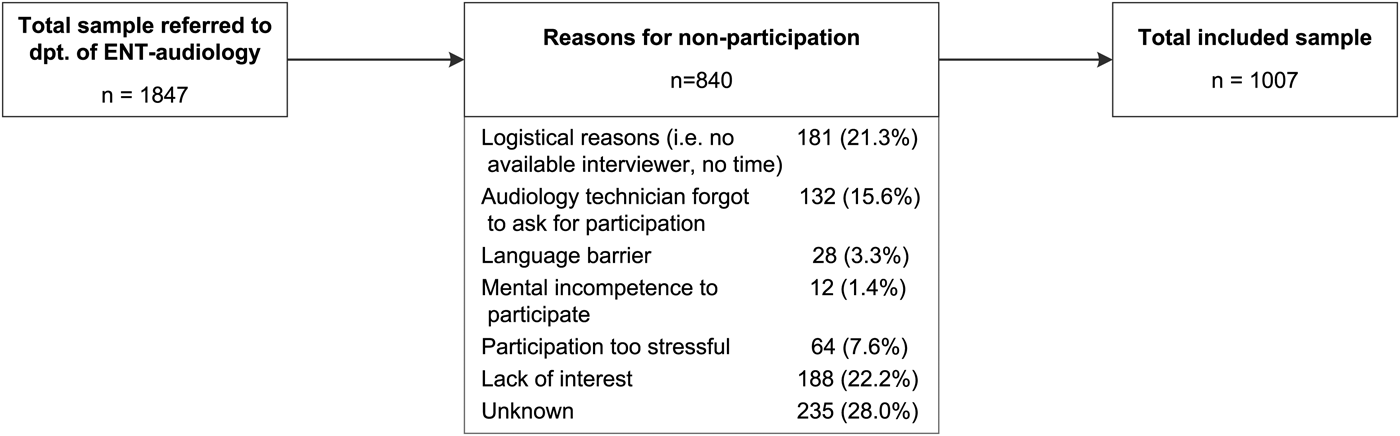
Out of 1847 eligible participants, 1007 adults were interviewed about the presence of auditory hallucinations. Reasons for non-participation and further descriptive statistics are described in Fig. 1. and online Supplementary table S1.
Flow chart of inclusion procedure, including reasons for non-participation.

Hearing impairment was present in 832 subjects with varying degrees of impairment severity. The 175 participants without impairment served as the control group. Data on hallucination frequency were missing in five participants with auditory hallucinations. These participants could only be included for the calculation of lifetime prevalence rates of hallucinations.
Results
Prevalence
In the complete group (1007 with and without hearing impairment), the prevalence of auditory hallucinations in the past 4 weeks was 14.4% (95% CI 12.3–16.7; n = 144/1002). The lifetime prevalence was 20.8% (95% CI 18.3–23.4; n = 209/1007).
The group with hearing impairment had a significantly higher percentage of auditory hallucinations in the past 4 weeks (16.2%; n = 134/829) than the group with unaffected hearing (5.8%; n = 10/173; p < 0.001, χ2 = 12.8, df = 1), with an odds ratio (OR) of 3.2 (95% CI 1.6–6.1).
Associated factors
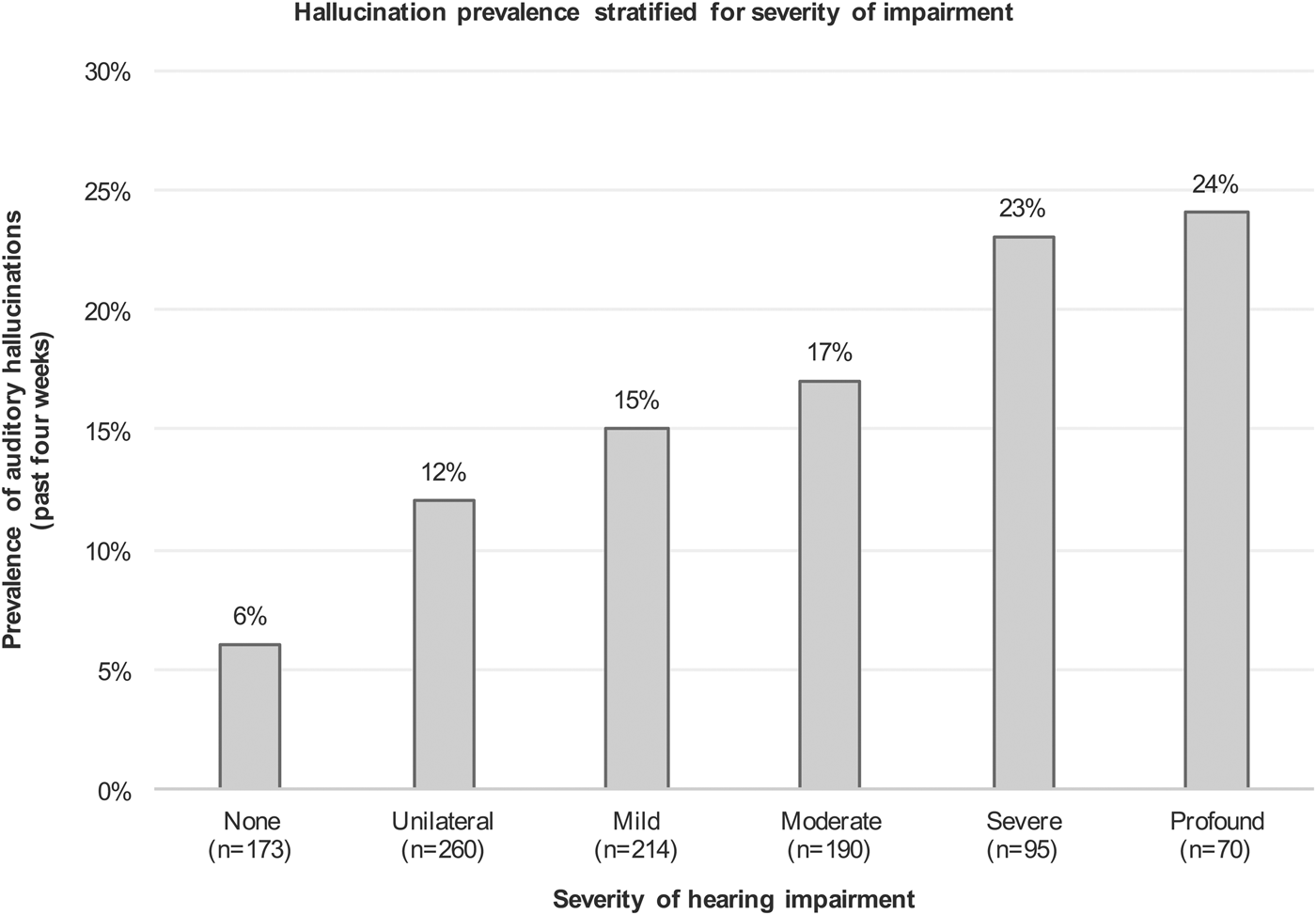
The prevalence of auditory hallucinations in the past 4 weeks increased with categorical degrees of impairment severity (p < 0.001, χ2 = 24.6, df = 5), with a prevalence rate of 24% in the group with profound impairment (Fig. 2).
Prevalence of auditory hallucinations in the past 4 weeks after stratification for severity of impairment. Distribution significantly differs from a uniform distribution (χ2 = 24.5, p < 0.001, df = 5; two-tailed p value). The following categories of hearing impairment severity have been applied. None: High Fletcher Index (HFI) of both ears 0–25 dB. Unilateral: HFI best ear 0–25 dB, HFI worst ear >25–125 dB. Mild: HFI best ear >25–40 dB. Moderate: HFI best ear >40–60 dB. Severe: HFI best ear >60–80 dB. Profound: HFI best ear >80–125 dB.

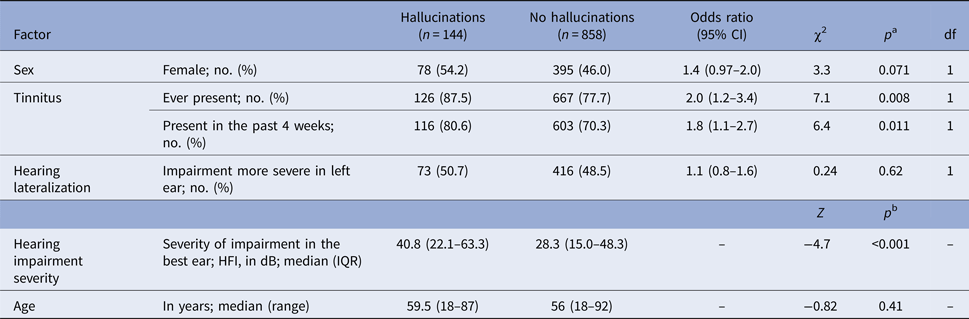
Table 1 shows the results of univariate analyses of several potentially associated factors on the presence of auditory hallucinations in the past 4 weeks. In comparison with the non-hallucinating group, the hallucinating sample had a significantly higher continuous severity of hearing impairment, and a significantly higher prevalence of tinnitus (both lifetime and in the past 4 weeks). The groups with and without hallucinations showed no significant differences with regard to age, sex, or side of most severe impairment (i.e. left or right ear), although we observed a statistical trend for female sex in the hallucinating group.
Univariate comparison of potentially associated factors in hallucinations in the past 4 weeks (n = 1002)

95% CI, 95% confidence interval; df, degrees of freedom; no., number; IQR, interquartile range; HFI, High Fletcher Index; dB, decibel.
a Pearson's χ2, two-tailed p value.
b Mann–Whitney U test, two-tailed p value.
Additionally, these factors were incorporated in a multivariate logistic regression model (Table 2). Female sex, presence of tinnitus in the past 4 weeks, and severity of hearing impairment were significantly associated with the current presence of auditory hallucinations. For each dB increase of impairment in the best ear, the odds of having auditory hallucinations increased 1.02 times (Table 2). This means that, theoretically, in someone with 40 dB of impairment in the best ear, the corrected OR of having auditory hallucinations would be 2.0 (95% CI 1.6–2.7) in comparison with a 0 dB reference.
Potentially associated factors in hallucinations in the past 4 weeks; multivariate logistic regression analysis (n = 1002)a, b

OR, odds ratio; 95% CI, 95% confidence interval; SE, standard error; df, degrees of freedom; HFI, High Fletcher Index; dB, decibel.
a Constant variable: β−2.9, SE β 0.41, Wald χ2 50, df 1, p < 0.001, exp(β) 0.057.
b Nagelkerke's R 2 0.061, Cox and Snell's R 2 0.034, Hosmer and Lemeshow's goodness of fit 0.34.
Auditory hallucinations
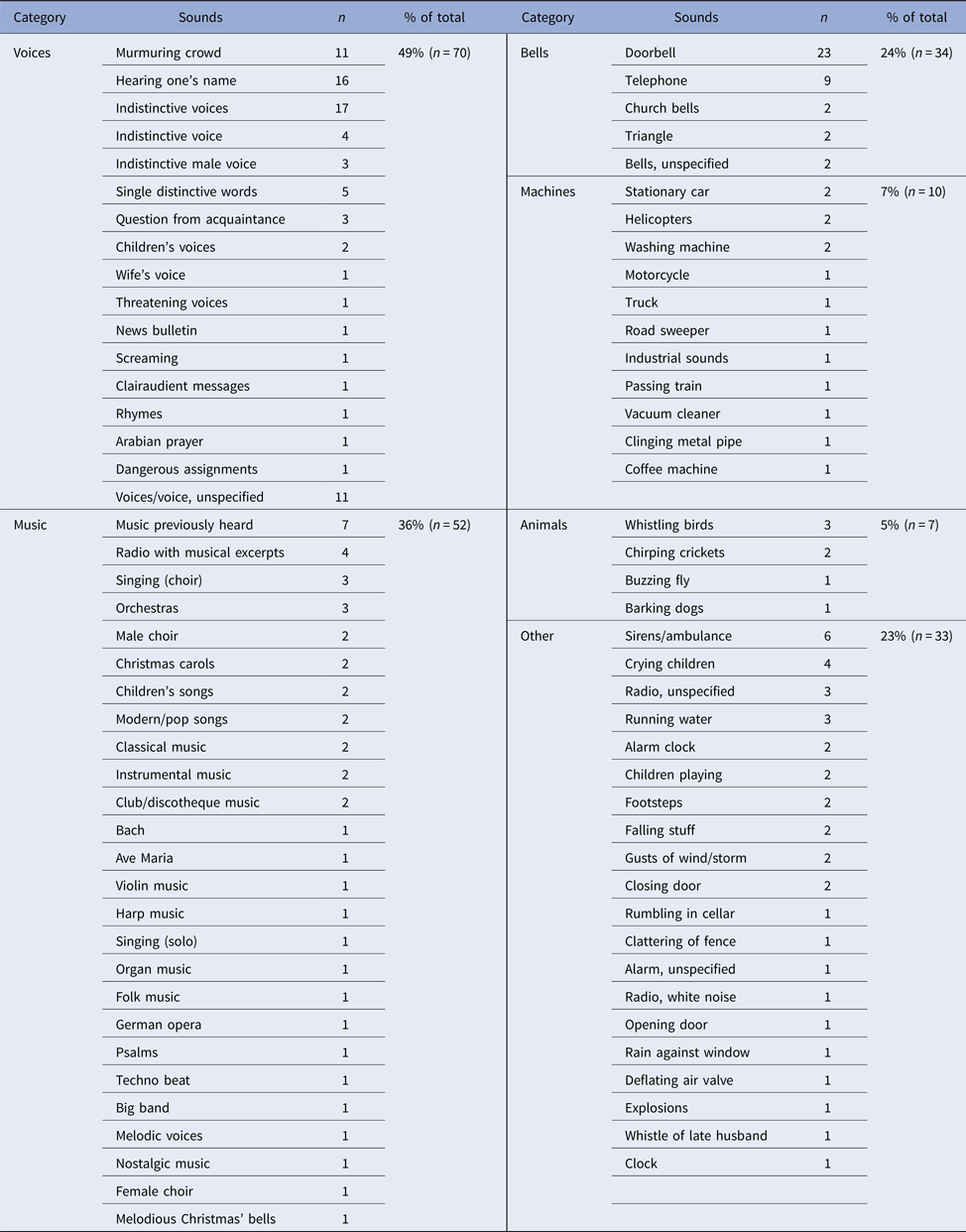
Table 3 contains categorized content of auditory hallucinations occurring in the past 4 weeks, within the entire sample (n = 144). The majority of participants described hearing voices (49%; n = 70). Other frequently described hallucinations concerned hearing music (36%; n = 52), and doorbells or telephones (24%; n = 34). The remaining hallucinations mostly encompassed environmental sounds (Table 3).
Categorized content of auditory hallucinations in the past 4 weeks within the hallucinating sample (n = 144)

Sensitivity analyses
Around 14% of the included subjects (n = 141) did not receive pure tone audiometry on the same day as they were interviewed about hallucinations. In theory, the results of these audiograms might not be entirely representative for their hearing status during study participation, as hearing might have intermittently worsened or improved. Similarly, out of the participants without auditory hallucinations in the past 4 weeks, 65 participants had experienced lifetime auditory hallucinations, which may have obscured the results within this group. Nonetheless, in both cases, iteration of analyses after omission of these subgroups from the total sample did not reveal relevant alterations (online Supplementary Table S2a,b; results of uni- and multivariate analyses upon request).
In the main multivariate regression analysis (Table 2), we used a continuous measure for impairment severity, thereby assuming that impairment severity and auditory hallucinations were linearly correlated. In sensitivity analyses, we substituted this continuous measure with a categorical measure for impairment severity (as previously applied in Fig. 2). In comparison to the non-impaired control group, each category of impairment severity was significantly associated with the presence of hallucinations (online Supplementary Table S3).
Lastly, considering the increasing risk for both hearing impairment and neurodegenerative disease at older ages (Hedden & Gabrieli, Reference Hedden and Gabrieli2004; Gates & Mills, Reference Gates and Mills2005), we repeated all uni- and multivariate analyses in subjects aged 65 and over (online Supplementary Table S4a,b,c). Although this selection impaired the number of subjects within the normal-hearing control group (n = 9/312) and subsequent statistical power, the presence of auditory hallucinations still significantly increased with both categorized (online Supplementary Table S4a) and continuous (online Supplementary Table S4b,c) measures of severity of hearing impairment.
Discussion
Our findings demonstrate a strong association between auditory hallucinations and the presence of hearing impairment in a large adult population, regardless of age. We observed a positive association between the severity of impairment and the presence of auditory hallucinations, suggesting an underlying dose-dependent mechanism. The prevalence of auditory hallucinations ranges from 12% in the group with unilateral hearing impairment to 24% in the most severely impaired group. The group with hallucinations had significantly increased percentages of tinnitus in comparison to the non-hallucinating population. Voices were the most frequently described content of hallucinations, followed by music.
This is the first study to confirm an association between objectively measured hearing impairment and complex auditory hallucinations in a large sample. Although the existence of such an association has been suggested for a long time [with reports of deaf patients hearing music or voices dating back to the early nineteenth century (Berrios, Reference Berrios1990)], the few studies that have investigated this phenomenon so far lack validity and reliability due to design limitations (Linszen et al. Reference Linszen, Brouwer, Heringa and Sommer2016).
Our results also show that auditory hallucinations in hearing impairment are more comparable to auditory hallucinations in psychiatric diagnoses than previously thought; almost half of the hallucinating subjects with hearing impairment heard voices, a phenomenon often thought to be characteristic for psychiatric disorders (Waters et al. Reference Waters, Allen, Aleman, Fernyhough, Woodward, Badcock, Barkus, Johns, Varese, Menon, Vercammen and Laroi2012). Only in one-third of the cases, hallucinations had a musical content, traditionally associated with hearing impairment (Berrios, Reference Berrios1990; Evers & Ellger, Reference Evers and Ellger2004; Teunisse & Olde Rikkert, Reference Teunisse and Olde Rikkert2012). This implicates that, based on their content, auditory hallucinations in patients with hearing impairment cannot always be distinguished from those associated with psychiatric illness.
The presence of tinnitus is positively associated with auditory hallucinations, even after correction for the severity of hearing impairment. Previous studies have suggested that in patients with hearing impairment, simple auditory hallucinations (such as tinnitus) and complex auditory hallucinations (such as music or voices) may represent different phenomena within the same spectrum, and may share etiological mechanisms, such as deafferentation (Vanneste et al. Reference Vanneste, Song and De Ridder2013; Mccarthy-Jones et al. Reference Mccarthy-Jones, Thomas, Strauss, Dodgson, Jones, Woods, Brewin, Hayward, Stephane, Barton, Kingdon and Sommer2014; Linszen et al. Reference Linszen, Brouwer, Heringa and Sommer2016). Although our findings do not directly prove the existence of such a spectrum, it deserves further study.
Considering the observed high prevalence rates of hallucinations in our sample and the frequent occurrence of hearing impairment, clinicians should be aware of the strong association between the two, regardless of their area of expertise.
First, hearing impairment needs to be implemented within the differential diagnosis of auditory hallucinations. In current practice, mental health care professionals do not systemically inquire into hearing impairment in patients presenting with auditory hallucinations. Evaluation of hearing function is desirable within the diagnostic assessment of patients that present with auditory hallucinations, as it may be a treatable contributing factor (Sommer et al. Reference Sommer, Roze, Linszen, Somers and van Zanten2014). Options in treating hearing impairment have improved drastically within the past decades (Blazer et al. Reference Blazer, Domnitz and Liverman2016). Indeed, some studies mention improvement of hallucinations (Coebergh et al. Reference Coebergh, Lauw, Bots, Sommer and Blom2015), and even full recovery of psychosis following treatment of hearing impairment with cochlear implantation (Sommer et al. Reference Sommer, Roze, Linszen, Somers and van Zanten2014).
Secondly, clinicians should inquire after the presence of auditory hallucinations in people with impaired hearing, as the threshold for patients to report these phenomena spontaneously may be high. The presence of hallucinations is often regarded as a sign of being mentally ill (Vilhauer, Reference Vilhauer2015), which may create an extra barrier for clinicians to inquire after their presence (McCarthy-Jones & Davidson, Reference McCarthy-Jones and Davidson2013). The fear of being mentally ill may also discourage individuals that experience hallucinations to discuss their experiences with a medical professional (McCarthy-Jones & Davidson, Reference McCarthy-Jones and Davidson2013). Because our findings show that auditory hallucinations are clearly prevalent in a large population referred for somatic purposes, it is important to make hallucinations a discussable topic during clinical counseling; especially since numerous case reports have stressed the need for treatment of auditory hallucinations in patients with hearing impairment, as they can cause distress (Sommer et al. Reference Sommer, Roze, Linszen, Somers and van Zanten2014; Coebergh et al. Reference Coebergh, Lauw, Bots, Sommer and Blom2015). In addition to clinical awareness, our findings can be used to improve community awareness of this phenomenon. Currently, in the general Western population, the presence of auditory hallucinations is still surrounded by stigma and incomprehension, and thus, for people who experience them, a potential cause for fear, embarrassment, and even avoidance of care (Vilhauer, Reference Vilhauer2015, Reference Vilhauer2017). Increasing community knowledge and understanding of auditory hallucinations in hearing impairment may contribute to destigmatize hallucinations and encourage those with need for care to seek professional treatment.
Lastly, with the confirmation of the existence of a long-time suggested phenomenon, an essential direction of future studies would be to increase understanding of hallucinations in hearing-impaired patients, and learn their prognosis and response to treatment. A first step in future studies on understanding hallucinations in hearing impairment would be further phenomenological assessment. Systematic assessment of their frequency, experienced distress, or functional impairment caused by hallucinations can provide essential clinical starting points to further recognize those in need for treatment and to monitor their treatment response. Those and other phenomenological hallucination characteristics (i.e. patient's insight in their unreal character and the presence of delusions and hallucinations in other modalities) also contribute to increase knowledge about their comparability with hallucinations in other populations. Another important future step is to examine potentially contributing factors to this phenomenon in more detail, in order to provide more targeted options in treating and assessing hallucinations in hearing-impaired patients. These vary from factors related to the ear and hearing (i.e. type and onset of impairment) to factors generally associated with hallucinations (i.e. loneliness, visual impairment, schizotypal personality traits, cognitive impairment), as well as studying neurocognitive and neuroimaging markers to test potentially underlying mechanisms, such as disturbances in source monitoring and deafferentation (Linszen et al. Reference Linszen, Brouwer, Heringa and Sommer2016).
Strengths and limitations
A core strength of this study is its sample size. Apart from strengthening the statistical power of our analyses, we could include a sample with a wide distribution of hearing impairment across different levels of severity, while the age range is high. This increases the generalizability of our findings.
The practical design of the study, modeled to comparable pioneering studies on musical hallucinations (Teunisse & Olde Rikkert, Reference Teunisse and Olde Rikkert2012) and Charles Bonnet syndrome (Teunisse et al. Reference Teunisse, Cruysberg, Hoefnagels, Verbeek and Zitman1996), allows for easy availability of high-quality, objectified assessment of hearing impairment, obtained regardless of study participation.
A potential limitation of the study is the use of a commonly used, yet non-validated questionnaire to assess auditory hallucinations. Despite this, we deliberately chose this interview as it is specifically designed to assess hallucinations in patients with hearing deficits. This is contrary to the questionnaires commonly used in schizophrenia, which are typically designed to solely assess auditory verbal hallucinations and thus appeared less applicable.
In order to enhance participation rates and maximize coverage of the approached population, the study design did not allow for assessments other than those on hearing and on auditory hallucinations. Hence, it was not possible to objectively assess other factors that may be of influence on the observed association between auditory hallucinations and impaired hearing, in particular cognitive functioning and visual impairment. In older adults, hearing impairment is associated with cognitive decline (Lin et al. Reference Lin, Yaffe, Xia, Xue, Harris, Purchase-helzner, Satterfield, Ayonayon, Ferrucci and Simonsick2013), and co-occurrence of visual impairment is common (Schneider et al. Reference Schneider, Gopinath, McMahon, Leeder, Mitchell and Wang2011). As both factors have been previously suggested to underlie hallucinations (Teunisse et al. Reference Teunisse, Cruysberg, Hoefnagels, Verbeek and Zitman1996; Ffytche, Reference ffytche2007; Waters et al. Reference Waters, Allen, Aleman, Fernyhough, Woodward, Badcock, Barkus, Johns, Varese, Menon, Vercammen and Laroi2012), they may have confounded our observations. Also, since we have no sufficient data on the functioning of other senses and the presence of hallucinations in other modalities, it is uncertain whether the observed phenomenon is specific to the auditory modality. Further research is necessary to unravel the influence of such potential confounding factors, as they may provide important alternative clinical targets and scientific explanations to the ones suggested in this paper.
The study has been carried out in patients referred to a tertiary center for audiometric testing. While its comparability to a more general population cannot be measured directly, the observed prevalence rate of hallucinations in the non-impaired group is similar to the rates in the general population (Linscott & van Os, Reference Linscott and van Os2013), suggesting generalizability.
Not all patients that visited the Department of ENT-Audiology during active recruitment could participate in this study. We cannot rule out the possibility that this has influenced our results, although demographic and audiometric data of non-participants were not substantially different from participants (online Supplementary Table S1) and most reasons for non-participation are likely to be random (i.e. not enough time between appointments, no available interviewer, audiology technician forgot to ask for participation).
Finally, due to the cross-sectional design of this study, it is not possible to draw time-related conclusions to the observed associations. Future longitudinal studies on auditory hallucinations in hearing-impaired patients can be of added value to further understand this phenomenon, by learning more about its natural course, prognosis, and response to decreasing or increasing changes in levels of hearing impairment, either due to the course of disease or to hearing interventions.
Conclusion
Auditory hallucinations occur in 16% of adults with hearing impairment, with a strong association between the severity of impairment and the prevalence of hallucinations, reaching 24% in the most severe group. Given the substantial prevalence rates, auditory hallucinations should be assessed in patients with hearing impairment. Our findings also stress that patients with auditory hallucinations should be evaluated for the presence of hearing impairment, since this a potentially treatable factor in hallucinations.
Supplementary material
The supplementary material for this article can be found at https://doi.org/10.1017/S0033291718000594
Acknowledgements
This work was supported by The Netherlands Organisation for Health Research and Development (ZonMw), TOP grant (40-00812-98-13009). The authors thank Roos van Westrhenen, Danique van de Water, Gerrie van Rooijen-Peek, Jacqueline Dello, Stefanie de Laat, Wendy Keuchenius, Roos Dijk, Matthijs Nijboer, Jouke Tromp, Linette Hordijk, Carolijn Scheffer, Anuja Soekhan, Anne Verhallen, and Bibi Navas Garcia for their considerable contributions to the collection of data, and Sophie Heringa for her substantial editorial support.
Conflicts of interest
None.
Ethical standards
The authors assert that all procedures contributing to this work comply with the ethical standards of the relevant national and institutional committees on human experimentation and with the Helsinki Declaration of 1975, as revised in 2008.