Introduction
There is strong and consistent evidence from large prospective studies of an inverse association between measures of cognition in childhood and adolescence (ages 7–18) (Alaraisanen et al., Reference Alaraisanen, Miettunen, Lauronen, Rasanen and Isohanni2006; Andersson et al., Reference Andersson, Allebeck, Gustafsson and Gunnell2008; Osler et al., Reference Osler, Nybo Andersen and Nordentoft2008; Bjorkenstam et al., Reference Bjorkenstam, Weitoft, Hjern, Nordstrom, Hallqvist and Ljung2011; Gunnell et al., Reference Gunnell, Lofving, Gustafsson and Allebeck2011; Sorberg Wallin et al., Reference Sorberg Wallin, Zeebari, Lager, Gunnell, Allebeck and Falkstedt2018) and/or early adulthood (ages 18–20) (Gravseth et al., Reference Gravseth, Mehlum, Bjerkedal and Kristensen2010) and later suicide outcomes (Gunnell et al., Reference Gunnell, Magnusson and Rasmussen2005; Alaraisanen et al., Reference Alaraisanen, Miettunen, Lauronen, Rasanen and Isohanni2006; Andersson et al., Reference Andersson, Allebeck, Gustafsson and Gunnell2008; Osler et al., Reference Osler, Nybo Andersen and Nordentoft2008; Batty et al., Reference Batty, Whitley, Deary, Gale, Tynelius and Rasmussen2010; Gravseth et al., Reference Gravseth, Mehlum, Bjerkedal and Kristensen2010; Bjorkenstam et al., Reference Bjorkenstam, Weitoft, Hjern, Nordstrom, Hallqvist and Ljung2011; Gunnell et al., Reference Gunnell, Lofving, Gustafsson and Allebeck2011; Sorberg Wallin et al., Reference Sorberg Wallin, Zeebari, Lager, Gunnell, Allebeck and Falkstedt2018). In a large Norwegian cohort including 610 359 participants, poorer academic performance at 18 years predicted increased risk of suicide mortality up to three decades later (Gravseth et al., Reference Gravseth, Mehlum, Bjerkedal and Kristensen2010). In another cohort following over 26 315 Swedish individuals an association between poor intellectual quotient (IQ) at 13 years and later suicide attempts in adulthood was fully explained by overall poor academic performance at age 16 years (Sorberg Wallin et al., Reference Sorberg Wallin, Zeebari, Lager, Gunnell, Allebeck and Falkstedt2018), suggesting that associations of poor IQ with suicide outcomes operate through its effect on educational attainment (Sorberg Wallin et al., Reference Sorberg Wallin, Zeebari, Lager, Gunnell, Allebeck and Falkstedt2018). The few studies that reported sex differences suggested that an association of impaired cognition with suicide outcomes is seen in males, but less consistently in females (Gunnell et al., Reference Gunnell, Lofving, Gustafsson and Allebeck2011).
However, it remains unclear how cognitive deficits develop across the life-course, as most existing prospective studies have been conducted with measures of cognition at only one point in time. As far as we are aware, only one prior study examined associations between general indicators of cognitive development at different ages (e.g. mother reports of age at first speech, doctor report of overall alertness at age 7 and intelligence test at age 15 years) and later suicide mortality (Neeleman et al., Reference Neeleman, Wessely and Wadsworth1998). Delayed speech development and low intelligence were risk factors for accidental death, but not suicide, though the number of suicides was low (n = 11). To our knowledge, no existing study has documented the development of cognitive abilities in suicidal individuals with prospective repeated measurements of academic performance and IQ from childhood to adolescence (7, 11, 16 years) while accounting for a broad set of confounding factors. This is a key period in the life-course, as neuroimaging research suggests that intellectual capacity changes during adolescence (Ramsden et al., Reference Ramsden, Richardson, Josse, Thomas, Ellis, Shakeshaft, Seghier and Price2011).
In a previous study based on the 1958 British Birth Cohort, we failed to find evidence of associations between academic performance in reading and mathematics at age 7 and suicide mortality by age 50 years, but statistical power was limited due to the low number of suicides in the cohort (Geoffroy et al., Reference Geoffroy, Gunnell and Power2014). Here we investigate (a) whether associations between academic performance (reading and mathematics) and/or IQ and suicide mortality emerge with measures recorded later in childhood and adolescence and (b) to determine to what extent such associations (if any) are accounted for by pre-existing early-life potential confounding factors (i.e. child's birth order and weight, mother's age, father social class) known for their associations with both cognition (Mosing et al., Reference Mosing, Lundholm, Cnattingius, Gatz and Pedersen2018) and suicide (Geoffroy et al., Reference Geoffroy, Gunnell and Power2014; Orri et al., Reference Orri, Gunnell, Richard-Devantoy, Bolanis, Boruff, Turecki and Geoffroy2019) across the life-course. A better understanding of the development of cognitive impairments in suicidal individuals could provide important information about the etiology of suicide and its prevention.
Methods
Participants
The 1958 British Birth Cohort is an ongoing longitudinal national birth cohort of 17 638 individuals born in 1 week of March 1958 in England, Scotland, and Wales and representing 98% of all births in Britain in that week. Details about the cohort, including study design and response rates can be found elsewhere (Power and Elliott, Reference Power and Elliott2006).
Participants were flagged for deaths on the National Health Service Central Register (NHSCR). The end of the mortality follow-up was September 2012 when participants were 54 years old. The NHSCR is not notified of deaths of emigrants; hence cohort members who had emigrated permanently from Britain (up to 2009) were excluded from our analyses. Information on academic performance and IQ was collected in childhood (7 and 11 years) and in adolescence (16 years) via standardized tests. Ethical approval was given (South-East Multicentre Research Ethics Committee ref. 01/01/44), and informed consent was obtained from all participants.
Measures
Suicide mortality
As with our prior publication with the cohort (Geoffroy et al., Reference Geoffroy, Gunnell and Power2014), suicides were identified using the International Classification of Diseases, ninth revision (ICD-9) codes E950–59 (suicide) and E980–89 (undetermined intent) or tenth revision (ICD-10) codes X60–84 (suicide) and Y10–34 (undetermined intent). Suicide and death of undetermined intent were combined (Gunnell et al., Reference Gunnell, Bennewith, Simkin, Cooper, Klineberg, Rodway, Sutton, Steeg, Wells, Hawton and Kapur2013). We have excluded pending verdicts (ICD-9 code 988.88; ICD-10 code Y33.9).
Cognitive ability from childhood to adolescence
At 7, 11, and 16 years, age-appropriate tests for mathematics and reading were administered by the participant's school teacher. The arithmetic test at age 7 comprised 10 problems with graded levels of difficulty; teachers read the questions to poor readers. At age 11, the mathematics test was constructed by the National Foundation for Educational Research in England and Wales. At 16 years, a mathematics comprehension test was constructed at Manchester University. The Southgate test (Southgate, Reference Southgate1962) (range 0–30) was used to detect poor readers at age 7: children selected from several words one that corresponded to a picture, and teachers also read out words that the children identified from a list. Reading tests at ages 11 and 16 years were similar to the Watts Vernon comprehension test. At 11 years, a general ability standardized 80-item test approximating general intelligence (e.g. IQ) with verbal and non-verbal scales was also administered (Douglas, Reference Douglas1964). At each age, tests were standardized for month and year of assessment for each sex separately. To ease interpretation, we converted all scores to internally standardized Z scores (mean = 0 and s.d. = 1).
Early-life confounding factors
Potential confounding factors were identified from our prior studies with this cohort as risk factors associated with suicide deaths by 49 years (p ⩽ 0.10) in multivariable analyses (Geoffroy et al., Reference Geoffroy, Gunnell and Power2014; Orri et al., Reference Orri, Gunnell, Richard-Devantoy, Bolanis, Boruff, Turecki and Geoffroy2019) and cognition (Geoffroy et al., Reference Geoffroy, Pinto Pereira, Li and Power2016). These include: low birthweight (low: <2.5 kg v. normal: ⩾2.5 kg, recorded at birth); child's birth order (reported by mothers when their child was 7 years, including all live and still births and deaths by 7 years; coded 1, 2, 3, or ⩾4), maternal age at the time of the study member's birth (categorized ⩽19, 20–29, and >29 years) and father's social class in 1958 [using the 1951 Registrar General's Classification, categorized as non-manual (I/II/IIINM) and manual (IIIM/IV/V)]. We have additionally controlled for fathers' social class at birth as it is strongly associated with cognitive skills (Jefferis et al., Reference Jefferis, Power and Hertzman2002).
Statistical analysis
First, using latent growth models we estimated trajectories of reading and mathematics abilities from age 7 to 16 years separately for two vital status groups, i.e. death by suicide v. still alive by September 2012. Models were estimated using maximum likelihood estimator in Mplus version 7.4. A major advantage of growth models is that they rely on the full information maximum likelihood estimation, which allows each participant with at least one data point to be included in the analysis (Enders and Bandalos, Reference Enders and Bandalos2001). Given that the distribution of reading abilities at age 7 was skewed, we performed sensitivity analyses using a robust (Huber–White) estimator for the standard errors, obtaining virtually identical results. Model fit was good according to the χ2 test of model fit (reading, χ2 0.532; p = 0.766; mathematics, χ2 = 1.61, p = 0.445), the comparative fit indices (reading and mathematics, 1.00), and the root mean square error of approximation [reading, 0.006 (90% confidence interval (CI) 0.00–0.02); mathematics, 0.00 (90% CI 0.00–0.03)]. We used Wald tests to compare reading and mathematics abilities of individuals who died by suicide to those still alive at each time point (i.e. age 7, 11, and 16 years). Similarly, reading/mathematics rate of change (i.e. slopes) were compared using Wald tests to determine whether individuals who died by suicide v. those still alive differed in their rate of change. These differences were expressed as effect size (Hedge's g); values <0.20 are interpreted as ‘small’, 0.21–0.50 ‘medium’, 0.51–0.80 ‘large’, and >0.80 ‘very large’, similarly to Cohen's d. Given known sex differences in suicide mortality in this cohort (Geoffroy et al., Reference Geoffroy, Gunnell and Power2014) and sex differences in the associations between cognitive and suicide outcomes (Gunnell et al., Reference Gunnell, Lofving, Gustafsson and Allebeck2011), cognitive ability trajectories were estimated in the whole sample and separately for males and females [data shown for males only, as there were few suicides in females (n = 7)], however findings must be interpreted with caution as there was no statistical evidence for sex-differences in the associations (p values for mathematics = 0.841 and reading = 0.812). Second, all models were re-estimated after adjusting for a priori identified potential early-life confounders. We tested for non-linear associations for mathematics and reading skills at any time point, but none reached significance. In additional analyses, using t tests we examined associations separately for intelligence and suicide mortality.
Missing data on covariables varied between 1% (father's social class) and 11% (birth order). To minimize further data loss, we imputed missing information on early-life confounders using multiple imputations by chained equations (Azur et al., Reference Azur, Stuart, Frangakis and Leaf2011) and conducted analyses across the 20 imputed data sets (primary analysis). Results based on complete cases were comparable to those based on multiple imputations.
Results
Population
Of 16 470 participants in the birth survey of 1958 and who had not emigrated permanently, we excluded 1524 participants who had died from causes other than suicide by age 54 (most deaths had occurred within the first year of life). A further 441 participants were excluded due to missing information on all mathematics and reading measurements at 7, 11, and 16 years, leaving 14 505 participants for analyses. Of these, 55 participants had died from suicide before age 54 years (48 males and 7 females, including 12 of undetermined intent). The median age of suicide was 41 years (range 18–52 years) for males and 44 years (range 21–49 years) for females.
Reading and mathematics skills trajectories from age 7 to 16 years
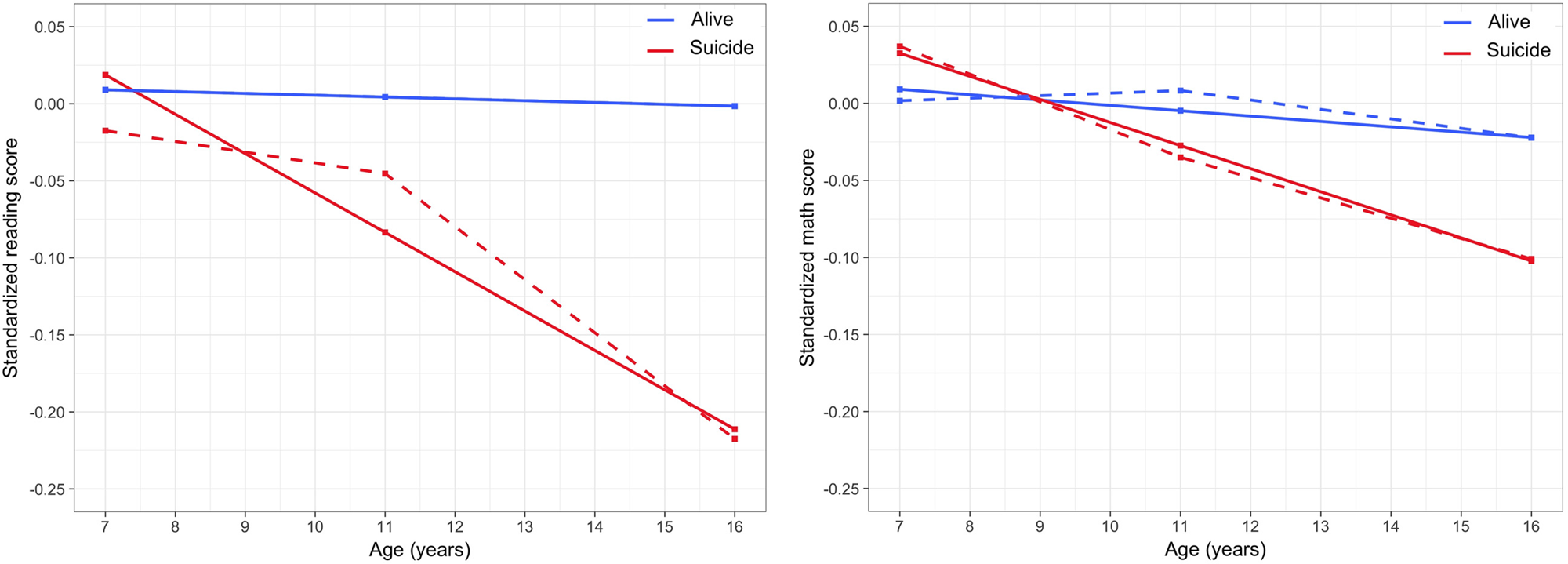
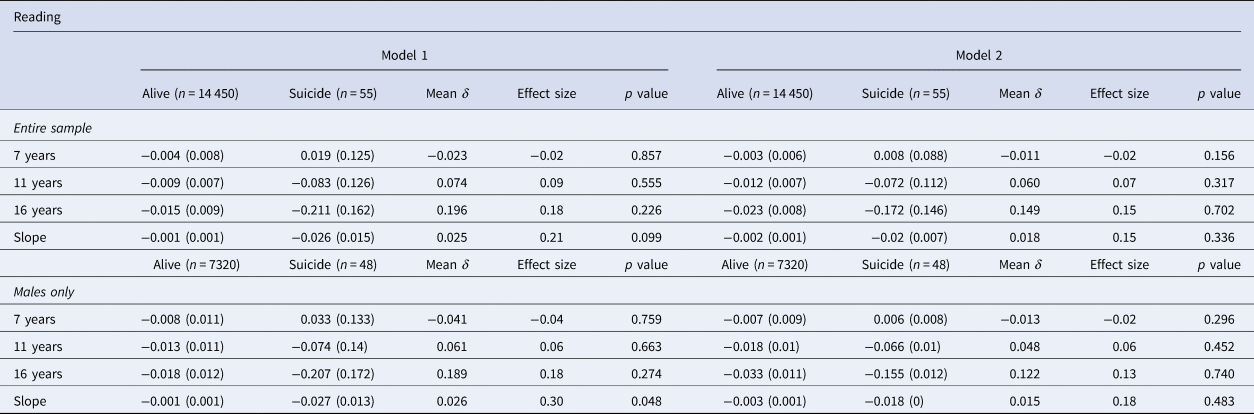
Reading and mathematics skills trajectories during childhood for participants who died by suicide compared to those still alive are shown in Fig. 1. For reading, participants who died by suicide had similar scores to those still alive at age 7 [effect size (g) = −0.02; p = 0.857] (model 1 in Table 1). At subsequent ages, the mean difference between the reading score of participants who died by suicide increased compared to those still alive (at age 11 years, g = 0.09; p = 0.555; at age 16 years: g = 0.18; p = 0.226). The effect size for the overall rate of change over time (slope) was moderate (g = 0.21, p = 0.099) indicating a less steep improvement in reading abilities for the participants who died by suicide. Restricting the analyses to males yielded similar results. However, the mean slope difference was larger than that observed in the entire sample (g = 0.30, p = 0.048 for males, g = 0.10, p = 0.830 for females).
Trajectories of mathematics and reading abilities from 7 to 16 years in individuals who died by suicide v. still alive, unadjusted associations. Dotted lines represent the observed values, solid lines represent the estimated values.

Estimated means of reading skills from age 7 to 16 years for the entire sample (n = 14 505) and for males only (N = 7368)

This table reports mean (standard error) for the alive and suicide groups.
Model 1: unadjusted model, not adjusted for sex.
Model 2: adjusted for early-life influences, i.e. sex (entire sample only), low birth weight, birth order, maternal age at child birth, father social class.
Mean δ: mean difference.
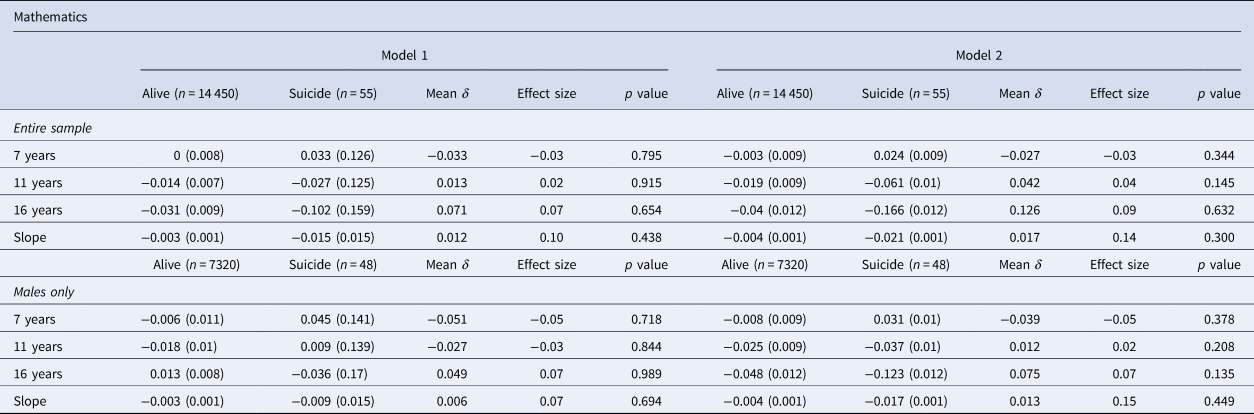
For mathematics, a similar pattern was observed (model 1 in Table 2). However, the differences between participants who died by suicide and participants still alive were smaller than those observed for reading, including the slope difference (entire sample, g = 0.01, p = 0.438; males only, g = 0.07, p = 0.694).
Estimated means of mathematic skills from age 7 to 16 years for the entire sample (n = 14 505) and for males only (N = 7368)

This table reports mean (standard error) for the alive and suicide groups.
Model 1: unadjusted model.
Model 2: adjusted for early-life influences, i.e. sex (entire sample only), low birth weight, birth order, maternal age at child birth, father social class.
Mean δ : mean difference.
Role of early-life factors in explaining reading skills trajectory differences between groups
We tested whether the observed difference in rate of change in reading between participants who died by suicide v. those still alive could be confounded by early-life factors. To do so, models were adjusted for key factors including paternal social class, maternal age at child's birth, birth weight, and birth order. As shown in model 2 in Table 1, the estimated mean difference in reading between the slope of individuals who died by suicide v. those still alive reduced in both the entire sample (g = 0.15, p = 0.336) and in males only (g = 0.18, p = 0.483). The strongest associations with reading slopes were seen for birth order and maternal age. This suggests that the observed differences in the slope were explained by other factors in general, and by birth order and maternal age in particular.
We found no difference in intelligence scores at age 11 years between participants who died by suicide and those still alive (whole sample: suicide, mean = 0.00, s.d. = 0.94; those still alive, mean = −0.10, s.d. = 1.07; p = 0.434; among males only: suicide, mean = 0.01, s.d. = 0.94; those still alive, mean = −0.09, s.d. = 1.12; p = 0.508).
Discussion
Our findings suggest that the participants who died by suicide had similar IQ scores and reading and mathematics scores in childhood and adolescence (as assessed with age-appropriate tests at school) than those still alive, but had a less steep improvement in their reading abilities. However, associations between reading ability trajectories and suicide mortality were accounted for by factors measured at birth that are associated with both suicide risk and cognitive skills (low birth weight, birth order, maternal age at childbirth, father's social class) (Geoffroy et al., Reference Geoffroy, Gunnell and Power2014, Reference Geoffroy, Pinto Pereira, Li and Power2016).
Alterations (typically deficits) in various cognitive functions have been associated with increased suicide risk in various populations (Keilp et al., Reference Keilp, Sackeim, Brodsky, Oquendo, Malone and Mann2001, Reference Keilp, Gorlyn, Oquendo, Burke and Mann2008; Richard-Devantoy et al., Reference Richard-Devantoy, Jollant, Kefi, Turecki, Olie, Annweiler, Beauchet and Le Gall2012, Reference Richard-Devantoy, Berlim and Jollant2014, Reference Richard-Devantoy, Szanto, Butters, Kalkus and Dombrovski2015b, Reference Richard-Devantoy, Olie, Guillaume and Courtet2016; Vadini et al., Reference Vadini, Calella, Pieri, Ricci, Fulcheri, Verrocchio, De Risio, Sciacca, Santilli and Parruti2018) and in various stages of life (Keilp et al., Reference Keilp, Sackeim, Brodsky, Oquendo, Malone and Mann2001, Reference Keilp, Gorlyn, Oquendo, Burke and Mann2008; Richard-Devantoy et al., Reference Richard-Devantoy, Jollant, Kefi, Turecki, Olie, Annweiler, Beauchet and Le Gall2012, Reference Richard-Devantoy, Berlim and Jollant2014, Reference Richard-Devantoy, Szanto, Butters, Kalkus and Dombrovski2015b, Reference Richard-Devantoy, Olie, Guillaume and Courtet2016; Vadini et al., Reference Vadini, Calella, Pieri, Ricci, Fulcheri, Verrocchio, De Risio, Sciacca, Santilli and Parruti2018). Our results are not consistent with previous studies showing negative associations between childhood cognitive abilities and suicidal risk such as performance (e.g. low grade point average) (Alaraisanen et al., Reference Alaraisanen, Miettunen, Lauronen, Rasanen and Isohanni2006; Bjorkenstam et al., Reference Bjorkenstam, Weitoft, Hjern, Nordstrom, Hallqvist and Ljung2011; Sorberg Wallin et al., Reference Sorberg Wallin, Zeebari, Lager, Gunnell, Allebeck and Falkstedt2018) or IQ (Andersson et al., Reference Andersson, Allebeck, Gustafsson and Gunnell2008, Batty et al., Reference Batty, Whitley, Deary, Gale, Tynelius and Rasmussen2010, Gunnell et al., Reference Gunnell, Bennewith, Simkin, Cooper, Klineberg, Rodway, Sutton, Steeg, Wells, Hawton and Kapur2013, Sorberg Wallin et al., Reference Sorberg Wallin, Zeebari, Lager, Gunnell, Allebeck and Falkstedt2018), but the relatively small number of suicides (n = 55) compared with 58–553 in previous studies limits power to detect relatively small effects. Our findings emphasize the importance of the developmental period from childhood to adolescence in understanding suicide (Turecki et al., Reference Turecki, Ernst, Jollant, Labonte and Mechawar2012). To our knowledge, our study is the first to show that differences in reading skills between suicidal and non-suicidal individuals are likely to emerge in the course of childhood and adolescence, rather than being evident in early childhood. Of note a prior study suggested that cognitive function at the age 18 years were more strongly associated to suicide mortality in adulthood than cognitive function at the age of 12 years, suggesting that the reduction in cognitive abilities per se may be a marker of suicidal risk (Osler et al., Reference Osler, Nybo Andersen and Nordentoft2008).
In the current study, controlling for early-life influences abolished associations between change in reading abilities over time and suicide risk, suggesting that the observed differences could be due to the impact of pre-existing early-life factors. Early-life environment has also been found to be associated with long-lasting cognitive impairments (Skogen et al., Reference Skogen, Overland, Smith, Mykletun and Stewart2013, Zhang et al., Reference Zhang, Liu, Li and Xu2018). For example, low socioeconomic status in the family may result in decreased access to cognitively-stimulating environments for the child, which in turn might influence the development of his/her cognitive abilities (Christensen et al., Reference Christensen, Schieve, Devine and Drews-Botsch2014). Although in our study, father's social class was measured at participants birth, social class is relatively stable over time (Power and Matthews, Reference Power and Matthews1997; Hackman et al., Reference Hackman, Gallop, Evans and Farah2015), and it is possible that social class later in childhood rather than early-life per se explained the relatively weaker improvement in reading abilities over time. Moreover, young motherhood is associated with psychopathology, lower economic resources, and maladaptive parenting practices, which are factors that can affect both suicidal risk and cognitive development of the individual (Pinderhughes et al., Reference Pinderhughes, Dodge, Bates, Pettit and Zelli2000). Such hypotheses should be formally tested in well-designed studies aiming to unravel the mechanisms linking early-life factors, development of cognitive skills, and suicidal risk. However, it is worth noting that in several prior studies reporting associations between IQ or school performance and suicide risk, these associations remained, even if attenuated, after controlling for early-life variables such as socioeconomic status (Batty et al., Reference Batty, Whitley, Deary, Gale, Tynelius and Rasmussen2010; Bjorkenstam et al., Reference Bjorkenstam, Weitoft, Hjern, Nordstrom, Hallqvist and Ljung2011; Gunnell et al., Reference Gunnell, Lofving, Gustafsson and Allebeck2011; Sorberg et al., Reference Sorberg, Allebeck, Melin, Gunnell and Hemmingsson2013).
In our study, the less steep improvement in academic abilities in individuals who died by suicide was of ‘moderate’ effect size in males and of ‘small’ effect size and non-significant for mathematics. As far as we are aware our study is the first study to compare the development of reading and mathematics abilities in individuals who died by suicide v. those still alive, and further studies are needed to clarify the nature of associations between development of reading abilities in childhood and adolescence and later suicide mortality. For example, the less steep improvement in reading abilities observed among individuals who died by suicide in comparison with those still alive could be an early marker for poor executive functions which are in turn associated with suicidal risk (Turecki et al., Reference Turecki, Ernst, Jollant, Labonte and Mechawar2012).
This study has a number of strengths including (1) the use of a large population-based sample followed from birth into adulthood (five decades), (2) the use of validated tests for the assessment of reading and mathematics skills and objective (coroner) information to determine the cause of death, and (3) the use of repeated measures of academic abilities allowing us to model the developmental course of reading and mathematics skills from early childhood to adolescence. Despite these strengths, some limitation must be acknowledged. First, the main limitation is the use of reading and mathematics skill measures as a proxy of cognitive performance or abilities. More specific cognitive measures such as tests of executive functions, memory, and decision-making would be more informative as previous studies have shown that deficits in suicidal patients specifically concerned these functions (Richard-Devantoy et al., Reference Richard-Devantoy, Berlim and Jollant2014, Reference Richard-Devantoy, Berlim and Jollant2015a). For example, a recent meta-analysis including 25 studies revealed that patients with suicide attempt history perform significantly worse in the Iowa Gambling Task (i.e. a measure of decision making), the Stroop Test (i.e. a measure of executive functions), and a categorical verbal fluency test (Richard-Devantoy et al., Reference Richard-Devantoy, Berlim and Jollant2014). It would be of interest to have such measures incorporated in future longitudinal studies including data points from early life. However, there is a strong correlation between school performance and cognitive skills such as executive function (Fuhs et al., Reference Fuhs, Nesbitt, Farran and Dong2014), and fine-grained cognitive evaluation is more suited to small scale cross-sectional studies and are difficult to obtain in large representative population-based samples. Although comparison of our results with the published literature is hampered by differences in measures [cognitive tests used in the 1958 British Birth Cohort (i.e. IQ and school performance tests) differ from tests used elsewhere [e.g. The Raven's Standard Progressive Matrices (Alati et al., Reference Alati, Gunnell, Najman, Williams and Lawlor2009), and National Adult Reading Test (NART) (Gunnell et al., Reference Gunnell, Harbord, Singleton, Jenkins and Lewis2009)]] we expect all tests to be correlated with some extent as recognized by general intelligence (Deary et al., Reference Deary, Penke and Johnson2010).
A second limitation is that, despite the size of the cohort (n ~ 14 000 participants), suicide is thankfully a relatively rare phenomenon, so we had limited statistical power to detect small effects. Further we were not able to examine the separate associations of cognitive skills with suicide mortality among females because of the small numbers of females who died by suicide in this cohort. Previous studies found that the presence of psychosis reverses the association between IQ or school performance and suicide risk, i.e. whereby higher IQ or better school performance predict higher risk of suicide in individuals with psychosis (Alaraisanen et al., Reference Alaraisanen, Miettunen, Lauronen, Rasanen and Isohanni2006; Andersson et al., Reference Andersson, Allebeck, Gustafsson and Gunnell2008; Batty et al., Reference Batty, Whitley, Deary, Gale, Tynelius and Rasmussen2010). If some of our 55 individuals who died by suicide were affected by psychosis, this might have introduced heterogeneity in our sample and reduced the strength of our associations. However, given that 5% of individuals who died by suicide are affected by psychosis (Hor and Taylor, Reference Hor and Taylor2010), it is unlikely that our estimates are significantly biased in this manner.
Conclusions
Our findings are consistent with the hypothesis that individuals who died by suicide had a poorer development in terms of their reading abilities in adolescence than those still alive, but no difference in reading abilities was present in the early years of life. Future longitudinal studies are needed to document the development of cognitive abilities of suicidal and control individuals over time. Such a study could help determine if differences in cognitive performance between suicidal and non-suicidal individuals continue to increase over the lifespan.
Supplementary material
The supplementary material for this article can be found at https://doi.org/10.1017/S0033291719003143
Acknowledgements
This work was supported by the National Institute for Health Research Biomedical Research Centre at Great Ormond Street Hospital for Children NHS Foundation Trust and University College London. The views expressed in the publication are those of the authors and not necessarily those of the Department of Health. The funders had no input into study design; data collection, analysis, and interpretation; in the writing of the report; and in the decision to submit the manuscript for publication. The authors acknowledge the Centre for Longitudinal Studies (CLS), UCL Institute of Education, for the use of 1958-NCDS data and the UK Data Service for making them available. Neither CLS nor the UK Data Service bear any responsibility for the analysis or interpretation of these data.
Financial support
DG is supported by the NIHR Biomedical Research Centre at University Hospitals Bristol NHS Foundation Trust and the University of Bristol, England. The views expressed in this publication are those of the author(s) and not necessarily those of the NHS, the National Institute for Health Research or the Department of Health and Social Care. MO is supported by the European Union's Horizon 2020 research and innovation program under grant agreement No. 793396 and the Canadian Institutes of Health Research. MCG holds a Canada Research Chair (Tier 2) and is supported by the American Foundation for Suicide Prevention (AFSP). Dr Turecki holds a Canada Research Chair (Tier 1) and a NARSAD Distinguished Investigator Award. He is supported by grants from the Canadian Institute of Health Research (CIHR) (FDN148374 and EGM141899). Drs Geoffroy and Turecki are supported by the Fonds de recherche du Québec – Santé (FRQS) through the Quebec Network on Suicide, Mood Disorders and Related Disorders.
Conflict of interest
All authors declare that they have no conflicts of interest with this text.