

Introduction
Individuals with psychiatric disorders are likely to have more difficulties establishing themselves on the labour market, compared with healthy individuals (Waghorn and Chant, Reference Waghorn and Chant2005). Furthermore, suffering from a psychiatric disorder is currently the main cause for leaving the labour market or never entering it (Organisation for Economic Cooperation and Development, 2003). Absence from the labour market entails a considerable loss of productivity (Organisation for Economic Cooperation and Development, 2003), with the subsequent economic impact, not only for the affected individuals but also for society at large.
Obsessive–compulsive disorder (OCD) is a chronic psychiatric disorder with a lifetime prevalence of approximately 2% (Ruscio et al., Reference Ruscio, Stein, Chiu and Kessler2010), similar in both genders (American Psychiatric Association, 2013), with well-documented detrimental effects on global functioning and quality of life (Eisen et al., Reference Eisen, Mancebo, Pinto, Coles, Pagano, Stout and Rasmussen2006). OCD also has a profound impact on the individuals’ educational attainment, particularly when first diagnosed in childhood/adolescence (Pérez-Vigil et al., Reference Pérez-Vigil, Fernández de la Cruz, Brander, Isomura, Jangmo, Feldman, Hesselmark, Serlachius, Lázaro, Rück, Kuja-Halkola, D'onofrio, Larsson and Mataix-Cols2018). Because there is a direct association between academic success and the likelihood of entering the labour market (Organisation for Economic Cooperation and Development, 2017), securing higher status occupations (Dubow et al., Reference Dubow, Huesmann, Boxer, Pulkkinen and Kokko2006) and higher wages (Organisation for Economic Cooperation and Development, 2016), it would be reasonable to expect worse labour market outcomes in individuals with OCD. Furthermore, clinical experience and results from a limited number of clinical and epidemiological studies (Hollander et al., Reference Hollander, Kwon, Stein, Broatch, Rowland and Himelein1996; Grabe et al., Reference Grabe, Meyer, Hapke, Rumph, Freyberger, Dilling and John2000; Sorensen et al., Reference Sorensen, Kirkeby and Thomsen2004; Mancebo et al., Reference Mancebo, Greenberg, Grant, Pinto, Eisen, Dyck and Rasmussen2008) suggest that OCD has an impact on the person's ability to enter and/or remain in the labour market. However, previous studies have suffered from various limitations, including the reliance on generally small samples from highly specialist clinics (Eisen et al., Reference Eisen, Mancebo, Pinto, Coles, Pagano, Stout and Rasmussen2006; Mancebo et al., Reference Mancebo, Greenberg, Grant, Pinto, Eisen, Dyck and Rasmussen2008), use of cross-sectional designs (Grabe et al., Reference Grabe, Meyer, Hapke, Rumph, Freyberger, Dilling and John2000; Sorensen et al., Reference Sorensen, Kirkeby and Thomsen2004; Eisen et al., Reference Eisen, Mancebo, Pinto, Coles, Pagano, Stout and Rasmussen2006; Mancebo et al., Reference Mancebo, Greenberg, Grant, Pinto, Eisen, Dyck and Rasmussen2008), focus on single indicators (e.g. unemployment) (Grabe et al., Reference Grabe, Meyer, Hapke, Rumph, Freyberger, Dilling and John2000), use of self-reported rather than objective measures of work-related outcomes (Hollander et al., Reference Hollander, Kwon, Stein, Broatch, Rowland and Himelein1996; Eisen et al., Reference Eisen, Mancebo, Pinto, Coles, Pagano, Stout and Rasmussen2006) and insufficient control of potential confounders, such as psychiatric comorbidity or familial factors that might influence both OCD and labour market outcomes.
To overcome some of the limitations of the above-mentioned studies, we conducted a population-based study aimed at investigating the association between OCD and a number of labour market marginalisation outcomes. Because it has been suggested that the adverse consequences of mental disorders are considerably underestimated if only single indicators of labour market marginalisation are used (Helgesson et al., Reference Helgesson, Tinghog, Niederkrotenthaler, Saboonchi and Mittendorfer-Rutz2017), we examined three different objectively defined indicators: receipt of newly granted disability pension, long-term sickness absence and long-term unemployment (Helgesson et al., Reference Helgesson, Tinghog, Niederkrotenthaler, Saboonchi and Mittendorfer-Rutz2017). In addition to adjusting for a number of measured confounders, such as somatic disorders, we employed a sibling design in order to control for unmeasured familial confounders shared by full siblings, such as genetic factors, parental psychopathology or socioeconomic status. To ensure that the observed associations were not entirely explained by comorbid psychiatric conditions, we also performed sensitivity analyses in subgroups in which all individuals with comorbid mental disorders were excluded. We hypothesised that individuals with OCD would be significantly more likely to receive disability pension, be on long-term sick-leave and be long-term unemployed, compared with population controls and with their unaffected siblings. All analyses were stratified by sex in order to explore whether there were sex differences regarding adverse occupational outcomes.
Methods
Ethical approval was obtained from the regional ethical review board in Stockholm (reference number 2007/762-31). The requirement for informed consent was waived because the study was register-based and the included individuals were de-identified.
Study population and design
The data originated from the Insurance Medicine All Sweden project (Mittendorfer-Rutz et al., Reference Mittendorfer-Rutz, Runeson, Perski, Melchior, Head and Alexanderson2012) and were obtained by linking the following population-based registers through the individuals’ unique personal identification numbers (Ludvigsson et al., Reference Ludvigsson, Otterblad-Olausson, Pettersson and Ekbom2009): (1) the Swedish National Patient Register (NPR), which covers all inpatient hospital admissions since 1969 and specialised outpatient care since 2001 (Ludvigsson et al., Reference Ludvigsson, Andersson, Ekbom, Feychting, Kim, Reuterwall, Heurgren and Olausson2011); (2) the Swedish Social Insurance Agency database (MIDAS), which covers data on dates of sickness absence and disability pension from 1994 onwards (Swedish Social Insurance Agency, 2014); (3) the Longitudinal Integration Database for Health Insurance and Labour Studies, which annually integrates data on the labour market (including unemployment) and education from all individuals from 31 December 1990; (4) the Swedish Register of Total Population, which contains demographic data such as birth date, death date, marital status, family relationships and migration within Sweden, as well as to and from other countries (Ludvigsson et al., Reference Ludvigsson, Almqvist, Bonamy, Ljung, Michaelsson, Neovius, Stephansson and Ye2016); (5) the Multi-Generation Register, which connects every person born in Sweden from 1932 onwards ever registered as living in Sweden after 1961 to their parents and enables to obtain a family pedigree for each subject (Ekbom, Reference Ekbom2011); and (6) the Cause of Death Register, with information on dates and causes of all deaths since 1961 (National Board of Health and Welfare, 2013).
We identified 16 390 individuals in the NPR receiving a diagnosis of OCD [International Classification of Diseases, 10th Revision (ICD-10) code F42] between 1 January 2001 and 31 December 2013, who were between 16 and 64 years old at the time of the first diagnosis and who were not on disability pension between 1994 (start of the MIDAS register) and the date of their OCD diagnosis (since the receipt of a disability pension is incompatible with the other two outcomes under study, i.e. being on sickness absence or unemployed). The ICD-10 codes for OCD have been previously validated and have shown excellent inter-rater reliability and validity, with positive predictive values ranging from 0.91 to 0.96 (Rück et al., Reference Rück, Larsson, Lind, Pérez-Vigil, Isomura, Sariaslan, Lichtenstein and Mataix-Cols2015). Further, individuals diagnosed with organic brain disorder (ICD-10 codes F00-F09) and/or mental retardation (ICD-10 codes F70-F79) were excluded (n = 123). Thus, 16 267 individuals with OCD were finally included in the cohort.
Each OCD patient in the cohort was matched on sex and birth year with up to 10 general population controls who did not have record of an OCD diagnosis during the study period (1 January 2001 to 31 December 2013) and had not received disability pension before their cohort entry date (see below). A total of 157 259 control individuals were identified. As in the OCD cohort, individuals diagnosed with organic brain disorder and/or mental retardation were also excluded (n = 83). Thus, 157 176 controls were finally included in the matched-control cohort.
Both cases and the corresponding matched controls were followed-up from the date of the first diagnosis of each OCD case (assigning the corresponding controls the same cohort entry date) until the date of the labour marginalisation outcomes, migration, death or end of the follow-up (31 December 2013), whichever came first. The mean length of the follow-up was 1228 days (s.d. = 1079) for the OCD cohort and 1671 days (s.d. = 1199) for the matched control cohort.
For the sibling-comparison analysis, we identified from the Multi-Generation Register a subsample of 7962 families within the OCD cohort with at least two full siblings (i.e. siblings sharing the same biological mother and father). We only included siblings of OCD cases who were not on disability pension between 1994 and the date of the OCD diagnosis of the affected sibling.
Labour market marginalisation outcomes
Three different outcome measures were analysed: (1) receipt of newly granted disability pension, (2) long-term sickness absence and (3) long-term unemployment.
Disability pension. In Sweden, all individuals aged 30–64 years who, due to disease or injury, have a permanently impaired work capacity can be granted disability pension. Since 2003, temporary disability pension can be granted for young individuals aged 19–29 years in case of reduced work capacity or in case that compulsory education is not completed at age 19. Disability pension amounts to a capped 65% of lost income.
Long-term sickness absence was defined as more than 90 consecutive net days on sickness absence regardless of grade (i.e. 25, 50 or 75% of full time) during 1 year. For instance, one net day of absence equates to a full day, 2 days with 50% absence or 4 days with 25% absence (Swedish Social Insurance Agency, 2016). All individuals who live in Sweden aged over 16 years and who have an income from work or unemployment benefits are eligible for sickness benefits if they have a reduced work capacity due to disease or injuries. Sick pay is paid by the respective employer for the first 2 weeks, and there is one qualifying day (more for self-employed) without benefits. After 7 days of self-certification, a physician certificate is required. Sickness absence amounts to a capped 80% of lost income (with a maximum amount of 714 SEK per day, about 65 GPB or 76 EUR) (Swedish Social Insurance Agency, 2017) and presupposes work in the period before the claim of the benefits.
Long-term unemployment was defined as more than 180 annual days registered as full time unemployed during the follow-up period. In order to be eligible for unemployment benefits, the individual needs to be unemployed, able to work and ready to accept work that is offered. In addition, prior to becoming unemployed, the applicant shall have worked at least 6 months (Swedish Social Insurance Agency, 2016). Unemployment amounts to a capped 80% of lost income (with a maximum amount of 910 SEK per day, about 83 GPB or 96 EUR), which is further capped after the first 100 days of unemployment benefits.
These three outcome measures are inter-related (Kivimaki et al., Reference Kivimaki, Forma, Wikstrom, Halmeenmaki, Pentti, Elovainio and Vahtera2004), whereby occurrence of unemployment or sickness absence is incompatible with the occurrence of disability pension. This was taken into consideration in the statistical analyses below (competing risk model).
Statistical methods
Cox proportional hazard regression models with competing risks were fitted to estimate the association between OCD and the labour market marginalisation outcomes. Death and emigration were regarded as competing events in the regression models. In the analyses regarding long-term sickness absence and long-term unemployment, disability pension was also regarded as a competing event. Results were expressed as hazard ratios (HR) with 95% confidence intervals (CI). For disability pension and long-term sickness absence, the actual starting dates were used to establish the date of the outcome. For long-term unemployment, January 1 of the first calendar year with more than 180 days of unemployment benefit was used as the outcome date.
Crude associations with OCD were modelled first together and then separately for each outcome. Subsequently, models were adjusted for the following factors measured during the year preceding the cohort entry date: educational level [low (<10 years), medium (10–12 years) or high (>12 years)], type of living area [big cities (Stockholm, Gothenburg and Malmö), medium-size cities (>90 000 inhabitants) or small cities/villages (⩽90 000 inhabitants)], family composition (married/cohabiting without children, married/cohabiting with children, single/divorced/widowed without children, single/divorced/widowed with children or children ⩽20 years living with their parents) and region of birth (Sweden, Nordic countries other than Sweden, non-Nordic European countries or outside Europe). Additionally, since labour marginalisation outcomes are closely related to each other, all outcomes were adjusted for previous unemployment (⩾180 days) and sickness absence (⩾90 days) during the calendar year before the cohort entry date and the year before the cohort entry date, respectively. An exception was the receipt of disability pension, which was not adjusted for sickness absence because nearly all people with disability pension will have a history of sickness absence. In a further analysis, this model was additionally adjusted for somatic disorders recorded during the year preceding the cohort entry date [all ICD-10 diagnoses except psychiatric diagnoses (F00-F99)].
A fixed-effects model was implemented in the subsample of clusters of all full siblings of individuals with OCD using stratified Cox proportional hazard regression models. By design, these models adjust for shared familial confounders (Allison, Reference Allison2009) and, in particular, for genetic factors and unmeasured shared confounders such as socioeconomic status, neighbourhood or stable parental factors. Furthermore, we adjusted for all measured confounders listed in the previous analysis.
To ensure that the associations were not entirely explained by comorbid psychiatric conditions, we also performed sensitivity analyses in subgroups in which all individuals with a record of comorbid psychiatric diagnoses in the NPR during the 5 years before the cohort entry date were excluded. These conditions were organised in seven clusters: (1) neuropsychiatric disorders (including attention-deficit/hyperactivity disorder, pervasive developmental disorders and Tourette's and chronic tic disorders; ICD-10 codes F90, F84, F95); (2) schizophrenia, schizotypal and delusional disorders (ICD-10 codes F20-F29); (3) phobic, anxiety and reaction to stress/adjustment disorders (ICD-10 codes F40-F41 and F43); (4) affective disorders (ICD-10 codes F30-F39); (5) substance use disorders (ICD-10 codes F10-F19); (6) personality disorders (ICD-10 code F60); and (7) other psychiatric disorders (including dissociative, somatoform, other neurotic disorders and behavioural syndromes associated with physiological disturbances and physical factors; ICD-10 codes F44, F45, F48, F50-F59). For comorbidities diagnosed in 1996, before ICD-10 codes were introduced in Sweden, the codes according to the International Classification of Diseases, Ninth Revision (ICD-9) were transformed to ICD-10 codes using the translation table from the Swedish National Board of Health and Welfare (National Board of Health and Welfare, 2017). These models also adjusted for educational level, type of living area, family composition, region of birth, unemployment and sickness absence at baseline, and somatic disorders.
All analyses were stratified by sex and were conducted using SAS, version 9.4 (SAS Institute Inc.) from June 1, 2016 to May 30, 2018.
Results
Descriptive statistics
The total cohort included 16 267 individuals with a diagnosis of OCD during the study period and 157 176 controls from the general population, matched on gender and birth year (Table 1). Individuals in the OCD group had significantly lower levels of education; were more likely to live in big cities; more frequently single, divorced or widowed; and more likely to be a native Swede. Individuals with OCD were also more likely to have sick-leave periods ⩾90 days (10.4% v. 1.6%, respectively) and unemployment periods ⩾180 days (4.0% v. 2.2%, respectively) the year before their cohort entry date. As expected, those with a diagnosis of OCD were more frequently diagnosed with other psychiatric disorders during the 5 years prior to the cohort entry date, compared with those without OCD (44.9% v. 3.4%, respectively).
Distribution of study variables among individuals aged 16–64 diagnosed with obsessive–compulsive disorder in specialist care between 2001 and 2013 and unaffected individuals from the general population, matched on sex and birth year

a Statistically significant between-group difference (p < 0.001) determined with a χ2 test.
b Includes attention-deficit/hyperactivity disorder, pervasive developmental disorders and Tourette's and chronic tic disorders.
c Includes dissociative, somatoform, other neurotic disorders and behavioural syndromes associated with physiological disturbances and physical factors.
d All ICD-10 diagnoses except psychiatric diagnoses (F00-F99).
Receipt of disability pension
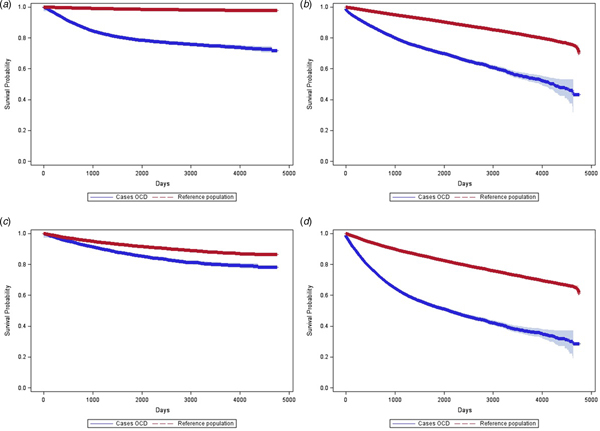
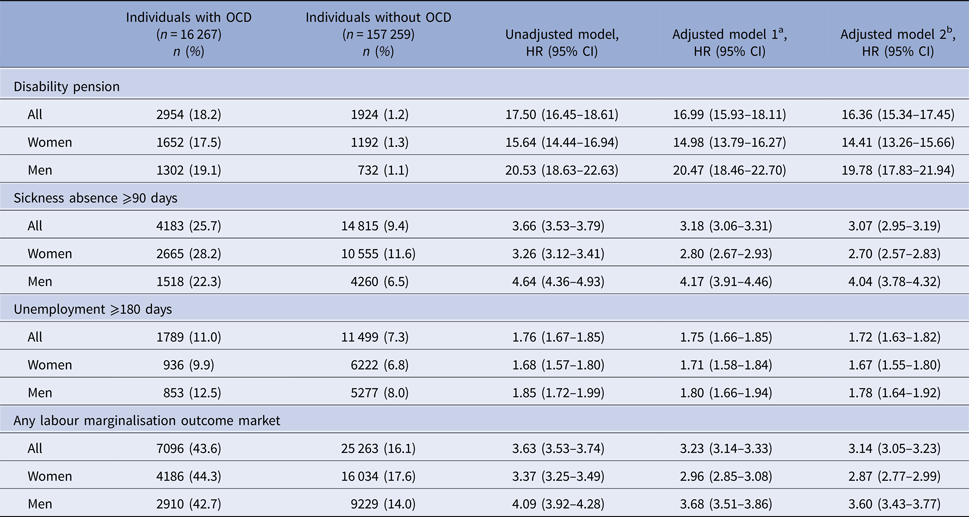
Individuals with OCD had a 17-fold increase risk of receiving disability pension, compared with individuals without the disorder [18.2% v. 1.2%; HR = 17.50 (95% CI 16.45–18.61)]. The HR decreased to 16.36 (95% CI 15.34–17.45) in the fully adjusted model (Table 2, Fig. 1a).
Kaplan–Meier estimate of survival function (with 95% Hall–Wellner confidence bands) for each of the outcomes under study – (a) disability pension, (b) long-term sickness absence, (c) long-term unemployment and (d) any labour market marginalisation outcome – in individuals with obsessive–compulsive disorder (OCD) and unaffected individuals from the general population matched on sex and birth year.

Main results. Hazard ratios and corresponding 95% confidence intervals for labour market marginalisation outcomes among individuals aged 16–64 diagnosed with obsessive–compulsive disorder in specialist care between 2001 and 2013, compared with unaffected individuals from the general population matched on sex and birth year, stratified by gender

CI, confidence interval; HR, hazard ratio; OCD, obsessive–compulsive disorder.
All hazard ratios in this table are statistically significant.
Individuals who were on disability pension between 1994 (start of the register) and the date of their OCD diagnosis (date when they entered the cohort) were excluded from the analyses.
a Adjusted by educational level, family composition, type of living area, region of birth, unemployment and sickness absence at baseline (except for disability pension which is not adjusted for sickness absence).
b Adjusted model 1 + adjusted by somatic disorders.
Long-term sickness absence
More than one-fourth of the individuals in the OCD group were on long-term sickness absence during the study period, compared with 9.4% of the controls. This corresponded to a HR of 3.66 (95% CI 3.53–3.79) in the crude analysis, which slightly decreased to 3.07 (95% CI 2.95–3.19) in the fully adjusted model (Table 2, Fig. 1b).
Long-term unemployment
In the crude analysis, the risk of being on long-term unemployment was higher in the OCD group, compared with the unaffected controls [11.0% v. 7.3%; HR = 1.76 (95% CI 1.67–1.85)]. This risk remained largely unchanged in the fully adjusted model [HR = 1.72 (95% CI 1.63–1.82)] (Table 2, Fig. 1c).
Receipt of any labour market marginalisation outcome
Over 43% of the individuals in the OCD cohort had at least one of the outcomes of interest, compared with 16% of the control population, corresponding to a 3.6-fold increased risk [HR = 3.63 (95% CI 3.53–3.74)]. The HR slightly decreased to 3.14 (95% CI 3.05–3.23) in the fully adjusted model (Table 2, Fig. 1d).
Gender differences
Across all outcomes, both men and women with OCD had a higher likelihood of receiving any of the labour market outcomes, compared with men and women from the general population. However, the difference in risk estimates was more pronounced in men than in women with OCD across all outcomes (Table 2).
Sibling analyses
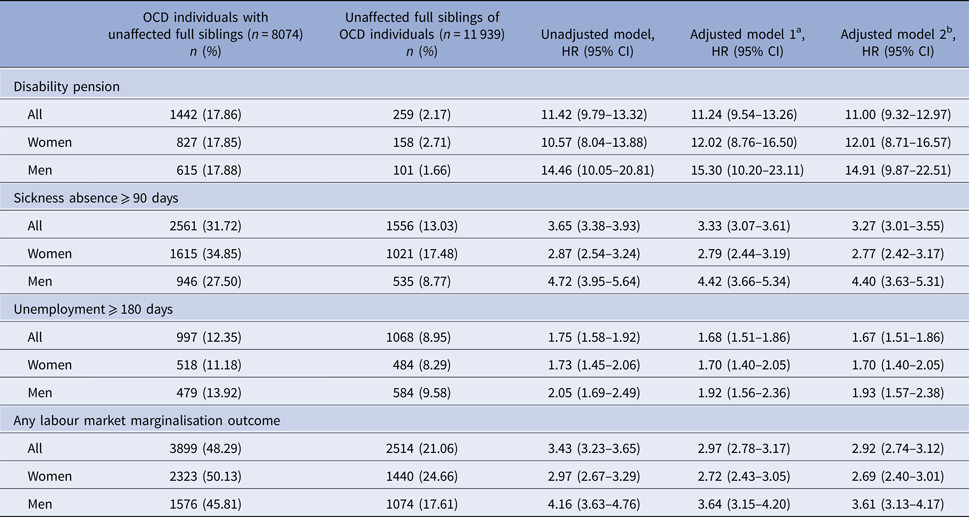
Of the 7962 families with at least two singleton children, 7905 (99.3%) included full siblings discordant for OCD. A total of 8074 patients (some families contained more than one sibling affected by OCD) were compared with their 11 939 unaffected siblings. OCD patients still had significantly higher risks of all outcomes when compared with their unaffected siblings, although the magnitude of the estimates was slightly reduced, compared with the previous models (Table 3).
Sibling analyses. Hazard ratios and corresponding 95% confidence intervals for labour market marginalisation among individuals aged 16–64 diagnosed with obsessive–compulsive disorder in specialist care between 2001 and 2013, compared with their unaffected full siblings, stratified by gender

CI, confidence interval; HR, hazard ratio; OCD, obsessive–compulsive disorder.
All hazard ratios in this table are statistically significant.
Individuals who were on disability pension between 1994 (start of the register) and the date of their OCD diagnosis (date when they entered the cohort) were excluded from the analyses.
a Adjusted by educational level, family composition, type of living area, region of birth, and unemployment and sickness absence at baseline (except for disability pension which is not adjusted for sickness absence).
b Adjusted by all variables in model 1 + somatic disorders.
Impact of psychiatric comorbidity
When individuals with different groups of comorbid psychiatric disorders diagnosed up to 5 years prior the cohort entry date were excluded from the analyses, the magnitude of estimates was only slightly reduced (Table 4). Fully adjusted HR ranged between 13.63 and 16.44 for disability pension, between 2.68 and 3.08 for long-term sickness absence, between 1.66 and 1.75 for long-term unemployment and between 2.93 and 3.50 for any labour market marginalisation outcome.
Comorbidity effects. Hazard ratios and corresponding 95% confidence intervals for labour market marginalisation outcomes among individuals aged 16–64 diagnosed with obsessive–compulsive disorder in specialist care between 2001 and 2013, compared with unaffected individuals from the general population matched on sex and birth year, excluding different groups of comorbidities recorded during the 5 years before the cohort entry date and stratified by gender

CI, confidence interval; HR, hazard ratio.
All hazard ratios in this table are statistically significant.
Individuals who were on disability pension between 1994 (start of the register) and the date of their OCD diagnosis (date when they entered the cohort) were excluded from the analyses.
a Adjusted by educational level, family composition, type of living area, region of birth, unemployment and sickness absence at baseline, and somatic disorders.
b Includes attention-deficit/hyperactivity disorder, pervasive developmental disorders and Tourette's and chronic tic disorders.
c Includes dissociative, somatoform, other neurotic disorders and behavioural syndromes associated with physiological disturbances and physical factors.
dAll ICD-10 diagnoses except psychiatric diagnoses (F00-F99).
Discussion
To our knowledge, this is the first study examining the association of OCD diagnosed in specialist settings with a range of objective indicators of labour market marginalisation at the population level. The main finding was that OCD is associated with pervasive labour market marginalisation, with approximately 44% of all patients having at least one of the outcomes of interest during the study period, corresponding to a 3.1-fold increase, compared with the general population. Approximately 18% of the patients received newly granted disability pension during the study period, corresponding to an alarming 16-fold increased risk, compared with the general population (as this is a relatively rare outcome only reserved for the most severely ill patients). The most common outcome was long-term sickness absence (around 26% of all OCD patients), corresponding to approximately threefold increased risk, compared with controls. Finally, OCD patients were 72% more likely to be long-term unemployed, compared with unaffected individuals. The magnitude of these associations was only marginally attenuated when measured confounders were strictly controlled, genetic and environmental factors shared by siblings were taken into account, and relevant psychiatric and somatic comorbidities were considered.
Our findings are in line with previous, much smaller studies reporting higher rates of unemployment (Hollander et al., Reference Hollander, Kwon, Stein, Broatch, Rowland and Himelein1996; Grabe et al., Reference Grabe, Meyer, Hapke, Rumph, Freyberger, Dilling and John2000) and disability payments (Sorensen et al., Reference Sorensen, Kirkeby and Thomsen2004; Eisen et al., Reference Eisen, Mancebo, Pinto, Coles, Pagano, Stout and Rasmussen2006; Mancebo et al., Reference Mancebo, Greenberg, Grant, Pinto, Eisen, Dyck and Rasmussen2008) in OCD, and substantially expand our understanding of the broad range of negative impacts, both medical and social, associated with the disorder. Focusing on three different outcomes, rather than single indicators, provided a fuller picture of the actual extent of the difficulties experienced by these patients. For example, the impact of OCD on unemployment measures was relatively modest, but this is largely explained by the fact that many patients are on long-term sickness leave or disability pension, and are therefore excluded from the unemployment estimates.
Putting the results in the context of similar research in psychiatric disorders, the estimated impact of OCD on labour market marginalisation measures is only second to schizophrenia and non-affective psychosis (these patients have a 25-fold increased risk of receiving disability pension than controls without mental disorders) (Helgesson et al., Reference Helgesson, Tinghog, Niederkrotenthaler, Saboonchi and Mittendorfer-Rutz2017), and clearly higher than in other common mental disorders such as affective (eightfold increase), personality (13-fold) or substance use disorders (fourfold) (Helgesson et al., Reference Helgesson, Tinghog, Niederkrotenthaler, Saboonchi and Mittendorfer-Rutz2017). Thus, OCD is a serious mental disorder that affects not only the person's health, quality of life and education, but also the ability to actively contribute to the labour market. This is likely to result in substantial economic impact for the person and the society at large. Intuitively, our results emphasise the need to treat OCD symptoms at an early stage, using evidence-based approaches, to increase the chances that affected individuals first enter, or return to, the labour market. In addition, whether vocational rehabilitation programmes specifically developed for OCD patients are associated with a higher likelihood of returning to work, as has been suggested in other psychiatric disorders (Falkum et al., Reference Falkum, Klungsoyr, Lysatd, Bull, Evensen, Martinsen, Friis and Ueland2017), is an important question for future research.
While both men and women with OCD were impaired on all outcome measures, compared with their respective controls, men with OCD generally had higher risk estimates, particularly for sickness absence. This was largely due to the fact that, in the general population, women are more likely to be on long-term sickness absence and receive disability pension than men (Nyman et al., Reference Nyman, Palmer and Bergendorff2002; Swedish Social Insurance Agency, 2016).
Because of the nature of our cohort, composed of treatment-seeking individuals who required specialist care, our results may not necessarily generalise to individuals with milder forms of OCD who do not seek help or are only mildly impaired. It is also worth considering the specific features of the Swedish welfare system and how these may potentially affect the generalisation of our findings to other parts of the world. The legislation regarding the minimum requirements for lost working ability, duration of sick-leave spells or compensation for sickness absence or disability pension differs substantially between countries. For instance, Sweden differs from other countries in that sick-leave and disability pension benefits can be granted full time or part time (25, 50, 75 or 100% of ordinary working time), which is a major difference in relation to most other European countries where part-time sick-leave benefit is not an option. Thus, our results might be more generalisable to countries with similar insurance systems or level of workers’ protection. Our hypothesis is that the generous welfare systems of the Nordic countries may comparatively place more people on disability pension/sick-leave, whereas other countries may place more people on unemployment benefits. For this reason, we included a fourth measure to estimate the likelihood of receiving ‘any’ of the three labour market marginalisation indicators. This might provide a more generalisable estimate to other countries whose insurance systems have lower levels of workers’ protection, since help-seeking patients might suffer a similar degree of work impairment irrespective of where the system places them (e.g. unemployed, receiving disability pension or sickness absence benefits). Thus, the figure that may be most useful to quote from our study is that nearly 44% of individuals with OCD have difficulties to participate in the labour market, compared with about 16% of individuals in the general population.
Strengths and limitations
Our study included one of the largest population-based cohorts of OCD patients in the world, identified from the Swedish registers using previously validated ICD codes (Rück et al., Reference Rück, Larsson, Lind, Pérez-Vigil, Isomura, Sariaslan, Lichtenstein and Mataix-Cols2015). Diagnoses were made by specialist physicians working across a variety of clinical settings, and outcomes were collected from records kept by government agencies or other organisations, which ensured minimal risk of selection, recall and report biases (Ludvigsson et al., Reference Ludvigsson, Andersson, Ekbom, Feychting, Kim, Reuterwall, Heurgren and Olausson2011; Ludvigsson et al., Reference Ludvigsson, Almqvist, Bonamy, Ljung, Michaelsson, Neovius, Stephansson and Ye2016). Our models adjusted for a large number of potentially confounding variables. Additionally, the use of sibling comparison models allowed us to strictly adjust for unmeasured confounders, such as genetic and environmental factors shared by siblings.
Several limitations of the study also need to be considered. First, patients included in the NPR may not be representative of all OCD cases in the population, as the register only includes specialist care visits and not patients seen in general practitioner clinics. Thus, while the patients included in our cohort resemble other patients recruited from specialist clinics around the world, it is possible that our results do not generalise to less severe patient samples. An additional limitation is that the NPR does not include measures of symptom severity, which may have a clear impact on the eventual labour market marginalisation of an individual. Finally, some individuals are not eligible to receive unemployment or sickness benefits despite being unemployed or unable to work due to illness, respectively. For example, persons who have recently migrated to Sweden may have not worked long enough to qualify for unemployment benefits. This may have resulted in an underestimate of risk for these particular outcomes.
Conclusions
Examination of the labour market marginalisation of this uniquely large cohort of individuals with OCD significantly increases our understanding of the burden and impact of this disorder. This new knowledge may stimulate connections between policy-makers, vocational rehabilitation and mental health services to design and implement prevention and intervention strategies to reduce labour market marginalisation in this patient group.
Acknowledgements
This work was supported by a research grant from the International OCD Foundation awarded to Dr Fernández de la Cruz. Ms Ana Pérez-Vigil is supported by a grant from the Alicia Koplowitz Foundation. Dr Fernández de la Cruz is supported by a Junior Researcher grant from the Swedish Research Council for Health, Working Life and Welfare (FORTE grant number 2015-00569). The funders had no role in the design and conduct of the study; collection, management, analysis and interpretation of the data; and preparation, review or approval of the manuscript; and decisions to submit the manuscript for publication.
Author contributions
Pérez-Vigil, Mittendorfer-Rutz, Fernández de la Cruz and Mataix-Cols conceived and designed the study. Helgesson analysed the data. Pérez-Vigil drafted the manuscript. All authors revised subsequent drafts and approved the final version.
Conflict of interest
Professor Mataix-Cols and Dr Fernández de la Cruz receive royalties for contributing articles to UpToDate, Wolters Kluwer Health.