

Introduction
The association between severe mental illness and offending has been established primarily by revealing elevated rates of offending, particularly of a violent nature, in persons suffering from schizophrenia and other psychotic disorders (Fazel et al. Reference Fazel, Gulati, Linsell, Geddes and Grann2009a). Substance misusers, persons suffering from antisocial personality disorder and adolescents with behavioural disorders (e.g. attention deficit/hyperactivity disorder, ADHD) have also been shown to have elevated rates of offending (Grann & Fazel, Reference Grann and Fazel2004; Retz & Rösler, Reference Retz and Rösler2007; Logan & Johnstone, Reference Logan and Johnstone2010) whereas there is little knowledge of offending behaviour in other non-psychotic disorders. Studies of prison populations have consistently shown that, in addition to psychotic and personality disorders, there are elevated rates of less severe disorders such as anxiety disorders and clinical depression in incarcerated offenders (Fazel & Danesh, Reference Fazel and Danesh2002) and those recently remanded (Andersen et al. Reference Andersen, Sestoft, Lillebaek, Gabrielsen and Kramp1996), suggesting that the association between crime and mental illness is not confined to the most serious disorders, although the nature of this association remains unclear.
Much of the existing research is based on studies that are too small to compare rates for men and women but, as discussed in Robbins et al. (Reference Robbins, Monahan and Silver2003), studies that do look at female offending have shown mental illness to be a stronger risk factor for offending in women than in men, such that the gender gap in crime rates tends to decrease after onset of psychotic disorders.
Offending behaviour in mentally ill persons has long been considered a consequence of the disorder, but there is now an emerging interest in comparing offending before and after illness onset among those with severe mental disorder. The few studies that do exist (Wallace et al. Reference Wallace, Mullen, Burgess, Palmer, Ruschena and Browne1998; Munkner et al. Reference Munkner, Haastrup, Joergensen and Kramp2003; Jones et al. Reference Jones, Van den Bree, Ferriter and Taylor2010) suggest that for many patients offending commences long before illness onset. The results of these studies still need to be replicated on a larger scale. Pre-onset offending in non-psychotic disorders remains unexamined.
Using a large population-based sample covering the full range of mental disorders, the aim of this study was to investigate the association between first psychiatric contact and prior offending across major diagnostic groups. We examined patterns of general and violent offending respectively, in each case distinguishing between one-time and repeat offending. We also assessed whether the pattern was comparable in males and females. Potential confounding of the results by co-morbid substance misuse and parental socio-economic status (SES) was also considered.
Method
Data were obtained by linking Danish population-based registers by means of the unique personal identification number. The Danish Civil Registration System (CRS) contains data for each individual on gender and date of birth, continuously updated information on vital status and the CRS numbers of parents, along with many other variables (Pedersen et al. Reference Pedersen, Gotzsche, Moller and Mortensen2006). The Danish Psychiatric Central Register (PCR) contains data relating to all admissions to psychiatric hospitals since 1969 and all out-patient contacts since 1995 (Munk-Jorgensen & Mortensen, Reference Munk-Jorgensen and Mortensen1997). Discharge diagnoses ascribed by the treating psychiatrist were recorded according to ICD-8 (WHO, 1967) from April 1969 to December 1993 and according to ICD-10 (WHO, 1992) from January 1994 onwards. The Danish National Crime Register (NCR) became electronic in November 1978 and all court verdicts and police decisions relating to criminal charges have been registered since this date. The NCR contains information on date of verdict (or police decision), type of offence and type of verdict along with length and type of sentence (Kyvsgaard, Reference Kyvsgaard1998), and data are made available through Statistics Denmark from 1980 onwards. The age of criminal responsibility in Denmark was 15 years during the study period.
Study population
Cases were identified as the total sample of Danish inhabitants born between 1 January 1965 and 31 December 1991 who were admitted for the first time to a psychiatric hospital or were registered with an out-patient contact or emergency room visit with an ICD-10 Chapter V (F) diagnosis between 1 January 1995 and 31 December 2006. In this way the study period was confined to the years where we have complete information on both in-patient and out-patient visits, and persons who had an ICD-8 diagnosis in the period 1969 to 1993 or an ICD-10 diagnosis in 1994 were therefore not included. Only persons who were at least 15 years of age at the time of their first contact were included because younger persons could not have a prior record of offending.
Each case was matched to a random sample of controls using a nested case-control design (Clayton & Hills, Reference Clayton and Hills1993). Controls were of the same gender as the case, were born on the same day, had no record of psychiatric contact up until and including the day the case was confirmed as a case, and were selected randomly from the entire Danish population such that the study population contained all cases and 25% of those at risk.
Assessment of mental disorders in cases
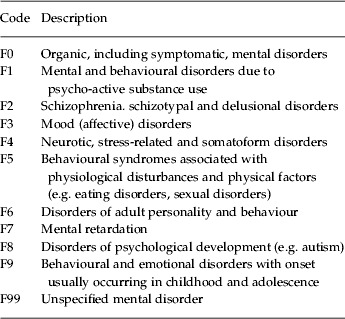
Information on main discharge diagnosis was obtained from the first admission, out-patient contact or emergency room visit. If the main diagnosis was not in ICD-10 Chapter V (F), secondary diagnoses were considered. The diagnoses were grouped according to the main categories of ICD-10 Chapter V (Table 1). In addition, all secondary diagnoses were searched for a code within F1 to establish the presence of co-morbid substance misuse.
Main categories of ICD-10 Chapter V

Assessment of offending
For all cases and controls the NCR was searched for guilty verdicts before the match date. Guilty verdict types included: custodial sentences, suspended sentences, conditional withdrawal of charges, fines and sentences to psychiatric treatment. Only convictions for crimes listed in the penal code were included in the study; traffic violations and violations of other special acts (e.g. tax laws, environmental laws) were not included. We recorded the total number of convictions in addition to the number of convictions for violent offences for each individual. Given the design of the study, we were able to obtain complete information on criminal convictions from the age of legal responsibility until the end of 2006.
Assessment of parental level of education
SES is known to correlate with both offending and mental illness (Agerbo et al. Reference Agerbo, Byrne, Eaton and Mortensen2004; Murray et al. Reference Murray, Irving, Farrington, Colman and Bloxsom2010) and because own SES may be a mediating effect rather than a confounder, we chose to use parental status. We used information on maternal and paternal level of education in the year in which the proband turned 15 years of age. The highest obtained level of education for each parent was coded as: basic education, vocational training, higher education, educational status unknown, and parent unknown. Data were obtained from the Integrated Database for Longitudinal Labour Market Research, which contains annually updated information from 1980 onwards in addition to information from the 1970 population and housing census (Danmarks Statistik, 1991). Using the level of educational attainment has the advantage over other measures of SES in that it is fairly stable over time, whereas income level, labour market attachment and receipt of welfare benefits may vary substantially from year to year.
Statistical analysis
Data were analysed by conditional logistic regression using the PHREG procedures in SAS version 9.1.3 (SAS Institute Inc., USA), where each case and matched controls formed a separate stratum. Because the controls were selected randomly within the appropriate risk sets, the estimated measures of relative risk are incidence rate ratios (IRRs; King & Zeng, Reference King and Zeng2002), with 95% Wald confidence intervals (CIs). For each gender we estimated the effect of one or several offences and of one or several violent offences respectively, and for all analyses adjusted models were fitted controlling for co-morbid substance misuse and parental level of education. Sensitivity analyses were performed on all models, eliminating cases or controls that were registered with a sentence to psychiatric treatment. We also fitted models that were restricted to cases where the time between offending and presentation exceeded 2 and 5 years respectively.
Results
Descriptive results
A total of 101 890 persons born in Denmark between 1 January 1965 and 31 December 1991 had their first admission to, or out-patient contact with, a psychiatric hospital in the years 1995 to 2006. Their age at first contact ranged from 15 to 41 years, where the lower limit is defined by the age of criminal responsibility in Denmark and the upper limit is restricted by the cohort definition. The cases were matched by incidence density sampling to a total of 2 236 195 controls.
Main findings
Overall, 19.2% of the psychiatric patients had a guilty verdict relating to the penal code prior to their first psychiatric contact, whereas 8.3% of population controls had at least one verdict corresponding to an IRR of 3.06 (95% CI 3.01–3.12). For violent offending 5.6% of cases and 1.8% of controls had at least one conviction, resulting in an IRR of 4.37 (95% CI 4.24–4.50).
Penal code offending and subsequent psychiatric contact
Males with one conviction had an IRR of 2.32 (95% CI 2.26–2.40) for psychiatric contact and two or more convictions resulted in an IRR of 4.97 (95% CI 4.83–5.11). The corresponding values for women were very similar, with an IRR of 2.25 (95% CI 2.17–2.33) for one conviction and 4.03 (95% CI 3.81–4.26) for several. A total of 34% of males with a psychiatric contact were registered with at least one offence but this applied to only 14.4% of the controls. Offending was less prevalent among females, where 8.4% of the cases and 3.5% of the controls had at least one conviction.
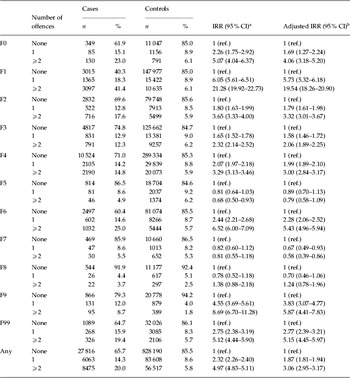
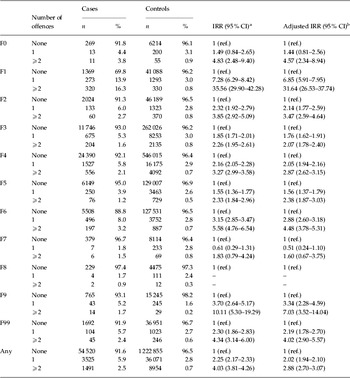
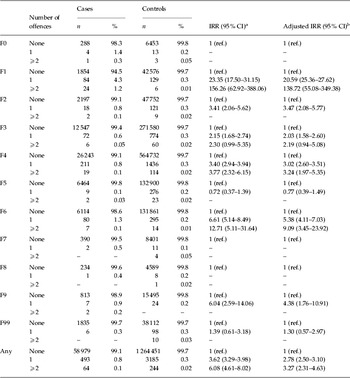
There was some variability in the effect sizes for different diagnostic groups (Tables 2 and 3). For both genders, prior offending had by far the strongest association with contacts due to substance-related disorders (F1). IRRs were 6.05 for males (95% CI 5.61–6.51) and 7.28 for females (95% CI 6.29–8.42) with one conviction and 21.28 for males (95% CI 19.92–22.73) and 35.56 for females (95% CI 29.90–42.28) with two or more convictions. Behavioural and emotional disorders with onset in childhood or adolescence (F9) were also strongly correlated with offending, with IRRs of 4.55 (95% CI 3.69–5.61) for males and 3.70 (95% CI 2.64–5.17) for females with one conviction. Neurotic, stress-related and somatoform disorders (F4), personality disorders (F6) and unspecified mental disorders (F99) were associated with an IRR >2 (range 2.07–3.24) in both genders. An estimate of this magnitude was also found for males with organic disorders (F0) and females with psychotic disorders (F2). Significantly elevated risks with an IRR <2 (range 1.49–1.85) were found in persons whose first diagnosis was affective disorders (F3), males with psychotic disorders (F2), and females with organic disorders (F0) or behavioural syndromes associated with physiological disturbances and physical factors (F5). The association with prior offending was not significant for persons who had a psychiatric contact for mental retardation (F7), males with behavioural syndromes associated with physiological disturbances and physical factors (F5) and males admitted with disorders of psychological development (F8).
Penal code offending prior to first psychiatric contact by diagnosis, men

IRR, Incidence rate ratio; CI, confidence interval.
a Matched for gender and exact birthday, adjusted for non-penal code offending.
b Matched for gender and exact birthday, adjusted for non-penal code offending, parental level of education and, except for F1, co-morbid substance misuse.
Penal code offending prior to first psychiatric contact by diagnosis, women

IRR, Incidence rate ratio; CI, confidence interval.
a Matched for gender and exact birthday, adjusted for non-penal code offending.
b Matched for gender and exact birthday, adjusted for non-penal code offending, parental level of education and, except for F1, co-morbid substance misuse.
When looking at single versus multiple convictions there was a dose–response relationship in both genders and for most diagnostic groups, such that multiple offences were associated with higher risks than just being convicted of a single offence. The exceptions to this pattern were males with a contact for mental retardation (F7) or behavioural syndromes associated with physiological disturbances and physical factors (F5), where the risk decreased with increasing number of convictions.
Adjusting the results for co-morbid substance misuse and parental level of education generally had the effect of attenuating the estimates, but the significant associations between diagnosis at first psychiatric contact and prior convictions persisted. The exception was behavioural syndromes associated with physiological disturbances and physical factors (F5), where adjusting the model led to higher estimates, and for males the significance of lower risk of multiple offences disappeared. Conversely, the risk of psychiatric contacts for mental retardation (F7) associated with males who had a history of offending became statistically significant only after adjustment.
Violent offending and subsequent psychiatric contact
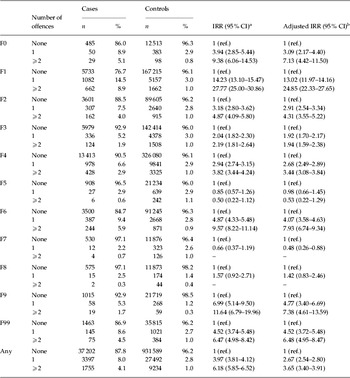
As was the case for penal code offending, the overall association between violent offending and later psychiatric contact was similar for men and women (Tables 4 and 5). The IRRs for psychiatric admissions were 3.89 (95% CI 3.75–4.04) for males with one violent conviction and 6.16 (95% CI 5.85–6.48) for multiple convictions. Similarly, females had IRRs of 3.59 (95% CI 3.27–3.94) and 6.00 (95% CI 4.60–7.84) for single and multiple violent offending respectively. The rates of offending were much greater in males than females (12% v. 0.9% of cases and 3.8% v. 0.3% of controls), which means that estimates for the latter are less robust and, for some diagnostic groups, unobtainable because of an insufficient number of exposed cases and indeed exposed controls in some instances.
Violent offending prior to first psychiatric contact by diagnosis, men

IRR, Incidence rate ratio; CI, confidence interval.
a Matched for gender and exact birthday, adjusted for non-penal code offending.
b Matched for gender and exact birthday, adjusted for non-penal code offending, parental level of education and, except for F1, co-morbid substance misuse.
Violent offending prior to first psychiatric contact by diagnosis, women

IRR, Incidence rate ratio; CI, confidence interval.
a Matched for gender and exact birthday, adjusted for non-penal code offending.
b Matched for gender and exact birthday, adjusted for non-penal code offending, parental level of education and, except for F1, co-morbid substance misuse.
In males, the pattern of violent offending prior to first psychiatric contact was similar to that found for all offending; however, the associations were generally stronger. IRRs >3 (range 3.18–6.99) were found for organic disorders (F0), psychotic disorders (F2), personality disorders (F6), behavioural and emotional disorders (F9) and unspecified mental disorders (F99), whereas substance-related disorders had an IRR of 14.23 (95% CI 13.10–15.47). Significantly elevated risks with an IRR <3 (range 2.04–2.94) were found for affective disorders (F3) and neurotic, stress-related and somatoform disorders (F4), whereas estimates for behavioural syndromes associated with physiological disturbances and physical factors (F5), mental retardation (F7) and disorders of psychological development (F8) were not statistically significant. Patterns for multiple versus single convictions and for adjustment for co-morbid substance misuse and parental level of education were analogous to those found for all offending.
Where estimates for females were obtainable they were of similar magnitude to their male counterparts. The clearest exception was for substance-related disorders (F1), where IRRs were much higher (IRR 23.35, 95% CI 17.50–31.15), and for unspecified mental disorders (F99), which were not significantly associated with violent offending in females.
Sensitivity analysis
There may be a direct link between offending and contact with mental health services in persons who have been sentenced to psychiatric treatment. To avoid these causing inflated estimates, we performed sensitivity analyses where persons who had ever received such a sentence (164 cases and 118 controls, corresponding to 0.2% and 0.01%) were eliminated from the models. Most persons with such a verdict were excluded by definition because mental assessments used by the courts would be recorded and hence first contact would be before the conviction date. Exceptions related to sentences that predate 1995 when out-patient contacts were not recorded and to mentally retarded persons who may have been assessed by doctors outside of psychiatric hospitals. The sensitivity analyses yielded results that were very similar to those presented above, but there were marginally lower estimates for women with mental retardation and men with organic disorders, personality disorders or mental retardation.
Restricting the time between offending and presentation to services would limit the impact that persons offending after illness onset but before first presentation to services would have on the results. In a model where there were 2 years between offending and presentation, the association between any offending and any psychiatric contact was reduced from 3.06 (95% CI 3.01–3.12) to 2.95 (95% CI 2.89–3.01), and imposing a 5-year minimum reduced it very slightly further to 2.94 (95% CI 2.87–3.00). However, part of this reduction is also probably due to elimination of those who have acute reactions to the strain of going through a trial, sentencing, etc.
Discussion
Main findings
In this study of the total national population of individuals in contact with mental health services we found that there was a strong association between offending and subsequent psychiatric contact across almost all diagnostic groups. We found IRRs of similar magnitude for men and women, although offending was much more prevalent in men. We also found that patterns of more serious offending (violent versus other offending, multiple versus single convictions) increased the association.
Although there has been a long-standing scientific interest in the association between mental disorders and offending, most prior research has focused on the lifetime risk of offending (Hodgins, Reference Hodgins1998; Brennan et al. Reference Brennan, Mednick and Hodgins2000), post-onset violence (Fazel et al. Reference Fazel, Gulati, Linsell, Geddes and Grann2009a,b) in serious mental disorders, co-occurring mental disorders and violence (Arseneault et al. Reference Arseneault, Moffitt, Caspi, Taylor and Silva2000), or has been based on self-report data where attrition rates are high (Corneau & Lanctot, Reference Corneau and Lanctot2004). Although a few studies of schizophrenia have reported the prevalence of pre-onset offending (Munkner et al. Reference Munkner, Haastrup, Joergensen and Kramp2003) or pre-onset violence (Dean et al. Reference Dean, Walsh, Morgan, Demjaha, Dazzan, Morgan, Lloyd, Fearon, Jones and Murray2007), little attention has been paid to pre-onset offending in other psychiatric disorders. In a Danish study Munkner et al. (Reference Munkner, Haastrup, Joergensen and Kramp2003) found that 37% of male and 7% of female schizophrenia patients had at least one criminal conviction before their first psychiatric contact, which is comparable to what we found for a wider group of psychiatric patients, where, regardless of diagnosis, 34% of males and 8.4% of females had a history of penal code offending before their first psychiatric contact. Dean et al. (Reference Dean, Walsh, Morgan, Demjaha, Dazzan, Morgan, Lloyd, Fearon, Jones and Murray2007) found that 14% of first-episode psychoses in the AESOP (Aetiology and Ethnicity of Schizophrenia and Other Psychoses) study had a history of violent offending. Their substantially higher percentage is unsurprising given their population was drawn from socially deprived urban areas where local crimes rates are relatively high.
What may be surprising is that the IRRs we found for males with psychotic disorders were <2 for a single conviction, thereby placing them among the weaker associations in the study, and although the association with violent offending was stronger, this association was also among the weaker relative to other groups of disorders. Although part of the explanation is probably differential selection bias (see discussion on limitations), compared to the strong associations generally found between psychotic disorders and post-onset violence this result lends credence to the theory that violence in psychosis can be divided into two groups, those who have long histories of offending and those whose offending is related directly to the psychotic symptoms and that only commenced post-onset (Hodgins et al. Reference Hodgins, Calem, Shimel, Williams, Harleston, Morgan, Dazzan, Fearon, Morgan, Lappin, Zanelli, Reichenberg and Jones2011; Large & Nielssen, Reference Large and Nielssen2011).
Understanding the association
There are several potential explanations for the association between offending and subsequent psychiatric contact. These include the occurrence of undetected pre-offending mental disorder, the consequences of offending causing mental disorder and the existence of common risk factors.
Because our analyses were based on hospital records, we were not able to take account of symptoms of mental disorder occurring prior to or at the time of an offence that did not lead to mental health service contact. In addition, some disorders are likely to have a long antecedent period that itself might be associated with offending. Numerous studies have shown that, even upon reception into remand facilities, there is a large over-representation of persons showing symptoms of mental illness (Andersen et al. Reference Andersen, Sestoft, Lillebaek, Gabrielsen and Kramp1996; Brooke et al. Reference Brooke, Taylor, Gunn and Maden1996; Birmingham et al. Reference Birmingham, Gray, Mason and Grubin2000), although the degree to which these persons have already been in touch with mental health services is not known. Furthermore, little is known about the presence of psychiatric morbidity in offenders receiving non-custodial sentences.
Conversely, the consequence of offending, court contact and sentencing, especially if custodial, can act as a life stressor that might itself trigger the onset of mental disorder (Hammen, Reference Hammen2005; Slavich et al. Reference Slavich, O'Donovan, Epel and Kemeny2010), particularly if perceived to have an element of humiliation or social rejection (Kendler et al. Reference Kendler, Hettema, Butera, Gardner and Prescott2003). Which explanation is most plausible is likely to vary between different groups of disorders. For instance, it is probable that undiagnosed psychoses or personality disorders may influence propensity to offend whereas anxiety and depressive disorders may be more likely to emerge consequent on offending/court contact.
Finally, it seems that risk factors such as low SES (Agerbo et al. Reference Agerbo, Byrne, Eaton and Mortensen2004; Murray et al. Reference Murray, Irving, Farrington, Colman and Bloxsom2010), living in an urban area (Flango & Sherbenou, Reference Flango and Sherbenou1976; Pedersen & Mortensen, Reference Pedersen and Mortensen2001), migration (Cantor-Graae & Selten, Reference Cantor-Graae and Selten2005; Laub & Sampson, Reference Laub and Sampson2006), family disruptions/instabilities (Mednick et al. Reference Mednick, Baker and Carothers1990; Niemi et al. Reference Niemi, Suvisaari, Tuulio-Henriksson and Lönnqvist2003) and inherited vulnerabilities (Dean et al. Reference Dean, Stevens, Mortensen, Murray, Walsh and Pedersen2010; Frisell et al. Reference Frisell, Lichtenstein and Langstrom2011) apply to offending and to psychiatric disorders, pointing to shared risk factors for both rather than a causal relationship between them. The dose–response nature of the association found between offending and subsequent mental disorder adds weight to the notion that the association reflects underlying causal processes.
It is also important to note that, although it is well known that disorders such as schizophrenia are not always diagnosed on the first contact with mental health services, especially in cases with a more insidious onset, the fact that we found strong associations across almost the full range of disorders makes it unlikely that the results are due to misclassification caused by reliance on the first treatment contact diagnosis. This also suggests that the association between crime and mental disorder has a much wider scope than that traditionally investigated.
Gender differences and similarities
In line with existing research, we found large differences in the prevalence of offending in men and women. Surprisingly, however, we also found offending to be a risk factor of similar magnitude for subsequent psychiatric contact in both genders. Numerous studies have found that the gender gap generally found in offending patterns narrows considerably in mentally disordered populations, such that mental illness is a much stronger risk factor for offending in females than in males (Robbins et al. Reference Robbins, Monahan and Silver2003; Fazel et al. Reference Fazel, Gulati, Linsell, Geddes and Grann2009a). Our findings may suggest that female offending arises to a greater extent from direct effects of mental disorders, rather than to common causes or vulnerabilities preceding the disorder.
Substance misuse
The use of illegal substances is highly correlated with criminal activity in general and when it is co-morbid with other mental illnesses (Grann & Fazel, Reference Grann and Fazel2004; Fazel et al. Reference Fazel, Langstrom, Hjern, Grann and Lichtenstein2009b) and is potentially a source of common vulnerability for offending and mental disorder, in addition to being associated with the antecedents of a range of mental disorders (Rosen et al. Reference Rosen, Miller, D'Andrea, McGlashan and Woods2004). An American study by Elbogen & Johnson (Reference Elbogen and Johnson2009) found that adjusting for substance misuse eliminated the association between mental disorders and violence, which contrasts to our surprising finding that adjusting for co-morbid substance misuse had only a limited impact on the estimates for other diagnoses, despite it having by far the strongest association with both violent and non-violent offending when appearing as a primary diagnosis. Although our results may be affected by residual confounding due to substance-related co-morbidity being under-represented in the register (Hansen et al. Reference Hansen, Munk-Jorgensen, Guldbaek, Solgard, Lauszus, Albrechtsen, Borg, Egander, Faurholdt, Gilberg, Gosden, Lorenzen, Richelsen, Weischer and Bertelsen2000), other studies have also found that the association persists after controlling for co-morbid substance misuse (Van Dorn et al. Reference Van Dorn, Volavka and Johnson2012). There may also be an issue of timing because offending may take place many years before the first psychiatric contact, by which time the person may no longer be misusing substances even if they were at the time of offending.
Strengths and limitations
Using national registers covering the entire Danish population enabled us to follow a large number of people over a long period of time. The advantages include the ability to investigate rare outcomes, such as violent offending in women, and the lack of bias in selecting controls and in the availability of information on cases and controls.
However, there are also some shortcomings to our data. First, out-patient contacts were not registered before 1995 and thus it is possible that some of the included cases had prior unregistered out-patient contacts. Second, mental disorders that were treated in primary care only were not included. Obviously these two factors are of differential importance for different diagnoses, such that less serious disorders are more likely to be unregistered. For disorders commonly treated in primary care, such as depression, the validity of our results is contingent upon referral to secondary care not being dependent on previous offending. Although being considered at risk for harm to others certainly could increase the likelihood of admittance, the inclusion of out-patient contacts would significantly lower the impact of this potential source of selection bias. Regardless, our findings cannot be generalized to all those in the population who experience psychiatric symptoms, but only the subgroup who seek treatment in secondary care. Third, although those diagnoses that have been validated have shown reassuring results (Kessing, Reference Kessing1998; Jakobsen et al. Reference Jakobsen, Frederiksen, Hansen, Jansson, Parnas and Werge2005; Phung et al. Reference Phung, Andersen, Hogh, Kessing, Mortensen and Waldemar2007), most of these routinely acquired diagnoses are not validated. However, the use of broader diagnostic groups rather than more specific diagnoses should lessen the extent to which misclassification would occur.
The age restrictions of the cohort are not so problematic for the measurement of criminality because most offending occurs in the teens and early twenties, but the generalizability of our results does vary between different disorders. The generalizability is likely to be good for disorders that commonly emerge in late adolescence or early adulthood (e.g. psychotic disorders), whereas findings for disorders of later onset (e.g. organic disorders, especially various forms of dementia) will be generalizable only to a selected group with earlier onset than is typical. The same applies to disorders that emerge in childhood (e.g. developmental or behavioural disorders and mental retardation), which almost certainly represent cases of late detection rather than late onset. Incidentally, the latter disorders are also the ones that failed to reach statistical significance.
Using the date of conviction rather than the date of the actual offence will tend to bias the results towards underestimation because any court-mandated psychiatric assessment will have taken place before conviction and thus the offence will be regarded as post-onset. This particularly applies to those suffering from psychotic disorders and those having committed (more serious) violent crimes (Rigsadvokatens Meddelelse, 2007).
Conclusions
In a study of a total national population of individuals in contact with mental health services we found that there was a strong association between offending and subsequent psychiatric contact. With almost one in five new patients presenting to mental health services having some history of offending, there is a clear clinical relevance to our findings. Having established that the risk is not confined to severe mental disorders, our results might encourage clinicians to enquire about an offending history more than they currently do. A history of offending could reflect important aetiological information for the individual and also suggests elevated risk for future offending. Our findings also add weight to the notion that antisocial behaviour heralds future risk for a range of mental disorders and so targeting those in contact with the Criminal Justice System may be effective not only for early detection, which is now increasingly being addressed in many countries, but also for preventive strategies.
Acknowledgements
H. Stevens was funded by the Danish Counsel for Independent Research, Medical Sciences and Danish Regions. Dr K. Dean acknowledges financial support from the National Institute for Health Research (NIHR) Biomedical Research Centre for Mental Health at the South London and Maudsley National Health Trust (NHS) Foundation Trust and the Institute of Psychiatry, King's College London. Drs E. Agerbo and P. B. Mortensen and P. R. Nielsen are supported financially by the Stanley Medical Foundation. The funders had no involvement in any aspect of this study.
Declaration of Interest
None.