Introduction
A range of theories have been proposed to explain the aetiology or development of psychosis but have been difficult to test as clinically diagnosed psychosis is rare (3% across the lifetime) (van Os, Linscott, Myin-Germeys, Delespaul, & Krabbendam, Reference van Os, Linscott, Myin-Germeys, Delespaul and Krabbendam2009). While in contrast, psychotic experiences (PE) are more frequently experienced in adolescence and adulthood (Zammit et al., Reference Zammit, Kounali, Cannon, David, Gunnell, Heron and Lewis2013) and are characterised by the same cluster of symptoms as psychotic disorders, including hallucinations, delusions and thought disorders, but do not meet the threshold for a clinical diagnosis (van Os et al., Reference van Os, Linscott, Myin-Germeys, Delespaul and Krabbendam2009). They are considered to be on the same continuum and the risk of psychotic disorders in adulthood has been found to be greater in those with PE in adolescence, suggesting that PE may become persistent and subsequently develop into clinical impairment (van Os et al., Reference van Os, Linscott, Myin-Germeys, Delespaul and Krabbendam2009; Zammit et al., Reference Zammit, Kounali, Cannon, David, Gunnell, Heron and Lewis2013). There is increasing evidence that factors found to be associated with psychosis are similarly associated with PE supporting their use in population studies (Johns & Os, Reference Johns and Os2001).
One of the most widely cited theory of psychosis is the neurodevelopmental model (NM) (Marenco & Weinberger, Reference Marenco and Weinberger2000), which explains psychosis as a consequence of early disturbed events in the development of the nervous system, creating lesions and disrupting neuronal connections in the brain of the developing foetus (McNeil, Cantor-Graae, & Weinberger, Reference McNeil, Cantor-Graae and Weinberger2000; Murray, Reference Murray1994; Murray & Lewis, Reference Murray and Lewis1987). The consequences of these early lesions could remain dormant until maturation of the prefrontal cortex in adolescence, leading to the use of neural networks that are not well developed and thus enabling the clinical expression of psychosis (Marenco & Weinberger, Reference Marenco and Weinberger2000; Murray, Reference Murray1994). There is evidence from neuroimaging studies of brain abnormalities such as enlarged ventricular volumes in first-episode and chronic schizophrenia patients (Adriano, Caltagirone, & Spalletta, Reference Adriano, Caltagirone and Spalletta2012; De Peri et al., Reference De Peri, Crescini, Deste, Fusar-Poli, Sacchetti and Vita2012), as well as studies showing increased prevalence of psychosis in people with a history of obstetric complications (Murray & Lewis, Reference Murray and Lewis1987). However, brain lesions are difficult to study in large population studies thus motor, cognitive and behavioural abnormalities in childhood prior to the onset of psychosis are often considered as intermediate phenotypes, with evidence of these abnormalities reported in previous studies (Jones, Rodgers, Murray, & Marmot, Reference Jones, Rodgers, Murray and Marmot1994; Pantelis et al., Reference Pantelis, Pantelis, Yücel, Wood, McGorry and Velakoulis2003; Dean, Walther, Bernard, & Mittal, Reference Dean, Walther, Bernard and Mittal2018). These neurodevelopmental impairments are frequent after low birth weight and premature birth and have been found to increase the risk of psychosis in adulthood (Byrne, Agerbo, Bennedsen, Eaton, & Mortensen, Reference Byrne, Agerbo, Bennedsen, Eaton and Mortensen2007; Nosarti et al., Reference Nosarti, Reichenberg, Murray, Cnattingius, Lambe, Yin and Hultman2012). However, these neurodevelopmental impairments have also been associated with exposure to early childhood deprivation and adversities (Sonuga-Barke et al., Reference Sonuga-Barke, Kennedy, Kumsta, Knights, Golm, Rutter and Kreppner2017); therefore, caution is needed to interpret these as support purely for the NM.
In contrast, another well-known theory of psychosis is the trauma model (TM), which places emphasis on the role of childhood adversity (Read, Reference Read1997). Increased exposure to stressful events in childhood can bias cognitive processes and lead to hostile interpretations of anomalous experiences, as well as disrupt the chemical balance of the dopamine system which are found to be abnormal at psychosis onset (Guy, Lee, & Wolke, Reference Guy, Lee and Wolke2017; Read, Fosse, Moskowitz, & Perry, Reference Read, Fosse, Moskowitz and Perry2014). Some studies have found that exposure to any trauma from caregivers (e.g. abuse) or peers (e.g. bullying) can increase the risk of psychotic disorders in later life (Croft et al., Reference Croft, Heron, Teufel, Cannon, Wolke, Thompson and Zammit2018; Varese et al., Reference Varese, Smeets, Drukker, Lieverse, Lataster, Viechtbauer and Bentall2012), and others found increased risk of PE with only certain types of trauma (Bell, Foulds, Horwood, Mulder, & Boden, Reference Bell, Foulds, Horwood, Mulder and Boden2019). The effects of childhood abuse may be partly due to gene–environment correlation, as abusive behaviour may originate from intergenerational transmission of violence (Hines & Saudino, Reference Hines and Saudino2002). Bullying does not have this gene–environment correlation and has similar effect sizes as other types of trauma on psychosis (Fisher et al., Reference Fisher, Schreier, Zammit, Maughan, Munafò, Lewis and Wolke2013; Wolke, Lereya, Fisher, Lewis, & Zammit, Reference Wolke, Lereya, Fisher, Lewis and Zammit2014), even when controlling for genetic risks (Croft et al., Reference Croft, Heron, Teufel, Cannon, Wolke, Thompson and Zammit2018).
The third theory – the developmental risk factor model (DRFM) – proposes an indirect or moderated pathway from neurodevelopmental risks to psychosis, through childhood trauma (Murray & Fearon, Reference Murray and Fearon1999). Early neurodevelopmental deficits can lead to social and behavioural problems, which in turn increase the likelihood of exposure to traumatic events (Murray, Bhavsar, Tripoli, & Howes, Reference Murray, Bhavsar, Tripoli and Howes2017). There are two mechanisms of how neurodevelopmental risks and exposure to trauma may relate to psychosis. First, children with neurodevelopmental deficits may be disproportionally more affected when exposed to trauma (i.e. more vulnerable to the effects of trauma; moderation effect). The alternative model proposes that children with neurodevelopmental deficits are simply more often exposed to trauma rather than being more vulnerable to its effects, i.e. mediation effect.
A test of these models requires the prospective study of children at risk of neurodevelopmental problems, whose exposure to trauma in childhood and PE in adulthood are assessed. Children born very preterm (VP; <32 weeks gestational age) or with very low birth weight (VLBW; <1500 g) provide a natural experiment as they have widespread brain abnormalities persisting into adulthood (de Kieviet, Zoetebier, van Elburg, Vermeulen, & Oosterlaan, Reference de Kieviet, Zoetebier, van Elburg, Vermeulen and Oosterlaan2012) making the whole population at risk for neurodevelopmental difficulties (Volpe, Reference Volpe2009). Furthermore, they have more cognitive, motor, social and behavioural difficulties (Allotey et al., Reference Allotey, Zamora, Cheong-See, Kalidindi, Arroyo-Manzano, Asztalos and Thangaratinam2018), considered as intermediate phenotypes in the NM. Finally, VP/VLBW children are also more likely to be exposed to peer inflicted trauma such as being bullied (Wolke, Baumann, Strauss, Johnson, & Marlow, Reference Wolke, Baumann, Strauss, Johnson and Marlow2015). Thus they represent an ideal naturalistic sample as a proxy to test the NM against the TM and DRFM of psychosis.
It is surprising that there are no studies examining the relationships between trauma and psychotic disorders in adulthood in VP/VLBW populations. One problem, as raised above, is that psychotic disorders are of low prevalence in the general population and VP/VLBW only make up 1–2% of all births, therefore large sample sizes are required in prospective studies. PE on the other hand are on the extended psychosis phenotype and more prevalent, and have been shown to be a significant risk factor for transitioning into psychotic disorders (Zammit et al., Reference Zammit, Kounali, Cannon, David, Gunnell, Heron and Lewis2013). Only one study (Thomas et al., Reference Thomas, Harrison, Zammit, Lewis, Horwood, Heron and Gunnell2009) found a significant effect of VP/VLBW on PE, although PE were only assessed at 12 years and childhood trauma was not examined.
The aim of this prospective longitudinal study from birth into adulthood was to simultaneously test which of the three models – the NM, the TM or the DRFM – best explains the development of PE. This was investigated in two prospective population-based cohort studies of preterm-born children: the German Bavarian Longitudinal Study (BLS), a regionally defined cohort study of VP/VLBW infants followed from birth until 26 years of age, and the EPICure study, a cohort of extremely preterm (EP; <26 weeks' gestation) children born in the UK and Ireland and followed-up until 19 years of age. The BLS was the discovery sample, and the EPICure cohort the replication sample. The assessment of PE was identical in both samples.
Methods
Design and participants
BLS
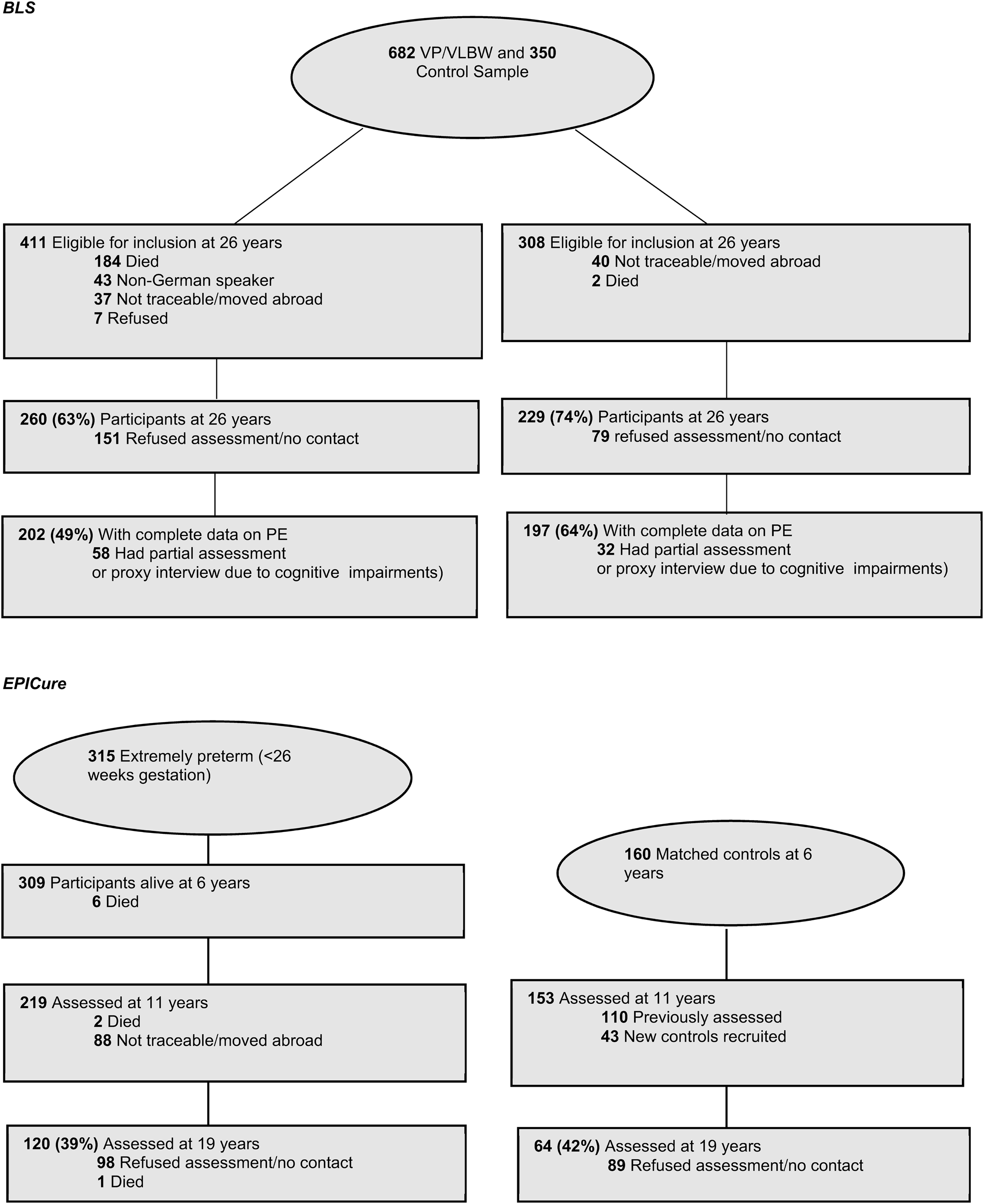
The BLS is a prospective whole population study of children born in Southern Bavaria (Germany) between January 1985 and March 1986, who required admission from obstetric wards to neonatal special care within the first 10 days after birth (Wolke & Meyer, Reference Wolke and Meyer1999). The sample has been described in detail previously (Madzwamuse, Baumann, Jaekel, Bartmann, & Wolke, Reference Madzwamuse, Baumann, Jaekel, Bartmann and Wolke2015). In short, 202 (49%) VP/VLBW and 197 (64%) term-born adults matched on sex and socioeconomic status (SES) who were also recruited at birth had completed PE assessment at 26 years (Fig. 1).
Flowchart of study participants in the BLS and EPICure cohort studies.

Ethical approval was obtained from the University of Munich Children's Hospital, the Bavarian Health Council and the Ethical Board of the University Hospital Bonn. Parents gave informed written consent and all participants gave informed written consent for the assessment in adulthood.
EPICure
The EPICure cohort included EP infants born before 26 weeks' gestation in the UK and Ireland from March through December 1995. The sample has been described in detail previously (Johnson et al., Reference Johnson, Fawke, Hennessy, Rowell, Thomas, Wolke and Marlow2009). In summary, 120 (39%) EP and 64 (42%) term-born adults matched on sex and ethnic group completed PE assessment at 19 years (Fig. 1). EP participants were recruited at birth whereas term-born participants were recruited at 6 years. Ethical approval was given by the South Central Hampshire A Research Ethics Committee (Ref: 13/SC/0514). Parents gave informed written consent and all participants gave informed written consent for the assessment in adulthood.
Measures
Peer victimisation
BLS: Victimisation experiences at ages 6 and 8 were assessed prospectively via a structured parent interview which has been reported previously (Wolke et al., Reference Wolke, Baumann, Strauss, Johnson and Marlow2015). The child was considered a victim if they were bullied ‘1–3 days per month’ to ‘everyday’. Victimisation at ages 6 and 8 was combined so that victimisation at either age represented peer victimisation in childhood.
Victimisation at age 13 was self-assessed prospectively by children using one item of the Strengths and Difficulties Questionnaire (SDQ) (Goodman, Reference Goodman2001): ‘other children pick on or bully me’. Responses were on a 3-point scale and children who answered ‘certainly true’ or ‘somewhat true’ were considered victims in adolescence. The following victimisation variables were constructed: (1) non-victimised children; (2) victim at one time period (childhood or adolescence) and (3) victim at two time periods (childhood and adolescence).
EPICure: Victimisation was reported by parents prospectively at ages 6 and 11 using the same item of the SDQ as the BLS at age 13 (Wolke et al., Reference Wolke, Baumann, Strauss, Johnson and Marlow2015). The same coding procedure was used as the BLS to produce the following variables: (1) non-victimised children; (2) victim at one time period (either 6 or 11 years) and (3) victim at two time periods (both 6 and 11 years).
Cognition
Both BLS and EPICure used the same assessment of IQ (Kaufman Assessment Battery for Children; K-ABC) (Kaufman & Kaufman, Reference Kaufman and Kaufman1983). The K-ABC is a standardised test with an average score of 100 and s.d. of 15. IQ was taken at age 6, but substituted by IQ data at age 8 (in the BLS sample, N = 1356, r = 0.83) or age 11 (in the EPICure sample, N = 306, r = 0.89) if scores were missing at age 6. In total, 12 cases were substituted for BLS and 15 for EPICure.
Motor impairment
Children's motor impairment was assessed using the Test of Motor Impairment (TOMI) (Stott, Moyes, & Headridge, Reference Stott, Moyes and Headridge1968) at ages 6 and 8 in BLS, and items from the Movement Assessment Battery for Children (M-ABC) (Henderson & Sudgen, Reference Henderson and Sudgen1992) at age 6 in EPICure, which is derived from the TOMI. Scores range from 0 to 16 in the TOMI and 0 to 5 in the M-ABC, with higher scores indicating more motor problems. For 33 participants in the BLS who did not have TOMI data at age 6, data were substituted by those taken at age 8 as there was a strong positive correlation between them (N = 1204, r = 0.63).
Psychotic experiences (PE)
PE were assessed by trained interviewers using a semi-structured psychotic-like symptoms interview (Zammit et al., Reference Zammit, Kounali, Cannon, David, Gunnell, Heron and Lewis2013) in the BLS at age 26 and EPICure at age 19. The interview consists of 12 core questions covering hallucinations, delusions and thought disorders occurring in the past 6 months. Participants who answered ‘yes’ or ‘maybe’ were cross-questioned and probed to establish whether the experience was psychotic by the interviewer. Coding of PE followed definitions and rating rules for the Schedules for Clinical Assessment in Neuropsychiatry (SCAN; World Health Organization, 1994) and unclear responses were rated down and only marked as definite when an example met SCAN rating rules. Detailed description of the interview has been reported previously (Zammit et al., Reference Zammit, Kounali, Cannon, David, Gunnell, Heron and Lewis2013). Interviewers rated each experience as not present, suspected or definitely present. In this study, PE was dichotomised into either no symptom or any suspected/definite psychotic symptoms if one or more symptoms were rated as suspected or definitely present. Previous studies reported good inter-rater and test–retest reliability (κ = 0.83 and 0.86 respectively) in childhood and early adulthood (Horwood et al., Reference Horwood, Salvi, Thomas, Duffy, Gunnell, Hollis and Harrison2008; Zammit et al., Reference Zammit, Kounali, Cannon, David, Gunnell, Heron and Lewis2013).
Covariates
Potential covariates included in both cohorts were sex and SES at birth, grouped as low, middle and high, and computed as a weighted composite score of parents' education and occupation in the BLS (Wolke & Meyer, Reference Wolke and Meyer1999). In EPICure it was classified based on parental occupation using Social Class based on Occupation (formerly Registrar General's Classification) (Office for National Statistics, 2005). Male and upper social class served as reference groups.
Statistical analysis
Analysis was conducted using R version 3.5.0. Differences between VP/VLBW/EP and term-born controls were reported, with differences in IQ and motor impairment computed to determine whether the VP/VLBW/EP group have more neurodevelopmental deficits as per design as a naturalistic experiment.
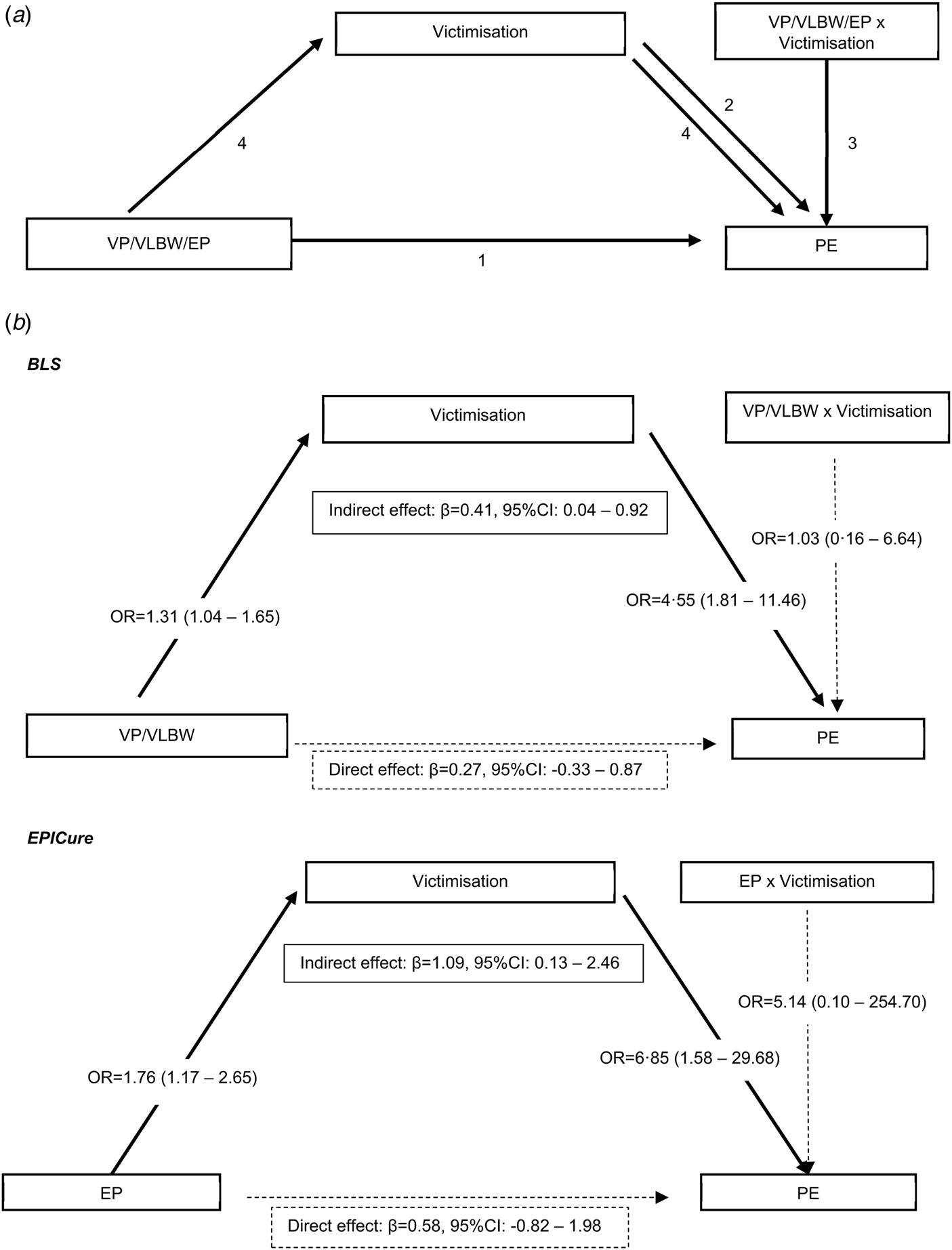
Four different models were specified: first, VP/VLBW/EP was specified as a predictor of PE to test the NM (Fig. 2a, path 1). Second, peer victimisation, as an index of trauma, was specified as a predictor of PE to test the TM (Fig. 2a, path 2). Finally, two alternative models to test the DRFM were proposed. Peer victimisation was specified as a predictor, with VP/VLBW/EP as a risk factor for either (a) being more exposed to and disproportionally affected by victimisation (interaction effect; Fig. 2a, path 3), or (b) being exposed more often to peer victimisation but not more vulnerable to the effects (mediation effect; Fig. 2a, path 4).
(a) Conceptual model showing the relationship between VP/VLBW/EP, trauma and PE. Pathway 1 tests the NM pathway; pathway 2 tests the TM pathway; pathway 3 tests the DRFM pathway (interaction effect) and pathway 4 tests the DRFM pathway (mediation effect). (b) Mediation model showing association between VP/VLBW/EP, victimisation and PE.

Simple and multiple logistic regression models (controlling for sex and SES) were computed to assess the first two models (NM and TM; Fig. 2a, paths 1 and 2). Additionally, interaction effects between VP/VLBW/EP and victimisation were also assessed to test the third model (DRFM; moderation effect, Fig. 2a, path 3), with the Firth-type penalised likelihood approach used in EPICure due to small data sets (Heinze, Reference Heinze2009). Finally, the RMediation package was used to test the mediation interpretation of the DRFM (Fig. 2a, path 4).
Missing data
The prevalence of missing data was 9.8% in the BLS and 19% in EPICure. Multiple imputation was carried out in R using multivariate imputation by chained equations (MICE), with 40 iterations as recommended to improve power (Graham, Olchowski, & Gilreath, Reference Graham, Olchowski and Gilreath2007). Results from the imputed data set are presented here and results from the complete case analysis are reported as a sensitivity analysis.
Results
Sample characteristics
Drop-out analyses have been described previously, with those dropping out more likely to be from lower SES, to have had more behavioural problems and neurodevelopmental impairment (Linsell, Reference Linsell2017; Madzwamuse et al., Reference Madzwamuse, Baumann, Jaekel, Bartmann and Wolke2015).
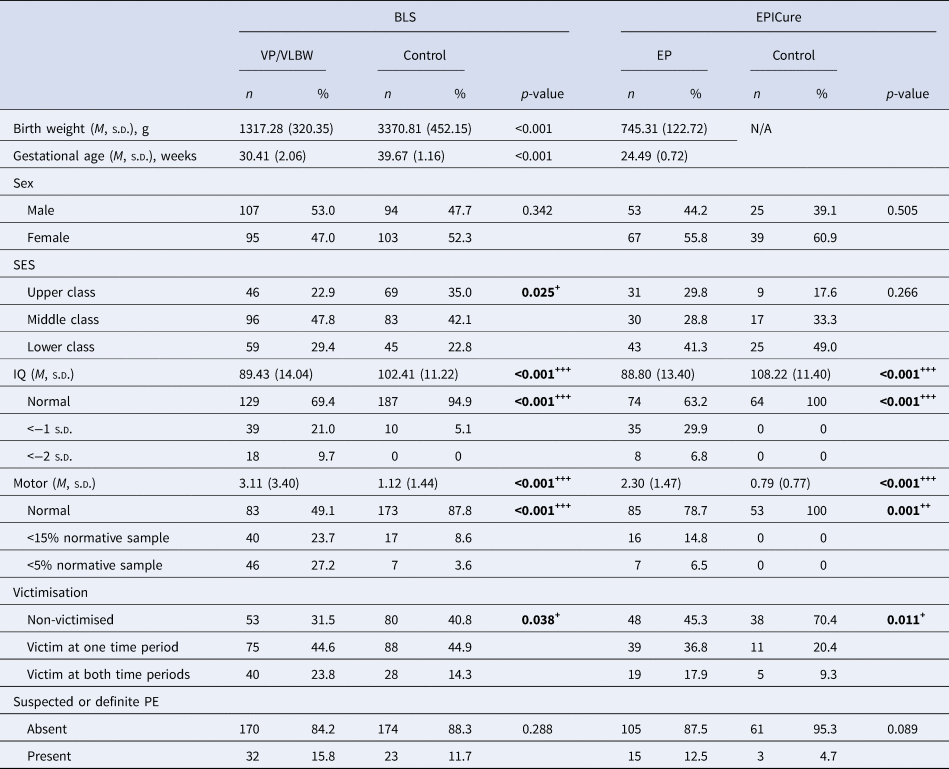
Descriptive statistics for variables in both samples are shown in Table 1. Both BLS and EPICure cohorts had similar distribution of male and female participants. However, the BLS preterm-born children were more likely to be of lower SES (29.4%) than term born controls (22.8%). Both VP/VLBW children and EP children were more likely to be victimised in both childhood and adolescence (23.8%, 17.9%) compared to term born controls (14.3%, 9.3%). The rates of PE were 13.8% for BLS and 9.8% for EPICure, with no significant differences between VP/VLBW/EP and controls in either cohort.
Sample characteristics of BLS and EPICure

N/A – not assessed – controls were only recruited at 6 years, therefore no perinatal data are available.
+<0.05, ++<0.01, +++<0.001.
In both cohorts, VP/VLBW/EP children had more neurodevelopmental deficits at age 6, as demonstrated by lower scores on IQ and motor tests than term-born controls (Table 1).
Model testing
VP/VLBW/EP and PE (NM)
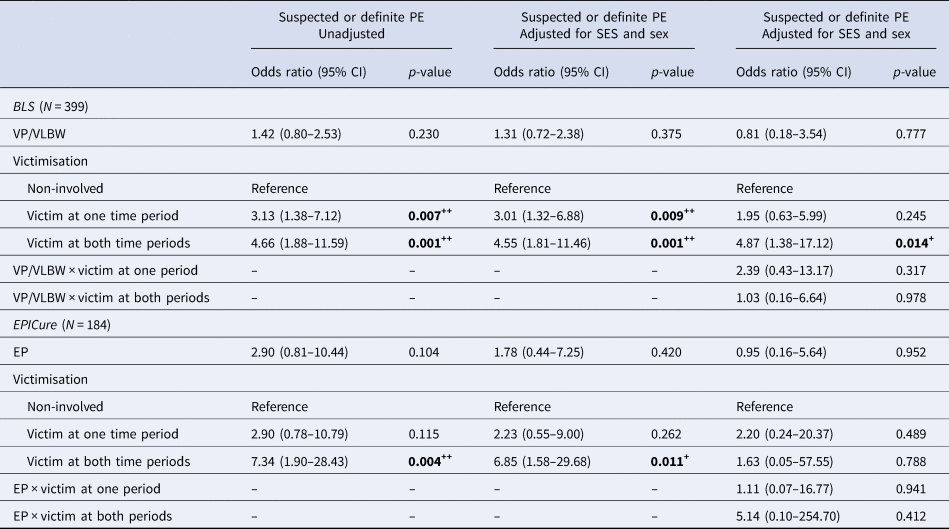
Pooled results from logistic regression models after imputation are shown in Table 2. VP/VLBW/EP was not a significant predictor of PE in either cohort.
Simple and multiple logistic regression models showing the effects of VP/VLBW/EP and victimisation on PE as well as showing the interaction between VP/VLBW/EP and victimisation

+<0.05, ++<0.01.
Peer victimisation and PE (TM)
Being victimised at both time periods was a significant predictor of PE in both BLS and EPICure cohorts and remained significant after adjustment for sex and SES. Being victimised at one time period also predicted PE but only in BLS, which showed an increased risk of PE with increased exposure (4.55 odds if victimised at both time periods v. 3.01 odds if victimised at one time period only) (Table 2).
VP/VLBW/EP, peer victimisation and PE (DRFM)
Interaction: No interaction effect between VP/VLBW/EP and victimisation was found in predicting PE in either cohort (Table 2).
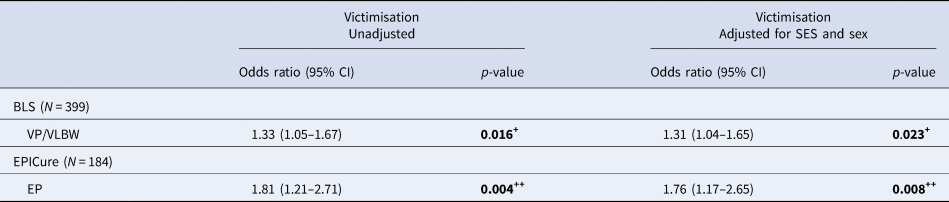
Mediation: In the BLS cohort, being born VP/VLBW increased risk of being victimised even after controlling for covariates in the ordinal logistic regression model (Table 3). Victimisation explained 8% of the variance in PE. A significant mediation path was found between VP/VLBW and PE via victimisation: β = 0.41, 95% confidence interval (CI) 0.04–0.92, but no significant direct effect was found: β = 0.27, 95% CI −0.33 to 0.87 (see Fig. 2b).
Simple and multiple ordinal logistic regression model showing the effects of VP/VLBW/EP on victimisation

+<0.05, ++<0.01.
In the EPICure cohort, EP predicted victimisation in the adjusted ordinal logistic regression model (Table 3). Victimisation explained 21% of the variance in PE. A significant mediation path was also found: β = 1.09, 95% CI 0.13–2.46. No significant direct effect was found: β = 0.58, 95% CI −0.82 to 1.98 (see Fig. 2b).
Sensitivity analysis
The analyses were repeated using complete cases from both cohorts. There were no differences in the pattern or magnitude of effects reported above. Detailed outputs are presented in online supplementary materials (Tables S1 and S2, Fig. S1).
Discussion
This analysis of two birth cohorts found that peer victimisation in middle childhood – regardless of birth weight or gestational age –increased the risk of PE in adulthood, at both 19 and 26 years. Preterm birth and associated neurodevelopmental risk did not have a direct effect on PE in either cohort. Test of mediation according to current statistical recommendations (Jaekel, Baumann, Bartmann, & Wolke, Reference Jaekel, Baumann, Bartmann and Wolke2018; Kenny & Judd, Reference Kenny and Judd2014; Rucker, Preacher, Tormala, & Petty, Reference Rucker, Preacher, Tormala and Petty2011) did show an indirect effect of VP/VLBW/EP on PE through increasing children's risk of being victimised more often by peers. This was shown in both the BLS and EPICure samples. Preterm children were not more vulnerable to the effects of victimisation; rather, they were more likely to be victimised. In sum, these findings support both the TM and DRFM, but no support was found for the NM.
The effect of peer victimisation on PE is consistent with previous research (Croft et al., Reference Croft, Heron, Teufel, Cannon, Wolke, Thompson and Zammit2018; Fisher et al., Reference Fisher, Schreier, Zammit, Maughan, Munafò, Lewis and Wolke2013; Wolke et al., Reference Wolke, Lereya, Fisher, Lewis and Zammit2014) with bullying at two time periods, or chronic bullying, having almost twice as much impact as bullying at one time period only. Although chronic bullying increased risk of PE in both cohorts, only the BLS study showed a risk of PE with victimisation at one time only. One explanation could be that the prevalence of PE at 26 years was higher than in EPICure at 19 years, which combined with the smaller sample size and higher dropout rates, may have contributed to the sample not having enough power to detect the effect of victimisation at one time period.
It is surprising that no support was found for the NM, which proposes a direct effect of neurodevelopmental risks on psychosis. The prevalence of PE was not significantly raised in the VP/VLBW/EP group – a population with a high prevalence of neurodevelopmental deficits as shown previously (de Kieviet et al., Reference de Kieviet, Zoetebier, van Elburg, Vermeulen and Oosterlaan2012) and in this study (e.g. IQ and motor deficits in childhood). It contradicts a previous large registry study which found prematurity as a risk factor for psychosis. The prevalence of psychosis in the preterm population may be an overestimate in registry studies, as they are more often in contact with professionals due to pre-existing health conditions and may thus be diagnosed more often (Nosarti et al., Reference Nosarti, Reichenberg, Murray, Cnattingius, Lambe, Yin and Hultman2012). Another explanation could be that previous studies examined psychotic disorders rather than PE, and the majority of people with PE do not go on to develop schizophrenia (Zammit et al., Reference Zammit, Kounali, Cannon, David, Gunnell, Heron and Lewis2013). However, we still found support for the TM, and we would have expected to find support for NM given the VP/VLBW/EP population represents an extreme group with widespread neurodevelopmental impairment.
The finding that preterm born children at high risk for neurodevelopmental impairments were bullied more often is consistent with previous longitudinal studies (Wolke et al., Reference Wolke, Baumann, Strauss, Johnson and Marlow2015) and supports the DRFM of psychosis, which proposes an indirect effect of neurodevelopmental risks on psychosis (Murray & Fearon, Reference Murray and Fearon1999). However, these children were not more vulnerable to the effects of trauma, contradicting previous research that showed extremely low birth weight born adults to be more vulnerable to childhood adversities in the development of depression and anxiety (Van Lieshout et al., Reference Van Lieshout, Boyle, Favotto, Krzeczkowski, Savoy, Saigal and Schmidt2018). This study found that peer victimisation increases the risk of PE equally for all children – however those with neurodevelopmental difficulties such as the preterm population are at increased risk of being exposed to peer bullying more often. Bullying is seen as a strategic way of achieving social dominance and those who are seen as vulnerable or are socially marginalised are likely targets of bullies (Juvonen, Graham, & Schuster, Reference Juvonen, Graham and Schuster2003). Preterm-born children have worse physical health, poorer cognitive and social skills, and have fewer friends to defend them (Allotey et al., Reference Allotey, Zamora, Cheong-See, Kalidindi, Arroyo-Manzano, Asztalos and Thangaratinam2018). Thus they are easy targets for bullies with low risk of retaliation.
Strengths and limitations
This is the first study to test three different theories of psychosis using four clearly defined models in two cohorts from two countries (Germany and UK). Peer victimisation was assessed repeatedly in both studies and the same measure for PE was used. Both studies also used the same measures of IQ and similar measures of motor impairment. Furthermore, the inclusion of VP/VLBW/EP children provided a naturalistic experiment to study the different models of psychosis as they are at high risk of neurodevelopmental deficits; thus this population acted as a proxy for testing the NM.
There are some limitations as well. First, it is inevitable in studies over 26 years that there is drop-out; those who dropped out were more likely to be socially disadvantaged and have neurodevelopmental deficits (Linsell, Reference Linsell2017; Madzwamuse et al., Reference Madzwamuse, Baumann, Jaekel, Bartmann and Wolke2015). However, there is some evidence from simulations of the effects of selective dropout that loss to follow-up may not reduce the validity of predicting outcomes in longitudinal studies (Wolke et al., Reference Wolke, Waylen, Samara, Steer, Goodman, Ford and Lamberts2009). Although there might still be a possibility of bias from reduced power due to a loss in follow-up, and there may be an association between social disadvantages and PE (Morgan et al., Reference Morgan, Fisher, Hutchinson, Kirkbride, Craig, Morgan and Fearon2009). Attempts to mitigate bias were made by using multiple imputation, and a sensitivity analysis was carried out comparing results after imputation with complete case analyses. Nonetheless, the wide CI in the EPICure cohort when testing interaction suggests the sample may have been underpowered to robustly test this pathway. Second, victimisation experiences were assessed by just one item from the SDQ in EPICure. Despite this, there was still a strong effect of victimisation on PE in both samples, which adds to the generalisability of the finding that peer victimisation is consistently associated with PE despite differences in measures (Day et al., Reference Day, Schmidt, Vaillancourt, Saigal, Boyle and Van Lieshout2016). Third, we did not examine other childhood adversities apart from bullying. There is evidence that trauma from caregivers (physical and sexual abuse, neglect) are also associated with increased risk of psychosis (Croft et al., Reference Croft, Heron, Teufel, Cannon, Wolke, Thompson and Zammit2018; Varese et al., Reference Varese, Smeets, Drukker, Lieverse, Lataster, Viechtbauer and Bentall2012). Finally, genetic factors were not examined. However, a previous study which controlled for genetic risks for schizophrenia found no change in the effects of victimisation on psychosis (Croft et al., Reference Croft, Heron, Teufel, Cannon, Wolke, Thompson and Zammit2018). Furthermore, the VP/VLBW/EP population was used as a proxy for a range of neurodevelopmental deficits as a whole, as they are more likely to have had intrauterine infections (Kemp, Reference Kemp2014) as well as specific deficits in IQ, behavioural problems and brain abnormalities.
Conclusion
When testing the three developmental models against each other, the data consistently support the TM and the DRFM in explaining the development of PE. The study provides further evidence that peer victimisation is a risk factor for PE in adulthood, and this risk is the same for children with or without neurodevelopmental deficits. Those with increased neurodevelopmental risk are not more vulnerable to the impact of bullying, but they are more likely to be bullied (Øksendal, Brandlistuen, Holte, & Wang, Reference Øksendal, Brandlistuen, Holte and Wang2019), which increases their risk of PE. One plausible mechanism is that persistent bullying can lead to feelings of social defeat, which has been shown to disrupt cortisol levels, inflammatory response and the hypothalamic–pituitary–adrenal axis in both animal and human studies (Selten, van der Ven, Rutten, & Cantor-Graae, Reference Selten, van der Ven, Rutten and Cantor-Graae2013). Furthermore, prolonged social defeat from victimisation can also lead to biased and hostile interpretation of social situations and the intention of others (Guy et al., Reference Guy, Lee and Wolke2017). We do not suggest there is a unified theory of psychosis, or that these models are mutually exclusive, as there are other theories of psychosis such as the stress-diathesis model which have received support. However, the study suggests that the risk of PE may be partially modifiable in childhood through effective anti-bullying strategies. Preterm-born children are more likely to be targets of bullying and this could be prevented. Furthermore, mental health services should routinely ask about histories of childhood trauma, particularly for people with psychosis, as it is a significant risk factor but is also one that is not frequently identified by health care professionals (Read, Harper, Tucker, & Kennedy, Reference Read, Harper, Tucker and Kennedy2018a, Reference Read, Harper, Tucker and Kennedy2018b).
Supplementary material
The supplementary material for this article can be found at https://doi.org/10.1017/S0033291719003349.
Data
Ms Liu and Prof Wolke had full access to all of the data in the study and take responsibility for the integrity of the data and the accuracy of the data analysis.
Acknowledgements
The authors thank all current and former Bavarian Longitudinal Study and EPICure group members, paediatricians, psychologists and research nurses.
Author contributions
All authors contributed to the interpretation of the data and critical revision of the manuscript, and Profs Johnson, Bartmann, Marlow, Wolke and Dr O'Reilly further contributed to the acquisition of data.
Financial support
Ms Liu has a funded Ph.D. studentship by the Department of Psychology at the University of Warwick. BLS received funding from the German Federal Ministry of Education and Science (grants PKE24, JUG14, 01EP9504 and 01ER0801), and EPICure from Medical Research Council Programme (grant ref no. MR/J01107X/1). Prof Marlow receives part funding from the Department of Health's NIHR Biomedical Research Centre's funding scheme at UCLH/UCL, and Prof Wolke, Prof Bartmann, Dr Mendonca and Prof Johnson from European Union's Horizon 2020 research and innovation programme (RECAP-Preterm) under grant agreement: 733280.