





Introduction
Stunting and obesity in the US paediatric refugee population
Refugee children arrive in the United States (US) having experienced a variety of migration stressors including trauma, family separation, infectious disease, environmental toxin exposure and nutritional deficits(Reference Dawson-Hahn, Pak-Gorstein and Hoopes1–Reference Polonsky, Ronsse and Ciglenecki4). Poor health in the paediatric refugee population has been well-described with some common issues upon arrival including vitamin deficiencies and malnutrition(Reference Dawson-Hahn, Pak-Gorstein and Hoopes1,Reference Shah, Suchdev and Mitchell5,Reference Sandell, Baker and Maccarone6) . These pre-resettlement experiences influence refugee children’s nutritional status upon arrival to the US(Reference Dawson-Hahn, Pak-Gorstein and Hoopes1,Reference Gushulak and MacPherson7) . Mobile populations including refugee populations reflect the health characteristics of their original environment, bringing these traits with them to their new location(Reference Gushulak and MacPherson7). After resettlement in the US, ill health often continues with a growing body of evidence suggesting that a considerable proportion of paediatric refugees become overweight and/or obese(Reference Alsubhi, Goldthorpe and Epton8–Reference Shapiro, Datto and Hossain10). Research indicates a combination of factors influence these health disparities including refugee genetic and epigenetic factors post-resettlement(Reference Gushulak and MacPherson7,Reference Alsubhi, Goldthorpe and Epton8) .
Stunting is the most prevalent form of childhood malnutrition and has been described as the best overall indicator of a child’s wellbeing and an accurate reflection of social inequalities(Reference de Onis and Branca11–Reference De Sanctis, Soliman and Alaaraj13). The condition can result from inadequate food intake, poor nutrient content of food and repeated infections(Reference Engidaw and Gebremariam14). One study comparing young refugee children with US low-income children found stunting was significantly more prevalent in refugees than US low-income children with 21·3 % of refugee children being stunted and 5·5 % of low-income US children being stunted(Reference Dawson-Hahn, Pak-Gorstein and Matheson15). Overall, approximately 3·4 % of children under 5 years are affected by stunting in the US(16). Studies have previously demonstrated significant frequencies of stunting in refugee children on first arrival in the US(Reference Shah, Suchdev and Mitchell5). Stunting can have both immediate (e.g. poor child development) and lasting consequences including increased risk of overweight status and associated chronic disease morbidity and mortality(Reference Campisi, Cherian and Bhutta12,Reference De Sanctis, Soliman and Alaaraj13,Reference Popkih, Richards and Mohtiero17) .
Stunted children are at increased risk for obesity resulting from increased susceptibility to accumulate fat, lower fat oxidation and lower energy expenditure(Reference De Sanctis, Soliman and Alaaraj13). Social environmental influences can also impact obesity rates among certain populations. Currently, low- and middle-income countries where refugees live prior to resettlement are undergoing nutrition transitions, potentially influencing weight near time of migration(Reference Choi18). In the US, obesity is common among children and increases the risk for poor health, especially when it continues into adulthood(19). Those with obesity are at increased risk for health conditions such as type 2 diabetes, heart disease and some cancers(20). Refugee children face a complex array of social factors including acculturation, socioeconomic, environmental, cognitive and family influences that impact obesity-related behaviours including less activity and more unhealthy eating habits after resettlement(Reference Alsubhi, Goldthorpe and Epton8).
Considering the long-term implications of obesity, early diagnosis and intervention becomes imperative. The American Academy of Pediatrics guidelines advocate for a patient-centred approach and highlight the need to consider a child’s individual health, surrounding environment and all potential social determinants of health(Reference Hampl, Hassink and Skinner21). This research supports the need for this all-encompassing clinical lens while also noting additional considerations needed for refugee children specifically(Reference Hampl, Hassink and Skinner21).
Local context
In the past decade, Syracuse, New York (NY), located in Onondaga County, has welcomed over 7000 refugees from 24 different countries. Between 2016 and 2020, 13·4 % of the city’s residents were foreign-born(22–24). Redlining is the practice of denying people access to credit despite meeting qualifications, in order to restrict them from living in a certain area. Historically, redlining was practised mainly in urban, black-populated neighbourhoods. A history of redlining and segregation in Syracuse contributes to socioeconomic and health inequities among residents today, with previously redlined areas in Syracuse corresponding to the city’s current highest rates of poverty and lowest median income levels (CNY Vitals, unpublished results, 2018)(Reference Kneebone and Holmes25). These city postal codes are where most refugees are resettled, potentially contributing to a worsening of health as poor socioeconomic environments have been linked to adverse health outcomes(Reference Pickett26).
The Pediatric International Health Clinic serves a diverse population of refugees and immigrants resettled in Syracuse, NY. A previous study of paediatric patients at this clinic revealed paediatric refugees in this population had a significant weight gain within three years of arrival in the US, with a change in BMI percentile from the 47th to the 63rd percentile(Reference Olson, Kurland and Rosenbaum27). This paper aims to further explore weight gain and stunting in the Syracuse, NY paediatric refugee population. We hypothesise that the paediatric refugee population seen in our clinic continues to experience weight gain upon arrival in the US and that those with stunting experience earlier onset of weight gain.
Methods
Participants and data collection
Data were collected in late 2019 and updated on September 1st, 2020 through a combination of chart review and electronic data abstraction for refugee patients (n 941) with established care in the Pediatric International Health Clinic between May 31, 2012 and June 1, 2017; follow-up of the existing cohort continued through August 2020. Authors had access to identifying information of individual participants during and after data collection. Within 90 d of arrival in the US, all refugees, including children, usually undergo an initial health screening(Reference Olson, Kurland and Rosenbaum27,28) . This visit includes a review of international records, previous vaccinations, a thorough medical history and physical exam and routine laboratory studies(28). Data collected at baseline included height and weight along with date of birth, sex, age, date of visit and country of origin. Serial heights and weights were extracted from the medical record at each subsequent clinic visit after arrival to create a longitudinal database to assess BMI trajectory based on Centers for Disease Control and Prevention BMI percentiles in the total population. Criteria for inclusion in all analyses were age greater than 2 years at arrival in the US and at least 2 clinic visits before aging out of the paediatric clinic at 20 years of age.
Measures
The variables of interest in this study include serial height in centimetres, weight in kilograms and the corresponding BMI kg/m2 and BMI percentiles. Both BMI variables were calculated using Centers for Disease Control and Prevention software which accounted for the age and sex of the child(29). The prevalence of obesity among those 2–19 years of age was defined as a BMI ≥ 95th percentile, while overweight was defined as a BMI ≥ the 85th percentile but < the 95th percentile. Underweight included those with a BMI percentile < the 5th percentile; a normal BMI included those between the 5 % and 85th percentiles(30). Stunting was defined based on the WHO definition as a height-for-age Z score of less than –2·0(31) (WHO infant and young child feeding counselling: an integrated course: trainer’s guide). Stunting was classed as present if observed at either the baseline visit or visit 2. Stunting Z scores which accounted for age and gender were calculated using software from the Canadian Pediatric Endocrine Group(32). Stunting was categorical and coded as present or absent. The maximum duration of time in the US was calculated based on the difference in the last follow-up date and the initial visit date plus 14 weeks to allow for the resettlement logistics upon arrival. The maximum duration of time in the US was categorised in one-year intervals (i.e. <1, 1 to <2, 2 to <3, 3 to <4, 4 to <5 and five or more years) based on the available data. Country of origin was categorised into regions as follows: Central or West Africa, East Africa, Southeast Asia, the Middle East and Cuba or Europe (the generic other category).
Analysis
Analyses were undertaken using SPSS (IBM SPSS Statistics for Windows, version 28 (IBM Corp., Armonk N.Y., USA) and included frequencies and proportions for categorical variables (e.g. sex) as well as means, sd, medians and ranges for continuous variables (e.g. age). Chi-square tests or independent t-tests/one-way ANOVA were used to assess differences across regions of origin for refugees. Stratification by stunting (present/absent) was undertaken to evaluate potential differences in the BMI percentile for participants in both cross-sectional and longitudinal analyses. Changes in BMI percentile across time were evaluated using linear mixed modelling with control for sex, initial stunting, country of origin, maximum duration in the US (categorical) and age in years at each visit. Sex, initial stunting, country of origin and maximum duration in the US were fixed effects while age was treated as a time-varying random effect. In the mixed model, the Middle East was used as the referent area for the region of origin while the referent category for the maximum duration of residency was less than 1 year in the US. Estimated BMI percentiles and 95 % CI are presented to summarise the mixed model findings for the categorical covariables assessed.
Results
A total of 941 refugee patients had data extracted via chart review. Seventeen percent of the total group (n 159) had only one clinic visit and appear in cross-sectional summaries of the total group at baseline only. An additional 7·8 % of participants (n 73) were less than age 2 at the time of arrival, so were not included in the longitudinal assessments of BMI change over time; these children were, however, included in selected cross-sectional summaries at baseline (e.g. stunting) and in the last follow-up evaluation of BMI if they were greater than 2 years of age at that visit. Overall, n 715 refugee patients had complete data and were included in all analyses as they were greater than 2 years of age at arrival in the US and had at least 2 clinic visits.
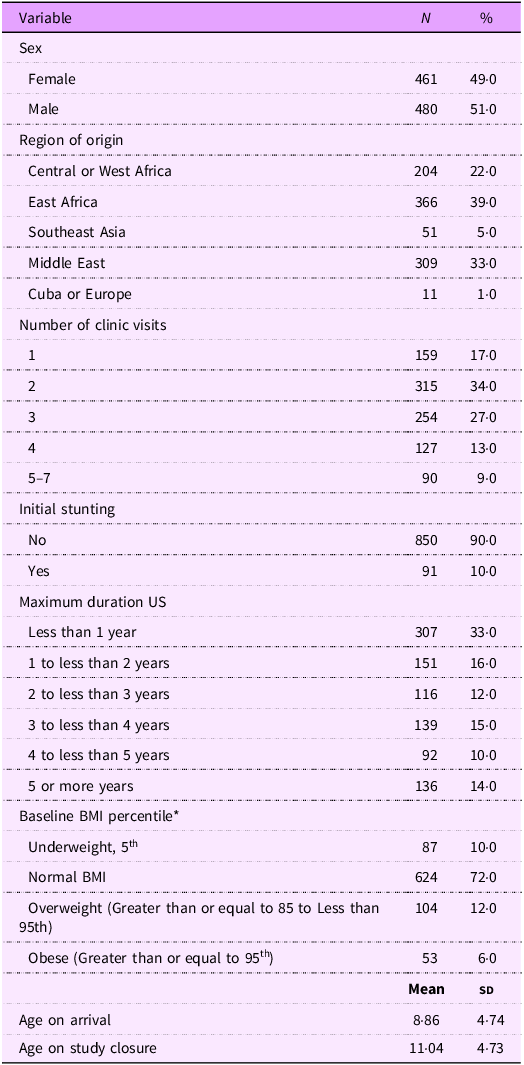
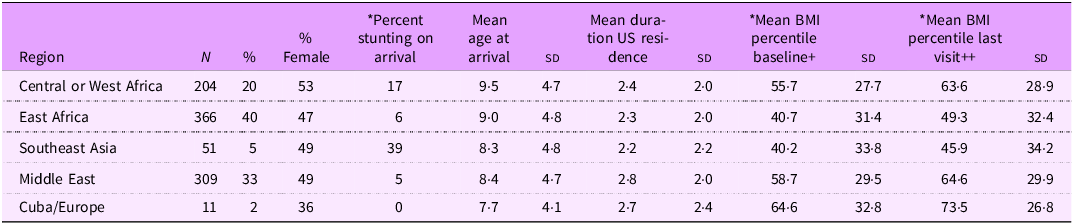
As shown in Table 1, females comprised 49 % of all participants. The mean age at arrival was 8·9 years (sd of 4·7) with a range of about 5 months to 18 plus years for the total cohort. Thirty-nine percent of the 941 paediatric refugees in our study originated from East Africa (primarily Somalia), followed by 33 % from the Middle East (primarily Syria, Iraq, Afghanistan) and 22 % from Central or West Africa (mostly Congo and Sudan). Participants from Southeast Asia were primarily from Myanmar and Bhutan. At their last follow-up, 33 % of study participants had lived in the US for <1 year, while 24 % of the group had been in the US for four or more years; the maximum duration of time in the US was just under 8 years. Refugees from the Middle East had the longest mean duration of residence in the US (Table 2).
Demographics and study characteristics, N 941

Table 1. Long description
The table presents demographic and study characteristics of 941 participants. It has 12 rows and 4 columns. The columns are labeled Variable, N, and %. The rows are grouped into categories: Sex, Region of origin, Number of clinic visits, Initial stunting, Maximum duration US, and Baseline BMI percentile. Each row lists the variable name, the number of participants (N), and the percentage (%). For example, under Sex, there are 461 females (49%) and 480 males (51%). Under Region of origin, East Africa has the highest percentage at 39%, while Cuba or Europe has the lowest at 1%. The table also includes mean and standard deviation for Age on arrival and Age on study closure.
* Participants less than 2 years of age not included (n 73).
Demographics of paediatric refugee study population by region (n 941)

Table 2. Long description
A table comparing demographic data of pediatric refugees by region. The table has 6 rows and 10 columns. Column headers are Region, N, percent, percent Female, Percent stunting on arrival, Mean age at arrival, Mean duration US residence, Mean BMI percentile baseline, and Mean BMI percentile last visit. Row labels are Central or West Africa, East Africa, Southeast Asia, Middle East, and Cuba/Europe. Row 1: Central or West Africa, 204, 20 percent, 53 percent Female, 17 percent stunting on arrival, 9.5 Mean age at arrival, 4.7 Mean duration US residence, 2.0 Mean BMI percentile baseline, 55.7 Mean BMI percentile last visit. Row 2: East Africa, 366, 40 percent, 47 percent Female, 6 percent stunting on arrival, 9.0 Mean age at arrival, 4.8 Mean duration US residence, 2.0 Mean BMI percentile baseline, 40.7 Mean BMI percentile last visit. Row 3: Southeast Asia, 51, 5 percent, 49 percent Female, 39 percent stunting on arrival, 8.3 Mean age at arrival, 4.8 Mean duration US residence, 2.2 Mean BMI percentile baseline, 40.2 Mean BMI percentile last visit. Row 4: Middle East, 309, 33 percent, 49 percent Female, 5 percent stunting on arrival, 8.4 Mean age at arrival, 4.7 Mean duration US residence, 2.0 Mean BMI percentile baseline, 58.7 Mean BMI percentile last visit. Row 5: Cuba/Europe, 11, 2 percent, 36 percent Female, 0 percent stunting on arrival, 7.7 Mean age at arrival, 4.1 Mean duration US residence, 2.4 Mean BMI percentile baseline, 64.6 Mean BMI percentile last visit.
* p < 0·001 across groups in chi-square test or one-way ANOVA.
+ n 868.
++ n 902.
The mean BMI percentile for the total cohort at visit one was 50·1 %, with a mean of 57·6 % at the end of the study for those with at least two visits. Eighteen percent (157/867) of refugees over the age of 2 years were overweight or obese at their initial clinic visit based on their Centers for Disease Control and Prevention BMI percentile. By the second clinic visit, the prevalence of overweight and obesity had increased to 27 % (206/754), with a further increase to 32 % by the third clinic visit (148/455). Both the baseline and the follow-up mean Centers for Disease Control and Prevention BMI percentiles varied significantly across regions of origin (Table 2) with children from Southeast Asia and East Africa having the lowest BMI percentiles at both baseline and their last follow-up visit.
Stunting at visit one or two was observed in 9·7 % (n 91) of the total study group, and, as shown in Table 2, was more prevalent in the children from southeast Asia and Central or West Africa (p < 0·001 across all geographic regions). Although refugees from East Africa tended to have lower mean BMI percentiles, stunting was only observed in 6 % of that group upon arrival.
The mean frequency of obesity in our total refugee study population after five or more years of residence in the US was 24 % (n 31/129) as compared to 2·7 % (8/292) for those refugees who had been in the US for less than one year. The overweight prevalence at < one year of residence was 13 % (38/292), while after 5 or more years in the US, it was 19·4 % (25/129), similar to the prevalence of obesity in the US among those 2 to 19 years of age of 19·7 %(19).
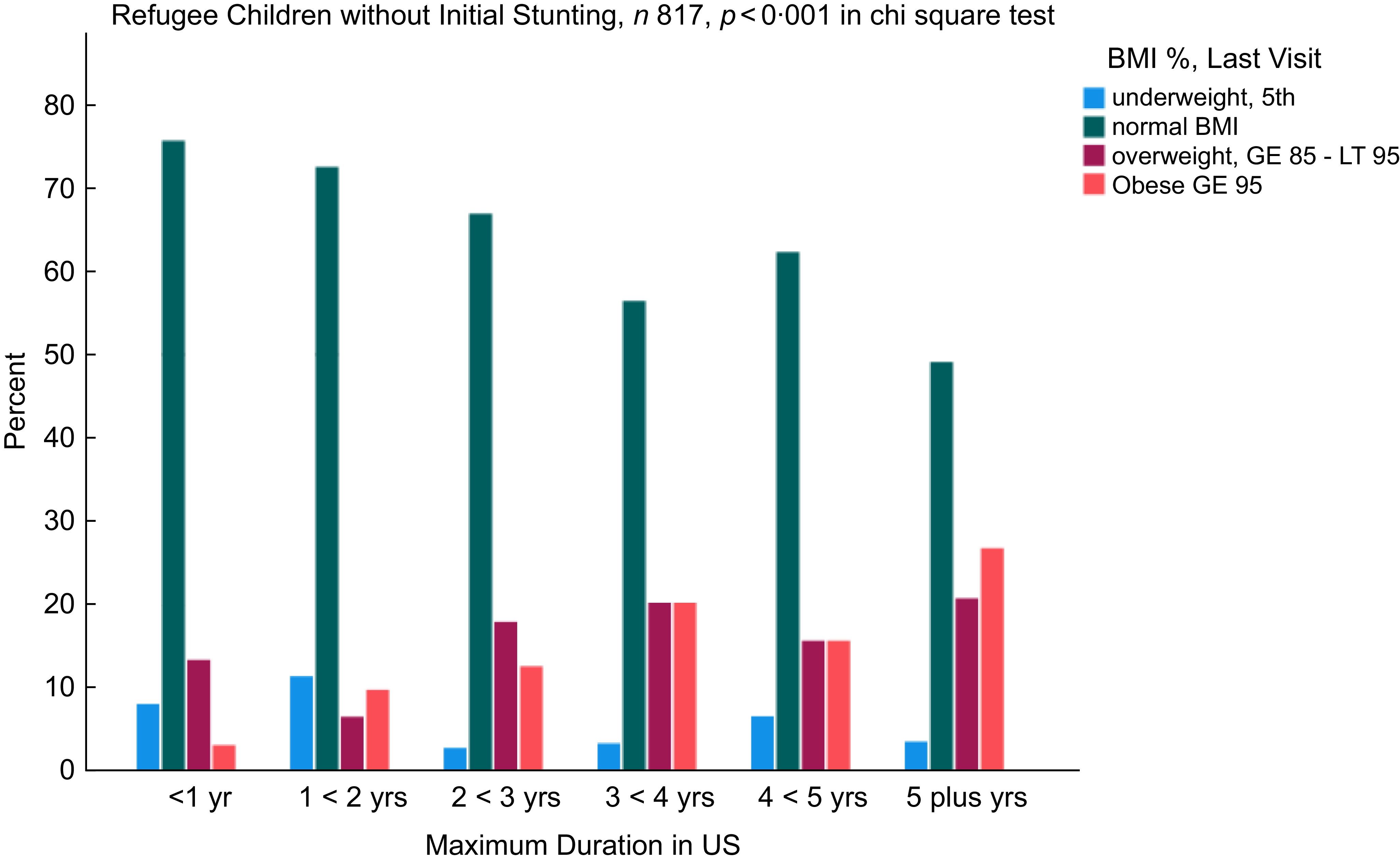
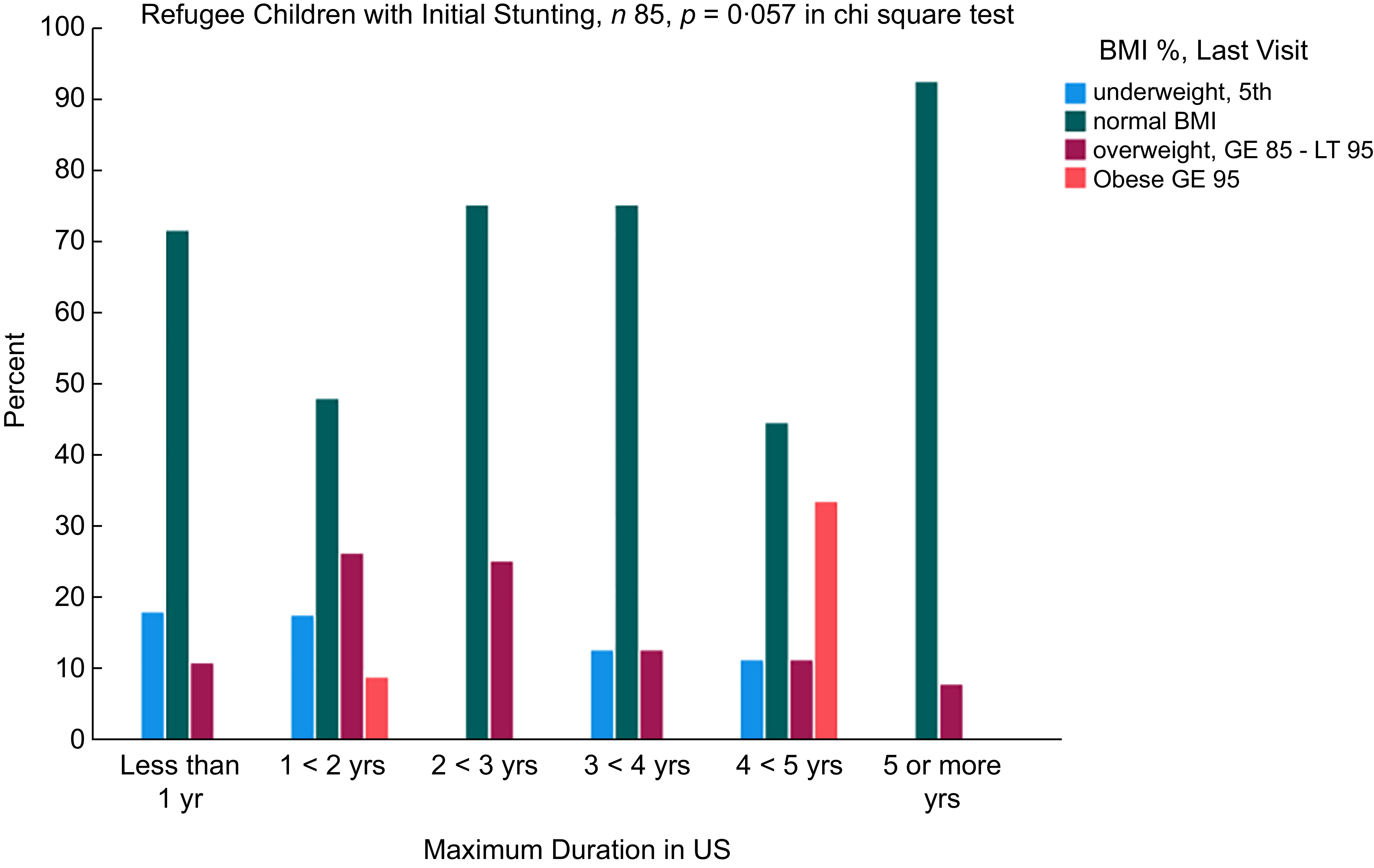
Figures 1 and 2 show the prevalence of underweight, normal weight, overweight and obesity by duration of time in the US with stratification for the absence/presence of initial stunting. Refugees without stunting appear to have a gradual increase in the prevalence of overweight and obesity (p < 0·001 across categories), whereas children with stunting appear to gain weight within the first year or two of US residency (p = 0·057 across categories). For example, among those without stunting, the prevalence of overweight increased from 13 % at the first visit to 21 % at 5 or more years in the US while the obesity prevalence increased from 3 % to almost 27 % at 5 or more years. Among the children with stunting, the prevalence of overweight upon arrival was around 11 % and increased to 26 % within 1 to <2 years of arrival. None of the children with stunting were obese upon arrival but the prevalence increased to just under 9 % within 1 to <2 years of arrival. There was a spike in obesity among those with stunting at 4 to 5 years post-arrival but there were too few participants with initial stunting in the later time periods for a more detailed assessment.
Children without initial stunting using Centers for Disease Control and Prevention BMI percentiles at last measurement (n 817). <1 n 264, 1 < 2 n 124; 2 < 3 n 112; 3 < 4 n 124; 4 < 5 n 77; 5 + n 116.

Children with initial stunting using Centers for Disease Control and Prevention BMI percentiles at last visit (n 85). <1 n 28; 1 < 2 n 23; 2 < 3 n 4; 3 < 4 n 8; 4 < 5 n 9; 5 + n 13.

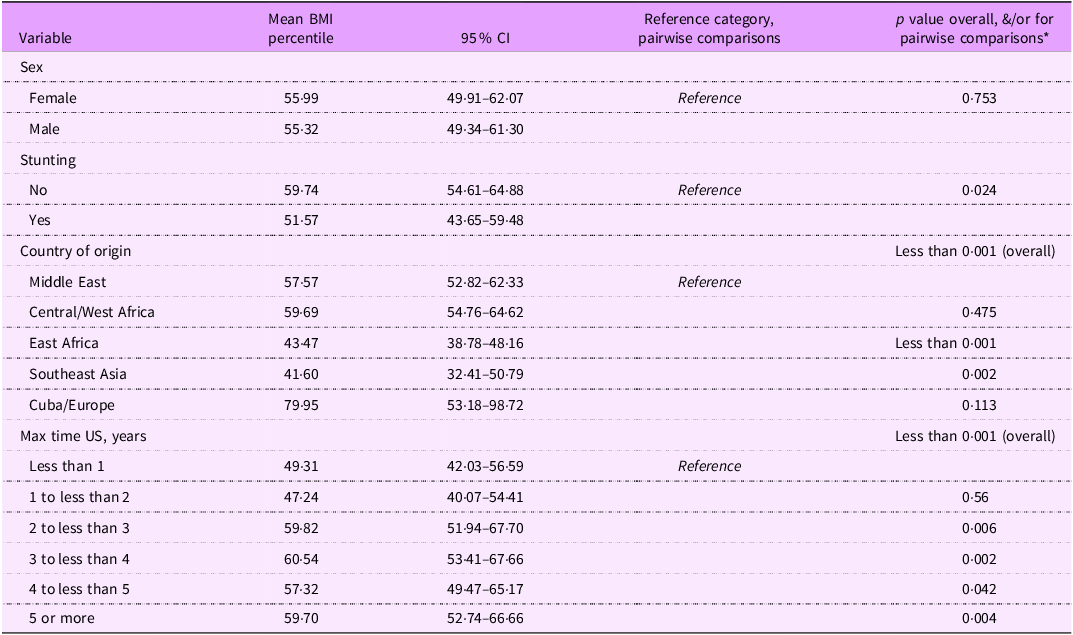
Adjusted BMI percentile estimates and 95 % CI from the mixed modelling appear in Table 3. In the fully adjusted model which also included age as a time-varying covariate, both initial stunting and maximum time spent in the US were significantly associated with longitudinal changes in the Centers for Disease Control and Prevention BMI percentile. Country of origin also was associated with significant differences in BMI percentiles whereas sex was not a predictor. Pairwise comparisons within the country of origin indicated that East Africans and Southeast Asian refugee children remained at significantly lower BMI percentiles than individuals from the Middle East, the reference group. While the BMI percentiles for children who were in the US for 1 to <2 years did not differ significantly from those who were here for less than one year, BMI percentiles for each of the subsequent years of residency (2 and greater) were significantly greater than the baseline BMI percentile. Refugees with stunting had significantly lower average BMI percentiles than those without baseline stunting.
Mixed model results evaluating predictors of Centers for Disease Control and Prevention BMI percentiles over time (n 715)

Table 3. Long description
A table comparing BMI percentiles across different variables. The table has 12 rows and 4 columns. Column headers are Variable, Mean BMI percentile, 95% CI, and p value overall, &/or for pairwise comparisons. Row labels include Sex, Stunting, Country of origin, and Max time in US. Row 1: Sex, Female, 55-99, 49-91-62-07, Reference, 0-753. Row 2: Sex, Male, 55-32, 49-34-61-30. Row 3: Stunting, No, 59-74, 54-61-64-88, Reference, 0-024. Row 4: Stunting, Yes, 51-57, 43-65-59-48. Row 5: Country of origin, Middle East, 57-57, 52-82-62-33, Reference, <0-001 (overall). Row 6: Country of origin, Central/West Africa, 59-69, 54-76-64-62, 0-475. Row 7: Country of origin, East Africa, 43-47, 38-78-48-16, <0-001. Row 8: Country of origin, Southeast Asia, 41-60, 32-41-50-79, 0-002. Row 9: Country of origin, Cuba/Europe, 79-95, 53-18-98-72, 0-113. Row 10: Max time in US, Less than 1, 49-31, 42-03-56-59, Reference, <0-001 (overall). Row 11: Max time in US, 1 to < 2, 47-24, 40-07-54-41, 0-56. Row 12: Max time in US, 2 to < 3, 59-82, 51-94-67-70, 0-006. Row 13: Max time in US, 3 to < 4, 60-54, 53-41-67-66, 0-002. Row 14: Max time in US, 4 to < 5, 57-32, 49-47-65-17, 0-042. Row 15: Max time in US, 5 or more, 59-70, 52-74-66-66, 0-004.
* Note: When only 2 categories, the overall and pairwise p values are the same.
Discussion
An increasing prevalence of overweight and obesity over the first few years of US residency was observed in our refugee population, within the total group and among those with and without initial stunting. Overweight and obesity were higher in our refugee population after 5 or more years of residence in the US than the prevalence in US children during a similar time period(19); stunting was also more prevalent than that seen in the general US population and similar to other refugee populations moving to the US(Reference Dawson-Hahn, Pak-Gorstein and Hoopes1,16) . Other studies have shown obesity to be a significant health disparity in the US refugee population, with refugees experiencing significant weight gain shortly after arrival in the US(Reference Sastre and Haldeman33–Reference Mulugeta, Glick and Min35). Considering the global obesity epidemic disproportionately affects refugees resettled in Western countries, and obesity increases risk for chronic disease and other morbidities and mortality, culturally appropriate obesity prevention strategies are important in health promotion among resettled refugees(Reference Rhodes, Chang and Percac-Lima34,Reference Field, Coakley and Must36) .
Although stunting was observed in 10 % of our refugee population, we found that stunting frequency varied by region in our study group, with higher frequencies in children from Southeast Asia (39 % upon arrival). These results differ from previous studies that found moderate levels of stunting among refugee children in Southeast Asia(Reference Praditsorn, Churak and Wimonpeerapattana37). Limited access to a variety of nutritious foods among people with limited resources has been cited as promoting stunting in the region(Reference Bloem, de Pee and Le Hop38). In addition, other studies found that the prevalence of childhood stunting in Sudan and Congo to be among the highest in the world(Reference Wogderes, Shibre and Zegeye39,Reference Kismul, Acharya and Mapatano40) . In our study, 17 % of children hailing from Central and West Africa were found to be stunted upon arrival.
We observed that refugees without stunting appeared to have had a more gradual increase in the prevalence of overweight and obesity, whereas children with stunting appeared to gain weight within the first year or two of US residency. Our subset of children with stunting was small however, and we were not able to draw firm conclusions about the role of stunting and weight gain. Only 13/85 refugees with initial stunting had a maximum duration of residence in the US of five or more years. As noted in the mixed modelling, stunting was a significant predictor of final BMI; those with stunting had lower BMIs at the final visit compared to those without stunting. Stunting has multiple implications for maintaining healthy weight. As noted in other studies, children with stunting may become obese more easily(Reference De Sanctis, Soliman and Alaaraj13,Reference Muhammad41) .
Both baseline and the follow-up mean Centers for Disease Control and Prevention BMI percentiles varied significantly across regions of origin in our study; regions with lower baseline values also had lower final visit values. These observations are similar to those reported by Dawson-Hahn et al, 2016 of refugees resettled in Washington state and Pennsylvania(Reference Dawson-Hahn, Pak-Gorstein and Matheson15). Previous research on immigrant populations has noted that place of origin influences differences in obesity between subgroups(Reference Choi18). Refugees from Cuba/Europe in our sample had the highest mean BMI percentile at both baseline and the last visit, potentially indicating higher risk of obesity in this subgroup. Choi and colleagues note that subgroup differences in overweight seen near migration could be due to developing countries’ nutrition transition(Reference Choi18).
The variation in BMI percentiles seen among individuals from East Africa and Southeast Asia when compared to those from the Middle East reference group could reflect the nutritional transition currently occurring in the Middle East, promoting higher BMI for individuals from this region(Reference Galal42). One study looking at Syrian refugee children pre-resettlement suggests effective pre-resettlement host community refugee assistance programmes and adequate population-level nutritional status of host communities could influence higher rates of overweight and obesity(Reference Pernitez-Agan, Wickramage and Yen43). The increase in BMI percentile over time is likely a result of US acculturation leading to a more sedentary lifestyle with unhealthy eating habits after resettlement(Reference Alsubhi, Goldthorpe and Epton8). The presence of initial stunting was also a significant predictor of BMI percentiles over time, with stunted individuals having a significantly lower BMI percentile at their last visit than those who were not stunted.
One of the limitations of this study is the fact that BMI measurements do not accurately predict adiposity in all children. This is especially the case with intermediate BMI categories and for Black, non-Hispanic children who are highly represented in our study(Reference Flegal, Ogden and Yanovski44). Moreover, we did not have information on the age of puberty in our refugee population. Pubertal onset differs by age, sex, adiposity and across populations and the income/development level of countries(Reference Proos and Gustafsson45). Although not a perfect measure, we employed country of origin in our analyses to account for population differences.
We ran BMI percentile change models using both Centers for Disease Control and Prevention and WHO growth standards since the refugees moved to the US but were predominantly from Africa, the Middle East and Asia. Resulting effect measures were similar for all variables in both models; we have shown our findings using the Centers for Disease Control and Prevention standards and not those using the WHO standards for BMI percentiles.
We used a mixed model methodology to allow for repeated measures with unequal clinic visit numbers among participants. As the dependent variable, BMI percentile and stunting were calculated using the refugee child’s age as part of the algorithm, and we were concerned about over-controlling for age in our model. For this reason, age was treated as a random effect and mixed models were run both with and without age. Minimal differences were observed across models but only results which included age as a time-varying random effect are shown in Table 3.
Additionally, we were unable to include those with only one visit and those less than 2 years of age at baseline in the longitudinal assessment; however, each group did appear in the appropriate baseline and follow-up cross-sectional summaries (total study size n 941). Nonetheless, the mixed modelling results were based on more than 700 refugee children. Lastly, the group with stunting was relatively small (n 85 in mixed models) which made it difficult to assess the growth trajectory among these refugees over the entire study period; in the chi-square test, many of the weight/duration of US residence categories included few or no participants. Even so, stunting was found to be a predictor of final BMI estimates in the mixed model results.
Factors influencing weight gain post-resettlement are complex with research indicating that a combination of elements related to changes in food intake and acculturation can influence diet during this time(Reference Alsubhi, Goldthorpe and Epton8). Specifically, language barriers, unfamiliarity with the US food environment and low post-resettlement socioeconomic status can all negatively influence refugees’ ability to purchase and prepare healthy foods, potentially contributing to obesity(Reference Alsubhi, Goldthorpe and Epton8). Consistent with American Academy of Pediatrics recommendations, obesity prevention and treatment should be family-centred, non-stigmatising and grounded in a chronic care model that takes into consideration the child’s household, access to food and activity spaces, and other social determinants of health(Reference Hampl, Hassink and Skinner21). Our results provide data supporting targeted interventions for obesity prevention among paediatric refugees based on region of origin and time spent in the US while interventions aimed at promoting healthy weight and development should support those who arrive with stunting as a means of increasing BMI to a healthy percentile. Paediatricians caring for refugee populations should incorporate refugee-specific contextual factors like geographic targeting when implementing nutritional programmes and addressing social inequalities for these vulnerable groups(Reference Kismul, Acharya and Mapatano40).
Conclusions
There are few studies looking at the relationship between stunting and weight gain post-resettlement among paediatric US refugee populations. This study expands on earlier research focused on paediatric obesity in our first cohort of refugees highlighting that stunting and obesity are distinct but connected predictors of future health concerns for paediatric refugees resettled in the US(Reference Olson, Kurland and Rosenbaum27). Although other studies have noted that children with stunting may more easily become obese, our models indicated that children with stunting upon arrival had lower BMIs at the final visit compared to those without stunting, even though an increase in the prevalence of overweight/obesity was observed early on in this subgroup. It is important to note that the social inequities, e.g. undernutrition and limited access to healthy foods, present during resettlement may persist for years in these populations post-resettlement. Therefore, prevention and education efforts should also share perspectives of these highly diverse refugee subgroups. This study is unique in that it reveals the variability in stunting and obesity results based on country of origin and points to the need for geographic targeting for nutritional programmes and additional considerations for American Academy of Pediatrics guidance aimed at combating both under- and over-nutrition alike. Early-life interventions focusing on maternal and child nutrition during critical growth periods and reducing social inequities are critical in supporting healthy development and reducing the risk of obesity.
Acknowledgements
None.
Authorship
MS: Writing – Original Draft, Writing – Review and Editing AA: Writing – Original Draft, Writing – Review and Editing PR: Conceptualisation, Formal Analysis, Visualisation, Writing – Original Draft, Writing – Review and Editing, Methodology AS: Conceptualisation, Writing – Review and Editing, Methodology CC: Conceptualisation, Project Administration, Writing – Review and Editing, Methodology, Supervision.
Financial support
The authors received no specific funding for this work.
Competing interests
None.
Ethical standards
This study was conducted according to the guidelines laid down in the Declaration of Helsinki, and all procedures involving research study participants were approved by State University of New York Upstate Medical University IRB (1249417-1). This project was a chart review/electronic data abstraction. It was exempt from human subjects research, and it did not require verbal or written consent (SUNY Upstate IRB 1249417-1).

 Open access

