

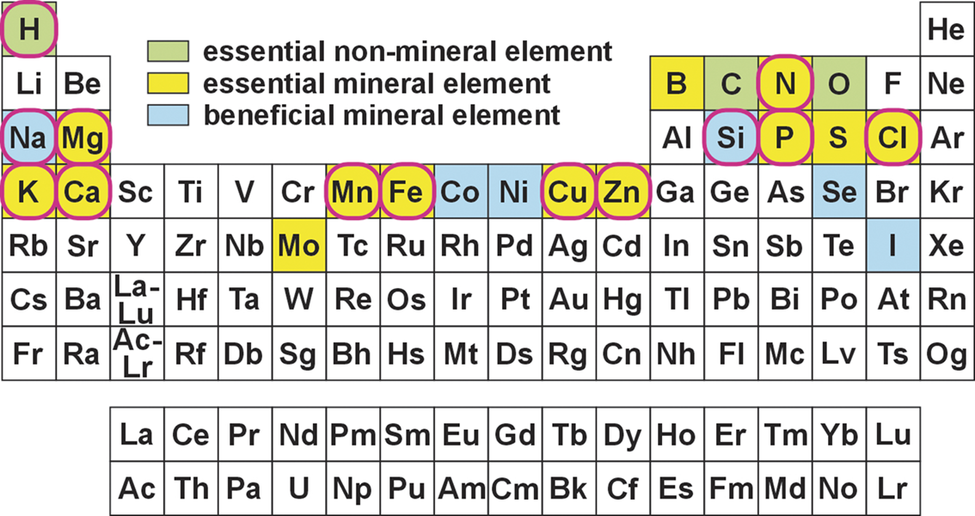
For growth, reproduction and metabolism, plants require 16 essential elements – 3 non-mineral and 13 mineral elements (Marschner, Reference Marschner2012) ( Figure 1 ). The non-mineral elements – hydrogen (H), carbon (C) and oxygen (O) – are derived primarily from the raw materials of photosynthesis, namely water (H2O) and carbon dioxide (CO2), while minerals are absorbed in ionic form from the aqueous solution in the soil. Essential mineral elements can be categorized into the primary macro nutrients Nitrogen (N, in its ionic forms nitrate and ammonium), Phosphorus (P, in its ionic form phosphate), and Potassium (K), the secondary nutrients Calcium (Ca), Magnesium (Mg), and Sulphur (S, in its ionic form sulphate), as well as the micronutrients Boron (B), Chlorine (Cl), Zinc (Zn), Copper (Cu), Manganese (Mn), Iron (Fe) and Molybdenum (Mo). In addition, plants also accumulate Sodium (Na), Silicon (Si), Cobalt (Co), Nickel (Ni), Iodine (I) and Selenium (Se), which are not always necessary for their survival but important for humans and animals that depend on plants for their diet.
Twenty-two essential and beneficial elements in plants and their representation in the periodic table of elements. Essential non-mineral elements (H, C, O) are highlighted in green, essential mineral elements (B, N, Mg, P, S, Cl, K, Ca, Mn, Fe, Cu, Zn, Mo) in yellow and beneficial mineral elements (Na, Si, Co, Ni, Se, I) in blue. For the elements circled in magenta, there is a dedicated article in the collection ‘Quantitative Approaches to Cellular Aspects of Plant Ion Homeostasis.’

Figure 1. Long description
A legend at the top center defines three color codes: green for essential non-mineral elements, yellow for essential mineral elements, and blue for beneficial mineral elements.
* Essential non-mineral elements (green): H, C, and O.
* Essential mineral elements (yellow): B, N, Mg, P, S, Cl, K, Ca, Mn, Fe, Cu, Zn, and Mo.
* Beneficial mineral elements (blue): Na, Si, Co, Ni, Se, and I.
Specific elements are further identified with a magenta circle around their chemical symbol: H, Na, Mg, K, Ca, Mn, Fe, Cu, Zn, Si, N, P, and Cl. The rest of the periodic table, including the Lanthanide and Actinide series at the bottom, is shown in white with standard black text symbols.
As Paracelsus already pointed out about 500 years ago: All things are poison, and nothing is without poison; the dosage alone makes it so a thing is not a poison. Thus, plants not only need to accumulate the different elements, but they also need to regulate the concentration of each element in their cells and cellular compartments according to their biophysical and biochemical needs; a process for which Walter B. Cannon coined the term “homeostasis” in his book The Wisdom of the Body (Reference Cannon1932). Homeostasis is directly linked to transport processes.
Over the past four decades, remarkable progress has been made in understanding ion transport within plants and across plant membranes. The fundamental mechanisms underlying active/energised and passive transport are now well understood – not only across the plasma membrane, but also across intracellular membranes. The genetic basis of transport systems for all ions has now been elucidated in various model organisms, and in some cases, the detailed physical structures of the membrane proteins involved have also been determined. This framework now makes it possible to ask new and important questions about the cell biology of ions in plants: what are the homeostatic mechanisms that control the concentrations of different ions in the cell, particularly in the sensitive metabolic environment of the cytosol? How are concentrations of ions maintained at a steady level in the face of a fluctuating environment? When physiologically necessary, how are the concentrations of ions shifted from one resting level to a new transient or permanent resting level? The enormous advances in our understanding of plant membrane transport at a molecular level now provide a mechanistic basis for understanding plant nutrition at cellular and whole plant levels.
To answer these questions, we need a holistic view that also includes quantitative methods. For each type of ion, we need information about the homeostatic conditions and feedback loops that maintain the ion concentration at an optimal level. At present, however, such information is only fragmentary for the 22 elements mentioned; for some of them, our understanding is deep, while for others it is relatively shallow. The goal of the collection “Quantitative Approaches to Cellular Aspects of Plant Ion Homeostasis” published by the journal Quantitative Plant Biology was to provide a contemporary assessment of our current understanding. It brings together leading researchers presenting their insights into fundamental knowledge for a wide range of elements in plants. The collection does not aim to provide comprehensive review articles (in addition to those already available in the literature). Rather, it focuses on selected aspects related to ion homeostasis.
Fifty-six authors from a dozen countries across 5 continents have contributed so far 15 articles under the overarching theme of ion homeostasis in plants. To introduce these articles, we move across the periodic table ( Figure 1 ) from left to right. We start with H and can refer to an article on the ubiquitous hydronium ion H+ (Xhelilaj et al., Reference Xhelilaj, Fuglsang, Gronnier and Palmgren2025), which plays a vital role in all aspects of plant life. Next are the alkali metals Na and K, whose ions Na+ (Tyerman et al., Reference Tyerman, Cuin, Bose and Munns2026) and K+ (Wegner et al., Reference Wegner, Pottosin, Dreyer and Shabala2025) have an ambivalent relationship with one another, and whose osmotic effects can be both essential and lethal. Another pair of twins is formed by the alkaline earth metals Mg and Ca. However, their ions Mg2+ (Wathar & Verbruggen, Reference Wathar and Verbruggen2026) and Ca2+ (Brownlee & Wheeler, Reference Brownlee and Wheeler2025) perform more diversified, complementary functions in plants. Among the transition metals, there are manganese (Mn; Meier et al., Reference Meier, Mariani and Peiter2025), iron (Fe; Leskova et al., Reference Leskova, Xiong, Mari and Curie2025), copper (Cu; Chia et al., Reference Chia, Zavodna, Shatokhina, Kavulych and Vatamaniuk2025) and zinc (Zn; Krämer, Reference Krämer2025), which, although they are trace elements, act as essential cofactors in enzymatic reactions and gene expression, for instance, with their functions partially overlapping and competing. On the right side of the periodic table, in the second period between boron (a review on B homeostasis is still pending), carbon and oxygen, is nitrogen, which plays a key role in plant nutrition in the form of nitrate (NO3 -) or ammonium (NH4 +) (N; Chen & Miller, Reference Chen and Miller2026). Finally, the third period contributes silicon (Si; Huang & Ma, Reference Huang and Ma2024), phosphorus/phosphate (P; Chiang et al., Reference Chiang, Yayen and Chiou2025), sulphur/sulphate (a review on S homeostasis is still pending) and chloride (Cl; Silva-Herrera et al., Reference Silva-Herrera, Wege, Franzisky, Ahmad, Roelfsema and Geilfus2025). In an era of scientific fragmentation, a broad collection like this is rare, if not unique, in its focus on ion homeostasis.
The collection is rounded out by two articles that address the mechanisms implicated in homeostatic control. To understand these mechanisms, the quantitative approach must be fundamentally expanded to include biophysical and mathematical descriptions of the underlying transport processes. In this sense, the approach corroborated the philosophy of William Thomson (Lord Kelvin, 1883/Reference Thomson2011): When you can measure what you are speaking about, and express it in numbers [or mathematical formulas], you know something about it; but when you cannot express it in numbers [or mathematical formulas], your knowledge is of a meagre and unsatisfactory kind; it may be the beginning of knowledge, but you have scarcely, in your thoughts, advanced to the stage of science, whatever the matter may be.
The homeostatic state of a system (plant cell, organelle and tissue) is controlled by networks of transporters called homeostats (Dreyer et al., Reference Dreyer, Hernández-Rojas, Bolua-Hernández, Tapia-Castillo, de los, Astola-Mariscal, Díaz-Pico, Mérida-Quesada, Vergara-Valladares, Arrey-Salas, Rubio-Meléndez, Riedelsberger and Michard2024). The mathematical description and analysis of these homeostats reveal that homeostasis is inextricably linked to nutrient cycles across the membrane (Dreyer, Reference Dreyer2021). Such nutrient cycles were formerly considered ‘futile’ cycles because they consume energy (Britto et al., Reference Britto, Siddiqi, Glass and Kronzucker2001; Britto & Kronzucker, Reference Britto and Kronzucker2006; Coskun et al., Reference Coskun, Britto, Li, Becker and Kronzucker2013; Shabala et al., Reference Shabala, Chen, Chen and Pottosin2020). However, the quantitative analytical approach suggests that they are not as ‘futile’ as thought; without these cycles, the system would collapse and the process of homeostasis would no longer function.
Another interesting aspect comes into play when the homeostatic state of a system is disrupted by external or internal factors or stimuli. The response of the transporter networks (homeostats) involves changes in membrane potential as well as in cytosolic H+ and Ca2+ concentrations (Contador-Álvarez et al., Reference Contador-Álvarez, Rojas-Rocco, Rodríguez-Gómez, Rubio-Meléndez, Riedelsberger, Michard and Dreyer2025), which serve as signalling parameters. This example shows that quantitative mathematical analysis is not just a gimmick, but can help us gain fundamentally new insights.
The journal Quantitative Plant Biology provides an interdisciplinary forum for high-quality research on ground-breaking discoveries and predictions in quantitative plant science. Its collection ‘Quantitative Approaches to Cellular Aspects of Plant Ion Homeostasis’ not only summarises the current state-of-knowledge of plant ion homeostasis, but also outlines future research directions to consolidate our understanding of the way in which the components of plant ion transport fit together in a cell biological context.
Open peer review
To view the open peer review materials for this article, please visit http://doi.org/10.1017/qpb.2026.10050.
Competing interest
The authors declare none.
Data availability statement
No data and code are available for this manuscript.
Author contributions
I.D. and D.S. wrote and edited the manuscript and approved its final version.
Funding statement
There is no funding to declare.

 Open access


Comments
Dear Editor of Quantitative Plant Biology,
please find with this letter our Editorial for the Collection “Quantitative Approaches to Cellular Aspects of Plant Ion Homeostasis”.
Best regards
Ingo Dreyer