In addition to its many famous innovations in popular government, the Athenian democracy seems to have also experimented with another, more ambivalent political institution familiar to modern societies—penal incarceration. In recent years, there has been renewed debate over the precise role of imprisonment in Athens, as an increasing number of voices, including Marcus Folch in this volume, make the case that imprisonment was an important point of contact between criminal punishment and democratic politics and society in Athens.Footnote 1
Of course, as these scholars have always been careful to acknowledge, penal incarceration in Athens was very different from the modern ‘penitentiary’, the institution immortalized in Foucault's Discipline and Punish, and whose debased remnants now make up the American ‘carceral state’.Footnote 2 The Athenian prison was not a site of juridical punishment in the modern sense; the point of incarceration was not the production of ‘docile bodies’ in the laboring class; it did not aim to ‘discipline’ criminals through the combination of expertise and state power; and, in contradistinction to the modern penitentiary, the prison in Athens was not tied to any theory of how to change criminal behavior.Footnote 3 In spite of these differences, however, the fact remains that both the Athenian system of punishment and the contemporary American ‘carceral state’ are deeply wrapped up in the problem of how criminality and political membership relate to one another. In the case of the U.S., Andrew Dilts has used the practice of felon disenfranchisement to show how the entire carceral system presumes a form of ‘punitive political membership’ fundamentally at odds with democratic government.Footnote 4 In the case of Athens, the prison may be better understood as a new and contestable political institution—one subject to interpretation and reinterpretation by different forms of democratic and anti-democratic political ideologies.
One strand in Athenian democratic political ideology that had an important impact on discussions around punishment and the prison was the claim that Athenian practices and institutions were supposed to be a ‘lesson’ (παίδευσις, Thuc. II.41.1, cf. III.37–50) both for citizens and for others. This idea dovetailed with an apparently democratic ambition to instruct and improve citizens, even those who had erred (cf. Pl. Protag. 323d–e), though it conflicted with equally powerful ideological strains that insisted on harsh punishment as the right and responsibility of the demos kurios.Footnote 5 Even those democratic politicians who tried to yoke the institution of punishment to the democratic value of citizen education did not, however, explain how and why a punishment could teach someone, let alone make her better.Footnote 6 The language of Athenian intellectuals may have spoken of ‘educating’ or ‘improving’ criminals, but the Athenian jail was in reality little more than a small peripheral building, staffed ephemerally and fitted with chains,Footnote 7 a far cry from the sprawling modern complexes where state power is meant to fuse with the scientific knowledge of behavior in order to ‘reform’ the criminal and return her to the citizen body.
In a familiar bit of political-theoretical irony, the person who provided the institutional and philosophical solution to the problem Athenian democrats had set themselves about how to simultaneously punish and improve was himself one of Athenian society's sharpest critics. Plato had good reasons to pay close attention to the prevailing ideas about crime and punishment; after all, his teacher Socrates died in the Athenian jail. Plato's Laws, with its subtle integration of the technique of punishment, the justification for punishment, and the theory of human behavior, both echoes the ambition of Athenian intellectuals to punish by improving and anticipates the ‘total institutions’ of modernity much more closely than any actual Athenian practices did. It was Plato's ideas about confinement as a plausible technique of psychic reformation which were to set a pattern for the theory of imprisonment that would survive, in various forms, until the eighteenth-century ‘birth of the prison’.
As we will see, Plato based his argument on premises that would have been familiar, and even attractive, to readers steeped in democratic ideas about citizenship and punishment, but he extracted from these premises a set of conclusions about incarceration that kicked away the democratic ladder on which it had climbed up, so to speak, and entrusted punishment to a new, rationalized institutional logic. Plato's intricately designed theory of how incarceration works, which has a close affinity with the world of democratic punishment without itself being committed to democracy, may hold some lessons for today's societies, where the modes and techniques of incarceration seem ever more alienated from the values of democratic politics.
I. The Prison and Platonic Punishment
1. Punishment is Improvement
Plato’s theory of incarceration is part of his general justification for punishment, the basic tenets of which can be summed up by two Socratic paradoxes: that ‘it is better to be punished justly than to escape punishment’ (because ‘being punished is being improved’) and that ‘no one does wrong willingly’.Footnote 8 The tendentious relationship between these paradoxes and the day-to-day beliefs of Athenian citizens is explored most clearly in Plato’s Gorgias, during the character Socrates’ examination of the rhetorician Polus.
If punishing a criminal is deemed ‘good’ by the people, and the criminal is one of the people (that is, he identifies with the aims of the community), Socrates insists that Polus must admit that a good thing is being done to the person who is punished. If being punished is good, then ‘one who is punished is benefited’ (477a2f.). Leaving aside whether the argument is valid,Footnote 9 it makes clever use of a contemporary Athenian civic-democratic norm. Socrates appeals to Polus’ sense of shame and identification with the community and elicits his agreement that, if the community (in the guise of, for instance, a jury) decides that a good thing is being done to him, then he must agree that it is also good for him (to be punished accordingly).
This communitarian-democratic notion of punishment, which relies on the identification of the individual with the political whole, falls apart in the face of the dialogue’s final interlocutor, Callicles. Callicles is an aspiring democratic (demagogic?) politician who thinks of himself as an elite ‘lion’ among the democratic sheep. While he agrees that it is important to discipline the masses, Callicles insists that it is the prerogative of a superior person to remain undisciplined and allow his desires ‘to run rampant’ (μὴ κολάζειν, 491e9–2a1). A Calliclean ‘lion’ feels no shame in the face of his fellow citizens, and thus need not agree with the community that his punishment is ‘good’. For Callicles, wanton or criminal behavior is the consequence of pursuing urges and desires motivated by pleasure, urges that everyone would indulge if they could be sure of getting away with it.
If Callicles’ psychological account of crime is true, then discipline and correction should focus on counteracting the allure of pleasure and getting these unruly desires under control. Socrates now introduces the language of ‘structure and order’ (τάξις καὶ κόσμησις) to define ‘law and what is lawful’ to Callicles (504c2, 504d1f.). By analogy with medical patients, whose appetites and intakes are closely monitored and controlled by the doctor, ‘it is necessary to restrain [the soul] from its appetites and not leave it to do anything except that from which it will become better’ (505b2–4). Punishing (κόλασις, ‘disciplining’) in its purest form is nothing other than keeping the soul away from the bad things that it desires.
Socrates does not draw the obvious conclusion from this, that the form of punishment best suited to disciplining desire would be isolation from harmful stimuli and watchful regimentation of life’s necessities. Rather, he suggests that it is discussion itself which should serve as punishment. Socrates is disappointed that Callicles ‘won’t undergo improving’ by continuing the argument ‘and [with it] undergoing the thing which the discussion is about, “being disciplined” (κολαζόμενος)’ (505c3f.), as if being refuted intellectually about pleasure would be enough to discipline Callicles.
Perhaps, under ideal conditions, Socrates could show anyone the truth of the idea that doing injustice is worse than suffering it and being justly disciplined is better than escaping punishment (cf. 527b–c). In convincing them of something that is true (and, less obviously, by reordering their souls) Socrates would have made them better. But, as Callicles’ stubbornness demonstrates, it is not clear whether an ‘undisciplined’ person would ever voluntarily stick around to be improved through philosophical discussion. More importantly, it is unclear why the reader should believe that discussion will in fact make such a person well-behaved. Like Callicles, a criminal can always walk away.Footnote 10
2. The Gorgias Myth
This incomplete argument about the form and technique of punishment may help to explain one of the most outstanding features of the Gorgias, the ‘eschatological myth’ that takes up its final pages.Footnote 11 The most important element in the myth is the stripping away of the corporeal and political context for punishment. Plato shows that, without bodies, without juries, without mobs and demagogues, it is easy to imagine a system where ‘those punished rightly by another, either become better and improve, or become examples to the others’ (525b3f.).Footnote 12 The souls of the dead are judged and sentenced to some sort of pain and suffering before being allowed to proceed to the Isle of the Blessed. The precise nature of the process is left unclear (cf. 525b–c, 526b–c), but, as the souls are disembodied, these must be cognitive pains similar to those suffered by Polus and Callicles above—like being shamed or being shown to be wrong. This image of true, fair punishment as an examination of the soul seems modelled on Socrates’ own brand of dialectical examination.Footnote 13
Plato's description of the geography of the afterlife contains another clue to the meaning of the myth. He posits two possible destinations for souls, the Isle of the Blessed and ‘Hades’ or ‘Tartarus’—the pit, which he also calls ‘the prison of retribution and justice’ (τὸ τῆς τίσεώς τε καὶ δίκης δεσμωτήριον, 523b3).Footnote 14 By using the image of a prison, Plato suggests that the afterlife is more akin to a civic institution than to the cosmic order of the poets. The myth is thus also an answer to Callicles’ stubborn refusal to be ‘improved’. If Socratic soul-treatment fails to complete the task of ordering on the individual level, then perhaps the solution lies at a higher level of social organization, with an institution designed to do the same sort of work on recalcitrant souls that the judges of the myth perform on the (metaphorically) scarred and scabby shades of the dead. If the myth of the afterlife is effectively describing a prison, then perhaps the prison can do the work of the afterlife.Footnote 15
As Marcus Folch notes in his piece in this volume, this link between carceral geography and mythography persists all the way to the Laws, which includes this striking passage: ‘It is necessary that the disciplining of these [criminals] here in their lifetime fall in no way short of that in Hades, as much as is possible’ (881a8–b2). In the Laws, Plato says clearly what is only hinted at in the Gorgias, that social and political institutions must carry out the role heretofore assigned to divine punishment. The prison is the place where the scars that injustice leaves on the soul will be seen clearly, and perhaps even be removed.
The idea that a brick-and-mortar prison might be able to accomplish something like the sort of psychic treatments proposed by the myth of the Gorgias is still not enough to defuse M.M. McCabe's cutting criticism of Plato's reformative theory—that punishment cannot truly improve people (and therefore, it ought not to be asked to do so, a criticism that has resurfaced in the modern criminological dictum that ‘nothing works’). The next section of this paper will examine Plato's effort to answer this challenge by connecting the technique of punishment (and especially incarceration) to an element of penology that has been in the background—the moral psychology of the criminal.Footnote 16 This effort reaches its fullest expression in the same dialogue where Plato gives his clearest account of a working reformatory prison, the Laws.
II. The Moral Psychology of Incarceration
1. The Politics of Psychology
The Laws, usually thought to be Plato's last work, is an investigation of an ideal state, its laws and institutions. Unlike the Gorgias (or the Republic), the Laws, set in Crete at an unspecified date sometime after the Persian Wars, self-consciously distances itself from any immediate Athenian context.Footnote 17 But, like those other dialogues, the work is as much about psychology as it is about political institutions and, more precisely, it assumes that the two must go hand in hand. The interlocutors, old men from Crete, Sparta, and Athens, begin their comparative inquiry into constitutional structure by comparing a city's struggle to maintain order and succeed against other cities to a person's inner struggle to be ‘better than himself’ (626e–7a). The Athenian Stranger, who leads the discussion, expands upon this analogy by using the image of a puppet, pulled in one direction by the ‘golden and holy’ string of ‘reasoning’ (λογισμός, linked to the form of public reason that is called law at 644d–5a), and pulled in the other by pleasures and pains, as well as expectation, fear, boldness, and other ‘passions’ (πάθοι, ibid.).
This image gives a structure for the role of both education and law in connecting the individual psyche with the political regime. The citizen must be educated in order to provide his reasoning the assistance it needs to overcome the pull of pain, pleasure, and passion on his behavior (645a–b).Footnote 18 The legal framework of a polity, insofar as it is well designed, both aligns with reason (the link between human reason and political law is essential to the Laws)Footnote 19 and provides the content of the moral education the citizen will experience from childhood and throughout his life through contact with various social institutions (cf. 643e).Footnote 20 Becoming ‘weaker’ or ‘stronger’ than one's self is thus a question of not only the power of the mind's reasoning faculty, but also of that faculty's assimilation of generally correct principles absorbed through contact with the civil law.Footnote 21 When a person's reasoning aligns with the objective demands of rational law she can be said to have ‘overcome herself’, or, to use another Platonic metaphor, she will reach a ‘harmony’ (συμφωνία) between reason, pleasures, and desires (653b).Footnote 22 Such a citizen is well educated (653c).
Given the role of education in aligning the reasoning faculty with civil law, the potential for utilizing education in punishment is clear. In fact, the Laws agrees with the Protagorean/Periclean project of creating a continuum between education and law. ‘Education is the “training” (ἀγωγή) and guiding of children towards right reason according to law’ (659d1–3), and judges in the courts are teachers of the public (659b). This should also put us in mind of the instinctual agreement Polus felt for whatever the public deemed ‘good’ in the Gorgias. When this social conditioning fails, when psychic harmony between communal law and individual desire has not been reached, when a person is not stronger than herself, then remedial education—punishment—becomes necessary.
In one of the rare moments of true disagreement between the characters in the Laws, the Cretan Clinias expresses some discomfort with Socratic doctrine as the basis for civil law: if ‘the unjust man is indeed bad, but he is unwillingly bad’ (860d5),Footnote 23 it will be impossible to distinguish the punishment for a great crime from that for a small one, given that all criminals are ignorant, and therefore unwilling (857b). The apparent conflict between moral principle and the necessities of a penal code is important enough that the Athenian Stranger appeals to technical ‘philosophy’ in an attempt to provide an answer (φιλοσοφεῖν, 857d2, in one of only two appearances of the word in the Laws). In this case, ‘philosophy’ provides the interlocutors (and the reader) with a more precise understanding of what goes on in the soul of the criminal.Footnote 24
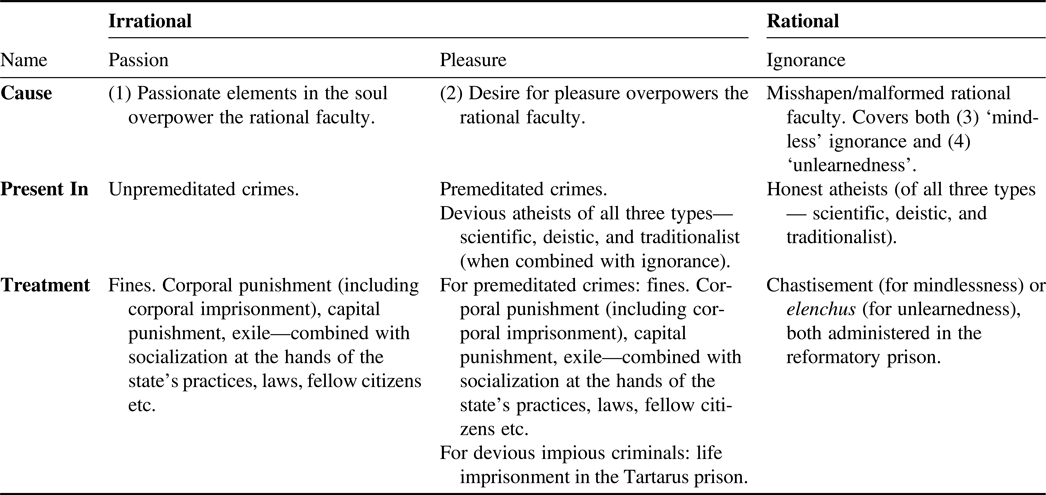
The Athenian proceeds analytically through the psychic causes of crime: there is something (1) in the nature of the soul that is connected to ‘passionate impulse’ (θυμός), and it ‘overturns many things through irrational force’ (863b4). Presumably one of the things it can overturn is rational decision-making. There is a separate power in the soul that responds to pleasure (2), though it works differently, achieving its aim through ‘force of deceit’ (863b8). Both of these elements, it is implied, can overcome the ‘rational thought’ (λογισμός) or ‘considered interests’ (βούλησις) of the actor, the first violently and immediately, the second slowly and corrosively. There is also a third cause of crime—‘ignorance’ (ἄγνοια)—which can be further subdivided into a ‘simple’ form (3) and a double form (4), where ignorance is compounded by the ‘illusion of wisdom’ (δόξῃ σοφίας), not knowing what one thinks one knows (863c–d). This worst type of ignorance itself comes in two forms, the ‘great and savage’ ignorance of the strong (4a) and the weaker errors of youth and old age (4b).
Using this scheme (reminiscent of, but not identical to, the theory of the soul in the Republic), the Athenian moves on to clarify what justice and injustice mean. Injustice is the ‘tyranny’ (τύραννις) of passion and fear, pleasure and pain, and jealousy and desire in the soul (863e8). In short, it is the disordering of the soul, whatever the cause. If, however,
the [true] belief about the highest good, whether it is a city or a private person who thinks to aim at it, …prevails in the soul and regulates every man, ‘even if some error is made’ (κἂν σφάλληταί τι), everything done thus must be said to be just…although most believe the damage to be an ‘involuntary injustice’.
(864a1–5)Footnote 25True belief is thus both a necessary and sufficient condition for justice, while injustice always requires the absence of true belief. According to this strong intellectualist thesis, justice does not preclude some intellectual errors, but they are, apparently, relatively unserious.Footnote 26
2. The Non-rational Psychology of Traditional Punishment
This division of the soul and its powers enables Plato to make a series of important distinctions concerning the causes of crime (and therefore allows him to answer Clinias’ worry about differentiating between different degrees of criminal). He distinguishes between passion and pleasure, both of which act ‘tyrannically’ to make a person ‘stronger’ or ‘weaker’ than herself; and ignorance, which is of a different species entirely, yet still causes people to act against their ‘best-considered inclination’ (βούλησις, 864b).
This division is stated even more clearly in a parallel discussion of the definition of injustice in Plato's Sophist, which identifies two ‘forms’ (ἔιδη) of badness in the soul. The first is wickedness, which is a disease due to ‘civil war’ (στάσις) between beliefs, desires, anger, pleasures, reason, and pain in the soul ([1] and [2] above). In the other form, ignorance ([3] and [4] above), which manifests as a sort of ‘shamefulness’, the soul tries to aim itself toward the truth, but misses the mark, due to some ‘disproportion’ (ἀμετρία) in its faculties.Footnote 27 Again, when discussing the cure for ignorance, the interlocutors in the Sophist realize the category must be further divided. The larger, more serious sort is the recognizable genus of ‘not knowing what one thinks one knows’ ([4a]), which is the cause of ‘when “we err” (σφαλλόμεθα) during contemplation’ (Soph. 229c5f.). This type of ignorance, it turns out, has a particular name (‘foolishness’—ἀμαθία—the same word Plato will use to describe the honest atheists imprisoned in the reformatory prison of the Laws) and a unique solution—‘liberal education’ (παιδεία—the task carried out in that prison).Footnote 28 This seems to be the sort of ignorance that encompasses both the most dangerous sorts of crime and, apparently, the example of the just criminal—the just man who makes some intellectual errors.
The picture of criminal psychology that emerges from these passages has a great deal of significance for how punishments must work: the first two types of injustice are the result of some internal discord in the soul due to passion or pleasure, and can be cured through ‘discipline’ (κόλασις), a technical reordering of the psychic elements into their correct arrangement. In such cases—an overpowering of rational thought (by passion) or an undercutting of it (by pleasure)—the rational element in the soul is intact, but silenced. The goal of corrective punishment in these cases, therefore, is not to act on or appeal to reason, it is to disencumber reason from these impediments.
In the Gorgias Plato presented, via the exchange between Socrates and Callicles, a theory of how the pursuit of pleasure was the cause of crime, and how the restriction of pleasure (or the dialectical proof that pleasures were not what the criminal thought they were) could serve as punishment. From the list of penal tools the Athenian gives in the Laws—‘deeds or words, or pleasures or pains, or honors or dishonors, or monetary fines or gifts’ (862d4–6)—it seems that corporal punishment, fines, and the threat of dishonor might all be used to temper the pleasure-seeking element that drove crime. Plato also assimilates crimes driven by anger/passion into this schema, calling passions ‘painful’ (864b3),Footnote 29 and suggesting that, just as administering physical pains can counteract physical pleasure, administering psychic pains (through the loss of honor, for instance) might be the correct antidote to the psychic excitement of anger.
For this interpretation to cohere with the reformative, intellectualist core of Plato's thought, non-educative punishments must have some connection to the rational element that produces just behavior. Here, the language of the Sophist is helpful. Non-rational punishments (whether corporal or pecuniary) are able to suppress one of the parties in the ‘civil war of the soul’ (228b4).Footnote 30 This means the (possibly painful) ‘break-up of an existing pattern’ of behavior which allows for the new habituation of the individual,Footnote 31 and Plato seems to include penal confinement (in its simplest sense of being ‘chained up’, δεσμοί) among other punishments that strike the necessary balance between the shock of non-rational punishment and the respect accorded to free citizens.Footnote 32 The Athenian Stranger proposes prison ‘for the sake of securing the bodies of the many’ (908a3), implicitly distinguishing the ‘corporal’ use of incarceration for punishing and remanding bodies from the use of incarceration for ‘soulcraft’.
Habituation, or reeducation, is not an explicit part of the punishment for crimes originating in the non-rational elements of the soul—because the whole constitution of the Laws is designed to be a form of education. Once any pathologies have been removed through the shock-therapy of non-rational punishment, the society described in the Laws will ensure that the rational element is in control of practical reasoning within the individual soul and correctly oriented to the principles of the society outside of it.
Plato's description of the non-rational causes of crime allows him to admit of non-rational punishments that can fix the psychological deficit in the criminal and improve her to the satisfaction of society. Non-rational forces such as shame and financial (or even physical) pain can be especially effective in improving criminals whose love of pleasure has overpowered their rational adherence to law or ‘balanced power of choice’ (βούλησις). By developing a place for non-rational punishment within the framework of a ‘rehabilitative’ theory, Plato has made a concession to the common-sense view that conversation will simply not be enough for every sort of criminal and every sort of crime. Nevertheless, he has not given up on dialectic as an important technique of punishment—he has just reached a much more precise understanding of how and why dialectic improves the one who undergoes it. Dialectic is the cure for the special case of criminal ignorance, and its use is confined to the inmates of a special prison.
3. The Rational Psychology of Incarceration
After these lengthy preliminaries, we are finally ready to address the role of penal confinement and how it can, according to Plato, successfully reform a criminal (as well as the additional puzzle of how philosophical argument can be a punishment). In addition to continuing the typology of criminals we began above (illustrated in Table 1), we will now examine more precisely what Plato thinks should go on in a prison, at least according to the Laws.
The moral psychology of crime in Plato's Laws

Incarceration is most closely connected to the last cause of crime in Plato's schema, ignorance (although, as we have noted, it also appears in the Laws as an additional form of corporal punishment—see the discussion in Marcus Folch's contribution to this volume). The major example of ‘ignorant’ criminals in the context of the Laws is the phenomenon of atheism discussed in Book X. There, we learn that three different types of atheism (scientific, deistic, and traditionalist) are caused by different forms of ignorance. They are to be treated by a variety of penal confinements.Footnote 33
The first sort of ignorance is its most minor form (simply not knowing enough to do the right thing, type [3] above), but that is a rather uninteresting category, easily treatable, according to the Sophist, through ‘technical training’ (229d1). More worrying is what the Athenian Stranger calls ‘a distinct and separate category, [which] is of expectations and opinion—it is a mere unsuccessful shot at the truth about the highest good’ (Laws 864b6f.)—ignorance about ends.Footnote 34 This is the ignorance of those people who think they know what they do not—criminals like Callicles ([4a] above). Both forms of ignorance share a distinct criminal pathology from passion or pleasure. They do not involve one psychic element overpowering the others (863d8). Rather, they point to an incompleteness within the reasoning element itself.
Within the second, more serious type of ignorance ([4] above), Plato further distinguishes between two subtypes—ignorance combined with an ‘incontinence’ towards pleasure, and the ignorance of a fundamentally just person (with a basically well-ordered soul) who errs solely intellectually (864a). The first subtype, the criminals who also suffer from the ‘civil war’ with pleasure, will be dangerous and ‘dishonest’.Footnote 35 On the one hand, such people have a defect in reasoning and so cannot only be punished non-rationally, but, on the other, they also have unbalanced psyches and so cannot be reformed only by dialectic (as the case of Callicles showed). In the city of the Laws, the Athenian decrees (908a) that they be given a sentence of life without parole in the prison called ‘Tartarus’, an isolated building on the border of the country (which shares a certain iconographic similarity to the mythological ‘prison of retribution’ described in the Gorgias).Footnote 36 The double corruption of mistaken knowledge and a ‘civil war’ with pleasure makes this the rare example of an ‘incurable’ penological type, where reform defers entirely to deterrence. Ignorance, or the weakness of the reasoning element, is still a chief cause of crime, but where pleasure combines with intellectual error the rule of the rational element cannot be restored.
The second sort of seriously ignorant criminal is not under the dangerous sway of pleasure or passion and does not have a ‘civil war’ in her soul. Her ignorance, unlike that of the pleasure-corrupted ignorant person, can be countered (and corrected) entirely with knowledge. In the context of the Laws, this correction will take place in the σωφρονιστήριον, or ‘reformatory prison’, where she will be subject to instruction by the philosopher-experts of the Nocturnal Council over the course of a five-year prison term (908e). Given that the psychological problem with this sort of criminal was ‘ignorance’, instruction can plausibly be said to both reform her and ‘make her better’.
At long last Plato has given us the site of the reformatory punishment he alluded to in the Gorgias, as well as a fuller psychological profile of the criminal who will be reformed. All that remains to uncover is the specific reformative technique that will be practiced within the reformatory prison. Here Plato introduces yet another division within this subtype. Some cases of ignorance can be fixed by ‘chastisement’ (νουθέτησις, cf. Soph. 229e–30a), one of the two tasks assigned to the reformatory prison (Laws 909a). This activity corresponds to a paternalistic form of ‘scolding or encouraging’, and can be applied to any criminal exhibiting ignorance. Chastisement is a more active version of the process encouraged throughout society by the educative function of law itself. Of the three types of atheists in the Laws, two, the deists and the traditionalists, are said to be driven by a ‘lack of reasoning’ (ἀλογία) and have a certain ‘intellectual weakness’ (οὐ δυνάμενος, 900a8). We may surmise that they will be ‘chastised’, given moral instruction meant to get the well-intentioned but weak-minded criminal back on track.
There now remains only the second half of this subtype, the last sort of ignorant criminal, a strong-minded but honest atheist, of the sort who does not believe in the gods because she ‘missed the mark’ in understanding philosophical first principles. These criminals will also be imprisoned in the reformatory prison with their weak-witted colleagues, but the Sophist describes a more demanding form of education for ‘someone who thinks he's saying something though he's saying nothing’ (230b4f., cf. Laws 881a), ‘[the punishers] collect his opinions together during the discussion, put them side by side, and show that they conflict with each other at the same time on the same subjects in relation to the same things and in the same respects… “Refutation” (ἔλεγχος) is the principal and most important kind of cleansing’ (230b, d) for this sort of person.Footnote 37 This penal regimen of dialectical, emphatically Socratic treatment is a punishment for those who are not disfigured by unruly passion, not incontinent with regard to pleasure, and not simply foolish. Plato has created an institutional form of the very sort of dialectical punishment he proposed for Callicles in the Gorgias (though Callicles himself, corrupted as he is by pleasure, would presumably be sent straight to the Tartarus prison). With the prisons of the Laws, a psychiatric framework for penal ‘soulcraft’ has come fully into view.
III. From Moral Psychology to Carceral Epistocracy
Plato's detailed and demanding theory of incarceration is even more striking when compared with the actual practice of incarceration as it existed in the Athens of his time. Incarceration, if we are to believe Demosthenes’ Against Timocrates, the only other extended discussion of this punishment in Attic prose, existed at the frontier of the democratic respect for the autonomy of free citizen bodies, and the need of the citizen demos to control wealthy elites. For Demosthenes and his contemporaries, the prison was part of a political struggle over the meaning of ‘democracy’– what defines membership in the demos? What are the limits to its power?Footnote 38
The question that motivates Platonic punishment, on the other hand, is not who wields authority, but rather what social and political structures are demanded by reason. At one point, Plato defines politics as the type of ‘knowledge’ (ἐπιστήμη) that has power over ‘common life’ (τὸ κοινόν, Statesman 305e4–6). For Plato, it is not enough to have an end or value in mind, like the rule of the many (or even the rule of the few), and then to test political practices against it. Institutions, including techniques of punishment, must be justified by correct knowledge at every step and in every aspect. The lawgiver or the statesman must know (and predict) how different sorts of people will react to different sorts of laws and institutions, and each detail of the law, each element of every institution must justify itself before the tribunal of reason.
Plato's ideal states are therefore sometimes called ‘epistocracies’ because those who have knowledge of what is right should rule. But especially in the Laws, where political knowledge is embedded in statutes and institutional design as much as in any person, epistocracy must be understood more precisely as the rule of knowledge.Footnote 39 Correct knowledge of human souls is the principle according to which state power, including punishment, is to be applied. In the best system of laws, it is knowledge itself, knowledge of the criminal mind, knowledge of human nature, that can be said to be responsible for punishment, rather than any public official.
I have intentionally framed this nexus of power and knowledge, of power distributed through the knowledge of human behavior, in a way meant to suggest Michel Foucault's conception of ‘Power/Knowledge’. The exercise of power (in the form of coercive violence) in the Laws is as much about causing citizens to internalize knowledge (as the analogy of the soul as a puppet susceptible to the pull of reason illustrates) as it is about using knowledge to enable or effect state violence. This affinity between Plato and modern theories of incarceration deepens when one considers the close intersection between penology and psychology that Foucault identified in the modern ‘punishment-correction’ of delinquency. The offenders in Plato's Laws are ‘delinquents’ avant la lettre. Criminal behavior is explained by the behavioral sciences rather than by the judicial processes of a court.
The actual Athenian use of incarceration, intertwined as it was with democratic values and the interests of the democratic jury system, seems to have lent itself to a more pragmatic, consequentialist, theory of punishment. If keeping a person, especially a rich and powerful person, under lock and key benefited the rule of the demos more than it harmed it, then, according to Demosthenes, incarceration was justified. Plato, for his part, demanded a procedural transparency for his political institutions that even modern ‘technocratic’ democracies still struggle to implement. The penal regime imagined by the Laws depends on a rationalized, technical process, and the adherence of this process to an external, non-politically contingent standard of truth, as much as it does on the identity of the offender. Placing a criminal under confinement must conform to autonomous penological reason. A citizen jury is simply not fit to mete out such punishments.
Despite these differences, the Athenian discourse around the prison and Plato's account of incarceration do share one striking detail—they are both focused on the punishment of elites. As Marcus Folch discusses in his contribution to this volume, references to the prison in Athenian historiography are always in the context of elite personalities, male or female. We should also confirm Folch's finding that in the Laws an atheist criminal, and thus a prisoner, can almost certainly be of either gender. After all, the high offices of the state, including the Nocturnal Counsellors who serve as prison wardens, are open to women (813c6–9), marking women as potential members of the same elite class that produces intellectual criminals.Footnote 40 The text does not make an allowance for prisons for different genders, but this may reflect the assumption that if men and women can dine together in the city's ‘communal messes’, they can reasonably be incarcerated together as well.
The reformatory prison is located on the acropolis, directly next to the seat of government (and is administered by its highest body, the Nocturnal Council). Even the Tartarus prison is filled with the sort of well-spoken personalities who sometimes become ‘tyrants and demagogues and generals’, founders of mystery cults and sophists (908d5f.).Footnote 41 This identification of elites with ‘atheists’ may seem rather exotic, but the supposition that the sources of social disorder come ‘from the top down’, so to speak, reminds us that both the popular Athenian and Platonic accounts of incarceration firmly belong to the social theory of ancient ‘face-to-face’ societies. According to this worldview, social threats have names and identities, they are not, for the most part, the product of the faceless many.
Despite being anchored in the pre-modern world of the city-state, Plato's approximation of the criminal psychology of delinquents, and his strikingly technocratic (or epistocratic) ideas about institutional design, cast into doubt some of the confidence that Foucault and others showed regarding the singular modernity of the reformatory prison. Plato developed an idea of the carceral regime in response to the threat of elite disorder, reflecting an elite Athenian preoccupation with atheists and demagogues as the source of social strife.Footnote 42 But his ideas about reform and instruction would prove attractive in very different political and intellectual contexts.Footnote 43 And even the eighteenth-century incarnation of rationalistic and psychologistic reformatory incarceration, while different from Plato in important ways, owes something to this Platonic tradition in its use of confinement and education in tandem, in the adoption of medical metaphors for criminal behavior, and in the intertwining of the juridical and psychological sciences.Footnote 44 Plato's fundamental contribution, which was to inspire thinking about correctional institutions for two-thousand years, was to take the democratic idea of ‘improving’ citizens, and that ‘anyone can be made better’, and go to the root of the question of what making someone better would actually require.
As we have seen, there are very specific conditions which are required in order to ‘improve’ a soul according to Plato. These conditions did not obtain in the actual prisons of Athens, both for technical and economic reasons, and because punishment in Athens was essentially a question of convincing the jury about what was in its best interests rather than addressing the status of an individual soul. Modern democracies have been more willing and able to experiment with explicitly ‘educational’ or ‘psychiatric’ institutions of punishment, but from our current vantage point we must admit that the record of this centuries-long experiment is mixed at best. Perhaps the Platonic fastidiousness about rational means of punishment can be made to work with a modern liberal desire to respect the integrity of the criminal as a rights-bearing citizen, but perhaps, in the age of mass incarceration and penal warehousing, the rift between the democratic common sense that punishment makes things worse and the Socratic insistence that it can rationally make things better has grown into an unbridgeable chasm.
Readers of Plato have always vacillated back and forth between emphasizing the philosopher's antagonism towards democratic values and acknowledging his engagement with and even intellectual debt to the prevailing democratic political culture into which he was born.Footnote 45 Plato's theory of incarceration provides an illuminating example of how, by attempting to rationally ground even ostensibly democratic practices, Plato arrived at political institutions (and theoretical justifications) that were entirely independent of, or even at odds with, democratic politics. In the case of the prison, the transformation of the jail from a site where the behavior of elite men (and perhaps women) was held up for democratic sanction to one where science of the soul was applied to errant citizens both accomplished the Athenian aim of civic education and severed that aim from its connection to popular rule. It is impossible to say whether Plato would have conjured up a prison if he had not seen it used by the Athenian courts, but, in a lesson that may also hold true for the troubled penitentiaries of today, his attempt to make a democratic institution subservient to an externally valid set of rational criteria ended up severing the prison from any specifically democratic idea of justice, a development whose consequences may remain with us in the democratically deficient prisons of our own day.