1. Introduction
Developing meaningful speaking interaction remains an outstanding issue for language massive open online courses (LMOOCs), both from a pedagogical and technological point of view. The implementation of speaking skills tasks within the context of LMOOCs is a complex instructional design issue, which is the key question addressed in this paper.
Difficulties arise both from the online and massive features of LMOOCs. Speaking practice is still a challenge in online education, and when the massive nature of MOOCs is added to this, it is not unusual to find that most LMOOCs do not address this key competence within their own platform. This comes as no surprise as it is an arduous task from an instructional design perspective, both in terms of technology and course logistics. Issues such as how to pair up a large number of students to perform synchronous speaking tasks, how to scaffold their learning practice, how students can receive meaningful individualised feedback, or how to ensure student accountability (Rubio, Fuchs & Dixon, Reference Rubio, Fuchs, Dixon, Martín-Monje, Elorza and Riaza2016) need to be solved if speaking interaction activities are to be feasible in LMOOCs.
Nevertheless, the two problematic features for speaking practice in LMOOCs, online and massive, present more opportunities than obstacles. It is precisely the presence of a large number of speakers in an online environment, free from time and space restrictions, that is the most valuable affordance for designing speaking interaction activities. Indeed, if all LMOOC participants were autonomous learners, then an LMOOC would be the ideal scenario for speaking practice, albeit short of one more element: the opportunity to interact with native speakers of the target language and thus engage in authentic target language use and with the target language culture. In this paper we present the design of an LMOOC in speaking skills in the course titled tandemMOOC English–Spanish (http://moodle.speakapps.org/), which takes advantage of the multitude of participants, and brings to the platform native speaker interlocutors by adopting a tandem language learning approach. In addition to speaking practice, a further objective of the tandemMOOC is for participants to become successful autonomous online learners who, after having participated in the course, can make the most out of online second language (L2) speaking opportunities.
A design-based research (DBR) approach was adopted to develop the tandemMOOC, which includes an initial design for the first edition in 2014 and three consecutive iterations (2016, 2018, and 2019). In DBR, researchers work together with practitioners in trying out solutions through iterations that lead to the formulation or refinement of theoretical design principles (Reeves & McKenney, Reference Reeves, McKenney, Rodriguez and Pardo-Ballester2013). This methodology is used to find solutions to complex educational problems, and thus Levy (Reference Levy, Rodriguez and Pardo-Ballester2013: 38) argues that DBR “can provide one pathway forward to CALL, particularly because of its engagement, from the outset, with the concerns of the practitioner and their interaction with systems”. As argued above, the object of study in this paper is complex, closely linked to practitioners’ concerns, and in need of a solution that can be integrated into MOOC provider platforms. All these factors led to the choice of DBR as the main framework to be used in the tandemMOOC design.
2. State of the art: LMOOCs and speaking
In a discussion on MOOC design principles, Guàrdia, Maina and Sangrà (Reference Guàrdia, Maina and Sangrà2013: 4) argued that a “deep pedagogical debate [was] still missing”, while other factors such as strategic, institutional, economic, social, and technological issues were dominating the discussion. Eight years later, although some progress has been made in relation to the organisation and presentation of materials (Oh, Chang & Park, Reference Oh, Chang and Park2020), Guàrdia et al.’s concern is still very much current, probably linked to the difficulties of personalisation with large numbers of learners (Beaven, Hauck, Comas-Quinn, Lewis & de los Arcos, Reference Beaven, Hauck, Comas-Quinn, Lewis and de los Arcos2014). In the area of LMOOCs, the very nature of language learning poses a serious problem, given that a high degree of collaboration, personalisation, and feedback is needed. This is an even more significant issue when it comes to speaking interaction activities, which cannot be addressed in MOOC formats based on individual work.
The concern over including pedagogical matters in instructional design is reflected in recommendations for the design of LMOOCs (Colpaert, Reference Colpaert, Martín-Monje and Bárcena2014; Read & Bárcena, Reference Read and Bárcena2020; Rubio et al., Reference Rubio, Fuchs, Dixon, Martín-Monje, Elorza and Riaza2016). Although there are emerging examples of student-centred designs that bring the concern for interaction and collaboration to the core of their design agenda, such as the LMOOC in Irish offered at Dublin City University (Irish 101; SCORE2020, 2016), there is still a gap when it comes to integrating speaking interaction activities in LMOOCs.
Most of the LMOOCs from various popular MOOC providers, such as Coursera, edX, or FutureLearn, still follow the traditional model of xMOOCs that are based on a cognitive behavioural pedagogical model (McLoughlin & Magnoni, Reference McLoughlin, Magnoni, Kan and Bax2017). In addition, only a few of these LMOOCs incorporate tasks that develop students’ speaking skills, and when they do so, it is in an asynchronous mode, addressing oral production skills. This is done by asking them to record a brief oral presentation (see an example in Spanish Vocabulary Project, https://www.coursera.org/learn/spanish-vocabulary-project), to record and share short podcasts (see Move-Me MOOC, McLoughlin & Magnoni, Reference McLoughlin, Magnoni, Kan and Bax2017), or to record their spoken contributions and post them on a discussion page (see The Open University Italian for Beginners, FutureLearn, https://www.futurelearn.com/courses/italian-for-beginners-1)
To our knowledge, only one LMOOC has so far integrated synchronous speaking interaction practice – Learn Spanish: Basic Spanish for English Speakers – and this was done as a supplement once the course had started and the designers realised that students yearned to interact with each other. This LMOOC organised both instructor-led sessions and learner-driven speaking practice sessions in Google Hangouts (Gimeno-Sanz, Reference Gimeno-Sanz, Borthwick, Bradley and Thouësny2017). In this vein, Motzo and Proudfoot (Reference Motzo, Proudfoot, Kan and Bax2017) suggest that using an external videoconferencing system, such as Google Hangouts, Skype, or Zoom, is precisely one way of incorporating speaking practice in an LMOOC, encouraging learners to set up small groups in social networks (SNs) to arrange their meetings.
One way in which traditional language courses have sought solutions to increase speaking practice opportunities for their students is through eTandem language learning. In eTandem, pairs of learners who are native or near-native speakers of each other’s target languages collaborate to learn each other’s language (Akiyama, Reference Akiyama, Dixon and Thomas2015; Appel, Reference Appel, Gros and Mas2013; O’Rourke, Reference O’Rourke and O’Dowd2007). Although there are no doubts about the potential of eTandem, there are some challenges concerning the difficulties of finding partners and ensuring the partnerships last until the end of the planned activity time.
Language learning SNs have tapped into the potential large online communities have for intercultural exchanges and language learning, and approach tandem language learning from a different angle. Here learners, rather than teachers, take the initiative to contact native speakers by joining the networks. Although the size of these networks facilitates finding a partner who may have common interests or goals, some studies point out that the lack of content and pedagogical support for the interactions means that these partnerships also fail to last and show little accuracy or fluency gains (Lin, Warschauer & Blake, Reference Lin, Warschauer and Blake2016).
SNs have identified the potential in large online communities for speaking practice, whereas tandem language learning projects have identified the potential in videoconferencing communication and have produced evidence for its benefits. We believe that LMOOCs are in a position to merge all these necessary elements to organise speaking practice and facilitate its sustainability.
3. Research questions
A design of an LMOOC incorporating tandem learning principles was developed to provide speaking interaction practice within an LMOOC. This design was analysed following seven design components through three iterations. The following research questions guided this study:
-
1. How can an eTandem speaking interaction be implemented in an LMOOC?
-
2. How do the three iterations of tandemMOOC compare in relation to the different design components?
4. Methodology
4.1 Design-based research
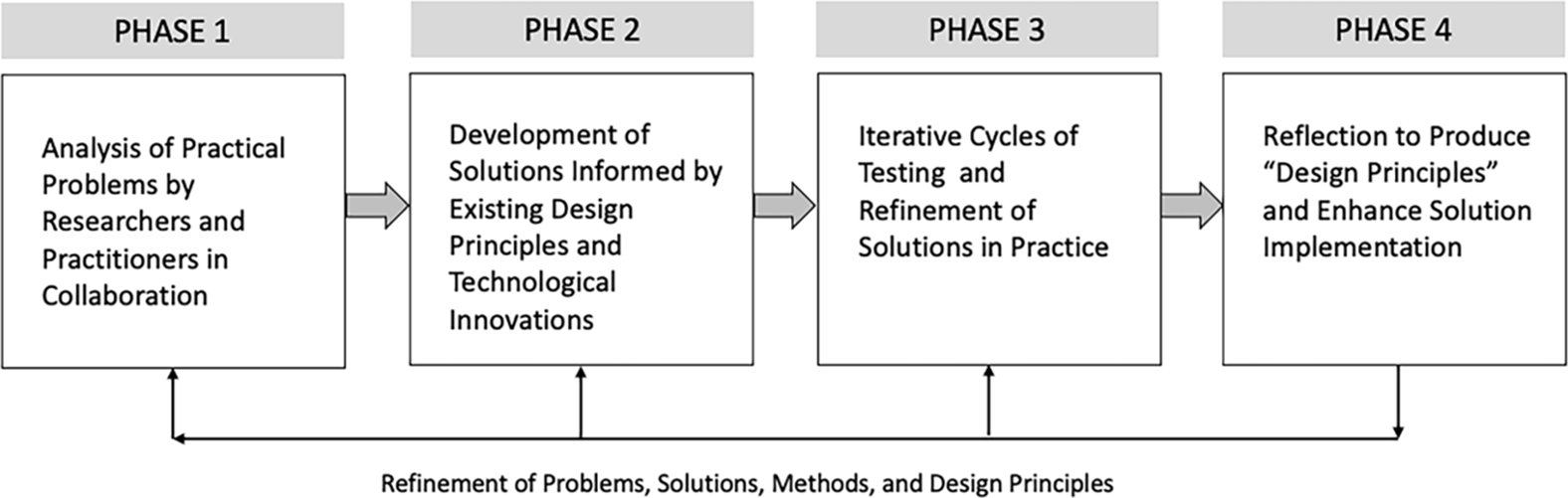
This study adopts a DBR approach (Design-Based Research Collective, 2003; McKenney & Reeves, Reference McKenney and Reeves2012; Reeves, Reference Reeves, Van Den Akker, Gravemeijer, McKenney and Nieveen2006; Wang & Hannafin, Reference Wang and Hannafin2005), and follows Reeves’ (Reference Reeves, Van Den Akker, Gravemeijer, McKenney and Nieveen2006) four phases for the refinement of problems, solutions, methods, and design principles.
Phase 1 (Figure 1) involved the identification of the educational problem by a team of practitioners, teachers, and instructional designers at a fully online university. Insufficient opportunities for speaking interaction and the lack of appropriate tools for online synchronous communication back in 2013 posed a challenge to the design of English as a foreign language courses with over 2,000 students. In addition, their experience in eTandem projects had raised the issue of complex logistics, poor sustainability, and the difficulty in finding enough tandem partners for all these students (Appel, Reference Appel, Gros and Mas2013). The design of an LMOOC centred around L2 speaking interaction skills using a tandem language learning approach seemed an initiative that offered solutions for the practical problems previously discussed. However, the absence of fully integrated speaking interaction activities in LMOOCs meant that an innovative approach was required.
Design-based research approach in educational technology research (Reeves, Reference Reeves, Van Den Akker, Gravemeijer, McKenney and Nieveen2006)

The existing design principles in the tandemMOOC were adopted from tandem language learning (Little & Brammerts, Reference Little and Brammerts1996) and task-based language teaching (González-Lloret & Ortega, Reference González-Lloret and Ortega2014). The technological innovations here were the tools and pedagogical solutions developed by the European Lifelong Learning project “SpeakApps: Production and Interaction in a Foreign Language Through Online ICT Tools” (Appel, Nic Giolla Mhichíl, Jager & Prizel-Kania, Reference Appel, Nic Giolla Mhichíl, Jager, Prizel-Kania, Jager, Bradley, Meima and Thouësny2014). The development of solutions using design principles (Figure 1, Phase 2) was applied to the tandemMOOC by a multidisciplinary team of educational technologists, language teachers, instructional designers, language education researchers, and learning analytics experts.
The first edition of tandemMOOC was developed and implemented in 2014. The design team analysed data collected during the course (see section 4.3) and suggested improvements to be made for the following iterations (Figure 1, Phase 3), thus testing and refining the course following DBR principles (Reeves, Reference Reeves, Van Den Akker, Gravemeijer, McKenney and Nieveen2006: 26). In this paper, the results of these iterations and the refined design features drawn from them are presented (Figure 1, Phase 4).
4.2 Context of the study
The tandemMOOC is a six-week course aimed at higher-intermediate (B2) learners of Spanish, who are native or near-native speakers of English, and learners of English, who are native or near-native speakers of Spanish. Participants work together to improve their oral skills and to develop learning and communicative strategies. The main objectives of the course are
-
to interact with a degree of fluency and spontaneity that allows for regular interaction with native speakers.
-
to take an active part in discussions in familiar contexts, accounting for and sustaining one’s views.
-
to practise basic communication strategies.
-
to self-regulate one’s learning regarding speaking skills in a foreign language and evaluate others’ speaking skills in your own language.
The demographic data of participants remained stable throughout the four iterations. The male/female distribution oscillated between 30/40 male and 70/60 female. Over the four editions, between 50% and 55% of the participants were under the age of 35, and came from over 18 different countries, with most learners of English coming from Spain, Colombia, Peru, and Mexico and learners of Spanish from the United States, Ireland, and the United Kingdom. Most participants (61%) had a higher education degree. When asked about their motives for registering for the course, over 80% indicated that they wanted to improve their speaking skills, 15% that they were preparing for an exam, and only 8% indicated that they wanted to meet native speakers of their target language.
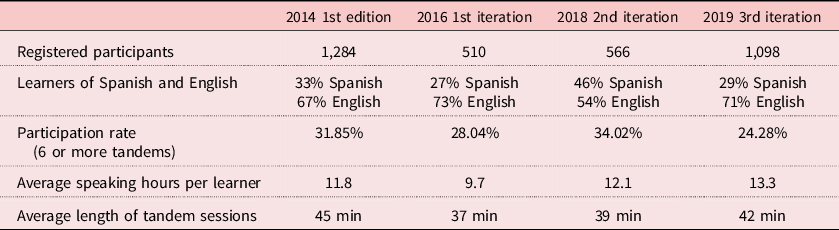
Table 1 shows the registration numbers for the four editions and the percentage of learners of Spanish versus learners of English. Striking a balance between learners of both languages was a recurrent issue in all editions. The average of participation is calculated taking into account learners who did six or more tandems. The highest participation rate corresponds to the 2018 edition, which coincides with the most balanced ratio between the learners of Spanish and English. The tandemMOOC achieved its objectives of providing speaking practice time in all iterations ranging from 9.7 to 13.3 hours per learner over six weeks, and participants stayed on task an average time that ranged from 37 to 45 minutes.
Registration and participation in all the editions of tandemMOOC

4.3 Data collection and analysis
The data collection and analysis undertook a mixed-methods approach (Creswell, Reference Creswell2013) following a concurrent approach “QUAL + QUAN” (Dörnyei, Reference Dörnyei2007: 169) with various combinations of quantitative and qualitative methods at different stages of the project. Varied collection methods were applied systematically to each iteration, which provided two types of data: in-process and follow-up.
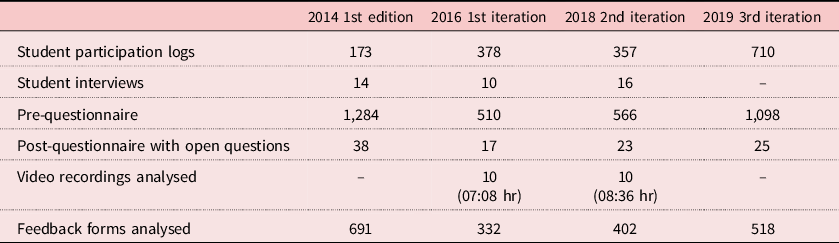
In-process data were collected during the course from various sources (Moodle Learning Analytics, Tandem tool dashboard, Forums, etc.), which allowed for ongoing design adjustments. Follow-up data were analysed at the end of the course in preparation for the following iteration and were mainly collected by means of pre- and post-course questionnaires, semi-structured student interviews, participation logs, and student tandem video recordings. Table 2 presents an overview of how many participants were involved in the data collection processes for each edition.
Summary of data collection

The analysis of quantitative data yielded descriptive statistics that provided relevant information on participant profiles, needs and expectations, patterns of usage, usability, levels of participation, anxiety scores, learner opinions, experiences, and behaviours on different aspects of the course in each edition. Content analysis was applied to qualitative data to identify themes relevant to course design, controlling for inter-rater agreement. As for the analysis of in-process data, the objective was to identify not only the instances of success but also, most importantly, frustrations and problems as they emerged. The issues identified in learners’ experiences and analysed in the weekly team meetings revolved around the seven components of the design (section 5.2). Analysis of follow-up data triangulated teacher, facilitator, and technical staff post-course reflections, participant comments in post-questionnaire and interviews, and video recording and classroom observations. This triangulation allowed us to cross verify the sources of both problematic and successful learner experiences before incorporating these findings into the following iteration, and ultimately this retrospective analysis fed into the tandemMOOC design.
5. Results
5.1 Initial design of tandemMOOC
The initial design of the first edition of the course, henceforth referred to as tandemMOOC14, corresponds to Phase 2 in the DBR sequence (Figure 1) and is informed by a set of existing design principles and technological innovations. The fundamental principles employed were adopted from language teaching communicative approaches, task-based, and tandem language learning. The technological innovations to match the features needed to implement these principles in the context of a MOOC were found in the solutions developed by the European project SpeakApps.
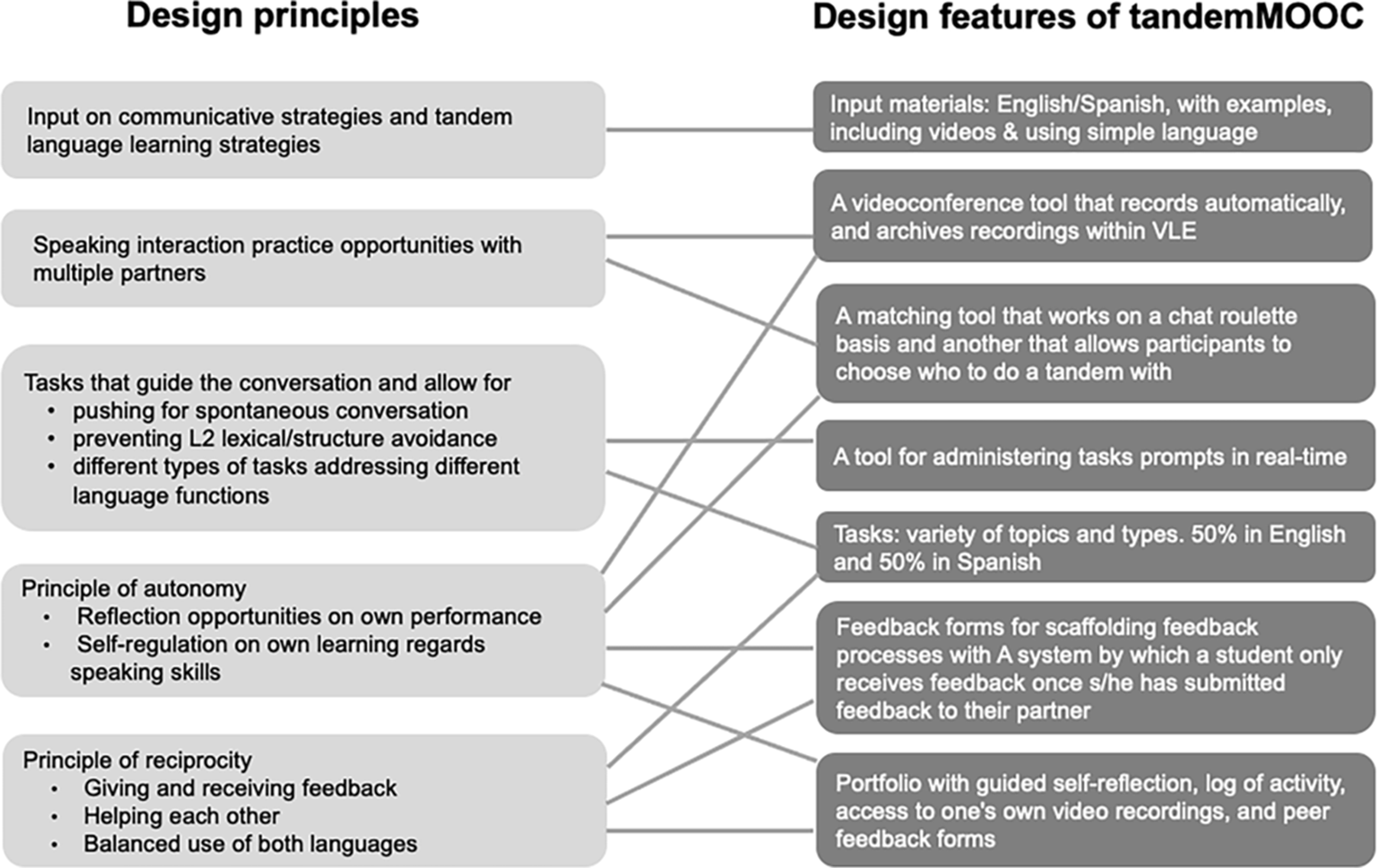
The design principles provide input, speaking practice, tasks to mediate the speaking practice, and reflection opportunities in order to give and receive feedback and develop self-regulation. Video materials were developed for input on strategies, a set of tools was adapted to the specific needs of the course, including a videoconferencing system, a tool to manage content during the task, and matching tools to help participants find a speaking partner. The tandem tasks were developed and organised into topics and different types in order to elicit a wide range of lexical and structural items. Finally, self-reflection and feedback forms were developed to scaffold self-regulation. Figure 2 shows a list of the design features of the tandemMOOC14 in relation to the initial design principles.
Relationship between design principles and features of the tandemMOOC14

5.2 TandemMOOC iterations (Phase 3)
In this section, the role of each of the seven design components in the course is addressed and the changes that were implemented over the subsequent three iterations from the initial design are presented.
5.2.1 The learning environment
The first decision concerning the learning environment was which MOOC learning platform to use. This platform needed to comply with three main criteria: offer tools for speaking interaction, real-time access to performance data, and flexibility to make swift changes in response to needs emerging from the in-process data analysis. The tools developed within the framework of the project SpeakApps (Appel et al., Reference Appel, Nic Giolla Mhichíl, Jager, Prizel-Kania, Jager, Bradley, Meima and Thouësny2014) suited the needs of tandemMOOC in that they provided tools for multimodal synchronous communication as well as real-time distribution of content to guide and scaffold this communication without the need of the presence of a teacher.
The decision was made to run the MOOC from a Moodle platform, allowing us to integrate the SpeakApps tools through an LTI (Learning Tools Interoperability) plugin. Forgoing the visibility that main MOOC providers such as Coursera or edX offer was outweighed by the advantages of having full access and control over the platform, tools, and data. This decision was kept over the subsequent iterations. The layout of the classrooms underwent minimal changes over the four editions as new themes were adopted to enhance the visibility of certain classroom elements.
5.2.2 Facilitation dynamics
Facilitation is essential for the smooth running of MOOCs and for encouraging students to participate in the course. While forums are the main facilitation channel, studies show that in LMOOCs learner participation in these forums can be low and not significantly linked to student success (Martín-Monje, Castrillo & Mañana-Rodríguez, Reference Martín-Monje, Castrillo and Mañana-Rodríguez2018). In the search for better alternatives, some MOOCs have used SNs to reach their participants (Borrás-Gené, Martínez-Núñez & Martín-Fernández, Reference Borrás-Gené, Martínez-Núñez and Martín-Fernández2019).
The facilitation role in tandemMOOC helps to build a learning community that will enable participants to create connections with other participants. This community is crucial to sustain the learning activity that relies not only on one learner’s self-determination to continue but also on the presence of other learners with the same self-determination. Facilitation is carried out by one teacher of English and one of Spanish who work together in supporting participants in their learning process and in building their course community.
A number of different facilitation strategies were used over the four tandemMOOC editions. The starting point in the first edition was a Noticeboard for announcements and Forums for learner interaction. There were only 569 learner interventions in the Forums in this edition, which led us to incorporate the SNs Facebook and Twitter into our facilitation strategy in 2016. However, learners limited their participation to assigning “likes” to facilitator messages (e.g. 37 likes for 18 posts by facilitators in Facebook), but only three comments were published in the course SN channels and no learner-initiated posts. More successful, however, was the inclusion of a classroom video blog (Langblog) producing 127 learner video interventions. Learner interviews indicated that SN announcements meant that they were more likely to stay away from the virtual classroom, while the video blog was perceived as a good means of getting to know other participants in the course, thus expanding their learning network on the platform itself. Another attempt to facilitate through SNs was made in 2018 by substituting Twitter with Instagram, with similar negative results. As such, the use of SNs for facilitation purposes was discontinued for subsequent iterations, while Langblog became a standard feature of the course.
The main challenge, nevertheless, remained in helping students find tandem partners with similar time availability for tandem meetings. Hence, a new strategy was designed for 2018 and 2019, more in line with the most frequently used means of communication at the time: mobile instant messaging (MIM). Telegram was our choice due to its privacy settings for groups where participants could join through a link without having to share their phone numbers. Participants immediately took to this option and perceived it as a useful additional means to contact tandem partners.
5.2.3 Dyad configuration
Pair work is a common dyad configuration for foreign language speaking interaction, and is also the default configuration for tandem language learning. Speaking practice with different interlocutors is useful because it exposes the learner to different geographical or social language varieties. Research on syntax priming, the phenomenon by which speakers tend to reuse structures they have heard, indicates that priming can be a form of implicit learning (Branigan & Messenger, Reference Branigan and Messenger2016). Further, Appel and Vogel (Reference Appel, Vogel and Cameron2001), in a study set in a tandem language learning context, found that convergence was stronger among individuals who had interacted with several interlocutors in a community than between isolated pairs. This has design implications as it implies that students benefit from interacting with different interlocutors, thus contrasting with common practice in tandem language learning where stable pairs are the most common configuration found in the literature.
One of the most innovative features of tandemMOOC is the Roulette Tandem tool, which is a new way of organising learner interaction, both in the context of speaking skills in MOOCs and in the area of tandem language learning. The tool is based on the Chatroulette concept, pairing random learners for tandem conversations, thus turning the massive element of a MOOC into an advantage. In the tandemMOOC14 edition, aside from the Roulette Tandem tool, there were also two more tools: YouChoose Tandem, which allowed participants to choose a tandem partner and a task, and the Social Tandem tool, which did not launch any tasks but rather let participants chat freely on any topic of their choice.
Connection logs to all three tools showed an equivalent use of the Roulette Tandem and the YouChoose tools, but scarce use of the Social Tandem tool. For that reason, the Social Tandem tool was not incorporated in subsequent iterations. Meanwhile, the Roulette Tandem tool was used more frequently in the first week, whereas the YouChoose tool was increasingly used during the course as learners established partnerships with other participants.
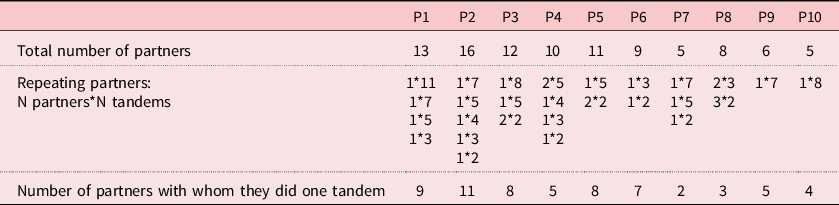
Interviews with participants from the 2014 and 2016 editions revealed the need for and complementarity of the Roulette and YouChoose Tandem tools. Participants expressed a variety of preferences, stable partners, or a variety of partners depending on their availability or stage of the course. Table 3 shows different interaction patterns in terms of choice of interlocutor by the 10 most active participants in the first iteration/2016 edition.
Tandem partners summary of the 10 most active participants in tandemMOOC 2016

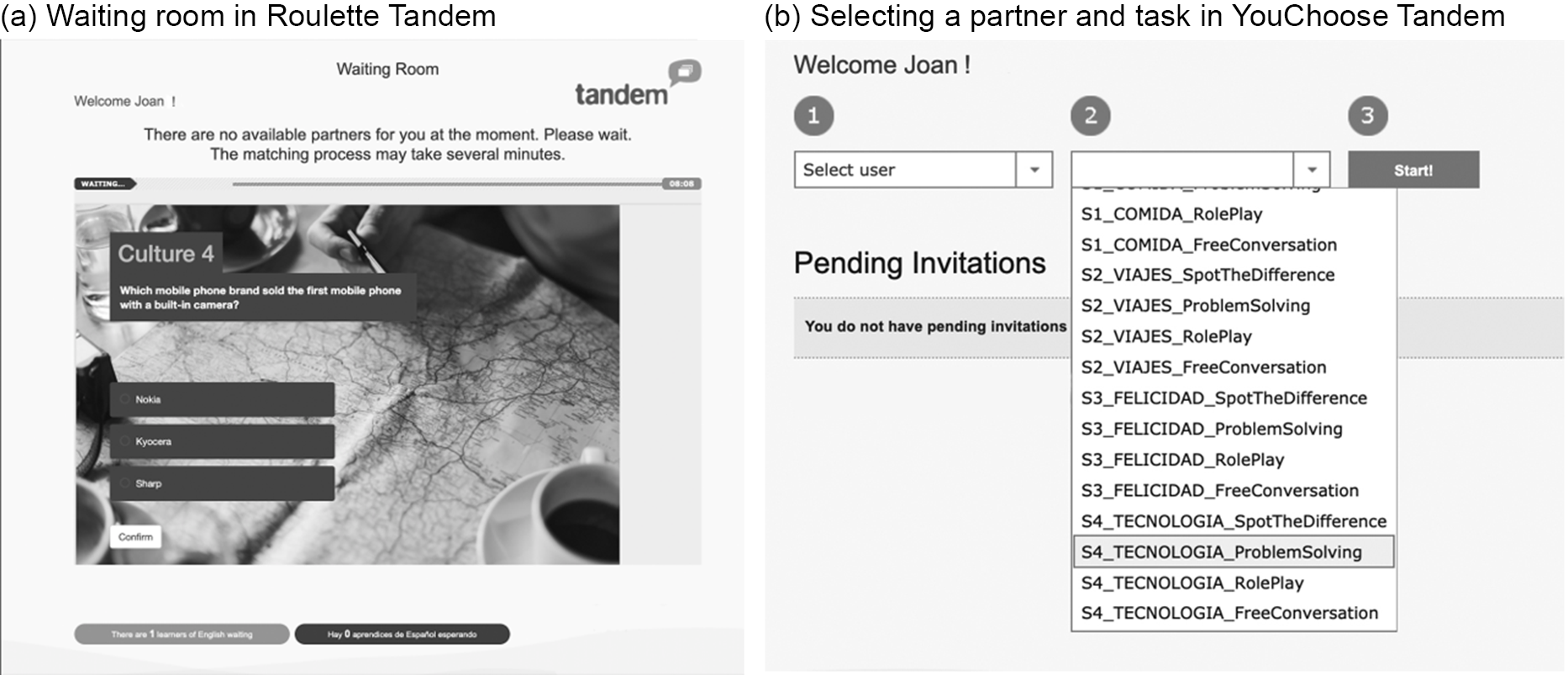
A new feature was added to Roulette Tandem in 2019 (iteration 3) after observing that most participants would not stay in the waiting room for more than two minutes. This feature consisted of a battery of multiple-choice questions on vocabulary, expressions, cultural information, and tandem strategies designed to keep participants occupied while waiting for their Roulette partners to connect (Figure 3a). This was not an issue in YouChoose Tandem since participants here had already prearranged to meet in advance (Figure 3b).
(a) Waiting room in Roulette Tandem; (b) selecting a partner and task in YouChoose Tandem

5.2.4 Tasks types
Finding interlocutors for learners is not enough in tandem language learning. It is also necessary to design for what takes place during the tandem conversations (Appel & Mullen, Reference Appel and Mullen2002), and for this, tasks are essential: they build connections between interlocutors, draw attention to the content of the conversation, prevent the conversation from running dry beyond the initial task of getting to know each other and push interlocutors out of their comfort zone, thus addressing learners’ tendency to use “risk-avoiding” strategies (Corder, Reference Corder and Richards1978).
In the 2014 edition, the instructional team designed tasks similar to those commonly used in the foreign language classroom for pair-work speaking practice: information gap, problem-solving, and role-play. Although the wide range of tasks met participant expectations, it hindered the analysis of participant performance. In 2016, a new and smaller set of tasks was designed based on the combination of two participation variables within the task conditions dimension of Robinson’s (Reference Robinson2001) triadic componential framework of task complexity: open/closed and convergent/divergent. This addressed an internal need to control for variables when looking at other factors such as learner anxiety/enjoyment or length of tasks, and ensure that we had a balanced range within these task types. (See Figure 4 in the supplementary material for an example of a closed/convergent task.)
The analysis of 10 video recordings (7:08 hours) from the most active 10 participants of the 2016 edition revealed that these participants did not take full advantage of the tandem setting affordances, strictly adhering to the language of the task and making no use of cross-linguistic knowledge. Many instances of struggling, unsuccessful negotiation of meaning were observed, which, in fact, could have been easily solved had they resorted momentarily to the use of the interlocutor’s first language. As for the 2018 edition, a pre-task activity was added to all the tasks to activate participants’ tandem language learning frame of mind, by asking them to explicitly help each other in finding equivalent language items in both languages (see Figure 5 in the supplementary material). An analysis of video recordings of the most active 10 participants of this edition, combined with interviews, revealed a decrease in unsuccessful negotiation of meaning episodes due to the use of code-switching for brief explanations, which led to more fluid conversations (see Extract 1 for an example) and a feeling of progress and self-confidence on the part of learners. Realising that they had been able to successfully help a tandem partner was also reported by participants as a positive emotion.
Extract 1, from tandem conversation
P23: I don’t [sic] how to say when the image is not clear
P24: you can say fuzzy or more commonly blurry
P23: blurry? … borroso?
P24: yes, so it’s not in focus
Finally, for the problem-solving task types (open and convergent), a change was made to the task seeking to enhance learner agency and engagement by making participants take active part collaboratively in the formulation of the task. (See Figure 6 in the supplementary material for an example in which participants produce a list of items that are then used to rewrite a story.)
5.2.5 Task topics
In the initial edition, task topics covered a wide range of general social-cultural themes. When engaging in a tandem task, participants had no preparation time as the intention was for them to relate the topic to their own experience spontaneously and find points in common with their partners; that is, following the Common European Framework of Reference for Languages guidelines for the B2 level (Council of Europe, 2001). However, qualitative data analysis of participant interviews and post-questionnaires together with course facilitator interviews informed the designer team that participants wished to be able to prepare for the tandem sessions and felt anxious at not knowing what topics they would be required to talk about in a tandem session.
To address the participants’ concerns, from 2016 onwards, the first four weeks of the course were organised around a topic of general interest (cooking, travelling, leisure, and digital life, respectively), adopting a topic-based approach. By focusing on specific general interest topics, participants could anticipate and select what sort of vocabulary and language structures they would need for their oral practice. However, while materials were developed to aid the preparation of each weekly topic, participant access logs to these materials showed little use of them, and interviews revealed that the value of these materials lay more in putting them at ease rather than actually helping them acquire new vocabulary or language structures prior to the tandem sessions.
The last two weeks of the course focused on metacognitive strategies with a two-fold goal: tying with the start-of-course input strategies videos, and prompting participants to consciously reflect on their own learning. Viewing logs of the start-of-course input videos on communication and learning strategies in the 2014 edition showed that less than a quarter of all active students accessed these materials. Despite the inclusion of the topic of strategies in the last two weeks, input videos remained a largely ignored part of the course over the subsequent iterations.
5.2.6 Feedback provision
Peer feedback is a key element for a successful tandem language learning partnership. In tandem language learning, two learners play a dual role of expert–novice, helping each other in their language learning process by sharing the experience and language learning strategies while learning each other’s native language. In terms of providing feedback, native speakers are not trained teachers and so can be reticent to correct their peers’ performance (Lee, Reference Lee2004). Moreover, there is evidence that the feedback provided by peers is often limited in scope or accuracy (Ware & O’Dowd, Reference Ware and O’Dowd2008).
As such, tandemMOOC14 participants were asked to fill in a form at the beginning of the course to self-assess their speaking skills. This initial form was identical to the feedback form they completed after each tandem task commenting on their partner’s L2 performance. The form consisted of two sections: the first was devoted to assessing the partner’s fluency and accuracy with a sliding bar for each ranging from 0% to 100% and a field to provide an overall grade; the second included three text boxes where the participant could write their partners’ errors in relation to three linguistic areas: pronunciation, vocabulary, and grammar, followed by an additional general observations text box. This feedback form was then archived in their respective portfolios connected to the video recording of the particular tandem task it referred to, for further revision later. In order to ensure reciprocity, participants only received a feedback report if and when they submitted a report for their tandem partner. At the end of the course, a final self-reflection form, mirroring the initial one, allowed for a comparative assessment.
Quantitative analysis results showed low participation in feedback forms in 2014 (33.64%). A subsequent content analysis of 691 feedback forms further disclosed that participants did not fill out most of the fields in the forms, and interviews revealed that participants struggled to classify the identified errors and were reticent to adopt what they perceived as a “teaching role” towards their tandem partner. The general observations text box was the space most used by participants, mostly for praise and positive feedback.
In the following edition (2016), it was decided to include a rubric for each linguistic aspect and some possible examples of what students could complete in the text boxes to help them fill in each section. Despite these changes, no improvement was found in the use of feedback forms.
In the 2018 iteration, the feedback form was completely transformed to simplify the process. In this form, participants completed two steps: first, they self-assessed their own performance by indicating one or more things that they had done well, and then listed at least three language errors they had made. After completing this brief self-assessment, they used the same format to give feedback on their partner’s performance (see Figure 7 in the supplementary material). The changes made to the form eliminated the idea of assessing the other and reinforced the tandem spirit of helping each other in a common language learning process. The idea of filling out the same form for self-assessment and tandem partner feedback meant that the feedback can be presented side by side for a visually effective comparison. The simplification of the form increased feedback participation by 10%, and post-questionnaires and interviews (see Table 2) showed that participants felt more at ease with the new form and were more satisfied with the feedback they received. No further changes were made to the feedback forms in the 2019 edition.
5.2.7 Gamification components
One common issue for all MOOCs is low completion rates. One relevant strategy to increase participant motivation is to introduce gamification (Borrás-Gené et al., Reference Borrás-Gené, Martínez-Núñez and Martín-Fernández2019). Gamification is a methodological strategy used to increase student engagement and refers to “the use of the elements of the game and design techniques of digital games in a non-game context” (Werbach & Hunter, Reference Werbach and Hunter2012: 26). The most frequently used game elements in gamified language courses are points, badges, and leaderboards (Pujolà & Appel, Reference Pujolà, Appel, Kruk and Peterson2020), as is the case in MOOCs (Ortega-Arranz, Muñoz-Cristóbal, Martínez-Monés, Bote-Lorenzo & Asensio-Pérez, Reference Ortega-Arranz, Muñoz-Cristóbal, Martínez-Monés, Bote-Lorenzo, Asensio-Pérez, Lavoué, Drachsler, Verbert, Broisin and Pérez-Sanagustín2017).
In tandemMOOC14, the first edition of the tandemMOOC, points and leaderboards were used so as to engage participants to do as many tandems as possible. Participants were awarded points according to the number of tandems and the number of minutes spent in tandem tasks. To ensure that participants gave each other feedback, an essential element of the tandem experience (see section 5.2.6), points were not awarded unless feedback forms had been submitted. This gamification strategy was quite successful and proved very popular, to the point that connections to the platform peaked on the day of the announcement of the ranking winners at the end of the course. Given the popularity of this award system, in the 2016 iteration the ranking prizes were introduced every two weeks. The ratings of feedback given, based on a 5-star system, were added to the points formula in an attempt to encourage participants to give good-quality feedback to their tandem partners. Participants competed fiercely for these prizes, and levels of participation increased exponentially in the 24 hours before the closing time of the weekly ranking.
In 2018, progress bars were added to help students visualise their progress relative to the minimum requirements to obtain a certificate. The reason behind this was to capture the attention of those participants who only did a few tandems and motivate them to increase their participation in the course.
Two systems of badges were added to the 2019 edition: a set of badges that were awarded as participants reached levels of participation (number of tandems) and a set of badges rewarding learning efforts and achievements. In the spirit of tandem design, some of these badges were named in Spanish and others in English. Post-questionnaires showed mixed reactions towards these badges, and the perception that they were an expendable element of the course.
6. Discussion
This study followed a DBR approach to develop solutions derived from the initial guiding design principles (Figure 2) for implementing an eTandem speaking interaction in an LMOOC. The design process of the tandemMOOC carried out in the different iterations on seven specific design components provides answers to the two research questions and sheds light on design principles to be considered when speaking interaction is integrated in LMOOCs.
Regarding the provision of input on communicative and tandem learning strategies, input in the form of materials and videos was largely ignored by participants, which is in line with other studies that have found low consultation of materials on learning strategies (Pujolà, Reference Pujolà2002). Metacognitive cues provided in context and connected to individual performance were better integrated into the course, highlighting the importance that video recordings of tandem sessions be available.
Providing speaking opportunities was one of the main objectives of the tandemMOOC. A wide variety of choice was offered to participants in terms of who to talk with and how, as well as choice of tasks and content for their speaking practice. The fact that the number of learners of English and Spanish was not balanced in three of the editions (see percentages in Table 1) did not impede the functioning of the course, as participants talk to different partners at different points in time. Coinciding in time was more of an issue; differing working and socialising times in different countries influenced the ratio of available interlocutors. Here is where the massive aspect of a MOOC holds potential in hosting participants in different time zones: the higher the number of students, the higher the diversity of individual availability windows. Facilitation within the platform or via an external MIM prompted participants to establish new connections with tandem partners. Our findings highlight that the use of MIM, with the appropriate privacy settings in place, proves to be a more efficient means to facilitate tandem meeting arrangements than mainstream SNs. This is in line with the results of Sun, Lin, Wu, Zhou and Luo (Reference Sun, Lin, Wu, Zhou and Luo2018) that highlight the potential of MIM to facilitate team building and social interaction.
Tasks were instrumental in guiding speaking practice in tandem sessions. The main requirements of these tasks at the beginning of the course were that they should push for spontaneous conversation, prevent avoidance, and elicit a variety of language items and functions. In the process of the analysis of the participant performance in the first iteration a fourth requirement was identified: activating a tandem state of mind that would encourage participants to help each other make use of their knowledge of both languages involved in the tandem session. In relation to task topics, weekly topics provided structure to the course and helped participants relate to their prior experience with a more traditional structure of language courses. Weekly topics were well received by participants who felt comfortable with topics that related to their everyday lives, in line with a recent tandem study by El-Hariri (Reference El-Hariri2016).
The principle of autonomy in tandemMOOC addressed reflection and self-regulation. Reflection opportunities arose from the archived portfolios with the video recordings and the attached feedback provided to and received from their partners. Efforts were made to explore different feedback formats, finding that learners were reticent to take on an expert role perceived as too close to that of the teacher (Lee, Reference Lee2004). Learners chose to strengthen their social presence by providing positive feedback, with words of praise and encouragement predominating in feedback forms, and avoided displaying any form of teaching presence (Garrison, Anderson & Archer, Reference Garrison, Anderson and Archer1999). As for self-regulation, finding an optimal way to manage peer feedback remains a challenge for online language learning, even when peers are native speakers of the target language, but positive steps in the tandemMOOC were taken to set the foundation for formats that can enhance the eliciting of peer feedback. Not all participants showed the same extent of self-regulation, which is not uncommon in MOOCs (Conde Gafaro, Reference Conde Gafaro and Andujar2020). Gamification elements were used to foster self-regulatory behaviour.
The principle of reciprocity can be difficult to guarantee in tandem projects and even more in a massive context such as an LMOOC. To make sure participants observed this principle, which is crucial for the sustainability of the course (if you only help and are not helped, you drop out), mechanisms to ensure reciprocity were embedded in the course: tasks with clear indicators of what language to be used, 5-star rating for help provided in all feedback forms, and no points were awarded for the ranking unless help had been provided to tandem partners.
Finally, learner emotions played a relevant role in tandemMOOC, as evident from participant surveys and interviews. This has led us to revise the design principles used at the start of the project and incorporate principles from the area of emotions such as anxiety, enjoyment, or achievement in language learning. This is in line with studies that call for a closer integration of concepts in psychology and L2 pedagogy (Shao, Pekrun & Nicholson, Reference Shao, Pekrun and Nicholson2019).
7. Conclusions
This paper has presented the design process of an LMOOC that integrates a tandem learning approach in order to foster foreign language speaking interaction practice. DBR methodology was adopted in this process and proved to be a practical approach that helped researchers and practitioners to make informed decisions in the design of the LMOOC. This paper presented the principles that led to the design features of the first edition of the course, and then described the refinements made in subsequent iterations. Seven design components have been identified as key to the design of the tandemMOOC: learning environment, facilitation dynamics, dyad configuration, task types, task topics, feedback provision, and gamification components. The study has documented the effectiveness and the effect of the design features implemented within the seven design components.
Integrating meaningful speaking interaction in an LMOOC is technologically challenging but a necessary instructional design endeavour to make sure LMOOCs address all competences involved in language learning. Our study proves that it is possible to fully integrate and implement speaking interaction in an LMOOC. For this purpose, LMOOC virtual environments need to offer appropriate tools that could include the means to pair or group learners, a videoconferencing system, and the means to facilitate speaking prompts in real time. It is also essential that tasks encourage learner reciprocity, recordings of this practice be made available for self-reflection, and scaffolding for peer feedback be embedded in the environment.
The combination of speaking interaction practice, collaboration, and peer feedback is a complex issue in the context of LMOOC instructional design. TandemMOOC has undertaken this task and has achieved positive results; for example, the course delivers an average of 13 hours of speaking practice per learner over six weeks. This is a considerable amount when compared with the amount of speaking practice that learners receive in other open online language courses.
Finally, our use of DBR has enabled the course design team to create and refine an LMOOC course based on both learners’ and teachers’ feedback and participation logs. The simultaneous research and design processes in DBR have helped to develop a careful, pedagogically sound design that has been used iteratively to ensure continued success.
Acknowledgements
We would like to thank the team of facilitators, instructional designers, research assistants, and technical support who have contributed to this project over the years, with special thanks to Toni Bertrán, Blanca Cristòfol, Xavier Mas, Maria Luisa Malerba, Ljubica Damevska, Laura Styles, and Dolores Barbazán.
Ethical statement
All participants included in this publication provided their consent for their participation data in tandemMOOC to be used for research purposes. Effort was made to ensure the participants’ anonymity. There are no conflicts of interest.
Supplementary material
To view supplementary material for this article, please visit https://doi.org/10.1017/S0958344021000045
About the authors
Christine Appel holds a PhD in applied linguistics from the University of Dublin, Trinity College. She is a senior lecturer at the Centre for Modern Languages in the Universitat Oberta de Catalunya. Her research interests include tandem language learning, online education, LMOOCs, gamification, and teacher training.
Joan-Tomàs Pujolà holds a PhD in applied linguistics from the University of Edinburgh. He is a senior lecturer at the Faculty of Education, Universitat de Barcelona. He is the principal investigator of the research group realTIC. His research interests include gamification, e-portfolios, LMOOCs, and teacher training.
Author ORCIDs
Christine Appel, https://orcid.org/0000-0002-9528-7002
Joan-Tomàs Pujolà, https://orcid.org/0000-0002-8664-432X