1. Introduction: Celebrating CALL
ReCALL has now been published for over 30 years, and, alongside other computer-assisted language learning (CALL) journals, is testimony to the growth in quality, scope and influence of CALL research, strengthened, in its case, by its association with EUROCALL, founded shortly afterwards in 1993. Involved in CALL throughout that period, the author is aware that, while there was initial modesty about our status in the research pantheon, there has been, and remains, a feeling among some CALL scholars of the need to justify and defend CALL’s research quality to colleagues in other disciplines, even within language studies and the humanities, who do not rate it highly, despite the strong rankings and impact factors for ReCALL, Computer Assisted Language Learning (CALL) and Language Learning & Technology (LLT).Footnote 1 Acknowledging ReCALL’s strong impact, while being conscious of this defensiveness, has provided the impetus for the conduct of this study, which aims to evaluate where CALL has reached and to ascertain whether these feelings of defensiveness are justified.
2. Methodology
2.1 Literature review: The area of investigation
Producing sound findings required consideration of a significant number of publications, over an extended recent period. The most practical method was to concentrate on a representative selection of international journals. Many publish exclusively on CALL topics or publish papers on CALL, and many book series and essay collections are produced. To make the project feasible, the study focused on all the articles from three major CALL journals: ReCALL, CALICO and CALL from 2006 to 2016: 197 from ReCALL, 265 from CALICO, and 315 from CALL, a total of 777.Footnote 2 They were chosen for their breadth of coverage, the fact that each is associated with regular conferences, the range of international scholars published and my familiarity with them as a reviewer. Ten years planned became 11 over the duration of the project, long enough to allow significant trends to be detected. It would have been a bonus to have considered LLT, one of the leading CALL journals with a consistently high impact factor, but it was not included to keep the study within reasonable bounds. However, given its importance, the Discussion section briefly considers its range of publications over the same period against the trends discovered as a way of testing my conclusions. Hopefully, this investigation will inspire further study to examine whether these trends apply to those publications not studied in detail.
This paper is an integrative synthesis, reviewing the chosen CALL journals and detecting broad trends, not a meta-analysis in the strict sense. No other article attempting such an overview was discovered. However, two categories of article – meta-analyses and historical surveys – were helpful. Meta-analyses, considered also in the Discussion section, although relatively infrequent, provided detailed pictures of specific thematic areas in greater depth, over a wide spectrum of time and range of publications, including those not considered in this study. Their focus was strategic: for example, detailed pragmatic studies of vocabulary learning (and associated disciplines including reading), such as Nakata’s (Reference Nakata2011) study of flashcard software; studies critically assessing the impact of a central area, such as Burston’s (Reference Burston2014a, Reference Burston2014b, Reference Burston2014c; Reference Burston2015) articles on mobile-assisted language learning (MALL), including, in the latter case, an assessment of learning outcomes over a 20-year period; detailed examinations of growing areas, such as Sauro’s (Reference Sauro2011) work on computer-mediated communication (CMC); and Steel and Levy’s (Reference Steel and Levy2013) analysis of the evolution of students’ use of technology in language learning. The range of topics covered is highly diverse, including peer feedback, writing enhanced by natural language processing (NLP), integration, games, speaking enhanced by NLP, data sharing, Web 2.0, online pedagogy, theory, evaluation and distance learning – all providing strong evidence of the strengths of CALL research.
Historical articles, often at milestone dates for these publications, were also valuable: Chapelle’s (Reference Chapelle2005) keynote at the CALICO 2005 conference calling for recognition of CALL as a serious area of research; Hubbard’s (Reference Hubbard2008) survey of CALL theory over the previous 25 years; Fischer’s (Reference Fischer2008) editorial for CALICO’s 25th year identifying key topics; Garrett’s (Reference Garrett2008) call in the same issue to avoid reinventing the wheel; Kennedy and Levy’s (Reference Kennedy and Levy2009) study of 15 years of CALL technology, and Gimeno-Sanz’s (Reference Gimeno-Sanz2016) look at the future of integrative CALL. However, this study does not evaluate these meta-analytical and historical articles, but rather learns from them, complements them and focuses on the issues they have raised (see below).
2.2 Research questions
An in-depth critical study of each article was impossible. All articles were read and assessed, paying particular attention the following: abstracts, keywords, country of origin, the CALL topic(s) studied (articles sometimes dealt with several topics), theoretical basis, knowledge and use of the literature, level of critical analysis and originality, research methods, structure, range of evidence, and conclusions. Topics were identified by their occurrence in the articles but also in relation to the various aspects of language teaching. An extensive body of material was gathered manually, not all of which is reported in this article. While this study clearly has quantitative elements, it also provides a qualitative assessment.
In seeking to discover where we are now in CALL, the key research questions emerged:
Which countries are engaged in CALL research?
Which topics are being researched?
How frequently?
What research methods are being used?
What trends can be detected?
What do these data show about the current state of CALL research?
What suggestions can be made for its future direction?
3. Results
3.1 International CALL
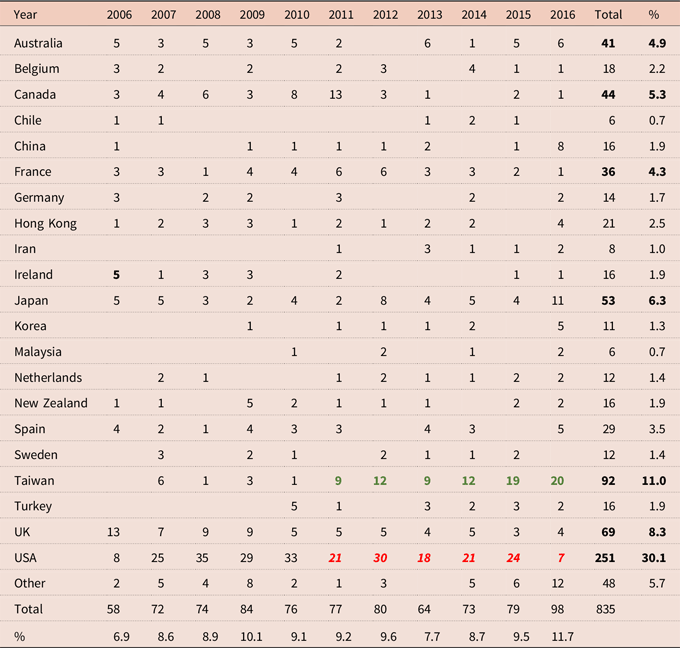
A wide range of countries is represented. The 21 countries listed in Table 1 have contributed significantly. Where publications involve two countries, both are recorded, and the authors’ location considered, not their nationality. The strength of CALL publicationFootnote 3 is concentrated in seven countries (in bold): United States (USA) 30%, Taiwan 11%, United Kingdom (UK) 8%, Japan 6%, Canada 5%, Australia 5%, France 4%. This distribution has remained steady, and their combined contribution makes up 70% of the total. However, CALL’s international expansion is indicated by the increasing number outside the top seven, with a further 29 countries contributing occasionally, in addition to the 21 recorded in the chart.Footnote 4 Individual figures for each journal can be found on the IRIS database.
Country of origin – all journals

Note. Bold indicates the top seven countries where CALL publication is concentrated. Figures in green represent a strengthening trend; figures in red a weakening trend.
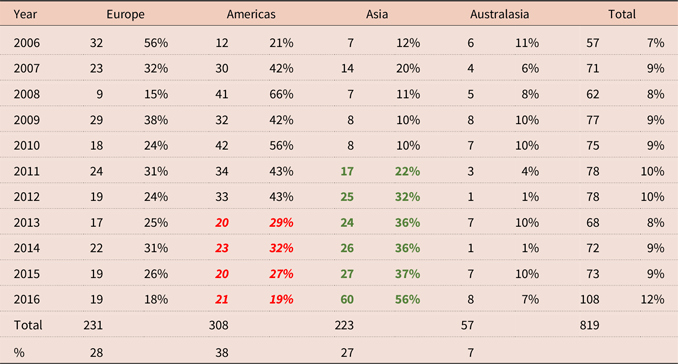
Considering publications by continent underlines this growing international strength (Table 2). By average number per continent, the Americas are still strongest overall, but have declined recently (indicated in italics). Europe’s contribution is consistently less strong in 2012–2016, whereas Asia’s production has increased substantially, especially in the last five years (indicated in bold); there are now three times more publications from this part of the world. Publications from Australasia have been maintained at a significant level. Africa is not included as only two African states were involved, working in partnership with lead institutions on other continents.
Publications by continent showing the yearly averages
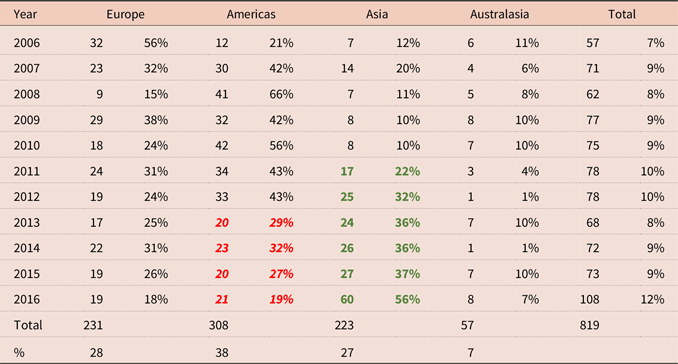
Note. Figures in green represent a strengthening trend; figures in red a weakening trend.
3.2 The topics researched
Considering the topics researched presents a taxonomical challenge as CALL has many aspects. For completeness, all aspects of language teaching significantly considered in each article were recorded, as a number of topics, such as speaking, reading and writing, may be studied together. Consequently, although 777 articles were examined, 1,415 CALL topics were identified. Topic frequency is presented from most to least researched, ranging across the whole of language teaching, and the results considered in the Discussion section. There are four tables for presentational reasons. The titles are quantitative, referring to each topic’s percentage in the overall table.
3.2.1 Group A: Most published topics
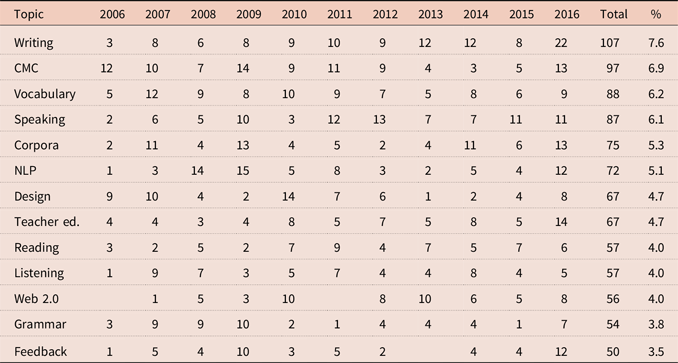
The most prominent finding is that the 13 most frequently researched topics, 65.9% of the total, are clearly ahead of the others (Table 3). Moreover, they have remained popular, with little movement in their positions relative to each other.
Most published topics

Note. CMC = computer-mediated communication; NLP = natural language processing.
3.2.2 Group B: Less published topics
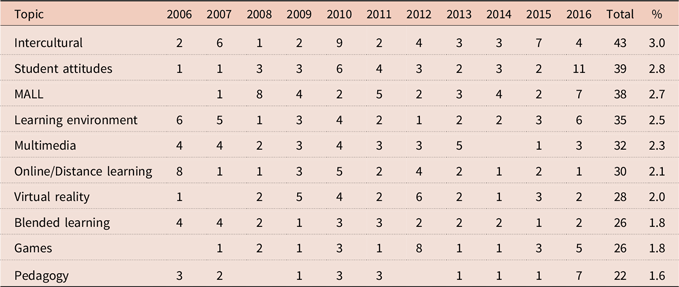
A second group (Table 4) shows a decline in entries, but, nonetheless, these 10 topics constitute 22.6% of the total. Along with Group A, they represent 88.5% of all topics. The bulk of research activity is focused here (no information is publicly available about articles unsuccessful in the review process).
Less published topics

Note. MALL = mobile-assisted language learning.
3.2.3 Group C: Scarcely published topics
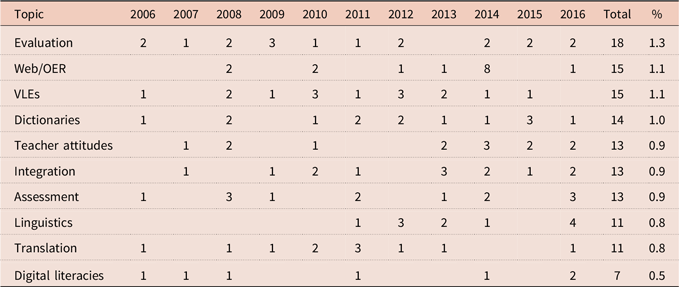
The 10 topics listed in Table 5 are all significant aspects of language teaching, yet constitute only 9.3% of the total.
Scarcely published topics

Note. OER = open educational resources; VLEs = virtual learning environments.
3.2.4 Group D: Least published topics
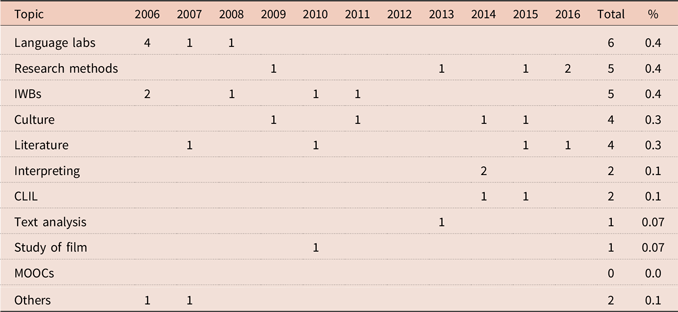
A final group, 2.2% of the total, contains under-researched topics (Table 6). All but one has registered at least once.
Least published topics

Note. IWBs = interactive whiteboards; CLIL = content and language integrated learning; MOOCs = massive open online courses.
3.2.5 Meta-analyses
Meta-analytical articles, which provide detailed pictures of specific topic areas, are relatively infrequent, constituting only 4.5% of the total (Table 7). CALICO has published meta-analyses regularly, whereas they appear infrequently in ReCALL and CALL; LLT has only two.
Meta-analytical articles

Replication studies are even scarcer. There are five: three in CALICO 32(2) (2015), with an earlier thought-provoking article by Chun in Reference Chun2012 on the importance of such studies, and one by Frankenberg-Garcia (Reference Frankenberg-Garcia2014) in ReCALL. This suggests a lack of follow-up in CALL projects.
3.3 The studies themselves
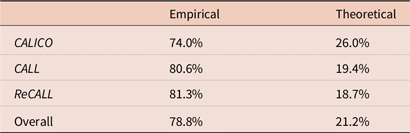
Empirical studies are defined as practical studies using CALL methods with students/pupils in university, secondary or primary school (there are few on the work of language schools or in-company training). Some studies classified as theoretical may make use of empirical findings, but their main focus is the elaboration of CALL theory. The figures for each journal (Table 8) indicate that the greater majority of articles are empirical rather than theoretical.
Empirical and theoretical articles

The majority of empirical studies relate to the teaching of English as a second language (Table 9), although this trend is less pronounced in CALICO.
Percentage of languages studied in empirical articles

4. Discussion
4.1 The international reach of CALL
The number of countries publishing CALL research has expanded, with 50 recorded in this survey. This increase is most pronounced in Asian countries, especially Taiwan. The USA is becoming less dominant, as indicated in Table 1 (bold for increase, italics for decrease). Interestingly, contributions from Germany and Scandinavia are fewer than one would expect, given past publishing patterns.
CALL is now a truly international discipline. This is emphasised if we consider the contribution from the different continents (Table 2). By 2016, the figure for Asia is much stronger, the same as Europe’s in 2006, and the proportion of papers from the Americas continues to decline. Asia’s growth is reflected in the increases since 2011 (outlined in bold). The Americas’ decline (outlined in italics) indicates the strengthening international participation in CALL research. Its number of papers peaks in 2010 and falls back to 2013, since when it has been steady. In 2016, its percentage is back to its 2006 level, whereas Asia’s proportion has climbed to over half.
These data indicate a wider participation in, and acceptance of, CALL. The number of different international scholars published is noteworthy. Over 1,330 have published at least one article during the period, either singly or jointly, which is evidence of a large and growing group of researchers.
4.2 The topics studied
4.2.1 Group A: Most published topics
Group A contains topics that are always central: the four skills of language teaching and learning – writing (basic to complex), speaking, reading, and listening, alongside the essential knowledge bases of vocabulary learning and grammar and the linked themes of feedback and error analysis and teacher education.
CMC (including telecollaboration) has maintained its popularity, in line with recent developments. Had it been classified with Web 2.0, its prominence would have been greater, although publications have fluctuated (two years with no entries) and were more frequent in the earlier years.
The presence of corpora, NLP and design in this group is linked to the topics mentioned above, providing support for the development of key skills, corpora frequently being linked with vocabulary learning and design to the creation of in-house courseware and related software. The strength of corpora and NLP has been strengthened through the publication of special issues,Footnote 5 which have encouraged research into these more complex areas (see Table 3 for these patterns).
4.2.2 Group B: Less published topics
In this group, the average is three to four entries per year. It includes topics viewed as strategic and innovative, such as MALL, which has also benefited from special issues on occasion, as have games and virtual reality (both less prominent recently). Despite this, the number of publications is limited.
Intercultural articles, while still numerically significant, tend to concern online contacts between students in different countries without necessarily involving deep knowledge of, and engagement with, those cultures, although articles such as Hadjistassou (Reference Hadjistassou2012) on cultural conflict and contradiction in online exchanges show that researchers are aware of this issue.
Topics related to delivery in the learning context in general – online and distance learning, blended learning, computer-based learning environments and multimedia – have limited treatment, although student attitudes has seen a welcome resurgence lately.
CALL pedagogy, despite a strong performance in 2016, remains under-researched. As in Group A, these trends have held broadly steady. There are fluctuations year on year, with no patterns of sustained change.
4.2.3 Group C: Scarcely published topics
These 10 topics relate to important areas of CALL, yet represent only a small percentage overall (9.3%). The trend noted in Group B regarding approaches to content and curriculum is more pronounced: there are few occurrences of web resources and open educational resources (OERs), integration, and virtual learning environments (VLEs). Digital literacies has five years without entries.
There are few articles on evaluation each year, but that low level remains consistent throughout. For four years nothing is published on assessment, a central element of language learning for which CALL can be helpful.Footnote 6 There are three years when nothing at all is published on translation, a central language skill. Published articles on translation relate to less advanced skills. Although CALL is considered a field of applied linguistics, there is little evidence of sustained engagement with linguistics (six years with no entries) beyond a concern for semiotics. Nothing is published for that topic until 2011. The gaps become more frequent, but these topics retain a presence throughout the period.
4.2.4 Group D: Least published topics
Continuing a pattern, some topics relating to the learning context have disappeared by 2016: language or multimedia labs by 2008 and interactive whiteboards by 2011. One could argue that they are no longer fashionable, or have been integrated into normal activity. That is less likely in the case of content and language integrated learning (only two articles) and massive open online courses (MOOCs – none), both content-related topics. Yet EUROCALL has an LMOOC Special Interest Group, so there is clearly interest in this area. Moreover, there are only occasional occurrences of articles on culture, literature, text analysis and film, suggesting that language-focused skills are more favoured. And interpreting, a practical and marketable skill, has only two publications, both in 2014.
There are only occasional articles on research methods, perhaps because the research article template is well established: abstract, keywords, introduction (area of investigation, theoretical background, literature review, research questions), methodology, results, discussion and conclusion. This structure is broadly consistent across the journals; however, deeper issues of research methodology could be addressed. The gaps in this group identify patterns of limited research.
Overall, these findings show that the pattern of CALL research has not changed significantly over the 11 years under study.
4.2.5 Meta-analyses
An examination of the meta-analyses reveals a similar pattern. Nine of the 35 are on vocabulary learning and associated disciplines including reading (Group A), two on CMC (Group A) and five on MALL (top of Group B), for a total of 46%.Footnote 7 Following this, a group made up of CALL trends (three), effectiveness studies (three) and technology choice (two) looks at CALL from a more strategic perspective (23%). However, the remaining 11 (31%) demonstrate the diversity of CALL: peer feedback, writing enhanced by NLP, integration, games, speaking enhanced by NLP, data sharing, Web 2.0, online pedagogy, theory, evaluation, and distance learning. This distribution indicates a similar pattern of concentration as the articles overall: a number of popular areas, and the rest less frequently considered, although the pattern is less marked.
4.2.6 The concentration of research studies
This phenomenon of the concentration of research studies on a smaller range of topics is interesting. Yet the tables include 46 topics. Moreover, CALL potentially interfaces with many different disciplines, including anthropology, educational theory, linguistics, cultural studies, philosophy, ethics, cognitive psychology, computer science, language technology, sociology, management and communication theory. However, engagement with these areas and the wider (inter)-disciplinary context appears limited.
Without providing detailed statistics, a brief overview of the articles in LLT using the same categories reveals a similar concentration but a strong emphasis on special issues. Sixteen of the 33 issues have a special focus, totalling 84 articles, as against 87 in the regular issues. Eight special issues focus on topics that occur in Group A of our survey: listening comprehension, reading, writing, grammar, speaking, vocabulary, CMC and teacher education; three in Group B: MALL, learning environments and games; and two in Group C on digital literacies. However, two issues concern less studied areas: hegemonies in CALL, less commonly taught languages; and one is a historical issue: 20 years of learning technology.
In the regular issues, 10 of the 13 topics from Group A appear at the top of the list. CMC is by far the most frequent, then writing, vocabulary, speaking, corpora, Web 2.0, listening, feedback, grammar, and reading. Intercultural studies, from the top of Group B, is also strong. Other topics appear only occasionally.
Book series, not systematically studied here, may not always conform to these trends. In the CALICO book series, for example, Group A topics are present: teacher education (2007), social networking and collaboration/social media and MOOCS (2009 and 2015), writing (2012) and design (2013), but there are also volumes on distance education (2008), Group B, and digital literacies (2014), Group C. Other volumes cover less researched areas such as limited technology contexts (2010), learner–computer interaction (2011), and more general areas, with two on new directions (2006 and 2011) and landmarks in CALL research (2016).
The research reported shows that the majority of CALL teaching is aimed at beginners and intermediate students, and focuses on the key language skills. Advanced skills and more complex topics are less frequently addressed (see, e.g., Burston & Arispe, Reference Burston and Arispe2018). Yet the latter remain important in the wider language teaching world. Advanced translation skills provide a key area of employment for linguists; and the study of literary, filmic and cultural texts provide language content that leads to a deeper knowledge of the culture of the language concerned. More on students’ and teachers’ psychology and motivation would be valuable; and the nature of the CALL curriculum needs serious theoretical consideration, as the evidence from this overview suggests.
In addition to the under-researched areas, one could easily make a wish list of topics that would benefit from being researched. CALL and ethics could be considered; for example, CALL in situations of conflict – in teaching refugees, or tracing the use of digital surveillance means in oppressive political systems. Articles such as this one, or on CALL history, or reflections on the nature of CALL are few, yet those published provide helpful strategic insights.
4.2.7 Reasons for this concentration
Although the CALL field has expanded considerably since 2000, as the list of topics has shown, I have detected an established pattern of concentration. A number of reasons for this can be tentatively advanced.
The publish or perish syndrome. Pressure to publish – to get or retain a post, or gain promotion – can tempt researchers to set up empirical projects that are easily to hand and relate to the skills they need to transmit in their teaching, often, as we have seen, from beginner to intermediate level. Therefore, except in teacher education, advanced language skills such as translation and interpreting are infrequently addressed and cultural content limited. Colpaert (Reference Colpaert2012) has written eloquently on these pressures. While understandable, there are consequences. Significant theoretical groundbreaking engagements or long-term projects become more difficult and less likely.
The fashion factor. Then there is the pressure to follow the fashion. The current favourites are CMC/telecollaboration, and Web 2.0/social media. While mirroring the digital direction of society, the unintended consequence can be the neglect of other areas. The risk is that if these trends persist, the sector will be diminished in overall effectiveness.
Integration and normalisation. Another factor is the advance of digital technology and skills in society. The groundbreaking change since 2006 has been the convergence of Web 2.0 and the smartphone, epitomised by the appearance of the iPhone in 2007. People of all kinds now have access, via a powerful handheld phone/computer, to the web and applications allowing them to perform a wide variety of tasks from banking, purchasing, booking flights, contacting friends, listening to music, taking photos and reading newspapers, to organising events, controlling home heating, finding travel directions, answering emails, taking photographs, scanning documents, and talking to people face to face thousands of miles away. With the arrival of the tablet computer and the resurgence of personal computers, computer use of all kinds is at the centre of everyday life. It has become normalised, to use Chambers and Bax’s (Reference Chambers and Bax2006) term.
This radical change can be seen in the Google generation’s dependence on using the Internet, email, Twitter, YouTube, Instagram, Facebook and Amazon almost without thinking. This environment has affected CALL teaching and research. Topics such as digital literacy seem less pressing, and risk being taken for granted, and the skills of web use and web searching and exploiting the Cloud have lacked significant scrutiny. That does not explain the relative lack of articles on the dynamics of distance learning, although useful theoretical work has been done by Bertin and Narcy-Combes (Reference Bertin and Narcy-Combes2012) on modelling to help tutor effectiveness.
In many contexts, we can now assume, unlike in 2006, that almost all students own smartphones and portable computers or tablets, and have ready institutional access to computers. The power, performance and reliability of campus computers is such that their use is much less problematic. Wi-Fi is ubiquitous, and VLEs are the norm, so it is reasonable to propose that teachers and students in universities worldwide work in computer-assisted learning environments. So topics such as web resources, VLEs, language laboratories, integration, and computer-based learning environments are the normal setting for teaching and research (while not always problem-free). In many contexts, blended learning, in one form or another, has become the norm. However, there are caveats such as Trinder’s (Reference Trinder2016) recent study, finding that there is still a strong preference for face-to-face work, without dismissing the advantages of an effective blended learning environment. Yet as these aspects of CALL have become more integrated, they are less separately studied, as our tables have shown, as they are the platforms on which other work is carried out. Indeed, one would be reluctant to say that these general computer skills, whether of digital immigrants or natives (e.g. Prensky, Reference Prensky2001), translate easily into computer learning skills, exposing another area that needs scrutiny.
4.3 The studies themselves
4.3.1 Empirical versus theoretical studies
The pattern in the three journals is similar, although CALICO has published more reflective articles on the history, nature and future strategies of CALL. It also publishes meta-analyses more consistently (see Table 7).
4.3.2 Small-scale empirical studies
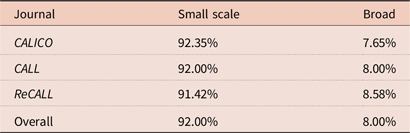
Furthermore, when considering empirical articles, a definite pattern of projects emerges. Most are small scale (Table 10) in that they share some of the following characteristics: they are conducted over a few weeks or a semester at most, or infrequently over one academic year; are preliminary, and usually not followed up; and involve a small number of students (sometimes fewer than 10), more often at beginners or intermediate level, in a single institution (except for CMC).
Classification of empirical articles

Other factors can come into play. The focus can concentrate on studying the use of one piece of software, in one class, related to one skill, such as reading comprehension. Students can be volunteers, risking only the motivated taking part, so potentially distorting results. Project evaluation more often surveys satisfaction levels of students and teachers, rather than evaluating academic outcomes.
Their conclusions concede the difficulty of generalising from their findings, rather than outlining what their next steps will be. Such honesty is positive, as is the willingness to report a project failing to produce the hoped-for results, but tends to undermine their impact. The evidential value of these often excellent studies could be enhanced if they were broad in approach, conducted over an extended period, with a range of students, including all the students of a cohort, often with other institutions, and collecting a significant amount of data, from a range of sources; for example, projects such as Newhouse and Cooper’s (Reference Newhouse and Cooper2013) work on computer-based oral exams in Italian language studies. This pattern is consistent across all three journals.
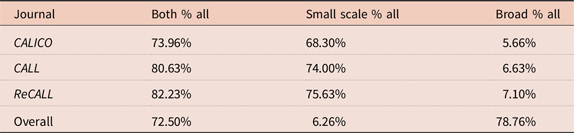
In each journal, over 90% of all empirical articles are small scale. The percentage of small-scale studies in relation to all articles (empirical and theoretical taken together) is still high, at well over 70% (Table 11). The discrepancy in relation to CALICO is because it publishes more theoretical articles.
Small-scale empirical articles as a percentage of all articles

It is clear that, although there are some minor fluctuations, the ratio of small-scale projects across all journals is increasing, with a particular spike in CALL in 2016 (Table 12; small-scale figures on the left, broad on the right); this is only partly accounted for because CALL started publishing eight issues that year, against six in 2014–2015 and five in earlier years. The changes are outlined in bold red.
Small-scale versus broad empirical articles per year

Note. Figures on the left represent small-scale empirical articles; figures on the right represent those broader in approach. Bold red font indicates a strengthening trend towards small-scale studies.
4.3.3 The predominance of the teaching of English
Another notable characteristic is the number of studies based on English teaching. As we have seen (Table 9), only five other major languages (Spanish 7.7%, French 6.4%, German 6.5%, Chinese 2.8% and Japanese 2.4%) have a substantial number of studies, and almost all multilingual studies include English.Footnote 8 Given English’s role as a global language, this trend is understandable. However, the majority of students are learning English for pragmatic reasons, as a small or minor part of a major degree in another discipline, their main focus. They are not language specialists, so their ambitions are limited. This may explain why so many empirical projects relate to beginners and intermediate level.
4.3.4 Research methods
These findings do not mean that small-scale empirical studies lack value. Their contribution to the field is significant and can point in many valuable directions. I have, however, suggested that their evidential authority, the generalisability of their conclusions and their impact would be greatly enhanced if more data (both quantitative and qualitative) were obtained from a range of students and institutions over a longer period. However, the academic rigour of all the articles needs to be emphasised. The quality of the editing of the journals is high. All articles had helpful abstracts and keywords; clear statements of the nature of the study; theoretical introductions (although the frequently mentioned theorists, such as Vygotsky, Bruner and Warschauer, suggest limited theoretical engagement) and extensive reviews of the literature; sound methodologies: mixed methods, control and experimental groups; relevant statistics and appropriately critical approaches to their qualitative data and the discussion of results.
The quality of the writing (many authors communicating in their second language) is consistently high. One noteworthy (albeit partly subjective) finding is that there were not many strikingly original pieces. The findings were what one might expect, and concerned the application to local contexts of principles established elsewhere in areas such as CMC. This would require a deeper analysis, which is beyond the scope of this article. As already stated, many studies focused on student/teacher responses rather than the more objective data provided by means such as student tracking, recommended by Fischer (Reference Fischer2007). More positively, show-and-tell projects merely considering student use of materials were rare, and there were impressive articles on software/courseware design processes for in-house projects. The pattern of researchers being the teachers and using their own students as the subjects of investigation is, as suggested, evidence of pressure in university contexts and an understandably practical solution to the publish or perish environment.
Positively, few projects compared paper-based with computer-based teaching methods to justify using the latter – though they still exist, even in 2016, which is evidence of the residual lack of confidence mentioned earlier. Do we still need to prove that CALL is respectable and worthwhile? The quality of the research articles studied suggests not, but such studies are nonetheless useful for control in relation to experimental designs.
4.4 Using past research to understand the future
Assessments of CALL history and development, whether general or on a specific topic, are under-represented (perhaps one reason for research concentration), but have been helpful in understanding the field and identifying the trends I have discovered. Chapelle’s (Reference Chapelle2005) keynote at the CALICO 2005 conference calls for recognition of CALL as a serious area of research and scholarship, with a place on the graduate linguistics curriculum, signalling its interdisciplinary character; Hubbard’s (Reference Hubbard2008) survey of CALL theory over the previous 25 years outlined the need for significant theoretical developments, with 113 different theories identified in 166 articles. A more recent assessment with Levy (Hubbard & Levy, Reference Hubbard, Levy, Farr and Murray2016) characterises this multiple use of theories as theory ensembles, proposes a framework to measure theory’s integration into practical studies and emphasises the need for serious theoretical reflection.
Fischer’s (Reference Fischer2008) overview editorial for CALICO’s commemorative issue provides evidence that some of the topics I have identified as frequent are present throughout those 25 years, such as reading, speaking, NLP/design, but also welcomes new developments. Garrett’s (Reference Garrett2008) call in the same issue to avoid reinventing the wheel by being aware of previous studies, while less of a problem, is still a consideration in the most recent articles considered for this study in 2016; Kennedy and Levy’s (Reference Kennedy and Levy2009) study of 15 years of CALL technology and the principles of sustainability that have been discovered epitomises the kind of broad, long-term strategic research that is needed. Gimeno-Sanz’s (Reference Gimeno-Sanz2016) insightful review of CALL history maps the challenges of the pace of technological development posed by “integrative CALL” and proposes a needs-driven “atomised CALL” to deliver high-quality OERs. My emphasis on the importance of the study of culture for language learning is not new, and a framework for approaching it is expertly outlined by Levy (Reference Levy2007), although his analysis stops short of a significant direct engagement with cultural content such as literature and metaphysics.
Seminal articles instrumental in the development of various areas, such as Kukulska-Hulme’s (Reference Kukulska-Hulme2009) piece on mobile learning, and Colpaert’s (Reference Colpaert2006) article on the design process for the development of CALL courseware and the importance of a research-based and research-oriented approach, have been helpful in showing how new areas should be developed. Articles such as that on fandom and the digital wilds (Thorne, Sauro & Smith, Reference Thorne, Sauro and Smith2015) are part of a growing movement towards the study of language alongside cultural content.
There have also been many innovative practical articles such as Gabaudan’s (Reference Gabaudan2016) outline of her use of the Internet for student support during their year abroad, Shei’s (Reference Shei2008) use of Google to assist in the process of concordancing, and Levy and Steel’s (Reference Levy and Steel2015) revealing broadly based practical study of the varied uses, and strategic importance for CALL learning, of electronic dictionaries. This selective list illustrates the research quality to which I have referred.
5. Where do we go from here?
This overview has indicated that CALL research has gone through a period of growth in terms of the quantity of articles published, quality and consistency, complexity, and the range and diversity of new areas opening up. These findings show a research area that is healthy, maturing and growing in confidence, not needing to be defensive.
I have identified issues that could be addressed: the concentration of a large percentage of research on a limited number of topics related to key language skills, leaving many strategic topics under-researched, the predominance of empirical over theoretical articles, and the small scale of most empirical projects. Of course, colleagues are free to make their own research choices. However, in my opinion based on this survey, CALL provides new opportunities to enhance our delivery of all aspects of the teaching and learning of languages in their social and cultural contexts.
5.1 Thinking strategically
A model of CALL research could be created identifying areas for development based on our knowledge of CALL history and our awareness of its current strengths. The challenge is to continue doing what we do well, but engage more with the less studied areas of language learning and see CALL integrated into all aspects of language teaching, from beginners and language for special purposes to specialist degrees and advanced language skills. We have the critical mass of international scholars to do so, from early-career researchers to CALL pioneers, and it is important to recognise that these questions are also a focus of cognate areas of linguistics. At present, one could argue that much of the theoretical thinking is taking place outside the CALL community, or at least outside major CALL journals.
CALL associations have a role to play. The journals examined all have special issues that could target under-researched areas, as LLT has done, with issues on hegemonies (16:2) and less commonly taught languages (17:1). More meta-analytical studies and historical and theoretical reflections would be valuable. Similarly, conferences or workshops on neglected areas such as CALL and translation, CALL and ethics and CALL and culture could be organised, and book series, such as CALICO’s, used strategically.
Encouragement could be given to researchers to think about longer projects by running research methods workshops at CALL association conferences, and delivered by research leaders to their doctoral students and fellow researchers. Extensive longitudinal studies partnering with other institutions could produce significant results with evidential force. Obtaining research funding to develop projects with other institutions, nationally and internationally, perhaps working through special interest groups, could assist this process. Such projects have been successful in the evolution of CALL over the years (Gimeno-Sanz, Reference Gimeno-Sanz2016).
A commitment to improving CALL research and growing the discipline is required: being prepared to undertake less fashionable projects, learning not only from leading CALL theorists and practitioners, but thinking theoretically and practically for ourselves. It means not assuming that the widespread digital skills of so-called digital natives translate easily into effortless language learning.
5.2 Deepening our understanding of language and culture
Ultimately, these avenues challenge our basic understanding of language and culture. Reflecting on their complex nature will enhance our approach to CALL.Footnote 9 CALL is not merely about transmitting basic language skills – focusing on language and culture could increase our research impact and effectiveness. Cultural CALL – that is, understanding how values (cultural, moral and metaphysical) infuse language and life – could help us deepen our research. Kramsch (Reference Kramsch2018), in her challenging keynote at EUROCALL 2018 in Jyväskylä, “Teaching foreign languages in the digital age”, spoke of the importance of developing a critical awareness of the worldviews we bring to our studies, of becoming more aware of the importance of the cultures in which languages exist, and being sensitive to the complexities of language.
These findings have indicated a limited engagement with culture and values, and the complexity of language, especially in relation to social and political situations. Exchanges through CMC have valuable cultural purchase, but approaches to culture could be deepened. Literature, text analysis and film are barely present in this survey, although there are some helpful contributions (e.g. Johnson, Reference Johnson2010), even though they, alongside politics and history, are important aspects of university language study, particularly for specialist degrees, and are at the heart of any advanced use of language. There is little on translation and interpreting, that crucial nexus between language, culture and communication. Alongside our excellent current research, engaging more fully with the social, ethical and cultural aspects of CALL would be valuable.
6. Conclusion
A synthetic overview of this kind identifies trends, indicates gaps and draws attention to research opportunities. The findings indicate an overall strength in research quality, and a welcome growth of the international CALL community. Perhaps the most striking finding of this project is the concentration of the majority of the articles examined on a relatively small number of topics. These topics admittedly relate to the key language skills of speaking, reading, writing and listening, alongside vocabulary and grammar development and CMC. However, this has meant that a number of strategic topics are under-researched, especially in relation to advanced language learning and those aspects of language that relate to cultural content and context. The predominance of empirical over theoretical articles, and the small scale of most of those empirical projects has been noted. There are clear benefits for the discipline in increasing the number of broadly based longitudinal studies alongside an increase in engagement with language learning theory.
An analysis such as this is inevitably limited in scope, as individual articles cannot be closely studied or critically commented upon. These findings would benefit from being measured and tested against a wider range of sources: other CALL journals such as LLT, Alsic and System, CALL articles in other journals, and peer-reviewed books and book series or chapters, as well as PhD dissertations.
However, while this project has been an encouraging exposure to the strength of contemporary CALL research, its findings challenge us as researchers to work on a wider range of topics, especially at advanced level language study, explore emerging areas, and consider broadening the scale, design and evidence base of our investigations.
Supplementary material
To view supplementary materials referred to in this article, please visit https://doi.org/10.1017/S0958344020000051
Ethical statement
Preliminary findings were presented at EUROCALL conferences, but this did not present any conflicts of interest, merely assisting with the presentational focus of the findings.
About the author
John Gillespie is a Professor of French language and literature at Ulster University (Emeritus). A founder member of EUROCALL, he has been treasurer of the association at its HQ since 2010. Research interests include CALL history and strategy; motivation in CALL; multimedia; learning environments; language policy; and the interaction of literature, philosophy, theology and religious belief in 20th-century (French) culture.
Author ORCIDs
John Gillespie, https://orcid.org/0000-0001-8211-827X