1. Introduction
Understanding the potential of massive open online courses (MOOCs) as useful tools for language learning requires a contextual, grounded, and, above all, conceptually coherent approach (Colpaert, Reference Colpaert, Martin-Monje and Bárcena2014: 163). Although this potential has generated a body of theoretical and methodological research dedicated to the concept (see Bárcena & Martín-Monje, Reference Bárcena, Martín-Monje, Martín-Monje and Bárcena2014; Dixon & Thomas, Reference Dixon and Thomas2015; Qian & Bax, Reference Qian, Bax, Qian and Bax2017, as examples), the number of studies exploring specific courses, and assessing their development, remains small (Miyazoe, Reference Miyazoe, Dron and Mishra2017: 638). Consequently, MOOC learners who are studying a language may represent a somewhat uncharted territory, with typical motives and behavioural patterns of language massive open online course (LMOOC) learning underexplored (however, see Beaven, Codreanu & Creuzé, Reference Beaven, Codreanu, Creuzé, Martín-Monje and Bárcena2014, for an innovative example of such a study). Guidance may be required for course designers who seek pedagogical lessons in “making the massive human(e)” (Sokolik, Reference Sokolik, Martín-Monje and Bárcena2014: 20). This further involves understanding the types of learners that may make use of resources, their underlying purpose for doing so, and the role of MOOC learning within a wider ecological approach to language learning (The Douglas Fir Group, 2016), and indeed in conceptualising MOOCs as just one element of the broader “lifespace” (Veletsianos, Reich & Pasquini, Reference Veletsianos, Reich and Pasquini2016) of learning a language. Indeed, we would argue that a central challenge is locating the “LMOOC learner” definitionally, in particular where their learning is placed within the wider “system of social relations, activities, experiences and multiple micro- and macro-contexts …” (Ushioda, Reference Ushioda, Dörnyei and Ushioda2009: 220), which learning a language necessarily involves. This is particularly important given that we might conceptualise a language learner using technology as being either a person whose interest in technology led them to study the language, or a learner of a language who uses technology to pursue their interest (as noted by Stockwell, Reference Stockwell2008). To define further involves considering the micro-level course behaviours and developing models based upon the actual needs of learners, as manifested through behaviour, and considering relational elements of such learners’ participation.
This paper presents initial exploratory results on this question using an Irish language LMOOC, Irish 101, as a case study. A mixed-methods approach to analysis was conducted using an instrument that measured the frequency of various learning behaviours (n = 125), in addition to making use of open-ended responses and in-course comments, to consider and identify the main drivers and impediments to learning behaviours in the LMOOC. We present both statistical and qualitative evidence that emphasise several of the challenges inherent in LMOOC design and argue that the future use of LMOOCs is dependent upon clarifying the precise role of such courses. If the instructional goal is to encourage second language (L2) production, as seems reasonable, further work may be needed to encourage participation within courses and to empower respondents to use what they are learning in a technology-mediated context to further use their learning in offline contexts.
1.1 LMOOC learning: Empirical research conducted to this point
As the arrival of this special issue suggests, the general paucity of research into LMOOCs, particularly in empirical examples of applied research, is notable, and exciting potential exists to further our understanding of why and how LMOOC learners participate, in addition to how to enable them to develop greater fluencies in the target language. Given the explosive global growth of MOOCs more generally (Shah, Reference Shah2018), their potential as a means of enhancing lifelong and informal forms of language learning should not be underestimated for language learners (see Chik & Ho, Reference Chik and Ho2017, on adult learner autonomy as well as Ushioda, Reference Ushioda2013, on wider mobile technologies), allowing learners to return to or to commence forms of study they consider valuable but difficult to continue within more structured, formalised pathways.
Two broad strands of research into LMOOC development are distinguishable: (a) identification of appropriate pedagogies and design principles for teaching a language at scale, and (b) a second strand focusing on the behaviours of learners within LMOOC platforms, respectively. Examples of the former, such as Bárcena and Martín-Monje (Reference Bárcena, Martín-Monje, Martín-Monje and Bárcena2014), suggest that LMOOCs are still very much in an initial phase of development (p. 6), and with something of a tension existing between how to deliver appropriate forms of feedback to promote communicative fluencies and the role of realistic course design within a wider ecology of learning of which we have spoken (Sokolik, Reference Sokolik, Martín-Monje and Bárcena2014: 21–25). It is here that much LMOOC research tends to bear a resemblance with the field of computer-assisted language learning (CALL) more broadly in considering how particular types of course designs, pedagogical approaches, and structures might be relevant to enable language learning using technological means. Particular issues loom large here, with an added dimension of the need for greater pedagogical research into the longer-term effects of mobile and digital technologies (see Shadiev, Hwang & Huang, Reference Shadiev, Hwang and Huang2017, for a recent review).
The latter strand, however, emphasising behavioural and psychological elements of learning, is where we locate our own work. A recent approach that focused strongly on understanding learner behaviour in context is that of Martín-Monje, Castrillo and Mañana-Rodríguez (Reference Martín-Monje, Castrillo and Mañana-Rodríguez2018), who analysed the patterns of behaviour visible in an English language MOOC. Their results suggested that most learners within the LMOOC under study could be classified as either “viewers” or “all-rounders”, using Anderson, Huttenlocher, Kleinberg and Leskovec’s (Reference Anderson, Huttenlocher, Kleinberg, Leskovec and Chung2014) taxonomical approach to engagement styles. The authors further noted that levels of social engagement were far lower than might be expected and did “not contribute significantly to explain student success in the LMOOC” (p. 267), a point to which we will return in this study. Beaven et al. (Reference Beaven, Codreanu, Creuzé, Martín-Monje and Bárcena2014), in an aforementioned initial study of a French language LMOOC, found several broad trends regarding motivation, such as a generally intrinsic orientation for most learners, that they were typically self-motivated and placed great emphasis on the voluntary nature of the MOOC (p. 63), and that they were free from external constraint in pursuing these interests (a tenet considered critical in self-determination theory; see Deci & Ryan, Reference Deci and Ryan1985). This is unsurprising, given that most LMOOCs are not (yet) credit yielding, and suggests that participants likely need to perceive their participation, however conceptualised, as being of some value (Brophy, Reference Brophy1999: 79). Absent such subjective assessment of value, learners may withdraw from engaging in further participation, or lack the interest to continue.
1.2 How do LMOOC learners behave, and why do they behave so?
It follows, synthesising both of the strands of research described, that the role of particular learning activities, pedagogical designs, and tasks in provoking (or depressing) particular behaviours, within particular courses, is critical. This need for grounded research can be considered the next step in moving from creating behavioural taxonomies and profiles to more granular analysis of activities in which learners might engage on a MOOC, and how these may relate to wider goals of learners.
This concern has begun to be applied more broadly within work discussing dynamics of behaviour on MOOCs; for example, many initial studies on MOOC participation focused heavily on the concept of completion as a heuristic for engaged participation (e.g. Jordan, Reference Jordan2015; Kizilcec & Schneider, Reference Kizilcec and Schneider2015). Although these studies have provided useful contextual information, and enabled the development of taxonomic approaches to categorising learners, we argue, in keeping with Henderickx, Kreijn and Kalz (Reference Henderickx, Kreijn and Kalz2017), that far more research is needed that considers the concept of learner subjective expectation. Where learners wish to complete only a small portion of course activities, and in fact then do so, it might not be entirely fair to make use of a course-completion metric, as the learner achieved what they intended. In a language learning context, this may be especially true, when considering issues of motivation, and language learning as a longer-term task. We note Henry and Lamb’s (Reference Henry, Lamb, Lamb, Csizér, Henry and Ryan2020: 609) and Bodnar, Cucchiarini, Strik and van Hout’s (Reference Bodnar, Cucchiarini, Strik and van Hout2016) recent arguments that a certain conundrum has been the low levels of cross-pollinating research between the fields of second language acquisition (SLA) motivation and CALL.
In this light, there has tended to be limited consideration of theories explicitly applied within wider SLA motivational research (for a summary of this broader body of work, see Dörnyei & Ushioda, Reference Dörnyei and Ushioda2013; Lamb, Csizér, Henry & Ryan Reference Lamb, Csizér, Henry and Ryan2020), such as understanding learners to not merely be engaged in interaction with language tools but to be bringing a whole constellation of behaviours, identities, and their wider selves to their learning processes (Thorne, Sauro & Smith, Reference Thorne, Sauro and Smith2015: 217), in addition to, in many instances, a desire to achieve a certain level of L2 fluency. A corresponding weakness also identified within the literature is the reverse: that issues of technology have often had limited impact on developments in the field of L2 motivation (Al-Hoorie, Reference Al-Hoorie2017: 15), in particular the innovative ways in which many learners use digital resources to engage in language learning as a longer-term act, and the limited empirical base for theorising such processes and viewing such behaviour in context.
We argue, therefore, that a need exists for studies that see which specific behaviours, both L2 oriented and not, are prevalent among LMOOC learners, to allow us to scrutinise and reflect on what types of specific, L2-directed patterns of participation might be established. Doing so might provide some inferential evidence as to what types of resources and pedagogical approaches can enable learners to continue learning over periods of time.
2. Case study: Irish 101
Irish 101 is an Irish-language MOOC that was launched on the FutureLearn platform in January 2018. The course is the first in a longer series of courses designed to enable learners to work towards an A2-level proficiency. The course is four weeks in length and consists of a mixture of cultural activities, discussions, quizzes, and a large corpus of audio and video files. The course also draws upon FutureLearn’s explicit social constructivist framework, incorporating frequent prompts for social engagement, sharing, and collective understanding. Since inception, the courses have had over 50,000 registrations, with Irish 101 itself accounting for over 20,000 of those registrations. High levels of social engagement have been recorded, with approximately 75% of registered learners being considered “active” (completing at least one step) and 30% of learners “social” (posting at least one comment) (both terms defined by FutureLearn itself; see Jenner, Reference Jenner2018).
2.1 The Irish language
Irish is an insular Celtic language, spoken natively on the island of Ireland. It is the first official language of the Republic of Ireland, a regional language within the United Kingdom (i.e. in Northern Ireland), and is an official language of the European Union. It is a minority language, with approximately 70,000 first language (L1) speakers, but a far broader proportion of Irish people claim fluency (1.7 million to some level; 500,000 or so fluently) (Central Statistics Office, 2017). The language is a mandatory school subject up to the age of 18 and is also studied around the world by communities of Irish heritage learners, and those with an interest in Irish culture, through a network of international resources, suggesting the language is “a global phenomenon … no longer restricted to Irish-based and Irish born” (Ó Conchubhair, Reference Conchubhair, Nic Pháidín and Ó Cearnaigh2008: 238). At present, over 1 million persons are actively learning Irish on Duolingo, for example, indicating that the language has a global reach and that many learners are undertaking learning the language using an array of distance, informal, and non-formal means (Ní Aodha, Reference Ní Aodha2016).
2.2 Typical participants: A brief overview
Ongoing research conducted within the project indicated that the majority of learners were older (51% over the age of 55), female (approximately 72%), and of Irish heritage (65%), or Irish (12%), though with substantial numbers of non-Irish heritage learners (23%). The course participants were also diverse in that approximately 25% spoke a language other than English as their L1, indicating an array of previous experience levels and exposure to the Irish language.
3. Methodology
All statistical data analysis was conducted using SPSS (Version 25) and involved exporting initial data from Qualtrics, the survey platform through which the questionnaire was administered. All qualitative data analysis was conducted using Qualtrics (Version 15), allowing the development of a coding frame.
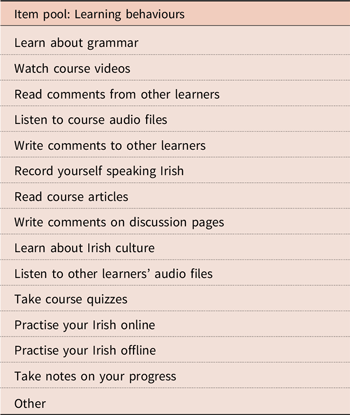
To measure the varying prevalence of different types of learning on the MOOC, an exploratory survey was designed describing 14 different activities that participants were likely to engage in during the MOOC (e.g. “take course quizzes”, “Learn about Irish grammar”). This survey was embedded at the end of each week in the third run of Irish 101 (registered participants, n = 3,254). Initial analysis aimed at ensuring a large enough sample to allow a week-level contrast, yet the sample size was too small to do so (n = 125, 117 of which were completed responses and 8 of which contained at least some missing data).
This item list (Table 1) was adopted to reflect the types of activities we expected of learners, including elements involving offline interaction, to reflect wider L2-oriented learning. An exploratory factor analysis (EFA) was conducted to consider whether these items could be grouped into latent factors. A confirmatory analysis was not conducted, given the small-scale sample involved and exploratory nature of the study.
Item pool

Additionally, a criterion question was measured, of how motivated respondents felt that week, which was used to measure whether specific items correlated more or less strongly with this general barometer and to demographic variables relating to age, gender, and national origin.
Complementary to this quantitative data, the study employed a pragmatic mixed-methods approach (Morgan, Reference Morgan2014) through utilising a secondary source of qualitative data: open-ended data responses in the survey, to which learners were asked to describe their engagement with course materials over the length of the week.
3.1 Research questions
Thus, the study had five research questions:
-
1. Which learning behaviours were most and least common on the LMOOC?
-
2. Were there underlying factors present within these behaviours in the data set?
-
3. What was the correlation between the various behaviours and a measure of general motivation?
-
4. Were significant differences observed in behaviours using gender, age, and national heritage as control variables?
-
5. How did learners assess their own behaviours, and what types of antecedents did they attribute to them?
4. Results
4.1 Question 1: Frequency of behaviours
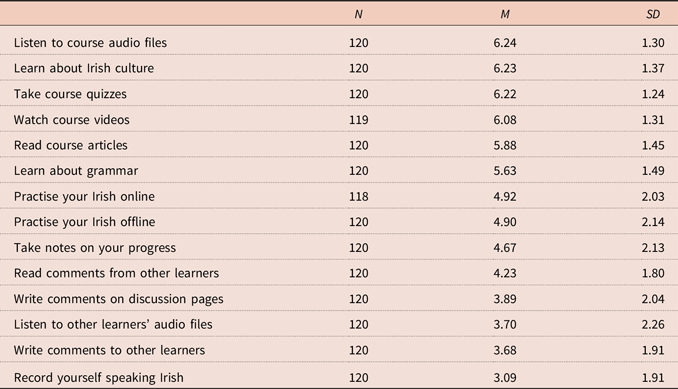
Our first results table (Table 2) demonstrates the degree of engagement of each individual task. As might be expected, the majority of items (10/14) had a positive average score, indicating that they were engaged in by most learners simultaneously. The three highest rated in this regard were listening to course audio files, learning about Irish culture, and taking course quizzes. All three, it could be noted, share in common their solitary and exploratory nature.
Descriptive statistics

Two inverse trends appeared to unite the lower-placed items; first, they typically involved producing L2 output (either writing or recording), but also interestingly involved listening to or assessing L2 output that other learners had produced, suggesting a common “social” dimension. Although the former might be expected in an ab initio course, given few learners might have practised the language before, the latter indicates learners did not focus on the potential of using the platform as a means of listening to other learners or of assessing their own proficiencies relative to others. This element might be important, particularly given the potential for a link between the two concepts, which we will explore below.
4.2 Question 2: Were there underlying factors present within the data set?
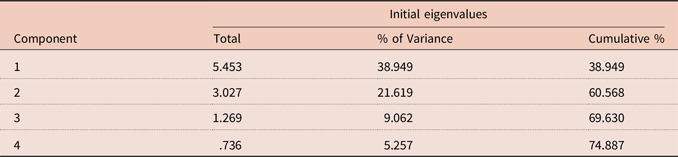
Our next question focused on whether particular types of behaviours could be grouped together. It was posited that latent factors would indeed be present, and for this purpose, an EFA was conducted using a principal components analysis/oblimin rotation. Model fit was strong (KMO = .849, p = .000), and scree-plot analysis indicated that a three-factor solution was most adequate, with an obvious “elbow” (Table 3).
Factor eigenvalues table

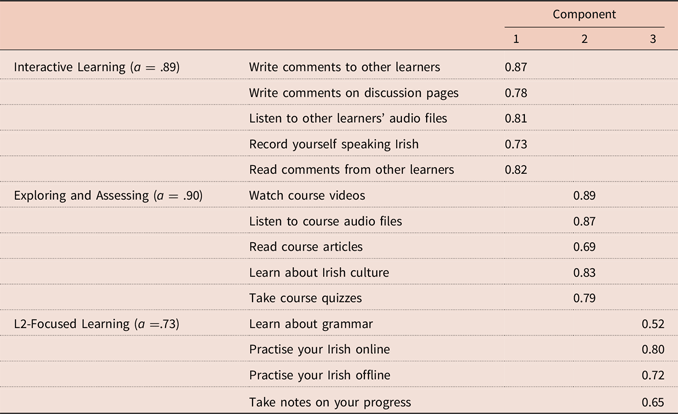
The three-factor solution accounted for 69.6% of variance, suggesting the model was a reasonable fit to the underlying data. Communality analysis suggested the model was also an adequate fit for most items, although two did not fit especially well, “taking notes on your progress” (.50) and “learning about grammar” (.46), to which we will return. Although inevitably a process of interpretation (Gorsuch, Reference Gorsuch, Nesselroade and Cattell1988), our analysis indicated that each of the three factors could be labelled quite easily, as each of the items shared several commonalities (Table 4).
Factor analysis pattern matrix

4.2.1 Factor 1: Interactive Learning (a =.89)
Factor 1 was labelled “Interactive Learning”, as it contained five items that all referred to producing speech/text and interacting with other learners. This factor demonstrated a strong alpha (a = .89), and as we have noted, many of the items were among the lowest rated by respondents.
4.2.2 Factor 2: Exploring and Assessing (a =.90)
In contrast, Factor 2, “Exploring and Assessing”, contained five items relating to consuming or assessing course content – watching, listening and reading materials, which were available on the MOOC. Given the course had no summative assessment, it is interesting to note that formative assessment (typically multiple-choice question quizzes) also loaded into this factor.
4.2.3 Factor 3: L2-Focused Learning (a =.73)
The third factor contained four items, each of which related to learning the language beyond the confines of the course. This included practising your Irish both online and offline, in addition to lower loadings for the two “complex” items we observed, those of taking notes and of learning about grammar. This factor also had the lowest alpha of the three (a = .73), although it was still acceptable.
4.2.4 Factor intercorrelation
At factor-analysis level, we found that all three factors were positively correlated (suggesting they are not dichotomous), though quite weakly. Factor 3, L2-Focused Learning, had a weak but significant correlation with both Interactive Learning (r = .33**) and Exploring and Assessing (r = .29**). Interestingly, those two factors were non-significantly correlated with each other (r = .09), indicating those exploring content were not especially more likely to engage in the social elements of learning, or viceversa.
4.2.5 Factor-level means
Analysis at factor level indicated that Exploring and Assessing had the highest mean (M = 6.13), followed by L2-Focused Learning (M = 5.03), with Interactive Learning considerably lower, scoring negatively (M = 3.59).
4.3 Question 3: Correlation with general motivated behaviour
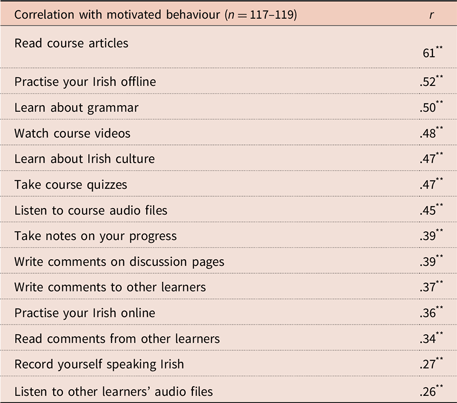
The next element of our analysis was to consider whether particular items might correlate strongly with the answer to a single question: “How motivated did you feel learning this week?” (Table 6). This question was selected, instead of utilising a more sophisticated scale, so as to enable simple and fast measurement, thus serving as a simple heuristic of motivated behaviour.
Factor correlation matrix

Note. Extraction method: principal components analysis. Rotation method: oblimin with Kaiser normalization. ** p = < .01.
Correlation with item “How motivated did you feel during this week?”

Note: ** denotes p-value of < .00.
The mean reported for this item was positive, M = 5.66 (SD = 1.31), indicating that learners who responded to the survey were (in general) quite motivated (although we note that this may be a consequence of the types of learners who reach the end of each week and additionally would be likely to respond).
All items across all three factors were significantly correlated with this measure, as we might expect (to engage in any particular behaviour would imply some form of motivation), but this varied by item and factor. Exploring and Assessing displayed the highest factor-level correlation with self-reported motivation (r = .50**), followed by L2-Focused Learning (r = .44**), and Interactive Learning displaying the lowest (r = .33**); the same order is visible with regard to mean scores.
At item level, the highest correlation was between reading a course article and motivated behaviour (a strong r = .61**), indicating that those who used the platform for reading appeared to feel highly motivated. All four other items on the factor displayed an equivalent level of correlation (r = .45–.48**). Within the L2-Focused Learning factor, an interesting element we note was that learning for the purpose of practising Irish offline (r = .52**) was considerably more strongly correlated than for practising online (r = .36**), and that a focus on learning grammar (r = .50**) was stronger than a focus on taking notes (r = .39**).
At the other end of the spectrum, the two weakest correlations with motivated behaviour were those who listened to other learners’ audio files (r = .26**) and who recorded themselves doing so (r = .27**).
These underlying patterns present a picture paradoxical to what might be expected: learners oriented towards interaction and L2 production displayed lower levels of motivation, whereas those who used the MOOC for purposes of assessment, resource collection, and a means to further other elements of language learning had higher levels of motivation (though we caution with regard to directionality).
4.4 Question 4: Were significant differences observed in behaviours using gender and age as independent variables?
Although the sample within the course was modest, we were curious if differences would be observable using gender and age as control variables, for either interaction or motivation.
4.4.1 Gender
Independent sample t-tests indicated that there were no significant differences between women (n = 81, 69.2%) or men (n = 35, 30.0%)Footnote 1 across any item, and thus we do not report on the n/s differences.
4.4.2 Age
To consider age as a variable, we divided the sample into those over the age of 55 (n = 60) and those under 55 (also n = 60). Although this marker of age between older and younger is arguably arbitrary, this was considered a reasonable dividing line (five respondents did not report their age). Here, we did find significant differences across rather specific variables (none at factor level, however). Older learners reported higher levels of overall motivation, M = 6.05/5.29, t(120) = 3.36, p = .00, eta2 = .09, in addition to higher levels of video usage, M = 6.42/5.73, t(120) = 2.97, p = .00, eta2 = .07, and quiz participation, M = 6.55/5.88, t(120) = 3.05, p = .00, eta2 = .07, all of which had moderate effect sizes.
Interestingly, no other elements demonstrated significant differences, indicating that greater age did not suggest that learners were any more or less likely to interact with course participants, to be studying the language online/offline, or to be using notes and learning about grammar, but that they did tend to be more motivated and tended to spend more time surveying video and quiz resources.
4.5 Question 5: How did learners assess their own behaviours, and what types of antecedents did they attribute to them?
Our final research question explores the reasons learners gave for their particular engagement, and non-engagement, in a range of social and personal learning activities. To do so, we made use of both open-ended survey data and feedback at the “Review of the week” steps.
4.5.1 Open-ended survey data
These data were collated through adding an additional question to the survey, asking respondents to describe how “in your own words, you engaged with the course this week?”. Eighty-five learners elaborated on their responses, providing data regarding their learning methods, and primary motivators, which we mapped using thematic elements to link similar responses.
Many respondents were simply descriptive in their contributions, and noted whether they did, or did not, do so:
I felt highly engaged with the course. I will go back over course materials, downloads and my notes for the remainder of the week. – Extract 1
This response appeared to hint at a pattern we observed in our survey results: many learners focused more on taking notes and downloading course materials, which could then be used for revision, than in using the platform to communicate with others.
Others referenced the means by which they did so, noting that they made use of different learning methods, such as on their mobile phone, and on their computer:
Mostly on my phone in the early morning but finished up on my laptop – Extract 2
A common trend within the elaborations was a distinction many drew between “surface” and “deep” engagement. Although the latter was often what respondents wanted to achieve, the former was often all they had time to do:
I tried to engage with everything. Sort of rushed through a few spots, and intend to go back and cover them again – will actually review everything again. The course was overall very easy to engage with and I was highly motivated. – Extract 3
Drawn to daily interactions (but not able to do every day). This is a fun and well done course. – Extract 4
This was a common complaint, that learners often felt they had difficulty applying themselves, and finding time to complete all the activities that were envisioned by course instructors within the space of a week. Indeed, a sense of “falling behind” was pervasive, with many learners referencing jobs, family, and other time commitments in explaining their self-perceived lack of participation:
Sporadically – the day job keeps getting in the way!! – Extract 4
I was very busy with work, so had to squeeze it in wed and Fri evening. Once I got into it though, I really enjoyed it, and was glad I didn’t slip too far behind. – Extract 5
I felt that I was very engaged this week. I try to do the lessons during my lunch time at work. – Extract 6
The evocation of particular times of the week into which learning was “squeezed in” is highly reminiscent of an element noted by Veletsianos et al. (Reference Veletsianos, Reich and Pasquini2016) regarding the need to locate “learning”, however defined, within a specific, multilayered context of a participant’s life (p. 5). Accounting for the fact that most learners were balancing many domains of their life simultaneously appears a salient element in describing MOOC participation.
Where learners did appear to interact, they more often described reading the responses of others than of participating themselves:
I read a lot of the other student’s comments and answer questions when I am able. I’ve also re-read some lessons. I always take the short quiz at the end of a lesson. – Extract 7
Fully engaged with the course, except for group discussions. I am working with little time. Trying to maximize learning in small time available to do so. – Extract 8
I read and listened to the course materials. – Extract 9
Some learners did, however, demonstrate what might be considered a “platonic” form of participation, from the perspective of course designers, engaging, reading, commenting, and completing:
I tried to really think about each lesson. Sometimes, I moved on and then returned to make my comments after thinking about what I had learned. I tried to repeat and repeat the phrases for pronunciation and to remember them. I read what others wrote in the comments and was relieved to see that we all have similar challenges. – Extract 10
This indicated that, for some, learning on the course was a multifaceted form of engagement, involving several elements of practice – reading, repetition, engaging with others and producing L2 speech, all used in conjunction. We also note in the above contribution that a degree of relatedness (Deci & Ryan, Reference Deci and Ryan1985) is referenced, whereby the learner was feeling a sense of connection to others throughout the learning process.
Others were highly selective, as our results might indicate, pointing to conscious decisions to use the MOOC for certain purposes, and explicitly avoiding using the course for others:
Read the articles, did the quizzes and watched the videos with great interest, skipped the rest. – Extract 11
Finally, examples were also present indicating multi-method learning, and that the MOOC was one of many resources that the respondents were using to learn Irish:
I took LOTS of notes, and practiced in another online forum. I also related the geography lessons to our Irish literature study group, since we’re just starting our study of the Dindsenchas [onomastics of Irish]! – Extract 12
I had more trouble staying engaged, but I tried to talk about course material with my wife in person, and to write more complex comments. – Extract 13
The first example is interesting as it indicated that the participant made use of what they were learning within the course but used other outlets to produce L2 output (i.e. another social forum). As noted by Thorne et al. (Reference Thorne, Sauro and Smith2015), digital technologies have led to a situation of “inside versus outside of class boundaries that are bridged by the introduction of computer-mediated interaction” (p. 219); this element, we submit, is also useful in considering how learners might conceptualise their participation in a MOOC as inevitably selective, self-regulated, and perhaps just one of many outlets for learning the language, which is consciously learned for use in other domains/contexts.
The latter example also provided evidence of the inherently social elements of learning on a MOOC for some participants who used family members as supports and took elements of their learning “offline” (also visible in the prevalence of notetaking and physical writing practice).
5. Discussion
Through taking a “small-lens” approach (a phrase adapted from Ushioda, Reference Ushioda2016), viewing a single course run of a single, minority-language MOOC, we discovered that LMOOC learner behaviour shows voluminous variation, even among those who might be considered “successful” or “completing”. This is not an unexpected finding, as large bodies of work suggest MOOC learners can be defined using various taxonomies (see Jordan, Reference Jordan2015; Kizilcec & Schneider, Reference Kizilcec and Schneider2015; Martín-Monje et al., Reference Martín-Monje, Castrillo and Mañana-Rodríguez2018). We suggest that such taxonomies might, without further elaboration, present a limited picture when they do not allow for the subjective reasons users may engage, or disengage, with specific elements of the learning process, or the exploration of specific L2 learning behaviours, using a wider life frame and motivational context. Through qualitative analysis, many different patterns emerged, which moved beyond somewhat static notions of a “completer” or “assessor”, to include the “squeezed it in” learner who has fallen behind, the “practising with my wife” learner whose social participation might be invisible in log data, but is very real, and the “relieved to read of the troubles of others” learner, who found comments comforting in fostering a sense of community even when others did not necessarily respond to them. We argue, in keeping with Veletsianos, Collier and Schneider (Reference Veletsianos, Collier and Schneider2015), that a particular weakness of MOOC research in general has been “limited by researchers’ extensive dependence on log file analyses and clickstream data to make inferences about learner behaviors” (p. 570). Without further study encompassing an array of “closer” methods of analysis and interpretation, patterns of behaviour and subjective assessment of potential utility (and indeed value) for individual learners might well be missed, an element perhaps even more critical when the subject of instruction is that most self-expressive of topics, the learning of a language.
To elaborate, our results suggest that many, if not most, of the learners within the sample viewed the course more as a store of information, and bank of L2 learning resources, rather than a means of communication with other learners, or opportunities to practise L2 production socially. This finding might challenge the degree to which LMOOCs, or at least in their current instructional iterations, might plausibly be considered potential “communities of practice” (Lave & Wenger, Reference Lave and Wenger1991), in addition to raising additional questions as to how the massive might truly be made humane (Sokolik, Reference Sokolik, Martín-Monje and Bárcena2014: 20). Both our survey data and qualitative responses indicated that even learners who had been studying Irish for some time, or who learned it in other contexts, were far more likely to view comments posted by others than to participate themselves, let alone to practise L2 speech or writing skills in so doing. It was also interesting to note that the highest correlation with motivated behaviour within the sample was that of reading course articles/text (r = .62**) and practising grammar (r = .50**), far higher than listening/recording speech elements (r = .27**), indicating that feeling motivated was more related to a willingness to engage in such “private” or self-directed learning elements. A second striking illustration of this trend was the paradoxical finding that although learners were engaging in an online language learning course, practising offline correlated more strongly with motivated behaviour than did practising online (r = .52**/.36**). This might suggest that although LMOOCs are valued for their resource provision, the most motivated learners are inevitably those who move beyond the limits of the course and attempt to apply this learning in their wider lives and language learning journeys.
A plausible interpretation for these findings that we note might be the course’s ab initio focus; many responses suggested learners were on a developing journey of gradual proficiency and intended to produce L2 output when they felt more confident with the basic groundings of the language. We do not discount this as a likely factor in the results, and note that much further study is needed at different levels of proficiency, given that ab initio courses may well prove more challenging to study in this regard than intermediate-level ones. Indeed, this stands as a fruitful potential avenue for LMOOC research, focusing on the dynamic interaction of online participation with gradually developing senses of competence, and what role online courses might play in such trajectories.
These findings also paint a picture of what we might term the “silent language learner”, who behaves both diligently and actively but chooses not to make themselves known to others (such learners have amusingly/perhaps unkindly been labelled “lurkers” in other MOOC contexts; see Honeychurch, Bozkurt, Singh & Koutropoulus, Reference Honeychurch, Bozkurt, Singh and Koutropoulus2017). Given that the goal of most L2 instructional design and pedagogical principles, either online or offline, is typically to promote L2 proficiencies and in-learning context L2 use, and given that comment participation has been found to be strongly correlated with course completion (Swinnerton, Hotchkiss & Morris, Reference Swinnerton, Hotchkiss and Morris2017: 61), how best for course designers to encourage L2 production and interaction as part of the learning process? Does it matter if learners view LMOOCs as a means of furthering their offline goals rather than fostering virtual communities? Much more work is to be done on this question, but we do note that a feeling of relatedness and community might be more likely to be fostered through smaller rather than larger groups of learners. More explicit opportunities to receive tutor feedback on L2 production, to practise with willing others, and to develop L2 proficiencies across a range of skills and activities may be future paths towards designing better, more learner-centred offerings.
A final element was the interesting statistical differences we observed regarding age, with older Irish 101 participants more likely to be motivated, to watch videos, and to complete quizzes, but not more likely to engage in any other activity. This element was also referenced frequently in comments. An obvious explanation may be that older participants may be more likely to have time to complete activities, given that time appeared to be a key mediator in participation, a finding common in MOOCs (Eriksson, Adawi & Stöhr, Reference Eriksson, Adawi and Stöhr2017: 143). This fails to explain our other findings, however, as it is only certain, specific activities that older participants appeared more likely to engage in, rather than displaying more motivated behaviour across the board. Older participants were prominent on this MOOC as a proportion of learners, and yet, as noted by Liyanagunawardena and Williams (Reference Liyanagunawardena and Williams2016), the specific motivations and focuses on such learners are often absent in design consideration and discourses regarding MOOCs. Similarly, the motivations of older language learners in general are also deeply underexplored (Murray, Reference Murray, Benson and Reinders2011: 141), with few studies focusing on the reasons such learners return to language learning and the types of behaviour they exhibit in doing so (Mackey & Sachs, Reference Mackey and Sachs2012: 706–707). Given time and sufficient will, learning a language is possible for most persons, at most ages (Singleton & Ryan, Reference Singleton and Ryan2004: 93–94), and thus LMOOCs might serve as a valuable way to allow adult learners of all ages to further explore the target language in question in a low-stakes, constructive, and growth-oriented manner.
We raise this point to note that LMOOC participants, like all learners, should be considered to be persons first and foremost and that approaching learning needs must be framed within understanding such persons in their specific contexts (Ushioda, Reference Ushioda, Dörnyei and Ushioda2009: 221). Further work should emphasise the undeniable power and utility of learning analytics, moving beyond descriptive and inferential statistics, to consider the human element of online language learning and enable learners to seek greater levels of L2 proficiency, while also understanding much more finely what types of uses LMOOCs might be put to within a wider ecology of language learning. Much work has been done to understand LMOOC learners, yet we now argue that it is important to move from taxonomies of “who” to answering the questions of “why” and “how” in more detail (Reich, Reference Reich2015: 34).
6. Conclusion
Learning Irish online, using LMOOCs, offers exciting opportunities for lifelong, social, and participatory forms of language learning. This potential is a demonstration of the affordances of scale and social and distance learning to empower participants, but we note that much more research is needed across a range of languages, proficiency levels, and design contexts to consider how adult language learners can be catered for in MOOCs.
This is particularly true given a hypothesis beyond the direct scope of this paper, raised to link to future and wider research trends – there is reason to believe that the learning behaviours of those learning Irish might differ from those learning other languages on other LMOOCs, and that these distinct behaviours likely reflect differences in sociocultural and linguistic contexts. The motivations and learning behaviours of those studying English for the purpose of skills development (for example) may prove distinct from those learning Irish, or other minority languages, with an emphasis in the former case on L2 use and production, which may not be as salient in this context. As this timely special issue demonstrates, LMOOCs are a moveable feast in exploring the 21st-century language learner. They present important questions for CALL, but we would also caution that the question of LMOOC provision should also explore how different types of MOOCs might be utilised for different learning purposes, by different learning populations.
The results of this study, and our recent writings elsewhere (see Mac Lochlainn, Nic Giolla Mhichíl, Beirne & Brown, Reference Mac Lochlainn, Nic Giolla Mhichíl, Beirne and Brown2020) imply that, in many instances, participants of these Irish language LMOOCs may be learning for the purposes of cultural enrichment and intrinsic exploration, rather distinct from instrumental motives those relating to functional progression (see Gardner & MacIntyre, Reference Gardner and MacIntyre1991: 58). If so, catering for such learners raises many questions regarding how this learning might be furthered in a learner-centred manner. Theoretical and pedagogical frameworks to better understand adult language learners who learn informally/non-formally (Chik & Ho, Reference Chik and Ho2017) are overdue, and it is here that a rich potential palette of research might be conducted, to both build better LMOOCs and to harness their ability to provide analytic data at scale.
6.1 Limitations
Some caution should be drawn regarding this preliminary work. Our results reflect a relatively small number of participants, both in absolute terms and as a percentage of overall MOOC participants within the course run. It is possible, likely even, that the sample is not entirely representative of the learning population of the MOOC, considering the discrepancy between the number of registered participants and those who are active within the course. Given that it is the latter that primarily concerns us, this is not critical, but it causes us to qualify our findings and note the need to also understand those who drop out or who do not participate in such MOOCs. Though challenging, it follows that a promising future research direction would be to track more closely rates of participation and to attempt to understand more closely those who drop out of LMOOCs as they do so.
Acknowledgements
This study was conducted as part of the Welcome Online (Fáilte ar Líne) initiative, a co-funded project by Dublin City University and the Irish Government’s Department of Heritage, Culture and Gaeltacht under the 20-Year Strategy for the Irish Language, with support from the National Lottery in Ireland.
Ethical statement
This exploratory, anonymous survey research was also carried out in accordance with Dublin City University’s ethical policies and processes, with participants indicating their consent to the use of their responses for the purposes of academic publication (DCUREC/2018/106).
About the authors
Conchúr Mac Lochlainn is a PhD candidate at Dublin City University. His research interests include the psychology of language learning, applied linguistics, and online pedagogical approaches, with a specific focus on informal, distance, and lifelong adult language learning.
Mairéad Nic Giolla Mhichíl is an associate professor and head of the Ideas Lab at the National Institute for Digital Learning at Dublin City University, as well as a senior research fellow with the National Institute for Digital Learning, researching MOOCs and implementing the university’s strategic initiative in this area.
Elaine Beirne is a researcher at Dublin City University. Elaine is recognised as an emerging scholar by the Online Learning Consortiums’ Research Center. Her research interests include educational psychology, MOOCs, and computer-assisted language learning.
Author ORCIDs
Conchúr Mac Lochlainn, https://orcid.org/0000-0001-6407-6256
Mairéad Nic Giolla Mhichíl, https://orcid.org/0000-0003-1885-6723
Elaine Beirne, https://orcid.org/0000-0003-0256-7062