1 Introduction
The scope of research in the field of CALL and teacher education is wide and encompasses studies as diverse as the use of interactive whiteboards for communicative language teaching (Cutrim Schmid, Reference Cutrim Schmid2010), the development of online language tutors’ competence (Guichon, Reference Guichon2009), and blended learning (Brudermann, Reference Brudermann2010), to name a few. The research presented in this paper adresses the effects of a CMC-based project on the development of trainee teachers’ L2 oral output.
Despite the spread of reliable desktop audio and videoconferencing facilities, some CMC-based projects still rely on asynchronous written environments, if only because of the temporal constraints of synchronicity (Guichon, Reference Guichon2009; Develotte et al., Reference Develotte, Guichon and Vincent2010). Besides, speaking is usually the skill students (including trainee teachers in France) most need to improve when learning a second language. This paper therefore sets out to measure the impact of distant written exchanges between NS and NNS on the development of NNS L2 oral output. It focuses specifically on the effect of phonological nativisation, a phenomenon which is “still often overlooked” although it has “long been known” (Troubetskoy, Reference Troubetskoy1939) and “may be detrimental to adequate uptake of the input” as Narcy-Combes observes (Reference Narcy-Combes2010a: 86).
After introducing the research context from an institutional as well as a theoretical perspective, the L2 oral output of the trainee teachers who took part in the CMC-based project will be considered. The results will then be examined in the light of the concept of nativisation, which opens up new perspectives for future teacher training programmes.
1.1 Research context
This paper is based on action research carried out in order to develop the learning environment provided to French trainee teachers to help them enhance their L2 skills. This methodological approach, which combines theory and practice (Narcy, Reference Narcy1998), is particularly appropriate when implementing and testing new CALL environments.
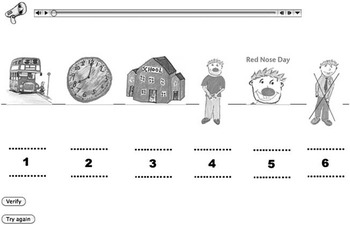
The research involved future primary school teachers from the university Paris Sorbonne – IUFM (Institut Universitaire de Formation des Maîtres) and Postgraduate Certificate in Education students from King's College, London. They were given the opportunity to participate in a project centred on the development of a web-based resource aimed at French primary school children. The objective of the interactive multimedia resource they chose to create together was to enable French children aged eight to ten to discover a cultural event much celebrated in English schools and yet generally unknown in France. Figure 1 shows a screen-shot from the resource. In this activity, young learners are expected to listen to the following transcript and order the pictures accordingly:
It's eight o'clock. John's taking the bus. He's going to school. But he's not wearing a uniform today! He's wearing a red T-shirt and a red nose! Today's Red Nose Day!
Screen-shot from multimedia resource

In order to develop this multimedia resource, the French and English trainee teachers communicated by means of asynchronous written exchanges. In previous projects between the two institutions (Abbott, Grosbois & Klein, Reference Abbott, Grosbois and Klein2005), videoconferencing had been used as the main means of communication among the participants. This time, though, the exchanges were limited to the asynchronous written mode as the trainee teachers on both sides were rarely available at the same time due to very heavy workloads.
Although the respective learning objectives were different for each group of participants, the project was designed so that both groups could benefit from taking part in the project. The British PGCE students were interested in the experience they could gain in the use of ICT for language teaching: they saw it as beneficial for the completion of their “ICT portfolio” which consisted of evidence of their ICT skills needed to meet the “QTS (Qualified Teacher Status) Standards and ITT (Initial Teacher Training) Requirements”Footnote 1. The French group was primarily interested in improving their mastery of English with a focus on the oral skills required for their teaching practice. Their answers in the initial questionnaire reflected a strong need to gain confidence in spoken English. It was therefore decided that all exchanges between the participants should take place in English.
The project was thus integrated into the curricula on both sides. It involved 32 PGCE students on the British side and 16 participants in France (the maximum number in a L2 class).
This paper considers the impact of the project on the French group of trainee teachers only. The research hypothesis was that such a project, which involved distant exchanges with native speakers of English by means of CMC, and which was at the core of the French trainee teachers’ 32-hour L2 English course, could contribute to the development of their L2 oral output. The following section outlines the theoretical framework that informed the exchanges.
1.2 Theoretical perspective
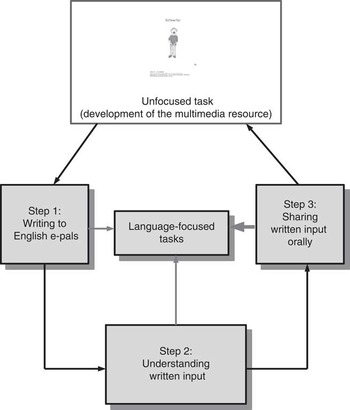
Figure 2 sums up the scenario. At the top comes the development of the multimedia resource which is an unfocused task or “real-life activity”, as defined by Ellis (Reference Ellis2003):
“A task is intended to result in language use that bears a resemblance, direct or indirect, to the way language is used in the real world” (op.cit.: 16).
Overview of the L2-learning scenario from the French perspective

Developing a multimedia resource also falls into the “collaborative tasks” category defined by O'Dowd and Ware (Reference O'Dowd and Ware2009) and more precisely into type 9 of their typology of tasks, named “Collaborating on product creation”. As O'Dowd and Ware explain, such tasks “bring about substantial amounts of negotiation of meaning both on linguistic and cultural levels as learners strive to reach agreement on their final product” (op.cit: 178).
All the other tasks performed during the L2 course were related to this collaborative task and can be summed up as follows:
– Step 1: The French trainee teachers wrote to their English e-pals individually, in order to obtain input that was likely to be useful for the development of the multimedia resource.
– Step 2: They had to make sense of the authentic written input that they received and to select some meaningful information worth sharing with their classmates.
– Step 3: Information deemed to be significant was shared orally in English with classmates so that joint decisions could be reached for the creation of the multimedia resource.
This iterative process was repeated five times during the course. Depending on the language difficulties the French trainee teachers encountered, specific tasks that focused on form were designed for them by their trainer. These customized tasks dealt with specific language points related to the trainee teachers’ individual needs, yet they emanated from the multimedia development task and were, thus, in keeping with Ellis's view:
“focused tasks aim to induce learners to process, receptively or productively, some particular linguistic feature, for example, a grammatical structure. Of course this processing must occur as a result of performing activities that satisfy the key criteria of a task, i.e. that language is used pragmatically to achieve some non-linguistic outcome” (Ellis, Reference Ellis2003: 16).
This approach to L2 learning is a socioconstructivist one (Vygotski, Reference Vygotski1934): it was hoped that the students would gradually develop their L2 skills by way of interacting with others (both their e-pals and classmates) while working on the development of the multimedia resource. The unfocused task was all the more meaningful for them as it was related to their future teaching practice. Learning was thus situated, which is “a critical element in fostering learning” according to Collins, Brown and Newman (Reference Collins, Brown and Newman1989: 487). Moreover, the CMC-based exchanges the student teachers engaged in with their British counterparts were all centred on the multimedia development, which is in line with Mangenot (Reference Mangenot1998: 138) who stresses the importance of the notion of project for learning to occur in CMC.
The scenario is also likely to be beneficial for L2 learning from the perspective of L2 acquisition theories. Indeed, Long's Hypothesis stipulates that interacting and negotiating meaning foster language acquisition (Long, Reference Long1983: 139; Long, Reference Long1996): it was all the more necessary for the trainee teachers as L2 interaction revealed some misunderstanding. Swain (Reference Swain1985: 249) introduced the notion of “pushed output”, stating that not only input but also output play an important role in L2 learning. The French trainee teachers were first “pushed” to write to their e-pals so as to obtain useful input for the development of the multimedia resource. They were then asked to orally share the individual input they had gathered, in order to be able to create the resource with their classmates. They thus engaged in “conversational interaction in a second language” which, according to Gass and Selinker (Reference Gass and Selinker2001: 294) “forms the basis for the development of language”.
Paying conscious attention to input and thus “noticing” and “noticing-the-gap”, defined by Schmidt (Reference Schmidt2001) as essential to the L2 acquisition process, was also encouraged by means of focused tasks centred mainly, but not exclusively, on phonological activities. As they were based on the difficulties encountered by the French trainee teachers, these phonological activities were performed whenever necessary in the overall sequence.
In line with the socioconstructivist approach and L2 acquisition theories, the research hypothesis put forward is that taking part in this CMC project could help the French trainee teachers enhance their L2 oral output.
2 Evolution of L2 oral output
2.1 Evaluation procedure and results
Opting for a task-based learning and teaching approach implies opting for a task-based evaluation (Chalhoub-Delville, Reference Chalhoub-Delville2001). Furthermore, trying to determine whether the project-based course helped the French trainee teachers improve their oral output in English makes it necessary to carry out a pre- and post-test. Finally, considering that a task-based approach combines linguistic and pragmatic features, both types of criteria need to be reflected in the evaluation.
Evaluation tasks were thus developed following the principles given by Ellis for the development of tasks for a task-based evaluation (2003: 303–304). In fact, two equivalent sets of tasks (one for the pre-test and one for the post-test) were designed. They are detailed in Grosbois (Reference Grosbois2010).
To evaluate the trainee teachers’ oral output, the grids from a French task-based standardized test called DCL (Diplôme de Compétence en Langue) were used (Grosbois, Reference Grosbois2009). They combine linguistic criteria (Verbal group, Syntax, Questioning, Nominal group, Lexicon, Phonology) and pragmatic criteria (Quantity, Efficiency, Interaction, Gathering information); overall a total of ten criteria, with five levels for the linguistic criteria and six levels for the pragmatic criteria (ranging from beginner knowledge to high level of proficiency). In order to obtain precise data, the trainee teachers’ oral productions were recorded and transcribed, which helped to reduce any bias due to the fact that the evaluator also happened to be the trainer.
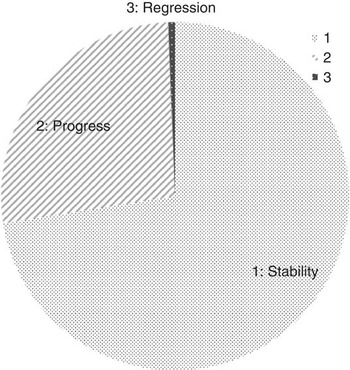
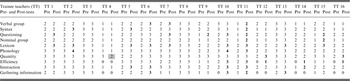
Figure 3 shows the results, which were obtained as follows. For each trainee teacher (n = 16), one level was selected (out of five levels for the linguistic criteria and out of six levels for the pragmatic criteria) for each of the ten criteria of the evaluation grid. This evaluation process was carried out before and at the end of the L2 course. The results of the pre- and post-tests, detailed in the Appendix, show 116 instances of stability, 43 instances of progress, and one instance of regression. (The latter may be regarded as negligible for two reasons: firstly, because it affected the “Quantity” criteria – which was not the course objective; secondly, because the same trainee teacher's fluency rate increased from 34 words/min to 81 words/min – which makes up for the loss in “Quantity” since it means that he spoke for a shorter length of time during the post-test but was more fluent than during the pre-test).
Evolution of L2 oral output

However limited the sample was, the results are in line with research in general, given that only 32 hours were devoted to the course over the academic year. As Chapelle (Reference Chapelle2003) observes: “Interlanguage development is a gradual process through which learners become aware of linguistic form, gain partial and fragile knowledge, and ultimately gain mastery through repeated exposure and practice” (op. cit.: 119–120).
Yet it is interesting to consider the way the trainee teachers themselves viewed their progress. A questionnaire that was given to them at the end of the course included the following question: “In your opinion, did the course contribute to the development of your speaking skill in English?” Thirteen out of sixteen students answered positively, even those who had not made any progress at all (two of them), and although the overall results show that stability prevails over progress. The students’ interpretation of their results was in fact biased by the motivation the project had fostered.
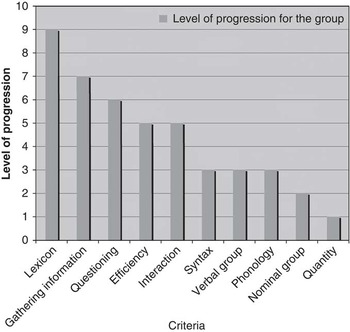
It also appeared that the trainee teachers’ progress was more significant for the pragmatic criteria (except for “Quantity”) and for two linguistic criteria: “Lexicon” and “Questioning”, as synthesized in Figure 4.
Progress ranked by criteria

These results are consistent with the tasks implied by the project since the trainee teachers had to gather information by questioning their English partners, then understand the information they had collected individually so as to be able to share it orally in class, in order to make collective decisions for the creation of the multimedia resource. Thus, they may have focused more on meaning than on form, being unable to do both given their L2 difficulties.
The results also show that the difference between the evolution of the linguistic and pragmatic criteria is negligible, which corresponds to Springer's conclusion (Reference Springer1999: 10), namely that both competences are intertwined.
Finally, phonology ranked among the criteria that increased the least, although phonological metalinguistic awareness had been encouraged by means of focused tasks during the course.
It was thus hypothesized that nativisation could have affected the trainee teachers’ oral output because the authentic input they got from their British partners was only written.
2.2 Effect of nativisation on L2 oral output
Andersen (Reference Andersen1983) defined nativisation as follows:
“In all the settings where the learner already has a language when he begins to acquire another, the linguistic features of his earlier-acquired language(s) are relevant to the outcome of his acquisition of the additional language. […] The input in all these settings is perceived and processed to a large extent in terms of the existing (or simultaneously acquired) languages the learner knows and uses” (op. cit.: 20).
Other researchers, such as Jordan (Reference Jordan2004: 168–172), Corder (Reference Corder1992: 27), Pallier, Dehaene, Ploine, Le Bihan, Argenti, Dupoux and Mehler (Reference Pallier, Dehaene, Ploine, Le Bihan, Argenti, Dupoux and Mehler2003: 160), also refer to the influence of one's prior knowledge and practice of other languages on the one being acquired. As Narcy-Combes (Reference Narcy-Combes2010a) posits: “It [nativization] is not invalidated by neurophysiological research (Ledoux, Reference Ledoux2003). Psycholinguistic or neurolinguistic evidence also confirm its role, without necessarily using this term or the term assimilation to describe the phenomena” (op. cit.: 86).
This study focuses on the phonological aspect of nativisation. Indeed, the second research hypothesis is that having access only to written input leads to more phonological nativisation than when the authentic input is oral. To test this hypothesis, the following protocol was set up.
2.2.1 Data collection and analysis
The procedure consisted in comparing the French trainee teachers’ oral output based on written input, to the oral output (of the same trainee teachers) based on oral input. For each trainee teacher, his/her oral output based on authentic written input was recorded on four separate occasions. (The authentic written input came from the e-mails the British partners had sent and which the French trainee teachers had to share orally in English with their classmates so as to make decisions regarding the creation of the multimedia resource). For each trainee teacher, his/her oral output based on authentic oral input was also recorded on two separate occasions. (The authentic oral input came from two oral documents provided by the French Ministry of Education for the evaluation of trainee teachers: two recorded dialogues between NS discussing educational issues. These two comparable sources were used for the pre- and post-tests for the purpose of this study. They are detailed in Grosbois, Reference Grosbois2010).
The French trainee teachers’ oral productions were also transcribed so as to be analysed. After having collected all the data, the following steps were observed.
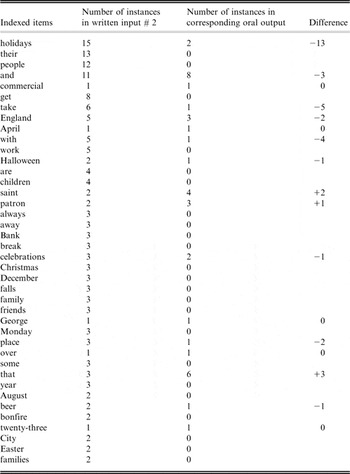
Step 1: For each trainee teacher, a concordancer indexed the items belonging to the source document (the input) and to the corresponding oral output. Table 1 is an excerpt of the first 40 items out of 184 indexed by the concordancer for trainee teacher A's oral output 2 (only the first initial of the participant's name has been kept so as to protect identity).
Example of items indexed by concordancer (trainee teacher A, recording 2)

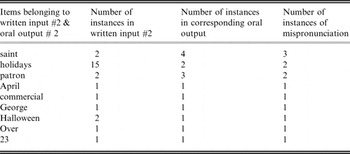
Step 2: Only the items that belonged to both the input and the trainee teacher's corresponding oral output were kept. Among those items, the ones that were mispronounced were identified (see Table 2).
Example of items belonging to both input and oral output, and mispronounced. (Trainee teacher A, recording 2)

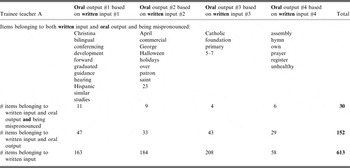
Step 3: For each trainee teacher, his/her four oral productions based on written input were analysed and synthesised as in Table 3.
Recap of oral output based on written input (trainee teacher A)

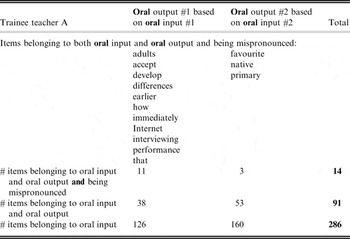
Step 4: The two oral productions based on oral input were analysed following the same procedure, as shown in Table 4.
Recap of oral output based on oral input (trainee teacher A)

Step 5: The oral productions of the sixteen French trainee teachers involved in the project were all treated similarly.
2.2.2 First set of results
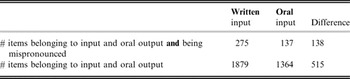
The procedure made it possible to compare the oral output depending on whether the input was oral or written. The results for the whole group (n = 16) are summed up in Table 5.
Comparison of oral output for the group

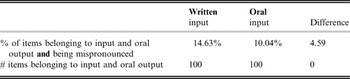
The number of items borrowed from oral input (1364) being lower than the number of items borrowed from written input (1879), this being partly due to the smaller amount of oral input and corresponding oral output, the figures had to be turned into percentages so as to allow comparison, as in Table 6.
Comparison of oral output for the group, in percentage

The first conclusion that can be drawn is that the percentage of items which were mispronounced is higher when oral output is based on written input, as could be anticipated.
Of course the significance of the 4.59% difference needs to be discussed. To do so within the overall context of the experiment, it is first necessary to analyse the cases of mispronunciation to determine whether they can be attributed to the influence of the trainee teachers’ native language (they did not speak other languages) and hence related to the effect of nativisation.
2.2.3 Further analysis and second set of results
The instances of mispronunciation were studied in the light of research work carried out by French linguists specializing in English phonetics and phonology, namely Deschamps (Reference Deschamps1994), Duchet (Reference Duchet1994), Groussier and Rivière (Reference Groussier and Rivière1996), Ginésy (Reference Ginésy2000), and Huart (Reference Huart2002).
In fact, all the instances of mispronunciation that had been listed turned out to be typical of French learners of English. An example in each of the three categories identified by Huart (Reference Huart2002): consonants, vowels, and word stress, can be used to illustrate this point.
/h/ was not pronounced in items such as have, history, happy, house and half, that consonant having no oral equivalent in French. Yet trainee teachers pronounced /h/ when they came across items beginning with a vowel as in age and eat, which once again is typical of French learners of English. As regards vowels, the contrast between /I/ and /i:/, for instance, was not observed in items such as each and eat, thus leading to misunderstanding in the second case since it was also pronounced with the /h/ phoneme at the start, which entailed confusion between eat and hit. Finally, as far as word stress is concerned, the trainee teachers tended either to stress each syllable equally or to stress the last syllable, as in French.
Having thus demonstrated that the instances of mispronunciation were influenced by the trainee teachers’ native language (French) and having previously come to the conclusion that the instances of mispronunciation were more numerous when the input was written than when it was oral, a link may be established between the nature of the input and the effect of nativisation from a phonological perspective.
3 Discussion and perspectives
The results of this study tend to prove that the effects of phonological nativisation are stronger when oral output is based on authentic written input than when oral output is based on authentic oral input.
The 4.59% difference between written and oral input may be regarded as not significant enough to draw such a conclusion, especially considering the margin of error. However, it can first be argued that the instances of mispronunciation would, in fact, have been even more numerous had complete sentences been considered and not just items. Secondly, given that the trainee teachers were not beginners (they had studied English for seven years minimum before enrolling in the programme), they had already been trained to reverse the process:
“When circumstances cause the learner to reconstruct his interlanguage to conform more closely to that of the input, he must in effect dismantle part of his “native” system […]. For want of a better term, I call this process “denativization”” (Andersen, Reference Andersen1983: 12).
Moreover, the fact that the trainee teachers were encouraged to perform some focused tasks, which were intended to develop their metalinguistic awareness, may have contributed to reducing the instances of nativisation. (Examples of such tasks are given in Grosbois, Reference Grosbois2006: 135, 138, 149, 157).
Therefore, the results may well be worth taking into consideration, not because approaching the norm is an end in itself, but because nativisation can lead to misunderstanding, as in the case of eat being pronounced like hit.
Consequently, if L2 oral production is the objective of an L2 course based on blended learning, then the nature of the authentic input should be considered. There are therefore two options. The first option consists of introducing authentic oral input. Desktop audio and videoconferencing equipment as well as web-based mobile phones being more and more accessible, such facilities could become part of the learning environment and be used even outside the institution for students to communicate easily with foreign partners. But getting authentic oral input may not be sufficient since denativisation also requires attention and mediation (Narcy-Combes, Reference Narcy-Combes2010a: 87). Therefore, developing metalinguistic awareness may also be necessary for students to be able to part from the effect of nativisation gradually (Narcy-Combes, Reference Narcy-Combes2010b: 114).
Recording a videoconference session being technically possible, metalinguistic tasks could then also be accomplished based on the saved oral exchanges between NS and NNS.
Moreover, since “NNS-NNS different-Language 1 dyads appear as the most beneficial for pronunciation development – both in achievement and instances of modified output – followed by NNS-NS dyads and NNS-NNS same-L1 dyads” (Bueno, Reference Bueno2010: 15) and since research indicates that plurilingualism helps to develop metalinguistic awareness (Degache, Reference Degache2006), then another option could consist in having students perform unfocused tasks in a plurilingual setting. Interactions in English between NNS-NNS different-Language 1 dyads might then be used for an inductive approach to metalinguistic awareness from a phonological perspective.
Based on this experiment and given the major changes that have recently taken place in teacher training in France (since May 2010 for instance, L2 and ICT certificates have become compulsory to get a position as a teacher), a new course has recently been set up at the University Paris Sorbonne – IUFM. It takes into account several of the conclusions drawn from this study, namely, that motivation is enhanced by participation in a collective problem-solving task linked to a professional domain and which triggers rich exchanges with native counterparts. But it also takes into account the fact that being limited to authentic written input has an impact on the evolution of L2 oral output from a phonological point of view. Consequently, as part of the new Master's degree designed for students who are likely to become primary school teachers and who will have to teach a foreign language at school (whether English, Spanish or German), this course articulates L2 learning and ICT by offering students the opportunity to participate in a virtual school: a project-oriented approach to L2 learning with problem-solving tasks that are situated professionally and which can now easily be performed with web 2.0 tools. It involves NS and NNS of English and will include audio and video-conferencing exchanges.
4 Conclusion
This article aimed at analysing CMC and L2 learning by focusing on the impact on L2 oral output, a key skill for most language learners. Although data needs to be obtained from a larger sample, the evaluation of the L2 oral output of the 16 trainee teachers involved in a CMC-based project with British partners indicates that stability prevails over progress, which is in line with research in general: a 32-hour course does not seem enough to foster the acquisition process. This study also confirms the importance of nativisation. Indeed, it shows that having access only to written input leads to more phonological nativisation than when the authentic input is oral. However, given the limitations of the results (a 4.59% difference only) further research needs to be carried out: the study should go beyond items for instance.
This research can therefore be regarded as an invitation to further explore the potential of audio and videoconferencing equipment, as well as that of mobile facilities, so as to introduce oral authentic input and thus facilitate the process of denativisation.
The results can also be interpreted as an invitation to promote metalinguistic awareness when participating in CMC-based projects. In that respect, a plurilingual environment might be worth looking into since research indicates that one of the characteristics of plurilingualism is the development of transferable metalinguistic skills (Degache, Reference Degache2006), and that NNS-NNS different-L1 dyads are beneficial for pronunciation improvement (Bueno, Reference Bueno2010).
It is finally worth noting that having trainee teachers experience a CMC-based project can also be regarded as a way to teach them to use technologies in their teaching practice. However, a linguistic approach was clearly favoured in this project, all the more so as it was carried out within a L2 course. This example of priority given to the mastery of the L2 over the development of pedagogical expertise might also reflect a specifically French approach to the field of teacher training.
Acknowledgement
The author would like to thank the two anonymous reviewers for their insightful comments on an earlier version of this article.
Appendix (Levels selected for Pre- and Post-tests on evaluation grid)