1 Introduction
Research in the past decade has revealed that peer collaborative dialogue is of great value in providing second language (L2) learning opportunities (Swain, Brooks & Tocalli-Beller, Reference Swain, Brooks and Tocalli-Beller2002). Evidence has shown that in collaborative dialogue learners collaboratively use language to reflect on language use and their joint effort results in the co-construction and internalization of new language knowledge. Although much of this research has been conducted in face-to-face (F2F) classroom settings (e.g. Dobao, Reference Dobao2012a; Leeser, Reference Leeser2004; Swain & Lapkin, Reference Swain and Lapkin2001), recent years have seen an increasing interest in investigation of collaborative dialogue in synchronous computer-mediated communication (SCMC) modalities (e.g. Lee, Reference Lee2008; Yilmaz, Reference Yilmaz2011; Zeng & Takatsuka, Reference Zeng and Takatsuka2009).
Despite research findings indicating the positive impact of peer collaborative dialogue on L2 learning in both F2F and SCMC modalities, little research to date has been devoted to examining how the collaborative dialogue generated in F2F communication compares with the collaborative dialogue that occurs in SCMC communication. In this study, collaborative dialogue was analysed in both SCMC and F2F modalities. Following sociocultural theory, this research explored how F2F and SCMC may differently affect peer collaborative dialogue in terms of its frequency and nature.
2 Review of related literature
2.1 Sociocultural theory
The last two decades have witnessed an increasing interest in understanding L2 education through a sociocultural lens. According to sociocultural theory (SCT), which originates from the work of Vygotsky (e.g. 1978, 1987), human cognition is socially constructed and should not be studied by isolating it from its social context. From this perspective, learning originates within the zone of proximal development (ZPD) and is mediated by sociocultural tools, of which language is the most important (Vygotsky, Reference Vygotsky1978). ZPD is “the distance between level of development already obtained and the cognitive functions comprising the proximal next stage that may be visible through participation in collaborative activity” (Lantolf & Thorne, Reference Lantolf and Thorne2006: 20). Language mediates learning on both interpersonal and intrapersonal levels. On an interpersonal level, language functions as a social tool to construct and sustain intersubjectivity for co-construction of knowledge; on an intrapersonal level, language serves as a psychological tool to reflect on, internalize and transform one’s co-constructed knowledge.
SCT provides a valuable framework for research in L2 learning. Within this framework, the locus of language learning lies not within an individual’s mind but in the participation of the socially mediated collaborative processes. SCT-inspired L2 research has traditionally focused on expert–novice interaction and evidence has been found that the assistance geared to the novice’s ZPD promotes language acquisition (e.g. Aljaafreh & Lantolf, Reference Aljaafreh and Lantolf1994; Nassaji & Swain, Reference Nassaji and Swain2000). A review of SCT research on L2 development shows that the scaffolding framework can be extended to peer interaction (see Lantolf & Thorne, Reference Lantolf and Thorne2006). The rationale for this line of research is that learners can assist one another by acting as both novices and experts and thus develop collective expertise (Donato, Reference Donato1994; Storch, Reference Storch2002). Of particular significance in using language as both a cognitive and a social tool for interactive peer-to-peer language learning processes is Swain’s (Reference Swain2000) concept of collaborative dialogue.
2.2 Collaborative dialogue
There has been a general consensus among researchers as to the positive role of interaction in L2 learning. Research targeting how interaction provides or maximizes learning opportunities is approached from two broad theoretical perspectives: interactionist theory and SCT. An interactionist approach focuses on how learners negotiate meaning to achieve mutual comprehension during communication breakdowns. Although this approach has shed much-needed light on the form-meaning relationship facilitated by interaction, it overemphasizes the role of negotiation for meaning (NfM), thereby ignoring those instances where learners co-construct resolutions to linguistic problems in pursuit of a better joint product. In contrast, SCT emphasizes more how learners mutually attend to language form that can be outside the scope of NfM (Foster & Ohta, Reference Foster and Ohta2005), which is best depicted by Swain’s notion of collaborative dialogue.
Collaborative dialogue is defined as “knowledge-building dialogue” which allows the superiority of jointly constructed performances over individual competence as well as the co-occurrence of language use and language learning (Swain, Reference Swain2000: 97). It derives from Swain’s original notion of output, which she assumes can push learners to notice the hole in their interlanguage and the gap between their interlanguage and the target language, to experiment with the target language, and to develop their metalinguistic awareness (Swain, Reference Swain1995). To overcome the constraints of the conduit metaphor, Swain (Reference Swain2000) re-examined the output hypothesis within sociocultural theory and developed collaborative dialogue as an alternative construct. According to Swain (Reference Swain2001a), collaborative dialogue can be promoted by collaborative tasks (e.g. dictogloss, jigsaw), which are characterized by dyadic interaction, formulation of a final product (oral or written) and meaning-oriented focus on form.
The construct of collaborative dialogue is instantiated by language-related episodes in which learners “talk about the language they are producing, question their language use, or other-or self-correct their language production” (Swain, Reference Swain2001b: 287). Unlike NfM, LREs are the instances when learners switch their attention from language meaning to language form not necessarily due to message incomprehensibility. Thus what is manifested in LREs is language learning in progress mediated by language use (Donato, Reference Donato1994).
2.3 Research on collaborative dialogue and L2 learning via F2F communication
A substantial body of research conducted over the last decade has provided evidence that collaborative dialogue is a powerful site for L2 learning (e.g. Swain & Lapkin, Reference Swain and Lapkin1998, Reference Swain and Lapkin2002; Tocalli-Beller & Swain, Reference Tocalli-Beller and Swain2005). In peer collaborative dialogue, learners are allowed to be “concurrently experts and novices” and benefit from their collective expertise (Swain, Brooks & Tocalli-Beller, Reference Swain, Brooks and Tocalli-Beller2002: 172). That is, learners with varying weaknesses and strengths can assist each other in solving language-related issues, thereby reaching a higher level of joint performance (Ohta, Reference Ohta2000). Edward (Reference Edward2005) noted that non-expert language learners were able to provide assistance to each other in addressing grammatical issues in a formalized assessment context. Their collaborative effort positively affected their quiz performances. Brooks and Swain (Reference Brooks and Swain2009) analysed pair interactions of English as a second language (ESL) learners working on a collaborative writing task. The results showed that their form-focused discussions contributed to a more effective expertise and therefore afforded opportunities for learning. Thus collaborative dialogue may facilitate learners’ co-construction of metalinguistic knowledge and enhance their language development.
Research has documented how collaborative dialogue is impacted by different variables including learner proficiency level, task types and pair dynamics. Most of these studies have been conducted in the classroom. To determine the frequency and nature of collaborative dialogue, LREs (i.e. the specific instances of collaborative dialogue) are usually identified and categorized for focus (e.g. lexical, grammatical) and outcome (e.g. correctly resolved, unresolved or incorrectly resolved).
Some studies have tried to examine the relationship between learners’ proficiency level and LRE production. These studies converged on the finding that proficiency does positively impact on the number and nature of LREs. For example, Lapkin, Swain and Smith (Reference Lapkin, Swain and Smith2002) compared four dyads of different proficiency levels (two average and two strong). Their findings indicate that strong dyads produce more and longer LREs than average dyads. Leeser (Reference Leeser2004) compared three types of dyads (High-High, High-Low, and Low-Low), finding that higher proficiency dyads produced more grammatical LREs and correctly resolved more language problems. Watanabe and Swain (Reference Watanabe and Swain2007) compared the same learners working with peers of higher level and lower level: pairing with more proficient partners led to higher occurrences of LREs than pairing with less proficient ones.
Previous research has also investigated task-related variation in collaborative dialogue. Storch (Reference Storch2001), by comparing a short descriptive composition, an editing task and a text reconstruction task, found that the text-reconstruction task produced the highest frequency of LREs. The study also revealed that the text-reconstruction task elicited more form-based LREs while the composition and editing tasks generated more lexis-based LREs.
In addition to learner proficiency and task factors, researchers have also explored the impact of interaction patterns on collaborative dialogue. Of particular significance are Storch’s (Reference Storch2001, Reference Storch2002, Reference Storch2005) series of findings on the nature of pair interactions. Storch (Reference Storch2001) investigated three pairs performing the same task and found they approached the task differently, ranging from non-collaborative to collaborative. Storch concluded that how learners collaborate with each other depends on the way they orient themselves to the assigned task and the joint activity. Based on the two dimensions of pair interaction (i.e. equality and mutuality), Storch (Reference Storch2002) identified four distinct patterns: expert/novice, collaborative, dominant/passive and dominant/dominant. The findings suggested that learning tends to occur in collaboration-oriented pairs (expert/novice and collaborative) rather than in non-collaboration-oriented pairs (dominant/passive and dominant/dominant).
2.4 Peer collaborative dialogue and L2 learning via SCMC
CMC as a new form of human interaction via networked computers has gradually become a major means of communication. As one mode of CMC, SCMC (or real-time CMC) has a unique feature of allowing learners to write and read at the same time during interaction. The text-based discourse enabled by the new modality is a hybrid of both speech and writing merging “the interactional and reflective aspects of language… in a single medium” (Warschauer, Reference Warschauer1997: 6).
In SCMC, the text can be used as a thinking device (Vygotsky, Reference Vygotsky1987), encouraging precision of language required for clarity of thought. Thus, language form in written messages may attract more attention than that in spoken messages. In addition, the slower flow of interaction allows more time to create, develop and refine the messages and may thus facilitate the noticing of language problems (Lai & Zhao, Reference Lai and Zhao2006; Warschauer & Kern, Reference Warschauer and Kern2000). Furthermore, the visibility of the messages leads to less demand on working memory, thereby amplifying learners’ mutual attention to language use as well as spurring further interaction (Kern, Ware & Warschauer, Reference Kern, Ware and Warschauer2004). Also, the retrievability of text-based interaction can free learners from the constraints of the messages being sent and received and thus allow more attention to be focused on language issues of the previous messages, thereby triggering more language-related discussions (Lee, Reference Lee2008). Finally, the non-physical presence of the interlocutor and the lack of non-verbal cues in SCMC may push learners to concentrate exclusively on text during interaction, thereby enhancing their metalinguistic awareness (Blake, Reference Blake2000). It seems then that the above-mentioned features of SCMC facilitate learners’ meaning-oriented interaction and form-focused reflection (Lee, Reference Lee2008; O’Rourke, Reference O’Rourke2005; Ware & O’Dowd, Reference Ware and O’Dowd2008; Zeng & Takatsuka, Reference Zeng and Takatsuka2009). This can help create favourable conditions for the emergence of collaborative dialogue, which encourages learners to attend to both meaning and form.
Overall, SCMC can make a contribution to L2 learning in its own right due to its unique features. Research on the relationship between the application of SCMC and the language learning opportunities it entails has largely centred on NfM, grounded in an interactionist approach (Blake, Reference Blake2000; de la Fuente, Reference de la Fuente2003; Kitade, Reference Kitade2000; Lee, Reference Lee2002; Smith, Reference Smith2003). These studies, however, have reported instances in which learners mutually assisted each other in addressing language-related issues. For example, Blake (Reference Blake2000) presented three episodes where participants discussed issues of pronunciation, gender marking and verbal aspect respectively. In other studies, instances were identified where learners corrected their own and each other’s linguistic errors (e.g. Kitade, Reference Kitade2000; Lee, Reference Lee2002; Morris, Reference Morris2005). Nonetheless, these reported instances are largely outside the focus of communication breakdowns which triggered NfM. On the whole, NfM-based research has not adequately examined the nature of learners’ attention to language form during task.
Warschauer (Reference Warschauer1997, Reference Warschauer2005), among many others, has argued for investigation into text-based SCMC interactions from a sociocultural perspective and stresses the potential role of SCMC in facilitating learners’ intentional and reciprocal collaboration in relation to the emerging language problems.
A growing body of research has suggested that SCMC facilitates the occurrence of collaborative dialogue (Lee, Reference Lee2008; Ware & O’Dowd, Reference Ware and O’Dowd2008; Yilmaz, Reference Yilmaz2011; Zeng & Takatsuka, Reference Zeng and Takatsuka2009). Motivated by sociocultural theory, this line of research has utilized LREs as a research tool to capture learners’ collaborative effort in solving language issues that may not result from communication breakdowns. For example, Lee (Reference Lee2008) examined how corrective feedback was negotiated through expert-to-novice collaborative engagement in an SCMC modality. The findings revealed that the expert scaffolding helped learners focus on form within a shared communicative context and thus stretched their ZPDs. Whereas this research highlighted expert-to-novice interaction, Zeng and Takatsuka (Reference Zeng and Takatsuka2009) emphasized peer-to-peer collaborative dialogue in an SCMC modality. The results showed that the learners collaboratively attended to language form and their joint effort positively impacted language learning. Both studies documented the existence of lexical and syntactic LREs. Previous studies have also reported that language-related discussions in SCMC are mainly focused on lexis, grammar and orthography (e.g. Lee, Reference Lee2002; Pellettieri, Reference Pellettieri2000; Tudini, Reference Tudini2003; Yilmaz, Reference Yilmaz2011).
To examine task effects in SCMC, Yilmaz (Reference Yilmaz2011) compared the effects of dictoglosses and jigsaws on collaborative dialogue. The study produced promising results corroborating Swain and Lapkin’s (Reference Swain and Lapkin2001) hypothesis that the dictogloss task produced more LREs than the jigsaw task. Furthermore, the LREs identified in the two tasks also differed in quality; that is, the dictogloss displayed significantly higher percentages of correctly resolved, orthographic, and negative feedback LREs whereas the jigsaw elicited a significantly higher frequency of unresolved LREs.
2.5 The study
As discussed in the previous section, much research has been devoted to investigating how collaborative dialogue is impacted by different variables including learner proficiency, task type and interactional patterns. However, the effects of modality on collaborative dialogue have remained largely unexplored. Early comparative studies between SCMC modality and F2F modality laid emphasis on discourse features including language production and complexity and participation patterns (Beauvois, Reference Beauvois1998; Chun, Reference Chun1994; Kern, Reference Kern1995; Sauro, Reference Sauro2012; Warschauer, Reference Warschauer1996). More recent studies have focused on how CMC and F2F differ in providing opportunities for negotiation of meaning triggered by incomprehensibility (de la Fuente, Reference de la Fuente2003; Fernandez-Garcia & Arbelaiz, Reference Fernandez-Garcia and Arbelaiz2003; Lai & Zhao, Reference Lai and Zhao2006; Yuksel & Inan, Reference Yuksel and Inan2014). Although these studies help us understand how differently the two communication modalities can affect L2 learning opportunities, there is an apparent need to move beyond NfM to better comprehend the difference in learners’ collaborative attention to linguistic form (co-construction of resolutions to emerging language issues) across the two modalities. More research is needed on the effects of modalities on collaborative dialogue in order to gain a useful insight into the learning opportunities afforded by SCMC.
To date, there have been only a few cross-study comparisons of collaborative dialogue in SCMC and F2F. For example, Shekary and Tahririan (Reference Shekary and Tahririan2006) and Zeng and Takatsuka (Reference Zeng and Takatsuka2009) compared LREs in CMC modality with those reported in F2F modality to confirm the existence of learners’ collaborative attention to form in SCMC modality. Given that “equal amounts of time do not reflect equal amounts of talk in these two contexts” (Shekary & Tahririan, Reference Shekary and Tahririan2006: 567), both studies calculated the ratio of LREs to amount of talk in comparison to that of F2F in Williams (Reference Williams1999), which reported the ratio of LREs ranging from 1.46 to 2.50 (LREs/10,000 words) during the learners’ face-to-face oral interactions. The findings of the two studies revealed that the ratio of LREs in CMC (89.49 and 91.9 respectively) far exceeded that of Williams’s research. However, the inconsistency in task selection and learner characteristics (task and learner variables) raises doubts about the validity of the cross-study comparison: a comparison of collaborative dialogue in the two modalities within one study is needed. The aim of the present study is to examine the effects of modality on collaborative dialogue with the same participants under the same task conditions. The research questions guiding the present study are as follows:
-
1. Are there any modality effects on the frequency of LREs?
-
2. Are there any modality effects on the nature of LREs?
3 Method
3.1 Participants
The study was carried out in a major university in the northeast of China. Thirty-two (thirteen females and nineteen males) second-year undergraduate EFL learners volunteered to participate in the study, ranging in age from 19 to 21. They had an average of four hours of a general English course per week (one hour for listening and speaking, three hours for reading and writing). Scored as College English Test Band 4 (CET-4), a standardized national English proficiency test for non-English majors in China, their English language proficiency ranged from intermediate to upper-intermediate. A background questionnaire revealed that all the participants had general computer skills and were familiar with online text-based chat. Based on the Band 4 exam results, the 32 participants were divided into two groups with each having a similar number of intermediate and upper-intermediate students. Gender was also considered when forming the two groups (six and seven female students respectively). Within each group, students worked in self-selected dyads to perform the assigned tasks.
3.2 Tasks and computer software
To overcome the limitation of using just one type of task, this study adopted two contrasting tasks: a meaning-focused jigsaw and a form-focused dictogloss. Previous research has established the validity and effectiveness of the two types of tasks in generating collaborative dialogue in both F2F (e.g. Lapkin et al., Reference Lapkin, Swain and Smith2002; Swain & Lapkin, Reference Swain and Lapkin2001) and SCMC modalities (e.g. Yilmaz, Reference Yilmaz2011; Yilmaz & Granena, Reference Yilmaz and Granena2010). The jigsaw task used in the treatment session was adapted from Swain and Lapkin (Reference Swain and Lapkin2001), and the dictogloss task from Rollet and Tremblay (Reference Rollet and Tremblay1975, cited in Yilmaz & Granena, Reference Yilmaz and Granena2010).
In the jigsaw task, one participant in each dyad held four even-numbered pictures while the other held four odd-numbered ones. They were required to work together to construct the story based on the eight pictures. The text of the dictogloss was read three times in English to the participants who took notes individually on its content while listening; each dyad then worked together on the reconstruction of the text based on their notes. The tasks were completed in both CMC and F2F modalities. To promote the students’ concentration on and collaboration in the task at hand, they were required to produce the story in writing upon the completion of the discussion in each task, in line with what Swain (Reference Swain2001a) characterizes as a collaborative task. We only focused on their oral (in F2F) and text-based (in SCMC) discussions; the process of producing the written work based on the discussions is not considered for this study.
For SCMC, a China-based instant messaging software service, Tencent QQ (popularly known simply as QQ), was employed. All the participants had a QQ account and were very familiar with its built-in functions.
3.3 Procedures
As mentioned above, two groups were arranged taking into account the factors of their proficiency and gender. Each group was required to complete the two types of task in the two modalities. To familiarize the participants with this, pretreatment sessions were conducted in which participants were assigned practice tasks (one jigsaw and one dictogloss) via SCMC and F2F. When we were sure that all participants would be comfortable implementing tasks in the two modalities, two treatment sessions were arranged (see Table 1). In the first treatment session, the eight dyads in Group 1 performed a dictogloss task via SCMC and the other eight dyads in Group 2 completed the same dictogloss task via F2F. In the second treatment session, the eight dyads in Group 1 performed a jigsaw task via F2F and the other eight dyads in Group 2 completed the same jigsaw task via SCMC. Each group thus implemented one task in each modality. This counterbalancing arrangement was designed to minimize the influence of additional variables (e.g. learner proficiency, task type) in collaborative dialogue. In order to minimize the impact of interaction patterns, we let the participants work in self-selected dyads so that they could feel comfortable in completing the assigned tasks, thereby potentially increasing the level of collaboration. However, we have to admit the impact could not be fully mitigated. This is because the development of interaction patterns is an emerging process, which depends on how students are oriented toward each other and the assigned task in the particular context. Furthermore, given that the same group performed different tasks in the two modalities, task-related pair patterns resulting from this counterbalancing may have affected the outcome.
Tasks in the two treatment sessions

* n represents the number of dyads.
For SCMC modality, students were required to chat via QQ in the computer room to complete the assigned tasks. The two students in each dyad were not allowed to sit side-by- side. At the end of the task, they submitted their online chat logs which were automatically stored in the software. For F2F modality, the two students in each dyad were required to sit face-to-face with the tape-recorder in the middle. Interactions in all F2F oral discussions were audiotaped by students themselves so that the possible interference effects from the researcher and the instructor’s presence during the discussions were eliminated. During the jigsaw task, the students were not allowed to see each other’s series of pictures, even when they were working on their written product. However, during the dictogloss, they were allowed to see (in F2F) or inquire about (in SCMC) each other’s notes while collaboratively reconstructing the text through discussions. The two treatment sessions were about 30 minutes each in length and were held one after another on the same day with 10 minutes in between. The students were also required to produce the written work directly after the discussions and submit it immediately. As mentioned earlier, the process of producing the written work and the written work itself are not the focus of this study.
At the end of the two treatment sessions, a follow-up two-part questionnaire was administered to elicit students’ perspectives and attitudes toward the learning experience in the two modalities. As the questionnaire was also intended for other research purposes, this paper only focuses on four related items in the second part to gain some insight into modality effects on collaborative dialogue from the students’ point of view (see Appendix 1). In the questionnaire, the students were asked to indicate their preference between SCMC and F2F, reflect on the pros and cons of the two modalities, and comment on the effectiveness of the adopted collaborative tasks. They were also asked to decide which modality was more helpful for noticing and resolving emerging language issues.
3.4 Data coding
Upon completion of the tasks, the data were collected and subsequently transcribed. The data analysis consisted of two main stages. In the first, we counted the number of words produced by each dyad when completing the tasks, as well as the time taken for each. In the second stage, following Swain (Reference Swain2001a), the author and another researcher with a PhD in applied linguistics independently coded the data for language-related episodes (LREs) and the agreement was 85%. Following Swain and Lapkin (Reference Swain and Lapkin1998), an LRE for this study was defined as “any part of a dialogue where the students talk about the language they are producing, question their language use, or correct themselves or others” (p. 326). The study included the instances of both explicit (with metalanguage) and implicit (without metalanguage) discussions about the language issues. Discrepancies found in the coded data were discussed until a consensus was reached. Following Yilmaz (Reference Yilmaz2011), the identified LREs were further categorized in terms of language focus (lexical, orthographical and grammatical), outcome (correctly resolved, incorrectly resolved, and unresolved) and type (request for assistance, self-correction, negative feedback and metatalk). Examples of these categories are presented in Appendix 2. Coding of each category was also independently carried out by the two raters. Interrater agreement (Kohen’s Kappa) was 0.92 for language focus, 0.88 for outcome and 0.82 for type. Again all the disagreements between the two raters were discussed and resolved.
4 Results
4.1 Research question 1
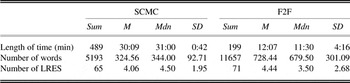
The first research question asked whether there would be any modality effects on the frequency of LREs. Table 2 presents the descriptive statistics for the length of time, the number of words and the number of LREs in SCMC and F2F. In SCMC each dyad spent an average of 30:09 mins on a task while in F2F it took each dyad 12:07 mins to complete a task on average. The amount of language production in F2F (M=728.44) more than doubled that in SCMC (M=324.56). Table 2 also reveals that F2F yielded only slightly more LREs than SCMC (71 vs 65).
Descriptive statistics for length of time, number of words and number of LREs

Due to the great differences in the time taken and the number of words produced in SCMC and F2F (as shown in Table 2), we calculated LREs per 100 words to standardize LRE scores across the two modalities. This way of standardizing LRE scores was consistent with previous related studies (e.g. Shekary & Tahririan, Reference Shekary and Tahririan2006; Yilmaz, Reference Yilmaz2011; Yilmaz & Granena, Reference Yilmaz and Granena2010; Zeng & Takatsuka, Reference Zeng and Takatsuka2009).
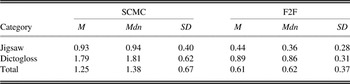
Table 3 displays the ratio of LREs per 100 words to quantity of learner output. The ratio of LREs per 100 words in SCMC was double that of F2F (M=1.25 vs M=0.61). A Mann-Whitney U-Test was performed on the mean ratio of LREs per 100 words in the two modalities. Results revealed that SCMC generated a significantly higher frequency of LREs than F2F (U=43.5, p=0.001).
Ratio of LREs per 100 words to quantity of learner output

It should be mentioned that differences were identified not only across the two modalities but also within each of them. Although SCMC generated an average of 1.25 LREs per 100 words, one dyad produced only 0.32. In spite of this variation, most of the SCMC dyads produced a higher frequency of LREs than the F2F dyads. This finding seems to be supported by the results of the questionnaire: 25 out of 32 respondents thought that SCMC was more helpful for noticing emergent language problems while only 7 believed that F2F was more effective for this (78.12% vs 21.88%).
We compared the ratio of LREs produced by the two types of task in the two modalities and obtained some interesting results. Table 3 shows that the form-focused dictogloss generated more frequent LREs than the meaning-focused jigsaw in both SCMC (M=1.79 vs M=0.93) and F2F (M=0.89 vs M=0.44). Overall, The Mann-Whitney U-Test revealed that the ratio of LREs elicited in the dictogloss (M=1.34) was significantly higher than that in the jigsaw (M=0.68) (U=56.5, p=0.007).
4.2 Research question 2
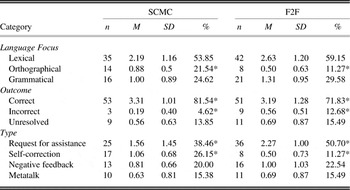
The second research question asked whether there would be any modality effects on the nature of LREs. To address this question, we compared the LREs generated in the two modalities in terms of language focus, outcome, and type. Table 4 displays the frequency and percentage of these three categories. With regard to language focus, lexical LREs occurred the most frequently (SCMC 53.85%; F2F 59.15%), followed by grammatical LREs (SCMC 29.58%; F2F 24.62%) and orthographical LREs (SCMC 21.54%; F2F 11.27%) in both modalities. Whereas the two modalities generated similar percentages of lexical and grammatical LREs, the percentages of orthographical LREs between the two modalities were different. The Mann-Whitney U-Test confirmed that differences in the percentage of orthographical LREs were statistically significant (U=65, p=0.014). The questionnaire results corroborated this finding. When asked about the pros of the two modalities, 7 out of 32 respondents explicitly claimed that SCMC facilitated the noticing of spelling errors while none mentioned this aspect in relation to F2F modality.
Descriptive statistics for categories of language focus, outcome, and type

* Statistically significant difference (p<0.05).
In terms of outcome, SCMC and F2F produced similar percentages of unresolved LREs (13.85% vs 15.49%). But differences can be observed between the two modalities in correctly and incorrectly resolved LREs. SCMC showed a higher percentage of correctly resolved LREs (81.54%) than F2F (71.83%). The Mann-Whitney U-Test revealed that the percentage of correctly resolved LREs was significantly different between the two modalities (U=73.5, p=0.036). The percentage of incorrectly resolved LREs in F2F (12.68%) was almost triple that in SCMC (4.62%). The Mann-Whitney U-Test confirmed that differences in the percentage of incorrectly resolved LREs were significant (U=73, p=0.017), but it should be noted that they were rather infrequent overall, with F2F generating nine and SCMC only three. Further evidence was found in the questionnaire results: when asked which modality was more helpful for solving language problems, 22 respondents thought SCMC was more effective in solving language issues compared to only 10 choosing F2F (68.75% vs 31.25%).
Unlike the previous two categories, type presented different frequency orders in the four types of LREs between SCMC and F2F (see Table 4). The Mann-Whitney U-Test revealed that the percentages of requests for assistance in the two modalities (SCMC 38.46%; F2F 50.70%) were significantly different (U=72.5, p=0.035). Similarly, clear differences can also be found in self-correction between the two modalities: SCMC produced seventeen self-correction LREs (26.15% of the total) against only eight in F2F (11.27% of the total). The Mann-Whitney U-Test confirmed that differences in the percentage of these LREs were statistically significant (U=53.5, p=0.003). The percentages of negative feedback (SCMC 20.00%; F2F 22.54%) and metatalk (SCMC, 15.38%; F2F, 15.49%) were very close in the two modalities and the Mann-Whitney U-Test revealed no significant statistical differences.
5 Discussion and implications
This study set out to examine how SCMC compares with F2F in terms of frequency and nature of the collaborative dialogue generated. We calculated the amount of talk elicited in both modalities, then identified LREs and calculated their ratio per 100 words to determine the difference in frequency between the two modalities. We also categorized the LREs identified with regard to focus, outcome and type to investigate whether they differ in nature between SCMC and F2F.
The first research question addressed the modality effects on the frequency of LREs. On the face of it, F2F generated more language output in a shorter time than SCMC. However, the ratio of LREs (the instantiation of collaborative dialogue) to the amount of language production revealed that they were significantly more frequent in SCMC than in F2F. This indicates that learners in SCMC could attend more to their own and each other’s language use while collaboratively completing assigned tasks. It can be concluded that SCMC provided a more effective environment for the emergence of collaborative dialogue. This is especially important for L2 learners who use the target language that they are still learning for communication. One possible explanation for this lies in the text-based nature of SCMC, which tends to direct learners’ conscious attention to language form (Karlström, Cerratto-Pargman, Lindström & Knutsson, Reference Karlström, Cerratto-Pargman, Lindström and Knutsson2007; O’Rourke, Reference O’Rourke2005; Pellettieri, Reference Pellettieri2000; Zeng & Takatsuka, Reference Zeng and Takatsuka2009). First, the visual display may magnify the visibility of language errors (Lee, Reference Lee2004, Reference Lee2008; O’Rourke, Reference O’Rourke2005). Second, the lack of social context cues may push the learners to resort solely to text-based communication, thereby facilitating easier noticing of language errors (Blake, Reference Blake2000). Finally, the accessibility of the previous messages allows learners to move back and forth through the interactions, thus increasing the chances of spotting the language problems (Lee, Reference Lee2008).
The results of the follow-up questionnaire provided further evidence to support this. When asked about the learning experience in the two modalities, 19 out of 32 respondents commented that language errors are more likely to be ignored in F2F than in SCMC. By contrast, sixteen respondents mentioned that SCMC provided more time for reflection and more opportunities for noticing language problems. Previous studies have confirmed the benefits of SCMC in facilitating reflection, and noticing of language issues (e.g. Lai & Zhao, Reference Lai and Zhao2006; Sauro, Reference Sauro2009; Yuksel & Inan, Reference Yuksel and Inan2014).
It is worth mentioning that there were significantly more LREs in the dictogloss than in the jigsaw task in both SCMC and F2F. Although the finding is outside the focus of the study, it sheds some light on how task type may affect the occurrence of LREs in the two modalities. The finding is consistent with that of previous research (e.g. Yilmaz, Reference Yilmaz2011; Yilmaz & Granena, Reference Yilmaz and Granena2010). The result indicates that task type plays an important role in the emergence of LREs in both modalities, corroborating Swain and Lapkin’s (Reference Swain and Lapkin2001) claim that form-focused dictogloss tasks would yield more LREs than meaning-focused jigsaw tasks. This can be explained in terms of the nature of the assigned tasks. In a jigsaw, which is more communicative in nature, learners’ attention is more likely to be directed to meaning rather than form. By contrast, a dictogloss is more form-focused, requiring learners to attend to and reproduce syntactically complex structures while reconstructing the text.
The second research question asked whether there would be any modality effects on the nature of LREs. The results revealed some cross-modality differences with regard to orthographical, correct, incorrect, request for assistance and self-correction LREs. These differences can be interpreted by referring to some of the unique features of SCMC that distinguish it from F2F. In this study, the percentage of orthographical LREs was higher in SCMC than in F2F. It could be that the visibility of SCMC interactions drew learners’ attention to spelling errors. Lamy and Goodfellow (Reference Lamy and Goodfellow1999) used the concept of “reflective conversation” to highlight the reflective aspect of CMC discourse. The visual display of learners’ online exchanges affords learners opportunities to consciously attend to and reflect on their language output (Kern, Ware & Warschauer, Reference Kern, Ware and Warschauer2004; Pellettieri, Reference Pellettieri2000). This result was also in line with the participants’ responses to the questionnaire, where they explicitly remarked that SCMC could be beneficial to spelling as they could view their messages while producing them.
The textuality of online discourse can also help visualize the solution-generating process, which may facilitate more attention to and more reflection upon the solutions, thus increasing their accuracy. This could help explain why in this study the frequency of correct LREs was higher and the frequency of incorrect LREs was lower in SCMC than in F2F. Other features contribute to this outcome. For example, messages in SCMC are retrievable, which can help relieve memory load, thus making learners concentrate more on the collaborative effort in identifying and solving emerging language problems. Furthermore, SCMC can be characterized as “conversation in slow motion” (Beauvois, Reference Beauvois1992: 455), enabling learners to have more time and less stress for emerging language problems and their solutions (Lai & Zhao, Reference Lai and Zhao2006; Lee, Reference Lee2008; Warschauer, Reference Warschauer1996; Warschauer & Kern, Reference Warschauer and Kern2000), and thus may result in more correct LREs.
Another noteworthy result was that the percentage of self-correction was higher in SCMC than in F2F. This might relate to the immediate visibility of the learners’ own output, which may reinforce the tendency toward reflection and self-correction: Lee (Reference Lee2001) has suggested that this feature of SCMC discourse may give rise to more frequent self-corrections than in F2F interaction. Also the physical absence of the interlocutor in SCMC could force learners to rely solely on the text-based messages to sustain the flow of interaction, giving rise to more focus on language form and more explicit and complete expression. Thus, self-corrections may help facilitate more effective communication in SCMC.
The study also revealed that there was lower percentage of requests for assistance in SCMC than in F2F. One possible reason could be that the slow pace of interaction in SCMC afforded learners more time to ponder the solutions on their own rather than request help. No previous studies could be found to corroborate this, and thus more research is called for on this topic.
Overall, the unique features of SCMC facilitated collaborative attention to the language issues in text-based exchanges (Shin, Reference Shin2006), contributing to the emergence of “a collective scaffold” (Donato, Reference Donato1994: 46) or “a greater expertise” (Ohta, Reference Ohta2001: 76). Thus text-based collaborative dialogue functions both as a cognitive tool for learners to reflect on language use and access their own and each other’s ZPDs and as a social tool for them to establish and maintain a state of intersubjectivity, which can promote L2 learning.
Two pedagogical implications can be offered from the present study. First, it offers further proved evidence that SCMC can facilitate the creation of an effective joint problem-solving environment. It is useful for language teachers to know that social and cognitive engagement in SCMC enabled by collaborative tasks can enhance target language learning. The study also supports the effectiveness of text-based interaction in promoting learners’ metalinguistic awareness and advances our understanding of the benefits of collaborative dialogue in SCMC. Thus, L2 teachers and curriculum designers should consider maximizing the potential benefits of integrating SCMC in collaborative L2 learning.
This research was limited in a number of ways. First, no posttests were created to determine the differences in the effectiveness of LREs on L2 learning in the two modalities. A posttest, especially a tailored one, may have provided informative data on the differences in the learning effects that resulted from LREs between the two modalities. Second, as mentioned in the previous section, the counterbalancing of the tasks and modalities could not substantially minimize the impact of interaction patterns. One must inevitably be cautious when interpreting the results, as the nature of pair interaction may have played a role in the outcome. Caution is also needed in generalizing from a relatively small sample to a wider population. Finally, the results were also limited by the particular type of collaborative tasks.
To achieve a deeper understanding of modality effects on collaborative dialogue, further research needs to involve individualized posttests developed from the identified LREs. Future research should also consider including more types of tasks (e.g. text-reconstructionFootnote 1 and spot-the-differencesFootnote 2 ) to provide further information about the differences across the two modalities. In addition, the scope of the current study could be further expanded by examining the modality effects on collaborative dialogue in terms of patterns of interaction (e.g. collaborative vs. non-collaborative; see Storch, Reference Storch2002) and group size (e.g. group vs. pair; see Dobao, Reference Dobao2012b). Finally, attention needs to be paid to long-term effects, and future studies could consider making a comparison over time to better understand how the two modalities differ from each other in generating collaborative dialogue.
6 Conclusion
The results from this research reveal that SCMC generates a higher frequency of LREs than F2F, which confirms results from several earlier studies (e.g. Shekary & Tahririan, Reference Shekary and Tahririan2006; Zeng & Takatsuka, Reference Zeng and Takatsuka2009). The findings strengthen the claim that SCMC provides learners with opportunities to focus on form and holds promise for promoting effective L2 learning. The data also suggest that LREs in the two modalities demonstrate a number of differences, which can be attributed to the nature of SCMC. It is important to note that we do not suggest that SCMC is superior to F2F in terms of collaborative dialogue; what we do argue is that SCMC should be considered as an optional modality to help language learners to enhance their linguistic competence.
Acknowledgements
The research reported in this paper is partially funded by “the Fundamental Research Funds for the Central Universities” (3132015101), “Research Funds from Education Department of Liaoning Province (W2013082)”, “Research Funds for the 12th Five-Year Foreign Language Teaching Reform in Higher Education of Liaoning Province (WYYB150114)” and “Research Funds from Liaoning Planning Office of Philosophy and Social Science (L14BYY006)”. I wish to thank the two anonymous reviewers for their insightful and constructive comments.
Appendix 1 Questionnaire
(Including only the items related to the present research)
-
1. Which modality did you prefer? Why?
-
2. How would you comment on the pros and cons of the two modalities?
-
3. Which of the two modalities was more helpful for noticing each other’s language problems? Why?
-
4. Which of the two modalities was more helpful for solving each other’s language problems? Why?
Appendix 2 Examples of language focus, outcome and type