1 Introduction
As Hampel (Reference Hampel2003: 21) points out, one of the main challenges when teaching language at a distance is addressing oral/aural skills. While the use of audio files can solve some of these problems, this type of material does not “address the need for interaction and the negotiation of meaning in a communicative situation”, i.e. the need for authentic communication (op. cit.). At the same time technology usage in distance language learning has moved on from software that involve “learners’ interaction with computers to interaction with other humans via the computer” (Kern & Warschauer, Reference Kern and Warschauer2000: 11). According to Ciekanski and Chanier (Reference Ciekanski and Chanier2008: 163), this trend from CALL to computer mediated communication (CMC) and computer-supported collaborative learning (CSCL) involves “every language skill and area”, including speaking and listening skills.
Various tools that allow for real-time oral communication have entered the educational arena in the past decade, and Ciekanski and Chanier (Reference Ciekanski and Chanier2008: 163) list three main types including those that integrate audio and text chat, those that integrate audio, textchat and video, and so-called “audio-graphic conferencing environments” that, in addition to the above functions, also include whiteboard tools for the display of various graphic images. Recently a fourth type of CMC tool that supports synchronous oral communication has entered the educational arena: virtual worlds, where Second Life (hereafter referred to as SL) is the best-known example. Conole (Reference Conole2008: 124) points to the new possibilities such new “rich immersive environments” can offer for learning, and since the inclusion of synchronous “voice chat” as a default tool in SL late in 2007, this list of possibilities has expanded. Many networks of language educators are beginning to explore the potential of SL in providing an arena for language learning (Second Life English Community, for example), but to date there are to our knowledge very few published CALL studies on the use of real-time audio in these environments.
While the emergence of new technologies for language teaching is exciting, and welcomed by many, it is not unproblematic. Some argue that sound pedagogy is not dependent on technology and that the technology should not dictate the pedagogical design (Felix, Reference Felix2003; Colpaert, Reference Colpaert2006). The question is complex, however, and perhaps Stockwell’s (Reference Stockwell2007: 118) “chicken and egg” metaphor more accurately describes the relationship between technology and pedagogy in a modern CMC context. Stockwell sees the relationship between technology and pedagogy as a “symbiotic one, where they are mutually dependent upon each other, potentially to their benefit, but also potentially to their detriment” (op. cit.). He thus concludes that “the most important responsibilities for those teachers who make the decision to use technology as a part of their language learning environments is to ensure that they are familiar with the technological options available and their suitability to particular learning goals”.
In this paper we describe our attempts to do just that: familiarise ourselves with a new environment and explore its suitability for our learning goals in two oral proficiency courses aimed at doctoral students.
1.1 On-line oral communication and task design
Many authors point to the limited number of studies exploring the possibilities of audio-synchronous tools in CMC contexts (Hampel, Reference Hampel2003; Jauregi & Bañados, Reference Jauregi and Bañados2008; Hauck & Youngs, Reference Hauck and Youngs2008). Of the recent studies that have been conducted, those that deal with oral communication (Lamy, Reference Lamy2004; Chanier et al., Reference Chanier, Vetter, Betbeder and Reffay2006) and task design (Hampel & Baber, Reference Hampel and Baber2003; Hampel & Hauck, Reference Hampel and Hauck2004; Hauck & Hampel, Reference Hauck and Hampel2005; Hampel, Reference Hampel2006; Hauck & Youngs, Reference Hauck and Youngs2008) are of particular interest here.
In the literature, there is an expressed concern that synchronous CMC tools are being approached according to the “you do what you did before approach” (Svensson, Reference Svensson2004), i.e. that expectations and practice models are based on familiar face-to-face settings, thus disregarding the added medium through which the student has to interact, namely the graphic interface and the communicative modes made available by it (Lamy, Reference Lamy2004: 521; Hampel, Reference Hampel2006: 106).
Many of the above studies point to the technical challenges this state of affairs poses: Hampel (Reference Hampel2006: 119) notes that the students in their study were “overwhelmed by the resources that are on offer as well as the greater anonymity of the environment”. Similarly, Hauck and Youngs (Reference Hauck and Youngs2008) could show that although the students participating in the telecollaborative exchange under investigation were aware of the importance of being familiar with the technicalities of the environment, only a minority made informed use of the modes available in the interface. Hampel (Reference Hampel2003: 34) concludes that CMC using audiosynchronous tools should not be “entered into lightly in the belief that it is a cheap and easy alternative”, and that it should be based on a “sound pedagogic rationale”.
With this in mind, it is not surprising that task design has been of special interest for those involved in synchronous oral CMC contexts. Hauck and Youngs (Reference Hauck and Youngs2008) argue that informed pedagogic design in this type of environment should take at least two criteria into consideration: the affordances of the technical environment and insights gained from previous experiences in the environment. In addition, Hampel (Reference Hampel2006: 111) reminds us that we cannot simply assume that the students are familiar with the affordances offered by the environment and that this must be taken into consideration when designing tasks. Given these prerequisites, a number of other features that should/could be included when designing tasks for audiosynchronous environments are discussed in Hampel (Reference Hampel2003).
Authenticity is a primary issue mentioned in task design. According to Hampel (Reference Hampel2003: 24) meaningful tasks include “the use of authentic materials and authentic settings”. She goes on to quote Warschauer (Reference Warschauer1997: 487) who “demands” that students be given the opportunity to “conduct actively ‘meaningful tasks and solve meaningful problems in an environment that reflects their own personal interests as well as the multiple purposes to which their knowledge will be put in the future’ ”.
Tasks that include collaborative elements have been reported as being effective in language learning in that they involve “creative and active language use” (Jones & Youngs, Reference Jones and Youngs2006: 276). Hampel (Reference Hampel2006: 110) describes collaborative tasks as “active, participatory and meaning-centred”. In referring to Meskill (Reference Meskill1999: 145), she lists a number of benefits including the provision of differing perspectives and opinions resulting in controversy, disagreement, resolution and consensus building. In addition, this type of task motivates active participation because there is no single correct answer and thereby learners are encouraged to take on active roles and situate themselves within the group of learners.
In addition, Hauck and Youngs (Reference Hauck and Youngs2008) list a number of criteria for task design based on recommendations for CALL and CMC by Chapelle (Reference Chapelle2000). These include focus on meaning (intercultural similarities for example), focus on form, whether the tasks were learner fit and how adequate the resources were for the task at hand (practicality).
Researchers also seem to agree that questions of pedagogy are increasingly “coming to the fore” (Hauck & Youngs, Reference Hauck and Youngs2008: 120).
2 Language learning in Second Life
Social software, often designed for commercial purposes, is increasingly finding its way into CALL contexts (Stevens, Reference Stevens2006). Multi-user virtual environments (MUVEs) constitute one such example. Initially developed for role-play gaming, such software is designed to support rich social interaction, something which makes them particularly suitable for learning based on the social cultural model (Nardi, Reference Nardi2006). SL is a MUVE developed by Linden Labs, and through its open access it offers participants spontaneous opportunities to meet and learn. Unlike most on-line games, SL has no set story line; the users are free to create their own contexts for interaction using visual, text and audio modes.
The literature on language learning in virtual worlds is limited. Most of what is written involves speculation about the potential of what this type of environment can offer language education, and there are very few descriptions of case studies involving SL (cf. Svensson, Reference Svensson2003; Schwienhorst, Reference Schwienhorst1998; Koenraad, Reference Koenraad2008). The expressed enthusiasm and ‘hype’ is at times bordering on the unrealistic: Graham Stanley, the project manager for the British Council’s island in SL, claims that SL is far superior to other CALL and CMC tools because it has “a sense of place”, which “makes learning, and indeed socializing in a virtual world, a more ‘human’ experience than many other online environments” (Erard, Reference Erard2007). On a similar note, Gavin Dudeney claims that SL “brings immersive, immediate and – more importantly – supportive, social and truly constructivist – potential to distance learning” (Vicker (no date)). Stevens (Reference Stevens2006) is more balanced in his overview of the potential of SL in education. Although he expresses excitement, claiming that SL “has opened doors to creativity and imagination that have been particularly transformative for education”, he also raises issues about the “uncomfortably corporate and profiteering” nature of SL. According to Stevens, one of the reasons for its success is that it is “being taken quite seriously by a growing number of successful people and entities firmly rooted in the non-virtual world”.
Of the few case studies involving CALL and virtual worlds that we could find, none have actually been carried out in SL. Active World and Traveler are two worlds that are mentioned (Svensson, Reference Svensson2003). Peterson (Reference Peterson2006), working in the virtual world Active Worlds with intermediate level EFL students, used the text chat tools for a variety of tasks. Peterson found that learner interaction was influenced by a number of variables including task type, sociolinguistic factors, context of use and the technical affordances provided by Active Worlds.
In exploring oral communication in Traveler, Örngren Berglund (Reference Örngren Berglund2006) reports that, although the environment did give distance students a sense of place and led to an immersive experience, there were several problems associated with Traveler: larger groups were difficult to manage and turn-taking was problematic because of ‘lag’ issues. In addition, the students experienced the avatars as unrealistic and there were several problems of access related to firewalls.
In our courses, a number of factors motivated the use of SL. The primary motivation was that the technology represented by SL allowed us to bring together people who would otherwise not be able to share a learning event. Of course there are other CMC tools we could have used, but the fact that we could recreate some of the physical settings that we tried to simulate, such as conference settings, was attractive to our design. The SL environment thus added to the feeling of authenticity. Standing in front of your presentation and addressing an audience in SL is actually a similar experience to doing it in real life. In the physical environment presented in the simulation there are also artefacts and props for interaction and communication; they are, in this sense, design objects which influence participation. For example, students participating in the courses we describe would ask each other for directions to find a particular location on the island and comment on each other’s appearance by passing compliments about their clothing. This type of exchange was an important factor in the initial stages of communication often constituting an excuse to break the ice and to establish more meaningful discourse. In this sense the learner dynamics in SL are actually closer to face-to-face classroom dynamics than those of the most common types of CMC tools. While SL is closer to real life than other CMC tools in some respects, it is very different in others: in SL a sense of anonymity is created by the use of the avatar. As has been documented for L2 learners using text chats (Toyoda & Harrison, Reference Toyoda and Harrison2002), we envisaged that the greater sense of privacy would lower anxiety and be beneficial to language learning. Paradoxically, feedback from SL students in the study below suggest that the animated environment and the reliance on avatar representations with limited expressive qualities may lead to more focus being placed on the speaking and listening aspects of language.
3 Research framework and methodological approach
The courses described in this study were conducted under Kamimo Islands, a project funded by the Norwegian University program (Norgesuniversitetet, NUV), whereby a virtual platform for life-long learning was developed in SL in order to “test and evaluate how effective the selected virtual environment (SL) is as a learning platform in a life long learning perspective” and “to test selected learning tools or elements together with the virtual environment (SL) to determine if they are suitable to achieve learning through social interaction” (Molka-Danielsen et al., Reference Molka-Danielsen, Richardson, Deutschmann and Carter2007).
3.1 Method – action research
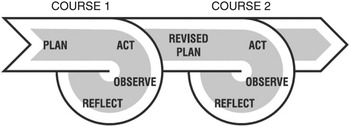
The study described here is based on a comparison of two oral proficiency courses aimed at doctoral students which took place in SL. It represents a research model of action research (see also Figure 1), a “framework for thinking systematically about what happens in social situations, implementing action for change and monitoring and evaluating the effects of the action with a view to continuing development” (Hudson, Owen & van Veen, Reference Hudson, Owen and van Veen2006: 581).
The moments of action research (from Hudson, Owen & van Veen, Reference Hudson, Owen and van Veen2006: 581).

3.2 Course setting
One of the target areas for the Kamimo research was language learning, and a course concept to be tested had arisen from needs analyses that indicated that doctoral students from the participating universities specifically required more oral practice in the target language and better linguistic tools to communicate their research in English; while many non-native doctoral students were used to writing about their research in English, talking about the same topic in informal/formal conference and workshop contexts seemed to come less naturally.
Our aim was thus to use Kamimo in order to provide groups of doctoral students from different language backgrounds with a platform for practising and developing their oral/aural communicative skills in English in an authentic professional linguistic setting, a setting which can best be described in terms of “English as a lingua franca” (ELF) (Seidlhofer, Reference Seidlhofer2005, Reference Seidlhofer2007). We designed a course concept to meet these learning goals and conducted Social English for Doctoral Students (hereafter called Course 1) during Autumn 2007. Working from an action research model and basing our judgements on the experiences and reflections of Course 1 (see Section 4.1 for details), we then redesigned the course concept. In early Spring 2008 we conducted Oral Competence for Doctoral Students (hereafter referred to as Course 2) with similar learning goals to the previous course. Courses 1 and 2 should thus be seen as two “moments” in an action research process. In line with our learning goals and the ambitions of the Kamimo project to test selected learning tools, the tool of interest here was thus the voice chat function in SL. Text chat mode was not investigated in this study.
3.3 Research question and variables measured
In our courses, we aimed to get the students to participate as actively as possible in order to practise their target language. Determining learner participation in an e-learning context is complex (White, Reference White2003), but in our study we simply chose to measure learner participation by isolating and analysing some of the measurable variables that came into play in the two courses. The variables we look at are floor space, turn length and turn taking patterns. We compared these variables in the two courses in an attempt to determine the consequences of our changes in course design. Our research question was thus related to how our changes in design affected student participation.
Data were collected via ‘in-world’ recordings of course sessions. For this purpose the software Camtasia was used. Empirical data collected from these recordings included the floor space occupied by each participant (including teachers) and turn-taking patterns. We limited our study to four sessions conducted in SL, the first and last sessions (hereafter Sessions 1 and 6) held during the courses. These were similar in that Sessions 1 on both courses dealt with issues related to introducing oneself, whereas Sessions 6 both involved giving public presentations. The choice of sessions was also motivated by an interest in comparing the initial and final participation of the students. We also gathered additional qualitative data from questionnaires, group evaluations and personal interviews.
3.4 Model of analysis
When assigning consequences of the different variables we take an ecological perspective of language learning (Panichi, Deutschmann & Molka-Danielsen, Reference Panichi, Deutschmann and Molka-Danielsen2008; van Lier, Reference van Lier2004). According to this model, all learning is situated in an environment and, as such, is contextualised. To be able to evaluate learning and teaching all evaluation must take into account the environment. In an ecological approach to learning, however, the environment does not exist per se (i.e. static) but is determined through a series of interactions: subject-learner, subject-teacher, mode of transmission-learner, subject-group, group-teacher, learner-learner, etc. and is as variable as the infinite possibilities of these interactions.
The outcome of these interactions then go on to feed into yet further interactions between elements in the environment in a continual process of change. In this sense the system is dynamic and interdependent, and variables cannot be isolated. Thus, in our analysis of the outcomes we do not attempt to assign a particular change in outcome to any particular change in design, as these can all be seen as interrelated.
4 Results
4.1 Changes made in Course 2 based on experiences from Course 1
The learning goals of both courses addressed oral proficiency in a professional setting. In Course 1, however, the emphasis was on production. After the experiences of the first course we also added listening skills, such as being a supportive listener and being able to signal when you do not understand, to the learning goals. This was done in order to emphasise the interactive elements of communication in this type of ELF setting.
Participants for both courses were recruited using the Kamimo network of researchers and educators. For practical reasons, the groups were kept relatively small. On the first course there were six doctoral students and on the second course there were seven. These were deemed to be manageable groups, especially since most of the participants, including some of the teachers, were first time users of SL. Whilst we did not change the number of participants we tried, as far as possible, to create a more homogeneous group in terms of research interests for Course 2, because the fact that students could not relate to each other’s research areas during Course 1 was sometimes problematic and led to misunderstandings.
The teacher student ratio was high on both courses. In Course 1, we had three teachers in SL so that each student would get the support s/he needed. At times, however, we felt that the high teacher presence was deemed as intimidating by the students and we thus decided to reduce the number to two teachers in Course 2. In addition, we felt that the teacher team was male dominated and therefore replaced two of the male teachers with a female teacher.
On both courses, the participants received detailed study guides, timetables, etc., as well as comprehensive information on how to access SL. For Course 1 we assumed that this written information would be enough to enable the students to access the environment. For two of the six students this proved not to be the case. In Course 2 we therefore added test sessions in SL prior to the start of the course, during which we made sure that they mastered the basics (voice chat, text chat and movement). All participants on Course 2 had thus accessed Kamimo and used the communicative tools prior to the course starting, something which proved to be very beneficial.
On both courses we used SL for our class sessions. In addition, we used e-mail to send out information to the participants. For the second course, however, we added Skype to the list of communicative tools. On the first course we had had several incidents when students could not enter SL and with Skype we were able to reach students and help them instantaneously. During Course 2, a course blog was also created. After the experiences of the first course, we felt that we needed a forum where students could read about the different sessions and get any information they may have missed in case they had been absent.
The general aim of both courses was to improve the participants’ oral proficiency in talking about their research and in interacting with research peers under less formal conditions. The design of the tasks differed greatly from Course 1 to Course 2, however. In Course 1, we worked from a role play model. One of the teachers involved had worked from this model extensively before, and we envisaged that this sort of task would be well suited to this type of game-like environment. In role play scenarios dealing with issues such as how to respond to critical questions, or how to interrupt a conversation between two eminent academics, the teachers would take on made-up roles of academics with whom the participants were expected to interact. Following each exercise, there were feedback sessions during which the teachers addressed general and linguistic issues that arose from the role play scenarios (Molka-Danielsen et al., forthcoming). The students did not respond to these exercises the way we had expected them to, however. We observed that they often did not enter the “correct mind set”, and on the whole we felt that instead they were rather bemused and embarrassed about the set-up. Experiences from the first course thus led us to construct a freer design, based on authentic input, where only the general themes were defined, and where the group dynamics dictated the specifics of the task content to a greater extent. The course design thus provided the framework for the interactions (which topics were to be discussed for example) but did not dictate the content as such. As was the case during Course 1, all meetings included a feedback session. These were, however, kept to the end of each course to avoid interrupting the group dynamics during the sessions. During the feedback sessions the participants were encouraged to talk about general issues such as how they experienced the environment and problems they had encountered relating to communication, and to reflect over the special communicative challenges that the environment posed. General feedback on linguistic issues were communicated in writing after each session.
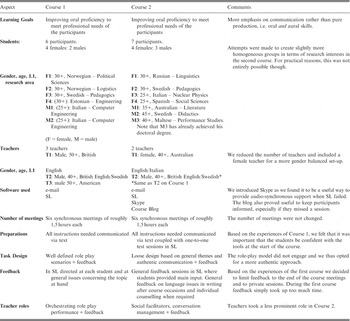
The task designs also affected the roles of the teachers in the two courses. During Course 1, much energy had to be spent explaining the roles and actively directing students’ performance to fit the role play tasks at hand. In the feed-back sessions much time was spent talking about how the students performed and about general issues related to the task. In Course 2, we decided instead to take a less central role and to facilitate learner participation rather than directing the actual performance. Obviously some instructions were given but the central roles of the teachers were in managing the conversations, making sure that everyone became active, and also in providing positive support by using supportive moves and by expressing interest. After the initial sessions, the teachers tended to stand back and let the students manage their interactions themselves. The “facilitator” role played by the teachers was designed to foster the development of learner autonomy as the course progressed. A summary of similarities and differences between the two courses is given in Table 1.
Summary of the structures of the two courses investigated in this study

4.2 Description of the sessions used for the participation analysis
4.2.1 Sessions 1, Courses 1 and 2
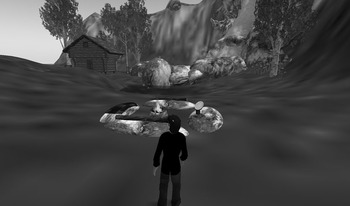
The aim of Sessions 1 of Courses 1 and 2 was that the students should work on introducing themselves to people they did not know. In Course 1, this introduction was worked into a role play scenario where the students should introduce themselves to two “extremely important and influential academics, who were members of funding committees”. In Course 2, the primary aim was that the students should get to know each other and they were encouraged to talk about their interests and their backgrounds. Students were also told to be prepared to say something about their previous language learning experiences, when they first started learning English and what other languages they knew. The sessions were both conducted around the informal setting of a camp fire on Kamimo Island (see Figure 2).
The informal setting of the The Camp Fire, the location used for Sessions 1 of the courses.

4.2.2 Sessions 6, Courses 1 and 2
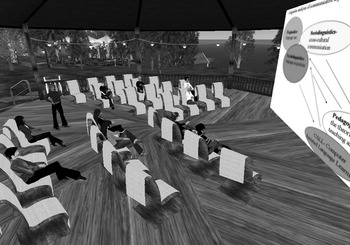
The aim of Sessions 6 on both courses was that the students should practise giving public presentations on their research interests and respond to questions. On both occasions, the students were asked to prepare a slide and a three-minute presentation of their research field. In Course 1, the session also included a role-play scenario whereby one of the teachers would play the role of the critical peer asking ‘nasty questions’. In Course 2 all questions were authentic and were mainly posed by the students themselves. In order to give a more realistic feel to the sessions, we used a virtual lecture theatre, the Peer Gynt Rotunda on Kamimo Island, constructed for this type of learning scenario (see Figure 3).
Peer Gynt Rotunda, the location for the public presentations of Sessions 6.

4.3 Participation
4.3.1 Floor space
The floor space taken up by the different individuals was measured by going through the recordings, measuring the length of each turn and noting the individuals who took the turn. Note that the initial sound checking, etc. was not included in the calculations.
Sessions 1
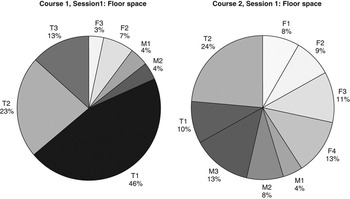
The total floor space time included in the analysis for Session 1, Course 1 was approximately 55 minutes and the total floor space time included in the analysis for Session 1, Course 2 was approximately 70 minutes. Note also that only four students were present during Session 1, Course 1. The floor space distributions for Sessions 1 are illustrated in Figure 4.
Floor space taken up by teachers and students during Sessions 1 of courses 1 and 2.

In Session 1 of Course 1, the teachers accounted for 82 per cent of the floor space. The remaining time was divided relatively evenly between the students, with student F2, a Norwegian post graduate studying Logistics, taking up the most space, 7 per cent.
In Session 1 of Course 2, the teachers accounted for 34 per cent of the floor space. The remaining 66 per cent was taken up by the seven students present where three students in particular were more active than the rest: M3, a Maltese researcher in the domain of Performance Studies (note that M3 had already achieved his doctoral degree) with high proficiency in English; F3 an Italian doctoral student in the domain of Nuclear Physics with relatively limited proficiency, and F4, a Spanish doctoral student from the domain of Social Sciences with medium proficiency. Interestingly, M1, an Australian doctoral student from the domain of Literature, with native proficiency, only accounted for four per cent of the floor space.
Sessions 6
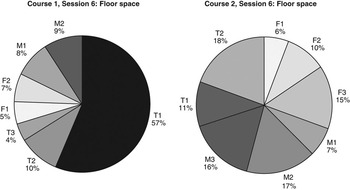
The total floor space time included in the analysis for Session 6, Course 1 was approximately 57 minutes, and the total floor space time included in the analysis for Session 6, Course 2 was approximately 83 minutes. Note also that only four students were present during Session 6, Course 1, and six students were present during Session 6, Course 2. The floor space distributions for Sessions 6 are illustrated in Figure 5.
Floor space taken up by teachers and students during Sessions 6 of Courses 1 and 2.

In Session 6 of Course 1, the teachers accounted for 71 per cent of the floor space. The remaining time was divided relatively evenly between the students, but with M1 and M2, both Italian doctoral students in the domain of Computer Engineering with medium proficiency skills, taking up slightly more time than F1 and F2.
In Session 6 of Course 2, the teachers accounted for 28 per cent of the floor space. The remaining 72 per cent was divided relatively evenly between the students. Students M2, a Swedish doctoral student in the domain of Literature, M3, a Maltese researcher in the domain of Performance Studies, and F3, an Italian postgraduate in the field of Nuclear Physics occupied on average more floor space than the rest of the participants.
4.3.2 Turn lengths
The turn lengths of the different individuals were based on the average lengths of all the turns a particular individual took. Note that the initial sound checking, etc., was not included in the calculations.
Sessions 1
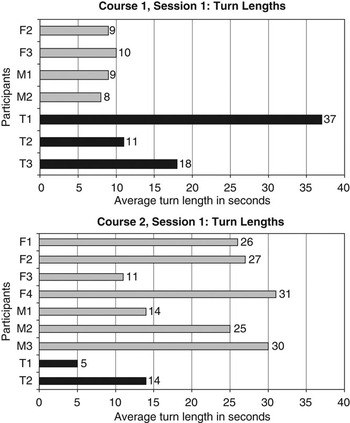
In Session 1 of Course 1 the teachers had much longer turn lengths than the students, Teacher 1 displaying the longest turn lengths with an average length of 37 seconds. The students, on the other hand, produced very short turns, on average lasting only 8–10 seconds. The turn length patterns are a reflection of the task design where students were asked to focus on ways of interrupting an ongoing conversation and introduce themselves. The very long teacher turn lengths are in turn a result of long feedback monologues during which role play performances were discussed and language issues were dealt with.
In Session 1 of Course 2 the teachers had, on average, shorter turn lengths than the students. Teacher 1 in particular displayed very short average turn lengths of only 5 seconds. The students, on the other hand, produced longer turns, on average lasting about 20–30 seconds. The turn length patterns are again a reflection of the task design where students were asked to speak freely about themselves. The shorter teacher turn lengths are in turn a result of the roles taken by the teachers during this session, i.e. that of facilitators. Many of the teacher turns consisted of single words and short supportive moves. The slightly longer turns of Teacher 2 can partly be explained by his role as instructor, introducing the task and giving instructions for the lesson. The results are summarised in Figure 6.
Average turn lengths during Sessions 1 of Course 1 and 2.

Sessions 6
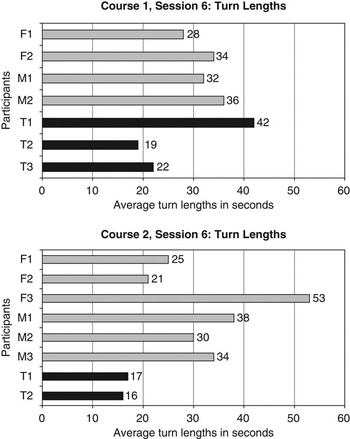
In Session 6 of Course 1 the turn lengths of the students were longer than in Session 1 on average. Teacher 1, however, still produced the longest turns on average of all the participants. The longer turn lengths are a reflection of the task design, where students were asked to give public presentations which were largely monologues followed by a question session. Note, however, that although students produced longer turns, they did not in fact actually occupy much more floor space. In other words they made a few long contributions only. The long turns of Teacher 1 are partly a result of him being responsible for the instructions for the lesson, but also partly a result of long feedback comments related to the students’ performances.
In Session 6 of Course 2 the students again had longer turns than the teachers on average. Their turn lengths were on average longer than during Session 1. Interestingly, the student with the longest turn lengths during this session, F3, an Italian doctoral student in the subject of Nuclear Physics, was arguably the least proficient of the participants. The teachers had, on average, much shorter turn lengths than the students. Teacher 1 and Teacher 2 had relatively similar average turn lengths during Session 6, a result of both of them being active in giving instructions and feedback during this session. The turn length patterns are again a result of the task design, but are also a reflection of the active question time sessions that followed each presentation. The students were genuinely interested in each other’s research and some were very active in asking questions. The results are summarised in Figure 7.
Average turn lengths during Sessions 6 of Course 1 and 2.

4.3.3 Turn-taking patterns
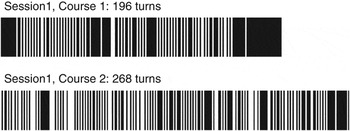
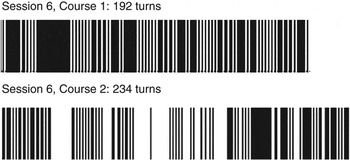
The turn-taking patterns were made visible by using colour coding in Excel. All cells representing turns taken by teachers were coloured black and those by students were coloured white. The emergent patterns give a picture of the turn patterns of teachers in relation to students during each session. The total number of turns for each session was also noted. Note, however, that the bars do not represent the lengths of the turns. Each turn, regardless of duration, was represented by one bar.
Sessions 1
The turn-taking patterns for Sessions 1 in SL consisted typically of student turns initiated by teachers. This was especially the case for Session 1, Course 1, where only four student turns following directly after another student turn were noted. In Session 1 of Course 2, this student-to-student pattern was more frequent and was observed on nineteen occasions. The norm, however, was still a teacher-student turn-taking pattern. During Sessions 1 of Courses 1 and 2, there were also many instances of teacher turns being followed by another teacher turn. This pattern was especially noticeable at the beginning of the session when instructions were being given and towards the end, during the feedback sessions. A diagrammatic representation of the turn-taking patterns of Sessions 1 is presented in Figure 8.
Turn-taking patterns Sessions 1, Courses 1 and 2. White bars represent student turns and black bars represent teacher turns.

Sessions 6
The turn-taking patterns of Sessions 6 of Courses 1 and 2 differed more than in Sessions 1. The teacher-student pattern observed during Sessions 1 was still the norm during Session 6 on Course 1. No student-student turns were produced during this session. Session 6 of Course 2 displayed quite a different pattern, however. There are examples of turn-taking involving up to fifteen turns where students respond to the turns of their fellow students without teacher involvement (represented by broader white bars in Figure 9). Again there are some parts of the session where teacher-teacher patterns are displayed. This was primarily the case during the feedback towards the end of the session. A diagrammatic representation of the turn-taking pattern of the two sessions 6 is presented in Figure 9.
Turn-taking patterns Sessions 6, Courses 1 and 2. White bars represent student turns and black bars represent teacher turns.

5 Lessons learnt
Given that our ambition in the study was to foster active participation, the results are encouraging. While it is impossible to attribute any particular change in design to any particular change in outcome (given our research design), we will here discuss some of the changes that we believe may have had particular impact.
With hindsight, it might be argued that we used the “you do what you did before approach” (Svensson, Reference Svensson2004) when designing Course 1. We assumed that role-play tasks would work well in SL because they had worked before in entirely different settings. We also fell into the trap of assuming that the students were, or at least would quickly become, familiar with the affordances of SL (cf. Hampel, Reference Hampel2006: 111). In fact this might have been a very important contributory factor to the failure of the role-play tasks – not the tasks themselves but the fact that the students could not immerse themselves in the fantasy of a role play while trying to figure out the basic functions of the interface. Thus we may have underestimated the effects of the “human-machine-human” nature of the interaction (Hutchby, Reference Hutchby2001: 8), a situation which may have meant that too much working memory was expended on the “human-machine” part of the interaction, leaving little energy for the demanding human-human part of the interaction. The stressful nature of this set-up may well have affected motivation and participation (cf. Affective filter hypothesis, Krashen, Reference Krashen1987).
We also speculate that one important factor adding to the increased participation in Course 2 was the authenticity of the tasks at hand. Again with hindsight, this should have come as no surprise (cf. Warschauer, Reference Warschauer1997: 487 and Hampel, Reference Hampel2003: 24). There was arguably also a stronger meaning focus (Chapelle, Reference Chapelle2000) in Course 2, since the students had more research interests in common and thus found the discussions more meaningful. In addition, the situations we simulated in both courses were directly applicable to the students’ professional lives.
The task design in Course 2 was also more collaborative, with the students themselves providing the content (cf. Meskill, Reference Meskill1999: 145). In many of the sessions, especially towards the end of the course, students did actually confront each other’s research ideas, resulting in controversy and disagreement as well as resolution and consensus. More elements of socialisation were worked into the design in Course 2, something which is deemed to be of particular importance in on-line courses (Salmon, Reference Salmon2004). One of the students actually expressed frustration, wanting time to get to know her fellow students in Course 1. The group feeling thus became greater in Course 2, something which was confirmed in the evaluation questionnaires which were sent out at the end of the course, where the statement “I felt very much part of the group” received an average score of eight on a ten point scale, where one represented strong disagreement and ten total agreement.
The behaviour of the teachers also differed greatly on the two courses. During Course 2, teacher behaviour promoting active participation was consciously worked into the design. This included directing questions to all present and also taking a less prominent role once the participants had become familiar with the group and the environment.
Attitudes toward the environment itself may have influenced engagement and participation. Several views were expressed, both negative and positive. Some students felt safe hiding behind an avatar. They felt less shy and less inhibited. Some students also felt that the environment appealed to their creative side and that it was engaging visually. On a more negative note others felt that the game culture they associated with SL was inappropriate for university courses, as one student put it: “SL felt like a game and I find it difficult to see how students will take it seriously.”
To sum up, with reference to Hauck and Youngs (Reference Hauck and Youngs2008), we could have done more initially to “investigate the affordances of the technical environment” but, on the other hand, the course experience did give us new insights which we could apply to the design in Course 2.
6 Concluding remarks
This study should only be seen as a first step towards investigating what affordances an environment such as SL can offer CALL. In response to our specific learning goals we have here focussed on task design and one mode of communication, namely oral communication using voice chat. In these respects, we have found that much of what has been found in research into task design aimed at more traditional audio-synchronous environments can be applied also to SL. There is, however, much left to be done, especially in the area of multimodal usage of SL, before we can fully begin to seriously evaluate the potential benefits of the environment in language learning.