1 Introduction
Learning to process academic literature and taking a motivated, critical stance toward it is a major challenge for any undergraduate university student. Novice learners tend to process texts in an atomistic, linear and unreflective fashion both in text comprehension and text production, having difficulties in bringing forth main ideas coherently and effectively (Brown & Day, Reference Brown and Day1983). In Bereiter and Scardamalias’ (Reference Bereiter and Scardamalia1987) terms, they engage in knowledge telling, a kind of memory dump, instead of knowledge transforming, which is an active, holistic and rhetorically sensitive problem solving process that is typical of skilled learners and experts.
Traditionally, educational contexts favour a knowledge telling type of behaviour. They are occupied with literacy practices that are based on acquiring, reproducing and demonstrating predefined, theoretical knowledge individually under the control of an authoritative teacher. This stands in contrast to real life professional environments, which engage in team work and make creative use of information for novel, authentic purposes (Scardamalia & Bereiter, Reference Scardamalia and Bereiter1996, Reference Scardamalia and Bereiter1999; Nystrand, Reference Nystrand1997; Tynjälä, Reference Tynjälä2001; Felix, Reference Felix2005; van Lier, Reference van Lier2007).
According to Nystrand (Reference Nystrand1997: 5), one consequence of traditional teacher-centred and product-oriented pedagogy is that students develop no ideas of their own and look for ready-made solutions for new problems. Employers, on the other hand, look for transformative potential when they recruit graduates (Kirschner, Martens & Strijbos, Reference Kirschner, Martens and Strijbos2004: 3; McPherson & Nunes, Reference McPherson and Nunes2004: 2). In the social constructivist and dialogical paradigm of learning that has been breaking ground in the field of general education and second language learning during the past two decades (see e.g. van Lier, Reference van Lier1996, Reference van Lier2000, Reference van Lier2007; Wells, Reference Wells1999; Lindberg, Reference Lindberg2004; Johnson, Reference Johnson2004; Felix, Reference Felix2005; Wegerif, Reference Wegerif2007), attempts are made to overcome such problems with inert knowledge. Agency, the socioculturally mediated capacity to act, is one key notion in these efforts (van Lier, Reference van Lier2007). Learning is seen as participation in meaningful activity rather than, or, in addition to, acquisition of predetermined knowledge (Sfard, Reference Sfard1998; Lipponen, Hakkarainen & Paavola, Reference Lipponen, Hakkarainen and Paavola2004; van Lier, Reference van Lier2007). Consequently, there is a growing emphasis on learning processes and collaborative and reflective work in the classroom. One important element of the participation framework is certain unpredictability: courses are designed to create affordances and support learning processes rather than attainment of predefined, fixed goals. In other words, the view on course design and learning outcomes is probabilistic rather than causal (Kirschner et al., Reference Kirschner, Martens and Strijbos2004: 11–12).
One way of facilitating the development of academic literacy and learning is discussing texts online, together with other students. Asynchronous computer conferencing in electronic learning platforms is the most commonly used technology in e-learning contexts, and the advantages and disadvantages of the medium are well recorded (see e.g. Hewitt, Reference Hewitt2001; Frey, Millie & Alman, Reference Frey, Millie and Alman2006; van der Pol, Admiraal & Simons, Reference van der Pol, Admiraal and Simons2006). As a written, asynchronous medium, computer conferencing offers plenty of time for reflection and drafting ideas in the spirit of writing-to-learn activities. Discussions are recorded permanently and can easily be returned to. Course members can participate at a time of their own choosing, giving everyone equal opportunities to express themselves without a sense of pressure or risk of interruption. As a form of many-to-many communication, asynchronous computer conferencing creates a promising space for enhanced, collaborative learning as students comment, complement and criticize each other’s messages.
However, there are also some disadvantages connected with the medium. In an asynchronous, text-only mode of communication, the meaning negotiation for a common ground and goal of discussion is challenging. As Saarenkunnas (Reference Saarenkunnas2004) points out, computer-supported learning is polycontextual by nature. Järvelä and Häkkinen (Reference Järvelä and Häkkinen2002: 5) discuss the difficulty of reaching reciprocity among the participants. Since there is no immediately shared social context, as in face-to-face communication, each participant approaches the discussion from his or her own current intentions, interests and interpretations, which can cause confusion. The lack of instant non-verbal feedback can even cause communicative anxiety (Wegerif, Reference Wegerif2007: 242). According to Hewitt (Reference Hewitt2001: 2), reply-based interaction in threaded discourse is also problematic due to lack of support for convergent, summarizing processes. The discussion easily leads to focus on individual notes and causes the discussion to lose its overall coherence. Very often students direct their responses to a particular note and do not review the thread as a whole. How much of the learning potential in a computer conference is realized thus depends, not only on the quality of the online discussion, but also on the students’ motivation and interest.
The present article deals with a university course on the theory of second language learning, where the central mode of communication was computer-mediated conferencing in a web-based learning platform called Optima (a presentation of the platform is at http://www.discendum.com/english/). The course design was based on the idea of process writing in order to support meaningful learning: it started with reading scholarly articles on language learning and language pedagogy, continued with threaded, online discussions of the texts, and resulted in a personal, reflective essay. The essays finally received both peer and teacher feedback.
This study focuses on phase two of this process: the online discussions of the articles. What happens in such meaning-oriented, collaborative discussions? What kinds of verbal action do the students engage in so as to make sense of the course literature? The study explores the ways that students make use of computer-mediated conferencing for collaborative text processing.
2 Research context
The material for this study was collected from an online course that was arranged for the foreign language students in the English and Swedish departments at the University of Oulu, Finland, in spring 2005. The purpose of the course was to introduce the students to current issues in the theory of second language learning. The course was optional and aimed at any English or Swedish students interested in the topic.
Over half of the language students at the University of Oulu become language teachers, but courses that explicitly deal with foreign language learning and teaching are rather limited. The curricula for the different language subjects traditionally concentrate on theory of language and culture (e.g. phonetics, grammar, language history, translation studies, literature) and language practice (oral and written skills, including translation), leaving language teaching matters to the Faculty of Education, where the students who opt for a teacing career do their teacher training later on in their studies. However, the need to provide studies that introduce language students to L2 theory at an early stage of their studies is obvious. Such studies help the students to conceptualize their own language learning and become efficient language learners. They also help the students to explore teaching as a potential profession. Finally, such studies serve students who are interested in writing their candidate’s or master’s thesis on a topic related to L2 matters. So, teachers from two departments combined their efforts and arranged a multilingual, introductory course on research in second language learning and teaching. The course was called Study circle on language teaching and learning.
On this particular course there were two teachers, the writer being one of them. The course languages were Finnish, Swedish and English. Finnish was the mother tongue for all the participants. The study circle centred around five articles that were discussed online. Three of the articles were written in Finnish, one in English and one in Swedish. The language of the online discussions was free, but in practice students mostly chose to use the language that the article was written in. The students were allowed to leave one article undiscussed according to their own choosing.
There were some practical challenges when planning the course. One challenge was the heterogeneous group of participants. The students represented two different study subjects, Swedish and English, and not everybody mastered both the languages equally well. So operating with different languages on the course required some sensitivity and encouragement. The students also came from different years. Most of them were second or first year students, but there were also some older students, who had already done their teacher training or had worked as teachers for some time. So, another challenge was to deal with the different levels of knowledge and interests of the participants. Yet a third challenge was the timetable. Since the students had different study backgrounds, a flexible course design was needed. In practice it would have been impossible to arrange a traditional course with face-to-face meetings on a weekly basis.
Twenty-three students enrolled on the course and eighteen completed it. The course design was based on the idea of process writing and writing to learn, and proceeded in the following steps:
1. read articles
2. reflect on the articles
3. share thoughts and questions online
4. reflect on the online discussions
5. summarize your insights in an essay
6. give and receive peer feedback on the essays.
First the students read the articles chosen by the teachers. Then they discussed the articles in computer conferences, each article on its own discussion list. After that they wrote a reflective essay on the basis of what they had read and discussed. Finally, the students also received peer and teacher feedback on the essays. In sum, the pedagogical communication on the course formed a continuum, where the students made meaning of the scholarly articles through writing: first informally and collectively in online discussions, then more formally and personally in the essays.
The function of the online discussions in the course context was to help the students get a grasp of the articles and to help them develop ideas for the reflective essay. In an introductory face-to-face meeting the function of the web conferences in the course context was discussed. The students were encouraged to pose questions on difficult points in the articles, explain difficult concepts to each other, look for similarities and dissimilarities between the articles, reflect on their own experiences in light of the theory, ask for clarification of each other’s messages, elaborate on each other’s thoughts, agree and disagree with the article and each other; that is, do anything that would make the articles intelligible and meaningful.
The aim of this study is to find out how the function of the computer conferences in the course context was fulfilled. What did the students actually do in the discussions in order to make sense of the articles? Given the relatively free instructions, it is interesting to see how the assignment evolved. Did the students approach the task as an opportunity to check their understanding of the semantic contents of the article (a kind of collaborative reading comprehension task), or did they use the article as a starting point for a more free exchange of experiences and opinions?
The data consists of 97 conference messages discussing a scholarly article written by Inger Lindberg, a well-known Swedish researcher specializing on interaction in second language learning. The article that the students read was entitled ‘Samtal och interaktion – ett andraspråksperspektiv’ (‘Conversation and interaction – a second language perspective’). It is a 24-page-long overview of research, dealing with the role of conversation and interaction in second language learning. The discussion about this specific article was chosen because of the present writer’s concern for gaining a better understanding of computer mediated conferencing, especially among students in her own teaching subject (Swedish). Also, the article is a good example of the kind of academic, expository prose that is potentially challenging for many undergraduate students. The discussion of the article continued for one month around March 2005 and was divided into eight threads. The first message was sent on February 28 and the last on April 10. Seventeen students and both the teachers took an active part in the discussion, so there were on average 5.1 messages per participant. The average length of the messages was 99 words.
At the end of the course a feedback questionnaire was executed, with three very open questions: What was good about the course? What was bad about the course? Was the work load suitable? Sixteen students answered the questionnaire. Answers from the questionnaire give valuable information about how the students experienced the course and can be used as supplementary data when interpreting the results.
To ensure the ethicality of the study, the students on the course were asked permission to use the online discussions and other material in the course environment for research purposes.
This is a small-scale study conducted in the spirit of teacher and action research, where the teacher aims at understanding and improving complex, day-to-day pedagogical practice through a cycle of planning, acting, observing, reflecting and revising (McNiff with Whitehead, 2002: 40–58; McDonough & McDonough, Reference McDonough and McDonough1997: 26; Salmon, Reference Salmon2002: 199–201). In this study the focus is on gaining a better understanding and control of asynchronous, computer-mediated conferencing as a mode of communication in university level content-teaching. There are both limitations and advantages to action research (see McNiff, 2001: 102–109; McDonough & McDonough, Reference McDonough and McDonough1997: 57–73; Salmon, Reference Salmon2002: 201–204). For example, the role of the teacher who investigates her own teaching is potentially problematic, since she is fully involved in the practice that is studied, which may raise arguments against objectivity and reliability. On the other hand, the strength of the research approach is that it builds on the teacher’s functional knowledge, which is likely to contribute to validity and sensitivity to data.
3 Theoretical and methodological framework
The central concept of this study is macro speech act (van Dijk, Reference van Dijk1980: 184–195, Reference van Dijk1997: 15, see also Bazerman, Reference Bazerman2004: 320–321). The unit of analysis is the conference message as a whole. The theoretical starting point lies in the assumption that a written text, even if it consists of several syntactic sentences, can be recognized on a global level as serving one main function. A text has, if it is coherent, a certain point or force that can be summarized with the help of a global speech act. So the relationship between the different sentences or utterances that a text consists of is hierarchical: the subordinate speech acts support the global one, for example by explaining or justifying it. The following is a simple example of a speech act sequence (van Dijk, Reference van Dijk1980: 182): I have no watch. Can you please tell me the time?
The first sentence in the above example is an assertion and the second one is a request. On a global level, however, we interpret the sequence as a request. This is because the assertion I have no watch is seen as a motivation to the following utterance. Subordinate speech acts of this kind can be related to what in speech act theory is called the felicity conditions of discourse (see Searle, Reference Searle1979: 44–45). I have no watch functions as a sincerity condition for the request: the request is appropriate only if the speaker himself cannot perform what he is asking for.
To illustrate the analysis of the online discussions, an example from the computer conference is presented below. The message opens a thread and is titled Language learning through interaction. The original message was written in Swedish, here presented along with a literal English translation of it.
Example message 1:
Jag tror att mycket av det som Lindberg skriver om att lära sig språk genom att tala med infödda talare är sant. Det märkte jag på en språkkurs i England förra sommaren. När jag talade med infödda engelskspråkiga, korrigerade de mig om jag gjorde fel (t.ex. använde “she” i stället för “he”) och hjälpte mig om jag inte visste något ord (t.ex. när jag försökte säga “kännykän laturi”). Det här var ju vad Lindberg skrev på s.465 ( “såväl språk som förståelse konstrueras i en ömsesidig process…”). Men har någon av er idéer hur vi kunde utnyttja det här systemet i skolan? Kanske skulle det vara möjligt att organisera frivilliga kurser, där eleverna kunde diskutera med svenskar eller engelsmän?
(I think much of what Lindberg writes about language learning through talking with native speakers is true. I noticed this on a language course in England last summer. When I talked with native English-speakers, they corrected me if I made mistakes (e.g. said “she” instead of “he”) and helped me if I didn’t know a word (e.g. when I tried to say “kännykän laturi” [mobile charger]). Isn’t this what Lindberg writes about on p. 465 (“language and understanding are constructed in a mutual process…”)? But does any of you have any ideas how we could make use of this system at school? Maybe it would be possible to arrange optional courses, where pupils could discuss with Swedes or Englishmen?)
How should one analyze this message in terms of macro speech act? It seems there is a lot going on in the sequence. First the sender takes a stand on the credibility of Lindberg’s article. Then she tells about her experiences on a language course. Then she very briefly cites the author, mainly to anchor the discussion to a specific part of the article. After that she poses a question to the other course participants. Finally, she makes a tentative suggestion on how some theoretical principles could be put into practice in schools. On a global level, however, the message can be interpreted as a request for ideas on how to increase the role of interaction in the language classroom. In other words, the sentence But does any of you have any ideas how we could make use of this system at school is considered to carry the main purpose of the message and function as a macro speech act. The question contains a presupposition, that the ‘system’ should be put into practice in schools. What is said before functions as a justification to the presupposition and, in that way, is subordinate to the question. The last sentence, in turn, functions as a prompt for what kind of ideas the writer is looking for.
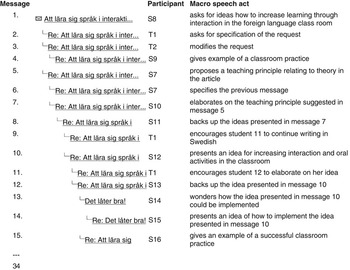
The analysis of the conference transcripts was carried out in two steps. First, each message was read and analyzed for its macro speech act, which was labelled as descriptively as possible. No attempt was made at this point to classify the messages into categories: using, for example, Searle’s (Reference Searle1979: 12–16) classification of speech acts into the five categories of assertives, directives, commissives, expressives and declaratives would have been too abstract to give a picture of what went on in the discussion. Figure 1 shows how the macro speech acts in the conference messages were labelled in this first step of analysis. The descriptions do not show the exact semantic content of the messages. The focus is, by definition, on the functions of the messages (the abbreviations S8, T1 etc. in the participant column refer to student and teacher numbers respectively).
Labels of macro speech acts in a thread

On the basis of the raw data acquired in step 1 (descriptions of macro speech acts in the computer conference) the messages were then divided into categories according to their main function in the discussion. The categories were informed by the research questions and the data itself. Four categories emerged as meaningfully covering the research questions and the material (each example message has been translated from Swedish):
1. Messages related to checking understanding of theory:What does the article say? What does it mean?
Example message 2:What is meant by ‘second language’ and ‘second language speaker’? Am I a second language speaker of German, even if I haven’t lived in Germany? I mean, do only immigrants count as second language speakers, or is anybody who has studied a foreign language (or else knows it a little) a second language speaker?
2. Messages related to exemplifying theory:What experiences have we had of the phenomena discussed in the article?
Example message 3:At school many years ago we played volleyball in two groups: one group consisted of good players, the other of bad players. When we bad players played together, the ball was always on the floor. Once I managed to get into the group of good players as they had noticed that I was not that bad, and after that I played with the good ones. I learned a lot about volleyball with them. I think study groups should consist of different kinds of pupils so that the weak ones can learn from the better ones and maybe the other way round. [From a discussion concerning level of input and scaffolding]
3. Messages related to theorizing practice:How should we understand/organize practice in light of theory?
Example message 4:According to Lindberg (p. 488), the native speaker’s attitude plays ‘a decisive role for the quality of the second language speaker’s communicative participation’. We aren’t native speakers, but if we, as teachers, dominate the discussion in the classroom, our pupils won’t dare to express their thoughts and questions. One should try to create more symmetrical situations, where teachers and pupils have equal opportunities to participate in the discussion and where everybody’s thoughts are respected.
4. Messages related to negotiating online communication:What do you mean by your message?
Example message 5:Can you elaborate on your idea a bit? What kind of themes would be covered? What would the role of the teacher be exactly? [Reaction to a teaching proposal]
Messages that inquire into the meaning of concepts or else aim at clarifying what the article says form category 1. Category 2 consists of messages that deal with the students’ own experiences and examples connected to some aspect of the theory, and category 3 of messages that deal with creating abstract principles on the basis of practical experiences.
Finally, one category was needed for messages that were related to negotiating online communication. Category 4 consists of messages that ask other discussion participants for clarification of their messages. Messages in category 1 are text-centred in the sense that they focus on creating an understanding of the wordings and propositional content of the article, whereas messages in categories 2 and 3 are reader-centred in the sense that they focus on elaborating and integrating the text information with the readers’ own reactions and associations.
4 Results
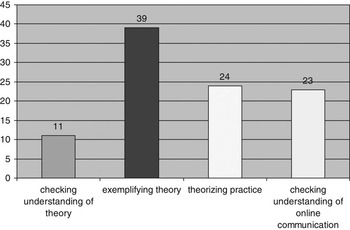
Figure 2 shows how the four main functions were distributed in the data. Out of the total of 97 messages 11 (11.3%) dealt with explicitly checking the meaning of the article. 39 messages (40.2%) were related to exemplifying theory, and 24 (24.7%) to theorizing practice. Finally, 23 messages (23.7%) were concerned with negotiating online communication.
Main functions of conference messages
The discussion can thus be characterized as reader-centred and practice-oriented: the two largest categories, approximately two thirds of the messages, were concerned with interpreting theory from a practical point of view, expressing the students’ personal experience, opinion or idea about a certain issue related to the article. In comparison, only one tenth dealt with checking the meaning of the article. The students seemed to take the content of the article as given, so to speak, something that everybody had read and could understand, a shared background knowledge against which they could ventilate their practical understanding.
It is interesting that there was relatively little discussion on checking and establishing the meaning of the article. Of course, the course design gave relatively wide freedom to the students as regards how to tackle the study material. Although they were encouraged to ask freely if they did not understand something, and not to be afraid of asking ‘stupid’ questions, they did not do that very often. The online discussion evolved more into a forum for free thought exchange around the topic. And although the two teachers were actively involved in the online communication, and, at least in principle, could direct and guide the discussions, it was the students who ultimately decided which aspects of the articles should be identified as problems for further development. One example of this is a thread-opener, where the teacher asked someone to explain one passage in the article to her. She did not receive any answers or comments at all. It is possible that the students experienced the teacher’s message as a test question, not in line with the authenticity of the discussion. Of course, it can also be interpreted as taking the easy way out, avoiding difficult topics and cognitive effort, something that is easily done in many-to-many, open-ended discourse, both on- and off-line.
There are studies that report how networked interaction in many learning projects results in superficial and experience-based discussion, so called lower-level learning activities (Järvelä & Häkkinen, Reference Järvelä and Häkkinen2002; Angeli, Valanides & Bonk, Reference Angeli, Valanides and Bonk2003; van der Pol et al., Reference van der Pol, Admiraal and Simons2006). The results of the present study do not contradict these findings in the sense that the majority of the messages were experience-related, as explained above. However, the discussions were felt by the teachers on the course to be successful and educationally valuable. This impression was supported by the students’ feedback in an anonymous questionnaire that was executed at the end of the course. Below are some examples of feedback comments on the online discussions (translated from Finnish):
The discussions were real and contained many new perspectives that were well motivated – it helped to write the essay.
The online discussions were the best part of the course. Even the most theoretical topics came alive and were combined with practice.
A really interesting course that successfully combined both theory and practice. When reading other students’ comments and essays one learned a lot – even about one’s own thoughts.
The discussions were really ‘discussion-like’ and not simply mechanical summary of the articles.
The students reported the online discussions to be mind-broadening and rewarding because they saw in them an interplay between theory and practice. Theoretically, this can be related to research on the development of expertise, as discussed by Tynjälä Reference Tynjälä2001. As she points out, expert knowledge consists of several components. Apart from formal, declarative knowledge that students mainly learn during their education, they also need practical knowledge and reflective skills. The online discussions in this case seem to have supported integration of different types of knowledge. The students translated abstract theories and formal knowledge in the article into use in practical situations and, vice versa, constructed more general principles on the basis of their practical experiences. Research suggests that particularizing theory and theorizing practice are key elements in the development of expert knowledge (Tynjälä, Reference Tynjälä2001: 39).
The results of this study can also be explained against Bruner’s (1986, 1990) notions of narrative and paradigmatic texts, or Grabe’s (2002) dichotomy of narrative versus expository macro-genres. Both refer to two interdependent but distinct modes of discourse through which human beings construct themselves and their view of the world. As Bruner (Reference Bruner1990: 43) explains it, the principal property of narrative lies in its sequentiality: a narrative is made up of a unique sequence of events and involves feeling human beings as actors in happenings that build up a distinct plot, told from a certain perspective. A narrative is thus inherently experience-related. It typically deals with human action and intentionality, and is open to different interpretations. Paradigmatic or expository texts, in contrast, deal with definitions, categorizations and conceptualizations. Linguistically they operate with nominalizations, which provide a way of symbolically handling the complex and dynamic experience of reality, transforming it into a manageable picture of concepts and taxonomies. They follow a logic that is constrained to the text itself, which is expected to be self-explanatory and non-contradictory (Bruner, Reference Bruner1986: 11–14; 1990: 43; Grabe, Reference Grabe2002: 253–254; Wells, Reference Wells1999: 145).
According to Eubanks (Reference Eubanks2004: 35), many current researchers hold that narrative and non-narrative texts and thought are profoundly woven together. As Grabe (Reference Grabe2002: 258–262) points out, the distinction between narrative and paradigmatic/expository texts is relevant in comprehension research, as, essentially, comprehension of text occurs at two levels: the textbase and the situation. At the level of textbase the reader reconstructs closely the information provided by the text, creating a close summary of the propositional contents of the text with minimal elaborations of his/her own. At the level of situation, on the other hand, the reader elaborates the text with background knowledge, reader purpose and attitude. Ideally, both levels are active in successful comprehension, as they complement each other (Grabe, Reference Grabe2002: 260). In the present study it is possible that the students overplayed the situation level of comprehension in an effort to make the scholarly article more familiar to their own knowledge base by ‘narrativizing’ it. The risk of such reader-centred text processing is, of course, skewed, hasty or downright mistaken interpretations. Felix (Reference Felix2005: 89) mentions ‘naïve constructivism’ as one of the problems associated with (social) constructivist approaches in education. As she points out, educators should not place too much faith in learners’ ability to structure their own learning, and simply equate activity with learning. On the other hand, it must be acknowledged that the learner’s previous knowledge and beliefs always direct his/her perceptions and interpretations of new information, as stated by the constructivist epistemology of learning (e.g. Tynjälä, Reference Tynjälä2001: 41). To build bridges between the narrative and paradigmatic/expository modes of thinking can in this light be seen as an essential part of learning. Turner (Reference Turner1996: 4–5) even argues that narrative imagining is the fundamental instrument of thought and that our rational capacities depend upon it. It is our chief means of explaining, predicting and planning.
There is also a second reason why I would be careful not to downplay the value of experience-based discussions. Computer-mediated conferencing is a medium combining both cognitive and social presence of its participants (Rourke, Anderson, Garrison & Archer, Reference Rourke, Anderson, Garrison and Archer1999). Given the interactivity of the medium, it is most likely that students more or less deliberately want to keep the level of discussion down-to-earth, using analogue and narrative as preferable modes of reasoning in order to create rapport among the participants. Technical jargon and an expository style on an abstract level might even be considered as bookish and improper. This does not necessarily mean that the students are insensitive to, or incapable of abstract and formal reasoning, only that the medium does not invite that kind of discourse. As Mercer (Reference Mercer2000: 103) contends, the process of thinking collectively is, generally speaking, a rhetorical activity. My tentative claim is that participants in computer-mediated conferencing are responsive to the social dimension of the medium and tend to prefer a style and genre that is personal and subjective, rather than analytical and objective. In terms of the traditional dichotomy of speech and writing, which characterizes speech as active, dynamic, concrete, spontaneous, narrative, social and dialogic, and writing as reflective, synoptic, abstract, scientific, paradigmatic, individual and monologic (Wells, Reference Wells1999: 146), participants in computer conferences would, in my line of reasoning, seem to incline towards a speech-like mode of discourse. The challenge for the educator, in this respect, would be to find a proper task for asynchronous computer conferencing in the overall course design.
5 Conclusion
This study explored the ways in which a computer-mediated conference evolved on a course that was designed on the principle of process writing. The students read scholarly articles and discussed them online in order to make sense of them collaboratively in preparation for a reflective essay. The purpose of the study was to investigate what kind of verbal action the students would engage in so as to make sense of the course literature. Did they adopt a text-centred approach to the computer-conference, checking the meaning of the text and establishing its propositional textbase, or did they adopt a more reader-centred approach, elaborating on the themes of the article from different personal angles? Ninety-seven conference messages were analyzed for their macro speech acts and divided into categories according to their main function. The majority of the messages turned out to be reader-centred, students reflecting theory in light of personal experiences. The result does not contradict previous research, which also reports a tendency toward experience-based discussion in electronic conferencing systems (e.g. Järvelä & Häkkinen, Reference Järvelä and Häkkinen2002; Angeli et al., Reference Angeli, Valanides and Bonk2003; van der Pol et al., Reference van der Pol, Admiraal and Simons2006). The result was interpreted in terms of the distinction between narrative and paradigmatic/expository texts (Bruner, Reference Bruner1986, Reference Bruner1990; Grabe, Reference Grabe2002). It was assumed that when students jointly discuss theoretical matters expressed in an expository text, they easily resort to a narrative mode of reasoning and communicating. In terms of ideas, this helps them to anchor text information to their world knowledge. Interpersonally, it is an accessible and non-face-threatening way of communicating around potentially difficult topics. The danger of such reader-centred text-processing is, however, that it allows different kinds of avoidance behaviour, for example social loafing and one-sided concentration on safe or easy topics.
The pedagogical significance of computer conferencing in teaching and learning depends on its place and function in the overall course and curriculum design. According to Bazerman (Reference Bazerman2004: 311) university courses can be seen as structured activity systems that build upon an infrastructure of different types of texts in different media. Planning university teaching entails creating systems of genres that mediate both teaching and learning effectively. As different media have different characteristics, they are useful for different purposes. Computer-mediated conferencing as a medium of education seems to be especially suited for open-ended, tentative discourse that allows for different ideas and interpretations to come up, as in brainstorming. However, such a discourse should be embedded in a wider genre system in a process-oriented fashion. The thoughts generated by the computer conferences should be refined and processed further in other activities and tasks, using complementary media and genres. Today’s education, in increasingly blended learning environments, offers plenty of alternatives for combining different forms of speech and writing in purposeful ways.
On the course reported here, fifteen out of the eighteen final essays made reference to the discussions in the computer conferences, either on a general level or explicitly mentioning a specific message and its writer. The online discussions contributed to the essays in different ways. For example, there were essays that took their starting point in some of the themes that had aroused discussion on the net. Other students’ opinions were also used for backing up the argumentation in the essays. In some cases, opinions that had been presented online received objections and alternative interpretations in the final essay. For future research it would be interesting to study more closely the influence of computer conferencing on subsequent tasks in corresponding, process-oriented course designs. Preferably, this would require using supplementary methodologies like interviews, questionnaires and/or study logs in addition to text analysis of conference messages and other student products. In particular, the question of how aware students are of different modes of discourse (narrative vs. expository), and to what extent they shift between them in different media for different purposes, needs to be explored further.