1 Introduction
There is a growing body of research on Computer-Mediated Communication (CMC) that examines the interactions of second language learners in synchronous and asynchronous communication settings. In the earlier studies of the CMC research, many studies found that there is a greater amount of collaboration among learners (Chun, Reference Chun1994), and learners produce more language (Kern, Reference Kern1995), feel more relaxed (Chun, Reference Chun1994), and contribute more (Kern, Reference Kern1995; Warschauer, Reference Warschauer1996) in CMC when compared to face-to-face interaction.
Sauro’s (Reference Sauro2011) study synthesized 97 studies from major journals that dealt with or focused on synchronous computer mediated communication (SCMC). She utilized the conceptual framework of communicative competence (Canale & Swain, Reference Canale and Swain1980) to examine whether and to what extent these previous studies provided evidence for the development of four sub-categories of communicative competence, namely grammatical, sociolinguistic, discourse and strategic. Her synthesis revealed that many studies of SCMC provided evidence in favour of the development of grammatical (e.g., Lai & Zhao, Reference Lai and Zhao2006; Sauro, Reference Sauro2009), sociolinguistic (e.g., Sotillo, Reference Sotillo2000; Chun, Reference Chun1994), discourse (e.g., Belz, Reference Belz2004; Warner, Reference Warner2004) and strategic competence (e.g., Smith, Reference Smith2009a; Tudini, Reference Tudini2003) of second language learners.
Following an interactionist perspective in Second Language Acquisition (SLA) (Gass Reference Gass1997; Long, Reference Long1996; Pica, Reference Pica1994), in this paper, we investigated the interaction in both task-based face-to-face (F2F) and synchronous computer-mediated communication (SCMC) environments. We focused on the instances, types and linguistic categories of negotiation of meaning (NofM) between non-native speakers of English in F2F and SCMC environments while the participants were performing two jigsaw tasks. We examined the number of different types and linguistic categories of NofM instances and duration of the tasks in different environments and their level of noticing by the participants.
2 Background and review of related literature
2.1 Negotiation of meaning in SCMC
Earlier research on SCMC focused on two main issues about negotiation of meaning in online communication environments. The first area of interest was the existence of instances of negotiation of meaning in SCMC. A growing body of studies confirmed that negotiation of meaning also occurs during SCMC (Arslanyilmaz, Reference Arslanyilmaz2007; Blake, Reference Blake2000, Reference Blake2005; Cho, Reference Cho2011; de la Fuente, Reference de la Fuente2003; Fernandez-Garcia & Arbelaiz, Reference Fernandez- Garcia and Arbelaiz2003; Jepson, Reference Jepson2005; Lee, Reference Lee2002; Smith Reference Smith2003, Reference Smith2009a, Reference Smith2009b; O’Rourke, Reference O’Rourke2005; Wang, Reference Wang2006). Another line of research sought to identify the differences in the occurrences of negotiation of meaning in two different mediums of communication, F2F and SCMC (Fernandez-Garcia & Arbelaiz, Reference Fernandez- Garcia and Arbelaiz2003; Kaneko, Reference Kaneko2009). In their study, Fernandez-Garcia and Arbelaiz investigated the instances of negotiation in the conversations of two non-native speakers (NNS-NNS), native speakers and non-native speakers (NS-NNS) and two native speakers (NS-NS) both in traditional F2F and SCMC environments. They used two uncontrolled and open-ended discussion tasks to elicit their data. Results of their study demonstrated that NS-NNS dyads negotiated significantly more in F2F interaction compared to SCMC, and also they negotiated significantly more than two other groups in a F2F environment.
After portraying the similarities and differences in two different mediums, the researchers focused on other aspects of interaction - task type, group structure (e.g., proficiency level and NS vs. NNS interaction), noticing etc. - in their studies. For example, Kaneko (Reference Kaneko2009) examined the effects of both the medium of communication and the task type on the instances of negotiation of meaning in F2F and SCMC environments. Sixteen dyads performed three different tasks in both mediums. Kaneko used three different tasks in her study: Spot the Differences, Role Play and Constructing Sentences. The findings of this study revealed that F2F communication had an advantage over SCMC when task types were compared quantitatively. Among the three tasks, Constructing Sentences yielded the highest number of instances of negotiation of meaning. In another study, Jeong (Reference Jeong2011) examined the effects of task type and group structure on the instances of NofM. Twelve dyads of homogenous and heterogeneous groups performed three different tasks in both mediums. Her findings revealed that jigsaw tasks produced the highest amount of negotiation of meaning; however, there was no statistical difference between homogenous and heterogeneous groups in terms of the amount of negotiation.
Another group of studies focused on the relationship between noticing and NofM (Lai & Zhao, Reference Lai and Zhao2006; Shekary & Tahririan, Reference Shekary and Tahirin2006); however, the conceptualization of noticing was different in these studies. Shekary and Tahririan examined the Language Related Episodes (LREs) and operationalized each instance of LRE as noticed linguistic structure; however, in Lai and Zhao’s study a stimulated recall protocol was used to identify the noticed instances.
The current study benefits from the designs and concepts of previous studies as it compares the effects of two communication mediums (F2F and SCMC) (Fernandez-Garcia & Arbelaiz, Reference Fernandez- Garcia and Arbelaiz2003), and it focuses on noticing of NofM instances (Lai & Zhao, Reference Lai and Zhao2006). However, it diverts from other studies by employing a more controlled task, a bigger number of participants and its EFL setting.
2.2 Interactionist perspective and noticing
One of the main premises of Interaction Hypothesis is that interaction that involves NofM and feedback facilitates second language acquisition (Gass, Mackey & Ross-Feldman, Reference Gass, Mackey and Ross-Feldman2005). More specifically, when learners are provided with opportunities to interact with each other to obtain comprehensible input and feedback, and to reformulate their own utterances, instances that promote and facilitate acquisition are created (Loewen & Erlam, Reference Loewen and Erlam2006). Moreover, interaction that pushes learners to produce output is claimed to lead to syntactic processing which in turn would assist second language development (Swain, Reference Swain1995).
Interaction Hypothesis was first formulated and later modified by Long (Reference Long1980; Reference Long1983 & Reference Long1996). In the most recent version of the Interaction Hypothesis, Long (Reference Long1996) argued that “negotiation for meaning, especially negotiation that triggers interactional adjustments by the NS or more competent interlocutor, facilitates acquisition because it connects input, internal learner capacities, particularly selective attention, and output in productive way” (op. cit:, 452). Thus far, many studies have reported that interaction has created instances that could facilitate second language development (Ellis & He, Reference Ellis and He1999; Mackey, Reference Mackey1999; Varonis & Gass, Reference Varonis and Gass1985).
In her comprehensive review of the studies that follow an interactionist perspective, Pica (Reference Pica1998) claims that negotiation has the following benefits: (a) It assists comprehension by providing the learners with input that has been interactionally modified to meet their current target abilities; (b) It brings salience to form-meaning relationships by drawing learners’ attention to misunderstanding caused by their incorrect use of forms and to areas where the learner’s interlanguage differs from the target language; (c) It creates opportunities for learners to receive useful feedback from their interlocutors with regard to target-like vocabulary, morphology, syntax, and L1/L2 contrasts; (d) It provides a context for the learners to use the kind of feedback that could produce modified output; (e) It provides a context for the learners to think about syntax by providing them with models of target-like morphosyntax that may help them restructure their flawed interlanguage morphosyntax.
The Interaction Hypothesis is based on the Input-Interaction and Output model of language learning (Block, Reference Block2003). Receiving comprehensible input and feedback about the comprehensibility of interaction, noticing the problems in interlanguage and being pushed to make oneself more comprehensible in output and negotiation for meaning are all claimed to be useful from an interactionist perspective.
The acquisition of linguistic structures, in Interaction Hypothesis, is also linked with their noticing (Gass, Reference Gass1991, Reference Gass1997; Schmidt, Reference Schmidt1990). Noticing hypothesis, as proposed by Schmidt (Reference Schmidt1990), claims that new forms of input should be noticed in order to be processed. In other words, the learners should consciously notice the differences between their production and target form(s) to process the input and transform it into intake (Schmidt, Reference Schmidt1994). In her comprehensive review of the Interaction Hypothesis, Gass (Reference Gass1997) credits noticing as a necessary condition of language acquisition. Some scholars argue that because of its hybrid nature (i.e., being similar to spoken and written communication modes at the same time), SCMC has an increased potential for noticing of forms compared to F2F (Bower & Kawaguchi, Reference Bower and Kawaguchi2011; Lai & Zhao, Reference Lai and Zhao2006; O’Rourke, Reference O’Rourke2005; Shekary & Tahririan, Reference Shekary and Tahirin2006). In fact, Lai and Zhao’s study revealed that participants who communicated through SCMC were able to recall more instances of noticing than those who communicated through F2F.
Based on these implications, it is believed that the more negotiation of meaning occurs in the classroom, the more interactions will take place that will facilitate second language development and the noticing of these communication breakdowns will facilitate the acquisition of the target forms. This study was designed to examine manifestations of these implications. In this study, the instances of negotiation of meaning were analyzed in two different mediums of communication: F2F and SCMC and participants’ noticing of the NofM instances was investigated. Statistical analyses were carried out to examine any statistically significant differences in any of these mediums about the instances of NofM, their types and linguistic categories, and their level of noticing.
2.3 Conceptualization of negotiation of meaning
Pica (Reference Pica1994) describes negotiation of meaning as an activity “in which learners seek clarification, confirmation and repetition of second language utterances they do not understand” (op. cit.: 56). In this study, three forms of negotiation of meaning that had been the focus of some other interactional research were examined. These three sub-categories of negotiation of meaning are Confirmation Checks, Comprehension Checks and Clarification Requests. In Confirmation Checks, one of the conversation partners checks if s/he correctly understood what his/her conversational partner is saying. These are typically in the form of tag questions, repetitions of all or part of the same speaker’s utterances with a rising intonation, and/or utterances like ‘Do you understand?’ which explicitly check comprehension (Long, Reference Long1980 as cited in Foster & Ohta, Reference Foster and Ohta2005). The following example illustrates an instance of confirmation check [all examples are taken from our study].
Excerpt 1 An example of Confirmation Check

In Comprehension Checks, speakers may have some idea that their partners did not understand some part of their utterances, and they check whether this is the case or not. In other words, Comprehension Checks are used to elicit confirmation to check if the utterances were appropriately heard or understood. Long (Reference Long1980) states that they are always formed by rising intonation questions and they always involve repetition of all or part of the other speaker’s preceding utterance. The example below illustrates an instance of a Comprehension Check.
Excerpt 2 An example of Comprehension Check

As the name suggests, Clarification Requests seek for clarification and acknowledge lack of comprehension. Clarification Requests are mostly formed by questions; however, statements such as ‘I don’t understand’ and imperatives like ‘try again’ can also function as Clarification Requests. The following excerpt is an example of Clarification Request.
Excerpt 3 An example of Clarification Request

According to Pica (Reference Pica1994), negotiation of meaning has two major benefits: it assists second language comprehension and also it draws attention to second language form. Most of the previous studies that follow an interactionist perspective emphasize the role of noticing in second language learning. Noticing is an important component of second language development according to many researchers (Gass, Reference Gass1997; Schmidt, Reference Schmidt1990). According to her model of second language acquisition, Gass (Reference Gass1991) claims that no target language can be incorporated into a learner’s existing interlanguage system unless it is consciously noticed. It is usually assumed that when learners are interacting and trying to communicate, their attention is on language form as well as meaning (Gass, Reference Gass1997; Long, Reference Long1996; Mackey, Reference Mackey1999; Pica, Reference Pica1994). In this study, as a second level of noticing, we used the stimulated recall technique.
As Foster and Ohta (Reference Foster and Ohta2005) state, most of the interaction studies are carried out by using tasks as research constructs. One of the frequently used task types is information gap activities where learners are given partial information on a topic and asked to collaborate with their partners to fulfill the requirements of that task. Different types of tasks have been used to create interaction. These tasks vary in their nature and the amount of interaction they create. Pica, Kanagy & Falodun (Reference Pica, Kanagy and Falodun1993) argue that the jigsaw type of task would elicit a higher degree of negotiation of meaning than most other kinds of information gap tasks. In our study, we used the same task type for all groups. That is why task type was not a variable of our study. We chose the task type, i.e., jigsaw, that would yield the highest amount of interaction and the greatest number of NofM instances based on previous research (Jeong, Reference Jeong2011; Pica et al., Reference Pica, Kanagy and Falodun1993; Smith, Reference Smith2003).
This study sought to answer the following research questions:
1. What are the frequencies of NofM instances in terms of (a) the types of the NofM, (b) linguistic focus and (c) duration in different mediums?
2. Did any of the types of the NofM episodes occur more than others in different mediums?
3. Based on the stimulated recall protocols, which medium leads to more instances of noticing of NofM when the types of NofM are examined globally?
4. Based on the stimulated recall protocols, what are the percentages of noticed NofM instances in terms of linguistic categories and is there any significant difference according to the mediums?
3 Methodology
3.1 Participants
Participants in this study were 64 English as a Foreign Language learners who were attending intensive English courses in a Turkish university. They were taking Basic English courses (e.g., Reading, Writing, Grammar, etc.) at the Preparatory School of a public university. According to an in-house placement test, they were all Intermediate level learners of English. Their ages ranged between 18 and 27 (M=21.8) and they had studied an average of 7.8 years of English prior to the study. Each student performed two different tasks, one F2F and one SCMC, with a different partner. Four days after working on the tasks, the participants were asked to perform the stimulated recall protocol about their task performance.
3.2 The jigsaw tasks used
As Foster and Ohta (Reference Foster and Ohta2005) state, most of the previous studies that examine the instances and features of negotiation of meaning design and implement an information gap task to elicit their data. The task that was utilized in this study is a jigsaw task, which is also known as a two-way information gap task (Pica, et al., Reference Pica, Kanagy and Falodun1993). In a jigsaw task, individuals are given different pieces of information and are asked to solve the task (Mackey, Reference Mackey2012; Mackey & Gass, Reference Mackey and Gass2005). Previous research suggests that the nature of interaction and learner production is affected by the type of task in many cases. As Skehan (Reference Shekan2003) argues, “to choose a particular task type may well mean that learners are pushed to advantage some areas of language performance and disadvantage others” (op. cit., 395). We utilized a closed, two-way information gap task because it is argued that closed and focused tasks with specific aims would promote focus on form and focus on meaning at the same time (de la Fuente, Reference de la Fuente2003).
Based on the review of Pica et al. (Reference Pica, Kanagy and Falodun1993), a two-way, controlled task with one possible outcome would be the most suitable for language learners. In this type of task, learners are required to hold, request and supply necessary information to complete the task. In other words, these tasks involve an information exchange as participants are required to interact with each other while completing the task (Mackey & Gass, Reference Mackey and Gass2005). These features create instances of communicative interaction among the participants. As mentioned before, jigsaw tasks are one of the frequently used two-way information tasks (Doughty & Pica, Reference Doughty and Pica1986; Pica, Reference Pica1991; Swain & Lapkin, Reference Swain and Lapkin2001). By their nature, the jigsaw tasks create an information gap and learners are asked to interact to complete the task. Having a specific outcome target is one of the important features of jigsaw tasks and usually together with some other controlled, two way information gap tasks, they promote “the greatest opportunities for learners to experience comprehension of input, feedback on production and interlanguage modification” (Pica et al., Reference Pica, Kanagy and Falodun1993: 17).
The jigsaw tasks (Messy Garage and Bus Trip) we used in this study were adapted from Smith (Reference Smith2001). In his study, Smith used two jigsaw tasks with the idea that they would elicit a high degree of negotiation of meaning. Participants in his study were given different parts of a six-part pictorial story. The three pictures given to each student were arranged in random order and each learner was asked to discuss with their partners to reach an agreement on the order of the picture story. Both groups kept these discussions in their assigned communication modes (i.e., F2F or SCMC). After agreeing on the order, Smith asked his participants to discuss some questions that were related to the pictures. In our study, we followed the same steps as Smith until the discussion questions. In other words, our participants ordered the pictures with their partners as the participants in Smith’s study did. After ordering the pictures, we asked our participants to write a story based on the pictures (e.g., Swain & Lapkin, Reference Swain and Lapkin2001; Yilmaz, Reference Yilmaz2011) with the idea that this type of task would “maximally foster negotiation of meaning” (Swain and Lapkin, Reference Swain and Lapkin2001: 101).
For the first part of the task (i.e., ordering the pictures), Smith (Reference Smith2001) states that the structure of both tasks was essentially the same where each story included a scenario where the protagonist(s) encountered a mild problem which was solved humorously. In the second part, we followed what other researchers (Swain & Lapkin, Reference Swain and Lapkin2001; Yilmaz, Reference Yilmaz2011) did to facilitate opportunities for negotiated interaction.
3.3 Computer tools
Participants used two computer programs, i.e., MSN Messenger and MoonEdit, while carrying out SCMC tasks. MSN Messenger was used as a tool for communication because of its popularity among Turkish university students and because it is freeware that can be accessed and downloaded easily from Internet. MSN Messenger allows its users to instant-message their texts in a real time environment. The history function of MSN Messenger was especially instrumental in helping to record the interaction. In the background survey, participants were asked if they were familiar with MSN Messenger and all of the participants confirmed that they were familiar with this tool and they had used it at least once in the last year. A screenshot of MSN Messenger is provided in Figure 1.
A screenshot of MSN Messenger.

MoonEdit was used as a second online protocol. MoonEdit is free software that is available through the Internet. It provides its users with simultaneous editing opportunities when there is more than one person working on the same file at the same time. The cursors of all people working on the text-construction are available to other users. In MoonEdit, each user chooses a text color, which enables the tracing of each participant’s contribution. The users can also see other users’ typing and hear their keystrokes if they choose to do so. Another strength of MoonEdit is the availability of the history of the document’s creation. The fact that the text of each participant’s contribution is shown in a different color in MoonEdit led the researchers to believe it might facilitate data analysis. A screenshot of MoonEdit is provided in Figure 2.
A screenshot of MoonEdit.
3.4 Procedures
F2F and SCMC group participants met in a meeting room with the researchers where they were given instructions about which steps they would follow during the process. In this meeting, the participants signed the consent forms and filled out background questionnaires. All the instructions were given in Turkish, which was the first language of all participants. After this meeting, which lasted around an hour, the participants were assigned to either a F2F or SCMC group randomly, and asked to go either to the computer lab (for the SCMC task) or to the classroom that was prepared for the F2F interaction task. All necessary data collection and interaction equipment and materials had been prepared and were ready to use at this stage. For the data collection process, first, the F2F interaction group or SCMC group performed one of the assigned jigsaw tasks, i.e., Messy Garage and Bus Trip (see Appendices for the Tasks and Instructions). During SCMC tasks each group member was placed in a seat away from the other group member so that s/he could not see the computer screen of the other member. While working on F2F tasks, a cartoon barrier was placed between the participants with the same purpose. In the second phase, the same participant carried out the other jigsaw task by pairing up with a different partner and using the other medium of communication. The first group of tasks lasted around two hours (including the preparation period) and after a break of 30 minutes, the participants were invited to the data collection settings for the second group of tasks. The whole process of the data collection of jigsaw tasks took around five to six hours. To give an example of the grouping of participants, if S1 was assigned to the F2F interaction group, s/he performed the T1F2F (Task One, Face-to-face) jigsaw task with S2 in the first phase, and the T2SCMC (Task Two, Online) with S5 in the second phase (See Figure 3 for details). By asking participants to perform two tasks in two mediums, we aimed to overcome some differences among participants that might affect the performance (i.e., inclination toward one type of medium and/or task ordering effects, etc.). By the end of the study, each participant performed one F2F and one SCMC jigsaw task. Four days after the completion of the tasks, the participants were again invited to the data collection setting for the stimulated recall procedures. Here each participant was given a time-slot to meet with one of the researchers.
Research design.
The tasks used in this study were adapted from Smith (Reference Smith2001). In his study, Smith utilized a jigsaw task, which asked learners to order some pictures. Each student was given a set of three pictures, and was asked to discuss the order of these pictures with their partners. After finishing the picture ordering task, the participants were asked to discuss some questions that were somehow related with the pictures. In our study, the first part of the task was the same: it asked participants to order some pictures. However, instead of asking participants to answer some questions, in the second part of the task, we asked them to write a story based on the pictures provided. We used different instructions for F2F and SCMC groups. The participants in the F2F interaction group were asked to write the story on the paper provided, whilst the participants in the SCMC group used MoonEdit to write their stories. The software in MoonEdit helped to record data, and we used tape recorders to capture F2F interaction (please see the Appendices section for the instructions and other task materials).
3.5 Stimulated recall
We employed the stimulated recall technique as a method of eliciting data to determine the noticing levels of NofM instances by our participants. Here, our focus was on the perception of the language breakdowns rather than NofM. The instruction for the stimulated recall was created on the basis of Egi (Reference Egi2004) and Gass and Mackey (Reference Gass and Mackey2000). The participants were given the videorecordings or printouts of the chatlogs of the task-based interaction in both mediums and asked to report what they had been thinking about in every instance of negotiation of meaning which included a communication breakdown. In other words, we showed the videorecording of the task-based interaction episodes to the F2F group and printouts of the chat logs to the SCMC group and asked them to point out the instances where the learners (either themselves or their partner) had a communication breakdown and they looked for ways to overcome this situation. We used the same instructions in both groups for all participants. Following Gass and Mackey (Reference Gass and Mackey2000), both groups received the instructions in Turkish. These sessions were audio-taped and analyzed to understand the level of perception of the language breakdowns and/or communication problems and their noticing.
3.6 Coding and interrater reliability
Based on the information from previous studies (e.g., Pica, Reference Pica1994; Foster & Ohta, Reference Foster and Ohta2005; Gass, Reference Gass2003) an operationalization of NofM was created, and one of the researchers identified the instances and linguistic categories of NofM in all groups and coded them as Confirmation Checks, Comprehension Checks and Clarification Requests in terms of their types, and lexical, grammatical and other, in terms of their linguistic categories. The second researcher, independently, examined the same data and carried out the same procedure. Later, both researchers came together and checked the accuracy of their codings. If there was a disagreement, they re-examined the data and tried to reach a consensus. A final list of coding was prepared after this process.
After this initial step, to ensure the reliability of the coding process, a training manual that included the definitions and linguistic categories of each type of NofM with examples was prepared, and two external reviewers were asked to recode 10 % of the randomly selected data. Both of the reviewers held a PhD in either Foreign Language Teaching or Linguistics and were experts in their fields. The interrater reliability score (Cohen’s kappa) was.92 for the instances of NofM with the first rater, and.95 with the second. Regarding the types of the NofM, the reliability score (Cohen’s kappa) was .88 with the first rater and .89 with the second, and regarding the linguistic categories the reliability scores were .91 and .92, respectively.
4 Results
4.1 Research question 1
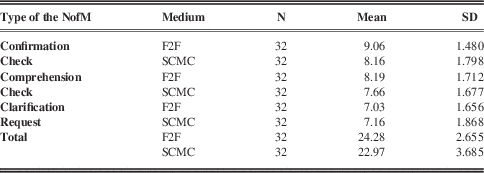
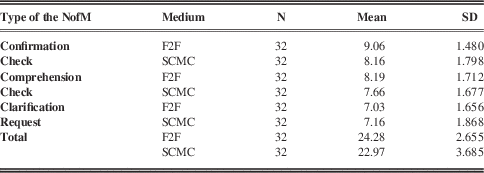
We examined the transcripts of the F2F tasks and text of the SCMC communication logs to determine the distribution of the types of NofM instances. As reported in many other previous studies, different types of NofM instances were also observed in our data. The first research question inquired about the types of negotiation of meaning sequences and their frequencies in different mediums. Overall, learners produced, per task, an average of 24.28 negotiation of meaning episodes in F2F and 22.97 instances of NofM episodes in SCMC. The high number of NofM episodes might be both about the type of the task given (i.e., jigsaw) and the duration of the tasks. Table 1 illustrates the descriptive statistics of the different types of NofM instances in different mediums. Descriptive statistics indicated that the Confirmation Check instances had the highest average in both mediums (M=9.06 in F2F and M=8.16 SCMC). Also instances of Comprehension Check (M=8.19 in F2F and M=7.66 SCMC) were higher than the instances of Clarification Request (M=7.03 in F2F and M=7.16 SCMC) in both mediums. F2F interaction produced more instances of Confirmation Check and Comprehension Check; however, SCMC generated a higher average of Clarification Request instances.
Descriptive statistics about the types of NofM instances
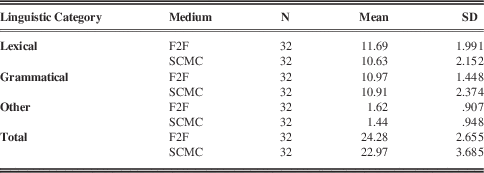
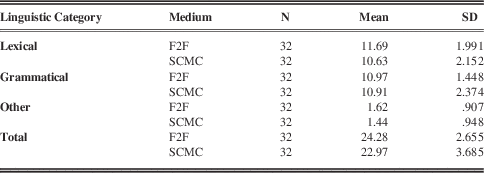
We also analyzed the linguistic categories of communication breakdowns in the NofM instances. We grouped the NofM instances according to three linguistic categories: lexical, grammatical and other. The category of ‘other’ included problems of pragmatics, discourse or some undecided episodes. Based on the descriptive statistics provided in Table 2, we can argue that there was a similar proportion of Lexical and Grammatical communication breakdowns in F2F and SCMC environments. The average of grammatical communication breakdowns was slightly higher than the lexical ones in SCMC (M=10.91 vs. M=10.63) whereas Lexical communication breakdowns were slightly higher than grammatical ones in F2F (M=11.69 vs. M=10.97).
Descriptive statistics about the linguistic category NofM instances
Previous research showed that the duration of the tasks in F2F and SCMC environments changed as well. We calculated the average duration of the tasks in two different mediums. The task-based interaction in the SCMC environment lasted much longer than the interaction in F2F (M=24.09 vs. M=16.23). While measuring the duration, we only considered the time spent on the task (on-task time) because in some dyads, after completing the task participants continued the conversation (in both English and Turkish) about other topics as shown in Table 3. Nevertheless, one should read these durations with caution because we could only measure the time of the on-task interaction but, as we have further analyzed, while some participants did not complete all steps of the tasks, they assumed that they had finished the task; others gave up working on the tasks after some time.
Descriptive statistics about the duration of the tasks in two different mediums

4.2 Research question 2
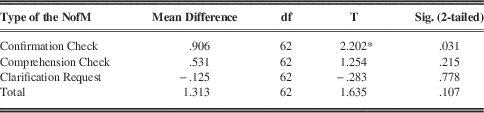
As a second research question we investigated whether there was any significant difference in the averages of different types of NofM (i.e., Confirmation Check, Clarification Request and Comprehension Check) instances in different mediums (e.g., F2F and SCMC). As shown in Table 4, Independent Samples T-Test results revealed that there was a significant difference in the averages of Confirmation Checks in F2F and SCMC (t=2.202, p=0.031). In other words, the average numbers of the Confirmation Check instances were significantly higher in F2F communication compared to SCMC. When F2F and SCMC mediums were compared in terms of Comprehension Check and Clarification Request instances, there were not statistically significant differences between the two mediums.
T-Test results for different types of NofM instances in different mediums
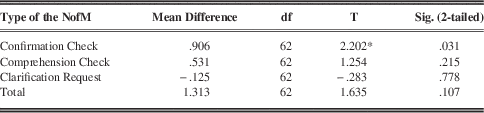
*p<0.05
4.3 Research question 3
One of the main aims of this research was to measure the noticing levels of the communication breakdowns in NofM instances and to identify if these levels differed in different mediums. To examine the participants’ noticing levels, we used the stimulated recall technique (see section 3.5). Table 5 demonstrates t-test results of the differences between the two mediums in terms of recalling the NofM instances, indicating that the mean difference between two mediums was 1.59 and that it was significant (t=3.48, p<0.01).
T-test results for the noticing of the communication breakdowns in NofM instances in different mediums

*p<0.01
4.4 Research question 4
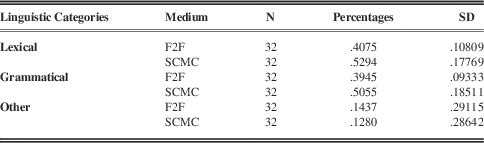
We also analyzed the percentages of noticing according to the linguistic category of the NofM instances. We wanted to examine if any of the linguistic categories we studied were noticed more than others. As shown in Table 6, our analysis revealed that participants in the SCMC environment recalled more instances of NofM in the Lexical and Grammar categories. Our findings demonstrated that 52% of the lexical communication breakdowns and 50% of the grammatical communication breakdowns were recalled by our SCMC participants in the stimulated recall protocols whereas in F2F the percentages were 40% and 39%, respectively.
Percentages of noticing according to the linguistic categories of NofM
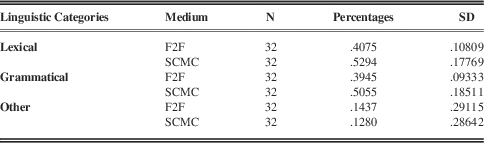
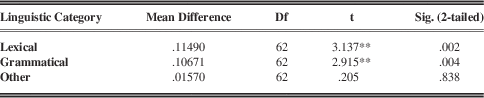
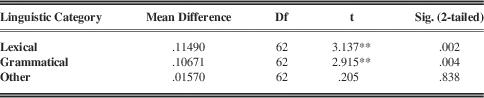
To examine whether these differences in noticing of the linguistic categories were significant or not, we ran an Independent Samples t-test (see Table 7 for details). Our findings demonstrated that the differences in the percentages of noticing of linguistic categories were significant both in lexical (t=3.137, p<0.05) and grammatical (t=2.915, p<0.05) communication breakdowns. In other words, the participants who were performing jigsaw tasks in the SCMC environment recalled significantly more instances of both lexical and grammatical negotiations.
T-Test results for differences of noticing of linguistic categories in different mediums
* p<0.05
5 Conclusion and discussion
In our study, we examined different types and linguistic categories of NofM in F2F and SCMC environments and their level of noticing by the participants based on a stimulated recall protocol. We also calculated the duration of the tasks in both mediums. The results of the study revealed that the average number of NofM exchanges was higher in F2F. When the types of NofM exchanges were analyzed, F2F interaction produced more instances of Confirmation and Comprehension Check sequences whereas SCMC generated a higher average of Clarification Request instances. In their study of comparison of F2F and SCMC interaction, Fernandez-Garcia & Arbelaiz (Reference Fernandez- Garcia and Arbelaiz2003) found that the NNS–NS group negotiated in the oral mode significantly more than in the written mode; this group also negotiated significantly more than the other two groups (NS-NNS and NS-NS) in the oral mode. Similar results were observed in Kaneko (Reference Kaneko2009). This finding of our research supports those of previous research: F2F creates more instances of NofM compared to SCMC.
One of the noteworthy results of our study was the high number of NofM instances in both mediums. We believe that it might be related to the type of the task we employed and the duration of the tasks. Jigsaw tasks, by their nature, facilitate more interaction and higher amounts of NofM (Jeong, Reference Jeong2011; Pica et al., Reference Pica, Kanagy and Falodun1993; Smith, Reference Smith2003). The high frequency of the NofM instances would be interpreted with Smith’s argument that “task type (i.e., jigsaw) does indeed influence the amount of negotiation that learners engage in during task-based CMC” (op. cit.: 52). Swain and Lapkin (Reference Swain and Lapkin2001) report a similar finding in favour of jigsaw tasks in their study on Language Related Episodes. Cho’s (Reference Cho2011) study also reveals that compared with information gap and decision-making tasks, the jigsaw task elicits the most negotiation routines for beginning-level students.
The analysis of linguistic categories of NofM sequences revealed that there were similar proportions of Lexical and Grammatical negotiations in F2F and SCMC environments but participants in the SCMC group recalled both lexical and grammatical items significantly more than those in the F2F group. In some other studies, there were more lexical negotiations compared to grammatical ones (Blake, Reference Blake2000; Smith, Reference Smith2003); however, the participants in our study produced similar amounts of lexical and grammatical negotiations. No previous study, to our best knowledge, compared the noticing levels of the linguistic categories of NofM instances. We could only find a previous study where Lai and Zhao (Reference Lai and Zhao2006) examined the effects of the linguistic category on the noticing levels of the recasts. Their study demonstrated that lexical items were noticed more in the stimulated recall protocols in F2F communication but SCMC provided a better environment for the noticing of grammatical items. The scarcity of research about the noticing levels of different linguistic categories calls for further research on this topic.
When the averages of different types of NofM instances in different mediums were examined to check whether there was any significant difference, we noticed that the average numbers of the Confirmation Check instances were significantly higher in F2F interaction compared to SCMC. However, there was no significant difference in Comprehension Check and Clarification Request in the different mediums.
Another aim of this research was to examine any difference in the noticing levels of communication breakdowns in NofM instances in different mediums. Here, we have to explicitly state that, in our study the operative part of the trigger in negotiation of meaning instances was the communication breakdown, and as we stated when we were giving instructions to our participants during the Stimulated Recall Protocols, our learners identified the instances where they had communication breakdowns. Our results revealed that the participants in the SCMC group could identify a higher average of communication breakdowns (M=10.72) compared to F2F group (M=9.13) and the difference was significant. Lai and Zhao (Reference Lai and Zhao2006) report a similar difference between the averages of noticed communication breakdowns in their study (M=.45 vs. M=.24, respectively). However, the difference between F2F and SCMC in terms of the noticed language breakdowns, in their study, was not significant.
In this study, we used a controlled jig-saw task to stimulate interaction in two different mediums with 64 intermediate level EFL participants. As Jeong (Reference Jeong2011) stated, most of the studies that examined the differences between F2F and SCMC interaction were conducted in ESL settings and many studies had 32 or fewer participants. The main strengths of this study are that we investigated the effects of the communication mediums on the instances, types and linguistic categories of NofM and their noticing in an EFL setting, and that the study involved 64 participants in 32 dyads.
Acknowledgement
We are grateful to Sibel Kaya for her support during statistical analysis. We would like to thank June Thompson and the anynomous reviewers for their helpful and constructive feedback and suggestions for the earlier versions of this paper.
Appendix 1A
Task 1
F2F
Student A
Messy Garage Footnote 1
Look at the series of pictures about a messy garage. You have three pictures and your partner has three different pictures. Together with your partner put the pictures in the correct order. To do this, you will need to describe each of your pictures to your partner since s/he cannot see your pictures.
The pictures are marked A-B-C-D-E-F. When you finish, please type the correct order to the paper provided.
After you make sure that you have the correct order of pictures, write a story based on the pictures. [Please see use the extra sheet of paper provided.]
Appendix 1B
Task 1
F2F
Student B
Messy Garage
Look at the series of pictures about a messy garage. You have three pictures and your partner has three different pictures. Together with your partner put the pictures in the correct order. To do this, you will need to describe each of your pictures to your partner since s/he cannot see your pictures.
The pictures are marked A-B-C-D-E-F. When you finish, please type the correct order to the paper provided.
After you make sure that you have the correct order of pictures, write a story based on the pictures. [Please see use the extra sheet of paper provided.]
Appendix 2A
Task 2
F2F
Student A
Bus Trip
Look at the series of pictures about a bus trip. You have three pictures and your partner has three different pictures. Together with your partner put the pictures in the correct order. To do this, you will need to describe each of your pictures to your partner since s/he cannot see your pictures.
The pictures are marked A-B-C-D-E-F. When you finish, please type the correct order to the paper provided.
After you make sure that you have the correct order of pictures, write a story based on the pictures. [Please see use the extra sheet of paper provided.]
Appendix 2B
Task 2
F2F
Student B
Bus Trip
Look at the series of pictures about a bus trip. You have three pictures and your partner has three different pictures. Together with your partner put the pictures in the correct order. To do this, you will need to describe each of your pictures to your partner since s/he cannot see your pictures.
The pictures are marked A-B-C-D-E-F. When you finish, please type the correct order to the paper provided.
After you make sure that you have the correct order of pictures, write a story based on the pictures. [Please see use the extra sheet of paper provided.]
Appendix 3A
Task 1
SCMC
Student A
Messy Garage Footnote 2
Look at the series of pictures about a messy garage. You have three pictures and your partner has three different pictures. Together with your partner put the pictures in the correct order. To do this, you will need to describe each of your pictures to your partner since s/he cannot see your pictures. Please use MSN Messenger to communicate with your partner.
The pictures are marked A-B-C-D-E-F. When you finish, please type the correct order on the MoonEdit screen that is located on the right side of your desktop screen.
After you make sure that you have the correct order of pictures, write a story based on the pictures. [Please see use the window that is on the right side of your desktop screen (MoonEdit).]
Appendix 3B
Task 1
SCMC
Student B
Messy Garage
Look at the series of pictures about a messy garage. You have three pictures and your partner has three different pictures. Together with your partner put the pictures in the correct order. To do this, you will need to describe each of your pictures to your partner since s/he cannot see your pictures.
The pictures are marked A-B-C-D-E-F. When you finish, please type the correct order on the MoonEdit screen that is located on the right side of your desktop screen.
After you make sure that you have the correct order of pictures, write a story based on the pictures. [Please see use the window that is on the right side of your desktop screen (MoonEdit).]
Appendix 4A
Task 2
SCMC
Student A
Bus Trip
Look at the series of pictures about a bus trip. You have three pictures and your partner has three different pictures. Together with your partner put the pictures in the correct order. To do this, you will need to describe each of your pictures to your partner since s/he cannot see your pictures.
The pictures are marked A-B-C-D-E-F. When you finish, please type the correct order on the MoonEdit screen that is located on the right side of your desktop screen.
After you make sure that you have the correct order of pictures, write a story based on the pictures. [Please see use the window that is on the right side of your desktop screen (MoonEdit).]
Appendix 4B
Task 2
SCMC
Student B
Bus Trip
Look at the series of pictures about a bus trip. You have three pictures and your partner has three different pictures. Together with your partner put the pictures in the correct order. To do this, you will need to describe each of your pictures to your partner since s/he cannot see your pictures.
The pictures are marked A-B-C-D-E-F. When you finish, please type the correct order on the MoonEdit screen that is located on the right side of your desktop screen.
After you make sure that you have the correct order of pictures, right now write a story based on the pictures. [Please see use the window that is on the right side of your desktop screen (MoonEdit).]