1. Introduction
Task-based language teaching (TBLT) has been widely adopted by educators teaching English as a foreign language (EFL) in most countries of the Asia-Pacific region such as Taiwan, Korea, and Japan. There is broad agreement that language learning benefits from TBLT that involves conversation in many ways. Different from activities that mainly focus on language forms, tasks support better input and output processes that resemble those in real-world situations (Richards & Rogers, Reference Richards and Rodgers2014). Tasks also foster processes of negotiation, modification, and experimentation while imitating realistic practices that are important for language development (Nakahama, Tyler & van Lier, Reference Nakahama, Tyler and van Lier2001). With regard to language learning per se, empirical studies have demonstrated that engaging learners in conversational tasks not only improves oral performance but also facilitates the learning of particular aspects of linguistic knowledge such as grammar (Fotos & Ellis, Reference Fotos and Ellis1991; Nakahama et al., Reference Nakahama, Tyler and van Lier2001). The linguistic conditions provided by TBLT are therefore particularly beneficial for EFL learners whose learning time mostly occurs in classrooms.
Although TBLT offers great pedagogical value, various challenges have been encountered. The main difficulty is the typically large classroom size in many EFL settings (Hwang et al., Reference Hwang, Shadiev, Hsu, Huang, Hsu and Lin2016), which limits learners’ active participation in tasks. Their low linguistic competence and lack of feedback oftentimes lead to communication breakdowns that undermine task performance. Also, EFL learners tend to avoid using the target language and rely on their own, thus circumventing the purpose of working on the task (Fotos, Reference Fotos1994). Because large classroom sizes make it harder for instructors to overcome these challenges (Bruton, Reference Bruton2005; Carless, Reference Carless2007), implementing TBLT may not effectively foster language processing and conversational interaction, which are considered essential for language learning (Mackey, Reference Mackey2006). However, technology offers the possibility of facilitating the success of pedagogic tasks and thus aligns well with the methodological principles of TBLT (Doughty & Long, Reference Doughty and Long2003).
Research has shown the benefits of integrating mobile learning (m-learning) into TBLT-based courses. M-learning expands the instructor’s capacity to track learning progress, provides real-time assistance, and fosters interactive learning experiences (Evans, Reference Evans2008; Kiernan & Aizawa, Reference Kiernan and Aizawa2004; Lai & Li, Reference Lai and Li2011; Lim & Churchill, Reference Lim and Churchill2016). However, most studies adopt mobile applications as the supplementary out-of-class tools for language practices, rather than as a part of in-class tasks (Burston, Reference Burston2014). Moreover, most in-class m-learning studies primarily focus on word-level learning, rarely extending beyond learning using L1/L2 flashcards and drills (Burston, Reference Burston2014). Further research is needed to explore the impact of mobile applications on supporting pedagogic tasks within the classroom. To help close this gap, the current study reports on a project providing two types of scaffolds, linguistic and task scaffolds, alongside the theory of zone of proximal development (ZPD) (Vygotsky, Reference Vygotsky1978) to enhance the implementation of TBLT for creating desirable conditions for language learning.
2. Literature review
2.1 Task-based language teaching and learning
TBLT-informed tasks can be understood and designed along a continuum from a general classroom task, or a pedagogic language task, to a more complex real-world task (Bygate, Skehan & Swain, Reference Bygate, Skehan and Swain2013; González-Lloret & Ortega, Reference González-Lloret, Ortega, González-Lloret and Ortega2014). Willis (Reference Willis1996) defines a classroom task as a communicative activity that is goal oriented with an emphasis on exchanging meaning and reaching a specific outcome. On the other side of the continuum, real-world tasks are defined as more holistic activities in which language learners engage more broadly to attain an objective using the target language (Van den Branden, Reference Van den Branden2006). Norris (Reference Norris, Long and Doughty2009) indicated that such tasks are part of a carefully organized TBLT program that subscribes to elements of needs analysis, task selection and sequencing, materials and instruction development, teaching, assessment, and evaluation. Within this framework, many studies have examined particular aspects of task-based learning, such as the development of materials, instructions, and learning activities to fully exploit the benefits of TBLT approaches.
Specifically, empirical studies have demonstrated the benefits of task interactions for language learning (see Mackey & Goo, Reference Mackey, Goo and Mackey2007, for a review). Erlam and Ellis (Reference Erlam and Ellis2018) investigated the effect of input-based tasks on the learning of vocabulary and grammar, and found that within the short period of two lessons, students acquired receptive knowledge of French vocabulary and productive knowledge of French target structures when compared to instruction on the same content without using input-based tasks. Similarly, Doughty and Pica (Reference Doughty and Pica1986) found that when a conversational task, such as an information gap (IG) activity, required students to exchange information, more language output was produced, making the task more conducive to language learning than a task that asked only for optional information exchange. Van de Guchte, Braaksma, Rijlaarsdam and Bimmel (Reference Van de Guchte, Braaksma, Rijlaarsdam and Bimmel2015) further investigated how task interaction led to better task-based language learning and found that receiving prompts when engaging in the tasks, such as clarification requests and metalinguistic feedback, promoted noticing and created opportunities for practicing the target grammar structures, thus enhancing the learning of grammar structures in German.
These studies highlighted the importance of task interaction, which involves processing of input and output, and opportunities to focus on forms and feedback as fundamental components in TBLT (Doughty & Long, Reference Doughty and Long2003; Ellis, Reference Ellis2003). However, some practical problems have been observed in the implementation of language tasks. One is that learners with lower proficiency levels produce limited meaning negotiations and provide less accurate grammatical input (Doughty & Pica, Reference Doughty and Pica1986). Another frequent problem is that the L1 is used to complete task requirements rather than the target language (Fotos, Reference Fotos1994). These challenges raise doubts about whether learners would fully participate in the language task. These challenges also echo one of the TBLT design principles (Norris, Reference Norris, Long and Doughty2009) where interactive activities need to be structured and scaffolded in ways that maximize how learners notice the form–function–meaning relationships. Furthermore, task interaction should be more process focused such that input and output are better addressed.
2.2 Scaffolding for pedagogic language tasks
Wood, Bruner and Ross (Reference Wood, Bruner and Ross1976: 90) proposed the concept of scaffolding, which refers to the support given to an individual to “solve a problem, carry out a task or achieve a goal which would be beyond his unassisted efforts.” The concept of scaffolding has its roots in Vygotsky’s (Reference Vygotsky1978) ZPD, in which learners who are not capable of mastering a task on their own can reach their potential with the assistance of capable or knowledgeable others. Scaffolding given to learners can help them to complete a task, thus allowing them to participate in learning beyond their current level of competence. From a sociocultural perspective, scaffolding can enhance interaction during the learning activity, which serves as a pedagogical tool for instruction to lead to development (Lantolf & Thorne, Reference Lantolf and Thorne2006).
However, as mentioned in the L2 context, low language proficiency and the use of non-target language can be obstacles to learners’ participation in linguistic conditions considered most desirable for language learning (Doughty & Pica, Reference Doughty and Pica1986; Fotos, Reference Fotos1994; Long, Reference Long2015), which hinder learners’ progress within their ZPD. To address this gap, mobile applications can be designed that scaffold language learning by providing structured activities (Lan & Lin, Reference Lan and Lin2016). For example, a linguistic hint or audio support can be provided to facilitate language use during a task so that learners can focus on completing the task. Real-time feedback can also be provided to motivate learners while remaining linguistically challenging (Liu & Chu, Reference Liu and Chu2010). Moreover, mobile applications can create a collaborative learning space that fosters goal-oriented and dialectical processes, leading to co-construction and internalization of L2 knowledge (Gánem-Gutiérrez, Reference Gánem-Gutiérrez, Lantolf and Poehner2018). These features have the potential to scaffold learners to be more successful at the pedagogic language task and fulfil the potential of their ZPD.
2.3 Language tasks via mobile phones
According to the concept of technology-mediated TBLT (González-Lloret & Ortega, Reference González-Lloret, Ortega, González-Lloret and Ortega2014), pedagogic tasks should be carefully selected in order to provide rich input and engagement in learning by doing by taking advantage of a technology. González-Lloret (Reference González-Lloret, González-Lloret and Ortega2014) further distinguished between pedagogic language tasks and pedagogic technology tasks, which can be complementary and sequenced to cater to teaching and learning needs. The pedagogic language tasks refer to tasks that focus more on the language forms, such as reading a hotel email, needed to accomplish the pedagogic technology tasks. The pedagogic technology tasks, such as making a hotel reservation, then follow to provide real-world tasks. It is important to explore whether mobile applications can enhance learning of linguistic forms by improving conversational interaction focusing primarily on pedagogic language tasks before learners are ready to engage in pedagogic technology tasks.
Although most technology-mediated TBLT studies have examined task interactions in different online environments outside the classroom, more research is needed to support classroom pedagogic tasks (Burston, Reference Burston2014). In non-traditional classroom settings, TBLT-informed online interactions such as text-based chats (Sauro, Reference Sauro2011), videoconferencing (Jauregi & Bañados, Reference Jauregi and Bañados2008), and virtual worlds (Deutschmann, Panichi & Molka-Danielsen, Reference Deutschmann, Panichi and Molka-Danielsen2009; González-Lloret, Reference González-Lloret2003) have been found to have positive effects on language learning at the level of grammar, discourse, and intercultural knowledge and skills. Focusing on classroom activities, a few studies have examined what affordances m-learning can offer. They found that pedagogic language tasks can be better supported by enriching the instructional materials (Abdous, Camarena & Facer, Reference Abdous, Camarena and Facer2009; Briggs, Reference Briggs2015) and promoting conversational interaction (Lys, Reference Lys2013; Wang, Fang, Han & Chen, Reference Wang, Fang, Han and Chen2016). For example, Lys (Reference Lys2013) investigated the integration of iPads into speaking tasks in an advanced L2 German conversation class. Students were engaged in a set of listening and speaking tasks both inside and outside of class using Glassboard and FaceTime. The results demonstrated that students spent more time on oral discussion tasks over time. At the end of the course, their oral proficiency improved, as evidenced by their use of more syntactically complex sentences.
Furthermore, mobile technology can structure the learning of particular linguistic elements by providing individualized and process-oriented practice. Lan, Sung and Chang (Reference Lan, Sung and Chang2007) adopted mobile phones to help elementary EFL learners master sight words through a phonological-skill training module. A peer-assessment module was also employed to enhance text comprehension following a step-by-step reading guide. Their findings demonstrated that the use of mobile phones promoted better inter- and intra-group interaction as opposed to conventional reading instruction. The application not only personalized individual learning but also scaffolded peer interaction to an extent that would be hard to attain in a traditional setting. These studies suggest that mobile applications can enhance language learning by promoting conversational interaction and providing process-oriented interaction during a pedagogic language task.
Based on the challenges of TBLT and the pedagogical benefits of m-learning reported in the literature review, this study developed an m-learning application to scaffold the implementation of TBLT within a large EFL classroom. Specifically, both linguistic and task scaffolds were designed to support language use for students with low proficiency levels and to enhance task interaction, which would be difficult to attain without a teacher’s assistance. The linguistic scaffolds included (1) structured output, (2) pushed input, and (3) linguistic hints; the task scaffolds included (1) real-time corrective feedback and (2) rewards during the task work. Theoretically, these scaffolds, which drew upon the concept of ZPD, would enable learners to work on the linguistic elements that are slightly beyond their current level of language competence and keep them working on the task toward achieving their maximum potential.
In the present study, a mobile application was implemented to examine the effects of systematic scaffolding in TBLT-based interaction on university students’ English linguistic achievement. As conversational interaction is essential in TBLT, this study also examined how students planned and executed their oral communication strategy during the task interaction. Two research questions were examined:
-
1. What effects does mobile-supported TBLT have on learners’ English achievement in terms of vocabulary, grammar, and conversation comprehension?
-
2. How does mobile-supported TBLT affect learners’ oral conversation strategies during the task interaction?
3. Method
To answer these research questions, a quasi-experiment with a between-participants design was conducted. Participants from two intact classes were randomly assigned to a control group (traditional TBLT) (n = 30) and an experimental group (mobile-supported TBLT) (n = 36). As part of a general English course, both groups participated in a three-week experiment. Each group was taught by the same instructor following the same instructional procedures.
3.1 Participants
Participants comprised 66 EFL undergraduate students, 56 males and 10 females, who were aged 18–20 and enrolled in the general English courses in a vocational university in Taiwan. Their mean score on the English proficiency test administered by the university was 93.05, which approximates Common European Framework of Reference (CEFR) A2 level. According to CEFR descriptors, participants at this level were considered basic users and could communicate in simple and routine tasks – they cannot usually understand enough to keep a conversation going. Participants were all Mandarin speakers and had studied English for 10 years on average (SD = 2.18).
3.2 Course and learning activities design
The objective of the course was to develop linguistic knowledge and skills in a communicative classroom. IG task was adopted as the main language task for its interactive nature and closed structure. The class met once a week for two consecutive sessions of 120 minutes and was taught in Mandarin. Although Mandarin was mainly used to explain grammar points, for practical reasons, such as time constraints, English was used to facilitate task interaction and classroom discussion. As our participants were CEFR-A2-level learners who had limited conversational ability, the tasks were designed with the goal of achieving higher fluency in conversation and advancing toward becoming users of English at the CEFR-B1 level.
The learning materials were adapted from the textbook Smart Choice Level 3 (Wilson & Boyle, Reference Wilson and Boyle2012). For each lesson, handouts were distributed, which contained vocabulary and grammar sections, and an exercise sheet for the IG activities. Each week, the learning activities were divided into two sessions following Willis’s (Reference Willis1996) three stage procedure: pre-task, task cycle, and post-task. Our focus is on supporting pedagogic language tasks because, in an EFL context, learners with low language proficiency would require more structured practice before they become ready for real-world tasks. Moreover, to effectively learn linguistic forms, learners might need more process-focused support when engaging in pedagogic tasks. In line with the TBLT principles of materials and instruction development and teaching, the activities were designed to elicit cognitive processes through processing of input, pushed output, and interaction (Doughty & Long, Reference Doughty and Long2003; Ellis, Reference Ellis2003).
Session one: Presentation of vocabulary and grammatical features. In session one, which focused on presenting the language input through the pre-task activities, the class received a new lesson with a theme (e.g. TV show) focusing on different vocabulary sets (e.g. sitcom, documentary, infomercial, etc.) and grammatical features (e.g. indirect questions and prepositions) with the purpose of using the language in a real-life situation. The pre-task phase was interactive, as the instructor constantly encouraged discussion and provided feedback. Session one did not aim to have students master the vocabulary and grammar but prepared them with necessary linguistic knowledge to engage in the IG tasks in the following session (see Appendix in IRIS).
Session two: Practice through IG activities. Session two consisted of a task cycle and post-task activities. In the task cycle stage, students were paired up to complete six IG tasks. The IG task provided conversational opportunities such as asking for missing information and filling in gaps in the task situation. This information exchange was designed to scaffold the processing of vocabulary and grammar learned from the previous session. After the task cycle stage, the whole class shifted to the post-task stage where students were randomly selected to engage in a conversation task to demonstrate their progress. At this time, students were assumed to have a better grasp of the language knowledge through the cycled tasks. Thus, the instructor would take this opportunity to explicitly focus on forms by pointing out potential linguistic mistakes.
3.3 A smartphone application for IG activities
3.3.1 System architecture
The system architecture consisted of two subsystems: a web-based smartphone application and a server. The application was developed using Android Studio, PHP, and JavaScript, which could be installed on a handheld device with an Android operating system for this study. A local web server was built using XAMPP to provide access for each device to a wireless local area network (WLAN) in the classroom. During class time, all students used handheld devices, such as smartphones or mini tablets, to perform the IG activities.
3.3.2 System features
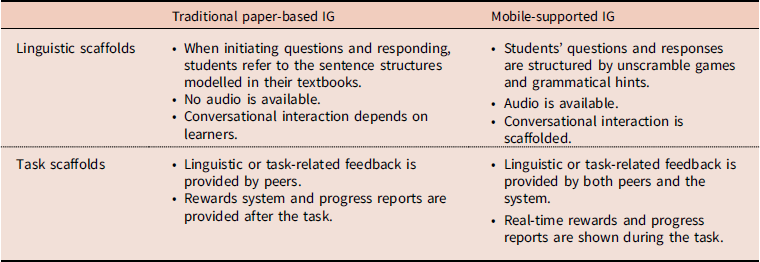
Based on a previous pilot study and consultation with a language instructor (Luo, Lin, Chen & Fang, Reference Luo, Lin, Chen and Fang2015), linguistic and task scaffolds were designed to enhance language processing and task interaction. Table 1 compares the traditional paper-based IG tasks with the mobile-supported IG tasks.
Comparison of traditional paper-based IG and mobile-supported IG

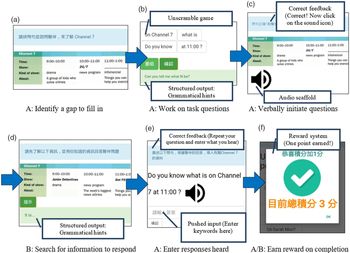
The mobile application employs six IG tasks that provide various conversational contexts but target the same vocabulary and grammar features of the weekly class. After an IG task begins, the application prompts Student A and Student B, sitting face-to-face, to fulfil the task requirements (Figure 1).
Illustration of IG scaffolded by mobile application (A stands for Student A; B stands for Student B)

During the task, linguistic scaffolds are provided to support language use: (1) structured output, (2) audio scaffolds, and (3) pushed input/output. Task scaffolds are provided to support task interaction: (1) corrective feedback and (2) reward system. As shown in Figure 1(b), the first step is to structure output by prompting Student A to unscramble the word puzzle to initiate the correct questions. For example, Student A orders the boxes into the correct sequence (e.g. on Channel 7/what is/do you know/at 11:00/?). If Student A’s responses to the unscramble game are incorrect, grammatical hints would be provided for another attempt. An audio pronunciation is also available to support the learner’s oral output. After hearing Student A’s question, Student B searches for information in order to orally answer it (see Figure 1 (d)). To scaffold Student B’s oral output, linguistic hints are provided if Student B clicks on the Hint button, which provides formulaic expressions or target structures (e.g. the … is on/at …). While listening to Student B’s responses, Student A is encouraged to focus on the oral output produced by Student B. Student A, for example, is prompted to enter the keywords spoken by Student B (see Figure 1(e)). The system would then provide corrective feedback based on fuzzy matching, where a keyword (e.g. commercial) submitted by the learner is considered correct when it matches any of the related pre-set keywords (e.g. infomercial, commercial, and advertisement). The application would only proceed to the next task when the previous task has been completed. This feature is intended to encourage pushed oral output and conversational interaction. During practice, the application gives timely reward points. Students’ roles are automatically switched in the next task to ensure equal practice and participation.
3.4 Instruments
3.4.1 English language achievement test
A researcher-constructed written post-test was developed in English to measure students’ English language achievement. According to the curriculum goals of the general English course, students were expected to develop linguistic knowledge and receptive skills so as to understand the communicative intent of a speaker or writer. Thus, the English language achievement test focused on (1) vocabulary and grammar knowledge and (2) the functional use of the vocabulary and grammar in a situational conversation, hereafter referred to as conversation comprehension. The vocabulary section contained 12 fill-in-the-blank questions accompanied by corresponding pictures. The grammar section and the conversation comprehension section each contained 12 multiple-choice questions. The conversation comprehension test provided communicative situations in which learners chose an expression that best filled in a conversation gap. The maximum achievable score was 36. The format and the difficulty of the post-test was examined by an expert panel consisting of a course instructor and a professor in language education, thus establishing satisfactory face and content validity.
3.4.2 Oral communication strategy scale
An area of interest to the researchers was the impact of the mobile-supported TBLT on students’ interactions while carrying out communicative tasks – specifically, how the linguistic and task scaffolds affected learners’ uses of strategies in maintaining a conversation. According to Faerch and Kasper (Reference Faerch and Kasper1984), the communication strategies used during a conversation reflect a learner’s planning and execution of speech production. Nakatani’s (Reference Nakatani2006) Oral Communication Strategy Inventory was adopted to reflect the interactional aspects of communication. For the purpose of this study, three constructs for speaking and two constructs for listening were included to demonstrate whether learners used strategies concerning fluency, accuracy, and meaning negotiation when they interacted with their partners during the tasks (see Appendix in IRIS).
-
Speaking constructs:
-
Fluency-oriented strategies (6 items) – learners pay attention to clarity, speaking speed, and speaking contexts to improve listeners’ comprehension.
-
Accuracy-oriented strategies (5 items) – learners pay attention to forms of their speech and seek grammatical accuracy.
-
Negotiation for meaning while speaking (4 items) – learners check listeners’ understanding of their intentions and modify speech to help listeners comprehend the intended meaning.
-
-
Listening constructs:
-
Fluency-maintaining strategies (5 items) – learners pay attention to the fluency of conversational flow, capture speakers’ intentions, and send continuation signals to facilitate smooth interaction.
-
Negotiation for meaning while listening (5 items) – learners repeat or make clarification requests to understand speakers’ intentions and appeal for the speakers’ help to prevent misunderstanding.
-
The questionnaire consisted of 25 items that were translated into Mandarin with back-translation technique employed to ensure linguistic validity. Learners were asked to indicate their use of the strategies on a 5-point Likert scale ranging from 1 (“strongly disagree”) to 5 (“strongly agree”). Cronbach’s alpha for each of the five subscales (i.e. fluency-oriented strategies for speaking, accuracy-oriented strategies for speaking, negotiation for meaning while speaking, accuracy-oriented strategies for listening, and negotiation for meaning while listening) was .88, .86, .79, .85, .86, respectively, which is considered reliable. There was also one open-ended question that was intended to gauge how students reflected on the effect of the scaffolds on their conversational interaction.
3.5 Procedures
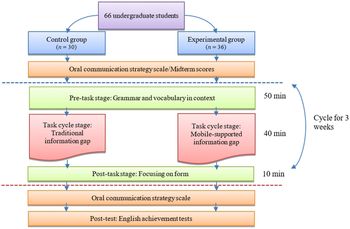
Having verbally consented to taking part in the study, all participants in the class were randomly assigned to the control or the experimental groups. At the preparatory phase, participants’ English midterm scores were collected to understand their initial English competence before the experiment, and they also completed the demographic questionnaire and the Oral Communication Strategy questionnaire. At the pre-task stage, as shown in Figure 2, the instructor distributed the lesson handouts and taught vocabulary and grammar of the week. Then, in the task cycle stage, the instructor demonstrated how to carry out an IG activity, and participants in the experimental group were given a practice session to familiarize themselves with the application. They then used mobile phones to carry out six IG tasks. All procedures were identical for both groups except that the experimental group used the application during the task cycle stage. The whole experiment was conducted in two 50-minute weekly sessions for three weeks. At the end of the experiment, participants from both groups completed the questionnaire on oral communication strategies again, followed by the paper-and-pencil post-test. All participants were then debriefed and thanked for their participation.
Experimental procedure

3.6 Data collection and analysis
As the dependent variables, the quantitative data included students’ post-test scores on the English achievement test and students’ questionnaire scores on oral communication strategies. The midterm scores, which measured learners’ linguistic knowledge, were collected to be entered into the multivariate analysis of covariance (MANCOVA), controlling for initial differences in English competence between the experimental and the control groups, as the experiment was not based on randomization. For analyzing oral communication strategies, the questionnaire scores were entered into the analysis of covariance (ANCOVA). System logs and paper records for the number of tasks completed were used as descriptive data to show the relationship between task completion and learning outcomes. Weekly field notes and responses to one open-ended question were collected from both groups to supplement the statistical findings and provide insight into the implementation of the mobile applications.
4. Results
4.1 English language achievement and task completion rates
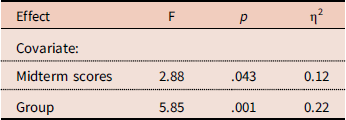
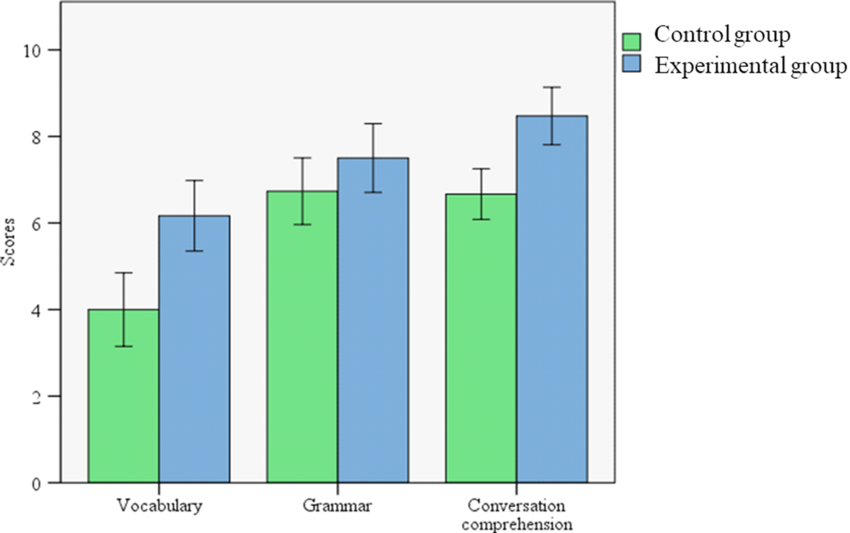
The first research question is concerned with whether mobile-supported TBLT helps to improve learners’ English achievement. A MANCOVA was performed using midterm scores as the covariate to control for students’ initial differences in language proficiency prior to the intervention and using the post-test scores on vocabulary, grammar, and conversation comprehension as the dependent variables. Table 2 shows that there was a significant effect of the midterm scores, Wilk’s Λ = 2.88, F(3,61) = 2.88, p = .043, η2 = .12, suggesting that participants showed differences in the initial English competence between the experimental group (M = 56.80, SD = 9.73) and the control group (M = 61.69, SD = 11.02), which had an impact on the post-test scores. After controlling for the initial competence differences, there was a significant group effect on all three language components, Wilk’s Λ = 0.78, F(3,61) = 5.85, p = .001, η2 = .22, with a large effect size. The univariate F test indicated a significant difference between the control group and the experimental group for the vocabulary component, F(1,63) = 11.26, p = .001, with the means for the experimental group (M = 6.17, SD = 2.41) being 54% higher than that for the control group (M = 4.00, SD = 2.27). There was also a significant difference between the two groups for the conversation comprehension component, F(1,63) = 12.45, p = .001, with the means for the experimental group (M = 8.47, SD = 1.96) being 27% higher than that for the control group (M = 6.67, SD = 1.56). For the grammar component, there was no significant difference between the two groups. Table 3 and Figure 3 show that the mobile-supported TBLT led to higher scores on the vocabulary and on the conversation comprehension post-tests.

Mean scores of language post-test by group

a ** = significant effect of group with p < .01 in the F tests; standard deviation is shown in parentheses.
Post-test scores by group. Error bars indicate one standard error

To further show the potential relationship between task completion and English language achievement, the average number of tasks completed was computed across the three weeks for each condition. The results of the system log showed that the average tasks completed over the three-week intervention was 4.63 out of 6 (SD = 1.45) for the control group and 3.05 out of 6 (SD = 1.13) for the experimental group. The total number of tasks for each week was six. The descriptive results suggest that students in the experimental group completed more tasks than those in the control group.
4.2 Oral communication strategy
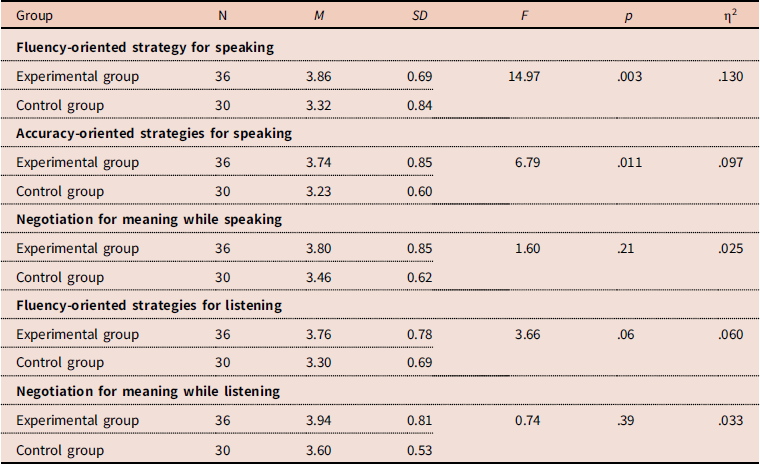
The second research question is concerned with whether there are differences in the self-perceived use of oral communication strategies between the two groups. ANCOVA analyses were conducted using the questionnaire scores obtained from week one as the covariate to control for individual differences in strategy use and the questionnaire scores from week three as the dependent variable. Table 4 shows that the scores were significantly different between the two groups in terms of fluency-oriented strategies for speaking, F(1,63) = 14.97, p = .003, η2 = .130, and accuracy-oriented strategies for speaking, F(1,63) = 6.79, p = .011, η2 = .097. The scores on fluency strategies for speaking were higher for the experimental group (M = 3.86, SD = 0.69) than for the control group (M = 3.32, SD = 0.84), and the scores on accuracy-oriented strategies for speaking were higher for the experimental group (M = 3.74, SD = 0.85) than for the control group (M = 3.23, SD = 0.60). There were no significant differences between the two groups in the other constructs. These findings show that engaging learners in the mobile-supported TBLT promoted both the use of fluency strategies and accuracy-oriented strategies for speaking.
ANCOVA results and descriptive statistics for oral communication strategies by group a

a The covariate in the multiple ANCOVA analyses was significant at the .05 significance level.
5. Discussion
We designed linguistic and task scaffolds built into the mobile application to support language use and task interaction in a large EFL classroom. The results of the study show that students who received the mobile-supported TBLT outperformed those who received traditional TBLT in vocabulary learning and conversation comprehension but not so much in grammar learning. The results are consistent with prior research that examined the effects of mobile-supported scaffolding on face-to-face instruction and showed improvement in learning outcomes through enhanced collaborative learning (Lan et al., Reference Lan, Sung and Chang2007), facilitated task interactions (Lys, Reference Lys2013), and reciprocal peer feedback (Fang, Cassim, Hsu & Chen, Reference Fang, Cassim, Hsu and Chen2018).
The mobile-supported TBLT designed in the current study appeared to provide supportive learning conditions for students to achieve pronounced gains in vocabulary (54%) and receptive knowledge to comprehend newly learned vocabulary and grammar in context (27%). These results suggest that integrating scaffolds into TBLT supported the target vocabulary learning and the application of vocabulary knowledge and to some extent grammar knowledge in a situational conversation. In this study the linguistic scaffolds, such as the unscramble games (i.e. has/how long/she/been/living/in LA) and the linguistic hints (i.e. someone has been (verb)-ing), were designed to structure output and focus on forms by enabling students to apply the newly learned vocabulary and structures to various topics. Encountering examples thoughtfully can aid the development of form–meaning connections, storing them in long-term memory (Ellis, Reference Ellis2005). The task scaffolds, such as the corrective feedback, were designed to enable students to monitor their conversation partners’ oral responses and thus encouraged students to attend to the input and the output they needed to complete the tasks during the oral interaction. With the aids of task scaffolds, students would make attempts to deliver their intended messages. This scaffolded interaction might have encouraged interactional modifications that bring about comprehensible input, or learner-contingent i+1 input, and enhanced comprehensibility, which is beneficial for language learning (Ortega, Reference Ortega2013). In addition, the reward system made language tasks engaging and thus motivated students to work on the task using the target language. Rather than waiting until all the tasks were completed, students received real-time rewards throughout the task cycle stages. This feature might have elicited active use of the target language and enhanced language learning immediately following a successful task (Ripollés et al., Reference Ripollés, Marco-Pallarés, Hielscher, Mestres-Missé, Tempelmann, Heinze, Rodríguez-Fornells and Noesselt2014).
With regard to the reason why mobile-supported TBLT did not lead to improvements in grammar learning, one possible explanation is that the scaffolds might not have promoted sufficient attention to grammatical features. Although the linguistic scaffolds encouraged learners to produce questions and responses by themselves that allowed them to model the target structures such as indirect questions (e.g. Do you know why this is popular?), the scaffolds might not have encouraged the processing of the grammatical features themselves when students practiced the varied tasks. Grammatical hints were conveniently provided throughout the whole task (e.g. Do you know why S+V?), possibly precluding the need for deep processing. Students, consequently, could complete the task without producing the correct order of the subject and verb themselves. Studies on task-essential practice suggest that tasks are most effective when learners have to use the target features in order to complete the task successfully (Keck, Iberri-Shea, Tracy-Ventura & Wa-Mbaleka, Reference Keck, Iberri-Shea, Tracy-Ventura, Wa-Mbaleka, Norris and Ortega2006). Moreover, from the perspective of cognitive psychology, learners benefit more from recalling the target forms than merely practicing the target forms (Suzuki, Nakata & Dekeyser, Reference Suzuki, Nakata and Dekeyser2019). Thus, the linguistic scaffolds did not appear to help the development of explicit knowledge of the target grammatical features.
Further analysis of the task completion rates supported the positive impact of the scaffolds on the learning outcomes. It was found that the traditional TBLT group completed more tasks (4.63 out of 6 on average) than the mobile-supported TBLT group (3.05 out of 6 on average). However, the mobile-supported TBLT led to better vocabulary learning and conversation comprehension. This finding implies that greater task completion is not the key to successful language learning; rather, it is the quality and nature of the interaction involved within a task. Given that the total class time was held constant for both groups, the lower task completion rates suggest that the mobile-supported TBLT group might have spent more time working on one task. For this group, because the application required part of the oral responses (i.e. keywords) to be correctly entered before they could proceed to the next task, the interlocutors were encouraged to produce oral responses (output) and attend to the keyword heard (input) at the same time. This individualized pacing for task completion might have encouraged linguistic accuracy, thus fostering more processing of input and output rather than merely completing the tasks without noticing them. On the other hand, our experiment notes showed that many students in the traditional TBLT group directly copied each other’s exercise sheets without actually engaging in conversational interaction, leading us to suggest that support in the form of scaffolding is important for student engagement with TBLT. This finding echoes the criticism that mere exposure to rich input and focus on meaning in a communicative task does not necessarily benefit language learning (Norris, Reference Norris, Long and Doughty2009) as students can easily achieve communicative success without attending to form. Norris and Ortega (Reference Norris and Ortega2000) argue that exposure to acquisitional processes such as input, interaction, and output can be intentionally planned to benefit language learning. As suggested by Zurita and Nussbaum (Reference Zurita and Nussbaum2004), mobile applications can create a better collaborative learning environment by fostering effective face-to-face task performance.
Furthermore, the results of the Oral Communication Strategy scale suggest that mobile-based TBLT prompted students to be more aware of the use of “fluency-oriented” and “accuracy-oriented” speaking strategies in maintaining a conversation compared to traditional TBLT. The results suggest that scaffolds provided in the current study encouraged students to apply speaking-related strategies. As detailed by the construct descriptors, although students were conscious of speaking clarity, speed, and contexts, they also paid attention to the forms of their oral production and sought grammatical accuracy. This result is consistent with Rossiter, Derwing, Manimtim and Thomson’s (Reference Rossiter, Derwing, Manimtim and Thomson2010) finding that providing formulaic sequences such as sentence stems (i.e. It’s a place that …) in a structured activity helped learners develop fluency and automaticity better than a free-production oral activity. At the same time, it was observed that due to the scaffolds embedded in the sequence of tasks, which required students to complete one task before they could proceed to the next one, they became aware of the advantage of being able to use the target language correctly. Similarly, Shehadeh (Reference Shehadeh1999) found that when learners were pushed in the direction of greater accuracy, they produced comprehensible output and thus showed improved conversation performance. As to why the scaffolds did not increase negotiating for meaning, it is possible that the ability to negotiate requires additional instruction. According to Nakatani (Reference Nakatani2010) and Fang et al. (Reference Fang, Cassim, Hsu and Chen2018), learners may lack the language knowledge to negotiate for meaning in communication tasks and thus may need consciousness-raising and additional training. These findings provide developmental implications that when learners were scaffolded in a challenging task they would actively adjust their language use during the conversational interaction, which suggested they were working toward the appropriation of L2 knowledge.
In summary, the findings of this study demonstrated that mobile applications can be used to provide scaffolds for enhancing TBLT within communicative classrooms. In line with Vygotsky’s ZPD theory (Rachels & Rockinson-Szapkiw, Reference Rachels and Rockinson-Szapkiw2018), the linguistic and task scaffolds played a role in mediating language learning by (1) enabling learners to work on the linguistic elements, such as vocabulary, during a challenging language task beyond their current linguistic competence, and (2) providing both task-related and linguistic feedback to keep them engaged. Our findings indicated that mobile applications can help instructors to provide individual assistance in a large class, as the application under investigation was able to monitor learners’ input and output as well as provide timely feedback. Engaging in mobile-supported pedagogic language tasks also encouraged better processing of the target language while enhancing learners’ oral communication strategies, which were beneficial for improving conversational interaction during language tasks.
However, while the scaffolds in the current study were able to promote linguistic achievement, it is important to consider the design of tasks and scaffolds on the one hand and potential pitfalls to avoid on the other hand. First, students in the present study might rely on linguistic scaffolds even when they were able to produce certain sentence structures independently. To avoid over-reliance on scaffolds, linguistic scaffolds can be gradually reduced as learners’ linguistic competence increases (Sharma & Hannafin, Reference Sharma and Hannafin2007). Dynamic assessment of learners’ linguistic competence can be adopted to provide appropriate dosage of scaffolds (Kozulin & Garb, Reference Kozulin and Garb2002). Second, students could complete the tasks without producing correct grammatical forms. Having learners rely on grammatical information during the language task can enhance learning outcomes (VanPatten, Reference VanPatten and VanPatten2004). Another potential strategy is to pair students with more advanced partners to produce corrective feedback. Such negative feedback has been found to enhance rule formation and grammar usage (Iwashita, Reference Iwashita2003).
As little research has been conducted to address the challenges of crowded conditions and limited learning time in many if not most EFL language classrooms, more research is needed to continue examining how mobile applications can help teachers meet these challenges. This study might be replicated over delayed post-tests, a longer period of time, with different proficiency levels, and at other educational levels to augment its findings regarding the task completion rates or linguistic achievement. More mobile affordances should also be exploited to support more complex language tasks in a communicative classroom so as to go beyond learning of basic language skills. Future studies should also further the understandings of a more holistic TBLT curriculum by including pedagogic technology tasks via mobile application in a larger curricular initiative.
6. Conclusion
This study provides empirical evidence and design details for both EFL instructors and m-learning researchers to explore the feasibility of mobile-supported TBLT in a large EFL classroom. The results demonstrated that mobile-supported TBLT led to improvements in vocabulary learning and conversation comprehension in significant ways, but not so much in grammar learning. Our further analysis also revealed the limitations of traditional TBLT, which led to higher task completion rates but lower learning outcomes when compared with the mobile-supported TBLT. This finding provides evidence that mobile technology can be used to overcome the challenges of a large EFL classroom in which students’ conversational interaction requires more monitoring and support, which are difficult for a single instructor to provide. Our results also suggest that the scaffolds promoted students’ use of fluency-oriented and accuracy-oriented strategies for speaking when they engaged in the task conversation. As more research is needed to investigate mobile technology as a support for classroom teaching and learning, this study contributes to the field of mobile-assisted language learning by exploring possible solutions to the existing challenges of EFL classrooms.
Acknowledgements
This study was supported by the Ministry of Science and Technology, Taiwan, under the project numbers of MOST-108-2511-H-224-008-MY3, MOST-107-2511-H-224-007-MY3, MOST-106-2511-S-224-005-MY3, and MOST 106-2628-S-224-001-MY3. We would like to thank Cindy Brantmeier, Haley Dolosic, and the anonymous reviewers for their valuable comments and input.
Ethical statement
The study/content of the submitted manuscript is in accordance with practices in Taiwan and the US considering the external validation of the experiment design, volunteer status of participants, and anonymity. Under the guidance of the Institutional Review Board at Washington University in St. Louis, verbal consents were obtained from the participants for the study, and the participants were well informed and debriefed about the study after the experiment. There is no conflict of interest involved.
About the authors
Wei-Chieh Fang has an interdisciplinary background in applied linguistics and cognitive psychology. His recent research explores the potential of smartphones to facilitate communicative language teaching. He has been on several projects exploring the technological affordances and applying learning principles within cognitive psychology to improve language learning (e.g., embodiment, test-enhanced learning, peer feedback). He received an award for excellence in online teaching in 2013.
Hui-Chin Yeh is currently a distinguished professor in the Department of Applied Foreign Languages and associate dean in the College of Humanities and Applied Science at National Yunlin University of Science and Technology in Taiwan. Her research interests center on EFL teacher education, computer-assisted language learning, and multiliteracies. She received distinguished young scholar awards from the Ministry of Science and Technology in 2011 and 2017, a 2016 Yunduo award in teaching and mentoring, a 2014 research excellence award, a 2011 excellent mentor award, and a 2010 teaching excellence award from her university. Her multimedia English course has been certified as a quality e-learning course by the Ministry of Education of Taiwan. In addition, in recognition of several different language systems developed, five patent achievements were honored with the TWPatentDB. She hopes her efforts in different aspects can contribute to academia.
Bo-Ru Luo was a master’s student in the Department of Information Management at the National Sun Yat-sen University. Her research interests include mobile learning and mobile-assisted language learning.
Nian-Shing Chen is chair professor in the Department of Applied Foreign Languages at National Yunlin University of Science and Technology, Taiwan. His current research interests include educational robots and game-based learning. Professor Chen is a golden core member of IEEE, ACM, and the former Chair of the IEEE Technical Committee on Learning Technology.
Author ORCIDs
Wei-Chieh Fang, https://orcid.org/0000-0002-7494-9425
Hui-Chin Yeh, https://orcid.org/0000-0001-9283-6291
Bo-Ru Luo, https://orcid.org/0000-0002-6191-0281
Nian-Shing Chen, https://orcid.org/0000-0001-7768-0997