1. Introduction
This article presents a conceptual replication study of Lee’s (Reference Lee2019) research on digital game-based learning (DGBL), student creativity, and creative writing with foreign language (FL) university students, and it aims at testing the reliability of the previous study’s findings under different conditions, trying to contribute to second language (L2) replication research (Marsden, Morgan-Short, Thompson & Abugaber, Reference Marsden, Morgan-Short, Thompson and Abugaber2018).
As for replication studies in computer-assisted language learning (CALL), the contextual variables that impact research include the differences among languages, learners’ proficiency levels, individual differences among learners, affective factors, amount of input, cognitive abilities, and sociocultural variables (Cai et al., Reference Cai, Morris, Hohensee, Hwang, Robison and Hiebert2018). Since this replication concentrates on FL learning and CALL, its goal was to see if the results hold for different populations, in different settings, and whether the findings could serve the purpose of confirming the generalizability or external validity of the research (Polio & Gass, Reference Polio and Gass1997). In doing so, we have addressed the above-mentioned variables, shown in Table 1.
Contextual variables in the replication study

The replication study followed the research protocol described in Lee (Reference Lee2019). The research questions posed for the replication are as follows:
-
RQ1: Does Her Story facilitate student creativity in different EFL writing classes? If so, how?
-
RQ2: Are there statistically significant differences between participants from two countries (Spain and Poland) regarding their creativity, focusing particularly on their EFL writing products, before and after using a DGBL experience based on the video game Her Story?
Considering that the sample of participants in the original study equaled 25 students from the Kyung Hee University in Korea, in this replication study 25 participants from the University of Córdoba (UCO) in Spain and 25 participants from the University of Lower Silesia (ULS) in Poland were involved to provide validity and reliability to the prior findings and produce more conclusive, generalizable results.
Since this project is a replication of a mixed-methods study, the authors followed the guidance provided by Cai et al. (Reference Cai, Morris, Hohensee, Hwang, Robison and Hiebert2018), trying not only to do what the original research did but also to advance knowledge and expand existing work. Lee (Reference Lee2019) developed her own pre- and post-project surveys. To improve this approach and increase its reliability in the replication study, we used the “Self-Ratings Scale for the Assessment of Individual Creativity” pre-questionnaire and “The Biographical Inventory of Creative Behaviors” (BICB), developed by Batey (Reference Batey2007), which helped us to understand participants’ creativity experiences before playing the video game Her Story.
2. Creativity and creative writing
The earliest creativity scholars viewed creativity and learning as interdependent or even indistinguishable (Guilford, Reference Guilford1950). In Torrance’s (1965) view, Socrates and Plato are good examples of how creative education should be implemented: the former highlighted the importance of asking provocative questions and the natural learning environment, and the latter believed that rigid discipline hindered student potential. This view is reflected by Plucker and Beghetto’s (Reference Plucker, Beghetto, Sternberg, Grigorenko and Singer2004) research, which confirms that too rigorous education can inhibit creativity and lead to overly rigid thinking. Torrance (Reference Torrance and Sternberg1988) defined creativity as the process of becoming sensitive to problems and gaps in knowledge, identifying the difficulty, searching for solutions by making guesses, testing and retesting the hypotheses and communicating the results. In the original article replicated here, Lee (Reference Lee2019) uses Torrance’s (Reference Torrance and Sternberg1988) constructs of creativity as a methodological lens for her study: (a) originality (generation of a new idea), (b) fluency (the number of new ideas), (c) flexibility (the number of categories of new ideas), and (d) elaboration (the degree of detail and precision of the idea).
Although research on creativity is not new, this type of research in FL classrooms remains scarce (Baleghizadeh & Dargahi, Reference Baleghizadeh, Dargahi and Tomlinson2016). The studies that endeavor to explore the concept of creativity in FL tend to focus mainly on learners’ language proficiency rather than on creativity in terms of ideas and content (Wang & Cheng, Reference Wang and Cheng2016). This can be linked to the fact that EFL learners normally practice short English writing on given topics, even at university level, as they often prepare for their language proficiency exams. However, according to Livingston (Reference Livingston2010), university-level education is suitable for adjusting pedagogical practices in support of a more individual approach to learning. If we are, therefore, to promote student creativity, then we should instill it into existing curricula (Renzulli, Reference Renzulli, Beghetto and Kaufman2017). Beghetto (Reference Beghetto, Kaufman, Glăveanu and Baer2017) suggests that this could be achieved by teaching for creativity, as it refers to boosting students’ creative potential in the context of academic subject areas and developing students’ creative achievement at the individual and sociocultural level. Tok and Kandemir (Reference Tok and Kandemir2015) discuss strong positive motivational effects from level-adjusted FL creative writing. When creativity is the goal, intrinsic motivation is preferable, as students can then engage more deeply and learn longer (Vansteenkiste, Lens & Deci, Reference Vansteenkiste, Lens and Deci2006). Creativity is pivotal to students’ motivation in FL performance and learning attainment (Wang & Cheng, Reference Wang and Cheng2016).
Digital technologies allow for and encourage fresh perspectives on creativity in the context of education (Livingston, Reference Livingston2010), which may in return affect student motivation. This is paramount, because as Bahous, Bacha and Nabhani’s (Reference Bahous, Bacha and Nabhani2011) and Lee’s (Reference Lee2019) research shows, EFL students nowadays feel unmotivated to develop their writing skills in an FL, which may be linked to an overemphasis on writing skills with very few new learning experiences. It may also be caused by a disconnect between students’ daily activities and their school literacy practices (Sandberg, Reference Sandberg2013). What is promising and should be considered are the extramural English activities, which could significantly contribute to students’ learning during gaming, creative writing, and school literacy practices, giving space for student creativity (Sylvén & Sundqvist, Reference Sylvén and Sundqvist2012). Considering this, video games are an interesting proposal here, as they are intrinsically motivating (Gee, Reference Gee2005).
3. Digital games and language learning
DGBL refers to the employment of the entertaining power of digital games to serve an educational purpose (Prensky, Reference Prensky2001). Two main types of games can be distinguished in DGBL: (a) commercial games for entertainment purposes that can also be exploited in educational settings (e.g. Her Story), and (b) games developed with an educational purpose in mind. The first type of games does not involve a teacher or a formal curriculum. Therefore, researchers or practitioners interested in bringing fun games into school need to consider the fact that a set of practices developed outside of education will be brought into a formal educational setting. Aspects such as enjoyment, interaction, and fantasy, which are not normally part of classroom settings due to time constraints or number of students in the classroom, to name a few, are brought into learning (Scholz, Reference Scholz2017).
The factors that make digital commercial games appropriate for an educational context include the story narrative, which supports a deeper engagement through the story (de Freitas & Maharg, Reference de Freitas, Maharg, de Freitas and Maharg2011); uncertainty, which enhances learning and has a positive relation with motivation (Ozcelik, Cagiltay & Ozcelik, Reference Ozcelik, Cagiltay and Ozcelik2013); and curiosity, which is a necessary precondition for exploration (Berlyne, Reference Berlyne1960). It is within the structure of narrative plausibility where curiosity is triggered (Kangas, Reference Kangas2010). When the above is fulfilled, play becomes an inner world, with believable social interactions and activities and a physiological “flow” designed specifically for engaging and maintaining the interest of the player (Csikszentmihalyi, Reference Csikszentmihalyi1990).
Although DGBL provides an authentic opportunity to use language in a meaningful and engaging context (Chiu, Kao & Reynolds, Reference Chiu, Kao and Reynolds2012), little research on creativity in foreign language learning through video games has been conducted. Ebrahimzadeh and Alavi (Reference Ebrahimzadeh and Alavi2017) found that commercial video games can enhance students’ language learning motivation and engagement. In this light, a detailed analysis has been done by Poole and Clarke-Midura (Reference Poole and Clarke-Midura2020) who identified 49 studies (2012–2017) on the use of digital games and L2 learning and synthesized them by the L2 aspects investigated in each study. This study suggests that research should move away from simply investigating vocabulary gains after playing video games and explore how other FL aspects are affected by digital games. Li (Reference Li, Sullivan, Lantz and Sullivan2020) analyzed the use of video games in second language acquisition in previous studies and concluded that many of those concerning the same topics have produced different, sometimes opposite, results, which inhibit the development of scientific knowledge. In this view, replication studies seem crucial to advance the field by validating prior findings.
The reason for using DGBL in the original and the replication study was to provide students with an authentic learning opportunity and meaningful language use through which learners were able to develop their creativity, using the FL in a meaningful and enjoyable way. The project was a media transfer study based on the students transforming one media format (game) into another (writing).
4. Method
4.1 Project and participants
The project was implemented in the compulsory course “EFL for Primary Education Teachers” of the third year of the BA in Primary Education at the UCO (Spain) and in a voluntary EFL course for a second-year Master’s degree in Primary Education and second year of the BA in Creative Media at the ULS (Poland). The overall English language proficiency of the students was advanced intermediate (B2+/C1 level). Study participants included 25 students from each institution with the following distribution regarding gender: 22 female and three male participants from UCO (all of them studying the BA in Primary Education), and 17 female and eight male study participants from ULS (10 students of the BA in Creative Media, including seven male participants, and 15 students of the Master’s degree in Primary Education, including one male student). The participant sample of students from different settings, studying different university courses, was chosen to add more generalizability to the study. Using homogeneous groups restricts generalizability only to a specific group, reducing external validity of the study (Ary, Jacobs, Irvine & Walker, Reference Ary, Jacobs, Irvine and Walker2018: 342). None of the students had previously played Her Story. Following Lee (Reference Lee2019), the purposes of this project were “(1) to improve the students’ language skills, particularly listening and writing, in an authentic context, (2) to provide an opportunity for the students to exhibit their creativity, and (3) to enhance the students’ interest and motivation regarding language learning” (p. 243). The students played the game both within and outside of the classroom, using Windows or macOS.
The instructions given to the participants included the information described as follows. First, participants had to watch at least 60% of the archived videos of Her Story, mostly in their own time, discovering facts about the murder, trying to reconstruct the story. Second, they were to produce a piece of creative writing (two A4 pages maximum) based on the video game using a genre and a viewpoint of their choice. Since students could view the videos on a random basis only, and they were working on their own, recording their progress in a journal log was recommended to help them organize their ideas, as it is believed that creative skills can be practiced through the discipline of keeping a record of one’s observations, ideas and reflections and cultivating creative connections between different elements in order to come up with original ideas (Claxton, Reference Claxton2006).
4.2 Resources: The video game
Her Story is a single-player, non-educational mystery game from Sam Barlow, which was released in 2015. It is an interactive movie genre telling stories through games, with an interface that is simple enough even for beginner players (Figure 1). This video game has a narrative that unravels through interactivity; its format is nonlinear, and therefore complex and intriguing. Players look at an internal police computer and analyze video clips to discover facts about a fictional murder case. There are 271 short videos of up to 80 seconds taken from seven interviews of the main character, a woman who is being interviewed by the police. Playing this interactive crime documentary lets players get into a police database, where they use keywords to search for videos, making sense of the information provided. The game does not reveal what actually happens. Considering all these features, Her Story not only catches the player’s attention but also serves as an effective scaffold for student creativity (Lee, Reference Lee2019).
Her Story screenshots

4.3 Instruments and data gathering
Collected data included the students’ creative writing papers and their responses to pre-project and post-project questionnaires (including self-reflection open-ended questions). Students’ writing was collected using the virtual platforms of the two institutions. Moreover, the pre-project questionnaire included the seven questions to obtain a self-assessment of the students’ creativity developed by Lee (Reference Lee2019), but was preceded by the “Self-Ratings Scale for the Assessment of Individual Creativity” and followed by the BICB, developed by Batey (Reference Batey2007), which has emerged as one of the more popular self-report tools to measure everyday creativity. The post-project questionnaire included 14 Likert-scale questions asking the students about their experiences with the project in terms of their level of interest, motivation, creativity, and language learning, and two open-ended questions (“What did you like most about this project based on Her Story?” and “What did you like least about this project based on Her Story? What would you change?”) were added. Both questionnaires were collected anonymously. All study participants signed a consent form to partake in this research project.
4.4 Data analysis
Considering the different types of data collected in this replication study, a mixed-methods data analysis was carried out and methodological triangulation was used.
Quantitative pre-project and post-project questionnaires were analyzed using the statistical package IBM SPSS Statistics V24.0 for macOS. To evaluate participants’ responses, mean comparisons between groups (UCO and ULS) have been examined through parametric Student’s t-test for independent samples. Statistical mean values were accepted whenever p < 0.05 (Sokal & Rohlf, Reference Sokal and Rohlf1995). Cohen’s d was used to calculate the effect size (Fritz, Morris & Richler, Reference Fritz, Morris and Richler2012).
Moreover, conventional qualitative content analysis, “a method for systematically describing the meaning of qualitative data” (Schreier, Reference Schreier and Flick2014: 170), was carried out for the open-ended questions. Open coding was done until themes emerged, and the most significant and frequently appearing themes were selected for axial and selective coding. This method is particularly useful for identifying themes and classifying text into categories that represent similar meanings (Hsieh & Shannon, Reference Hsieh and Shannon2005), but also for identifying the presence of certain words, concepts, and themes within texts. No preconceived categories were used (Kondracki, Wellman & Amundson, Reference Kondracki, Wellman and Amundson2002). Codes were defined during data analysis. Subsequently, directed qualitative content analysis was used and a deductive use of theory applied to analyze students’ writing products (Potter & Levine-Donnerstein, Reference Potter and Levine-Donnerstein1999). The process involved axial coding and targeted the relatedness of their writing to the game story and to the three constructs of creativity: originality, flexibility, and elaboration (Torrance, Reference Torrance and Sternberg1988). Although both authors conducted the analyses, content analysis was done independently to check interpretations against the data and to provide transparency of the coding process (O’Connor & Joffe, Reference O’Connor and Joffe2020).
5. Results
5.1 Students’ self-perceptions, self-ratings of individual creativity, and inventory of creative behaviors before the implementation of the project
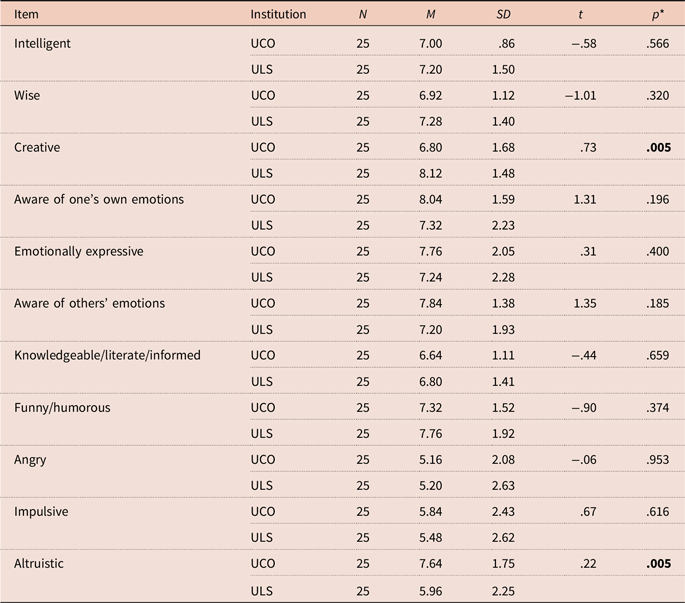
This section presents the results of the pre-test questionnaire carried out before implementing the DGBL project. The results of the “Self-Ratings Scale for the Assessment of Individual Creativity” (Batey, Reference Batey2007), used to explore participants’ creativity and whose scale ranges from 1 to 10, show a positive self-perception of the participants’ personality traits, as shown in Table 2.
Student’s t-test considering institution for the “Self-Ratings Scale for the Assessment of Individual Creativity” (Batey, Reference Batey2007)

Note. UCO = University of Córdoba, Spain; ULS = University of Lower Silesia, Poland.
* p ≤ 0.05 is recognized as statistically significant (in bold).
Focusing on the question “how creative are you?”, 80% of UCO participants and 96% of ULS participants scored 6 or more. Despite these positive general results, significant differences are found regarding creativity and altruism (showing also a large effect size when calculating Cohen’s d) when comparing participants from the two institutions by applying Student’s t-test.
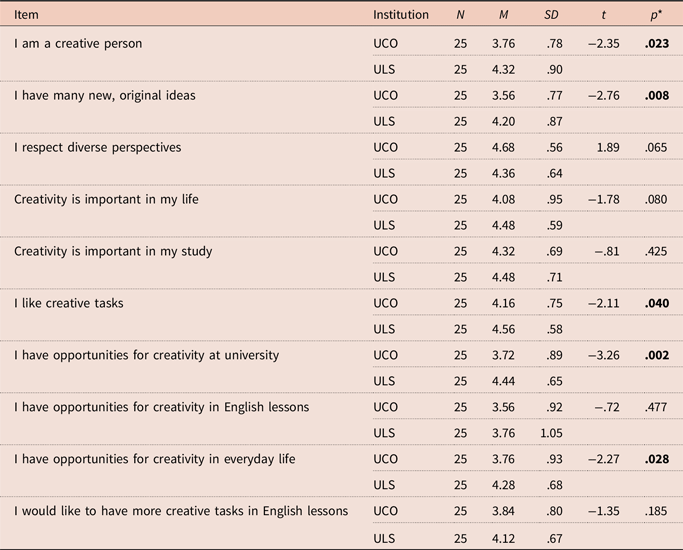
Regarding the answers to the questions of the pre-test used by Lee (Reference Lee2019) in the original study, participants from UCO and ULS show a positive attitude, being the answers to all items over 3 and near or over 4 in many cases, as presented in Table 3.
Student’s t-test considering institution according to self-perceived creativity

Note. UCO = University of Córdoba, Spain; ULS = University of Lower Silesia, Poland.
* p ≤ 0.05 is recognized as statistically significant (in bold).
Considering the differences in the results by the two participating institutions in this replication, Student’s t-test was conducted to determine whether there are statistically significant differences between UCO and ULS students. As shown in Table 3, 60% of UCO students agree or strongly agree that they have opportunities for creativity at university, and 44% agree or strongly agree that they have opportunities for creativity in EFL lessons. These results are even better in ULS, where 92% agree or strongly agree that they have opportunities for creativity at university, and 64% agree or strongly agree that they have opportunities for creativity in EFL lessons. Moreover, 68% of UCO and 84% of ULS participants indicated that they wanted to engage in more creative tasks. Moreover, ULS participants score higher in all items except for “I respect diverse perspectives,” where UCO participants score higher, although without statistically significant differences, showing medium or large effect size after calculating Cohen’s d.
Among these results, the first two items are especially relevant, where UCO students score significantly lower than ULS students – Spanish students consider themselves not as creative and having new, original ideas as their Polish counterparts. When asking the participants about the reasons why they cannot be creative in EFL lessons, 28% of UCO participants and 12% of ULS participants mention the type of tasks used, the use of the textbook and the attachment to the curriculum; 8% from UCO and 16% from ULS report personal traits or circumstances (e.g. shyness, feeling of not being creative) and/or an insufficient level of the target language. Despite this, 40% of UCO and 16% of ULS students consider they can be creative in EFL lessons.
Focusing finally on the answers to BICB (Batey, Reference Batey2007), 100% of UCO and 100% of ULS participants had carried out at least one creative activity in the last 12 months. Nevertheless, ULS participants declare they do more different creative activities than their UCO counterparts: out of the possible 34 options included in BICB, the average number of creative tasks reported by ULS participants is 8.08 (range: 2–17), whereas the average for UCO participants is 6.92 (range: 1–16). In the context of this research, it is relevant to highlight that more participants from ULS had previously developed tasks related to creative written expression (i.e. written a short story, written a novel, produced a TV/play script, composed a poem); UCO participants, in contrast, stood out in creative plastic/visual expression (i.e. redesigned and redecorated, drew a cartoon, produced a picture, made a collage).
5.2 Participants’ writing products
This section examines creativity in the students’ writing in relation to the three constructs of creativity: originality, flexibility, and elaboration (Torrance, Reference Torrance and Sternberg1988).
Originality, referring to unusual or unique responses, was observed in students’ interpretations of the story’s main plot, which was reflected in the writing of their own reimagined stories. As in the original article, some participants (44% from ULS and 48% from UCO) created new titles for the story to indicate their interpretation of the plot and of a new genre, which may not be rare or unusual, but included a number of new ideas, which is linked to the dimension of fluency. Moreover, 24% of the participants from ULS and 8% from UCO recreated the story based on the events from the game as closely as possible. Other students reconstructed the story based on the original but changed some events during the process of writing (44% from ULS and 48% from UCO). Furthermore, 28% of the participants from ULS and 28% from UCO created additional characters to the story that were not present in the original game. The most unusual conclusions with infrequent ideas include a story involving retrospection of events (ULS05), using humor (ULS12, UCO02), or ending with a moral (UCO04).
Focusing on flexibility, different viewpoints and genres were used, including
-
a diary written by a player (ULS13, ULS16, UCO15) or a story character (ULS21, UCO21)
-
a fictional story written by an anonymous narrator (ULS15, ULS23)
-
an account of events written by a detective (ULS17, UCO11), a volunteer helping the police to solve the case (ULS20), or a journalist (UCO14)
-
a medical report written by a psychiatrist (ULS22, ULS25)
-
a letter written by one story character to another (UCO01, UCO02, UCO06, UCO017, UCO18)
-
a story for children written by a narrator (UCO04, UCO05).
Moreover, two participants employed multiple points of view in their work to view the case more objectively. Interesting examples of that include multiple viewpoints of a police officer and a game player (ULS04), and a dialogue with three characters (a police officer, a forensic and Eve) (UCO23).
Finally, regarding elaboration, participants elaborated on the events and characters of the original story in considerable detail by using a lot of imagination to create vivid images. The most common way to elaborate was by adding appropriate language functions and discourse markers, but also many imaginary details and personal opinion and other perspectives about the characters and events in the story. For instance, a good example of a high level of elaboration in a story is a piece of writing with dialogues told by Hanna’s daughter to Sarah’s friend (characters created by UCO18), who was not in the game. Another example is a very emotional letter to Sarah from her mom, where a student describes many contextual details in great detail (UCO07). A further interesting instance of expanding the ideas beyond the minimum necessary by showing the future presenting three documents – the police report, the case resolution, and the final document – concerns the case being reopened; all the three steps are well documented, follow logical argumentation, and are very engaging for the reader (UCO13).
Some students who wrote a narrative account of events with an anonymous narrator, in the form of a police report (ULS01, ULS07), or a transcript of a recording (ULS06), or from the perspective of a player (ULS07, ULS09, ULS11, ULS14, UCO03, UCO06), did not elaborate on the events or characters in the story too much; rather, they focused on the facts they retrieved from the game and their own opinion of what has happened.
In terms of the number of videos watched, based on a random sample, we cannot state that the number of watched videos correlates with highly creative writing. Two instances were considered: (a) the more input, the more creativity in writing; and (b) watching up to 60% of the videos is an advantage for creative writing. The former meant watching nearly all the videos and producing highly creative writing, and can be confirmed only in the case of ULS students. The latter varies across student writing samples, both at ULS and UCO.
5.3 Participants’ experience of the game as a springboard for writing
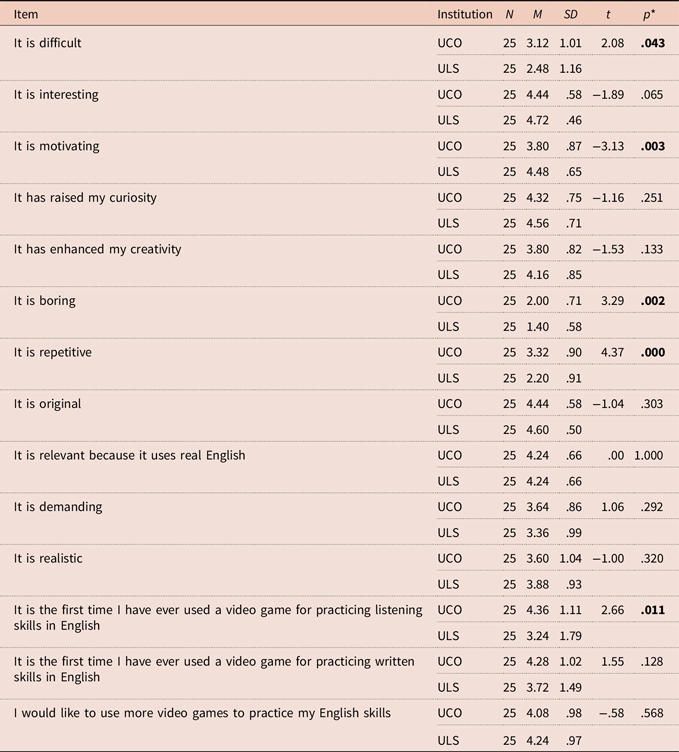
The post-test questionnaire included 14 Likert-scale questions asking the students about their experiences with the project (Cronbach’s α = 0.590) and two open-ended questions, following Lee (Reference Lee2019). To present the comparison between both institutions, the results of Student’s t-test are shown in Table 4.
Student’s t-test results of the post-questionnaire considering institution

Note. UCO = University of Córdoba, Spain; ULS = University of Lower Silesia, Poland.
* p ≤ 0.05 is recognized as statistically significant (in bold).
Feedback provided by the participants in this experience is very good, although ULS students tend to score higher in positive statements (e.g. “It is interesting,” “It is original”) and lower in negative statements (e.g. “It is demanding”). Only five items show statistically significant results (marked in bold), although in all cases they show medium or large effect size after calculating Cohen’s d.
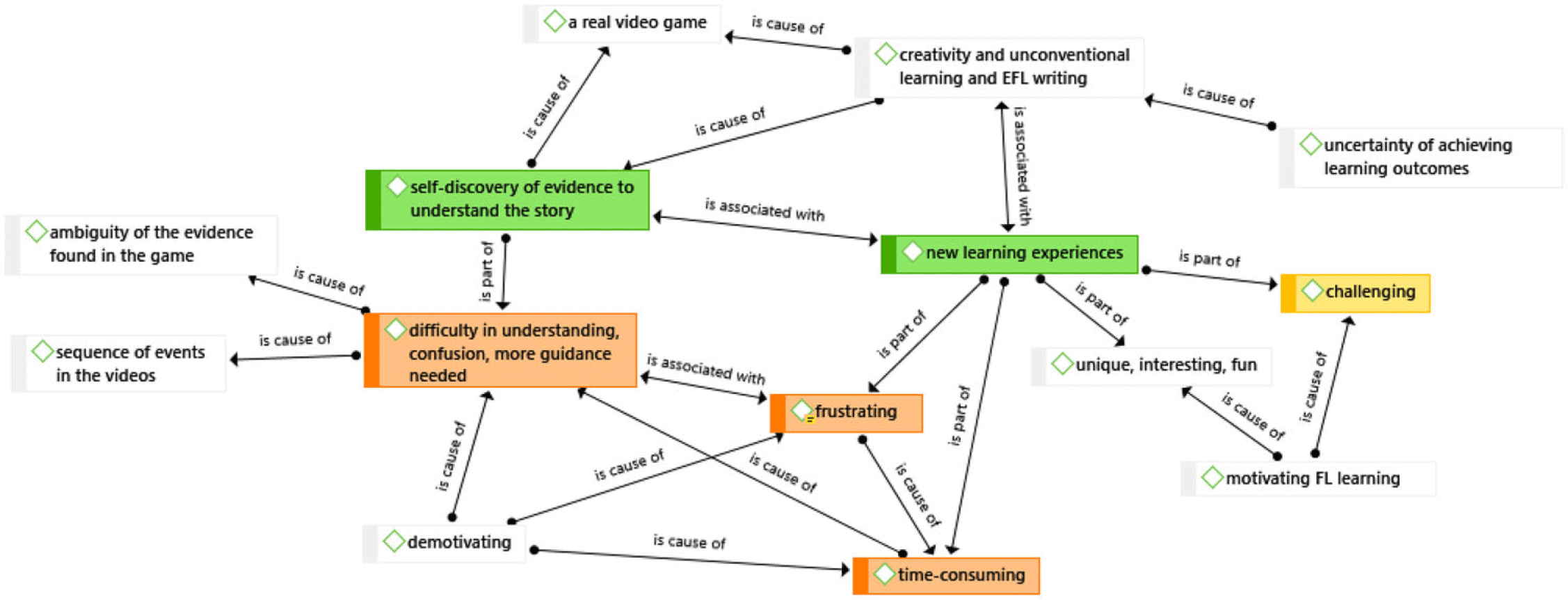
Furthermore, the analysis of students’ answers was done using open coding in Atlas.ti. Codes were assigned to student responses as the themes emerged. The aim was to identify substantive connections by associating categories and linking data (Dey, Reference Dey1993) and then to select the main categories according to their conceptual density and relate the other categories to them (Strauss & Corbin, Reference Strauss and Corbin1998). The network-building feature of Atlas.ti was used to visually connect the categories by means of a diagram (Figure 2).
Network of codes based on students’ answers

As shown in Figure 2, students’ answers indicated that the task was difficult, and more guidance was needed at times. Students were instructed to reconstruct the story as they understand it. The inability to do so and having to work with ambiguous evidence caused frustration in some of them (11 students from UCO and five from ULS). Moreover, students considered that videos with irrelevant information were confusing and time-consuming (12 students from UCO and six from ULS). Despite being a challenging project (code considered both positive and negative), the two categories in green (i.e. self-discovery of evidence to understand the story and new learning experiences) are perceived by students as the two most positive and important factors of the project. As a consequence, students considered that this video game-based project was “unique,” “interesting” and “fun,” which leads to creativity and unconventional learning (especially of EFL writing) and it was a motivating experience in the FL classroom.
6. Discussion
This study aimed to replicate Lee’s (Reference Lee2019) study in two different contexts to see whether the results hold for different populations in different settings and whether the findings could serve the purpose of confirming the generalizability or external validity of the original research. The analysis of participants’ performance provides insightful data in response to the research questions.
Research Question 1: Does Her Story facilitate student creativity in different EFL writing classes? If so, how?
UCO and ULS participants declare that they had developed creativity experiences before playing Her Story, although ULS participants had carried out more different creative activities than their UCO counterparts. Moreover, ULS participants had also more experience than UCO participants in creative writing. Despite or thanks to these previous experiences, Her Story motivated students in both contexts to practice creative writing in EFL, as it was seen as original, interesting and challenging, giving students a sense of achievement and opportunities for using English for real purposes. Self-discovery of evidence to understand the story and new learning experiences are perceived by students as the two most positive and important factors of the project. Students felt intrinsically motivated by playing a video game (Gee, Reference Gee2005) and using language in a meaningful and engaging context (Chiu et al., Reference Chiu, Kao and Reynolds2012). This resulted in students wanting to learn more despite encountered difficulties. This is also linked to the achievement of learning outcomes and student satisfaction. Student satisfaction overall is very high among participants from both contexts. What is interesting is that UCO students for whom this project was part of an obligatory university course felt they needed more guidance compared to the ULS participants who volunteered to participate in this project. This may be because 10 out of 25 ULS participants were creative media students, but also because they were not bound by an end-of-course grade and therefore free to experiment with new ways of language learning. This may be linked to what Goff (Reference Goff1992) says that creativity takes a lot of courage as you fail a lot in the process. Student satisfaction is also linked to whether learners’ expectations of given educational experiences have been met (Elliot & Shin, Reference Elliot and Shin2002). That is to say that some of the ULS creative media students’ expectations have not been met in terms of the game interface and a tedious task of watching too many videos.
It is also necessary to highlight that the different approaches to the writing task support that the incorporation of DGBL in creative EFL writing classes promotes student creativity greatly in the dimension of elaboration by giving students the possibility of exploring new text genres, creating new characters, expanding ideas, and using different points of view for the same reality, among other strategies. Participants have interpreted the experiences of the characters and developed the events in the story in novel and personally meaningful ways, which benefited their creative thinking (Beghetto & Kaufman, Reference Beghetto and Kaufman2007).
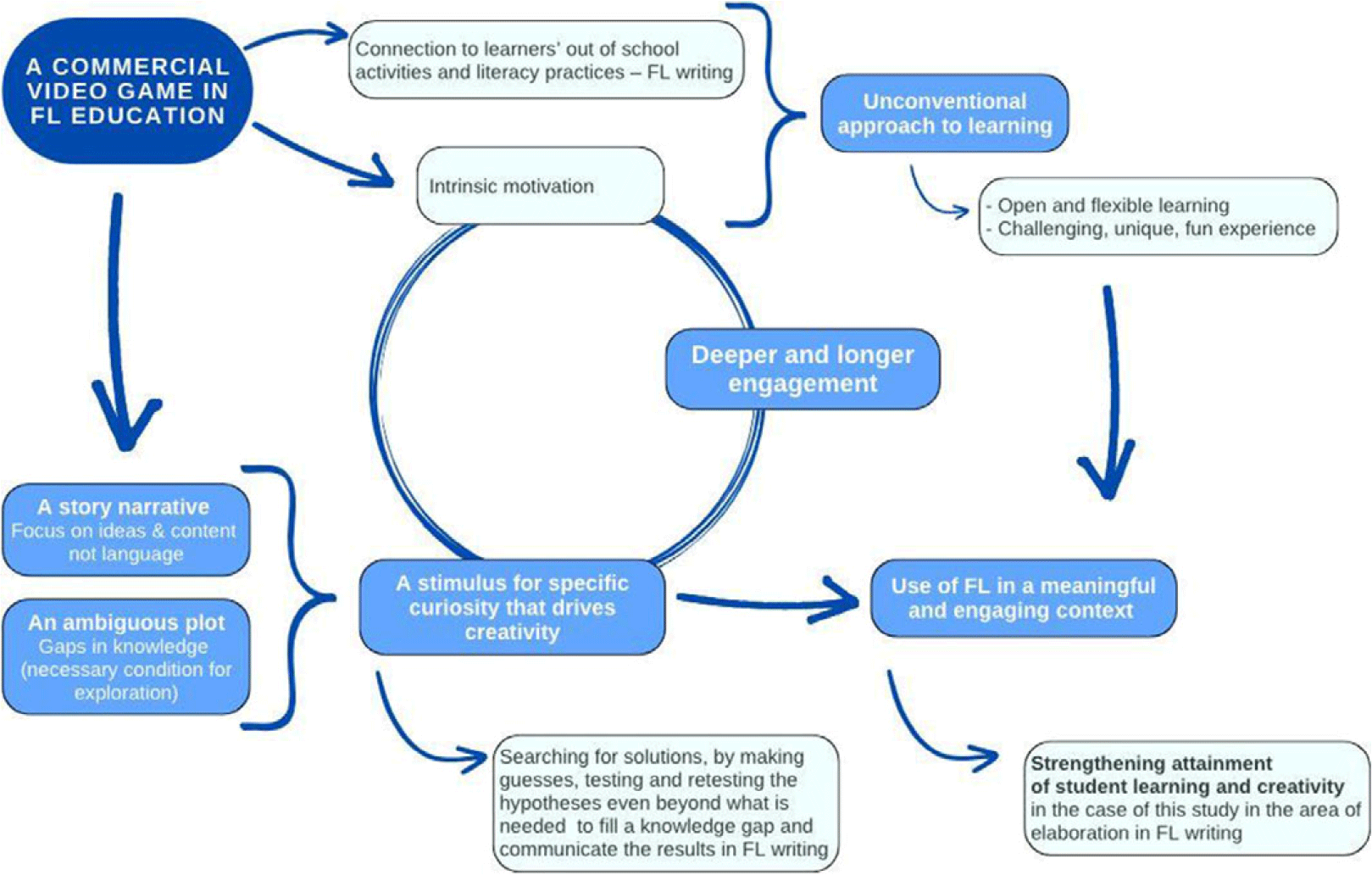
The results presented above are in line not only with Lee (Reference Lee2019) but also with Breien and Wasson (Reference Breien and Wasson2021) and Ebrahimzadeh and Alavi (Reference Ebrahimzadeh and Alavi2017) regarding the increase in engagement, motivation and learning in DGBL, and Aguilar, Holman and Fishman (Reference Aguilar, Holman and Fishman2018), considering that DGBL generates students’ motivation and curiosity, which is reinforced through the narrative. Our analysis shows that Her Story’s narrative and an ambiguous plot act as a stimulus for specific curiosity, which can be characterized by a desire to gain knowledge about something in particular to fill a knowledge gap (Hagtvedt, Dossinger, Harrison & Huang, Reference Hagtvedt, Dossinger, Harrison and Huang2019). This type of curiosity drives creativity and can be described as intrinsic motivation (Gross, Zedelius & Schooler, Reference Gross, Zedelius and Schooler2020) (see Figure 3).
Pedagogical implications for the use of a commercial video game in foreign language writing

Research Question 2: Are there statistically significant differences between participants from two countries (Spain and Poland) regarding their creativity, focusing particularly on their EFL writing products, before and after using a DGBL experience based on the video game Her Story?
The pre-test questionnaire showed a positive self-perception regarding their individual creativity identified by Batey (Reference Batey2007) as linked to creativity in both groups. Nevertheless, ULS participants obtained statistically significant higher scores regarding being creative. In this line, and focusing now on Lee’s (Reference Lee2019) pre-test, ULS participants scored higher that UCO participants in all the items except “I respect diverse ideas.” In fact, a total of five out of 10 items presented statistically significant differences in favor of ULS students, who considered themselves more creative than UCO students before starting the project. This result may have been influenced by the creative media students at ULS, who made up 40% of this group. Similarly, the opportunities for creativity at university is also statistically significantly lower for UCO students, which is in line with previous research that highlights that creativity in the curricula of Spanish universities is residual (Fernández Souto & Balonas, Reference Fernández Souto and Balonas2021).
Focusing on the question “how creative are you?”, 80% of UCO participants and 96% of ULS participants scored 6 or more, which contrasts with Lee (Reference Lee2019), where only 32.2% of the students reported that they considered themselves to be creative. Moreover, it is also interesting to highlight that 20.8% of Lee’s (Reference Lee2019) students responded positively when asked whether they could use creativity in their EFL lessons, which contrasts again with the results in the replication. Nonetheless, this study’s findings and data analysis demonstrate that the negative view of one’s creativity is not the determining factor for producing original, quality ideas in writing.
The writing products, however, presented similar results between the two groups of participants considering the three constructs of creativity (originality, flexibility, and elaboration) identified by Torrance (Reference Torrance and Sternberg1988). Students’ interpretations of the plot and the use of different viewpoints and genres varied across the sample. There were no incidents of highly original work found. The findings indicate that the choice of genre and a viewpoint in writing may influence the level of elaboration in the texts produced by students. What is noteworthy is that 24% of the participants from ULS and 8% from UCO, similar to Lee’s (Reference Lee2019) study, recreated the story based on the events from the game as closely as possible. This may be caused by the lack of instructions linked to the concept of creativity. This could be a limitation of this study, as such understanding can influence students’ work (Beghetto, Reference Beghetto2005) and thus lead to various, sometimes erroneous, assumptions about being creative.
Finally, the feedback provided after completing the project is very positive for both groups. Focusing on the post-test questionnaire, no statistically significant differences between UCO and ULS were found for the positive statements (e.g. “interesting,” “original”), except for “It is motivating”; in all cases, ULS scored higher. Regarding the negative statements, UCO participants scored higher, showing statistically significant differences in three items (i.e. “boring,” “repetitive” and “difficult” project). It is also relevant to highlight that for most UCO participants, it was the first time they used DGBL for practicing listening and writing skills in English, although ULS participants were more willing to use video games to continue practicing their English skills. The open questions showed similar results, as more students from UCO than from ULS experienced difficulties in finishing the project, due to the lack of instructions or because of repetition. Despite this, the global assessment by both groups is that this video game-based project was “unique,” “interesting” and “fun”, fostered their creativity, enhanced unconventional learning (especially of EFL writing), and was a motivating experience in the FL classroom.
The results demonstrate that the use of a video game with an ambiguous storyline prompts discovery (specific curiosity) and could be the determining factor for producing original, quality ideas in writing even when holding a negative view of one’s creativity. Figure 3 shows key pedagogical implications based on the findings and data analysis of this study.
The pedagogical implications illustrated in Figure 3 show suggestions for teachers in terms of choosing a commercial video game in an FL and the features it should have in order to stimulate specific curiosity, which drives creativity and intrinsic motivation and provides a meaningful and deeply engaging context for FL learning. Nonetheless, educators should pay closer attention to the type of game they choose, guidelines developed for students and support provided during such projects to avoid participants’ frustration and demotivation (see Figure 2).
7. Conclusion
Replication is of major importance in empirical science, as it aims to increase the impact of research and to test generalizability of the earlier findings under different conditions to determine whether the findings were not an isolated outcome and can be separated from the original context (Porte, Reference Porte2012). Nevertheless, replication should add extra value to the original research (Brendel, Diederich & Niederman, Reference Brendel, Diederich and Niederman2021). In this line, this replication study has not only used the procedure and instruments suggested by Lee (Reference Lee2019) but also included two validated and consolidated instruments on creativity (Batey, Reference Batey2007) to explore participants’ creativity experiences before and after the experiment.
It is widely probed that creativity is instrumental in facilitating a meaningful learning experience as learners can actively apply their imagination to formulate and experiment with alternative ideas in an authentic context (Kampylis & Berki, Reference Kampylis and Berki2014), which adds to the development of intrinsic motivation and allows students to engage more deeply and learn longer (Vansteenkiste et al., Reference Vansteenkiste, Lens and Deci2006), even despite the difficulties encountered, as this study showed. As Ellis (Reference Ellis, Jones and Richards2015) states, the relationship between individuals’ creativity and language learning is potentially two way: “more creative people make better language learners but, also, language learning may foster creativity in people” (p. 33). The results of the mixed-methods analysis conducted in this replication study support the latter idea as the video game, by reason of its ambiguity, which prompts discovery (specific curiosity), provided the stimulus for language work and affected creativity in FL writing, especially in the dimension of elaboration. According to Torrance (Reference Torrance and Sternberg1988), a stimulus is necessary for creative fluency to be developed. In other words, for the number of interpretable, meaningful, and relevant ideas to be generated, one needs the ideas flowing to unlock their creative thoughts. The stimulus for reconstructing stories seems crucial in the process of creation, because one needs knowledge to think creatively and the ability to free oneself of that knowledge (Johnson-Laird, Reference Johnson-Laird and Sternberg1988; Sternberg, Reference Sternberg2012). Her Story provided the plot but left the interpretations of the events to the players’ imagination, leaving the students in control of the game. This is important, because people learn in multiple ways, and the process of learning should cultivate learner autonomy and inspire learners to take control of their own learning (Hampson, Patton & Shanks, Reference Hampson, Patton and Shanks2011). Unquestionably, working with the video game was organized around each “learner’s journey” at their own pace and in their own time, making learning a habit rather than an activity forced upon them (Leadbeater, Reference Leadbeater2009). The results of this study were similar to that of Lee (Reference Lee2019), in that Her Story motivated students to practice writing in EFL as it was seen as an interesting project based on using English for real purposes, even though Lee’s students did not see themselves as creative, contrary to some of the participants in the replication. Our data analysis and findings demonstrate, however, that the negative view of one’s creativity is not the determining factor for producing original, quality ideas in writing. The incorporation of DGBL in creative EFL writing classes promoted student creativity by enabling them to explore new text genres, create new characters, and use different points of view for the same reality, which in turn helped them to develop their voices and reshape points of view. In both studies, original and replication, students were engaged in a deliberate practice of creativity to some extent. Nonetheless, further research is needed to establish whether providing students with a definition of the concept of creativity or exploring their understanding of this notion and then asking them to produce a piece of creative writing in an FL (deliberate practice of creativity) would help them to produce more original writing (McVey, Reference McVey2008). It is also worth investigating further whether students’ openness to new experiences using creativity in class and the lack of a prescriptive curriculum (e.g. a video game), which stimulates discovery at students’ own pace and provides a stimulus necessary to create, could be the determining factors for producing original, quality EFL writing even when holding a negative view of one’s creativity.
Acknowledgements
The authors deeply thank Sam Barlow, developer of the video game Her Story, for providing us with licenses for all the participants to engage in this research.
Author contributions
The authors participated equally in the writing of the article.
Ethical statement and competing interests
This work is entirely original, and others’ work has been cited appropriately. Institutional requirements were followed in data collection procedures, and data analysis was carried out after grades had been assigned. There was no conflict of interest in this study.
About the authors
Cristina A. Huertas-Abril is an associate professor at the University of Córdoba, Spain. She belongs to the Department of English and German Philologies, and mainly teaches in the Faculty of Education and Psychology. Her research interests include computer-assisted language learning, TEFL, bilingual education, and teacher training.
Barbara Muszyńska is a Fulbright Senior Award scholar at Texas Woman’s University (2021–2022), who works as an assistant professor at the University of Lower Silesia in Wrocław, Poland. Her research focuses on language education in multilingual and multicultural contexts promoting the conditions for critical reflection.
Author ORCIDs
Cristina A. Huertas-Abril, https://orcid.org/0000-0002-9057-5224
Barbara Muszyńska, https://orcid.org/0000-0002-0137-363X