1. Introduction
In today’s digital era, language learners are wired with all forms of technology anytime and anywhere. Our digital generation invests substantial time online, frequents social networking spheres, plays online games, and multitasks with assignments while emailing and texting (Prensky, Reference Prensky2005a, Reference Prensky2005b). Three-dimensional (3D) multi-user virtual environments (MUVEs), such as World of Warcraft, Active Worlds, and SimCity, have gained popularity among the Net Generation due to their affordances augmented by simulation, immersion, creativity, and collaboration (Peterson, Reference Peterson2016a; Puentedura, Reference Puentedura2006; Sadler, Reference Sadler2012). Second Life (SL) has also drawn the attention of second language (L2) learners to explore this vibrant 3D space and interact with other users in world languages. It offers a pedagogical avenue to realize real-life tasks, from dining in a 3D Italian restaurant to taking a virtual field trip to Machu Picchu. Designing technology-enhanced, task-based instruction in 3D MUVEs has enabled educators to experiment with innovative ways of teaching, and to stimulate learners to practice target languages beyond the walls of their class. In addition, it promotes the use of language for communicative, meaningful, and experiential purposes (Chen, Reference Chen2016a, Reference Chen2016b, Reference Chen2018; Chun, Kern & Smith, Reference Chun, Kern and Smith2016; Dawley & Dede, Reference Dawley, Dede, Spector, Merrill, Elen and Bishop2014; Sadler & Dooly, Reference Sadler, Dooly, Thomas, Reinders and Warschauer2013).
Prior research on pre-task planning explored the role played in L2 learners’ interlanguage development and the quality of their planned output (Crookes, Reference Crookes1989; Ellis, Reference Ellis1987; Ortega, 1999). The effects of pre-task planning are reported to mitigate the cognitive overload of the task demands for L2 learners on their speech outcomes measured by complexity, accuracy, and fluency (Ellis, Reference Ellis2009a; Foster & Skehan, Reference Foster and Skehan1996; Skehan, Reference Skehan1996; Yuan & Ellis, Reference Yuan and Ellis2003). The opportunity of time provided for L2 learners to plan before coming to terms with the higher levels of task demands has theoretical and pedagogical implications in the field of second language acquisition (SLA). This has not only illuminated how learners’ internal planning processes can benefit their noticing of L2 forms and monitoring the output but also motivated language teachers to incorporate the concept of pre-task planning in instruction to optimize L2 learners’ interlanguage development and usage. Despite the positive claims, previous studies on pre-task planning were mostly conducted in a physical class or a lab setting (Mehnert, Reference Mehnert1998; Skehan & Foster; Reference Skehan, Foster and Ellis2005; Tajima, Reference Tajima2003). Less research attention has been directed toward the effects of pre-task planning on English as a foreign language (EFL) learners’ oral output in 3D MUVEs, much less targeting EFL learners with culturally/linguistically diverse backgrounds. This under-researched area serves as a catalyst for this study, rendering a new research avenue to investigate whether pre-task planning could be a facilitative factor in enhancing the quality and quantity of EFL learners’ task-oriented, voice-based outcomes in SL.
2. Research background
2.1 Task-based design in Second Life
SL, developed by Linden Lab in 2003, is a 3D MUVE that allows its users (used interchangeably here with residents) to utilize self-created avatars to interact with other users. According to the analytics report released by Linden Lab (2013), SL has drawn more than 36 million users worldwide to this 3D virtual sphere since its launch, and the number is still increasing. Depending on one’s personal preferences and creativity, SL residents can change their avatar’s appearances and outfits to make their identities versatile and surreal. For example, they can instantaneously change their avatar’s representation into a superhero, an animal, or a person that may or may not resemble their true self in real life. Avatars in SL can teleport to various virtual islands (in land) through SLURLs (SL teleport links) to designated SL locations with just the click of a mouse. SL also affords residents to walk, fly, and socialize with others via public text chat, voice chat, private instant message, or performing paralinguistic cues, such as laughing and dancing.
Another unique feature of SL is that the residents can build 3D objects (e.g. house, clothing) using scripting functions and take snapshots of in-land activities on the fly (Sadler & Dooly, Reference Sadler, Dooly, Thomas, Reinders and Warschauer2013). Similar to the real world, SL enables avatars to participate in a variety of social events that simulate real-life routines (e.g. attending a conference or visiting Times Square) (Wang & Burton, Reference Wang and Burton2013). Due to viable affordances in 3D simulation, immersion, tele/copresence, and multimodality, language learners can easily access SL without the constraints of time and physical boundaries (Canto, de Graaff & Jauregi, Reference Canto, de Graaff, Jauregi, González-Lloret and Ortega2014; Cooke-Plagwitz, Reference Cooke-Plagwitz, Oxford and Oxford2009; Peterson, Reference Peterson2016a). Specifically, it allows them to use a target language to simultaneously and spontaneously interact with speakers from culturally/linguistically diverse backgrounds as if they were in the real world (Lee & Gerber, Reference Lee and Gerber2013; Peterson, Reference Peterson2012, Reference Peterson, Farr and Murray2016b). Hence, the flexibility, low cost, and vibrant features afforded by SL have attracted a growing number of language learners to create their own second life with hopes of practicing their target language for communicative and authentic purposes.
The methodological principles of task-based language teaching (TBLT), as argued by Doughty and Long (Reference Doughty and Long2003), are theoretically sound (e.g. focus on meaning and form [not on forms], rich input, and authentic tasks) and pedagogically driven (e.g. problem-solving, collaborative learning, and individualized instruction), with great potential for online language instruction. Learning by doing, one of the integral TBLT principles, is well suited for the immersive nature of SL, which augments reality and deepens one’s learning experience (Puentedura, Reference Puentedura2006). Interactive tasks also draw learners’ attention to linguistic forms that need refinement, leading to better quality in language production as measured by accuracy and complexity (Swain & Lapkin, Reference Swain and Lapkin1995; Yuan & Ellis, Reference Yuan and Ellis2003). This mechanism also allows teachers/researchers to elicit learners’ answers during their task-based practices throughout various communication task types, such as the two-way information gap or jigsaw tasks (Chen, Reference Chen2016a, Reference Chen2018; Peterson, Reference Peterson2006; Smith, Reference Smith2003).
Ortega and González-Lloret (Reference Ortega, González-Lloret and Bygate2015) proposed a technology-mediated TBLT framework to operationalize task-based design in the virtual world to invigorate experiential learning that transcends the classroom. Three criteria are proposed for the dynamic duo (i.e. tasks and technology) to function: (1) real-life tasks need to be authentic in nature rather than camouflaged as exercise-based activities simply delivered to a digital platform; (2) teacher educators should consider wider applications of technology-mediated TBLT to language education and SLA; and (3) rigorous task-based design supported by relevant technology needs to follow a full task cycle, such as conducting needs analysis, selecting/sequencing tasks, and evaluating learners’ task performance (González-Lloret & Ortega, Reference González-Lloret and Ortega2014). Hence, meaningful real-life tasks that might seem cumbersome or challenging when carried out in a traditional class (e.g. checking into a hotel or taking multiple field trips in a target country) can be seamlessly configured in SL, thus mitigating issues related to travel arrangements and budget concerns (Canto et al., Reference Canto, de Graaff, Jauregi, González-Lloret and Ortega2014; Lee & Gerber, Reference Lee and Gerber2013; Peterson, Reference Peterson2012).
Given that language practices are developmental and complex in nature, a full-fledged virtual course extending over a longer time span was conducted in this study to capture the dynamic learning spectrum (Peterson, Reference Peterson2006, Reference Peterson2010a, Reference Peterson2010b). It not only enabled students to fully immerse themselves in the virtual community of practice, but also allowed the researcher to consistently observe and document the students’ language practices for richer data. A task-based syllabus that addressed students’ needs, promoted spontaneous interaction, and incorporated real-life scenarios into SL was adopted in this virtual course under the principles of TBLT design (Doughty & Long, Reference Doughty and Long2003; González-Lloret & Ortega, Reference González-Lloret and Ortega2014; Nunan, Reference Nunan2006; Skehan, Reference Skehan2003; see section 4.2, Data collection, for detail). The implementation of the TBLT syllabus that consistently documented task delivery and how learners’ oral performance played out in SL further provides practical implications for language teachers interested in task-based instruction using 3D MUVEs (Chen, Reference Chen2016b, Reference Chen2018).
2.2 Pre-task planning
Ellis (Reference Ellis1987) conceptualizes pre-task planning as an opportunity for L2 learners to plan and monitor their language output by restructuring their linguistic repertoire, which would help them ease into different levels of task demand (e.g. drafting a story outline before telling it orally). He further categorizes pre-task planning into rehearsal (“planning takes the form of an opportunity to perform the complete task once before performing it a second time”) and strategic planning (“planning what content to express and what language to use but without opportunity to rehearse the complete task”; Ellis, Reference Ellis2009a: 474). Crookes (Reference Crookes1989) also gives credit to its impact on fostering the learners’ interlanguage processes because planned outputs can stretch learners’ interlanguage system through planning and monitoring their language production. As L2 learners are generally expected to demonstrate their language proficiency against task performance, Skehan (Reference Skehan1996) argues planning can be operationalized in “manipulable” task conditions in order to control the cognitive load placed on L2 learners. This points to the importance of planning for learners to access, process, and organize their language resources before being tasked – in line with Ellis’s (Reference Ellis1987) conceptualization of pre-task planning.
Hence, the opportunity to plan before the tasks holds the potential to lower the learners’ affective filter during pressed communication time as well as free up their cognitive capacity to attend to linguistic forms (Mehnert, Reference Mehnert1998; Skehan & Foster, Reference Skehan, Foster and Ellis2005). Those “hot spots” in L2 learners’ interlanguage system that are not fully proceduralized will then have a better chance to be accessed and restructured under controlled task conditions for planning. In this sense, those difficult forms could be remedied and modified, leading to a more refined planned production (Foster & Skehan, Reference Foster and Skehan1996; Tajima, Reference Tajima2003; Yuan & Ellis, Reference Yuan and Ellis2003). Although previous studies have argued that pre-task planning could optimize planned output in fluency, accuracy, and complexity, Ortega’s (1999) studies on the effects of planning on interlanguage development reveals a mixed result – coinciding with Ellis’s (Reference Ellis2009a) comprehensive review. That is, a planned output is more conducive to fluent and syntactically complex quality than an unplanned output, but it is inconclusive in terms of accuracy. Despite this, Ortega (1999) argues
… the theoretically interesting claim is not only that planning may lessen the cognitive load of a given task and free up attentional resources at the micro levels of speech production but also that it may foster during the planning phase a shift of conscious attention to formal aspects of the language needed to accomplish the task. (Ortega, 1999: 110)
We can hypothesize that planning allows for learners’ attentional resources to be freed up for use and cognitive load can be lessened without time pressure. O’Malley and Chamot (Reference O’Malley and Chamot1990) also stress that language learning is a complex cognitive process that takes both declarative knowledge (what we know) and procedural knowledge (what we know how to do) of the learner’s interlanguage mechanism for learning to take place. It also requires practice to proceduralize the declarative knowledge (e.g. grammar rules, vocabulary) into a spontaneous “stage” for the purpose of language use (e.g. communication).
While pre-task planning appears pedagogically sound, there is still a paucity of studies on marrying SL and pre-task planning, thus deserving a closer observation in the current 3D MUVE and SLA literature. It would offer research and practical implications for SLA stakeholders to examine how pre-task planning as an instructional condition can impact learners’ planned task outcomes in their oral output. Given the unique SL features that afford immersive simulation, real-time interaction, avatar-enabled tele/copresence, and multimodal communication, task-based design can be operationalized in 3D form to facilitate task delivery that transcends physical boundaries (González-Lloret, Reference González-Lloret2015; Jauregi, Reference Jauregi and Carrió-Pastor2016; Ortega & González-Lloret, Reference Ortega, González-Lloret and Bygate2015; Peterson, Reference Peterson, Farr and Murray2016b; Wigham & Chanier, Reference Wigham and Chanier2015). In response to Ortega’s (1999) and Ellis’s (Reference Ellis2009a) mixed results, this study aims to investigate whether pre-task planning makes a difference in EFL learners’ voice-based task performance in SL.
3. Research questions
The key question addressed in this study is, “Does pre-task planning make a difference in EFL learners’ oral performance as measured by complexity and accuracy in a task-based class conducted in SL?” To address this, the quality and quantity of EFL learners’ oral outputs during their task-based performance in the virtual course were measured at the levels of complexity and accuracy (Yuan & Ellis, Reference Yuan and Ellis2003; see also section 4.3, Data analysis). In order to document their ongoing language practice in this virtual class, discourse samples selected from each student’s oral task presentations were collected to provide empirical evidence on the effects of pre-task planning on learners’ oral production in SL.
4. Methodology
4.1 Setting, participants, and ethics
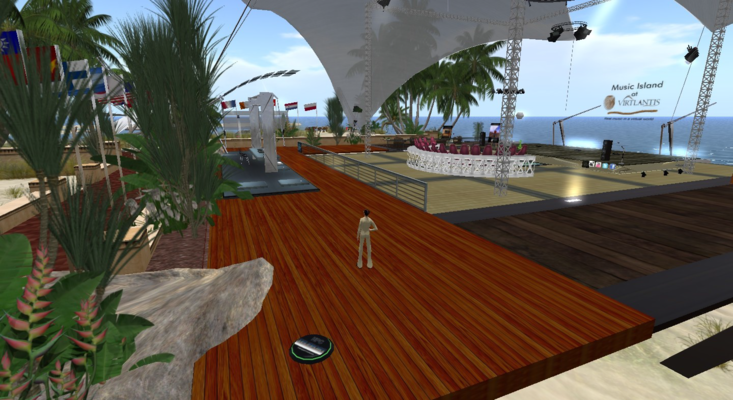
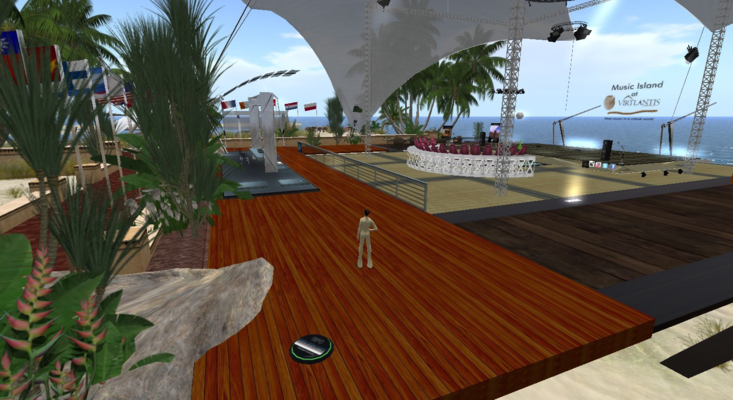
VIRTLANTIS, a 3D island in SL, was selected as the research site for the virtual class, as it provides free language classes that attract SL residents to learn different foreign languages. Teacher volunteers are also present to offer classes to help students improve their target language proficiency. The major factor that distinguishes online teaching in VIRTLANTIS from teaching in real life is that it enables language teachers and learners to maximize real-life task-learning experience by using the salient SL features. For instance, learners in avatar form can build 3D objects in a Sandbox, teleport/fly to various spaces for social events, or simulate a real-life scenario (e.g. dining at a restaurant) by rezzing the Holodeck feature (i.e. creating or dragging a 3D object to the ground to make it appear; see Figure 1).
A snapshot of VIRTLANTIS island in SL
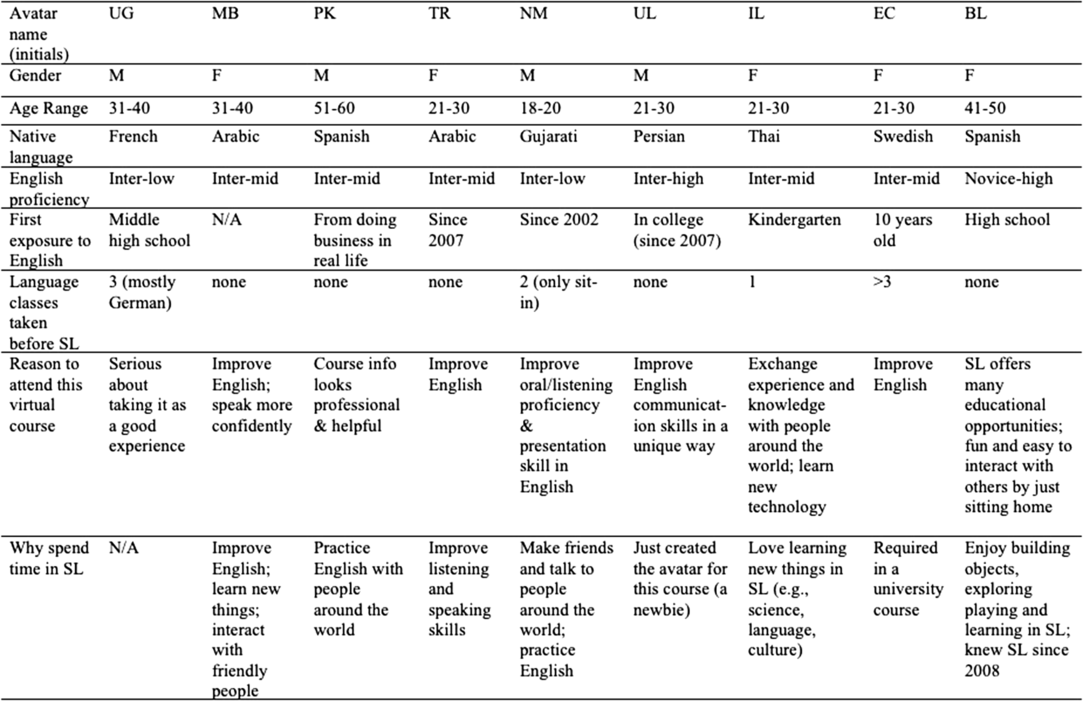
Snowball sampling (a non-random sampling procedure to encourage potential participants to spread the word to other like-minded participants) was employed via an invitation notecard sent to all VIRTLANTIS members regarding the nature of the task-based course and purpose of this study. Nine EFL learners who were keen on improving their English oral communication skills expressed interest in joining the class. They initially met with the researcher (also the teacher) in VIRTLANTIS for a one-on-one debriefing session to obtain their informed consent. They were informed that their oral production in each session would be audio-recorded for research purposes and their real-life identities would be kept intact, as their avatar names were not directly linked to personal names. They could also withdraw from the study at any time without obligations. Students were adult residents in SL (aged between 21 and 60) and came from diverse linguistic and cultural backgrounds (e.g. French, Spanish, Arabic, Indian, and Swedish). All were familiar with SL features and knew how to use voice/text chat to communicate with other avatars. Following the proficiency standards of the American Council on the Teaching of Foreign Languages (Swender, Conrad & Vicars, Reference Swender, Conrad and Vicars2012), the researcher had the chance to assess each learner’s English proficiency during their oral interview at the debriefing session (e.g. “Why do you come to SL for practicing English?”) and their oral performance in pre-course task-based interaction. Their levels of language proficiency ranged from novice-high to intermediate-high, as assessed. Figure 2 presents a full version of each learner’s demographic information, language learning background, English proficiency level, and intention to participate in this SL class (see Chen, Reference Chen2016a).
Demographic information of the participants

4.2 Data collection
The 10-session virtual class (1.5 hours per session, twice weekly) incorporated real-life tasks that were meaningful and engaging to the EFL learners (Ellis, Reference Ellis2000; Nunan, Reference Nunan2006; Skehan, Reference Skehan2003). The task design was motivated by the pedagogical framework of technology-mediated TBLT (Doughty & Long, Reference Doughty and Long2003; Ortega & González-Lloret, Reference Ortega, González-Lloret and Bygate2015), targeting authentic real-life tasks, potential implications for language learning, appropriate selection of technology, needs analysis, and task evaluation (González-Lloret & Ortega, Reference González-Lloret and Ortega2014). To illustrate, a task-based syllabus was adapted from a pilot version with an EFL student group in SL who shared similar backgrounds. That is, they were also adult EFL students with culturally/linguistically diverse backgrounds, had no prior task-based learning experience before the SL class and came to VIRTLANTIS to practice English with others around the world (also see Chen, Reference Chen2016a, Reference Chen2018). Based on actual implementation, lesson materials and task designs were modified to strengthen the content validity. Additionally, tasks were selected in accordance with the needs analysis of the students based on their responses to a post-course survey and opinions in the interview of the pilot study to ensure face validity (Chen, Reference Chen2016b). For instance, selected tasks not only enabled them to simulate real-life scenarios they found meaningful and engaging, but were also built upon their cultural repertoires in tandem with SL affordances to facilitate task delivery and experiential learning, such as teleporting to field trip sites or wearing cultural outfits in avatar form. The detailed task-based syllabus can also be viewed in the supplementary material (Chen, Reference Chen2016b).
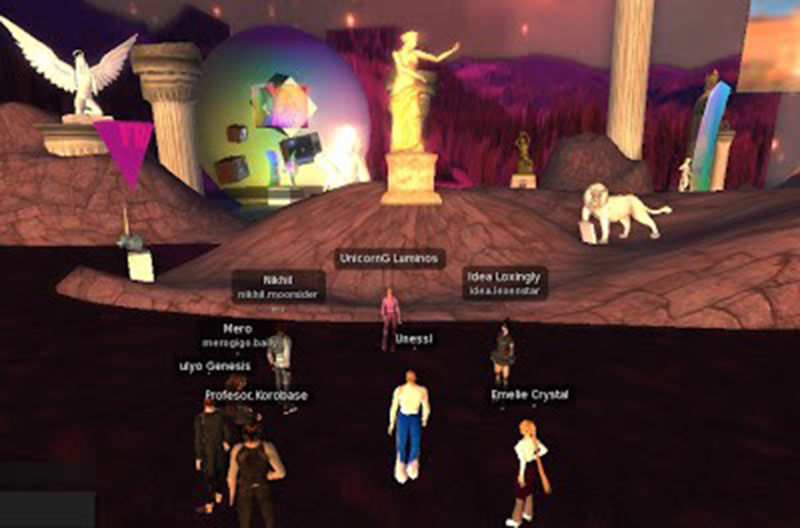
In order to examine the effect of pre-task planning on their oral outputs, students were given rehearsal time for task planning (Ellis, Reference Ellis2009a) at home before orally presenting their work in SL. As this virtual course was not obligatory and the class was not conducted in a lab, allocating specific time for pre-task planning was not feasible or controllable in this case. Hence, the students were allowed to have as much time as needed to rehearse at home to merit this ecological approach (Eckerth, Reference Eckerth2008). For instance, they would research information on how to be a tour guide leading the class to different SL landmarks that simulated tourist spots in their country (e.g. Le Mont-Saint-Michel). Similarly, they demonstrated how to cook a cultural dish (e.g. paella), showcased their cultural costume worn by their avatar (e.g. flamenco costume), or introduced an artifact to the audience in a 3D museum gallery as a curator (see Figures 3 and 4 for illustrative task examples). This course also coincided with González-Lloret and Ortega’s (Reference González-Lloret and Ortega2014) suggestion of designing a language program in a complete cycle to document the trajectories of learners’ task performance and gather empirical evidence of the measured accuracy and complexity of their language outcomes in SL.
A student working as a tour guide to showcase her Egyptian home culture

A student presenting an artifact to the class as a sculpture gallery curator

4.3 Data analysis
This study adopted Yuan and Ellis’s (Reference Yuan and Ellis2003) analytical framework that used T-units to measure the quality and quantity of EFL learners’ oral productions over time. A T-unit is the shortest unit of a sentence that can stand alone grammatically – “a main clause and related subordinate clauses and nonclausal structures embedded in it” (Hunt, 1970, as cited in Pica & Doughty, Reference Pica, Doughty, Gass and Madden1985: 119). A T-unit analysis has also been used extensively as a device to measure the syntactic complexity and accuracy of learners’ speaking or writing samples in SLA (Pica & Doughty, Reference Pica, Doughty, Gass and Madden1985; Young, Reference Young1995; Yuan & Ellis, Reference Yuan and Ellis2003). An ANOVA with repeated measures was performed and post hoc Bonferroni tests were run later to determine the locations of the significance through pairwise comparisons if the F scores were statistically significant (p < .05). Effect sizes are reported to further examine the strength and magnitude of this study (Brown, Reference Brown2008; Dörnyei, Reference Dörnyei2007). Both independent and dependent variables are described in the following sections.
4.3.1 Independent variable
Throughout the 10-session task-based course, six of the tasks required students to make oral presentations in front of the class, as previously explained. However, some of the students did not complete every task due to their real-life commitments. In order to ensure consistency of data analysis, three different points of time in which all students (N = 9) were present to perform all of those tasks were selected: session 4 (show and tell one’s cultural outfit in avatar or digital poster form), session 8 (work as a gallery curator), session 9 (work as a tour guide). Each session was denoted as T1 (session 4), T2 (session 8), and T3 (session 9) based on the time progression for each task.
4.3.2 Dependent variables
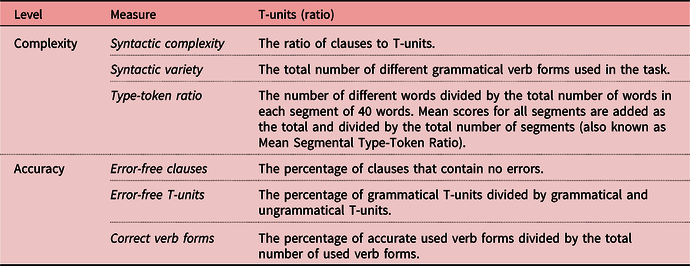
Since the students’ oral presentations were monologic in nature and contained few elliptical utterances, T-units rather than C-units were analyzed, as rationalized by Yuan and Ellis (Reference Yuan and Ellis2003). An adopted measure scheme is presented in Table 1 (for detailed specifications of each measured variable, see Yuan & Ellis, Reference Yuan and Ellis2003: 13–14).
Measured variables for complexity and accuracy using T-units

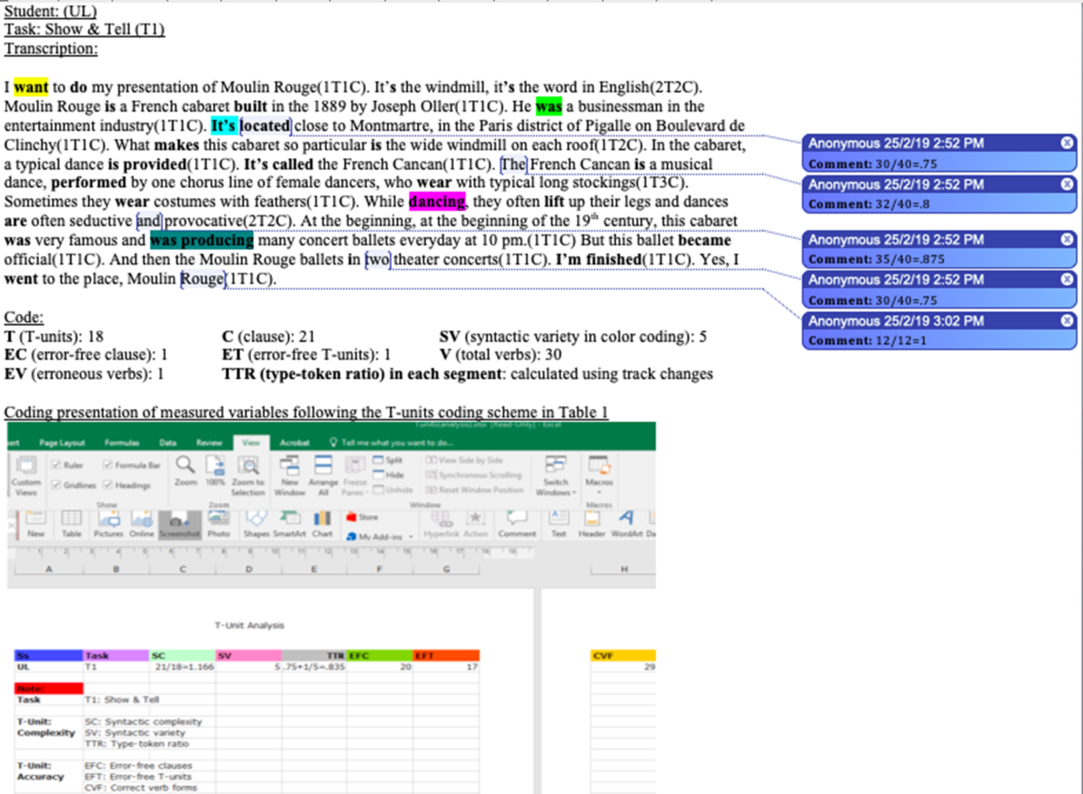
In order to ensure coding consistency, an SLA specialist was recruited to ensure intercoder reliability. Before independent coding, the researcher conducted several training sessions where instructions for coding schemes were clearly explained to the second coder and sample data were also provided for her to practice. After questions and concerns raised by the second coder were resolved, they independently coded 30% of the whole data set. Intercoder reliability was then calculated using the formula of an intraclass correlation coefficient, which was set at a two-way mixed model (i.e. raters were fixed) and the absolute agreement type suggested by McGraw and Wong (Reference McGraw and Wong1996). A high level of agreement was reached at .994 of average measure intraclass correlation coefficient (p < .01). The discrepancies in both codings were further compared and discussed before the rest of the data were coded. Figure 5 illustrates a vivid coding example of a student’s oral presentation (T1: show and tell) with color coding and data quantification following each coding category of measured T-units (see Table 1).
A coding example of the T-unit analysis

5. Results
5.1 Complexity
Table 1 shows three dependent variables tapping into the construct of complexity of the nine students’ language output in the format of oral presentation: syntactic complexity, syntactic variety, and lexical variety (measured by Mean Segmental Type-Token Ratio). Results of the complexity level of students’ oral production measured by each variable are presented in Table 2.
Differences in complexity throughout three progressional sessions

Note. T1 = session 4; T2 = session 8; T3 = session 9; par. eta2 (ηp 2) = partial eta squared (effect size).
* p < .05.
** p < .001.
After performing a series of one-way repeated measures ANOVAs with Huynh–Feldt corrections (i.e. a more conservative procedure), the results showed that the overall differences in the means of the three dependent variables measuring complexity across the three sessions over time were statistically significant in syntactic complexity, F(2, 16) = 6.38, p = .009, and syntactic variety, F(2, 16) = 12.43, p = .001, but not in lexical variety, F(2, 16) =.93, p = .415. The effect sizes also indicated that the magnitude of the difference was large, with 44.4% and 60.8% of the variance accounted for by syntactic complexity and syntactic variety respectively. In other words, EFL students throughout the course showed improvement in their grammatical complexity at the level of syntactic complexity and variety, but not as much in lexical sophistication measured by the variety of vocabulary use.
A further post hoc test using Bonferroni correction (to mitigate the statistical problem in multiple comparisons, such as ANOVAs) revealed that in the case of syntactic complexity, students in session 8 (T2) improved more than in session 4 (T1) at the statistically significant level (p = .035). However, the language output produced in the last session (T3) did not differ significantly from T1, although it was greater in mean (M = 1.35 > M = 1.27). The post hoc test on syntactic variety also showed a similar result in that students’ latter output in the final session (T3) outperformed the two earlier sessions both at the statistically significant levels (p = .011 for the T2–T3 comparison, and p = .003 for the T1–T3 comparison). However, no difference was found when the first two sessions were compared, and the mean of the latter was slightly smaller than the former (M = 5.67 < M = 5.89). As the difference in lexical variety was not statistically significant, the post hoc test was not performed. Nevertheless, the means in the lexical variety of the three sessions were almost equal (.79), although slightly smaller (.77) in the second session (T2).
5.2 Accuracy
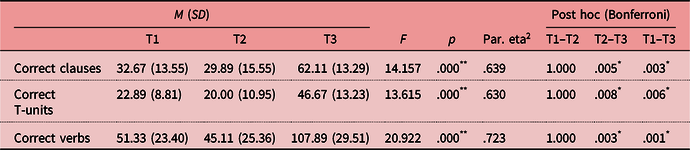
The accuracy of the students’ oral production was measured based on the percentages of error-free clauses, error-free T-units, and correct use of verb forms. Table 3 summarizes the results.
Differences in accuracy across three progressional sessions
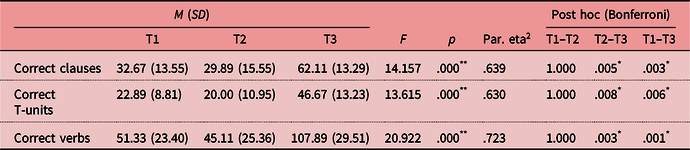
Note. T1 = session 2; T2 = session 8; T3 = session 10; par. eta2 (ηp 2) = partial eta squared (effect size).
* p < .05.
** p < .001.
Overall, statistically significant differences were found for all three dependent variables that measured the construct of accuracy in the students’ oral production across the three sessions over time: F(2, 16) = 14.157, p < .001, for correct clauses; F(2, 16) = 13.615, p < .001, for correct T-units; F(2, 16) = 20.922, p < .001, for correct verbs. The effect sizes also indicated that the strength of the within-subject effect accounted for by each measured variable was considerably large (63.9% for correct clauses, 63.0% for correct T-units, and 72.3% for correct verbs). The positive findings indicated that the quality of the students’ language output was greatly improved in terms of accuracy measured by error-free clauses, error-free T-units, and the correct use of verb forms.
Further post hoc tests pointed to the fact that statistically significant differences were located between the last session (T3) and the other two (T1, T2) in each measured variable, but no statistically significant differences were found between T1 and T2. In other words, students’ oral production in terms of accuracy progressed greatly in the final sessions of the course. However, the mean of each variable in T2 was slightly lower than in T1, a finding that warrants further discussion below.
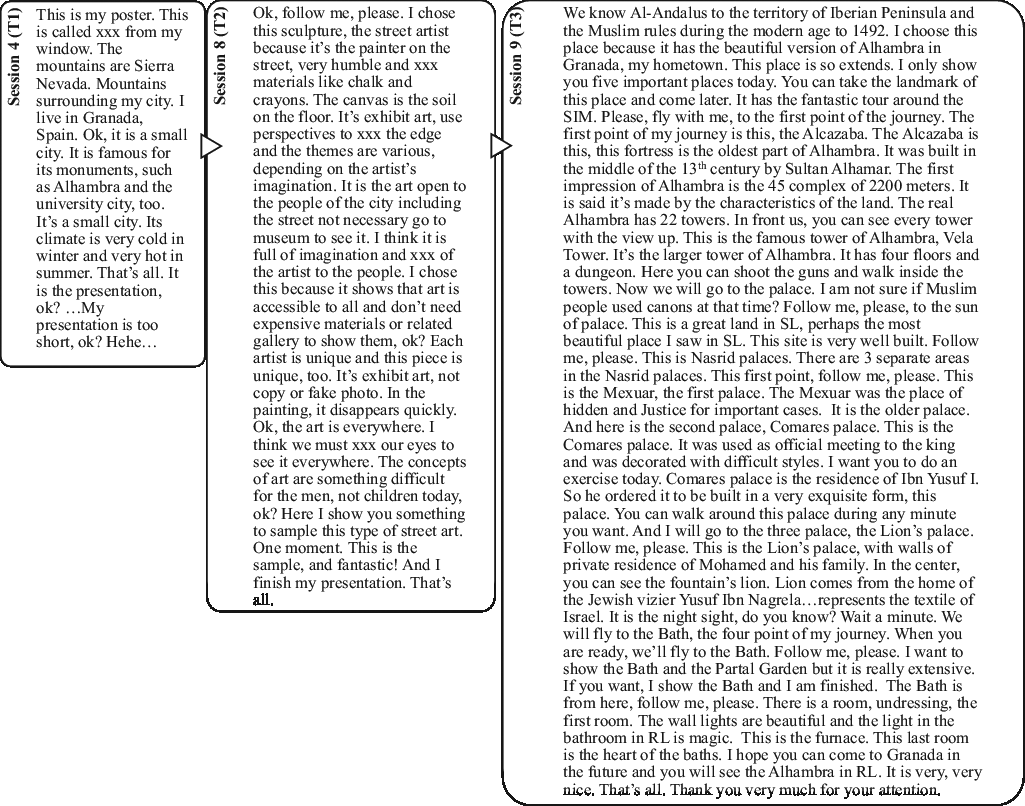
5.3 Quality and quantity
The quality and quantity of EFL students’ oral production did change over time throughout the task-based course. A vivid example is the language development of the beginner-level student (BL) throughout the course (see Figure 6). Not only did the quantity of her oral production in the final session increase more than the first two classes combined as measured by word counts (T3: 543 > T2: 196 > T1: 75), the language complexity also improved in relation to the number of different verbs used (T3: 7 > T1: 5 > T2: 4). More correct clauses (T3: 70 > T1: 22 > T2: 20), correct T-units (T3: 62 > T1: 18 > T2: 16) and correct verb forms (T3: 103 > T1: 32 > T2: 28) were also used.
Excerpts of the developmental change in quality and quantity of student BL’s oral output

6. Discussion
The results of learners’ oral production were mixed. In terms of complexity of language output, the statistical results (as shown in Table 2) revealed that the EFL students showed marked improvement in the area of syntactic complexity and variety, but not in lexical variety. The results were also supported by the large effect sizes, with 44.4% and 60.8% of the variance accounted for in syntactic complexity and syntactic variety respectively. In terms of accuracy, the students’ linguistic performance in the aspect of accuracy improved at all levels as the large effect sizes indicated 63.9%, 63.0%, and 72.3% of the variance were accounted for by error-free clauses, error-free T-units, and correct verb forms respectively. This finding was unexpected, as this task-oriented course was focused more on the process of task completion rather than on linguistic elements (Long, Reference Long and Anivan1990). Although “focus on form” could also be implemented in a task-based syllabus design (Ellis, Reference Ellis2009b; Long & Crookes, Reference Long and Crookes1992), greater attention was paid to whether the students could finish their oral presentation followed by peer’s and teacher’s feedback on their overall performance given the time constraint in each session. It was also hypothesized that the sophistication of students’ vocabulary use measured by their lexical variety would have outpaced their improvement in grammar since the “noticing” of learners’ interlanguage processing was triggered mostly by lexical input, as previously discussed (e.g. Blake, Reference Blake2000; Smith, Reference Smith2003). Vocabulary acquisition, be it intentional or incidental, is also the building block of language development due to students’ exposure to abundant lexical input from peers’ oral presentations and teacher talk (Gass, Reference Gass1999).
One possible explanation for this unexpected finding is the students’ pre-task planning investment in each oral presentation. Unlike the unrehearsed task-based interaction in pre- and post-course interaction sessions (see Chen, Reference Chen2016a, Reference Chen2018), students were allowed to prepare their materials and carefully plan their linguistic performance at home before their oral presentations in SL. Regarding the complexity variable, the current study supports the claim that pre-task planning has a positive impact on grammatical complexity of the learners’ language production (Crookes, Reference Crookes1989; Foster & Skehan, Reference Foster and Skehan1996; Ortega, 1999). In terms of grammatical complexity, the students showed improvement as measured by the ratio of clauses to T-units and syntactic variety, and by the total number of different verbs used. Mehnert (Reference Mehnert1998) also found that the more time allocated for pre-task planning (i.e. none vs. 10 minutes in her study), the better the complexity – this finding is supported by this study as students had more than 10 minutes to prepare at home before producing their oral output in SL. Skehan (Reference Skehan1996) also argued that L2 learners usually have difficulties attending to both meaning and form simultaneously and need to compensate for allocating attentional resources to one aspect but not to both. Given the time to plan for modifying the linguistic aspects (e.g. syntactic and lexical), they have a better chance to improve the quality of their language output. As evidenced in this study, the EFL learners had more time to plan and revise their presentations, thus resulting in the use of more complex grammatical structures in oral presentations than those in previous studies.
Another surprising but positive finding is that the learners’ linguistic performance improved on all accuracy levels, namely error-free clauses, error-free T-units, and correct verb forms (see Table 1). It is worth noting that this virtual course was developed following a task-based syllabus design instead of a grammar-based one. Grammatical errors made during the students’ oral presentations were not corrected in order to keep the flow. The fact that the quality of their oral production excelled in accuracy across all measured levels was unexpected. This finding may support prior SLA research on pre-task planning in that allowing time for learners to plan before they are tasked will optimize the accuracy of their grammatical performance (see also Ellis, Reference Ellis1987; Foster & Skehan, Reference Foster and Skehan1996; Mehnert, Reference Mehnert1998; Ortega, 1999; Skehan & Foster, Reference Skehan and Foster1997).
Even though EFL learners did produce more complex and accurate language output on the syntactic level in SL, the post hoc tests revealed mixed results of the locations of significance across the three progressional virtual sessions. Regarding the complexity measure, the last session (T3) outperformed the previous two (T1, T2) on syntactic variety, but the differences were not statistically significant on syntactic complexity and lexical variety, although the mean averages of T3 were slightly greater than the previous two. Interestingly, session 8 (T2) was hypothesized to outperform the previous session (T1), but it was not statistically significant on the measures of syntactic and lexical variety, albeit surpassing on syntactic complexity. Furthermore, the means in T2 were slightly lower than T1 on the last two measures on complexity. As for the accuracy measure, the locations of statistical significance performed by the post hoc tests quite consistently resided at the developmental trend where the last session (T3) outperformed the first two (i.e. T3 > T1; T3 > T2) across error-free clauses, error-free T-units, and correct verb forms. However, no statistically significant difference was found between T1 and T2 after the post hoc tests. It turned out that the average means in T2 across the three measures were slightly lower than T1, which was unexpected and should have been otherwise.
The mixed results might have been confounded by the factor of interaction of time and task conditions despite the format of oral presentation being consistent in all three sessions. It would be hard to determine if the positive effect was due to the progression of time or the tasks in SL. However, when the task conditions in the three sessions were examined, it was found that students in session 8 (T2: work as a gallery curator) were allowed to work collaboratively in pairs due to the time constraint, whereas students in session 4 (T1: show and tell one’s cultural outfit) and session 9 (T3: work as a tour guide) were mostly engaged in individual work as each student brought his/her own cultural expertise from their home country that might or might not be shared by others. In this case, the students’ oral production in session 8 (T2) might be constrained by time (as each student only had limited time to finish his/her part); this could have lowered the overall ratio of T-units analysis in T2. This may also explain why T2 did not outperform T1 on syntactic and lexical variety, as the two levels were measured by the total numbers of different grammatical verb forms and type-token ratio.
7. Implications
7.1 The impact of pre-task planning on linguistic performance
In summary, a strong claim that the EFL students did develop better linguistic complexity over time cannot be made due to the confounding factor of the interaction of time and task conditions (i.e. students worked in pairs in T2, whereas in T1 and T3 sessions, they were mostly engaged in individual work). However, this study did reveal the statistically significant improvements on the EFL students’ syntactic complexity and variety across all accuracy levels in oral performance. These positive results were owing to the pre-task planning effects on grammatical complexity of learners’ oral production and grammatical accuracy (Ellis, Reference Ellis1987; Skehan & Foster, Reference Skehan and Foster1997, Reference Skehan, Foster and Ellis2005; Tajima, Reference Tajima2003). This finding also supports the positive claim of prior research, namely allowing time for learners to plan before tasks will make a difference in the learners’ linguistic performance measured by complexity and accuracy (Crookes, Reference Crookes1989; Ellis, Reference Ellis2009a; Mehnert, Reference Mehnert1998; Ortega, 1999; Skehan, Reference Skehan1996; Yuan & Ellis, Reference Yuan and Ellis2003). Therefore, it is suggested that pre-task planning be seeded in task-based instruction either in a classroom-based setting or a 3D MUVE in order to optimize the learners’ language acquisition and production.
Above all, the quality and quantity of students’ pre-task planning investment also hinges upon the level of task engagement and relevance perceived by the learners (see further discussion in section 7.3). As indicated previously, the unique features of SL afford learners to simulate real-world tasks that may be infeasible or cumbersome to conduct in a physical class, thus deepening their language immersion experiences in 3D form (Chen, Reference Chen2016b, Reference Chen2018; Cooke-Plagwitz, Reference Cooke-Plagwitz2008, Reference Cooke-Plagwitz, Oxford and Oxford2009; Peterson, Reference Peterson2016a, Reference Peterson, Farr and Murray2016b). These affordances make real-life task operationalization feasible and engaging, which in turn stimulates and sustains learners’ task planning to better perform the tasks. Hence, this 3D MUVE approach offers a dynamic alternative to pre-task planning typically conducted in classroom or lab settings.
7.2 Learner investment propelled by positive peer pressure
An interesting phenomenon that was witnessed in the progression of the virtual course was “peer stimuli.” Seeing well-prepared and well-articulated peer presentations over time motivated the learners to improve their output in order to be perceived as a “professional” by their peers. Student UL, for example, after seeing his colleagues’ high-caliber presentations, requested that his oral presentation be postponed so that he could do more planning. The comments received on the weekly learning journals and in the post-course interview (see Chen, Reference Chen2016b) also revealed that students spent a considerable amount of time researching online to strengthen the content of their presentation. They would go to Wikipedia or other sites to search for more information about the topic in order to talk like a professional in front of the class. Consequently, they were also exposed to rich syntactic and lexical input from online materials. It was noted that the work and time that the students put into the pre-task planning also translated into richer content and more complex sentence structures and sophisticated vocabulary – although the latter did not factor as much as the former in the oral production measured by overall quality.
7.3 Task-based instruction in SL: Authentic, cultural, and simulated
Operationalized under TBLT, this 10-session virtual course was aimed at building connections between authentic tasks and students’ experiential learning that “contrasts with a ‘transmission’ approach to education in which the learner acquires knowledge passively from the teacher” (Nunan, Reference Nunan2006: 12). Given the multicultural/lingual nature of this class, EFL students also brought their cultural, linguistic, and SL expertise to the class. Thus, tasks were purposefully designed to capitalize on their funds of knowledge and cultural repertoires that enabled simulation of real-life tasks and to promote learning by doing (Doughty & Long, Reference Doughty and Long2003). Taking on their role as a “culture ambassador” also motivated them to promote their home culture and invest more time and effort into enhancing the quality of their presentation, by making it more accurate and professional. Increased engagement and commitment in the tasks assigned to them helped them move from the periphery toward the center of the virtual community of practices (Lave & Wenger, Reference Lave and Wenger1991) while having their investment of time and effort validated by the virtual community members (Norton, Reference Norton and Breen2001).
Indeed, for these EFL students, doing real-life tasks that required “authentic” use of the target language for meaningful purposes was unfortunately confined to the classroom. The immersive and simulated nature of SL makes carrying out real-life tasks much easier, so much so that they could go on multiple virtual field trips within a few seconds, which would have been difficult to achieve in a conventional English class setting (Canto et al., Reference Canto, de Graaff, Jauregi, González-Lloret and Ortega2014; Peterson, Reference Peterson2012). Simulated tasks not only deepened the EFL students’ real-life task-learning experience, but also maximized their input acquisition of new knowledge and vocabulary, as represented in 3D scenes and objects (Chen, Reference Chen2016a, Reference Chen2018; Peterson, Reference Peterson2016a, Reference Peterson, Farr and Murray2016b). Immersing themselves in simulated real-life scenarios also removed their feeling of “being in a class,” which heightened their motivation and engagement (Lee & Gerber, Reference Lee and Gerber2013; Wang & Burton, Reference Wang and Burton2013). Hence, the ability to simulate real-life language immersion situations also enabled them to take ownership of discovering and constructing new knowledge (Dawley & Dede, Reference Dawley, Dede, Spector, Merrill, Elen and Bishop2014), promoting authentic target language use while providing rich exposure to language input enhanced by 3D, multimodal support (Cooke-Plagwitz, Reference Cooke-Plagwitz2008, Reference Cooke-Plagwitz, Oxford and Oxford2009). The findings of this study also echoed the positive claims in SL research that 3D MUVEs can transcend time and distance and promote experiential learning (Canto et al., Reference Canto, de Graaff, Jauregi, González-Lloret and Ortega2014; Chen, Reference Chen2016b). After all, the tasks should include activities that students will encounter in the real world, namely “… the hundred and one things people do in everyday life, at work, at play, and in between” (Long, Reference Long, Hyltenstam and Pienemann1985: 89).
8. Limitations and future directions
Analyzing the quality of students’ oral production over time also indicated external factors that might have confounded the interaction of time and tasks (e.g. students might have also learned and used English outside the SL class), which, however, were not controllable in this research design. Unless it was a one-shot research design using tests in a lab setting, this confounding variable would still sneak into the data. In other words, it is hard to ascertain whether the positive effects were mostly due to the progression of time or to the tasks despite efforts made to keep tasks comparable throughout each session and the fact that statistically significant improvements were also evidenced as measured by complexity and accuracy. In order to avoid this pitfall in future research, it is suggested that a counterbalanced measures approach be employed to cancel out the carryover (sequence) effects in future repeated measures design. In order to spread out the carryover effects (time*task) evenly over the measured conditions, it is also suggested that future studies use (1) random ordering of tasks for each student or (2) the counterbalanced measures design through Latin Square procedure for the sake of practicality. That is, the tasks will be rotated throughout each course session and students will be randomly divided into several subgroups.Footnote 1 Consequently, each student group will receive all the treatments (tasks) in exact form but in a different order for each group. By so doing, the effects of the confounding factor could be minimized since the variations have been spread out evenly over each condition.
It is also acknowledged that it would have been ideal to track how students had utilized their planning time, as pointed out by Ellis (Reference Ellis2018). However, conducting a SL class where recruited students come from all over the world and live in different time zones is challenging, as evidenced in this case study. This factor also constrains the extent to which the researcher would have the capacity to track each student’s pre-task planning in their own home as opposed to a lab setting where it is more controllable. Since this SL course was voluntary in nature, the participants were under no obligation to attend each session. While this aspect is ecologically and ethically sound, it also mirrors the reality that not every learner would consistently attend all the sessions for the purpose of data collection, unfortunately. Regardless, the recorded oral outputs in SL sessions provide solid evidence-based results showing the effects of pre-task planning on the quality and quantity of the students’ oral performance, which is the essence of this study. That said, the aforementioned constraints, although inevitable and hence uncontrollable, prevented the researcher from designing a control group to consistently compare with the treatment group following the task-based approach. As no control group was utilized, it might be hard to ascertain the actual effects of pre-task planning found in this study with confidence, and other researchers and practitioners should use discretion when interpreting the findings vis-à-vis their own settings.
Plagiarism is another unforeseen factor that might have impacted the results of the students’ oral productions. A couple of students inadvertently used parts of the web content they had researched in order to “enrich” their presentation – especially when the information sought was beyond their current cultural and world knowledge (e.g. the origin of Persian rugs). These students read their scripts word for word during their oral presentations, as opposed to spontaneous speaking and using notes as talking points. The issue of plagiarism was not evident until the researcher started to transcribe the data. Although the copied contents were removed from data analysis and only the students’ own words were analyzed, the issue of plagiarism should have been raised with the students and taken into consideration in the research design.
9. Conclusion
This study epitomizes the positive impact of incorporating theoretically sound and pedagogically oriented task design on EFL learners’ oral productions in SL. When tasks are related to the real world and tapping into learners’ cultural, linguistic, and world knowledge, learners will become more engaged, motivated, and willing to tackle the demands of the task. Worth noting are the learning initiatives taken by the EFL students in this non-credit-bearing and obligation-free course. Since participants could see the connection between the SL tasks and their home cultures, they exploited their cultural resources to help them perform culture-embedded tasks in English that might be cognitively and linguistically challenging. Thus, authentic cultural tasks triggered improved language outputs and stimulated cognitive processes that drew upon students’ background knowledge surrounding their home culture and the world (Duff, Reference Duff and Day1986). Given the simulated immersion and multimodal features in SL, real-life task simulation was not only feasible for the EFL students, but also enhanced experiential learning and deepened knowledge construction and input acquisition (Chun et al., Reference Chun, Kern and Smith2016; Dawley & Dede, Reference Dawley, Dede, Spector, Merrill, Elen and Bishop2014; Peterson, Reference Peterson2016a, Reference Peterson, Farr and Murray2016b; Sadler & Dooly, Reference Sadler, Dooly, Thomas, Reinders and Warschauer2013).
Finally, the development of EFL learners’ language output measured by complexity and accuracy using T-units discourse analysis is still a relatively new avenue in 3D MUVEs. Hence, it is worth exploring the extent to which the quality and quantity of learners’ task-based language output can progress over time in 3D MUVEs. Empirical evidence and discourse gathered from this study has made a case in this regard.
Supplementary material
To view supplementary materials referred to in this article, please visit https://doi.org/10.1017/S0958344020000026
Ethical statement
Please refer to section 4.1, Setting, participants, and ethics, in this article.
About the author
Julian ChengChiang Chen is a senior lecturer in the Master of Arts (Applied Linguistics) course at Curtin University, Australia. His research interests include technology-enhanced language learning, task-based language teaching, and action research. His work has appeared in flagship journals, such as Computer Assisted Language Learning, Computers & Education, System, TESOL Quarterly and The Modern Language Journal.
Author ORCIDs
Julian ChengChiang Chen, https://orcid.org/0000-0001-7788-0462