1 Introduction
Topic interest and prior knowledge are considered to be important factors facilitating reading comprehension. While there has been extensive focus on the role of prior knowledge in L2 reading, topic interest has received little attention. As Bernhardt (Reference Bernhardt2005) suggests, the role of affect in L2 reading still needs to be explored.
Interest is a major affective factor in text processing (Hidi, Reference Hidi2001). Although interest is conceptualized in different ways, research has mostly focused on individual interest and situational interest (Renninger, Hidi & Krapp, Reference Renninger, Hidi and Krapp1992). While the former involves personal preferences and is relatively enduring, the latter is evoked by the environment such as text-based features, visual or auditory stimuli. Both types of interest facilitate cognitive processing and learning (Hidi, Reference Hidi1990; Hidi, Reference Hidi2001; Schiefele, Krapp & Winteler, Reference Schiefele, Krapp and Winteler1992). In fact, interest has been shown to affect not only the amount of information recalled but also the quality of learning in that it facilitates both recall of main ideas and deeper text processing that requires going beyond the text (Krapp, Reference Krapp1999; Ryan, Connell & Plant, Reference Ryan, Connell and Plant1990; Schiefele, Reference Schiefele1996; Schiefele & Krapp, Reference Schiefele and Krapp1996).
Topic interest is defined as feelings associated with a certain topic and significance attributed to a topic by an individual (Schiefele & Krapp, Reference Schiefele and Krapp1996). Ainley, Hidi and Berndorff (Reference Ainley, Hidi and Berndorff2002) have shown that both individual and situational factors contribute to topic interest. A number of studies conducted with L1 readers have demonstrated that topic interest is positively related to text learning (Alexander, Kulikowich & Schulze, Reference Alexander, Kulikowich and Schulze1994; Renninger, Reference Renninger1992; Schiefele, Reference Schiefele1992). As for the role of topic interest in L2 reading, Brantmeier (Reference Brantmeier2003, Reference Brantmeier2006) found that topic interest did not predict text recall for intermediate and advanced level L2 learners of Spanish. On the other hand, Brantmeier (Reference Brantmeier2006) showed that interest significantly predicted performance on sentence completion and multiple-choice comprehension tasks.
Prior knowledge labelled as background knowledge, domain knowledge, cultural knowledge, or topic familiarity refers to the reader’s existing knowledge about a given topic (Bernhardt, Reference Bernhardt1991). It is a major factor with significant positive effects on L2 reading comprehension (Alderson, Reference Alderson2000; Alptekin, Reference Alptekin2006; Barry & Lazarte, Reference Barry and Lazarte1998; Bernhardt, Reference Bernhardt1991; Carrell, Reference Carrell1988; Carrell & Eisterhold, Reference Carrell and Eisterhold1983; Grabe, Reference Grabe2004; Nassaji, Reference Nassaji2002; Urquhart & Weir, Reference Urquhart and Weir1998). In fact, a number of L2 studies indicated that background knowledge predicted comprehension ability better than text-based linguistic factors such as syntactic ease or explicit vocabulary knowledge in L2 reading (Alderson & Urquhart, Reference Alderson and Urquhart1988; Johnson, Reference Johnson1982; Mohammed & Swales, Reference Mohammed and Swales1984; Nunan, Reference Nunan1985). According to Kintsch’s construction-integration model (Reference Kintsch1998), background knowledge plays a crucial role in getting a deeper understanding of the text. Readers first form a textbase from the propositions in the text. When the textbase is combined with the reader’s relevant prior knowledge, the situation model is formed. While the textbase provides a shallow understanding of the text, the situation model allows the reader to go beyond the text and engage in higher-level reading processes such as making inferences.
The joint effects of topic interest and prior knowledge on reading comprehension and the amount of shared variance between these variables have not received much attention in L2 reading research. The commonsense notion is that domain knowledge and interest would increase together (Renninger, Reference Renninger1992). Alexander, Jetton and Kulikowich (Reference Alexander, Jetton and Kulikowich1995) provide empirical support for a model of domain learning which incorporates knowledge, interest, and text recall. According to this model, learning in a domain involves three stages: acclimation, competency, and proficiency/expertise. The acclimation stage is characterized by fragmented knowledge and less durable interest in the domain. As learners go through stages of competency and proficiency, their domain knowledge gets richer and more coherent while their interest gets deeper and more durable. In other words, as prior knowledge increases, so does interest. Through a cluster analysis, Alexander et al. demonstrated that more complex subject matter was associated with higher ratings of interest in passages and with higher recall scores. On the other hand, Schraw, Bruning and Svoboda (Reference Schraw, Bruning and Svoboda1995) showed that prior knowledge ratings were marginally related to perceived interest and unrelated to recall. Thus, they concluded that knowledge alone is not sufficient to increase text-based learning and interest. Similarly, Baldwin, Peleg-Bruckner and McClintock (Reference Baldwin, Peleg-Bruckner and McClintock1985) found that little variance was shared between prior knowledge and topic interest, yet their findings also indicated that topic interest and prior knowledge had additive effects on reading comprehension for seventh- and eighth-grade students.
As for L2 reading, Carrell and Wise (Reference Carrell and Wise1998), in a study conducted with 104 students learning English for academic purposes, demonstrated that there was a very low correlation between students’ prior knowledge of the topics and interest in the topics used in the study. Carrell and Wise stated that their results conflicted with the commonsense notion that prior knowledge and topic interest should be highly correlated. They explained this finding by the fact that in academic settings students might be forced to study topics whether they were interested in them or not. Therefore, they argued that their participants, who were college students, could express low interest in topics about which they had a lot of knowledge, and conversely, that they could indicate high interest in topics about which they knew very little. Thus, they suggested that topic interest and prior knowledge might not be necessarily correlated for any group of learners in any settings. Regarding the influence of topic interest and prior knowledge on reading comprehension, they found that these variables had nonsignificant main effects and their interaction was marginally significant (p = .056). Carrell and Wise concluded that when topic interest and prior knowledge was high, reading comprehension was slightly facilitated. On the other hand, reading comprehension suffered most when both prior knowledge and topic interest were low.
1.1 Reading comprehension in hypermedia environments
Hypermedia combines hypertext and multimedia within one system (Jonassen, Reference Jonassen1996). Hypertext is characterized by its presentation of information through embedded links to support reading in a nonlinear fashion while multimedia involves integration of media such as text, sound, graphics, animation and video. Thus, hypermedia refers to computer-based applications that involve nodes with associative links providing chunks of information in the form of text, graphics, sound recordings, or video clips (Jonassen, Reference Jonassen1996). These features add flexibility and interactivity to hypermedia in that readers are actively involved in a decision-making process to determine their own reading paths (Bolter, Reference Bolter1991). Thus, they have control over their progression throughout the text.
While interactivity, flexibility, and the use of different media are considered to be potential benefits of hypermedia, they also pose potential problems such as disorientation during navigation and inefficient learning strategies (Chen & Ford, Reference Chen and Ford1997). The number, type, and structure of links are found to be important factors that may increase cognitive load and lead to problems in navigation and comprehension (see DeStefano & LeFevre, Reference DeStefano and LeFevre2007 for a comprehensive review). For instance, a higher number of links may increase the decision-making demands on the reader and result in less efficient navigation. McDonald and Stevenson (Reference McDonald and Stevenson1996) found that linear text with the fewest links required the least amount of time to find information compared to hypertexts. They also demonstrated that hierarchical hypertext with a moderate number of links required less time than nonlinear hypertext with the highest number of links.
Of particular interest is how the structure of links and nodes affects learning, comprehension, and the use of strategies. Apart from linear organization of links that allows for only forward and backward navigation, links can also be organized in a hierarchical manner that allows for links between superordinate and subordinate nodes or in a networked fashion that involves semantic links connecting related notes. Dee-Lucas (Reference Dee-Lucas1996) investigated the effects of different overview structures (i.e., hierarchical, list, and linear) on text recall. The participants were provided with three texts with identical content organized in three different ways. All of the participants read the texts in the same order, but reviewed them in one of the three overview structures. Results indicated that readers found the hierarchical overview easier to use; they spent less time reviewing the units and were able to recall more titles in hypertexts with hierarchical or list overview than traditional text with linear overview. The analysis of recall protocols revealed no significant differences among the groups in terms of the proportion of propositions recalled, yet summaries of hierarchical and linear texts contained significantly more main ideas than the summary of list text.
Several studies have shown that the effect of text structure is more influential for low knowledge readers than for high knowledge readers. Low knowledge learners suffer more from incoherent transitions between the links (Chen, Fan & Macredie, Reference Chen, Fan and Macredie2006; Salmerón, Kintsch & Cañas, Reference Salmerón, Kintsch and Cañas2006a). In other words, incoherent reading order increases cognitive load and impairs comprehension (Madrid, Van Oostendorp & Puerta Melguizo, Reference Madrid, Van Oostendorp and Puerta Melguizo2008). On the other hand, it is also found that these learners benefit from hypertext with a hierarchical structure compared to linear text or hypertext with semantic network links in terms of text comprehension (Calisir & Gürel, Reference Calisir and Gürel2003; Potelle & Rouet, Reference Potelle and Rouet2003).
In their review of hypertext studies, DeStefano and LeFevre (Reference DeStefano and LeFevre2007) concluded that increasing decision making demands by the number and type of links affects the reading process negatively. In other words, having more choices slows navigation while a hierarchical structure of links helps navigation. Despite a number of meta analyses that revealed the overall effectiveness of hypertext/hypermedia systems on learning compared to nonhypertext systems (Chen & Rada, Reference Chen and Rada1996; Liao, Reference Liao1999), the effects of these factors on reading comprehension and learning in hypermedia environments are not conclusive and need further exploration (DeStefano & LeFevre, Reference DeStefano and LeFevre2007).
1.2 L2 reading in hypermedia environments
Most of the studies conducted on L2 reading in hypermedia environments investigated the effectiveness of multimedia annotations for reading comprehension (see Chun, Reference Chun2006 for a comprehensive review). Annotations are defined as ‘a special link type’ to ‘a small, additional amount of information’ which allows the reader to depart from the primary material temporarily and return after having finished the annotation (Nielsen, Reference Nielsen1995).
Annotations may involve both verbal and visual information provided through various media types such as text, audio, graphics, video or animation. The theoretical support for combining different modes of information comes from Dual Coding Theory (Paivio, Reference Paivio1986). The theory suggests that two separate but partly interconnected systems exist to process verbal and nonverbal information: the verbal system and the nonverbal or imagery system. The former is specialized for the representation and processing of language-specific information such as auditory and visual words while the latter is used to generate, analyze, and synthesize images as well as environmental sounds and the feel of objects. Thus, the theory predicts that information dually coded will be processed and retained better compared to single representation.
Annotations are particularly useful in second language learning because they function as input enhancements (Chapelle, Reference Chapelle2003) that can provide word-level and topic-level explanation. Research has shown that L2 learners have a strong preference for verbal information providing definitions or first language translations of unknown words (Chun & Payne, Reference Chun and Payne2004; Davis & Lyman-Hager, Reference Davis and Lyman-Hager1997; Ercetin, Reference Ercetin2003; Lomicka, Reference Lomicka1998) and visual information such as pictures or videos providing further information about the topic (Sakar & Ercetin, Reference Sakar and Ercetin2005). The effectiveness of multimedia annotations on L2 reading comprehension is still not resolved. While some studies demonstrated that annotated texts were more beneficial for comprehension than texts without annotations (Davis, Reference Davis1989; Ko, Reference Ko2005; Lomicka, Reference Lomicka1998), others did not find a meaningful relationship between learners’ annotation use and reading comprehension (Ariew & Ercetin, Reference Ariew and Ercetin2004; Davis & Lyman-Hager, Reference Davis and Lyman-Hager1997).
1.3 The role of topic interest and prior knowledge in reading hypermedia texts
Topic interest and prior knowledge are of special interest in reading hypermedia texts. Mayer’s Generative Theory of Multimedia Learning (Reference Mayer2001) suggests that learning in multimedia environments takes place when the new verbal and visual information is integrated into already existing knowledge structures. The role of prior knowledge in hypermedia reading is also emphasized by Leu and Reinking (Reference Leu and Reinking1996), who argue that hypermedia environments can accommodate different information needs of learners due to differences in their prior knowledge by providing additional information in multiple forms of media. For instance, Hillinger and Leu (Reference Hillinger and Leu1994) have demonstrated that learners with low prior knowledge learned more from a hypermedia-based repair and maintenance manual than learners with high prior knowledge.
Research conducted with L1 readers has further revealed that topic interest and prior knowledge influence how readers navigate or collect information while reading hypertext documents. Three profiles of readers have been found: knowledge seekers, feature explorers, and apathetic users (Lawless, Brown, Mills & Mayall, Reference Lawless, Brown, Mills and Mayall2003; Lawless & Kulikowich, Reference Lawless and Kulikowich1998). Knowledge seekers systematically select cards that provide content information. They may have high or moderate levels of knowledge but they have strong interest in navigating the content-related screens. Feature explorers have low prior knowledge and temporary situational interest aroused by text resources such as quick-time movies, sound, and visual effects; they read the text in a very nonlinear path due to their situational interest in different text resources. Apathetic users spend a short amount of time on screens and have no logical navigational order. They may have a high level of knowledge but show no interest in navigation. Recent research by Salmerón et al. (Reference Salmerón, Kintsch and Cañas2006a, Reference Salmerón, Kintsch and Cañas2006b) has revealed that readers with low prior knowledge benefit from selecting semantically related nodes while those with high prior knowledge benefit from selecting both semantically related nodes and nodes that they consider interesting.
Little empirical research exists on the role of topic interest and prior knowledge in reading hypermedia texts in the L2. In a study conducted with ESL learners, Ariew and Ercetin (Reference Ariew and Ercetin2004) have shown that the role of prior knowledge in hypermedia reading may change in relation to L2 proficiency level. They found that prior knowledge accounted for 26 percent of variability in reading comprehension scores of intermediate learners, whereas it explained a nine percent variability in the reading comprehension scores of advanced learners. Akyel and Erçetin (Reference Akyel and Erçetin2009) provided qualitative data suggesting that L2 readers’ selection of nodes is affected by their interest in the topic and their prior knowledge.
Based on the above considerations about the relationship between topic interest and prior knowledge, and their effects on text recall and choice of annotations in reading a hypermedia text in the L2, the following questions were investigated:
(a) Is there a relationship between topic interest and prior knowledge for proficient learners of English engaged in reading a hypermedia text in the L2?
(b) Do topic interest and prior knowledge have interactive or independent effects on L2 text recall for proficient learners of English engaged in reading a hypermedia text?
(c) Do topic interest and prior knowledge have interactive or independent effects on learners’ choice of annotations while reading a hypermedia text in the L2?
Given previous L1 and L2 research that shows little shared variance between topic interest and prior knowledge (Baldwin et al., Reference Baldwin, Peleg-Bruckner and McClintock1985; Carrell & Wise, Reference Carrell and Wise1998), a weak correlation is expected between these variables (Hypothesis 1). The predicted weak correlation between topic interest and prior knowledge led to the hypothesis that these variables would have independent effects on the number of idea units recalled after reading the hypermedia text (Hypothesis 2). Considering research on navigational behaviors of hypertext users (Lawless et al., Reference Lawless, Brown, Mills and Mayall2003; Lawless & Kulikowich, Reference Lawless and Kulikowich1998), the third hypothesis expected an interaction between topic interest and prior knowledge. Participants with high prior knowledge and high topic interest are expected to use content related annotations more frequently than other participants, regardless of the type of media (Hypothesis 3).
2 Method
2.1 Participants
The participants were Turkish undergraduate students enrolled in an English-medium university in Turkey. They had all been successful on the university’s English proficiency test whose minimum pass mark is accepted as the equivalent of 550 on the paper-based version of the TOEFL. They had also obtained high scores on the verbal sections of the national university entrance examination (ÖSS) administered in Turkish. Thus, the participants were homogeneous in terms of their L1 and L2 reading ability. Of the 54 students who participated in the study, 41 were female and 13 were male. Their ages ranged between 20 and 22 years. All of the participants were competent in using computers as they all had taken two undergraduate courses on computer use: introduction to computers and the use of computer software to develop instructional materials. They also reported that they frequently read documents on the Web. Thus, it is assumed that the participants are all experienced computer users and are used to reading hypermedia texts.
2.2 Materials and procedures
Materials for the study consisted of a hypermedia reading text with an embedded tracking tool which recorded the participants’ use of annotations, an immediate recall protocol, a topic interest questionnaire, a prior knowledge test, and semi-structured interviews.
2.2.1 Hypermedia text
An electronic text titled ‘the origin of universe’ was annotated. The annotations involved glosses that provided definitions of words as well as background information about the topic. Definitions of words were available in the form of an internal glossary, that is to say, definitions could be viewed upon clicking on highlighted words within the text. On the other hand, topic-level information was available through buttons placed outside the text and information could be viewed in the form of text, audio, graphics, and video. The participants were able to choose and view as many annotations as were available. Thus, the word ‘annotation’ refers to links providing both word- and topic-level information in this paper.
The text without the annotations consisted of 1143 words and 11 pages organized in a hierarchical manner. A navigation map was available on each page to show how the pages were organized; the page that was being read was highlighted on the map. There were also labelled buttons on each page that allowed the reader to navigate throughout the whole document. These links were different from the links to annotations that only allowed to go back to the page where the link was located. No time limits were imposed during the reading task.
2.2.2 Tracking tool
The participants’ interaction with the text was recorded and saved as a log file through a tracking tool, which provided an unobtrusive way of collecting information. The participants were told that their behavior during reading would be recorded. The tracking tool recorded the amount of time (in seconds) spent on viewing the annotations, the number of times the annotations were accessed, and the order in which the annotations were accessed. The number of clicks made by the participants to view the annotations determined the frequency of access to annotations. Since there were unequal numbers of annotations, the frequency of access to annotations was calculated by the ratio of the total number of times the participants accessed a given annotation to the total number of times that annotation occurred in the text.
2.2.3 Recall protocols
The participants were asked to read the material carefully with the purpose of comprehension. Immediately after reading the text, they were asked to write down everything they remembered from the reading passage. Although the participants were allowed to use either the L1 or the L2 in their recall protocols, all of them except one preferred to write in the L2. Based on the simple propositional analysis for scoring recall protocols described by Bernhardt (Reference Bernhardt1991), three native speakers of English read the text to themselves and identified the pausal units in the text. There was almost 90 percent overlap among the pausal units provided by the readers. Disagreements were solved in conferences. Each pausal unit was considered to be a proposition. Thus, there were a total of 259 propositions, each of which was worth one point. Recall protocols were scored by two independent raters with high inter-rater reliability (.94).
2.2.4 Prior knowledge test
Prior knowledge, defined as reader’s already existing knowledge about the topic, was measured with five open-ended questions about the topic. The test was administered in English two days before the participants read the hypermedia text and was scored by two independent raters using a detailed rubric. The highest possible score on the test was 10 points. High interrater reliability (.96) between two independent raters was found. Considering the descriptive statistics (M = 3.11, SD = 1.76, Md. = 3, Min. = 1, Max. = 7), the participants who got a score above 3 were categorized as high prior knowledge readers and those who got 3 and below were categorized as low prior knowledge readers. An independent samples t-test (t52 = 1.75, p < .001) revealed that the mean of the high knowledge group (M = 4.83, SD = .96) was significantly different from that of the low knowledge group (M = 1.73, SD = .69).
2.2.5 Topic interest questionnaire
Topic interest was measured through a questionnaire adapted from Schiefele and Krapp (Reference Schiefele and Krapp1996). The test was given on the same day as the prior knowledge test before the participants read the hypermedia text. The questionnaire involved questions that tapped the participants’ feelings associated with the topic (feeling-related valences) and the significance they attributed to the topic (value-related valences). To determine feeling-related valences, the participants were asked to indicate how they expected to feel while reading the text (e.g., ‘bored’, ‘interested’, ‘involved’) on a four point scale. Similarly, they indicated their expectations using adjectives such as ‘unimportant’, ‘useful’, ‘worthless’ to determine value-related valences. Topic interest scores were computed by adding feeling-related and value-related scales. The highest possible score was 36. Considering the descriptive statistics (M = 29.72, SD = 3.21, Md. = 30, Min. = 23, Max. = 36), participants with scores above 30 were considered to be high interest readers and those with scores of 30 and below were categorized as low interest readers. An independent samples t-test (t52 = 10.66, p < .001) revealed that the mean of the high interest group (M = 32.78, SD = 1.41) was significantly different from that of the low interest group (M = 27.45, SD = 2.06).
2.2.6 Interviews
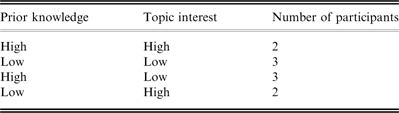
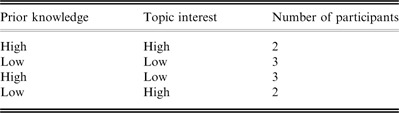
Semi-structured interviews with ten volunteering participants (see Table 1) were conducted immediately after they completed the reading task. The participants were asked to report on their reading experience. More specifically, they were asked what factors affected their selection of links and annotations, the characteristics of hypermedia reading that they found most striking, and whether they experienced any problems with navigation.
Distribution of the participants interviewed based on the categories of prior knowledge and topic interest
3 Results
3.1 Topic interest, prior knowledge and text recall
Spearman rank-order correlation between raw topic interest and prior knowledge scores was computed in order to determine whether they shared any variance. A nonsignificant correlation (r = .18, p > .05) was obtained indicating a weak relationship between the two variables. In other words, topic interest and prior knowledge do not seem to be related in reading a hypermedia text in the L2.
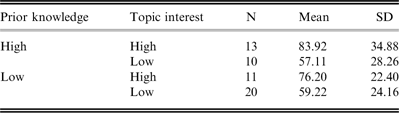
In order to examine the recall scores in relation to topic interest and prior knowledge, descriptive statistics were obtained for the categories of topic interest and prior knowledge (see Table 2).
Descriptive statistics for recall scores based on topic interest and prior knowledge
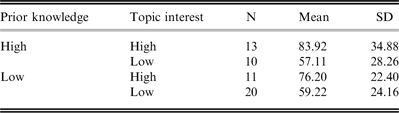
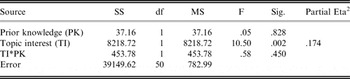
Table 2 indicates that the participants with high prior knowledge and high topic interest recalled the highest number of propositions followed by those with low prior knowledge and high topic interest. Low prior knowledge, low topic interest participants and high prior knowledge, low topic interest participants showed the worst performance. In other words, performance seems to be facilitated when topic interest is high. In order to determine whether topic interest and prior knowledge had independent or interactive effects on the number of propositions recalled, a 2 × 2 between groups ANOVA was conducted (see Table 3). The homogeneity of variance assumption of the ANOVA was sustained.
ANOVA summary table
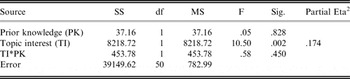
The ANOVA results indicate a significant main effect for topic interest. The main effect of prior knowledge and the interaction between topic interest and prior knowledge are nonsignificant. The nonsignificant interaction suggests that these variables have independent effects on text recall. However, only the main effect of topic interest is statistically significant. In other words, participants with high topic interest recalled a significantly higher number of propositions than those with low topic interest, while the difference between high prior knowledge and low prior knowledge participants in terms of the number of propositions recalled is negligible. The partial eta squared statistic indicates that topic interest explains 17 percent variability in text recall.
3.2 Topic interest, prior knowledge, and annotation use
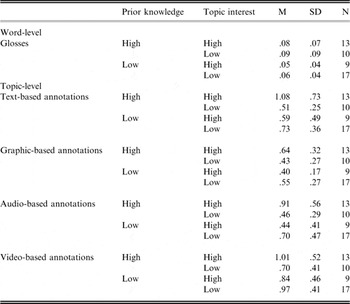
The participants’ use of annotations while reading the text was determined by the ratio of the number of times they clicked on a particular annotation to the total number of times that annotation appeared in the text. Descriptive statistics indicate that, in general, the participants preferred annotations providing extra information about the topic to glosses providing definitions of words. More specifically, they used video-based (M = .88, SD = .46) and text-based (M = .73, SD = .53) annotations more frequently than audio-based (M = .65, SD = .48) and graphic-based (M = .52, SD = .28) annotations. Glosses that provided definitions of words were used the least frequently (M = .07, SD = .06). Table 4 provides the descriptive statistics for frequency of access to each type of annotation according to prior knowledge and topic interest.
Descriptive statistics for the frequency of access to annotations

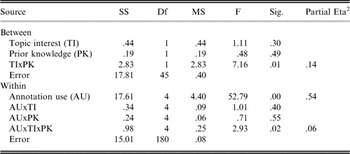
Table 4 shows that high prior knowledge and high topic interest participants diverge from the other participants with their frequent use of text-based and video-based annotations providing extra information about the topic. There do not seem to be clear-cut differences among the groups in the use of other types of annotations. In order to determine whether prior knowledge and topic interest have independent or interactive effects on the use of annotations, a 2 × 2 × 5 mixed ANOVA was conducted (see Table 5). The assumptions of homogeneity of variance and the homogeneity of covariance matrices were sustained. Since the sphericity assumption was not sustained, the F values were evaluated using Greenhouse-Geisser correction.
ANOVA summary table

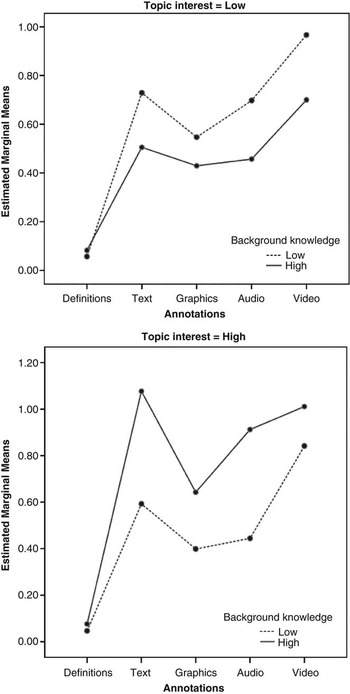
ANOVA results revealed a significant triple interaction. The interaction between topic interest and prior knowledge and the main effect of frequency of access to annotations are also significant. However, these effects are not interpreted due to the significant triple interaction (see Figure 1). The plots in Figure 1 indicate that when topic interest was low the participants with low prior knowledge accessed topic-level annotations more frequently than those with high prior knowledge. On the other hand, when topic interest was high, participants with high prior knowledge consistently accessed topic-level annotations more frequently than those with low prior knowledge.
Plots illustrating the interaction among prior knowledge, topic interest, and text recall

3.3 Insights from the interviews
The quantitative results suggest that topic interest is a more important factor related to comprehension in a hypermedia environment than prior knowledge. The significance of topic interest is also evident in data obtained from the semi-structured interviews. The participants with high topic interest stated that their selection of links and annotations was determined by their interest in the topic as can be illustrated with the following remark, “I followed all of the links because I was curious about the topic. To me anything that is scientific is interesting.” The remarks of the participants with low topic interest clearly demonstrated their lack of interest in the topic. One of them said that the text “wasn’t interesting” while another indicated that he read the text hoping that he would find “something interesting” but he didn’t. When the participants were asked what struck them most about their reading experience, three participants with high topic interest emphasized the content of the text. For instance, one participant said, “… dark matter … also black holes … I was able to visualize black holes after reading the text”. On the other hand, four participants with low topic interest commented on the design of the hypermedia document such as types of media and navigation tools, as illustrated by the following comments: “I liked the movies and pictures”, “The buttons allowed to go back and forth … I also liked the links to movies, sound, and pictures”, “I liked the map. I could easily see the links between the pages”.
As for the participants’ use of annotations, the quantitative findings indicated that low topic interest participants with low prior knowledge used the topic-level annotations more frequently than those with high prior knowledge. The three interviews conducted with such participants revealed that their use of annotations was rather fragmented. They jumped from one type of annotation to another without trying to establish connections among them. For instance, one participant said, “I first looked at the movies, then graphics, then sound, and finally the text. I used all types of annotations. Each had a different function.” On the other hand, the participants with low topic interest but high prior knowledge indicated they used the annotations when they felt it was necessary to understand a concept. For instance, one participant said, “The annotations were useful in making concepts more concrete. It was important for me to understand the text. So I used the word-level annotations while reading the text. If I don’t understand the words, I loose my motivation to read the text. The topic-level annotations were useful as visual supports to the text”.
The quantitative findings also indicated that high topic interest and high prior knowledge participants accessed topic-level annotations more frequently than those with high topic interest but low prior knowledge. In the interviews, the two participants with high prior knowledge and high topic interest indicated that their knowledge in the topic triggered their use of topic-level annotations, as can be seen in the following remark, “All of the annotations were useful. I knew about Stephen Hawking before but I wanted to see his picture. When I saw his picture I said ‘Oh, this is the guy’ ”.
4 Discussion
The quantitative findings confirm the first research hypothesis that topic interest and prior knowledge are two independent variables with a weak relationship. Although the current study focuses on reading a hypermedia text in the L2, this finding corroborates the findings of Baldwin et al. (Reference Baldwin, Peleg-Bruckner and McClintock1985) conducted in the L1 and Carrell and Wise (Reference Carrell and Wise1998) conducted in the L2, both of which involved reading print texts. These findings are contrary to the commonsense idea that readers’ interest would increase as they get more knowledgeable about a topic. Carrell and Wise, adopting Baldwin et al.’s argument to explain the lack of relationship between these variables, suggest that students in academic settings have a fair amount of knowledge about topics in which they have little interest. Therefore, the two variables do not necessarrily correlate in such settings. Since the students in the current study are also English for Academic Purposes (EAP) students, this explanation may be applicable for this finding as well.
As for the effects of prior knowledge and topic interest on text recall, descriptive statistics indicate that recall is facilitated most when both topic interest and prior knowledge are high and it suffers when both are low. These findings are similar to Carrell and Wise’s findings. However, the interaction of these variables is nonsignificant in the current study and it only approached significance in Carrell and Wise’s study. The findings of the current study show that topic interest has a facilitative effect with a significant main effect while prior knowledge seems to have no effect on recall. Thus, the second research hypothesis which predicted additive effects of topic interest and prior knowledge on text recall was partially confirmed. The significant effect of topic interest corroborates the findings of other studies conducted with L2 readers (Bügel & Buunk, Reference Bügel and Buunk1996; LeLoup, Reference Leloup1993 cited in Carrell and Wise). The nonsignificant effect of prior knowledge is consistent with Hammadou (Reference Hammadou1991) who found that participants’ topic familiarity ratings were uncorrelated to L2 reading comprehension and with Lawless et al. (Reference Lawless, Brown, Mills and Mayall2003) who found no effect of prior knowledge on the text recall of university students engaged in reading a hypertext document. Yet a large body of research supports the facilitative effects of existing prior knowledge, as discussed in the literature review above. Hammadou explains her finding by suggesting that asking participants to indicate their familiarity with a certain topic is a problematic measure of topic familiarity. Lawless et al., on the other hand, argue that their findings cannot be attributed to poor scale construction as the psychometric properties of the instrument yielded reliable and valid scores. There may be two different explanations for the nonsignificant effect of prior knowledge in the current study. First, the variability among the participants of the current study in terms of their prior knowledge may be limited. In other words, the participants were quite homogeneous in terms of their educational background. A more heterogeneous group in terms of topic knowledge may be necessary to detect the effect of prior knowledge. Another possible explanation may come from the fact that the reading task took place in a hypermedia environment where annotations provided extra information about the topic, which may have reduced the differences between high and low prior knowledge participants. In other words, low prior knowledge participants might have compensated for the lack of topic knowledge by using annotations that provided extra topical information, as research with L1 readers has indicated that low knowledge learners benefit more from a multimedia presentation than high knowledge learners (Hillinger & Leu, Reference Hillinger and Leu1994; Mayer, Reference Mayer1997).
As for the effects of prior knowledge and topic interest on annotation use, the third hypothesis that predicted an interaction was confirmed. When topic interest is low the participants with low prior knowledge accessed topic-level annotations more frequently than those with high prior knowledge. On the other hand, when topic interest is high, the participants with high prior knowledge consistently accessed topic-level annotations more frequently than those with low prior knowledge. High knowledge high interest participants may be considered knowledge seekers with strong interest in the topic. The two interviews with high prior knowledge and high topic interest participants after the reading task suggest that the more these participants knew about the content, the more they were interested in the annotations. A surprising finding is the frequent use of content-related annotations by low interest low knowledge participants. For these readers, lack of prior knowledge seems to have played an important role in their use of annotations. According to Lawless and Kulikowich (Reference Lawless and Kulikowich1998), these individuals need to select pages that contain information directly related to the reading task and disregard pages that are unrelated so that they can form connections between disparate schemata. Interviews after the reading task indicated that these participants used the annotations in order to learn more about the topic. However, they used annotations in a fragmented manner, jumping from one annotation to another rather than trying to establish coherent connections between the text and the annotations.
5 Conclusion
Little empirical research exists to help us understand the L2 reading process in hypermedia environments. Such environments are rich in input and can facilitate L2 reading process through resources such as multimedia glosses and annotations. The findings of the current study indicate that prior knowledge and topic interest are important factors that affect learners’ use of such text resources. In other words, learners can compensate for their lack of prior knowledge by using annotations, which may, in turn, increase their interest in the topic.
Findings also indicate that topic interest is a more important factor than prior knowledge in facilitating text recall in this environment. In other words, interest determines the choice of annotations which, in turn, affects text recall. The finding that prior knowledge is not a factor affecting recall may suggest that low knowledge learners may catch up with high knowledge learners by using annotations that provide extra background information.
This study has several limitations. First, the participants are proficient learners of academic English. Topic interest and prior knowledge may play different roles when examined in relation to different proficiency levels. Second, the data were collected when the participants were engaged in reading a hypermedia text on a single topic. Since hypermedia documents provide large amounts of input, it would in practice be impossible to engage participants in reading more than one text. Therefore, the findings should be verified with different texts. Third, other factors related to individual differences such as computer literacy, working memory capacity, or cognitive styles may mediate the effects of the factors on reading comprehension. Fourth, the results may be attributed to the hierarchical design of the hypertext. Replication of the study with different hypertext structures is necessary. Finally, further qualitative data investigating participants’ use of annotations in relation to their prior knowledge and topic interest, as well as the design of the hypermedia text and the nature of the information provided via the annotations, would provide a deeper understanding of the phenomena. Conducting interviews after the tracker data is analyzed could allow deeper probing into the reading process.
Acknowledgements
This study was supported by a grant (02HD603) from the Bogaziçi University Research Fund. The author would like to thank the two anonymous reviewers for their insightful comments on an earlier version of this article.