1 Introduction
Book-based dictionaries have been useful resources for language learners to identify the meaning of unknown words. However, as technology continues to evolve, the popularity, variety, and accessibility of modern dictionaries have increased; this is particularly true for electronic and on-line dictionaries. For instance, with just a few mouse-clicks, using Internet websites such as dictionary.com and learnersdictionary.com, users can quickly look up the meaning of an unknown word. In addition, the platforms on which on-line dictionaries can be accessed have also changed dramatically. The introduction of the Amazon Kindle e-book reader in 2007 and the Apple iPad tablet computer in 2010 are just two examples of mobile devices that allow language learners to quickly select an unfamiliar word in a digital book or periodical and rapidly access its meaning from more than one dictionary virtually anywhere and at any time. However, because the advances in technology have changed the dynamic in which words can be accessed, it would be specious to assume that the research findings of previous studies involving traditional book-based dictionaries apply to the use of modern electronic resources. Therefore, a number of issues need to be addressed regarding how the different functions of modern devices can assist in foreign-language vocabulary learning.
2 Background research
The first issue addressed in this study concerns how different look-up conditions with an on-line dictionary affect the retention of word forms. Previous researchers examining the use of on-line dictionaries did not require participants to spell or type words completely into an on-line dictionary. Rather, they had participants either partially type the spelling of a word (Knight, Reference Knight1994) or choose from a list of annotations (Chun & Plass, Reference Chun and Plass1996). Also, Al-Shehri and Gitsaki (Reference Al-Shehri and Gitsaki2010) and Alharbi (Reference Alharbi2016) found that learners who read a passage on a computer with access to an on-line dictionary performed better on vocabulary tests compared to those who did not use a dictionary. However, to date, there has been no direct comparison of the retention of unknown word forms between (a) mouse-clicking on unknown words linked to an on-line dictionary, and (b) typing the spelling of unknown words into an on-line dictionary when learners transfer their attention away from a reading passage.
The second issue addressed in this study concerns how different look-up conditions impact the retention of word meanings. Previous researchers, for example, demonstrated that there are different effects on the retention of word meanings when learners access different resources, such as traditional book-based dictionaries compared to marginal glosses (Cho & Krashen, Reference Cho and Krashen1994; Hulstijn, Hollander & Greidanus, Reference Hulstijn, Hollander and Greidanus1996). However, studies comparing on-line to paper or book-based to electronic or on-line dictionaries have provided mixed results. Chen (Reference Chen2012) and Dziemianko (Reference Dziemianko2011, Reference Dziemianko2012) did not find significant differences for vocabulary learning between the two types of dictionaries, but Dziemianko (Reference Dziemianko2010, Reference Dziemianko2017) found on-line dictionaries were better for the learning of nouns, phrases, and collocations compared to book-based dictionaries. With regard to on-line dictionaries themselves, Liu and Lin (Reference Liu and Lin2011) and Alharbi (Reference Alharbi2016) found that learners acquired the meanings of words more quickly when accessed through a pop-up dictionary as opposed to a type-in dictionary. However, in these studies the participants were permitted to read the unknown words in the context of a sentence next to their definitions in a dictionary simultaneously. Al-Shehri and Gitsaki (Reference Al-Shehri and Gitsaki2010) found that learners using either an integrated or split-attention format who had access to an on-line dictionary performed better on vocabulary tests compared to those who were not afforded dictionary access. Yet, in this study, the participants were only required to mouse-click on unknown words to access their meanings. Thus far, past studies have indicated that different resources can foster different levels of retention. However, the direct comparison of transferring attention away from a reading passage and (a) mouse-clicking on unknown words linked to an on-line dictionary, to (b) typing the spelling of unknown words into an on-line dictionary for the retention of unknown word meanings is in need of exploration.
The third issue addressed in this study concerns how different look-up conditions using an on-line dictionary impact the comprehension of a reading passage. Some studies suggest that learners have greater passage comprehension when they use an on-line or book dictionary compared to not using a dictionary (Chun, Reference Chun2001; Goyette, Reference Goyette1997; Knight, Reference Knight1994); other studies suggest that there is no significant difference for passage comprehension when different types of dictionaries are used (Aust, Kelly & Roby, Reference Aust, Kelly and Roby1993; Liu & Lin, Reference Liu and Lin2011; Prichard & Matsumoto, Reference Prichard and Matsumoto2011). Although Alharbi (Reference Alharbi2016) found that the passage comprehension for participants who used a pop-up dictionary was higher than for participants who used a type-in dictionary, book dictionary, or no dictionary, in this study participants were permitted to simultaneously view the definitions of unknown words while they read. However, like looking up an unknown word in a book dictionary while reading, there has not been a study that compares the effects on comprehension when learners completely transfer their attention away from a passage to access unknown words by mouse-clicking to an on-line dictionary versus mouse-clicking and then completely typing the form of an unknown word into an on-line dictionary.
3 Purposes of the study
The primary purpose of this study was to compare the effectiveness of learning vocabulary and understanding passage content using on-line dictionaries when learners’ attention is transferred away from a reading passage in three conditions for reading and understanding a word: (a) from only the context of a passage (control); (b) by mouse-clicking on unknown words linked to an on-line dictionary (click); or (c) by spelling the form of an unknown word into an on-line dictionary search box using a computer keyboard (spell). Therefore, the three conditions for this study were as follows:
-
∙ Control treatment (control): reading only.
-
∙ Experimental treatment 1 (click): reading+second language (L2) (English) definition of an unknown word using a mouse-click that transfers the user to the corresponding entry in an on-line dictionary.
-
∙ Experimental treatment 2 (spell): reading+L2 (English) definition of an unknown word using a mouse-click transfer to an on-line dictionary+typing the form of the word into the word search box of an on-line dictionary.
For this study, reading+no definition of unknown words (control) does not require the learners to leave the reading passage. However, both mouse-clicking (click) on an unknown word and typing in (spell) the form of an unknown word require learners to transfer away from a reading passage temporarily in order to access word meanings in an on-line dictionary. Therefore, the research questions for this study were as follows:
-
1. To what extent do the control, click, and spell conditions differ in their effect on learners’ attempts to recognize and recall the forms of recently encountered new words?
-
2. To what extent do the control, click, and spell conditions differ in their effect on learners’ attempts to recognize and recall the meanings of recently encountered new words?
-
3. To what extent do the control, click, and spell conditions differ in their effect on learners’ comprehension of a reading passage?
4 Theories of processing
4.1 Type of processing-resource allocation (TOPRA)
Type of processing-resource allocation (TOPRA) (Barcroft, Reference Barcroft2000, Reference Barcroft2002, Reference Barcroft2003, Reference Barcroft2004) can be used to explain the processing of word forms and meanings. This model proposes an inverse relationship between the formal and semantic components for processing and learning word forms and meanings, respectively. The model states that if the processing demands of a form-related task to learn word spellings are high, the formal learning for that particular word will be high. This consequently decreases the learning of the semantic properties of the word. Conversely, if the processing demands of a semantic task to learn the meaning of a word are high, the semantic learning for that word will also be high. This consequently decreases the learning for the formal properties of the word.
4.2 Cognitive load theory (CLT)
Cognitive load theory (CLT) (Sweller, Reference Sweller1988) is relevant to explain how both learning vocabulary and understanding a reading passage can be influenced by the manner in which tasks are designed. Specifically, CLT hypothesizes that three types of cognitive load determine how information is learned. Intrinsic cognitive load refers to the idea that all instruction has an inherent difficulty associated with it. Extraneous cognitive load refers to how information is presented to learners. Germane cognitive load refers to the mental effort learners devote to learning new material in order for efficient learning to occur. CLT claims that how well learners process new information depends on the manner in which the three cognitive loads of an activity are coordinated (Sweller, van Merrienboer & Paas, Reference Sweller, van Merrienboer and Paas1998).
5 Methodology
5.1 Participants
The participants in the on-line dictionary study were three cohorts of 28 first-year Japanese medical students (N=84). Before entering the medical university, all participants had at least six years of formal English instruction at their respective junior and senior high schools. The participants had an average score of 511 on a 30-minute computerized abridged TOEIC test measuring listening and reading comprehension; this corresponds approximately to a low B1 on the CEFR, or lower-intermediate level.
5.2 Target word criteria
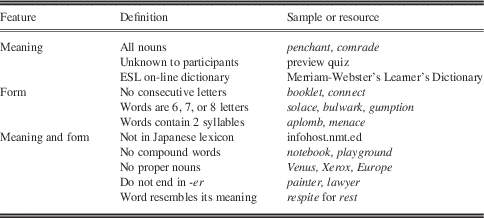
In order to accurately assess retention, several criteria were applied for selecting target words on the basis of meaning, form, and both meaning and form. Table 1 lists the criteria for selecting the target words.
Target word criteria

5.3 Vocabulary preview quiz
To determine whether the participants had previous knowledge of the target words, a 10-minute vocabulary preview quiz was administered on the first day of class. It comprised of 56 English words, with 32 distracters alongside the 24 words used in the study. A large number of items were chosen to prevent the participants from learning words that would be used in the study four weeks later. The participants indicated if they had seen the words or knew their meanings; those who thought they did then wrote the words’ meanings in either English or Japanese. The words that had not been identified in form and meaning were used in this study. An example item from the vocabulary preview quiz is shown in Figure 1.
Vocabulary preview quiz

5.4 On-line dictionary
All target words were linked to the Merriam-Webster’s Learner’s Dictionary (MWLD) whose homepage states that this dictionary is for students of English as a second or foreign language (ESL and EFL) as well as those preparing for the TOEIC test, and the website’s design characteristics were conducive to helping the participants easily access and understand the meanings of unknown words. As a result, 99% of the defining vocabulary of the target words used in this study were high-frequency words.
Links from the target words in the reading passages to their definitions in the MWLD were used for both the click and spell conditions. For the click condition, first, the correct spelling of a target word was typed into the MWLD in order to access its specific URL (e.g. http://learnersdictionary.com/definition/spectrum for the target word spectrum). Second, this address was copied and pasted to the function from the homestead.com webpage creator that enables words to be hyper-linked to the Internet. In this way, clicking on the target word links directly to the word’s meaning in the MWLD. However, for the spell condition, the URL for the MWLD homepage was used instead of the specific entry for the target word. Upon arriving at this page, participants then had to type the correct spelling of the target word into the search window of this dictionary to access a definition.
5.5 Reading passages
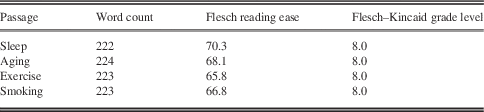
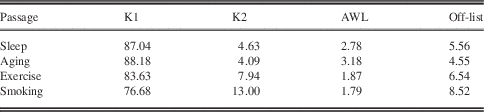
Four reading passages were used in this study. Each reading passage was approximately 220 words with two target words in each of the three paragraphs. Table 2 shows the Flesch Reading Ease Scores and Flesch–Kincaid Grade Level readability statistics for the four passages using Microsoft Word 2010. Table 3 shows the lexical composition of each passage using the “classic” version of the Vocab Profile tool in Cobb’s (Reference Cobb2011) Compleat Lexical Tutor.
Readability statistics for the four reading passages from MS Word 2010

Lexical composition of the four reading passages from Vocab Profile (Classic)

Note. K1=the first 1,000 high-frequency words of English; K2=the second 1,000 high-frequency words of English; AWL=Academic Word List Vocabulary; Off-list=all other items.
6 Procedure
6.1 Computer Language Lab website
The website used in this study was created by the instructor using a program from homestead.com. The title of the homepage was Computer Language Lab with a one-sentence description of the website written below the title. Beneath the title and description were four groups: Group 1, Group 2, Group 3, and Group 4 (see Appendix A). Each group had the titles of five reading passages: Nutrition, Aging, Exercise, Sleep, and Smoking. When mouse-clicked, each title opened a reading passage that replaced the homepage. The passages were exactly the same under each title. Each passage contained two target words highlighted in bold print in each of the three paragraphs for a total of six target words (see Appendix B).
The target words were the same in each respective group but differed in how they were linked to the MWLD. Group 1 functioned as the control condition in which participants read a passage and learned its target words from context without using any tools. Group 3 functioned as the click condition in which participants mouse-clicked on a bold print target word to access its meaning in the MWLD. Group 4 functioned as the spell condition in which participants mouse-clicked and typed the spelling of a target word to access its meaning in the MWLD. (Group 2 functioned as the gloss condition. Although this condition was used in pilot studies, it was not used as a part of this study.)
6.2 Orientation and research design
For the first orientation session, the participants came to the computer lab and were told that they had five minutes to read and comprehend the Sleep passage and learn its six highlighted words. To learn the first two target words in the first paragraph, they were instructed only to read the passage. However, learning the second two target words in the second paragraph of the passage involved two steps. First, they were to read the passage and mouse-click on the items to learn their meanings. This action brought the participants to another website where they could view the definitions of the target word in the on-line MWLD. Second, the participants were shown how to return to the reading passage by double-clicking the left-pointing arrow in the top left corner of the screen. The participants were then shown how to return to the Computer Language Lab homepage from the reading passage by single-clicking on the left-pointing arrow in the top left corner of the screen.
Four steps were needed for the participants to learn the last two target words in the third and final paragraph of the reading passage. First, they were told to read the passage and to click on the highlighted words; this brought them to an empty word search box in the MWLD, where they were to type the word in the on-line dictionary’s word search box. Pressing the Enter key on their keyboard provided the website where they could view the word’s definitions. Finally, the participants were shown how to return to the reading passage by double-clicking the left-pointing arrow at the top left corner of the screen.
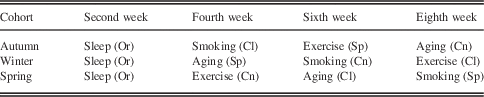
The participants visited the computer lab every other week. For each session they were asked for their consent to participate and then instructed to log onto the website, read the assigned passage, and learn the target words either from context, mouse-clicking, or spelling. After five minutes, they were asked to stop reading and return to the homepage where they were prompted to complete the tasks in their quiz booklets. The procedures for the participants for the autumn, winter, and spring trimesters were exactly the same except that the passages and conditions were randomized in order to examine how the same reading passages fared under different conditions. Table 4 shows the research design that was implemented for three separate cohorts over a 10-week trimester.
Research design

Note. Or=orientation; Cl=click; Sp=spell; Cn=control.
6.3 Quiz booklets and scoring
After five minutes, the participants were told to stop reading, click back to the homepage, and open their quiz booklets. Each booklet contained five quiz types (see Appendix C) that were designed to examine the effects of the different conditions on passage comprehension and the recall of word forms and word meanings. For each quiz, the instructor first read the directions to the participants, told them they had one minute, and cued them to begin. Participants could neither look at the other quizzes in their booklet nor view the reading passage while completing a quiz.
Quiz 1 (comprehension – Comp.) gauged how much information the participants could remember by having them focus on both the target words and passage content. This quiz was made up of two questions from each paragraph for a total of six questions. The participants had to choose the best answer to each question from four options based on the information in the reading passage. Correct responses received a score of 1 point and incorrect responses or no answer received a score of 0 points.
In Quiz 2 (productive form – PF) the participants had to recall and write the spellings or forms of the target words. Pilot tests demonstrated that they wrote very few target words if no prompt was given, so the complete quiz provided the first letter of each target word, which were all different. If participants were able to write the correct spelling of a target word, they received 1 point. However, if they were unable to write the complete spelling of a target word or if they did not provide any letters for a word, they received 0 points.
Quiz 3 (receptive form – RF) was a receptive test in which the participants had to choose the correct English spelling of a target word in the reading passage from one of four possible options. Of the four spellings displayed for a target word, one was the correct spelling, one contained an incorrect letter, one contained two interchanged letters, and one contained an incorrect letter and two interchanged letters. Correct responses received a score of 1 point and incorrect responses or no answer received a score of 0 points.
Quiz 4 (productive meaning – PM) was a meaning-focused quiz in which the participants had to write, in either English or Japanese, a brief definition or synonym of the target word from the reading passage. Two professors who are native speakers of English scored the responses written in English, while two professors who are native speakers of Japanese scored those responses written in Japanese. Correct responses received a score of 1 point and incorrect responses or no answer received 0 points. Cohen’s kappa coefficient was used to verify overall reliability. There was a high level of internal consistency as determined by a Cronbach’s alpha of 0.825, and thus no further steps were needed.
Quiz 5 (receptive meaning – RM) was a meaning-focused receptive quiz that required the participants to identify the correct meaning of each of the six target words from four possible choices. One choice was the correct definition of the target word, one choice was the definition of another highlighted word taken from the same paragraph as the target word, one choice was another highlighted word taken from another paragraph, and one choice was an incorrect definition related to the content of the paragraph. Correct responses received a score of 1 point and incorrect responses or no answer received a score of 0 points.
7 Results
Although rating the three passages through the three treatment conditions controlled for differences in passage-item difficulty, a possible cohort effect might have been created. In addition, because each participant read one passage under only one of the three treatment conditions, arranging the data into SPSS would result in a data matrix with two thirds of the data missing and a need to impute values for the missing cells. For this reason, a Rasch analysis was used.
Rasch analysis handles missing data easily and requires no imputing. By anchoring various facets to zero in sequential analyses, it was possible to determine whether cohort ability and passage difficulty were measurably different, to treat quiz type and treatment condition by anchoring them to zero, and to examine whether the treatment condition “biased” the performance on the five quiz types, the primary area of interest for the three research questions in this study. Therefore, the bias interaction output from the Rasch analysis with attendant t-values was used to judge the statistical differences between quiz type and treatment condition interactions for research questions 1, 2, and 3.
7.1 Comprehension, form, and meaning quizzes
The initial analysis indicated that the three cohorts were not measurably different, and therefore the cohorts were anchored to zero. However, to determine whether the control, click, or spell conditions differentially affected performance on the five quiz types, the analysis was run again with quiz type and treatment condition anchored to zero. The zero setting prevented the quiz and treatment from affecting the estimates of the other four facets: student ability, cohort ability, passage difficulty, and item difficulty. The degree to which a quiz and condition impacted performance can be seen in Figure 2, with the bias interaction expressed in t-values.
Interaction of look-up conditions with quizzes

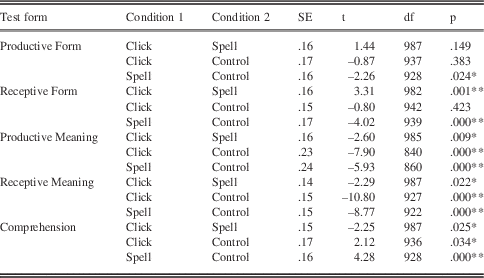
The bias interaction pairwise report table for condition and quiz was used to examine t-values and probabilities. Probabilities of p<.05 were considered measurably different in the context of this particular sample. To control for inflated Type II error because of multiple statistical comparisons (3 conditions x 5 quizzes=15), a Bonferroni adjustment was applied. As a result, comparisons at p<.003 (.05 ÷ 15=.003) were considered statistically significant and generalizable to a larger population. Table 5 shows the comparisons of the conditions with each quiz.
Bias interaction pairwise report for condition and quiz

Note. *=measurably different p<.05 in the context of this study. **=statistically significant p<.003.
7.2 Research question 1: Look-up conditions and learning word forms
To what extent do the control, click, and spell conditions differ in their effect on learners’ attempts to recognize and recall the forms of recently encountered new words?
First, the effects were neither measurably different nor statistically significant between the click and spell (p=.149) conditions for the PF quiz. Second, the effects between the click and spell conditions (p=.001) were statistically significant for the RF quiz (p=.000) and, in the context of this study, measurably different between the spell and control conditions (p=.024) for the PF quiz. Third, the effects were neither statistically significant nor measurably different between the click and control for either the PF quiz (p=.383) or for the RF quiz (p=.423).
7.3 Research question 2: Look-up conditions and learning word meanings
To what extent do the control, click, and spell conditions differ in their effect on learners’ attempts to recognize and recall the meanings of recently encountered new words?
Although the effects between the click and spell conditions were measurably different for both the PM quiz (p=.009) and the RM quiz (p=.022), they were not statistically significant. Second, the effects between the click and control conditions were statistically significant for both the PM quiz (p=.000) and RM quiz (p=.000). Third, the effects between the spell and control conditions were statistically significant for both the PM quiz (p=.000) and the RM quiz (p=.000).
7.4 Research question 3: Look-up conditions and passage comprehension
To what extent do the control, click, and spell conditions differ in their effect on learners’ comprehension of a reading passage?
Although the click and control conditions produced measurably different results, they were not statistically significant (p=.034). However, the effects between the spell and control conditions (p=.000) were statistically significant. Finally, although the effects between the click and spell conditions were measurably different, they were not statistically significant (p=.025).
8 Discussion
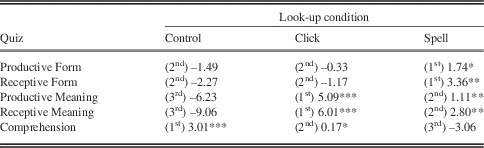
Quiz results from using the Rasch analysis bias interaction report make it possible to compare and rank the three learning conditions if both statistically significant and measurably different t-values are considered. For example, with regard to the form-based quizzes, the spell condition had t-values that were measurably higher than the control condition for the PF quiz and significantly higher than both the click and control conditions for the RF quiz. However, the results from the click and control conditions were not measurably different from one another on either type of quiz. With regard to the meaning-based quizzes, the click condition had t-values that were measurably higher than the spell condition and significantly higher than the control condition. This was followed by the t-values from the spell condition, which were significantly higher than the control condition. With regard to the comprehension quiz, the control condition had t-values that were measurably higher than the click condition and significantly higher than the spell condition. This was followed by t-values from the click condition, which were measurably higher than the spell condition. Table 6 shows the ranking of statistically significant and measurably different t-values.
Ranking of statistically significant and measurably different t-values

Note. *=Measurably different to the condition with the lowest t-value. **=Statistically significant to condition(s) with lower t-values. ***=Measurably different to the next condition with a lower t-value and statistically significant to the condition with the lowest t-value.
Information from the TOPRA model and CLT help explain the results of using different conditions to learn word forms and meanings and comprehend reading passages. First, with regard to the retention of word forms, the TOPRA model states that if the processing demands of word forms are high, learning the form of that word will also be high. In this study, the effects of the spell condition were measurably higher than the control condition for the PF quiz, and significantly higher than both the click and control conditions for the RF quiz. Therefore, the action of noting the form of a target word and typing its spelling under the spell condition might require greater processing of a word form compared to the other two conditions. As a result, clicking on a target word to access its meaning in an on-line dictionary does not result in substantially better retention of word forms compared to simply reading a target word in a passage.
The results from this study build upon previous examinations of methods of producing words and their effects on the retention of word forms. For example, in a study that involved both disabled and non-disabled primary school students, Cunningham and Stanovich (Reference Cunningham and Stanovich1990) examined the conditions of handwriting, sorting letter titles, and typing on a computer and found that handwriting was more effective for spelling acquisition. In a replication of this study, Vaughn, Schumm and Gordon (Reference Vaughn, Schumm and Gordon1992) found that handwriting was not superior to the other two conditions for learning the spellings of words for either group. Other studies from Longcamp, Zerbato-Poudou and Velay (Reference Longcamp, Zerbato-Poudou and Velay2005), which involved L1 preschool children, and Longcamp, Boucard, Gilhodes and Velay (Reference Longcamp, Boucard, Gilhodes and Velay2006), which involved adults, found that writing words by hand was superior to typing words on a keyboard. In addition, Koyama and Taguchi (Reference Koyama and Takeuchi2003) found that there was no significant difference for the retention of word forms between typing the spellings of words in an electronic dictionary versus looking them up in a printed dictionary. The results from this study suggest that, when looking up words in an on-line dictionary, typing the form of a word might be superior for the retention of word forms compared to clicking on a word or simply reading it in context.
Second, with regard to the retention of word meanings, the TOPRA model states that if the processing demand of a semantic task to learn a new word is high, the semantic learning for that word will also be high. However, if the processing demand of word forms is high, the semantic properties will be low. Therefore, the reason why the scores from the click and spell conditions were both significantly higher than those of the control condition might be because both conditions allowed for more semantic processing of target words than the control condition. For example, the click and the spell conditions afforded participants the possibility of learning the target words both from definitions in an on-line dictionary and from the context of the reading passage. The participants in the control condition, however, were only afforded the opportunity to learn the target words from the context of the reading passage.
The present results reinforce those of previous studies that have examined similar dictionary look-up conditions to learn the meanings of new words. For instance, Knight (Reference Knight1994) showed that participants who partially typed words into a computer dictionary learned more words than participants who only read and learned words from a reading passage. Similarly, this study showed that participants who typed the form of a word into an on-line dictionary in the spell condition learned the meanings of more words than the participants who only read target words from context in the control condition. In addition, Liu and Lin (Reference Liu and Lin2011) and Alharbi (Reference Alharbi2016) found that participants who used a pop-up dictionary learned more words than participants who used a type-in dictionary. Likewise, this study revealed that the participants who accessed words to learn their meanings under the click condition had scores that were measurably higher to those participants who typed the form of a word into an on-line dictionary under the spell condition.
Third, with regard to passage comprehension, CLT states that how well information is learned can depend on the manner in which the three cognitive loads of an activity are coordinated. Specifically, the combination of the intrinsic cognitive load (i.e. the inherent difficulty of a task), the extraneous cognitive load (i.e. how information is presented to learners), and the germane cognitive load (i.e. the mental effort learners devote toward learning new material) affects the quality of learning. In this study, the various cognitive loads might have caused the scores to vary among the three conditions.
The participants in the control condition might have scored highest among the three conditions for reading comprehension because they were assigned the lowest cumulative cognitive load. For example, they were subjected to the intrinsic load of reading and learning information presented in the reading passage (1 intrinsic), the extraneous load or presentation of information on one page (1 extraneous), and the germane load or mental effort to process and understand the meanings of the unknown words and the passage content from the reading passage itself (1 germane). Therefore, the cumulative cognitive load score for this condition was 3 (1 intrinsic+1 extraneous+1 germane).
The participants in the click condition were subjected to a higher cumulative cognitive load than those in the control condition. Like the participants in the control condition, these participants were subjected to the same intrinsic load of understanding passage content (1 intrinsic); however, because the information was presented in both the reading passage and the on-line dictionary, the extraneous load was higher (2 extraneous). In addition, the germane load to process and understand the meanings of unknown words and understand the passage involved a two-step process: reading the passage and recalling the meanings of the newly learned words in order to apply them and understand the reading passage (2 germane). Consequently, the cumulative cognitive load score for this condition was 5 (1 intrinsic+2 extraneous+2 germane).
The spell condition had the highest cumulative cognitive load of the three conditions. Like the control and click conditions, the intrinsic load of understanding the content of the passage was 1 (1 intrinsic). In addition, the extraneous load of information, like that of the click condition, was presented in both the reading passage and in the on-line dictionary (2 extraneous). However, unlike the click condition, the germane load or mental effort to learn the unknown words in the reading passage involved three steps: (a) reading the passage, (b) noting the form of the target word in order to type and spell it correctly into the on-line dictionary, and (c) recalling the meanings of the newly learned words to apply them in a context in order to understand the reading passage (3 germane). Therefore, the cumulative cognitive load score for this condition was 6 (1 intrinsic+2 extraneous+3 germane).
The results of this study are somewhat contrary to previous studies that have examined similar dictionary look-up conditions to comprehend reading passages. For instance, with regard to the use of an on-line dictionary versus not using a dictionary, Goyette (Reference Goyette1997) found that participants who accessed the stems of words in an on-line dictionary had higher comprehension compared to participants who did not use a dictionary. In addition, Prichard and Matsumoto (Reference Prichard and Matsumoto2011) and Alharbi (Reference Alharbi2016) found that participants who clicked on unknown words to access meanings had higher comprehension scores than participants who read a passage without a dictionary. However, the present study revealed that the participants who did not access a dictionary under the control condition had scores that were measurably higher to those participants who accessed an on-line dictionary under the click condition. With regard to more active look-up methods, Knight (Reference Knight1994) found that participants who partially spelled new words in a computer dictionary had higher comprehension compared to participants who did not use a dictionary. However, in the present study, the participants who only read a passage under the control condition had significantly higher comprehension scores than the participants who typed words into the on-line dictionary under the spell condition.
9 Conclusion
The results of this study suggest three implications for learning new words and understanding reading passages while using an on-line dictionary. First, typing the spellings of an unknown word into an on-line dictionary (spell) promotes better retention of word forms compared to only reading unknown words in a passage (control) or mouse-clicking on unknown words linked to an on-line dictionary (click). As a result, when learners need to learn the forms of a small number of unknown words in a reading passage, the condition of typing the spelling into an on-line dictionary might be the ideal learning condition.
Second, mouse-clicking on unknown words linked to an on-line dictionary in a reading passage promotes better retention for word meanings compared to the conditions of only reading a word in a passage or typing its spelling into an on-line dictionary. Therefore, when learners need to learn unknown words in a reading passage, mouse-clicking to an on-line dictionary might be the ideal learning condition.
Third, simply reading a passage seems to promote better comprehension of unknown words than using an on-line dictionary (whether clicking or typing). As a result, if learners need to comprehend a reading passage that has a handful of unknown words, reading only the passage might be the ideal learning condition.
Based on these findings, language instructors should encourage learners to utilize look-up conditions that promote the learning of words and passage content depending on the resources available and the language goal. For instance, when learners use laptop computers to learn new words from a reading passage, if the goal of a learning task is to learn word forms, they should be instructed to type word spellings into an on-line dictionary. Or, if the goal of the learning task is to learn the meanings of words, the learners should be instructed to mouse-click on target words linked to an on-line dictionary. If the learning goal is to learn both the forms and meanings of new words, learners should type the spelling of a target word into an on-line dictionary. If passage comprehension is the goal, learners should be instructed only to read passage content and not use a dictionary. However, if the language goal is to learn word meanings and to comprehend passage content, learners should mouse-click on target words linked to an on-line dictionary as they read the passage.
In addition to these implications, future research might consider a few of the limitations of this study in order to enhance the use of on-line dictionaries for language learning. First, for this study, the data collected were examined shortly after the participants’ computer lab sessions, thus only short-term effects were investigated; other studies exploring the long-term retention of vocabulary through using on-line dictionaries would be useful. Second, the target words used in this study were two-syllable nouns of five to seven letters. In order to determine whether the findings from this study can be generalized to different words, future studies might investigate how words of different parts of speech or words with more syllables and letters affect the learning of word forms, word meanings, and passage comprehension. Third, this study required participants to transfer their attention to an on-line dictionary to look up and learn target words. Recent studies, however, permitted participants to simultaneously view the definitions of unknown target words from an on-line dictionary while reading a passage (Al-Shehri & Gitsaki, Reference Al-Shehri and Gitsaki2010; Liu & Lin, Reference Liu and Lin2011). Therefore, it would be interesting if future studies explored how transferring away from a reading passage to an on-line dictionary compares with simultaneously viewing both a reading passage with definitions from an on-line dictionary. Such a study might yield useful information for both teachers and learners, as technological advances with mobile devices now afford users the convenience of simply touching on a word within a downloaded book or periodical to view its meaning while reading.
Appendix A
Look-up groups and reading passages
Computer Language Lab
Welcome to the Computer Language Lab. This website will give you the opportunity to read passages in English and learn new vocabulary.

Appendix B
Sleep reading passage
Sleep
In today’s busy world, getting plenty of sleep is an important part of the day because it gives people the energy and strength to live and grow. An infant (1), for example, requires a lot of sleep to grow. A teenager needs to have about 10 hours of sleep a night, while an adult requires about seven to eight hours. Therefore, there seems to be a spectrum (1) of hours needed for sleep depending on one’s age.
Not sleeping enough can gradually turn a person’s life into a tumult (2). For example, a person may feel sleepy the next morning if he or she only sleeps two or three hours one night. If a person does not sleep for one night, it may be difficult to think clearly the next day. However, if a person does not sleep for two consecutive nights, he or she can get a migraine (1) or be at risk to have a serious accident.
There are other reasons to get plenty of sleep every night. Sleep keeps the body healthy and prevents a person from getting ill. Also, sleep gives people the energy to share fervor (1) and joy with family and friends. Thus, everybody should get enough sleep and remember the precept (1), “Early to bed and early to rise makes a person healthy, wealthy, and wise.”
Appendix C
Orientation sleep passage quiz booklet
Group Number: ________
Today’s Date: _____________________________
Name: ____________________________________
Student Number: __________________
The following quizzes are for research purposes. Your results will not impact your course grade.
Please check Yes or No below:
I agree to participate in this study: Yes _____ No _____
- -- -- -- -- -- -- -- -- -- -- -- -- -- -- -- -- -- -- -- -- -- -- -- -- -- -- -- -- -- -- -- -- -- -- -- -- -- -- -- -- -- -- -- -- -- -- -- -- -- --
DIRECTIONS:
-
1. Read the passage that you are assigned and, when necessary, look up the target words.
-
2. When you have finished reading, immediately look at the screen in front of the classroom and record your remaining time on the line below.
-
3. Click back to the homepage and wait for further instructions from your instructor.
Example: START TIME: 05:00 Your Start Time: _____
END TIME: 00:50 Your End Time: _____
Do not write down words with your pencil!
Do not talk to another student!
SLEEP: PAGE #3
DIRECTIONS: Read the questions below and circle the letter of the best answer according to the Sleep passage. You have one minute (60 seconds).
DO NOT LOOK BACK AT THE PASSAGE!
-
1. If a person does not sleep for _______, it may be difficult to think clearly the following day.
A. one nightB. two nightsC. three consecutive hoursD. four consecutive hours
-
2. How many hours of sleep do adults need?
A. 6 to 7 B. 7 to 8 C. 8 to 9 D. 9 to 10
-
3. Sleep keeps the body healthy and prevents a person from _______________
A. getting ill B. becoming weak C. becoming angry D. making mistakes
-
4. How many hours of sleep do teenagers need?
A. 8 B. 9 C. 10 D. 11
-
5. Finish the sentence: “Early to bed and early to rise makes a person ___________, wealthy, and wise.”
A. happy B. hardy C. healthy D. holy
-
6. A person may feel sleepy the next morning if he or she only sleeps ____ hours one night.
A. one or two B. two or three C. three or four D. four or five
SLEEP: PAGE #5
DIRECTIONS: Complete the spelling of the bold (dark) English word that you read in the Sleep passage. You have one minute (60 seconds).
-
7. s______________________
-
8. t______________________
-
9. f______________________
-
10. i ______________________
-
11. p______________________
-
12. m______________________
SLEEP: PAGE #7
DIRECTIONS: Choose and write the letter for the correct spelling of the bold (dark) word that you read in the Sleep passage. You have one minute (60 seconds).
1.____
A. migraine B. migreine C. mirgaine D. mirgeine
2._____
A. ifnent B. ifnant C. infant D. infent
3. _____
A. spactrum B. spectrum C. specturm D. spacturm
4. _____
A. tolmot B. tulmut C. tomult D. tumult
5._____
A. fervor B. ferver C. frevor D. frever
6._____
A. percipt B. percept C. precipt D. precept
SLEEP: PAGE #9
DIRECTIONS: Write the meaning of the words below in either English (英語) or Japanese (日本語) according to the Sleep passage and the on-line dictionary. You have one minute (60 seconds).
-
13. precept –
-
14. tumult –
-
15. spectrum –
-
16. migraine –
-
17. fervor –
-
18. infant –
SLEEP: PAGE #11
DIRECTIONS: Write the letter for the EXACT answer that matches the meaning of the bold (dark) word. You have one minute (60 seconds).
1. tumult _____
A. a very serious accident
B. a state of great mental or emotional disorder
C. a very bad headache
D. a rule that says how someone should behave
2. fervor_____
A. the amount of sleep depending on one’s age
B. a rule that says how people should behave
C. a complete range of different opinions, people, etc.
D. a strong feeling of excitement and enthusiasm
3. infant _____
A. a very bad headache
B. a complete range of different opinions, people, etc.
C. a sleeping disorder
D. a very young child
4. precept ____
A. a rule that says how people should behave
B. a strong feeling of excitement and enthusiasm
C. a state of great mental or emotional disorder
D. the amount of sleep depending on one’s age
5. migraine _____
A. a very serious accident
B. a very young child
C. a state of great mental or emotional disorder
D. a very bad headache
6. spectrum ____
A. a very young child
B. a complete range of different opinions, people, etc.
C. a strong feeling of excitement and enthusiasm
D. a sleeping disorder
About the author
Robert Dilenschneider is a tenured lecturer at Jichi Medical University and teaches English to students studying to become medical practitioners. He has taught ESL in Japan for over 20 years and specializes in research involving the use of on-line dictionaries and thesauruses for language teaching and learning.