1 Introduction
A critical issue in educating teachers in computer-assisted language learning (CALL) is the need to design and adapt preparatory CALL courses to facilitate the integration of technology into teachers’ classrooms. Situated learning has been proposed as a potential model to address this need (e.g., Chao, Reference Chao2006; Egbert, Reference Egbert2006; Egbert, Paulus & Nakamichi, Reference Egbert, Paulus and Nakamichi2002; Hanson-Smith, Reference Hanson-Smith2006; Kessler & Plakans, Reference Herrington, Oliver and Reeves2008). Some CALL researchers have described studies operationalizing situated learning mirroring Lave and Wenger's (Reference Hubbard and Levy1991) notion of cognitive apprenticeship whereby newcomers to a community of practice become full-acting members through increased levels of scaffolded participation. While this view of situated learning holds potential for CALL teacher educators, it is now also accepted that situated learning can be applied to activities and projects by mindfully addressing specific environmental characteristics of teacher education classrooms, such as the availability of multiple resources, opportunities for collaboration, and access to expert modeling and feedback (Herrington & Oliver, Reference Egbert, Paulus and Nakamichi2000). Although a few studies have drawn from this definition of situated learning (e.g., Chao, Reference Chao2006; Egbert, Reference Egbert2006; Egbert & Brander, Reference Egbert and Brander2010), these studies discussed or evaluated situated learning from the teacher's perspective only and did not attempt to explicitly link a situated environment with CALL learning for students.
By collecting data from MA TESOL students in a CALL-focused teacher education class in South Korea regarding the situated nature of the course, its activities, and the development of CALL skills, this study attempted to address these shortcomings. Before reporting the results and implications of this exploratory study, the paper begins by reviewing literature related to CALL professional development and situated learning.
2 Relevant literature
2.1 CALL skills, attitudes and integration
A general finding reported in the CALL teacher education literature is that, while formal CALL courses have the power to enhance teachers’ technological literacy skills and attitudes towards CALL, these achievements do not equate to CALL integration in actual classrooms. Peters (Reference Peters2006), for example, found that the technological skills and CALL attitudes of 43 Canadian pre-service teachers increased after taking a one-semester technology course. Importantly, however, the teachers did not feel comfortable about integrating technology into their future classrooms. Hegelheimer et al. (Reference Hegelheimer, Reppert, Broberg, Daisy, Grgurovic, Middlebrooks and Liu2004) reported similar findings. Although they found that the nine graduate students participating in a one-semester course showed improvement regarding attitudes toward CALL and computer skills, only one of the students implemented web-based activities from the course into her classroom. From these findings, Hegelheimer et al. (Reference Hegelheimer, Reppert, Broberg, Daisy, Grgurovic, Middlebrooks and Liu2004) remarked, “even though computer literacy increased, the integration of these skills in the classroom does not happen as rapidly as one could hope” (op. cit.: 441). These studies and others (e.g., Desjardins & Peters, Reference Desjardins and Peters2007; Kessler, Reference Kessler2007), suggest that while teacher-education students might have technological skills and positive attitudes regarding CALL, technology implementation does not automatically result from these abilities.
A study examining the transfer of formally learned CALL skills and knowledge to authentic contexts further supports this point. Among other research foci, Egbert, Paulus and Nakamichi (Reference Egbert, Paulus and Nakamichi2002) attempted to understand how activities covered within previous CALL coursework were implemented into teachers’ current practices. After collecting data from twenty graduate students who had taken the same CALL course within a four-year period, Egbert et al. found that previous CALL familiarity, not coursework, appears to be a better predictor of technology integration. Due in part to the lack of transfer from formal education to classroom practice, the researchers suggested that their findings, “support a shift from isolated coursework in CALL to the development of a sequence of situated technology experiences for teachers” (op. cit.: 122). In accord with Egbert et al. (Reference Egbert, Paulus and Nakamichi2002), others have called for more contextualized or situated CALL teacher education (e.g., Chao, Reference Chao2006; Debski, Reference Debski2006; Egbert, Reference Egbert2006; Hanson-Smith, Reference Hanson-Smith2006; Kessler & Plakans, Reference Hubbard and Levy2008).
2.2 Situated learning and CALL study
Situated cognition (Brown, Collins & Duguid, Reference Brown, Collins and Duguid1989; Lave & Wenger, Reference Hubbard and Levy1991) has been proposed as a model for CALL teacher education because it accounts for the usability of knowledge and skills deriving from instruction. From a situated learning perspective, when instruction separates knowing what and knowing how, the result is inert, unusable knowledge; transferable knowledge, on the other hand, emerges from extended and contextualized authentic activity, where learners are exposed to and participate in ways of thinking and doing that are defined by specific cultures (Brown et al., Reference Brown, Collins and Duguid1989). Lave and Wenger (Reference Hubbard and Levy1991) offered the term legitimate peripheral participation to capture the idea of an apprentice gaining levels of access within a community of practice (CoP) by observing the various roles of expert practice and taking on increasing responsibility for the community's practices. Situated learning has served as a guiding framework in studies of teachers learning CALL. However, situated learning is defined and applied differently across studies. These diverging applications are discussed below in two broad categories: those examining situated learning with regard to actual contexts and those that aim to situate instruction by constructing authentic learning environments.
2.3 Situated learning in “real” contexts
A handful of studies have examined CALL teacher education in connection with practising experts and CoPs. For example, Hanson-Smith (Reference Hanson-Smith2006) discussed the importance of exposing students to expert practices. After highlighting critical features of CoPs, Hanson-Smith described ways in which teachers can acquire CALL-related skills through interacting with already existing, virtual CoPs. Other studies have attempted to pair students with experts in both virtual and face-to-face settings.
Meskill et al. (Reference Meskill, Anthony, Hilliker-VanStrander, Tseng and You2006) reported the findings from a three-year project that aimed at increasing the use of technology in K-8 language classrooms. Three groups of participants - in-service and pre-service teachers, and doctoral students - worked together to facilitate collaborative, expert-novice mentorships. The project required participants to interact with each other throughout different tasks. Data showed that participants increased their positive attitudes toward CALL and confidence in CALL integration. This study illustrates how CALL learning and integration is facilitated through expert-novice interactions in field settings.
Arnold, Ducate, and Lomicka (Reference Arnold, Ducate and Lomicka2007) also examined the benefits of expert assistance and student learning in online environments. Thirty-one pre- and in-service teachers from different universities worked together in synchronous and asynchronous environments, where peer-to-peer and peer-to-expert interactions took place. Arnold et al. Reference Arnold, Ducate and Lomicka2007 found that although many students felt that peer-to-peer discussions were beneficial, students valued peer-to-expert discussions more because the experts could provide better rationales and examples to support their ideas.
The studies reviewed in this section focused primarily on connecting students to practising experts, and the findings illustrate the promise this operationalization of situated learning holds for CALL professional development. However, planning field assignments for teacher-education students is time and resource intensive (Egbert, Reference Egbert2006; Herrington, Oliver & Reeves, Reference Herrington, Oliver and Reeves2003). In academic contexts, situated learning can be applied differently, as noted below.
2.4 Situating learning environments
Situated professional development can be achieved by structuring classroom environments that reflect the cognitive demands of real-life (i.e. out of the classroom) tasks (e.g., Egbert, Reference Egbert2006; Herrington & Oliver, Reference Herrington and Oliver2000; Herrington, Oliver, & Reeves, Reference Herrington, Oliver and Reeves2003). For example, Herrington et al. (Reference Herrington, Oliver and Reeves2003) argued that learning can be promoted without direct access to real-life situations by providing complex tasks that engage students in cognitive realism, or problem solving processes that take place in real-life situations. Studies in CALL teacher education have presented students with projects and problems to facilitate these processes. For instance, Debski (Reference Debski2006) described a project-oriented CALL course. By creating a website for Japanese students coming to an Australian university, graduate students prepared CALL materials for authentic audiences while taking on various roles and receiving peer support. Debski reported that by participating in authentic projects, “the students assumed roles and practiced skills that would not be able to develop in a more traditional class” (op. cit.: 112). This study shows the value of project-based CALL coursework.
Similar to Debski (Reference Debski2006), Chao (Reference Chao2006) explained how she implemented WebQuests (Dodge, Reference Dodge1997) to contextualize CALL training for 42 MA TESOL in-service teachers in Taiwan. Drawing from a situated learning model defined with reference to six scaffolding methods (i.e., modeling, coaching, scaffolding, articulation, reflection, exploration), Chao discussed how she attempted to promote this scaffolding during the course. Chao noted that the teachers responded positively to the course, but also that not many of the teachers used WebQuests in their subsequent teaching. Chao rightly suggested that this lack of integration could be due to factors other than technology ability. However, when considering that the teachers participated in only one project and that their technology skills were not assessed directly, questions remain regarding the lack of integration and levels of technological literacy. Another weakness of this study is that it narrowly defines situated learning (i.e., in terms of six scaffolding methods). As discussed below, other studies have offered more comprehensive frameworks for evaluating situated learning environments.
In two different studies (Egbert, Reference Egbert2006; Egbert & Brander, Reference Egbert and Brander2010), Egbert presents and describes ways for CALL researchers to evaluate situated learning environments. In both studies, Egbert's evaluation tools draw from the work of Herrington and Oliver (Reference Herrington and Oliver2000). Herrington and Oliver extensively reviewed the situated learning literature to identify the critical features of situated learning environments and uncovered nine characteristics:
1) Provide authentic contexts reflecting the ways knowledge will be used in real life
2) Provide authentic activities
3) Provide access to expert performances and the modeling of processes
4) Provide multiple roles and perspectives
5) Support collaborative construction of knowledge
6) Promote reflection so that abstractions can be formed
7) Promote articulation to enable tacit knowledge to be explicit
8) Provide coaching and scaffolding by the teacher at critical times
9) Provide for authentic assessment of learning within the tasks (op. cit.: 26).
Stemming from these features, Herrington and Oliver (Reference Herrington and Oliver2000) offered six questions to evaluate situated learning opportunities:
1) Does it provide authentic context that reflects the way knowledge will be used in real life?
2) Does it provide authentic activities?
3) Does it provide access to expert performances and modeling?
4) Does it provide multiple roles and perspectives?
5) Does it promote collaboration, reflection, and articulation and provide coaching and scaffolding?
6) Does it provide authentic assessment within the tasks?
Using these six questions, Egbert (Reference Egbert2006) evaluated two situated CALL professional development contexts. After evaluating the first context, an online course, Egbert found that although the course met many of the requisite characteristics of situated learning, it did not offer many opportunities for students to revise their products in order to master the development goals. For the second context, a case study activity, Egbert found that the case lacked opportunities for students to observe true expert performances and modeling. This study illustrated how to evaluate situated learning environments beyond the six scaffolding methods identified by Chao, but it did not attempt to link CALL skills development with the quality of the environment.
Egbert and Brander (Reference Egbert and Brander2010) also did not focus on accounting for the specific CALL skills learned by teachers in a situated environment. Rather, in describing how situated learning can serve as an effective teacher-learning framework to develop culturally responsive teachers, the researchers implemented a more developed tool to evaluate situated learning. Egbert and Brander adapted a Situated Learning Tasks Descriptor that includes sub-questions for each of the six main questions used in Egbert (Reference Egbert2006). Using this instrument to evaluate the situatedness of an online teacher education course, the researchers found that the course did not provide opportunities for students to work collaboratively and it did not allow students to revise their work. By demonstrating how contexts can be evaluated in terms of critical situated learning features, Egbert and Brander's study provides an important step towards determining the influence of a situated learning environment on CALL learning.
In sum, the literature suggests that situated learning may be a valuable model to help increase teachers’ technology use in their classrooms. Situated learning has been operationalized in different ways; some draw from situated learning to theorize the contributions of CoPs and interactions in field settings, while others attempt to construct authentic contexts that incorporate critical features of situated learning environments. Egbert and Brander (Reference Egbert and Brander2010) provided a way to evaluate the situated learning opportunities afforded by CALL coursework. However, because one of the major goals of situated learning environments is to reflect the way knowledge will be used in real settings, obtaining the student or pre-service teachers’ perspectives about the environment created is important. This is because they have their own conceptions regarding the practical knowledge they will need in real-life contexts that could make the difference between learning and not learning. This perspective has received little attention in the literature. Additionally, although the studies reviewed here describe how projects and problems were implemented into CALL teacher preparation courses, the question remains whether and how learners develop CALL skills within these contextualized learning environments. In order to begin to address these gaps in the literature, the current study asked two research questions:
1) To what degree do students perceive a CALL course and its activities to be situated?
2) What is the relationship between students’ perceived situatedness of the course and their development of CALL skills?
3 Methods
3.1 Participants
Twenty-one MA TESOL students at a large university in Seoul, South Korea participated in the study. The students were comprised of both non-native English-speakers (18 Koreans - 17 females and one male - and one Pakistani male) and native-English speakers (one American, and one Canadian male). Each semester, students in the TESOL program register for two courses. The participants in this study elected to take the CALL course, which was taught by the researcher. Most students (15) were in their second semester of coursework within the program, although some were in their first (5) or third (1) semester. All participants were teaching English as a foreign language at the time of study in classrooms in public and private elementary, middle, and high schools and at university level. One participant had taught for seven years, and years of teaching experience for the other participants ranged from two to four.
3.2 CALL Course
The 15-week course that participants enrolled in was Multimedia Evaluation and Production. Students met face-to-face once per week in a computer lab for three hours. The course was one of the first CALL classes offered at this university. The aim of the course was to prepare teachers to integrate digital images, audio, and video into their teaching of the four skills (i.e., speaking, writing, reading, listening), grammar, and vocabulary. Therefore, the goal was to meld teaching and technology skills in order to develop a hybrid CALL practitioner-CALL developer (Hubbard & Levy, Reference Hubbard and Levy2006). This dual focus was reflected in the course activities.
3.2.1 Course Activities
The course required students to engage in six main activities that differed in regard to situatedness as measured by Herrington and Oliver's (Reference Herrington and Oliver2000) six questions (see literature review in Section 2 for questions). Overall, the micro-teaching, midterm and final projects, and the workshop activities were more situated than the teaching journal and technology journal activities. In this section, each activity is described briefly, with the main situated learning characteristics facilitated in each activity italicized and noted in parentheses.
3.2.1.1 The first major activity, a bi-weekly teaching journal, completed by students as homework, was comprised of four sub-tasks
First, after reading the course textbook (i.e., Chapelle & Jamieson, Reference Chapelle and Jamieson2008) and a research article about one of the four skills, students identified the key teaching principles outlined in the material (providing access to expert performance). Then, students were prompted to reflect upon their own practices in order to describe the ways they teach that specific skill (promoting reflection; providing authentic contexts). After reflecting upon the book's and their own practices, participants were asked to compare and contrast these two approaches. In the last step, students brainstormed and listed ways to use technology to help teach the specified skill in their own classrooms (providing authentic contexts).
3.2.1.2 In addition to the teaching journal, students were required to complete outside-of-class a three-part technology journal every other week
First, students found a CALL task referred to in the course textbook and evaluated it (providing multiple perspectives). Second, students described how the task met the pedagogical principles for teaching the skill as outlined in the course textbook. Last, participants stated whether they would use this task in their classrooms and justified their statements (providing authentic contexts; promoting articulation).
3.2.1.3 Workshops also took place every other week and consisted of two parts
First, for about 30 to 45 minutes, while explaining choices and rationale aloud, the instructor either created CALL tasks in front of the class or presented to the class a CALL activity that he created for EFL students (providing access to expert performances and modeling). Then, during the second half of the workshops, students selected one or two partners in order to conceptualize and create CALL tasks that reflected the specified language skill of the week and one that they were teaching in their classrooms (supporting collaboration; providing authentic contexts; providing authentic activities). If a student and her partner were not teaching that skill in their classrooms, they were encouraged to create their own contexts. The second portion of the workshop usually lasted about 50 minutes, and instructions generally included the following points: 1) With your partner, select a context and create a CALL task that helps promote X skill; 2) Use the technologies that have been presented in this course or any other technologies that help you meet your goals (providing large number of resources); 3) Ask classmates and the instructor for help (providing coaching and scaffolding). The tasks created during workshops could be developed further and used for the fourth major activity, micro-teaching (providing opportunities for students to revise products).
3.2.1.4 For micro-teaching, students selected one of the four skills, based on the skills they were teaching in their classrooms (providing authentic context), and created a CALL task to teach to a group of classmates (providing authentic activities)
The micro-teaching lasted about 25 minutes and students: 1) described their teaching context; 2) stated the learning objective of the task; 3) carried-out the CALL task; 4) received peer and instructor feedback (providing authentic assessment within the task; providing multiple perspectives); and 5) wrote a reflection based on self and peer evaluations (promoting reflection).
3.2.1.5 Like the third and fourth activities, the fifth and sixth major activities were linked
The midterm project required students to create a CALL task (a task different from the one presented during micro-teaching) and write a paper justifying the task (promoting articulation). Justification for the task came from the course textbook and the assigned research articles. After creating and justifying a task for the midterm project, students were encouraged to try out their tasks in their actual classrooms (providing authentic contexts; providing authentic activities).
3.2.1.6 Therefore, for the final project, students collected data that reflected either their students’ perceptions of the task (e.g., perceived learning, enjoyment) or evaluated the extent to which students met the learning objective (promoting reflection)
Descriptions of the main activities clearly show differences among them in degrees of situatedness. For example, the teaching and technology journals resemble more traditional tasks that separate students from authentic activity and require them to answer pre-determined questions. Therefore, these two activities provide access to expert performance peripherally, through reading texts only. Additionally, there is no scaffolding or coaching offered when completing these two activities, and although students are reflecting about ways they have taught a certain skill in their particular contexts, this reflection is not asking them to reflect upon how they used or attempted to use technology to teach that skill.
The remaining four activities in the course were more situated. The micro-teaching, the midterm and final projects, and the workshop were designed to provide students with authentic contexts reflecting authentic activity that offered opportunities to access expert performances, view products from multiple perspectives, collaborate with peers, revise products, articulate the reasons why they used technology to meet learning goals, and reflect upon their products. The biggest difference between these four activities was the ways in which they were assessed; micro-teaching included peer and self-assessment and a written reflection, as well as a debriefing session with the instructor. Including these various types of authentic assessment helped make the micro-teaching the most situated task in the course. The workshops were not assessed directly, although students could use products from these tasks for other activities, and the midterm and final projects were graded using a general rubric that assessed students in terms of the quality of their writing, rationale for supporting claims, and the relationship between the task created and the learning goals of the task.
3.3 Data collection
This exploratory case study collected both open-ended and numerical qualitative data to describe student experiences within a situated environment and the relationship between that environment and CALL learning. Data collection occurred at three different times throughout the 15-week semester. In Week 1, students completed a pre-course CALL Skills Survey. Then, for the next 13 weeks, students participated in course activities. In Week 14, students completed a post-course CALL Skills Survey. Finally, at the beginning of class in Week 15, participants completed a Perception of Situatedness Questionnaire, and at the end of that same class, answered a Relevant Activities Questionnaire.
3.3.1 Data Sources and Analyses
Three main data sources were used in the study. The first was Egbert and Brander's (Reference Egbert and Brander2010) Situated Learning Task Descriptor. In the current study it is referred to as the Perception of Situatedness Questionnaire (PSQ) to avoid confusion since it was used to tap students’ perceptions regarding the course as a whole, not a single task. Egbert and Brander constructed the 25-statement questionnaire from the main and sub-questions offered by Herrington and Oliver (Reference Herrington and Oliver2000) to evaluate situated learning environments. Each statement asked students to indicate how often the course provided a specific situated learning environment element by selecting one of five options, ranging from Never (0%) to Always (100%).
The PSQ was scored by assigning each of the five response options a corresponding point. For example, a response of Never was given 1 point, and a response of Always was given 5 points. Scores for each of the 25 statements were input into SPSS and served as a data source to answer both research questions. Regarding Research Question 1— To what degree do students perceive the course to be situated? - descriptive statistics for each of the 25 statements were computed in order to show the areas in which learners perceived the course was most strongly and weakly situated. For Research Question 2— What is the relationship between students’ perceived situatedness of the course and their development of CALL skills? - students’ total scores from both the PSQ and the post-course CALL Skills Survey were paired in order to compute a Pearson correlation coefficient.
Like the PSQ, the Relevant Activities Questionnaire (RAQ) was used to answer Research Question 1. However, whereas the PSQ provided data regarding students’ perceptions about the situatedness of the course overall, the RAQ aimed at gathering students’ perceptions concerning the specific activities they found most situated. To achieve this, the RAQ was divided into two parts. The first part prompted students to rank the course's six main activities (e.g., teaching journal, micro-teaching) from most to least relevant. The second part of the RAQ required students to explain their rationale for selecting these most and least relevant activities. The purpose of this task was to identify the characteristics of relevant and less relevant activities.
To analyze the RAQ ranking task, the order in which the activities were ranked was assigned a score. The most relevant activity was assigned a score of 6, and the least relevant activity was assigned a 1. After inputting the scores for each of the six activities into SPSS, the mean for each activity was calculated, with the highest mean score indicating the most relevant activity. Then, by ordering the activities by their mean scores, the researcher could determine the overall relevancy of the tasks.
The second part of the RAQ was open-ended, and student responses were coded by using Bogdan and Biklen (Reference Bogdan and Biklen2006) coding scheme. First, two individual sets of response data were created based upon the mean scores from the first part of the RAQ. One group consisted of student explanations for the three most relevant activities and the second group explanations for the three least relevant activities. Then, each group of data were read for open-coding. Open-coding for both sets of data produced salient themes and initial frameworks that underwent revisions after subsequent rounds of analyses. The final coding framework for the three most relevant activities consisted of four codes (i.e., collaborative assistance; authentic context; authentic task; reflection), while four codes formed the final coding scheme for the three least relevant activities (i.e., insufficient time; lack of assessment; inauthentic context; response structure). Data were coded independently by the researcher and a second rater. Initial inter-rater reliability was 89%; all codes were then reconciled to reach 100% agreement through discussion.
The CALL Skills Survey (CSS) was administered at the beginning and end of the course in order to address the second research question. The CSS was adapted from Kessler (Reference Kessler2007). In its original form, the survey consists of 25 statements aimed at measuring participants’ “skills and knowledge relevant to successful CALL knowledge and use” (op. cit.: 175). Kessler validated the content of this survey by citing numerous scholars promoting each of the skills represented. The CSS was adapted from its 25-statement format, to include 21 statements for the present study. Statements that attempted to tap participant skills that were not addressed in the course (i.e., statements 2, 17, 23, 25) were excluded. Students responded to the remaining 21 statements from five response options ranging from Strongly Disagree to Strongly Agree.
The CSS was scored by assigning each of the five response options a corresponding point. For example, a response of Strongly Disagree was given 1 point, and a response of Strongly Agree was given 5 points. Responses for each statement, as well as the total points scored on the CSS were input into SPSS, where a paired-samples t-test was used to document CALL learning by comparing students’ CSS scores from the beginning and end of the course. Then, a Pearson correlation coefficient was produced to determine the strength of the relationship between the post-course CSS and the Perception of Situatedness Questionnaire (PSQ).
4 Results
This section presents the results of data analyses. For ease of comprehension, the results are presented in order of the research questions.
4.1 Research question 1. Situatedness of the course
Research Question 1 was answered by analyzing data from the PSQ and the RAQ. Responses to the PSQ indicate that students found the course to be nearly Usually (M = 3.86 out of 5) situated. However, since mean data do not explain well the nature of the students’ perceptions, Table 1 includes each statement from the PSQ, ranked by its mean score from highest to lowest.
PSQ Mean Scores Ranked from Most to Least Often

Table 1 shows that students perceived that 10 elements of situated contexts were facilitated by the course more than Usually (i.e., mean scores greater than 4). Among these 10 statements, students reported that the course most often allowed them to complete assignments for authentic audiences (M = 4.33), offered assignments that were relevant to their classrooms (M = 4.29), provided informative resources (M = 4.29), and allowed the instructor to provide ideas and information (M = 4.29).
Although 23 of the 25 PSQ statements had mean scores above 3.5, two statements with mean scores hovering near 3, the neutral position among the five response choices, suggests that some situated learning elements were not fostered consistently. Students reported that the course offered only limited opportunities for them to defend their answers (M = 3.14) and to work with classmates on assignments (M = 3.21).
While the PSQ provided evidence regarding students’ perceptions of the situatedness of the course as a whole, the results of the RAQ help to illustrate the relevance of each of the course's main activities.
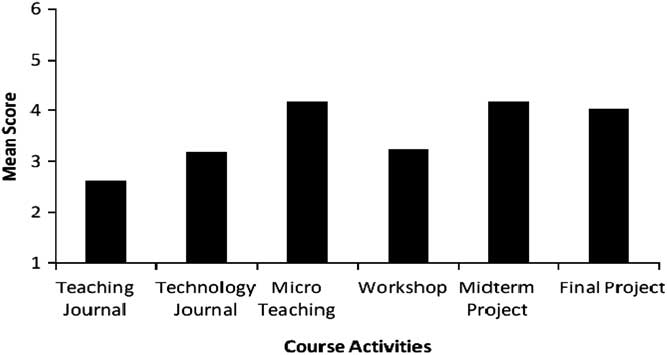
On the RAQ, students ordered the course's six main activities and then explained why they ranked the activities in this way. Figure 1 shows the mean scores for each activity's ranking, with the highest scores indicating the most relevant activities.
Results of the Ranking Activities Task

Figure 1 helps illustrate that the micro-teaching and midterm project were most relevant to the students (M = 4.19), and almost nearly as relevant to the students was the final project (M = 4.14). According to the students’ open-ended responses, these relevant activities provided authentic contexts, collaborative assistance, and authentic tasks.
Many students stated that these three tasks allowed them to think about and prepare CALL materials for their actual classrooms. The importance of authentic context is shown in the responses below.
• Creating CALL activities for my students was really helpful to me. It was a real practice.
• I should think about both pedagogical and technological aspects to prepare one micro teach. I practiced how to make it proper to my students.
Additionally, the participants reported that relevant CALL activities provided opportunities for collaborative assistance, or help from classmates and the instructor.
• I could get more sophisticated skills than I've got from the instructor and could ask personal questions to the presenter that might be embarrassing in class.
• The end of the micro teach was good because I got your (the instructor's) feedback and ideas about why my activity was good or bad.
Reponses from students such as, “I could think and consider how to achieve the goal by myself” and “there was the opportunity to select one skill among four” demonstrate how authentic tasks helped make the micro-teaching, midterm, and final projects relevant.
While these three activities were relevant to the participants, the teaching journal (M = 2.61), technology journal (M = 3.19), and workshop (M = 3.24) were clearly less relevant. Students reported that the least relevant activities did not provide an authentic context, included structured responses, and lacked assessment and sufficient time for activity completion.
Many students commented about the lack of authenticity of these activities. For example, one student stated that, “Compared with my restricted teaching environment, the goals or experiments described on the book or in the other articles seemed to exist too far from my classroom.” Responses referring to inauthentic contexts were related to the teaching and technology journals because these activities asked students to read studies that took place across various settings. With the participants teaching at different levels (e.g., elementary, university), they were bound to read articles from settings unrelated to theirs. Similarly, students found that journals were less relevant than other activities because they provided students with response templates. Disfavor for structured responses was evident in a number of comments.
• I found the journals to be the least relevant. The journals had templates, so I found myself doing my best not to write repetitively. More time went into avoiding repetition than I would have liked.
The participants also described the lack of assessment and time as characteristics of less relevant activities, but these characteristics were associated with the workshops. Based on the instructor's evaluation of course situatedness, the workshops were considered to be as situated as the midterm and final projects. However, the students did not find this activity as relevant. In describing why, students cited the notions of time and assessment most commonly. One student wrote, “Most of the time, I ended up finishing up the activity creation (in the workshop) in hurry due to lack of time. I felt like I needed more time to finish and discuss with my classmates.” Time was an issue because micro-teachings were held on the same days as workshops. During micro-teaching, two students presented their tasks and the instructor debriefed those tasks. Then, once the workshop began, the instructor modeled his CALL task before students had time to work together to create a new CALL task of their own.
Assessment, or lack thereof, was another major reason students felt that workshops were not as relevant as other activities. Although the workshops were conceived as a time for students to conceptualize and create tasks that they could later use for other assignments, some students felt that this activity should be assessed itself, and that assessment could keep some students on task.
• I thought the classroom workshops could have been a better use of class time when wisely used. If students were asked for a task completion to be turned in and marked, we could have done much more things with computers.
• I think maybe the class needed to be more controlled, pushing students to hand in products.
Overall, the results from the PSQ and RAQ suggest that the course offered a situated learning environment. However, data from the RAQ indicates that some activities were more situated than others.
4.2 Research question 2. The relationship between perceived situatedness and CALL skills
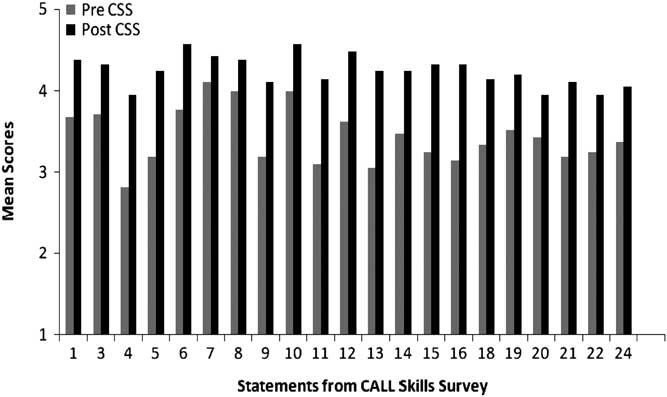
Data were analyzed in two ways to answer Research Question 2. First, the pre-course CSS was compared to the post-course CSS to determine if students’ CALL skills improved over the course of a semester. As expected, a paired-samples t-test (a = .05, t(20) = −4.92, p = .000) indicated that students reported their CALL skills to be significantly higher at the end of the course (M = 89.1, SD = 7.74) when compared to the beginning of the course (M = 72, SD = 14.24). Figure 2 shows pre and post mean scores for each of the 21 CSS statements.
Pre versus post mean scores for each CALL Skills Survey statement
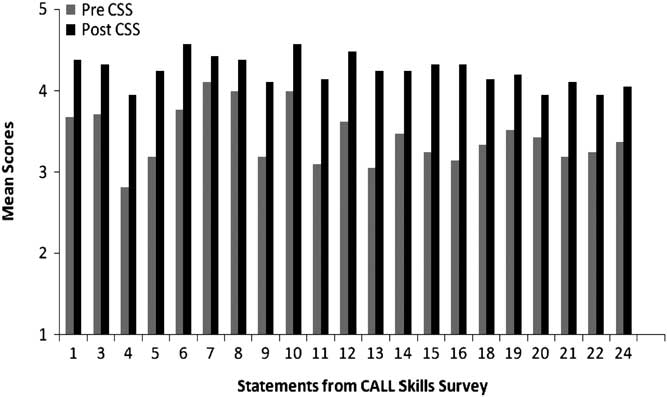
Figure 2 shows that students perceived that they increased in every CALL skill measured. Statements 4 (evaluate computer-based materials), 5 (use CALL to teach speaking), 11 (use CALL to teach reading), 13 (use CALL to teach grammar), 15 (create computer-based instructional materials), and 16 (create computer-based video materials), showed the largest pre- to post-course improvements.
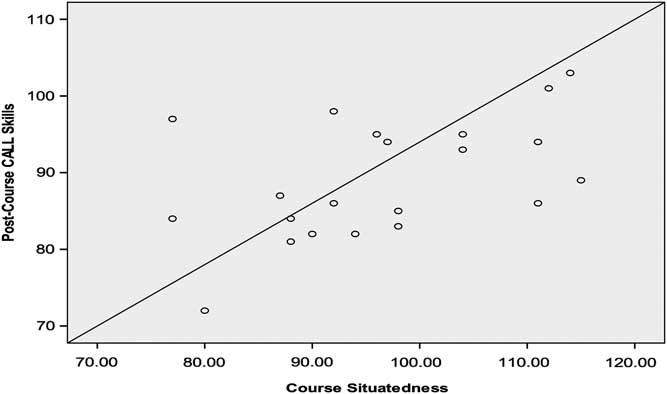
After completing the t-test, a Pearson coefficient was computed to determine the strength of the relationship between students’ perceptions of course situatedness and their post-course CALL skills. The results indicated that these two variables share a strong, positive, and significant relationship (a = .05, r = .50, p = .022). The scatterplot in Figure 3 presents the relationship between these two variables visually.
A scatterplot illustrating the relationship between perceptions of situated learning and post-course CALL skills

Figure 3 shows that the data points for CALL skills and perceptions of situatedness cluster closely together in a linear fashion. This visual pattern along with the correlation coefficient suggests that the two variables are strongly related.
5 Discussion
This study investigated students’ perceptions regarding the situated nature of a CALL course and the relationship between those perceptions and CALL learning. Before discussing the major findings from this study, it is important to note that the study was exploratory in nature and had limitations, such as the small sample size and duration of the study. Another prime limitation was that measurements of CALL learning and situated learning consisted of self-reported data. To help overcome this limitation, the study drew from multiple data sources to help strengthen the findings. Three major findings are discussed below.
The first major finding from this study was that the students felt that the course often provided many features of situated learning environments. The course was designed following Herrington and Oliver's (Reference Herrington and Oliver2000) guiding questions to evaluate situated learning opportunities, and its activities were presented to students in order to help link formal CALL learning to their actual classrooms through contextualized and authentic practice. Other studies have implemented situated learning frameworks to design and evaluate CALL courses (Chao, Reference Chao2006; Egbert, Reference Egbert2006; Egbert & Brander, Reference Egbert and Brander2010); however, the current study extends this literature by showing the need for students to evaluate CALL coursework, in addition to teachers. While a pre-course evaluation of workshops indicated that this was a situated activity, responses from students suggested that this activity did not achieve this goal. Therefore, student and course-designer evaluations of situated learning opportunities may help to provide more authentic CALL coursework.
Another finding of this study was the consistency of the students’ perceptions regarding situated learning activities. Data from the activities ranking task and student open-ended responses showed that they found relevant activities that related to their teaching contexts, reflected real-life tasks, and offered feedback through either collaboration or assessment. These characteristics are similar to recommendations for CALL professional development offered by CALL educators. For example, the importance of providing authentic tasks and contexts to pre- and in-service teachers has been discussed frequently throughout the literature (e.g., Egbert, Reference Egbert2006; Kessler & Plakans, Reference Hubbard and Levy2008; Meskill et al., Reference Meskill, Mossop, DiAngelo and Pasquale2002). Like Debski (Reference Debski2006), who noted that the students in his study were, “profoundly aware of the audience” (op. cit.: 109) for which they made materials, the students in the current study reported the importance of activities that allowed them to create activities for their students. When activities failed to provide real-world relevance, such as the journal assignments, students were sensitive to this disconnect. Moreover, participants found that collaborative assistance was a key characteristic of relevant CALL learning activities. Assistance, especially from practising experts, is a foundational principle of situated learning (Brown et al., 1993; Lave & Wenger, Reference Hubbard and Levy1991) and other studies have found that teachers learning CALL find collaboration with peers and others valuable (e.g., Arnold et al., Reference Arnold, Ducate and Lomicka2007; Meskill et al., Reference Meskill, Anthony, Hilliker-VanStrander, Tseng and You2006).
Lastly, this study found a strong relationship between students’ perceptions of situatedness and self-reported CALL skills. As noted above, some studies have evaluated the situatedness of CALL coursework (Egbert, Reference Egbert2006; Egbert & Brander, Reference Egbert and Brander2010) and others have documented improvements in teachers’ CALL skills (e.g., Desjardins & Peters, Reference Desjardins and Peters2007; Hegelheimer et al., Reference Hegelheimer, Reppert, Broberg, Daisy, Grgurovic, Middlebrooks and Liu2004; Peters, Reference Peters2006). This study contributes to the literature by directly exploring the relationship between these two variables. Situated learning theory offers one explanation for the strong correlation observed. Brown et al. (Reference Brown, Collins and Duguid1989) argued that, “the activity in which knowledge is developed and deployed … is not separable from or ancillary to learning and cognition” (op. cit.: 32). From this perspective, the situated activities that students engaged in during the course were a major contributor to CALL learning. While this interpretation is supported by other studies that show that project-based and contextualized CALL professional development facilitates CALL learning (Debski, Reference Debski2006; Meskill et al., Reference Meskill, Anthony, Hilliker-VanStrander, Tseng and You2006), a causal effect cannot be established from correlational designs. There is the possibility that the strong relationship found between situated learning and CALL learning in this study is mediated by a third variable. The literature has identified a number of variables that impact CALL learning, such as the numbers of CALL courses taken (Desjardins & Peters, Reference Desjardins and Peters2007), teachers’ attitudes and confidence with CALL (Kessler & Plakans, Reference Hubbard and Levy2008), and years of teaching experience (Meskill et al., Reference Meskill, Mossop, DiAngelo and Pasquale2002). Future studies will need to investigate these variables and others alongside perceptions of situatedness and CALL skills to more fully understand this relationship.
6 Conclusion
It is not uncommon for teacher education students in formal CALL courses to improve their CALL skills. The problem is, however, that this change does not always equate to technology integration in their actual classrooms. Situated learning has been proposed as a framework to counter this problem. While on a theoretical level situated learning explains how students produce usable knowledge and skills, only a handful of studies have applied situated learning to CALL teacher education. Thus many questions remain regarding how to operationalize situated learning, how to evaluate it, and how to understand the impact of situated learning on CALL learning and use. Findings from the current study suggest that adding the students’ perspective helps enrich evaluations of situated learning opportunities. If situated learning is couched in terms of producing environments that emulate the cognitive demands of out-of-class tasks, then the student perspective offers a legitimate data source to evaluate situated learning because teachers are often aware of the realities of their classrooms in ways that researchers are not.
This study also provides a preliminary look into the relationship shared by situated learning and CALL learning. Data from student perceptions of course situatedness were strongly correlated to perceptions of CALL skills. While encouraging, later investigations into this relationship should employ tools that are more sensitive to situated characteristics at the task level and then relate those characteristics to observed CALL use. It is difficult for the present study to pinpoint precisely which course activities fostered the development of which particular CALL skill. For example, data from the pre- and post-course CSS showed improvements among many skills, such as item 5 (i.e., I can effectively evaluate computer-based materials.). However, is this improvement attributed to the technology journal that asked students to evaluate CALL tasks presented in the course book, or did interacting with peers or the instructor during micro-teachings help facilitate this ability? By documenting and describing the activities that individual students select from CALL courses that allow students to choose the learning objectives and contexts of their assignments, research can better account for the CALL competencies that emerge within situated activity and those resulting from traditional coursework. Most importantly, future research investigating situated learning and CALL learning should examine the transfer of teachers’ CALL skills and knowledge from situated coursework to language education classrooms. When CALL researchers are able to account for situated learning environments, describe the activities and skills acquired within them, and observe the transfer of those abilities to actual classrooms, then situated learning as a model of CALL teacher education can be more appropriately assessed.
Acknowledgements
I thank the reviewers for their insightful comments. This study was supported by Sookmyung Women's University Research Grant 2011.