1. Introduction
Promoting collaborative dialogue and the formation of virtual communities of practice (VCoPs) in online and blended-learning contexts has received increasing attention in the field of computer-assisted language learning in recent years (e.g. Peeters, Reference Peeters2018; Petersen, Divitini & Chabert, Reference Petersen, Divitini and Chabert2008; Reinhardt, Reference Reinhardt2019; Zeng, Reference Zeng2017). Traditionally, members of a CoP establish a “shared domain of interest”, or a shared commitment to a cause. They form a “community” in which members intend to pursue their interests and in which they actively engage with others while developing a certain “practice” or “a shared repertoire of resources: experiences, stories, tools, [and] ways of addressing recurring problems” (Wenger-Trayner & Wenger-Trayner, Reference Wenger-Trayner and Wenger-Trayner2015: 2). In VCoPs, technology is used to establish a virtual group in which individual members are expected to create a team dynamic that leads to a “virtual knowledge based community” (Chrisentary & Barrett, Reference Chrisentary and Barrett2015: 27). In these contexts, research remains inconclusive on how learners develop a sense of community (Jewson, Reference Jewson, Hughes, Jewson and Unwin2013) and, by extension, how dynamic the different roles are that participants can take up. A question that logically follows is what effect these different roles can have on interaction and learning.
In this paper, we used the principles of social network analysis to explore the configuration of two distinct VCoPs that have similar learning outcomes but different set-ups and participant numbers. Social network analysis allows us to see how the members in these networks interact, and what the similarities and the differences are between them. In short, through social network analysis, we can depict the members of these communities as actors in a network and illustrate the different relations, or ties, between them. A tie represents a connection: every time an actor talks to another actor, they form a tie. These ties can be assigned “a ‘direction’ to represent the flow of influence or resources in a social network and they can be assigned a ‘value’ to represent the strength of the relation” (Scott, Reference Scott2011: 22). In an online conversation where two people talk to one another, the actor who posts the first message is considered to have established the initial connection, so the tie is directed outward. The actor who replies to the initial message is on the receiving end. For this actor, the tie is directed inward. The more these actors interact, the stronger the tie becomes. These basic principles of presenting members of a network as actors and investigating what kind of ties there are between them enabled us to assign them different roles and analyse their behaviour when they interact. In doing so, we present an empirical approach to determine how the peer-interaction process in such online environments can unfold and develop, and, by determining how different actors relate to each other, how learners give rise to a “community”, or fail to do so.
In the analysis of the configuration of a VCoP and the concept of “community”, the focus of this study primarily lies on the roles participants took up, particularly in terms of who played a leadership role in the community and how committed participants were to interact with one another (Chrisentary & Barrett, Reference Chrisentary and Barrett2015; Wenger, McDermott & Snyder, Reference Wenger, McDermott and Snyder2002). These concepts can be measured by determining how many ties different actors have established – that is, how often they interacted with others – and whether these ties allowed certain members to exert more control over the conversations in the network than others by participating in a majority of the interactions (Aviv, Erlich, Ravid & Geva, Reference Aviv, Erlich, Ravid and Geva2003), or whether all members interacted at equal rates.
The present paper reports on a comparative study between two learner groups that differ in size (Group 1: N = 123, Group 2: N = 34), with both enrolled in English as a foreign language courses in Belgian higher education. This comparative study originated from the desire to compare the observations made by two individual teacher-researchers when they were using Facebook in their first-year English as a foreign language (EFL) classrooms. The social networking site (SNS) Facebook was chosen because of its community-building capacity (Lamy & Zourou, Reference Lamy and Zourou2013) as well as its popularity among both student groups. The teacher-researchers used Facebook as a tool in their classrooms independently from each other and did not consult each other on how to integrate or organise the SNS for their specific context beforehand. While both courses aimed to promote peer interaction and collaboration through the SNS, the student groups acted and interacted differently. The teacher-researchers wanted to compare the results of their projects and examine the differences and similarities between them.
Using social network analysis, we aimed to show how both learner groups established and developed a network of peers. In many studies on the development of CoPs and VCoPs, it is acknowledged that members should be active participants in the interactive process of learning and establish a common ground or a shared domain of interest (Reinhardt, Reference Reinhardt2019). To study how they do so, we looked at the position of every actor in the network and calculated their centrality degree scores (Hanneman & Riddle, Reference Hanneman and Riddle2005; Scott, Reference Scott2011). The more ties an actor has with others, the more central they are in the network. By examining centrality, it can be investigated to what extent a group of actors clusters together or whether a majority find themselves in the periphery of the network. Borgatti and Everett (Reference Borgatti and Everett2006), who have thoroughly explored the core–periphery structure within social network analysis, conclude that actors who find themselves in a central position in a network have more influence on the direction of the network, whereas actors in the periphery generally have less access to information and resources because they have fewer connections with others and thus fewer pathways to satisfy their wants or needs. How often an actor interacts with another actor in the network – that is, the value of the tie, and the direction of the ties that are formed – has also been analysed. Examining the value and direction of ties provided insights into when, how, and how often actors interacted with members of the network and whether they predominantly led conversations or followed up on posts made by others.
Measuring learners’ level of participation, their level of connectivity and centrality scores allowed us to describe certain power relations between participants, and more specifically actors’ level of “leadership” (De Laat, Lally, Lipponen & Simons, Reference De Laat, Lally, Lipponen and Simons2007). Based on earlier research by Manca and Grion (Reference Manca and Grion2017), we hypothesised that certain factors such as teacher presence and the ways materials are disseminated in an online VCoP may affect the way learners establish, or fail to establish, connections with others and, by extension, the way they exert any type of leadership. In order to analyse whether this was the case, the following research questions were formulated:
-
1. Based on the strength and direction of the ties between actors, what kind of roles can be defined in the VCoPs when learners are engaged in peer interaction on the Facebook forums?
-
2. Does any type of leadership emerge in the VCoPs when learners are engaged in peer interaction on the Facebook forums?
For both groups, a participation matrix has been developed. These matrices include every tie that has been established between actors, enabling us to highlight the different roles within the VCoPs and the power different participants may hold within the network. Based on these findings, and informed by the set-up of the two VCoPs, implications for establishing and developing VCoPs in language learning contexts were formulated.
2. Literature review
2.1 The peer-interaction process
2.1.1 Peer interaction and sociocultural theory
Building a VCoP is highly dependent on the willingness of participants to interact. In their review of Vygotskyan literature on the sociocultural tradition, Lantolf and Thorne (Reference Lantolf, Thorne, VanPatten and Williams2007) conclude that language can be regarded as “the most pervasive and powerful cultural artifact that humans possess to mediate their connection to the world, to each other, and to themselves” (205). In the observations they make, based on several cases that address sociocultural theory and language learning, they connect the social world and social interaction on the one hand – which they regard as the source of all learning – and the fact that learning, on the other hand, can only fully blossom when part of culturally organised activity. This means that only having access to others is not enough. Interactions need to be meaningful and need to provide access to the artefacts of others as well (i.e. generated content such as written work) about which personal interpretations can then be shared.
By tapping into these insights, researchers and educators can design and devise learning spaces that give prominence to the social, cognitive and organisational aspects of our mental processes (Peeters, Reference Peeters2019). Consequently, this also entails that interaction and collaboration can originate rather organically and do not necessarily have to be initiated or triggered by cognitive, organisational or linguistic problems or challenges all the time (Foster & Otha, Reference Foster and Ohta2005). The learning process thus can become an interactive process in which there is room for interpretation and development, both on a group and on a personal level.
2.1.2 Peer interaction on Facebook
Several studies on the social, community-building capacity of Facebook in language learning environments in higher education have found that the SNS opens up new opportunities to encourage interpersonal communication, both in the personal lives of students and in various language learning environments (Lamy & Zourou, Reference Lamy and Zourou2013; Peeters, Reference Peeters2018; Reinhardt, Reference Reinhardt2019). It is primarily social, informal engagement between learners that has been found to enhance the feeling of solidarity among peers and, additionally, lowers the threshold to question and test their use of the target language (Lantz-Andersson, Reference Lantz-Andersson2016; Sato & Ballinger, Reference Sato and Ballinger2016). Based on sociocultural approaches to language learning, Lomicka and Lord (Reference Lomicka, Lord, Farr and Murray2016) furthermore have pointed out that learners interacting in these spaces “can gain confidence by working with others and by establishing recognition as members of a particular community” (257). They moreover explain that these interactions may contribute to developments in “both [learners’] identity and in relationships and can expose students to current, real and meaningful language use for specific tasks” (257). Based on these insights, the two Facebook projects described in this study opted to foster language development as a social, collaborative process and encourage learners to share their ideas and interpretations by letting them engage in peer-interaction activities on the SNS part of their language learning environment in higher education.
2.2 The roles within a community of practice
The term “CoP” was first coined by Lave and Wenger (Reference Lave and Wenger1991) and framed within situated learning. As touched upon in the Introduction, to call a group of people a CoP, that group needs to adhere to a number of key features. First of all, there should be a “shared domain of interest”, which implies a certain level of competence dealing with and working towards goals and objectives (Wenger-Trayner & Wenger-Trayner, Reference Wenger-Trayner and Wenger-Trayner2015). Second, there should be a “community” in which members are intending to interact with others, build relationships and, eventually, learn from each other. Finally, CoPs establish a certain “practice”, or “a shared repertoire of resources” (Wenger-Trayner & Wenger-Trayner, Reference Wenger-Trayner and Wenger-Trayner2015: 2). When applying this theory to social learning environments, Wenger (Reference Wenger, Nicolini, Gherardi and Yanow2003) described a fourth dimension that completes the list of key features of a CoP: the discipline of convening. This feature stipulates that partnerships should be sustainable to ensure productive enquiry, and suggests that a certain type of leadership will emerge in such communities.
The concept of leadership implies that different actors’ level of participation may vary in a CoP. Wenger etal. (Reference Wenger, McDermott and Snyder2002) have argued that the most active participants, that is, the core group, usually take up 10% to 15% in such a community. Participants who engage regularly but who are not part of the core group usually take up about a fifth (between 15% and 20%). The group of less active participants takes up the rest. Commonly, this is the largest group of participants who often engage less frequently, and more superficially, with others (Wenger etal., Reference Wenger, McDermott and Snyder2002: 56). It has been argued that roles in a CoP are flexible and that members can move from the periphery to the core group, or viceversa, over time (Borzillo, Aznar & Schmitt, Reference Borzillo, Aznar and Schmitt2011).
2.3 Social network analysis and community of practice
The present study explores the concept of leadership in a peer-interaction environment for language learning by drawing on the principles of social network analysis. In particular, this study is interested in relational data – that is, the configuration of ties between different actors based on the interactions they have with each other – to analyse the connections learners form and how they act as interactants in the VCoP. In line with an earlier study by Aviv etal. (Reference Aviv, Erlich, Ravid and Geva2003) in which the researchers analysed interaction patterns in online learning spaces, measures of actors’ centrality scores within the network revealed that there is a hierarchy among participants. Some actors had a dominant voice and others did not. The researchers also looked at the direction of the ties in the network, which they refer to as studying “causal force”, or studying who functions as a trigger and who functions as a responder to determine if any type of leadership emerges in the network. De Laat etal. (Reference De Laat, Lally, Lipponen and Simons2007) also applied these social network analysis methods to study interactants’ behaviour in networking spaces for learning and argue that actors’ high centrality scores make them more likely to dominate conversations and exert considerable control over the direction of the network. By looking at centrality degree measures over a longer period of time in their study on the use of blogs in the language learning classroom, Lee and Bonk (Reference Lee and Bonk2016), additionally, found that their learners’ online communicative behaviour changed as they became more and more connected to each other as time went by. They found a significant correlation between the number of connections learners made and their perceived emotional closeness to others: the more ties they had formed with other actors, the more they felt an integral part of the learning community.
Analysing the configuration of a VCoP using social network analysis enables us to both calculate and visualise the concept of “community”. Jewson (Reference Jewson, Hughes, Jewson and Unwin2013) has suggested that these approaches to studying CoPs have become increasingly important to further our understanding of the concept, pointing out that “the notion of communities of practice has, implicitly and uncritically, drawn on one particular theoretical tradition in the study of communities – that which focuses on the symbolic construction of imagined collective entities” (78). In other words, rather than taking the concept of “community” as an imagined collective, this study measures the weight and direction of the connections made and visualises the network that has been created. More information on the methodological applications and approach can be found in section 3.3.2.
3. Methodology
3.1 Participants
In the present study, Group 1 consisted of first-year language and literature majors, studying EFL for academic purposes. Group 2 consisted of medical pre-professionals enrolled in EFL language training for occupational purposes. This paper aims to demonstrate how to analyse the interactive behaviour of these two different VCoPs and how to conceptualise the ways they succeeded or failed in establishing a community. The distinction between the two groups proved to be an opportunity for us to study the configuration of VCoPs and test the methods we have proposed in two different areas of foreign language education. What connected them is the fact that both learner groups had to learn how to function within their respective domains (i.e. their academic and professional environments) using English as a foreign language. In other words, the two EFL courses may have had different “purposes”, but essentially they had the same goal: to facilitate students’ acculturation into an academic and professional context (Van de Poel, Vanagt, Schrimpf & Gasiorek, Reference Van de Poel, Vanagt, Schrimpf and Gasiorek2013).
Group 1 consisted of 123 participants enrolled in an introductory academic writing course, an integral component of the strand English Proficiency at the University of Antwerp, Belgium. Participants were undergraduate students in BA1 English Language and Literature and studied English, either in combination with one other language – Dutch (for all students their first language or L1), German, French or Spanish (all qualifying as foreign languages) – or as part of Theatre, Film and Literature studies. The age of the participants in Group 1 predominantly ranged between 17 and 23 years old. Three quarters (74.8%) of the participants were female and one quarter (25.2%) were male. Students were expected to have intermediate or upper-intermediate English language proficiency when entering university.
The 34 participants in Group 2 were bridging students working in the healthcare industry as carers while pursuing a professional bachelor’s degree in nursing at Artesis Plantijn Hogeschool, Belgium. The participants could take the Nursing on the Move English language and communication training course as an alternative to a compulsory individual research project. Participants’ age ranged between 20 and 52 years. Twenty-eight of the participants were female and six were male. The participants were mainly Belgians, with six participants from the Netherlands and one from Iran. Consequently, Dutch was the most common L1. Two participants spoke Thai and Persian as their respective L1s with near-native proficiency in their L2, Dutch. Participants’ proficiency in English ranged from beginner to intermediate.
3.2 Course set-up
For Group 1, the Facebook environment functioned as a peer-interaction space where learners could share their thoughts and concerns about a number of academic writing assignments they had to complete for the course. They had to hand in three writing assignments over a 12-week period. Students were instructed to write three 300-word essays arguing for or against a debatable statement (e.g. “Read, read, read. Students ask me how to become a writer, and I ask them who is their favorite author. If they have none, they have no love of words”; Wills, Reference Wills2009: para. 3). Assignments were handed out in class, after which learners had time to do an initial brainstorm together. The instruction sheets included a debatable statement, submission details and white space for students to note initial ideas. They were informed that, when finishing their assignments at home, they could continue sharing any questions they had with the peer group via the Facebook platform and perform peer review online if they so pleased. Because the SNS functioned as a peer-interaction space, the teacher was not present online. At the bottom of the instruction sheet, a space was included where learners were asked to write down the question they had posted online (if any) as well as the most helpful answer they had received. This way they could report back to the teacher about their online engagement without the teacher having to review the Facebook group.
For Group 2, the online environment functioned primarily as a learning-management system that was used to disseminate materials, set up online tasks and interact with the teacher. The aim of the five online tasks, which were posted on the group by the teacher, was to keep students engaged in learning, especially as there were only five contact sessions with students over a 12-week period. In addition, students had to complete five online learning units individually. Students were thus required to complete one online unit every two weeks, with one corresponding contact session for each unit. In the weeks without contact sessions, students were required to complete an activity on Facebook, with each activity relating to the online learning unit they were working on at that time. The Facebook group was thus configured as a type of extension of the classroom. These activities were aimed at generating discussion among learners with reference to the materials that they complete independently online. For example, the first two online units dealt with introductions, greetings and politeness phenomena in English, amongst other things, and the first Facebook activity was thus to introduce themselves to the group and comment on what they would like to gain from the course. The second activity consisted of a nurse–patient dialogue that was particularly formal and abrupt; they were instructed to make suggestions for adding politeness features to the dialogue in order to make it less formal and facilitate rapport building. The intention of such activities was to support and enrich the independent learning experience by providing a platform for peer interaction and interaction with the teacher as an online extension of the classroom. Because of the smaller number of participants, the teacher was included in the online environment, as it was considered a manageable group size to assist any of the participants in their learning individually if necessary.
3.3 Data and methods
3.3.1 Facebook data
Group 1 generated 4,278 online posts over a time span of four months. Group 2 generated 129 online posts over a similar time span. A Graph API Explorer tool was used to extract the data from the online environment after which it was transferred to a word processing file for analysis. The corpus consists of participants’ user codes, their posts and comments, thread markers, like counts, time stamps, modality markers and captions. Participant information was anonymised by assigning them a new random user code before any analysis was conducted. The technical computing package Wolfram Mathematica was used to compile the matrices (using automated triangulation of user codes) and make subsequent calculations and visualisations.
3.3.2 Social network analysis
In order to study the configuration of the network of peers in an online interactive context, the centrality of the different actors is calculated (cf. Aviv etal., Reference Aviv, Erlich, Ravid and Geva2003; De Laat etal., Reference De Laat, Lally, Lipponen and Simons2007). Adjacency matrices have been created for both groups. In such a matrix all participants are mapped on two axes (horizontally and vertically). The point at which two actors meet in the matrix shows the total number of connections that they have made with each other. These connections can be subdivided in “initial posts” and “comments” looking at rectangular arrangement along the rows and columns. By looking at the number of connections individual actors make with others, these matrices reveal if and how we can define different roles and whether there is a cohesive pattern in the connections participants make (Scott, Reference Scott2017). For each actor, it is also possible to determine how many outgoing connections (represented in the far left-hand column) and incoming connections (represented in the top row) they have. Footnote 1 In other words, it is possible to determine who predominantly initiates dialogue on Facebook and who predominantly replies to existing threads as a commentator, how often they do so and whether there are participants who take up a leadership role (Scott, Reference Scott2017).
Network analysis stipulates that participants who establish a large number of connections with others are in preferred positions when it comes to the acquisition of knowledge or resources as “they may have alternative ways to satisfy needs, and hence are less dependent on other individuals” (Hanneman & Riddle, Reference Hanneman and Riddle2005: 145). Participants with many connections are, therefore, often considered to be influential. Furthermore, the more connections there are between participants, the denser the network, which should increase “the speed at which information diffuses among the nodes, and the extent to which actors have high levels of social capital and/or social constraint” (Hanneman & Riddle, Reference Hanneman and Riddle2005: 147). In other words, a large number of links between participants can result in faster information transfer and, by extension, a more effective peer-interaction network for learning.
4. Results
4.1 Matrices of the peer-interaction process
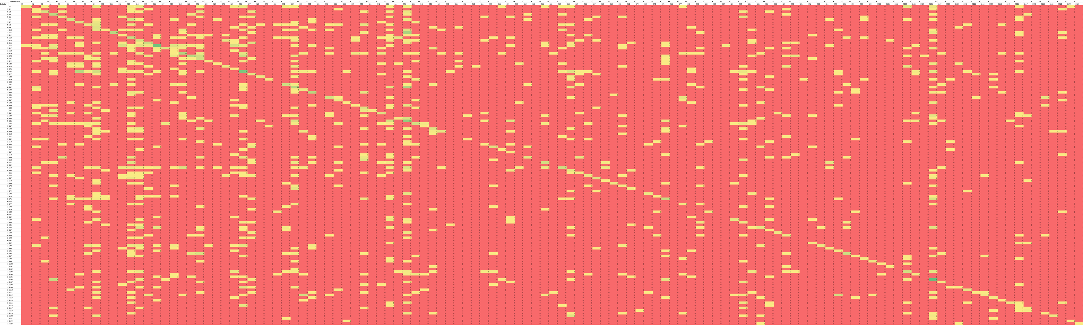
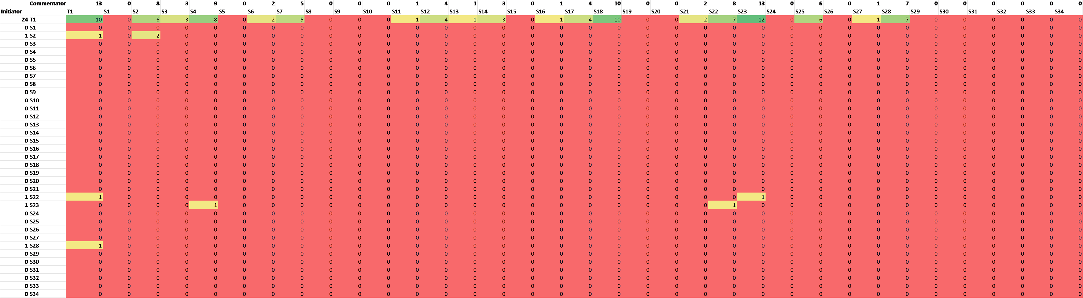
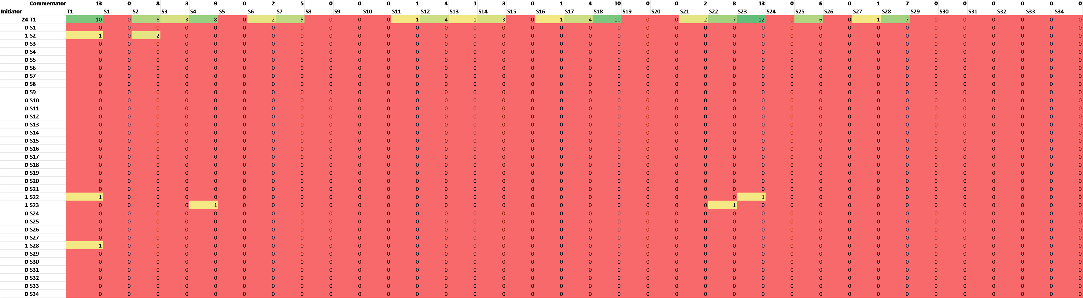
The matrices generated in this study provide an overview of the connections learners make with others. For Group 1, which consists of 123 students, the matrix shows that all participants, except for two, have made efforts to connect with others, either by making a post or by leaving a reply, as illustrated in Table 1 in the Appendix. For Group 2, which consists of 34 students, 18 have made efforts to connect with others, either by making a post or by leaving a reply, as illustrated in Table 2 in the Appendix. It can also be observed that learners in Group 1 tend to connect with a variety of peers, whereas in Group 2, learners tend to connect with one specific actor, that being the teacher.
4.2 The concept of leadership
4.2.1 Level of participation
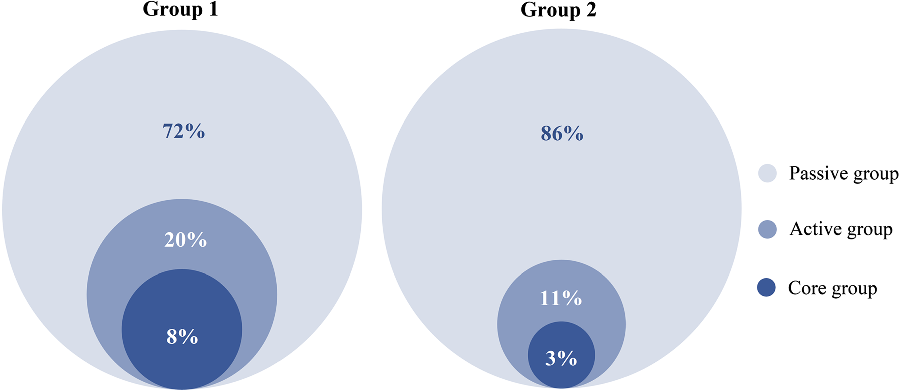
Looking at participation numbers, participants seem to take up different roles within the community and can be subdivided into leaders (core group), active participants, and passive participants. Analysis shows that, in Group 1, 8% of participants (N = 10) generated a third of all postings, as shown in Figure 1. Following the same principles, for Group 2, the core group consists of one person – that being the teacher. This core group is most active and, on average, individuals generate 87 postings in Group 1 and 37 postings in Group 2. Next to this core group, a larger active group that generates another third of all postings was identified (Group 1: N = 25, Group 2: N = 4). Participants in this cohort engage frequently with others and, on average, individuals generate 36 postings in Group 1 and 11 in Group 2. Finally, there is a group of learners that is more silent and engages less frequently (Group 1: N = 88, Group 2: N = 30). In this cohort participants generate 10 postings on average in Group 1 and two postings in Group 2.
Distribution of participants within core, active, and passive groups
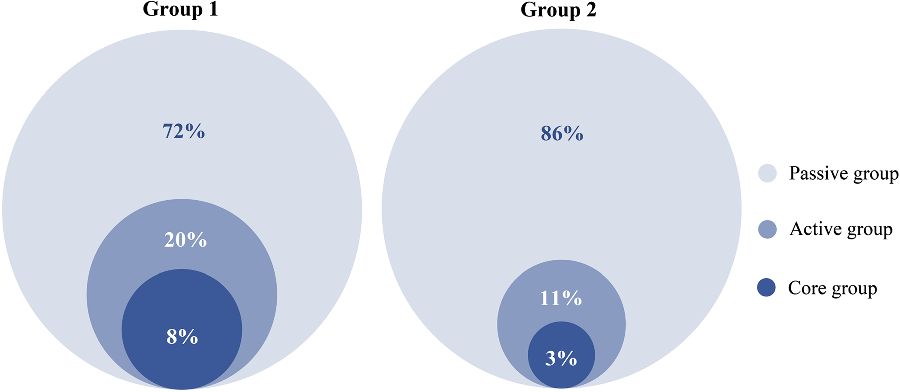
Participation numbers for Group 1 show that the core group and active group constitute about a third of the community. This subdivision does not mean that only a third of the learners are actually learning or gaining something from the peer interaction. Research shows that members in these cohorts can develop (tacit) knowledge when observing the community without taking part in active negotiation (Lewis etal., Reference Lewis, Koston, Quartley and Adsit2011). Furthermore, every member of this community was expected to hand in assignments for the course and assess their own writing, pose a question and report back to the teacher, which ensured that all learners were involved in the peer-interaction process at least once per assignment.
In contrast, Group 2 does not seem to form a community of good practice, as the core group is not a group at all but consists only of the teacher. Some of the learners reply to the teacher’s post and also initiate conversations themselves. Nevertheless, it can be observed that a majority of the learners do not talk to peers but only react to posts shared by the teacher.
4.2.2 Connectivity and centrality within the virtual community of practice
The number and distribution of individual connections in the matrices reveal that learners participate to different degrees in the two groups. In Group 1, four learners (or 3% of participants) did not initiate any conversations and six learners (5%) did not reply to any conversations. In total, two learners (2%) did not participate at all. In Group 2, 30 learners (88%) did not initiate any conversations and 16 learners (47%) did not reply to any conversations. In total, those same 16 learners did not participate at all.
The level of participation, together with the strength and direction of the ties in both networks, enable us to describe participants’ centrality within their peer groups. To visualise centrality, sociograms have been created, illustrating the predominant dynamics within the VCoPs. The ties between actors are directed, depicting how they go from one actor to the other. The more connections a certain actor has with others, the more central they are placed within the network. The more actors find themselves in this position, the more likely it is that a central cluster will form in the VCoP.
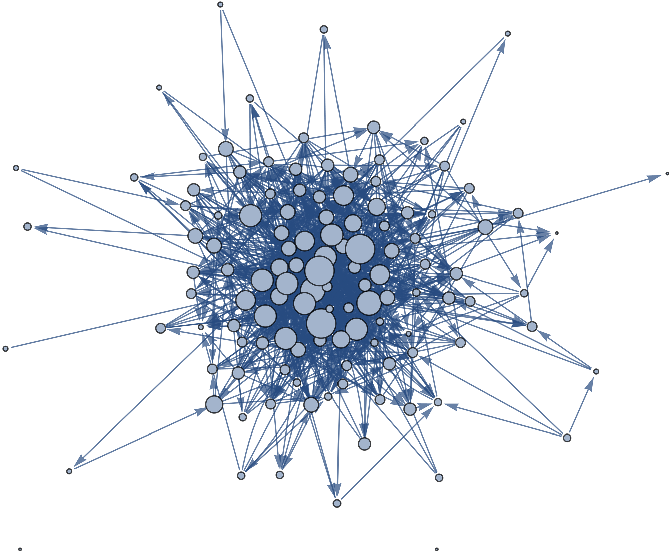
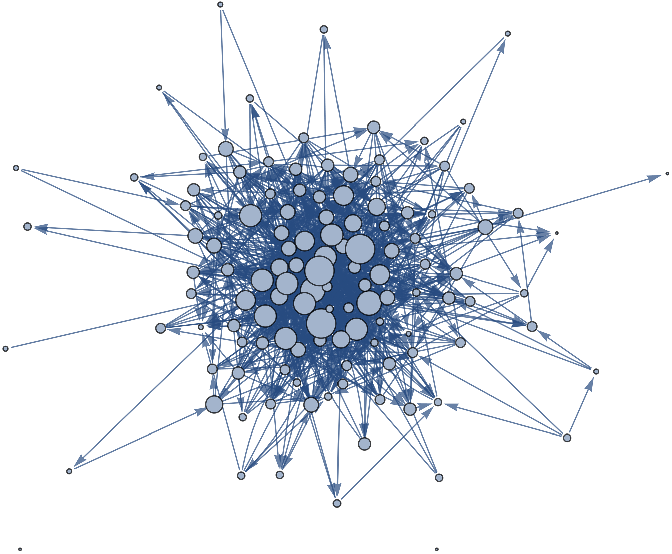
For Group 1, a vast majority of the participants find themselves in a central cluster, with a minority of participants in the periphery of the network, as illustrated in Figure 2. Two actors find themselves at the outskirts of the network without any ties to others. They were part of the online environment but did not actively interact. It can also be observed that, in a few cases, actors initiate conversations – illustrated by having ties directed outward – but do not reply to any other posts – illustrated by the absence of any ties directed towards them. The opposite pattern can be observed in cases where actors only have incoming ties, and thus only reply to comments, and no outgoing ties, which means they did not initiate a conversation online.
Sociogram with directed ties between actors in Group 1. The size of the nodes illustrates the relative number of times actors connect with others
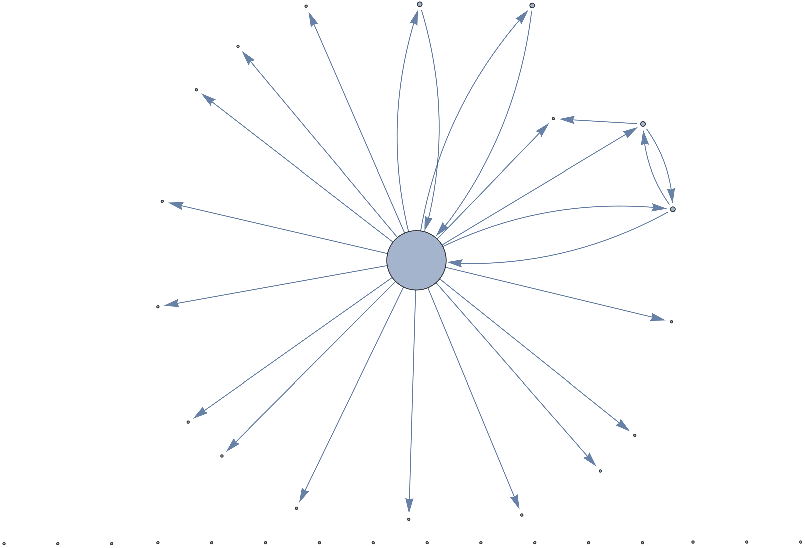
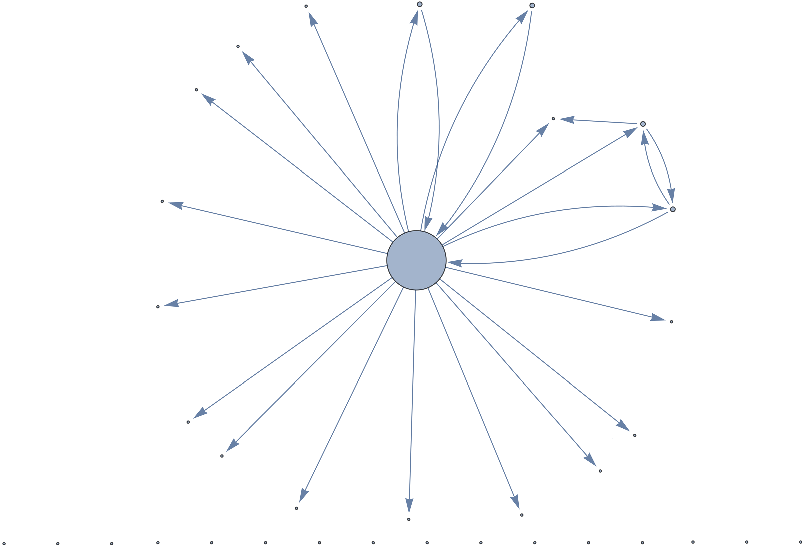
For Group 2, a different picture emerges. There is no predominant central cluster due to the fact that only one actor – the teacher – finds themselves in a central position with all other actors in their periphery, as illustrated in Figure 3. The sociogram illustrates the dominant role of the teacher as an initiator, with only four other actors having outgoing ties. These ties, furthermore, are predominantly linked to the central actor and only in two cases form a connection with other actors in the periphery. Sixteen actors are at the outskirts of the network without any ties to others. They were part of the online environment but did not actively interact with the teacher or with other learners in the network. This dandelion network illustrates the dominant role and the voice of the teacher in the conversations and shows that the communication process in this environment rarely involves peer-to-peer interaction.
Sociogram with directed ties between actors in Group 2. The size of the nodes illustrates the relative number of times actors connect with others
5. Discussion: The configuration of a community
5.1 A peer-interaction network as a virtual community of practice
For both groups, the Facebook environments were integrated into the EFL courses as community-building tools. From the data, it can be observed that the interaction process among actors in such online environments and, by extension, the ways in which they give rise to a “community”, differed across the two groups. As Wenger-Trayner and Wenger-Trayner (Reference Wenger-Trayner and Wenger-Trayner2015) describe CoPs succinctly as “groups of people who share a concern or a passion for something they do and learn how to do it better as they interact regularly” (1), it is the way in which actors connected to one another that became of special interest in the present study. Actors in Group 1 took up different roles, as part of a core group, an active group, or a more passive group. They predominantly followed the principles of a CoP, increasing the chances that members of this community may further develop “a sense of belonging and commitment” (Handley, Sturdy, Fincham & Clark, Reference Handley, Sturdy, Fincham and Clark2006: 642) while establishing connections with others. Referring to Goos, Galbraith and Renshaw (Reference Goos, Galbraith and Renshaw2002), Kenney, Kumar and Hart (Reference Kenney, Kumar and Hart2013) have observed similar patterns in their study on online educational VCoPs and assert that Facebook interactions need to represent a certain kind of “mutuality” or “the interactive building of understanding of a shared learning goal based on diverse viewpoints” (366) in order to make a community successful.
Interaction among actors in Group 2 developed differently, with the teacher leading conversations and being the only member of the “core group”. With regard to the CoP description above, one could argue that participants in this community did not “utilise the collective knowledge to help solve problems within their work or academic environments” (Kenney etal., Reference Kenney, Kumar and Hart2013: 358). It is important to consider that even though this Facebook environment was used as a community-building tool, it additionally functioned as a learning-management system. This dual purpose might have hampered the formation of stronger ties between different actors. Manca and Grion (Reference Manca and Grion2017) have provided evidence that low participation rates in such online spaces can be ascribed to inadequate or unsuitable design principles such as unbalanced power relations (e.g. between learners and teachers), a lack of authenticity and inadequate incentives to promote inclusion. The fact that the platform was used to disseminate materials, set up online tasks and interact with the teacher can thus be seen as one of the reasons why a “community”, as observed in Group 1, did not take root. A marked example of this is that only four participants in this group reached out to others, as can be seen in Figure 3. Although the platform may have functioned well as a learning-management system, the community-building capacity of Facebook seems to have been undermined, restricting the possibility for the platform to function as a peer-interaction space in which participants could easily and organically connect with others within the learning setting (cf. Kenney etal., Reference Kenney, Kumar and Hart2013; Peeters, Reference Peeters2019). In other words, Group 2 failed to function as a VCoP with a team dynamic that leads to a knowledge-based community (Chrisentary & Barrett, Reference Chrisentary and Barrett2015). The authors believe a number of reasons have contributed to the failure of Group 2 as a VCoP – most notably the initial set-up of the online space – as elaborated on below.
5.2 Factors that may affect the formation of a virtual community of practice
From the start, there are at least three major differences between the two groups that contribute to the differences in results. First, the online assignments differed in terms of what is at stake. In contrast with Group 1, where participants were asked to report on their interaction in relation to assignments that are graded, the activities in Group 2 were not connected to any grades. Second, the presence or absence of a teacher online seems to have affected “learner leadership”. Since the teacher in Group 2 posted the activities directly onto Facebook, the participants most often simply responded to these posts rather than initiated new conversations. There was no real need for participants to initiate dialogue because the teacher already did so. In Group 1, however, we did see learner leadership emerge with a core group taking charge of the peer-interaction process. Closely linked to these observations is a third contrastive element between the groups, this being the presence of an authority figure. Although research has shown that including a teacher in SNS environments benefits learners’ beliefs about the online environment as a space for learning (e.g. Callaghan & Bower, Reference Callaghan and Bower2012), the potential interference of a teacher’s eagle eye has also been found to inhibit more informal peer interaction (Sato & Ballinger, Reference Sato and Ballinger2016). In this regard, while it was the teacher’s intent to keep students in Group 2 engaged in learning by introducing tasks through Facebook when they were not meeting in class that week, their presence might have impacted students’ engagement negatively.
Next to these three initial observations, the type of activities that the two groups were given are also likely to have affected the nature and extent of interaction (Sato & Ballinger, Reference Sato and Ballinger2016). In Group 1, participants had a certain degree of freedom to post questions about their writing process and ask for advice, as well as review their peers’ written work. Not only is this instrumental in community building as they share in each other’s struggles and collaborate to improve as writers, it also opens up the discussion as there are different ways in which various writing “problems” can be solved (Colpaert & Spruyt, Reference Colpaert, Spruyt, Simons and Smits2018). Also, asking for advice in solving one problem can lead to discussions about any number of related problems. Individuals’ challenges can thus become part of a shared narrative as learners may gradually discover they are not alone in their struggle, and their individual opinions, experiences and advice can become valuable pieces of advice to others (Peeters, Reference Peeters2015).
In contrast, the activities completed by participants in Group 2 were of a different nature. Some activities did draw from learners’ personal experiences – for example, asking them to post a funny incident involving a misunderstanding due to a language barrier and then discussing how to resolve or avoid such problems – but may have lacked external incentive such as grades. Other activities were of a more close-ended nature; for example, participants being asked to improve a cold, stilted dialogue, making use of pragmatic features that they had learned in class. Corrections to this text reached saturation point fairly quickly, well before all participants had reacted to the activity because it is a “fixed task” (Colpaert & Spruyt, Reference Colpaert, Spruyt, Simons and Smits2018). In this case, once sufficient “corrections” had been provided, responses ceased. Thus, the use of activities that require collective problem-solving, drawing on participants’ competencies and experience, especially where this adds value to others (i.e. helping them improve their text that is to be graded), might be more likely to foster the development of an active and interactive VCoP.
5.3 Implications
First of all, this study presents an empirical approach to analysing and visualising the different roles participants can adopt within a VCoP part of an EFL learning environment in higher education. This approach further informs our understanding of the concepts of “leadership” and “community” within VCoPs (Jewson, Reference Jewson, Hughes, Jewson and Unwin2013) and holds implications for future practice.
The configuration of both groups illustrates how “leadership” can be understood as well as how the voice of the teacher may affect learner leadership and participation in these communities. While learners in Group 1 created and developed a community in which learners themselves took up a leading role, participants in Group 2, where the teacher was included, made few connections with each other, but rather flocked around one central figure. The reason for this can largely be found in the design of the online space. Facebook had been used primarily as an extension of the classroom and a learning-management system, which gives preference to teacher–student communication in Group 2. Using the platform in this way seems to have resulted in unbalanced power relations between interactants in the online environment (Manca & Grion, Reference Manca and Grion2017), preventing extensive peer interaction from taking place because of teacher presence (Sato & Ballinger, Reference Sato and Ballinger2016). It has to be pointed out, though, that if the aim of such a group is indeed for a teacher to keep in touch with students, and developing peer interaction within the boundaries of a VCoP is not the target, then the teacher’s presence in the group is suitable. However, if fostering peer interaction is the aim, interaction in Group 2 shows that teacher presence is not ideal.
The social network analysis shows that the configuration of “leadership” and the conceptualisation of a “community” are heavily dependent on the design of the educational environment and of the different spaces learners engage in. This paper, therefore, proposes a list of measures to ensure responsible and sustainable design principles for educators who want to promote collaborative dialogue and the formation of VCoPs in their professional practice:
-
1. Group purpose. The purpose defines the design. Using Facebook groups, or other online platforms, as a learning-management system or an extension of the classroom needs to be approached differently to using such platforms to develop a VCoP for peer interaction. The recommendation: one platform, one purpose.
-
2. Participant inclusion. Depending on the aim of the online environment, teacher presence is either necessary or restricting. It can be argued that, in the two groups we observed, the presence of a teacher made the formation of an interactive “community” unnecessary as the teacher can act as a coaching, teaching or expert voice, not requiring any of the learners to take up a key leadership position.
-
3. Participation incentive. Although forcing interaction by integrating incentives (e.g. giving grades for participation) is not always desirable, it can provide an impetus to initiate interaction. As found elsewhere (Cappellini, Lewis & Rivens Mompean, Reference Cappellini, Lewis and Rivens Mompean2017; Peeters, Reference Peeters2015), online peer-interaction processes with high-stakes tasks are by no means limited to task-oriented interaction, and include a fair amount of socio-affective, metacognitive and organisational interaction (Peeters, Reference Peeters2018). Introducing high-stakes incentives as stimulus, therefore, may be a necessary stepping stone to raise learners’ awareness of the purpose and potential value of the online environment. The number of incentives that should be integrated and how they should impact learners is dependent on both the learner group and the purpose of the online environment.
-
4. Design of activities. Activities of an open-ended nature that value individual contribution by multiple group members and are linked to incentives are likely to generate more interaction, while activities of a close-ended nature will generate less participation per activity as it takes a limited number of answers and participants to complete. In other words, the degree of freedom for the learner is likely to impact their interactive behaviour (Colpaert & Spruyt, Reference Colpaert, Spruyt, Simons and Smits2018).
-
5. Participant profile. Group size, language proficiency and other aspects of participants’ learning curve such as pragmatic awareness, digital literacy and level of autonomy (Blin, Reference Blin2004; Cappellini etal., Reference Cappellini, Lewis and Rivens Mompean2017; Sato & Ballinger, Reference Sato and Ballinger2016) can inform all of the above, including group purpose, presence or absence of a teacher and the selection of open- as opposed to close-ended activities.
6. Limitations and future research
While the present paper used centrality degree measures to analyse direct ties between actors, social network analysis offers alternative approaches to studying the configuration of a peer-interaction network, which further scrutinise power relations. Although beyond the scope of this paper, closeness centrality and betweenness centrality measures could shed more light on indirect and possible binary relations between actors, in addition to overall graph centrality, to uncover less overt connections between participants (Hanneman & Riddle, Reference Hanneman and Riddle2005).
This study considered two particular online groups to draft recommendations for future research and practice. As this paper originated from the desire to compare observations made by two individual teacher-researchers, further research, preferably of a longitudinal nature, could provide useful insights into the ways in which group interaction may develop over time. Different group configurations and task types should also be assessed in this regard.
7. Conclusion
The present paper examined the peer-interaction process of two EFL learner groups on Facebook to find evidence for the ways in which learners of a foreign language give rise to a “community” and coincides with recent studies on the configuration of VCoPs to promote peer interaction through Web 2.0 tools (cf. Cappellini etal., Reference Cappellini, Lewis and Rivens Mompean2017; Sato & Ballinger, Reference Sato and Ballinger2016). In accordance with the first research question, we delved into the concept of “community” whereby three distinct roles originated from studying centrality scores, enabling us to distinguish between a core group, an active group, and a passive group in both cases. Comparing participants’ interactive behaviour, including the direction and value of the ties created in the two Facebook environments, however, revealed that the configuration of these communities is distinctly different. Answering the second research question, we do observe that different actors – being members of the learner group or the teacher – hold key positions in the networks. Depending on the set-up of the online environment, a number of learners take up a leadership role when engaged in peer-interaction activities. In the present study, this seems to be heavily dependent on the type of incentives, the nature of online activities and the inclusion of a teacher online. Where one group formed a community with leading figures, active and passive participants, the other group had the teacher as a central authority, leaving little space for learners to become leading figures themselves.
These findings also illustrate that regarding the concept of “community” in CoPs and VCoPs as an abstract, imagined collective (Jewson, Reference Jewson, Hughes, Jewson and Unwin2013) is unjustified since the configuration and behaviour of this community is heavily dependent on the way the environment in which they operate has been designed. The present paper has formulated a list of implications that educators can use to design suitable and sustainable online learning environments using Facebook or similar Web 2.0 platforms. In short, these online spaces should serve a clear, single purpose, with made-to-measure incentives and activities, informed by and adapted to the profile of the learners participating. Both the ways in which activities are integrated into the curriculum and the ways materials are disseminated can, furthermore, influence the rate at and degree to which learners may participate, which also counts for the designated role of the teacher.
In the end, fostering peer interaction and learner participation online can only be successful if both teachers and learners find their place within the spaces that have been created. The purpose and the set-up of online environments, the flexibility of roles and the ability and freedom of different actors to actually take up those roles dictate how we can establish effective collaborative dialogue within VCoPs and ensure that all participants can connect, interact and learn.
Ethical statement
Participants in the studies were informed orally and in writing that their participation was voluntary and informed consent was obtained from all student participants. Participant consent, data storage and methods of analysis have been approved and executed according to the rules taken up in the Guidelines for Ethical Review, published by the Ethics Committee for the Social Sciences and Humanities (EA SHW) at the University of Antwerp. The authors confirm that there are no conflicts of interest to report.
Appendix
Adjacency matrix of ties between actors on Facebook (Group 1). The far-left column represents the number of initial posts by actor. The top row represents the number of comments by actor

Adjacency matrix of ties between actors on Facebook (Group 2). The far-left column represents the number of initial posts by actor. The top row represents the number of comments by actor
About the authors
Ward Peeters is a postdoctoral researcher in applied linguistics at the University of Antwerp (Belgium) and a research fellow at Kanda University of International Studies (Japan). He studies social network impact in foreign language learning and has conducted research projects in Belgium, South Africa and Japan as part of an extensive study on computer-supported collaborative work.
Marilize Pretorius is a postdoctoral researcher and lecturer in applied linguistics at the University of Antwerp (Belgium), as well as research fellow at the University of the Free State (South Africa). Her research interests include teaching English language and communication skills for the nursing profession and English academic literacy.
Author ORCIDs
Ward Peeters, https://orcid.org/0000-0001-5531-3926
Marilize Pretorius, https://orcid.org/0000-0003-3217-6011