1 Introduction
Borrowing the words from a classic Bob Dylan song, almost anyone involved in teacher education today would recognize that “the times they are a-changin” as is testified by the numerous articles, conferences, workshops, online communities, and recent research into teacher education and the use of communication technologies. Over half a decade ago, Jung alluded to the importance of seeing education and technology as two sides of the same coin.
Teaching is becoming one of the most challenging professions in our society where knowledge is expanding rapidly and much of it is available to students as well as teachers at the same time (…) teachers are expected to facilitate learning and make it meaningful (…). Modern developments of innovative technologies have provided new possibilities (…) at the same time have placed more demands on teachers to learn how to use these new technologies in their teaching. (Jung Reference Jung2005: 94)
However, recent studies show that it is not yet possible to claim that technology has been fully integrated into language teaching, despite the many advances made thus far. A follow-up study to a 3-year European project designed to give student-teachers experience in pedagogical applications of various Web 2.0 resources indicated that once the student-teachers had finished their studies and were active in the teaching profession, only a low percentage of them actively used technologies in their own teaching and that of this percentage the number of teachers using communication-focused activities was even lower (Dooly, Reference Dooly2009). While the respondents in the 2009 study indicated that they were well aware of the potential and also knew that they had the resources and knowledge for carrying out network-based activities, there was an explicit gap between theory and practice.
Thus, as a ‘follow-up’ to the ‘follow-up study’, and in hopes of mitigating the gap between theory and practice, the authors of this article decided to take a more integrated approach to teaching about and through technological resources and methods for communicative-based language learning. This decision was founded on evaluation of results from the previous network-based collaboration between their student-teachers during the academic years of 2005–2008 and on the aforementioned study (Dooly, Reference Dooly2009). Reflection on the process and performance of the first period of collaboration resulted in admitting that there had been too much emphasis on technological possibilities and opportunities (presentation of a broad range of tools and ideas) and less emphasis on experiential use and integration of specific technological modes in the student-teachers’ own learning process. It was also recognized that student-teachers’ worries and fears needed to be acknowledged (e.g., worries about classroom management when using computers, worries about the ‘wild’ world of knowledge that is opened up with the use of Computer Mediated Communication, worries about ‘losing control’ of the lesson, etc.) and that effective, alternative solutions needed to be explored together between student-teachers and teacher educators.
A new instructional model, a type of ‘cognitive apprenticeship’ (Collins, Brown & Newman, Reference Collins, Brown and Newman1989; Hockly, Reference Hockly2000; Dickey, Reference Dickey2007a, Reference Dickey2007b; Vasileiou & Paraskeva, Reference Vasileiou and Paraskeva2010) in which student-teachers jointly construct knowledge through active participation, interaction and reflection—in our case through telecollaboration—was designed to promote ownership of knowledge. Hauck and Wernecke (Reference Hauck and Wernecke2013) talk about the importance of ‘exploratory’ teaching practice and the need for ‘experiential modelling’ in teacher education (see also Hampel & Stickler, Reference Hampel and Stickler2005; Guichon, Reference Guichon2009; Hampel, Reference Hampel2009).
The underlying paradigms of the newer instructional models of teacher education can be traced back to a “constructivist view of how people learn to teach” (Freeman & Johnson, Reference Freeman and Johnson1998: 402), which has, in turn, given way to a social constructivist view of teacher education (Johnson, Reference Johnson2006, Reference Johnson2009), which is now distinctly prominent in CMC-based teacher education approaches (Dooly, Reference Dooly2010).
With all of the above in mind, a new pedagogical blueprint of the collaboration was drawn up which included the endeavor to create a virtual Community of Practice (CoP) for ‘knowledge-sharing activities’ between teachers and student-teachers; and beween student-teachers and student-teachers (Wenger, Reference Wenger1998; Kahan, Reference Kahan2004) so that future teachers could see that teacher educators also ‘walk the walk and talk the talk’ in relation to the integration of technology into teaching practice. This afforded the integration of concepts such as CoPs and professional learning communities (Stoll & Louis, Reference Stoll and Louis2007), which have enriched the “theorisation of school-based learning” and “the understanding of learning-to-teach in school and classroom contexts” (Wright, Reference Wright2010: 282).
Before describing the online collaboration (carried out between 2009 and 2011), this article will first briefly discuss the concept of ‘Teacher 2.0’. Following that, qualitative data stemming from both process and output are presented and analysed.
2 Teacher 1.0 in a 2.0 world
Studies indicate that while technology is becoming more and more an integral part of school life, more often than not it is used in the language classroom as a means of information retrieval, as a means of cloze-type language practice or as a means of quite teacher-controlled publication processes (BECTA, 2008; Dooly, Reference Dooly2009). Internet-based platforms are used less frequently for communication-based activities, and often these activities are top-down and teacher-controlled rather than student-centred—even in Virtual Worlds, the interaction may often remain teacher-centred (Sadler, Reference Sadler2011; Sadler & Dooly, Reference Sadler and Dooly2013). This use of the Web stands in sharp contrast to the way that most language learners engage with the Internet outside of the classroom. “Many teachers are still working with their students in a Web 1.0 world for school learning—while their students, outside of the classroom, are operating in a Web 2.0 world of social networking with social tools such as MySpace, Facebook, Ning” (Dooly, Reference Dooly2010: 281).
The growing popularity of the use of the Internet in language teaching and learning is quite often theoretically associated with the pedagogical paradigms of socio-constructivism and situated learning within a dynamic social process (Rueschoff & Ritter, Reference Rueschoff and Ritter2001; Lamy & Hampel, Reference Lamy and Hampel2007; Meskill & Anthony, Reference Meskill and Anthony2010; Guth & Helm, Reference Guth and Helm2010; Dooly, Reference Dooly2010; Sadler, Reference Sadler2011). In such approaches, learning is understood as part of socially and culturally situated interactions in which new meanings and knowledge are ‘constructed’, all this through the collaboration of sharing knowledge.
However, as Brophy (Reference Brophy2002, Reference Brophy2006) has pointed out, organising and implementing these types of learning processes effectively in the classroom is very challenging; and it might be added that for the novice teacher this is even more so if they have not experienced this type of learning environment themselves (Pajares, Reference Pajares1992, Lewin & Stuart, Reference Lewin and Stuart2003, Bigelow & Ranney, Reference Bigelow and Ranney2005). As Arnold and Ducate (Reference Arnold and Ducate2006) point out, the task-type in online situations can influence whether reflection and higher-order thinking occurs. Added to this, the apparent complexity and difficulties of integrating the use of technology into everyday teaching may simply seem too daunting for many teachers.
The knowledge and skills taught in educational programs do not necessarily translate into the educator's daily practice in class (Joyce & Showers, Reference Joyce and Showers2002), providing a sound argument for the bi-focal perspective taken here that required the future teachers to work with Web 2.0 tools through ‘situated cognition’, as both students and teachers.
One important goal in the field of technology in teacher education should be to discuss theoretical frameworks which help teachers to adopt a cognitive and social-constructive view on technology in education. (Narciss & Koerndle, Reference Narciss and Koerndle2008: 272)
This argument has been set out by other researchers, for instance, Egbert, Paulus and Nakamichi call for “the development of a sequence of situated technology experiences for teachers” (Reference Egbert, Paulus and Nakamichi2002: 122) and Egbert (Reference Egbert2006) emphasizes the need for situated learning of teachers learning to work with technology. Hubbard (Reference Hubbard2008: 178) mentions the lack of established methodology, especially considering that “in the absence of experience, the textbook selected may to a large degree determine the content and structure of the course.” He also underscores the “lack of experienced, knowledgeable educators”, citing this factor as “the single, most critical obstacle for the field as a whole”.
Furthermore, while discussion as part of reflective practice is important, it does not necessarily guarantee that student-teachers will be able to bridge the gap between theory and practice (Edwards & Protheroe, Reference Edwards and Protheroe2003; OECD, 2005; Akbari, Reference Akbari2007). Focusing on a technologically-enhanced teacher education environment, Slaouti and Motteram (Reference Slaouti and Motteram2006) underscore the value of student-teacher reflection as a means of ensuring the transformative nature of learning. According to these authors, reflective learning can constitute a type of reconstructive process which may even include conscious articulation of the student-teachers’ learning. However, this reconstructive process, through reflection, must be facilitated through class activities so that students move beyond ‘critiquing’ toward true understanding of theory and how it can be applied.
Thus, our teacher-education model endeavoured to help the students ‘connect-the-dots’ between theory and practice by gradually immersing them in more and more complex online learning interactions by promoting both ‘doing’ and ‘reflecting on doing’.
2.0 teaching approach is learner-centred, not technology-centred. (…) teachers must know how to transform the way they (and their students) think about these resources so that the perspective is on their potential as ‘added value’ to the learning process, not as ‘additional products’. (Dooly, Reference Dooly2010: 278)
Schwartz (Reference Schwartz2008) has argued that teachers have difficulty in adopting a socio-constructivist approach when working with technology because they do not conceive of technology as a cognitive tool to be integrated into the teaching and learning process. However, this lack of vision or understanding implies ignoring current reality. Johnson (Reference Johnson2009) states that
A major challenge for L2 teacher education is the recognition that the professional development of L2 teachers takes place in ever changing sociopolitical and socioeconomic contexts around the world. (…) Most L2 teachers, however, continue to work in institutions in which they, their students, and their instructional practices are constructed by the positivistic paradigm that defines good teaching in terms of student performance on standardized tests and conceptualizes learning as internal to the learner. (op. cit.: 113–114; 121)
The results of the 2009 study (Dooly) corroborates this theory; teachers do not necessarily understand, nor reflect on, how these tools and the interaction through these tools can help students actively construct new knowledge (and, one might add, in a manner appropriate to today's ‘Knowledge Society’). To be precise, in an increasingly interconnected world, students should be introduced to embedded, contextualized learning that reflects the way knowledge is constructed and shared today; not fragmented ‘chunks’ of information. Moreover, teachers need to help their students see the relevancy of what they are learning and how they learn – as this is the type of competency their students will be expected to have in the future, whether in online business meetings, virtual conferences or personal social interactions. In summary, to successfully use 2.0 technologies as part of the language learner's experience, teachers must be able to relate their teaching objectives, teaching style and curriculum to an integrated use of technology.
3 Project outline
3.1 Rationale
The teacher-education project aimed to promote an involved, critical stance towards the academic literature and teaching theory used in our teaching methods courses; and to get student-teachers to move from ‘knowledge telling’ to ‘knowledge transforming’. The concept of teachers as “reflective practitioners” has been a staple of teacher education for some time now (Schön, Reference Schön1983; International Society for Technology in Education [ISTE], 2008; Wright, Reference Wright2010). Integrating reflective practice implies that student-teachers are encouraged to critically examine their values, assumptions, theories and strategies that underlie their behavior and then take informed decisions in their teaching.
Thus, taking an empirical collaborative learning approach, the online interactions between the student-teachers were designed to compel them to work together towards common tasks; tasks that required both pedagogical and technological knowledge, within a virtual environment and, at the same time (a) foster reflection on practice in teachers and trainees and augment their critical thinking capacity; (b) reduce teacher isolation and provide support and sharing of ideas, opinions, and experiences; and (c) provide the means for the creation of virtual, distanced communities of practices (VCoPs).
3.2 Context and participants
The participants were student-teachers located in Spain and in the USA. All of the participants were studying to become language teachers; however, the level of experience with the use of technology was generally different: the Spanish student-teachers had little or no experience in telecollaboration while the American group was not only more experienced in technology, the course they were taking specifically involved learning and using technology for teaching language. The two universities involved were the Universitat Autònoma de Barcelona (UAB) and the University of Illinois Urbana-Champaign (UIUC). To maintain anonymity of the students, fake names were invented.
The two groups were studying similar degrees but at different levels. The UAB student-teachers were taking part in their school internship tutorials in their final year of Initial Teacher Training, specialising in English as a Foreign Language; the UIUC students were involved in two specialized courses (Reading and Writing for English as a Second Language and Computer-Mediated Communication (CMC) for ESL Teaching), both at a MA level for a Teaching of English as a Second Language degree.
3.3 Activities and tools
The same activities were carried out twice over a period of two years. In both years, in the first semester, student-teachers worked in small online groups to provide feedback and constructive criticism to each group member's individual teaching sequence (TS). The collaborative groups of two to three students each included members from both UIUC and UAB. A TS was required for both courses and could be on any subject the student-teachers wanted as long as it was in line with their internship teaching and had been approved by the university teacher educator and/or the school tutor (however, only the UAB students had compulsory internship teaching). The online interaction began first with short personal introductions through the online presentation platform ‘Voicethread’. The group members commented on the Voicethreads and then the students were provided with more spaces for interaction (Moodle forum, chat rooms). These spaces were used for initial brainstorming of ideas for their teaching sequences and then smaller online groups were created based on common interests shown in these interactions. In the meantime, in the face-to-face sessions of each institution a very rough draft of the TS was presented, with observations and recommendations for the first ideas coming from both face-to-face (F2F) and online partners.
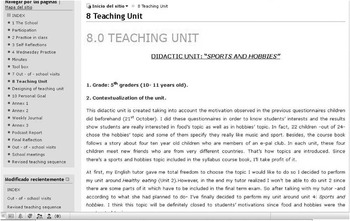
The first drafts of their teaching sequences were then uploaded into a Zoho Wiki so that the group members could highlight and emphasize different aspects directly into the TS draft online (see figure 1).
Example of student-teacher's commented teaching sequence

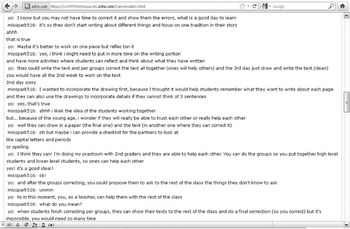
After the first TS drafts had been commented on by all of the group members (assigned by interests), the student-teachers were then asked to arrange online meetings to discuss the comments made on each TS draft. The modality—text or audio chat—and timetable were left up to each group to decide since one of the implicit goals was to get the students to practise with as many technological tools as possible. Therefore, the student-teachers were introduced to a number of CMC platforms (e.g., Skype, Moodle chat rooms), but they decided which best suited their needs. Student-teachers were asked to keep records of their meetings (text transcripts or audio files, see figure 2) which eventually became a component of their final teacher portfolio, also done in a wiki (see figure 3).
Example of posted text transcript of online group meeting

Online Student-Teacher Portfolio Commenting Telecollaborative Exchange

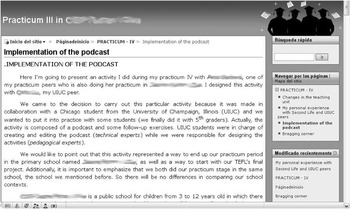
Following these meetings, the student-teachers were expected to revize their draft a second time, and then meet again with their small online working groups before presenting a third (but not final) version of their draft to the face-to-face partners in each institution. In these second presentations, a ‘close-to-the-final version’ was presented, along with the changes that had been made and the rationale for these changes (supported by evidence of reflection concerning online partners’ input and any other source of input they may have had). These teaching sequences were then finalized, incorporating any last input from university tutors, school tutors, classmates or online peers and implemented during the student-teachers’ internship teaching (this applies only to the UAB student-teachers). Reflection on the design and implementation were included in the students’ online wiki (see figure 4).
Implementation of TS Commented in Wiki

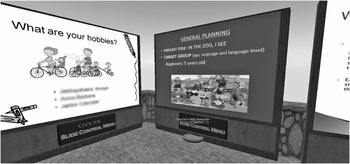
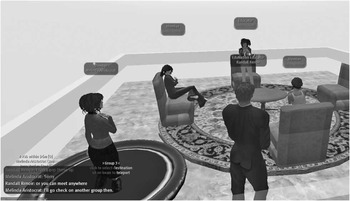
For the second semester, the teacher educators/authors felt the need to include an online activity that required more group collaboration. The student-teachers were asked to work together to design and develop podcasts and accompanying teaching activities. Working in groups, the student-teachers were provided with virtual ‘spaces’ and tools for meetings, this time in a Virtual World (Second Life). In order to introduce all of the students to the Virtual World (VW), an initial online meeting was prepared for a Saturday morning (the only possible day to coordinate dates and hours). An initial ‘round robin’ of introductions via avatars was held and then the students were given instructions for a ‘scavenger hunt’ in order to become more familiar with the ‘lay-out’ of the Second Life (SL) environment, and also to get to know their online working partners (unknown to the student-teachers, the members of these groups had already been assigned and they ‘ended up’ as groups in the scavenger hunt). Clues were given to the different groups to hunt for specific places on the islands in SL (EduNation Islands). At each place, the group members would ‘discover’ hidden ‘notecards’ for clues to the next place to go, ‘notecards’ of questions they were expected to answer later on about their partners (to encourage more interaction) and SL ‘freebies’ (e.g., a motor scooter). The scavenger hunt ‘ended’ at the large group's ‘gathering place’ in the VW which had been designed for them to be able to display their first drafts of the podcast (see figure 5). Various ‘smaller’ meeting places had been arranged for the groups (who had just finished getting to know each other in the scavenger hunt) so they could begin their initial brainstorming of their podcast (see figure 6 and transcript extract 1).
Second Life environment for Podcast draft displays

Smaller SL environments for Podcast planning activities

Transcript 1. Brainstorming the podcast topic and content (part i)
[12:02] Sara: fisrt of all
[12:02] Jazz: its okey
[12:02] Sara: do you know how to save this conversation?
[12:02] Disconnected from in-world Voice Chat
[12:02] Jazz: I just was trying to let you guys know that I was here.
[12:03] Sara: ok ok
[12:04] Sara: Ok
[12:04] Sara: let's decide objectives, etc…
[12:05] Sara: hey
[12:06] Sara: let's say what we know okay?
[12:06] Jazz: Where do you want to start?
[12:07] Sara: do you really want to do a bilingual podcast?
[12:07] Jazz: We can do something more simple
[12:07] Sara: cause if we do it for College students then I don't mind if it's all in Spanish
[12:08] Sara: what you prefer
[12:08] Sara: Let's start again
[12:08] Sara: …
[12:09] Sara: Spanish podcast for 14 year old students? does this fit in your classes?
[12:09] Jazz: Well I don't really mind the language. If you want to use it. We can choose english.
[12:09] Sara: ok
[12:10] Sara: So english podcast for College students?
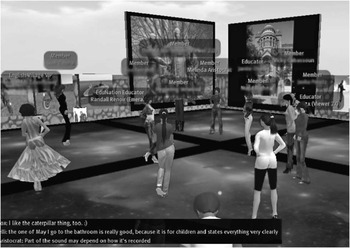
The groups worked together on both the podcast and the teaching activities (pre-, during and post-) activities, although there were different leaders for the varying tasks, depending on individual expertise (technological, pedagogical, etc.). In other words, the student-teachers were organized in what Barab and Duffy (Reference Barab and Duffy2000) have called ‘activity groups’ that consisted of participants coming together temporarily around a particular task (or in this case, various tasks in a Virtual World) that led up to a podcast-based teaching unit. A final, synchronous SL meeting served as both closure (SL party) of the virtual collaboration between the two groups and an opportunity for peers to give feedback on the finished podcasts (see figure 7).
SL closure: Feedback and final party

3.4 Data corpus
The raw data were collected during the two-year collaboration, using ethnographic methods. Data sets were comprized of recordings and transcripts of face-to-face tutorial sessions (for internship teaching) and methodology courses, online wiki (teaching internship digital reports), screenshots from Virtual World collective interactions, forum posts, email exchanges between partnered students, recorded and transcribed text and audio chats between partnered students, student-teachers’ planned teaching sequences (online), and students’ personal learning objectives, self-evaluation sheets and observers’ field notes. Due to space limitations, the data discussed in this article derive principally from the students’ final reports (online wikis), chat transcripts and final (oral) presentations of assimilated learning objectives.
3.5 Collection of data and analytical approach
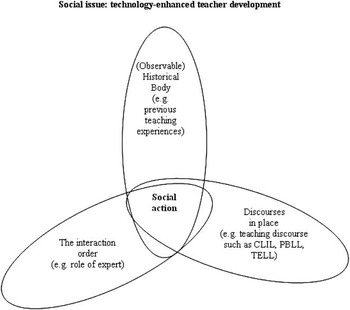
Beginning from an educational ethnographic perspective, data sets were compiled in order to explore teacher development facilitated through the year-long online interaction, using a focus of “nexus analysis” (Scollon & Scollon, Reference Scollon and Scollon2004). Nexus analysis offers a strategy for combining ethnography, conversation analysis and discourse analysis and provides a theoretical account of how participants, context, discourses and objects facilitate action and social change, interconnectedly. Because the study aimed to discern the efficiency of the course design in general, single case studies of individual participants were not sufficient, and multiple action research cases would have produced too much data to analyze. Furthermore, as Scollon and Scollon point out, in complex social interaction, determining which factors are relevant to any action in question is a challenge for researchers. Their approach offers a means of exploring how multiple aspects of complex social action interrelate rather than attempting to analyze one component in isolation. Inevitably socialization occurs through individual actions; however, individual actions are afforded and made intelligible only in respect to the potentially relevant aspects of the context, which includes each individual history, along with the sociohistorical discourses, and interactional organization in which the action takes place. Moments of interrelated action are understood as ‘nexus’. A “nexus” is understood here as a site of engagement where some type of social action is facilitated by a set of social processes (figure 8).
Three main factors of social action, based on Scollon and Scollon (Reference Scollon and Scollon2004)

In this study the social action consists of practices designed to promote novice teachers’ process of professionalization. This social action interrelates with discourses and procedures that limit or facilitate action (the study focuses only on the discourse made relevant and observable by the participants, such as teacher repertoire and teaching paradigms). The site is also interconnected to interaction order, or the way in which the persons involved organize the social event (for instance, taking on the role of ‘expert’ in an online chat). The third process that plays a role in the nexus is historical bodies, or the embedded individual habits. Because the researchers did not have direct access to observable sets of data in this process, this has not been included in the analysis.
Scollon and Scollon's analytical sequencing of long-term activities implies the recognition and identification of the “nexus of practice”Footnote 1 by locating the researchers within the same zone of identification as the participants. Researchers can then identify significant mediated action; for the sake of brevity this article only considers interaction order (how the participants organize themselves for social interaction) and discourses in place (cycles of discourse; dominant discourses which may be overt or backgrounded, or internalized as practice, etc.) which allows for the selection of interactional ‘sites’ germane to the study. Since our focus is on how redistribution of interaction order shows teacher development and learning, we also take into consideration nexus of practices that were related to phenomena of ‘being a teacher’ as well as teaching concepts that were deliberately integrated into the course design because they were felt to be relevant to teacher competences.
4.1 Analysis
4.1.1 Interaction order and discourses in place: talking like a teacher
The activity design fomented intensive, online discussion about individual teaching sequences, as seen in the transcript below where Clara (from UAB) is giving feedback to her partner Lynn (in the US). In the following transcript (recorded in Skype and then transcribed) it is possible to see how discourses that had been put into play in the F2F tutorial sessions become part of the mediated discourse for Clara's feedback. In particular, in lines 3–6, concepts of competences and Content Language and Integrated Learning (CLIL) are brought up; several lines are dedicated to the need to provide clearly defined objectives and finally, the idea of project-based online interaction as a final output is proposed. All of these notions (competence-based learning, derivatives of Communicative Language Teaching such as CLIL and Project-Based Language Learning, the importance of clear objectives for continuous, competence-based assessment) were key topics that had been extensively discussed and developed throughout the year while the exchange was taking place.
Transcript 2. Online Chat: Online Partner Feedback on Teaching SequencesFootnote 2
1.
Clara: OK [1] Ok great (.) so I wrote that I thought about give you some feedback about your draft and I had three main ideas that I would like to comment with you
2.
Lynn: ah that's XXX
3.
Clara: It's that you can pras- practice reading comprehension and at the same time to: to work with certain learning I mean to learn something else (.) I mean to connect here in Spain we've got uhm curriculum competences [2] yes here in Spain we are working with competences and (.) and we can connect the English language with another subject for instance Science
4.
Clara: [and]
5.
Lynn: [Ah I see]
6.
Clara: it's I I thought that you could work the reading comprehension related with another subject (.) for instance history (.) and so on (.) to be more connected with them
7.
Lynn: mmmm
8.
Lynn: yeah yeah I see
(…)
25.
Clara: ok nice
26.
Lynn: yeah that's a great idea thank you
27.
Clara: (laughs) you're welcome (.) another thing that I thought that you could explain them what they are going to learn during these sequences because in your draft in the in the interaction I didn't see that you you wrote about how to to explain what the students will be able to do or what they are going to do during these teaching sequences so I thought that it could be a good idea for them to explain what they are going to achieve during these session (.) or not?
(…)
35.
Clara: the objectives (.) I mean do you have you seen my dropbox
36.
Lynn: yeah I I saw yours
37.
Clara: ah you tell me to think about your objectives no (1)
38.
Lynn: ahm ahm I mean do you have any suggestion for my draft as for objectives
39.
Clara: objectives I mean so students will be able to (.) to umpreh comprehend different reading texts
40.
Lynn: ah: I see OK yeah that would be great
41.
Clara: Students will be able to I don't know
42.
Lynn: ((laughs)) OK that sounds yeah oh good fine
43.
Clara: ((laughs)) What else what else you could prepare this ah also in your final I don't know session I thought that it could be a good a great idea if you could prepare a unit to collaborate on a project with another school from for example Spain (.) and these schools would have to deal a reading text about a topic they could do it in pairs and then each pair will have a a peer assigned for the other I don't know how to (.) I'm reading I mean in this sess- the last session I mean all your teaching sequences will be focused like to building a project with another school and to share information
44.
Lynn: I know what you mean when you say another school another school abroad
45.
Clara: Yeah
46.
Lynn: ah I see: just like us
It is relevant to note that Clara suggests that Lynn should think of a final output that will bring closure to her teaching sequence and her recommendation is to use telecollaboration. Lynn immediately picks up on the idea and then adds “just like us” (line 46).
Dialogic discussion of teaching practices was integrated into the computer-mediated communication taking place in the first semester; however, in order to promote a stronger sense of collaboration between the partners, in the second semester ‘activity groups’ (Barab & Duffy, Reference Barab and Duffy2000) were designed for Virtual Worlds, in order to test the hypothesis that greater group cohesion and collaboration would take place (Steinkuehler & Williams, Reference Steinkuehler and Williams2006). Interestingly, the way in which the participants (in this case Jazz, from UIUC and Sara, from UAB; see transcript 3) organized themselves for social interaction during their Podcast planning in Second LifeFootnote 3 shows that the participants were very much ‘on-task’ (identifying themselves with the simulated ‘activity groups’), and both participants call into play ‘teacher talk’ (e.g., objectives, topic, pre-activity, intro and related activities; age-related activities, etc.), very similar to the excerpt shown during the TS feedback session shown in transcript 2.
Transcript 3. Brainstorming the podcast topic and content (part ii)
[12:10] Jazz: We can use the posd cast as a pre activity
[12:10] Sara: yes yes
[12:10] Jazz: I mean we can do it for children. If we are going to use English
[12:11] Sara: I think the podcast should be like an intro and then we can do activities related to it
[12:11] Jazz: I can find native speakers of english easily
[12:11] Janet: yes
[12:11] Sara: yes children but what age???
[12:12] Jazz: Yes, I was thinking that it could be use for introduce vocabulary.
[12:12] Jazz: The age that works for use.
(…)
[12:20] Jazz: We can introduce some words with pictures. Put them voice and text.
[12:20] Sara: ok
[12:20] Jazz: Then do a short conversation example of using those words
[12:20] Sara: and the teacher goals are…
[12:21] Sara: Are the teacher goals and the objectives the same?
[12:21] Jazz: Prepared the students with the vocabulary necessary in order to complete the classroom activities.
[12:21] Janet: u mean the objectives?
[12:21] Janet: ok
[12:22] Jazz: With this vocabulary you can teach past tense, present tense or future.
[12:22] Sara: goals refers to what the T expects? and objectives is related to the SWBAT's?Footnote 4
(…)
[12:42] Sara: then the objectives (what we expect children to do by watching and listening to the podcast) could be the following
[12:42] Jazz: About the second one, is going to depend of how we design the posd cast
[12:43] Sara: SWBAT: 1) comprehension; 2) repdroduction (imitation) and finally 3) production
[12:43] Jazz: Thank you Sara
[12:43] Sara: the objectives go according to the postactivities
The participants’ mediated discourse included a shared teacher culture (or “cycles of discourse”) as demonstrated by similar jargon, topics, etc. which are made relevant by the participants during their Virtual World interaction.
[The] traits that are made relevant by the student-teachers in their online discourse are based on commonalities that they seem to attribute to the whole group, for instance, ‘teacher-identity’. This ‘shared’ identity of ‘teacher’ in the virtual community allowed them to form a cohesion that was more important than other possible identities (for instance, exchange student, Korean, mother, wife, brother, etc.). This is clear in the way in which the majority of their online discourse aligns with ‘teacher-talk’ (Dooly Reference Dooly2011: 325).
The discourses in place indicate a gradual internalization of nexus of practice as they ‘aligned’ themselves with the community of teaching practitioners (Wenger, Reference Wenger1998). The ‘teacher talk’ visible here in these Virtual World ‘activity groups’ are examples of the constellations of mediated discourse practices that were linked to other discursive practices (teacher educators’ discussions, face-to-face discussions) which came from the general ‘nexus of practice’ of teaching but which had just been introduced to the student-teachers at the time of the interaction. Moreover, the discourse mediated through the technology clearly shows how the student-teachers put themselves in the role of teacher-tutor, adopting the discourse of the nexus of practice of this type of interaction and which they arguably will be able to replicate in their own teaching practices with their future students (more discussion on this later).
4.1.2 Redistribution of the interaction order: from ‘knowledge telling’ to ‘knowledge transforming’
Importantly, it is through the mediational means of technology that the participants’ social actions bring about a redistribution of the interaction order and bring new discourse and new nexus of practice (new for the student-teachers) into play. At the same time, it is necessary to look carefully to see if the use of nexus of practice discourse is mainly a ‘knowledge telling’ activity or whether real transformation of knowledge has taken place. Socio-constructivism places great emphasis on the recall and application of previous knowledge (and newly constructed knowledge) in new and different contexts. The Podcast activity was conceived as an activity for collaboration (design) between the UAB-UIUC partners and then reflection on its implementation by the UAB partner involved in the design. However, some of the students took the activity one step further and used and adapted the same Podcasts for different activities, with different face-to-face partners (different from the original pairing), thus drawing in new participants to the Podcast implementation and casting a wider circle of knowledge-sharing members (see figure 9).
Final wiki reporting on Podcast implementation

Scollon and Scollon (Reference Scollon and Scollon2004) propose an analytical framework that, apart from looking at the discursive practices, also interrogates how the individual members experience the nexus of practice. Figure 9 shows the participant's pedagogical understanding of technology-mediated activities, from both the designing side of the activity and the implementation side. The wiki report also indicates growing awareness of how to use technology effectively in the language learning process—in this case the need to adapt the technology according to the level of the target group. In another case, in a focus group discussion (post-SL podcast activity), one of the participants highlights the learning that he felt took place at a distance (in Second Life) while working on the Podcast activity (see transcript 4).
Transcript 4: F2F discussion; Participants: University Teacher (UT); David (DAV)
DAV: i've i've learned a lot from both of the:m and (.) i think one was higher than me and the other one lower (.) but i think when you are supposed to (.) to assess their their wo:rk you have to synthetize your knowledge
(…)
i think it's very hard for you (.) but i've learned a lot of (.) from them a lot from BOTH of them (…) and and do it all on (.) at a DIstance
This is an especially interesting extract when considered from the point of view of ‘scaffolding’—traditionally scaffolding is said to take place between expert and novice, however, this student makes the case for the possibility of peer-to-peer scaffolding in the Virtual World, in this case through the interaction order of taking turns in the role of tutor. The idea that a learner would benefit from working with someone of a higher level (as mentioned by David) is not surprising to those familiar with Vygotsky's Zone of Proximal Development (ZPD) which maintains that:
the distance between the actual developmental level as determined by independent problem solving and the level of potential development as determined through problem solving under adult guidance or in collaboration with more capable peers. (Vygotsky,Reference Vygotsky1978: 86)
However, David's experience in learning a lot from the other partner, who was “lower”, suggests that—for teacher trainees at the very least—the ZPD can be modified to include potential benefits for the more capable peers in the working relationship (for a more thorough analysis of the constraints and affordances of ZPD and peer scaffolding, see Lantolf & Thorne, Reference Lantolf and Thorne2006).
Moreover, this means of scaffolding through technologically mediated discourse helped the student-teachers develop a greater level of capacity for critical thinking, based on reflection on their own work. Consider this student-teacher's reflection on the co-constructed podcast and activities:
To sum up, the podcast and the activity were not very well contextualized and the link between them was weak. (…) there should be a clear link between the podcast and the follow-up activity/ies. In the lesson plan the follow-up activity has the same format as the podcast, but not the same content. In other words, the podcast was more like an extensive modeling of the activity, rather than introducing anything new. (Final reflection in wiki report)
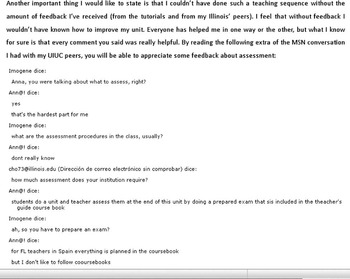
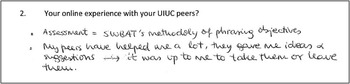
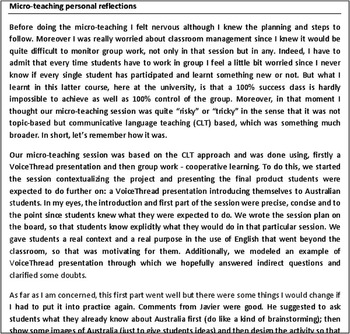
This development of nexus of practice as well as more critical thinking is corroborated by the student-teachers’ self-evaluation of the exchange (see figure 10) in which the student highlights new jargon that emerged from the interaction order (SWBATs) and the need for carefully phrasing objectives as well as learning to interact with peer assessment.
Student-teacher assessment of online experience

This is an especially intriguing example of redistribution of interaction order that outlines both gradual internalization of discourse of the nexus of practice and the way in which the ‘virtual’ Community of Practice contributed to socially distributed cognition of the new participants. The two teacher educators/researchers can be considered as the ‘original’ members of the Community who help the peripheral members (student-teachers) join the community. Within this VCoP, The ‘SWBAT’ term was first introduced into ‘nexus’ discourse by the UIUC teacher in F2F sessions, his student-teachers appropriated the term and then ‘taught’ the term to the UAB student-teachers in their online exchange. In short, CMC facilitated the transfer of knowledge indirectly from the UIUC teacher to the UAB student-teachers.
4.1.3 Significant mediated action bringing about social change: integration of technology into teacher practice
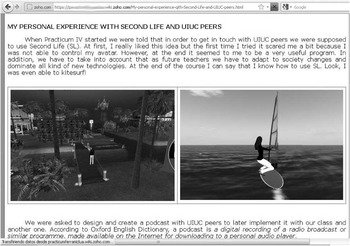
Perhaps some of the most significant events of redistribution of interaction order were within the parameter of new technologies for language teaching, as perceived by the participants before and after the Virtual World exchange. All of the participants indicated that the experience had given them a sense of self-achievement and confidence to work with technology in their own teaching. While not all of them found SL to be relevant to their teaching in primary education, they did indicate that the steep learning curve of working in SL had given them the confidence that they could meet other challenges posed by technology (see figure 11).
Evaluation of SL by individual member

Consistently, in the UAB group, the student feedback (final wikis, focus group interviews) indicated that the Virtual World environment, while exciting and innovative (and perhaps a bit scary at times), was their least favorite tool used during the collaboration. Perhaps this is not surprising considering that they are studying to become primary education teachers and at that time only users aged eighteen and older were allowed on the main grid (SL now allows access to users as young as thirteen with some restrictions). Adjustments to the teacher education course will take these opinions into account although this does not imply that Virtual Worlds will be left out of the exchange. Instead, the student-teachers will have the opportunity to read about and experiment with successful use of Virtual Worlds with very young language learners (see Sadler & Dooly (2013) for an account of the use of SL with six-year-old EFL students) and thus help them to see the relevance of this tool for their teaching as well.
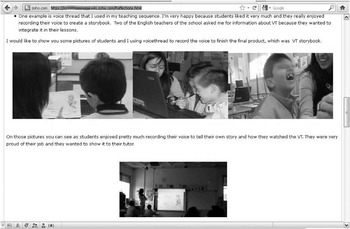
However, despite their reluctance to accept SL as a useful teaching tool for them, the student-teachers felt that the experience had increased their general confidence in facing unfamiliar technology and it also indicates a degree of critical thinking and reflection concerning the selection and integration of technology in their own teaching. Chapelle and Hegelheimer stressed the need for twenty-first century teachers to “effectively and critically engage in technology-related teaching issues (…) within a world that is decisively supported and interconnected by technology” (Reference Chapelle and Hegelheimer2004: 300). The term ‘critically’ is sometimes overlooked when teachers are being pushed to adopt technology into their classes—not all tools will meet the needs of their students and teachers need to be able to discern this. The following figure denotes one of the student-teachers’ deliberate integration of one of the tools used during this collaboration (VoiceThread) into an internship teaching activity. Further on in her digital report she was also able to justify why she did not think another tool that was used during the course, Virtual Worlds, was appropriate for her students (not shown).
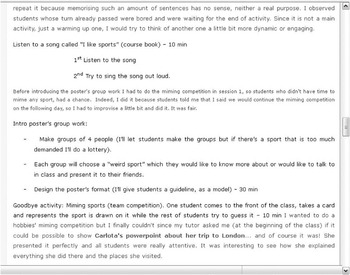
Just as the student in figure 12 appropriated one of the tools used during the collaboration (Voicethread) as a component of her TS, another student decided to integrate a telecollaborative project into one of her teaching activities (see figure 13). In her explanation in her wiki and in a focus group interview, the rationale she provides for using telecollaboration is that it provides a ‘real opportunity’ for students to use ‘real language’ to communicate. In other words, she has come to recognize the affordances of Computer-mediated Communication for Communicative Language Teaching.
Wiki report outlining use of tool for communicative-based language teaching

Student-teacher provides rationale for designing telecollaborative task

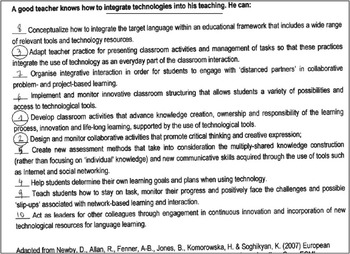
At the beginning of the academic period, the student-teachers were asked to rank themselves in different areas of competence, using a self-evaluation sheet adapted from the European Portfolio of Student Teachers of Languages (Newby et al., Reference Newby, Allan, Fenner, Jones, Komorowska and Soghikyan2007). The student-teachers were asked to indicate the competences they felt they already had and to take note of competences that they wished to work on during the year. Part of their final ‘wiki’ report (as shown in figures 1, 2, 3, 4, 9, 11, 12 and 13) included reflection on the competences assimilated by the end of the year and explanations of why they felt that they now held these competences. Returning to their self-ranking, the students had to revise and reflect on their level of assimilation of the competences they had chosen for the personal learning objectives.
Example of self-ranking of competences

Eighty-two percent of the student-teachers from both years listed the following competences in their top three assimilated during the academic year:
• Adapt teacher practice for presenting classroom activities and management of tasks so that the practices integrate the use of technology as an everyday part of the classroom interaction.
• Develop classroom activities that advance knowledge creation, ownership and responsibility of the learning process, innovation and life-long learning, supported by the use of technological tools.
• Create new assessment methods that take into consideration the multiply-shared knowledge construction (rather than focusing on ‘individual’ knowledge) and new communicative skills acquired through the use of tools such as Internet and social networking.
5 Limitations of the study
This is a study that endeavours to take a micro-analytical, cross-sectional examination of several events that make up a whole—in this case, the design and implementation of a telecollaborative language learning project in a blended environment. The researchers opted for a wider perspective than a case study of only one student or one pair would have afforded; however, because the study takes a micro-analysis approach, only quite limited data samples can be presented. Nonetheless, this approach yields a rich description of the complexity of behaviour, including the typology and intensity of the actions of the participants involved although it cannot be interpreted as representative of the collective experience of all the participants, as might be done with quantitative analysis.
6 Conclusion
‘Testimony’ by students at the end of the year during final presentations to the university tutor and invited guests university tutor and invited guests (school tutors, other teacher educators, and the Dean of the Education Faculty) corroborates the findings from the data. In these presentations, the students had to synthesize their learning and discuss the assimilated objectives they had set for themselves. In transcript 5, Alicia mentions the exchange as one of the key features in helping her become more ‘professional’. She highlights how all of this has helped her to be more objective about teaching decisions (‘filter through advice’ and ‘have confidence in her decisions’) and the importance of ‘communicating with other teachers’ beyond the school (or, arguably, participating in communities of practice).
Transcript 5: Final presentation: My Teaching Trajectory (i)
Alicia: okay i'd like to present my journey (…) my trajectory my trajectory to (.) become a teacher: u:h (.) i've tried to symmarize what i did a:nd (.) the impact that has on me these ((points to the powerpoint)) are some of things i did here at the UAB (.) which were the tutorials the vignettes the microteaching: the online exhange with (.) UIUC students and the action research these are SOME things which has made me (…) i've learned to filter throu:gh the advice you gave me (…) gain confidence in my own decision-making and ability in front of the cla:ss (.) (…) okay another thing u:h (.) i gave is to think about the importance of communication among tea:chers (.) this is basically with (…) that communication goes beyond school
In transcript 6, a student-teacher mentions the importance of carefully planning interaction so that real communication and interaction can take place which can be promoted through the innovative use of technologies (she even mentions Second Life as a possibility!). The student-teacher demonstrates that she has come to understand that technology can serve as a tool for her students to learn languages in a contextualized, purposeful manner.
Transcript 6: Final presentation: My Teaching Trajectory (ii)
now i can see the li:ght (…) interaction (.) i think we have to promote not only (.) m (.) stu- teacher faced and student interaction but (.) also promoting interaction among students (…) a:nd xx i think it's important to promote the use of technologies in teaching and (.) innovative tools that just we did he:re with second life XXXX to be there a:nd voicethread (…) the three last points which are the most important ones for me is that students you have to (.) at least you have to TRY that students see that they use the language for a purPOSE which is communiCATE °to communicate with OTHERS° (…) no matter the language then you you need to (.) to contextualize the LEARNING so they will see that they learn for a purPOSE and then as cristina pointed out just now to see learning as a continuous process °it never ends° so in the end this is me ((points at the powerpoint)) as a professional educator
The final goal of any teacher education course must be to prepare future teachers to succeed in the classroom. As indicated in the above testimony, the telecollaborative interaction between the two groups of student-teachers helped make this goal a reality. These transcripts, as well as the other data presented, highlight the competences they assimilated through the collaboration but, perhaps more importantly, they indicate their convictions that the theory taught (e.g., the need to create authentic language use for their students) can be combined with newfound resources (e.g., the use of CMC and telecollaboration in project-based language learning). Through this collaboration the student-teachers at UAB and UIUC became more professional and engaged in VCoPs where they saw the importance of teacher-teacher collaboration in creating better lessons for their own students and moved from ‘knowledge telling’ to ‘knowledge transforming’.
Acknowledgements
The authors would like to thank the students depicted in this article for graciously agreeing to be recorded during all their classes and for allowing us insight into the process of their professional development. Also, thanks to Victoria Antoniadou, PhD candidate at the Universitat Autònoma de Barcelona (Spain) for Transcripts 4 and 5. We are grateful to the reviewers for their insightful comments.