1 Introduction
From active knowledge creation to social networking, Web 2.0 technologies including blogs have opened up new horizons for L2 teaching and learning. Blogs or weblogs are websites, typically authored by an individual and organized in a reverse chronological order over a period of time. In contrast to traditional web creation, blogs are easy to make without the need of HTML knowledge. Multimedia features including external links, digital photos, audio and video clips are used to enhance the content and the attractiveness of the appearance. Given that blogs are asynchronous modes of computer-mediated communication (CMC), authors write at their own pace without time pressure, which allows them to reflect critically upon the content (Oravec, Reference Oravec2002; Richardson, Reference Richardson2005). As opposed to the teacher-centered setting, creating blogs promotes learners’ autonomy because they are in charge of making their own decisions as to what, how much and when to publish their work online. The instantaneous nature of content publishing for a broad audience rather than for a sole instructor increases students’ motivation to produce quality work (Ward, Reference Ward2004). Furthermore, archived entries that document students’ work over time enable teachers and students to assess writing in progress (Godwin-Jones, Reference Godwin-Jones2003). Unlike browsing through static web pages, blogs evolve into a dynamic and interactive network where authors not only create and update content but also share and exchange ideas through responses with comments (Lee, Reference Lee2009a; Rodzvilla, Reference Rodzvilla2002). In sum, blogs open both personal and social spaces for learners to express thoughts, develop digital identity, and make connection with others within a virtual learning community (Huffaker, Reference Huffaker2004).
2 Using blogs as a L2 teaching and learning tool
With the aforementioned benefits, blogs have received attention from language practitioners (e.g., Ducate & Lomicka, Reference Ducate and Lomicka2008; Elola & Oskoz, Reference Elola and Oskoz2008; Murray & Hourigan, Reference Murray and Hourigan2008; Pinkman, Reference Pinkman2005) and have continued to evolve in L2 instruction. L2 blogs are used in various ways for different pedagogical purposes. For example, personal blogs are collections of online journals that foster self-expression and self-reflection, whereas collective blogs involve an entire class or small groups of students who collaboratively construct L2 knowledge. L2 research has shown that learners benefit from writing and reading blogs. Blogs written by native speakers afford students the opportunity to gain cultural knowledge from a range of different perspectives (Elola & Oskoz, Reference Elola and Oskoz2008; Ducate & Lomicka, Reference Ducate and Lomicka2005; Pinkman, Reference Pinkman2005; Schuetz, Reference Schuetz2005). Ducate and Lomicka (Reference Ducate and Lomicka2005) stress that students become active readers by being given the freedom to choose their own topics to read and further develop a better understanding of the target culture. By being exposed to multiple views, learners also develop their interpretative and critical thinking skills (Ward, Reference Ward2004).
Regarding writing blogs, L2 research has mainly focused on using blogs as online journals for the development of learners’ writing fluency (e.g., Armstrong & Retterer, Reference Armstrong and Retterer2008; Bloch, Reference Bloch2007; Campbell, Reference Campbell2003; Fellner & Apple, Reference Fellner and Apple2006; Johnson, Reference Johnson2004). Murray and Hourigan (Reference Murray and Hourigan2008), for example, have discussed the essential aspects of using blogs for creative and reflective writing in the academic setting. According to Williams and Jacobs (Reference Williams and Jacobs2004), creating blogs helps students increase their awareness of the target audience as they think critically about how their views might be reflected upon by the readers. Moreover, students develop their metacognitive skills to regulate their own writing in the process of blogging (Ward, Reference Ward2004). Learners experience a sense of self-discovery and personal growth during the reflective period (Oravec, Reference Oravec2002; Wagner, Reference Wagner2003). Murray and Hourigan (Reference Murray and Hourigan2006) remark that learners gain confidence in writing and develop their own approaches that suit their personal writing styles. Lee (2009a) adds that students increase their motivation to write because they no longer just write for a sole instructor but rather for a broad audience.
Using a socio-cognitive approach, class blogs have been designed primarily for intercultural exchanges to promote cross-cultural awareness (Carney, Reference Carney2007; Ducate & Lomicka, Reference Ducate and Lomicka2005; Lee, Reference Lee2009b). For example, Ducate and Lomicka (Reference Ducate and Lomicka2005) in their study found that both American and French students benefited from sharing their study abroad experiences of the target culture. The results of Lee’s (2009b) intercultural exchange study showed that group blogs created a social workspace where students worked collaboratively to share knowledge and exchange ideas. Through peer feedback, both Spanish and American groups gained cross-cultural awareness and linguistic knowledge. Dippold (Reference Dippold2009) and Lee (2009b) conclude that peer feedback through collaborative scaffolding is less intimidating than teacher-led evaluation. Interactive feedback further helps L2 learners develop new ideas and notice linguistic problems that may lead to error corrections. In sum, L2 research has shown that using blogs not only enhances learners’ writing fluency and literacy skills (Baggetun & Wasson, Reference Baggetun and Wasson2006; Bloch, Reference Bloch2007; Godwin-Jones, Reference Godwin-Jones2006, Reference Godwin-Jones2008; Lee, Reference Lee2009a; Ward, Reference Ward2004), but also facilitates intercultural learning (Elola & Oskoz, Reference Elola and Oskoz2008; Jones & Nuhfer-Halten, Reference Jones and Nuhfer-Halten2006).
Despite the fact that the existing research is valuable to understanding blog technology in L2 teaching and learning, no study has yet investigated closely the effectiveness of blogs within the context of advanced Spanish language instruction at university level. Using a four-skill integrated approach to task-based activities, the study on which this paper is based explores how a blog as computer-mediated tool engages learners of Spanish in reflective and interactive learning. The study involved seventeen college students in a fifth semester advanced language course, who created personal blogs in order to share and exchange ideas with their peers. Drawing on a triangulated data collection from blog entries, post surveys and final interviews, this paper discusses the potential and challenge for using personal blogs by examining students’ views of the digital tools, the role of task, and the effect of feedback.
In accordance with the expressivistFootnote 1 and socio-cognitivistFootnote 2 approaches to blog writing proposed by Murray and Hourigan (Reference Murray and Hourigan2008), the current project aimed: (1) to build learners’ writing fluency through self-expression and reflection, (2) to create an interactive community where students share and exchange ideas with each other through social networking and (3) to enhance critical thinking through peer comments and language awareness through expert scaffolding.
3 Methodology
3.1 Project setting and goals
The blog project was carried out as part of the Advanced Spanish Composition and Conversation Course Footnote 3 at a large public university in the northeastern United States. The class met weekly for three hours in real time in the spring of 2009. In addition to other course assignments, blog entries worth 20% of the course grade were part of homework outlined in the syllabus. It should be noted that the course management system—Blackboard–has been regularly integrated into the author’s courses to supplement course materials and organize assignments outside of class. However, since Web 2.0 tools including blogs were not available in Blackboard at the author’s institution, several free software programs were adopted for the blog project (see section 3.3 for more information). The primary goal of the project was to create additional opportunities for students to express personal views on various topics and to interact socially through knowledge sharing outside of the classroom. Lee’s (Reference Lee2008) CMC study on focus-on-form through scaffolding illuminated how the expert drew learners’ attention to focus on linguistic problems that resulted in error corrections. Thus, for this project, the instructor played a facilitative role in providing students with linguistic feedback including syntactic and lexical items to reinforce language accuracy.
3.2 Participants
The participants were seventeen students who enrolled in an advanced Spanish course taught by the author. The students had successfully completed the intermediate courses or were placed into the course by a computer standardized placement testFootnote 4. The majority of the students were either Spanish majors (n = 4) or minors (n = 9). Most of the students had reached the intermediate level of language proficiency based on the results of the placement test prior to the study. They had sufficient language skills to express themselves and exchange ideas with others in the target language. The class consisted of freshmen (n = 8), sophomores (n = 6), juniors (n = 2) and senior (n = 1). A few students (n = 4) had spent one to three weeks in a Spanish-speaking country (Peru = 1; Costa Rica = 1; Spain = 2) during their senior year of high school. Despite the fact that the students were comfortable with Web 1.0 technology including browsing information online, e-mail and text-chat, none of them had used blogs for L2 learning prior to the project. Therefore, a brief training session on how to use Blogger for blogs and iMovie for voice recordings was provided to the students.
3.3 Web 2.0 Tools
Several freely available software programs were adopted to facilitate this project. Blogger (http://www.blogger.com), one of the most widely used weblog services, was employed to create personal blogs. Blogger was chosen because of its simple to use interface that allows users to easily change page layout (e.g., fonts, color, alignment). Users can also add other multimedia features including images, audio and video files to support the content. Blogger is currently available in 41 languages including Spanish, which enables L2 learners to create the entire site in the target language. In addition to Blogger, iMovie was used to create audio recordings to be embedded in Blogger. It should be noted that the Language Resource Center at the researcher’s institution owns a Mac lab and iMovie is one of the software programs already installed in the lab. The greatest advantage of using iMovie is its capacity for recording both audio and video clips with images that display during play. Other features, including the addition of adding titles, transitions and special effects, are also available as editing tools. Recordings can be easily saved as MP4 filesFootnote 5 to upload to Blogger. The uploading process may be slow, as videos tend to be large files.
To facilitate the process and avoid technical difficulties, the instructor asked students to bring their laptops to class at the beginning of the semester and provided them with a hands-on session during which they created an introductory entry to practise the main features of Blogger including adding photos, images, external links and videos. To provide additional assistance, students were encouraged to use the online Blogger Help site (http://help.blogger.com/). Additionally, the instructor prepared a step-by-step handout to guide students to use iMovie. With the assistance of a lab technician, students learned how to use iMovie and upload recordings to Blogger. Students were encouraged to familiarize themselves with Blogger and iMovie prior to the blog project.
3.4 Task design
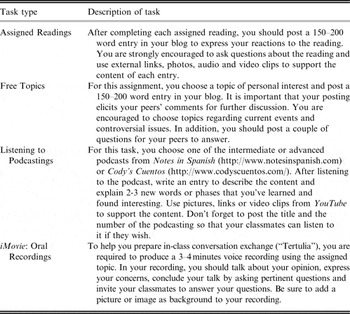
According to Samuda and Bygate (Reference Samuda and Bygate2008), task-based activities aim to enhance learners’ abilities to use the target language rather than to acquire new language skills. Thus, a four-skill integrative approach was implemented in the design of various tasks. Four types of tasks were created and each type aimed at the use of a particular language skill (Table 1). For instance, listening to selected podcast sites reinforces students’ aural and interpretative skills, whereas making oral recordings using iMovie enhances their pronunciation and speaking skills.
Task type and description of task

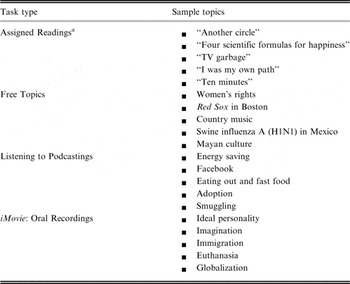
Readings from the textbook, student-chosen topics, selective podcasting sites and various controversial issues served as a point of departure for blog assignments (Table 2).
Sample topics for each type of task

aAssigned readings were drawn from the textbook Revista (Blanco, Reference Blanco2010), which contains poetry, drama, prose and essays, published by Vista Higher Learning.
3.5 Procedure
As part of the course requirement, each student kept a personal blog throughout the semester. Each week students were responsible for posting one or two entries using various types of task (see Table 1). Students spent approximately three weeks designing their blogs and posting the first two entries. Upon completion of the initial assignments, the instructor collected the blog addresses and posted them in Blackboard.
Students were asked to read, comment on and respond to each other’s entries. As these students were still developing their interlanguage and did not have sufficient linguistic knowledge to offer corrective feedback on lexical and grammar items, they were only required to provide feedback on the content. In order to obtain spontaneous peer feedback, no restrictions were placed on when, how and how much feedback should be provided. The instructor facilitated the process of blogging by monitoring students’ discussions and provided them with linguistic feedback throughout the semester. The instructor read the students’ entries and wrote comments on incorrect usage of lexical items and grammatical structures. For instance, the instructor underlined each error and wrote the code for the correction, such as “vt” for verb tense, “voc” for wrong word and “prep” for incorrect preposition. In addition, brief explanations of major linguistic issues (e.g., the preterit vs. the imperfect) were provided to the students to guide them through the process of error corrections. The entries were then sent to the students via Digital DropBox in Blackboard. After receiving the instructor’s feedback, students made error corrections by editing the entries on their blogs.
At the end of the semester, the instructor created an online survey hosted by SurveyMonkey.com to gauge students’ views and attitudes toward the blog project. More than 90% of the students (n = 16) voluntarily completed the post survey. The instructor also conducted final interviews to gather additional feedback and to secure in-depth understanding of how students’ experiences with blogs have affected the way they view online writing. Final interviews were carried out with a group of three or four students to create an interactive dialogue between the students and the instructor. Each group interview lasted approximately 40 minutes and was recorded digitally for data analysis.
3.6 Data collection and analysis
The data gathered from student-made blogs, online surveys and final interviews were used for data analysis. This triangulation of data lends credibility and confirmability to the findings. The online survey consisted of 13 statements. A 5-point Likert scale ranging from 1 (1 = Strongly Disagree) to 5 (5 = Strongly Agree) was used to gauge students’ reactions to the blog project. Students indicated their level of satisfaction by ranking each statement from 1–5. The survey elicited responses in three areas: the effectiveness of blogs for online writing and exchange, the affordance of task type, and the role of feedback. Additionally, a 4-point scale statement from 1 (1 = Not at all interesting) to 4 (4 = Very interesting) was employed to determine students’ rating of each task type. Open-ended interview questions were used to obtain additional observations and offer suggestions for improvement. Responses on similar topics were grouped together and incorporated into the survey results for discussion. Qualitative data from readily available blog posts and comments provided additional evidence to illustrate and support the findings.
4 Findings and discussion
4.1 Effectiveness of blogging for online writing and idea exchange
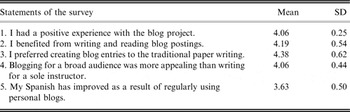
The mean score displayed in Table 3 records the students’ reactions to the use of blogs for online writing and idea exchange with their peers.
Student perspectives of the blog project

Overall, students reacted very positively toward the blog project (statement 1) and agreed that they benefited from creating and reading blog entries (statement 2). During the final interviews, more than 50% of the students expressed their enjoyment in using personal blogs to share ideas with their peers. The following comment drawn from the final interview exemplifies this sentiment:
“Writing entries gave me a personal space to reflect on different topics.
Blogging is a unique way to connect and interact with others. Despite the amount of time and effort invested into creating this project, I know I have benefitted greatly from it. I would definitely use blogs again for my other Spanish classes.”
Overwhelmingly, more than 80% of the students preferred blogs to writing on a piece of paper (statement 3). For example, in comparison to the traditional formal writing, students found blogging more fun and less stressful. Students were also in favor of using multimedia (e.g., external links, photos, YouTube video clips) to support the text content. Writing for an audience of their peers was particularly appealing to the students (statement 4). Students repeatedly remarked that they felt more compelled to write when they knew that their peers, rather than a sole instructor, would read and respond to their postings. One student explained: “Knowing my blog posted in Blackboard made me more serious about my writing. I usually checked each entry a couple of times before I published it online because I did not want to make careless mistakes.” Such perceptions of awareness of their own writing were also reported in the study of Lee (2009a). After using one-semester blogs, many students (78%) believed that using blogs on a regular basis had helped them develop L2 competence, especially their writing fluency (statement 5). One student acknowledged:
“Writing has become easier for me. I’m now more confident in expressing myself after having posted more than 20 entries. Not only did I improve my writing skills but also gained different perspectives that I had never thought about before.”
Furthermore, students made comments about the chronologically archived entries that recorded their writing and allowed them to view the progress of their work. These findings suggest that blogs as a computer-mediated tool foster the development of personal reflective writing.
4.2 The affordance of task type and choice
Regarding task-based activities, students were asked to rate three statements to find out the role of task (Table 4).
Student views of task-based activities

The results shown in Table 3 indicate that students mostly found tasks stimulating because they promoted the meaningful use of the target language (statement 6) and they were satisfied with both assigned and free topics (statement 7). During the final interview, one student expressed her approval of using various types of tasks:
“I liked how teacher-assigned topics required us to critically think about the readings and free topics allowed us to incorporate personal interests and write about world issues that concerned us the most.”
Significantly, tasks created affordable opportunities for students to use the four language skills (statement 8). The following excerpts drawn from the final interviews further demonstrate how the students viewed the positive effects that tasks had on the development of their language competence:
• In my view, using various types of tasks that required the use of certain language skills was the most beneficial aspect of this blog project. I enjoyed most the native-speaker podcasts because it helped me improve my listening comprehension.
• Tasks were engaging and created a dynamic way of using blogs for real-world communication. At the beginning it was a bit confusing because we had to go to different web sites or use different tools for the assignments. Overall, I really liked how each task was targeted to a different language skill.
• I think blogs got us to a well-balanced exposure to the use of four language skills. For example, using iMovie for voice recordings allowed me to practice my pronunciation and speaking skills, which were my weaknesses.
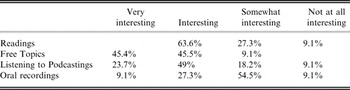
When asking students to rate their preference among the various types of tasks, the results clearly showed that they were in favor of using free topics (Table 5). Topic choice appears to affect the amount of writing that students produced and the degree to which they socially interacted with each other. More than 50% of students not only produced longer entries (approximately 300 words for each entry) using free topics but also added a variety of embedded multimedia resources including personal pictures, slide shows and video clips to support the content.
Student ratings of different types of task
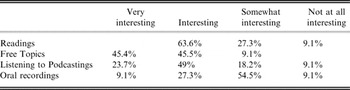
It is likely that students at the intermediate level of language proficiency felt comfortable discussing topics that related well to their personal experience including travel, hobbies, university lives and daily activities. One student echoed the same statement: “I felt motivated posting entries using topics of my choice because it enabled me to incorporate my personal interests and be creative. I really wanted to share my views about things that mattered to me the most with my peers.” As a result, students wrote and responded to more comments on free-topic entries than on teacher-assigned topics.
Despite the fact that students liked the idea of using the readings from the text, some students (n = 6) admitted that it was challenging for them to write meaningful reflections and substantial comments to respond to their peers. One disappointed student explained: “Most people made similar observations about the readings and some of the comments were repetitive. I did not find this assignment engaging and useful.” In contrast to what Murray and Hourigan (Reference Murray and Hourigan2008) found in their study, the readings did not appear to foster deeper thinking and further discussion. It is possible that the majority of the students were freshmen and sophomores, and they might not know how to write critically. The instructor could use questions to prompt students to reflect on reading materials.
As shown in Table 5, oral recordings received the lowest rating from students. Comments drawn from final interviews revealed that students’ technology skills affected how they felt about recording assignments. Due to the fact that nearly the entire class had never used a voice recording prior to the project, it is likely that students encountered difficulty in using iMovie. Students suggested that additional training on iMovie should be made available for them to maximize its potential use. In addition, more than one third of the students (n = 7) acknowledged that they found making voice recordings time consuming because it took a lot of time to upload a video to Blogger. A few studentsFootnote 6 expressed discontent with making voice recordings in the open space of the language lab. As a result, they became frustrated and were not satisfied with the quality of the recordings. The use of technology should not be a burdensome task for the students (Armstrong & Retterer, Reference Armstrong and Retterer2008). One recommendation would be to provide students with private rooms to ensure the quality of recordings. Instructors should seek alternatives, such as using two platform recording software such as Audacity to accommodate individual needs.
4.3 Feedback on content and linguistic form
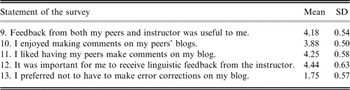
Students were asked to rate five statements regarding the role of peer and teacher feedback (Table 6).
Student reactions to peer and teacher feedback

The results proved that a combined strategy for the use of peer and teacher feedback was useful and motivational to the students (statement 9). Comments gathered from the interviews revealed that most of the students did not feel comfortable providing linguistic feedback to each other because the lack of confidence in their own L2 knowledge would not enable them to give meaningful advice. These findings corroborate those found in the blog research conducted by Dippold (Reference Dippold2009) and Lee (Reference Lee2009b). Although a few students (n = 3) complained about the amount of time that they had to spend on readings blogs, students enjoyed writing comments on each other’s posts (statement 10) as well as receiving feedback from their peers (statement 11). Comments gathered from the interviews revealed that students were eager to read peer commentaries about their posts and their interest in responding to their peers increased as well. Peer interactive feedback indeed strengthened reflective thinking. The following is an exampleFootnote 7 of how a student responded to her peer’s comment on the overuse of Facebook in a reflective manner (translated to English):
“Your point was interesting. I have never thought about the parents. My mom has a facebook but she only uses it to post family pictures. I agree that facebook is a wonderful tool for us to connect with people. However, I think people spend too much time online. Also there is not much privacy. I actually prefer e-mail.”
Furthermore, peer feedback appears to show affective support of social interaction. For example, this student complimented his peer’s work in the following example (translated from Spanish):
“I really enjoyed reading your entry about having New York City go dark for Earth Hour. I did not know about this and I think it is a great idea to shut off the lights for an hour to save energy. I wish people would turn off the light when they leave the room. We waste too much energy in this country. Well-done! Matt.”
Peer interaction also makes students feel emotionally connected. In another case, the student expressed her sympathy for another student by commenting on what she wrote about not being able to sleep during the stressful semester (translated to English):
“Sara, I feel for your stress. I have almost the same schedule as yours. I know you will survive! If you need someone to talk to, I’m here for you.”
Pragmatically competent speakers know how to express themselves appropriately in a social context. By putting herself in Sara’s shoes and offering affective support to her, the student demonstrated her pragmatic ability. Overall, peer interactive feedback was not threatening to the students. In fact, it created a comfortable and supportive learning atmosphere for online interaction.
Like other asynchronous CMC, blogs tend to encourage fluency rather than accuracy. Not until students receive linguistic feedback do they use L2 as a primary means of communication and self-expression (Lee, Reference Lee2008; Murray & Hourigan, Reference Murray and Hourigan2008). The finding clearly showed that students valued the instructor’s linguistic feedback (statement 12). The high rating of corrective feedback received from the instructor (4.45 out of 5) suggests that focus-on-form procedure carried utmost importance for the majority of students. A number of students admitted that linguistically they were not strong enough to detect lexical and grammatical errors and they further acknowledged that teacher feedback encouraged them to pay more attention to the language itself. As a result, they gained a better understanding of certain grammatical structures and usage of lexical items. Moreover, linguistic feedback helped them reflect on their own weaknesses and strengths, as illustrated by this student’s comments during the final interview:
“I must admit that sometimes I was just focusing on expressing myself and forgot to check my writing carefully before I published them online. Teacher feedback raised specific grammatical issues. After reviewing my entries, I noticed that the major weakness in my writing was the use of the past tense. I tended to overuse the preterit. The process of making error corrections helped me understand better these complex grammar structures. I feel that my writing has improved.”
Although this study did not attempt to measure students’ progress in L2 writing, after reviewing the entries that this student wrote throughout the semester, the quality of her writing indeed demonstrated improvement, especially her understanding of using the two temporal aspects of the preterit and the imperfect as shown in the following unedited blog entries during the third and the eighth week:
“El año pasado mi familia hizo un viaje a europa. Este fue mi primer viaje afuera de los estados unidos y mi primera vez en un avión. Estuve muy emocionada y tuve miedo también. Cuando llegamos en Barcelona, fueron casi las once de la tarde. Nos quedamos en Barcelona tres días y veíamos muchas cosas como Montserrat …. Al final, era muy contenta con la experiencia.” (third week)
[Last year my family took a trip to europe. This was my first trip outside of the United States and my first time in a plane. I was very emotional and afraid too. When we arrived at Barcelona, it was almost eleven o’clock at night. We stayed in Barcelona three days and we saw a lot of things like Montserrat … At the end, I was happy with the experience.]
As the above example shows, the student had difficulty in using the correct structure of the past tense, such as “fueron” (the preterit) versus “eran” (the impefect) and “estuve” (the preterit) versus “estaba” (the imperfect). By the eighth week, her writing did show improvement in the use of the two distinct aspectual past tenses:
“Me gustaban estos podcasts mucho. Recientemente empecé a mirar la tele española y a veces, es muy difícil comprender. La historia que Mariana y Ben hablaron era muy interesante. Un hombre robó muchos bancos y la policía no pudo cogerlo por 15 años. El hombre llevaba una peluca y tenía armas. La polícia descubrió que robó casi 600,000 euros y mató dos guardias civiles.” (eighth week)
[I liked these podcasts a lot. Recently I began to watch Spanish TV and sometimes, it is very difficult to understand. The story that Mariana and Ben told was very interesting. The man robbed a lot of banks and the police couldn’t catch him for 14 years. The man wore a wig and had weapons. The police discovered that the man stole almost 600,000 euros and killed two civil guards.]
The above excerpt written by the same student illustrates her understanding of the preterit and the imperfect by using several verbs “pudo” (couldn’t), “llevaba” (wore), “tenía” (had), “robó” (robbed) and “mató” (killed) correctly.
Overall, peer commentary feedback in combination with teacher corrective feedback proved beneficial to the majority of students. The finding constitutes support for the notion of maintaining a balance of fluency (meaning) and accuracy (form) addressed by CMC researchers (Lee, Reference Lee2008; Levy & Kennedy, Reference Levy and Kennedy2004; Ware & O’Dowd, Reference Ware and O’Dowd2008).
5 Limitations and directions for future research
Although the findings of this study have shed light on our understanding of the effectiveness of using personal blogs for L2 instruction, much more research is still needed. It would be worthwhile to explore instructors’ responses to utilizing blogs as a teaching tool for L2 learning. Another limitation of this study is that the data collection only included a post-survey. A future study focusing on the comparison of the results of pre- and post-surveys will contribute to a better understanding of personal reflection and interactive exchange through blogging. Another potential area that warrants further study is the use of blogs for telecollaboration involving learners from two institutions with different cultures. It would also be beneficial to include various levels of language proficiency (e.g., beginning and intermediate level) to determine whether they influence how the participants socially and cognitively exchange knowledge in the process of using blogs. Finally, more detailed investigation into the quality of feedback including learning effect on language accuracy will increase our knowledge about using feedback to support online learning.
6 Pedagogical implications and conclusion
More L2 learning is taking place outside of class and it is often facilitated by the use of computer-mediated technology. While a one-semester study of blogs is limited in scope and depth, the students’ perceptions toward blogging have offered valuable insights into our understanding of the use of blogs for reflective writing and social interaction. The findings of this study are noteworthy and offer important pedagogical implications. Firstly, the application of blog technology itself does not guarantee the success of learning outcomes. Tasks that are linguistically and cognitively suitable for the target learners are essential because they affect significantly the quality of writing and the degree of interaction among students (Lee, Reference Lee2009b; Murray & Hourigan, Reference Murray and Hourigan2008). Secondly, as students at the intermediate level of language proficiency are still acquiring their language skills, the integration of a four-language-skill approach to task-based activities not only motivates students to voice their opinions but also enhances the development of their language competence. Thirdly, to promote deeper reflection, the instructor needs to guide students through the peer commenting process and offer them strategies for critical thinking to prompt in-depth and thoughtful responses. Finally, it is important for instructors to create appropriate awareness-raising activities through which focus-on-form is guaranteed in the content-based CMC context.
In conclusion, the study has made a further contribution to our understanding of the use of academic blogs to enhance learning performance and enrich social interaction, both for individual knowledge construction and information sharing. The blog project succeeded in making online learning a rewarding experience for advanced language students. Writing blog entries by using less structure-controlled but more open-ended tasks that are relevant to students’ personal interests empowers them to be creative with the content. Not only the confident but also the shy students participated in interactive exchanges to express their points of view, query the information given by others and defend their opinions. Lee (Reference Lee2008) posits that both meaning-oriented interaction and focus-on-form reflection are essential for L2 development in network-based teaching and learning. While the primary focus of utilizing personal blogs was meaning creation and exchange, the integration of the teacher’s feedback afforded students the opportunity to notice and attend to linguistic problems that resulted in error corrections. Furthermore, regular blogging resulted in creating a greater sense of community and of interactive learning than would have otherwise been possible within the traditional classroom setting. The project serves as a model for L2 professionals who wish to implement blog technology in instructional settings to facilitate L2 development and to promote learners’ critical reflection through multiple perspectives within a socially bounded learning environment.