1. Introduction
Causal explanations not only dominate the written language of science (Wellington & Osborne, Reference Wellington and Osborne2001), but they also go beyond science and “are part of academic literacy generally” (Mohan & Slater, Reference Mohan and Slater2004: 255–256). Despite their centrality in academic success, causal explanations have not received enough attention from writing researchers. The existing studies are mostly descriptive, examining causal language development over time. There is a huge gap in research on how students develop causal language with formative feedback in instructional settings.
Given the challenging amount of work that evaluating learners’ causal explanations and generating discourse-specific feedback manually would result in, such provision of detailed feedback may be through the use of automated writing evaluation (AWE) programs. “AWE programs … are designed to foster learner autonomy by performing error diagnosis of learner input, generating individualized feedback, and offering self-access resources such as dictionaries, thesauri, editing tools, and student portfolios” (Chen & Cheng, Reference Chen and Cheng2008: 97). Since the entrance of AWE programs into the field of second language (L2) writing, several studies have demonstrated positive findings regarding their effectiveness in improving learners’ grammatical and mechanical correctness (e.g. Chodorow, Gamon & Tetreault, Reference Chodorow, Gamon and Tetreault2010; Grimes & Warschauer, Reference Grimes and Warschauer2010; Rock, Reference Rock2007). However, there is a lack of studies on their effectiveness to improve learners’ discourse due to the inability of AWE tools to evaluate meaning. Addressing this gap, this study explores the effectiveness of an automated causal discourse evaluation tool (ACDET), which was specifically developed for the purpose of improving learners’ written causal explanations.
2. Automated feedback on written causal explanations
2.1 Causal explanations
As causal relations have a crucial role in general knowledge (Lakoff & Johnson, Reference Lakoff and Johnson1999), writers’ ability to express causal relations in writing is also fundamental. This ability requires the knowledge of causal language features, which are the linguistic structures that express causal meaning and causal relationship between events (Chukharev-Hudilainen & Saricaoglu, Reference Chukharev-Hudilainen and Saricaoglu2016). In writing, causal explanations are made either implicitly or explicitly (Stefanowitsch, Reference Stefanowitsch2001). The focus of this study is explicit causal expressions: the linguistic forms that imply causal relationship/meaning. For example, the sentence “Last month the vet gave us the bad news: There was a tumor the size of a golf ball near her heart, which caused her to die within a month” (Stefanowitsch, Reference Stefanowitsch2001: 25) includes the causal verb cause, which is an explicit causal language form.
In this study, causal explanations are evaluated based on six categories that were identified through corpus analysis in an earlier study during the development of ACDET (Saricaoglu, Reference Saricaoglu2015). According to this categorization, causal relations can be expressed using (a) causal conjunctions such as for, if, or so that; (b) causal adverbs such as fatally or in response; (c) causal prepositions (including prepositional phrases) such as through or as a consequence of; (d) causal verbs (including phrasal verbs) such as freeze or result from; (e) causal adjectives such as beneficial; and (f) causal nouns such as influence. Sophisticated causal writing displays more of nouns rather than conjunctions or adverbs as nouns represent higher development according to the developmental path of cause (Halliday & Martin, Reference Halliday and Martin1993; Mohan & Beckett, Reference Mohan and Beckett2003). Therefore, learners would benefit from feedback that would help them move along the developmental path of cause; that is, from conjunctions to nouns.
2.2 Developmental path of causal language
To learn how to write about causal explanations in a more sophisticated way, English as a second language (ESL) learners need feedback on their writing: “If teachers are consistently and reflectively assessing student explanations, focusing on aspects that students are having trouble with, they can provide successful assessment-learning cycles for teaching the forms and meanings of causal explanations” (Slater & Mohan, Reference Slater and Mohan2010: 267).
According to Slater and Mohan (Reference Slater and Mohan2010), the developmental path of cause can guide the formative assessment of causal explanations. Throughout their causal language development learners demonstrate a shift from conjunctions to verbs and nouns, which characterizes the causal developmental path (Halliday & Martin, Reference Halliday and Martin1993). At the early stages of causal language development, learners use conjunctions to express causal relations (e.g. because); later on, they also choose verbs (e.g. cause); and finally, they add nominalizations to their causal repertoires (e.g. the cause) (Mohan & Beckett, Reference Mohan and Beckett2003). In their evaluations of learners’ explanations from early childhood to late adolescence, Christie and Derewianka (Reference Christie and Derewianka2008) found out that the students whose causal explanations were more congruent were between the ages of seven and 12 while the students whose causal explanations were less congruent or incongruent were between the ages of 15 and 17. Halliday (Reference Halliday1994) refers to this development as a shift from more congruent to less congruent (also referred to as grammatically metaphorical) expression of meaning. “Man clean car” exemplifies a child’s congruent language (Halliday, Reference Halliday2003: 19). “Man” is the doer (subject) and he does the cleaning. The action of cleaning is expressed with a verb that follows the subject. This pattern is a congruent pattern, and congruent patterns are characteristic of children’s early language (Halliday, Reference Halliday2003).
In causal explanations, conjunctions represent the congruent expressions of causal relations, prepositions represent less congruent expressions, and verbs and nouns incongruent expressions (Mohan & Beckett, Reference Mohan and Beckett2003). For example, the sentence “My plane was late so I had to run across the terminal” would be the most congruent way of explaining the situation. The development of causal language reflects the transition from congruent expressions to less congruent or incongruent (or more grammatically metaphorical) expressions: “The late plane was the cause of my running.” Slater and Mohan (Reference Slater and Mohan2010) claim that the path from so to the cause can inform the formative assessment of causal explanations. However, performing this assessment manually by identifying causal language forms in student drafts and giving formative feedback based on the causal developmental path would be a very time-consuming task. Providing automated formative feedback instead may help writing instructors overcome issues of practicality.
2.3 Computer-assisted language learning and automated writing evaluation
AWE tools are built based on artificial intelligence, natural language processing, and statistical techniques that enable them to accomplish evaluations of written texts in a much shorter time than manual evaluations (Grimes & Warschauer, Reference Grimes and Warschauer2010). Since their entrance into computer-assisted language learning, AWE tools have been investigated for their accuracy in detecting language errors and scoring essays. Liu and Kunnan (Reference Liu and Kunnan2016) found out that WriteToLearn was not a reliable tool because it could not identify students’ errors in certain categories as articles, prepositions, word choice, and expression. According to Lavolette, Polio and Kahng (Reference Lavolette, Polio and Kahng2015), Criterion also failed to identify many errors of students, and out of all the errors it identified, 75% was correctly identified. Despite such limitations, several other studies have found AWE feedback to be helpful for writing improvement, especially in grammar and mechanics (e.g. Chodorow et al., Reference Chodorow, Gamon and Tetreault2010; Grimes & Warschauer, Reference Grimes and Warschauer2010; Lai, Reference Lai2010; Rock, Reference Rock2007). Li, Link and Hegelheimer (Reference Li, Link and Hegelheimer2015) showed that Criterion feedback significantly reduced the error rates from the first to the final drafts for three papers written by lower level students and for four papers written by higher level students. Liao (Reference Liao2016) also showed that using Criterion improved learners’ accuracy in fragments, subject–verb disagreement, run-on sentences, and ill-formed verbs when both revising texts and constructing new texts. Ma and Slater (Reference Ma and Slater2016), who connected Criterion scores to ESL learners’ use of causal language, revealed that Criterion scores reflected students’ developmental levels of causal language.
The feedback that current AWE tools generate for the macro-level aspects of language such as organization, content, and development is more generic than the feedback for micro-level aspects including punctuation, spelling, mechanics, grammar, and usage. For example, Criterion evaluates learner writing in terms of grammar, usage, mechanics, style, organization, and development (Burstein, Chodorow & Leacock, Reference Burstein, Chodorow and Leacock2003). However, its generic feedback on discourse elements as “Is this part of the essay your thesis? The purpose of a thesis is to organize, predict, control, and define your essay. Look in the Writer’s Handbook for ways to improve your thesis. (Criterion feedback)” (Hegelheimer & Lee, Reference Hegelheimer and Lee2013: 293) does not address the content of the essay discourse elements.
Using AWE tools only for micro-level textual aspects (e.g. grammar, mechanics, usage, etc.) is “against the very social and interactive nature of writing” (Hegelheimer & Lee, Reference Hegelheimer and Lee2013: 293). Writing “takes place within a context, that accomplishes a particular purpose, and that is appropriately shaped for its intended audience” (Hamp-Lyons & Kroll, Reference Hamp-Lyons and Kroll1997: 8). Therefore, the capabilities of AWE systems, as Cotos (Reference Cotos2012: 88) emphasizes, need to be expanded to the “contextual richness and functional meanings of the discourse.” ACDET, which is a recently developed automated causal discourse evaluation tool, analyzes a wide range of causal language forms and provides formative feedback on causal explanations, and therefore has been chosen as the AWE tool for this study.
3. The current study
3.1 Theoretical framework
This study is informed by the interaction hypothesis (IH). IH hypothesizes that language learners need to interact with others and to receive feedback from them for learning to happen as a result (Long, Reference Long1983). Interaction enhances L2 learning by providing learners with access to linguistic input, drawing their attention to linguistic form, giving feedback on their language, and creating opportunities for output and interactional modifications (Gass, Reference Gass1997; Long, Reference Long1996; Pica, Reference Pica1994). Taking into account that today people interact not only with other people but also with computers, Chapelle (Reference Chapelle2003) expanded the definition of interaction to “the activity between person and computer” (p. 56), which may also enhance language development (Chapelle, Reference Chapelle1998). She suggests that learners’ output can be marked to draw learners’ attention to the errors in their output. Such feedback can draw learners’ attention to language form, give them a chance to notice the gap between their forms and the target forms to correct their errors, and ultimately enhance language learning in instructional settings (Robinson, Mackey, Gass & Schmidt, Reference Robinson, Mackey, Gass and Schmidt2012). “[V]isually enhancing a particular structure in the input” (Robinson et al., Reference Robinson, Mackey, Gass and Schmidt2012: 249) exemplifies attention-drawing feedback.
This study aims to draw learners’ attention to causal explanations through automated feedback and to help them notice what needs to be improved during their interactions with ACDET. In this study, interaction is defined as the activity between learners and ACDET. In this activity, learners revised their cause-and-effect essays to improve their causal explanations through ACDET feedback.
3.2 Research questions
This study aims to answer the following research questions:
1. To what extent does automated formative feedback provided by ACDET lead to improvement of ESL learners’ written causal explanations within essays?
2. To what extent does automated formative feedback provided by ACDET lead to improvement of ESL learners’ written causal explanations across pre- and post-tests?
In this study, improvement in written causal explanations within essays is defined as a shift in learners’ causal explanations from congruent expressions of causal meaning (i.e. causal conjunctions) to less congruent expressions (i.e. causal verbs and nouns), the latter being grammatical metaphor. Improvement in students’ written causal explanations across pre- and post-tests is defined as a decrease in the number of more congruent expressions of causal meaning and an increase in the number of less congruent expressions.
4. Methodology
This study employs a pre-experimental pre-test/post-test design. In the pre-test, students wrote a cause-and-effect essay (henceforth pre-test drafts). In the treatment, they wrote two different cause-and-effect essays (henceforth Essay 1 and Essay 2 drafts), received automated feedback on their causal language, and revised their drafts based on ACDET feedback. Their revisions, as captured by screen-capturing recordings in Essay 1 and Essay 2 as well as the automatically generated feedback reports for first and revised drafts of both essays, were analyzed for causal language improvement within essays. In the post-test, students wrote a cause-and-effect essay (henceforth post-test drafts). Their causal language in the pre-test drafts was compared with their causal language in their post-test drafts for improvement across pre- and post-tests.
4.1 Context and participants
Participants of this study were 32 first-year undergraduate ESL learners (11 female, 21 male) from two sections of an advanced-low-level academic writing class at a Midwestern university in the USA. The two sections were taught by the same writing instructor following the same classroom procedures. The instructor was a fifth-year female PhD student in the applied linguistics and technology program at the same university. She had prior experience of teaching academic writing and using AWE tools in classroom settings.
Participants were placed into the academic writing class based on their essay writing scores from the university’s English Placement Test. They were native speakers of different languages: Chinese (66%, n=21), Malay (13%, n=4), Spanish (9%, n=3), Hindi (3%, n=1), Korean (3%, n=1), Portuguese (3%, n=1), and Thai (3%, n=1). Their ages ranged from 18 to 25, and they were from a variety of majors with the majority being from business, civil engineering, electrical engineering, food science, mechanical engineering, and nutritional science.
The academic writing class was an undergraduate-level English class for non-native speakers of English. In this class, students were required to write five essays: an expository essay, a classification essay, a comparison and contrast essay, and two cause-and-effect essays. For each essay, students first received textbook instructions. Then they followed a process approach in which they wrote their first drafts, received peer and/or teacher feedback, and revised their drafts based on the feedback received.
4.2 Materials and instruments
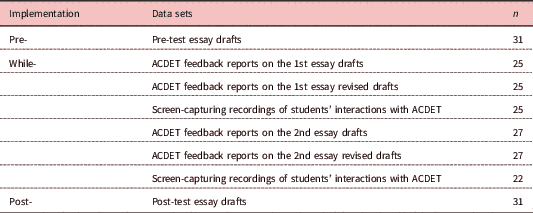
This study was conducted in three stages as pre-implementation, while-implementation, and post-implementation. Students’ cause-and-effect essay drafts from both pre- and post-test, ACDET feedback reports on students’ first and revised drafts of two cause-and-effect essays, and screen-capturing recordings of students’ interactions with ACDET for revising their written explanations were collected (see Table 1 for a summary of data collected).
Summary of data collected
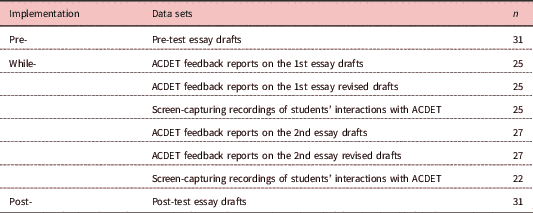
Note. The number in each data set is different due to absent students or the technical problems students had in recording their screens.
Given that written tasks are differentiated by the communicative goal such as comparison and contrast, narration, argumentation, or cause and effect (Ruiz-Funes, Reference Ruiz-Funes2015), the same written task (cause and effect) was used in all data collection stages with different topics to ensure that the levels of complexity were not different across tasks (Yasuda, Reference Yasuda2011).
4.2.1 Pre-tests
In pre-implementation stage, students were asked to write a cause-and-effect essay around 350–500 words, and their essays were collected as pre-test drafts to compare their written explanations in the pre-test with those in the post-test. The pre-test was administered in class, and students were given 40 minutes following the standard time limit for the writing exams in the program. The topic for the pre-test was as follows: “Write an essay about the causes and effects of poverty (not having enough money to pay for one’s needs) for a family or a city or a country.” The same topic was used in both sections, and 31 pre-test drafts were collected in total.
Prior to the pre-test, students had completed the expository, classification, and comparison and contrast essays. Given that this study assessed only causal language development as a shift from more congruent to less congruent expressions of causal meaning, students’ background in essay writing was assumed not to have any impact on the pre- and post-test findings. The cause-and-effect chapter that students completed after the pre-test and before the use of ACDET, as a requirement of the course, included exercises that addressed only a few cause-and-effect items (e.g. nouns: cause, effect, factor, reason, result; verbs: cause, lead to, result in), which helped learners gain the grammatical knowledge they needed to understand ACDET feedback (e.g. causal noun, causal verb, causal conjunction). All the cause-and-effect exercises done were based on isolated items, and no instruction was given on causal language development, thus creating no impact on the pre- and post-test findings.
4.2.2 ACDET feedback reports
Students used ACDET in two cause-and-effect essays. They wrote their first drafts on ACDET outside class without receiving feedback, and they received automated feedback on their essays in class. They used ACDET for 50 minutes for each essay in class and revised their written explanations based on automated feedback. In both essays, students were asked to write an essay of about 700 words on one of the following three topics (different in each essay): the effects of globalization on a country, region, or city; the reasons why a country has a strong, weak, or a variable economy; the effects of a specific event (like an earthquake or flood) that brought about positive, negative, or mixed economic results in a country, region, or city (like modernization, or new industry, a political change, a treaty agreement, a war, or other action).
ACDET evaluates written causal explanations and provides sentence-level feedback highlighting causal meaning and form in the text, and formative text-level feedback aiming to help learners improve their causal explanations. ACDET was developed using a hybrid natural language processing combining a statistical approach (automatic tagging of sentences and words by the Stanford CoreNLP) with a rule-based approach (hand-coded linguistic rules written in Prolog based on part-of-speech tags and type dependencies). ACDET was developed based on expert writing and was tested and improved based on learner writing (for the details of ACDET development and its analysis of cause-and-effect sentences, see Chukharev-Hudilainen & Saricaoglu, Reference Chukharev-Hudilainen and Saricaoglu2016).
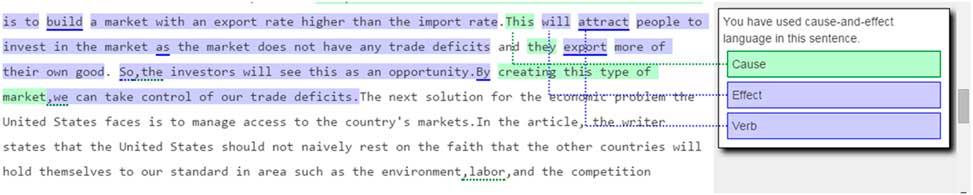
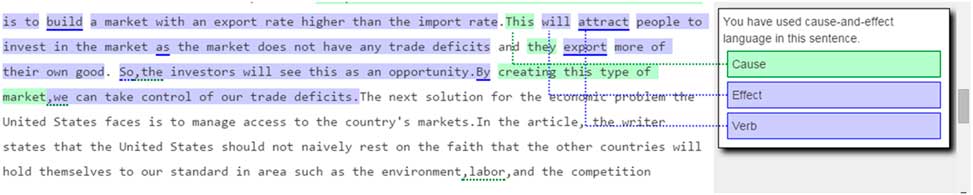
ACDET highlights the cause in green and effect in blue, and underlines the explicit causal language form (see Figure 1) to draw learners’ attention to causal meaning and form. When students click on one highlighted sentence, they receive sentence-level feedback presented in a box in the left margin. The comment in the box includes elaboration of the color-coded feedback.
Sentence-level feedback by ACDET.
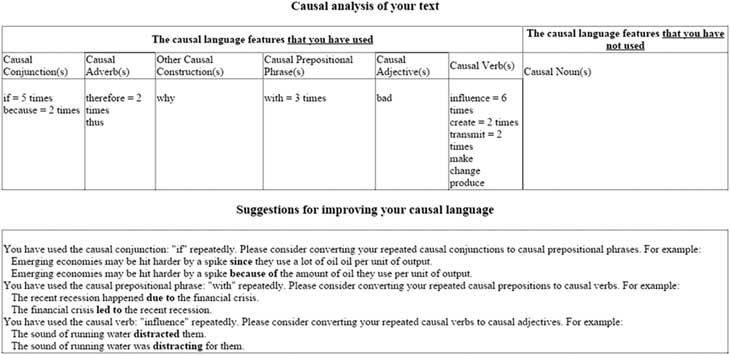
ACDET also provides learners with text-level feedback consisting of two parts (see Figure 2). In the first part, the causal language features are summarized in a table with two columns as “the casual language features that you have used” and “the causal language features that you have not used.” The analysis presents the word counts of causal language features in each category.
ACDET’s text-level feedback.
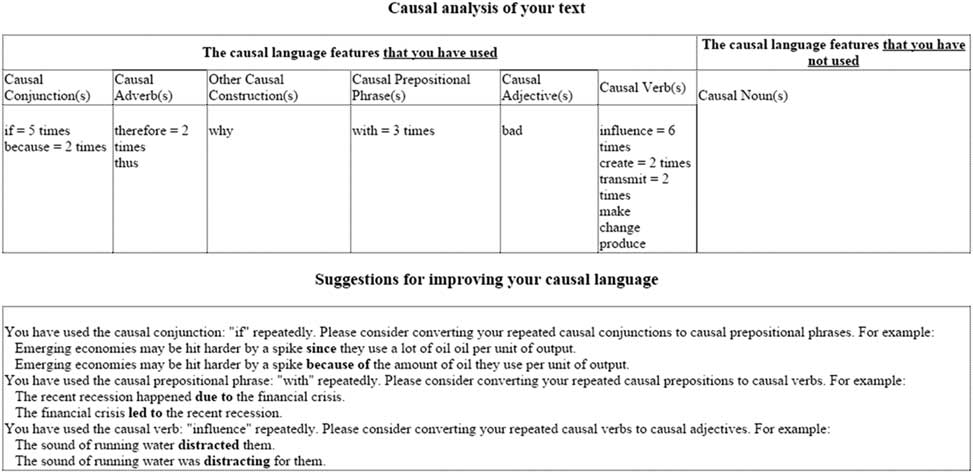
The second part of the text-level feedback gives learners suggestions for improvement and provides examples for revision. The feedback is offered based on the frequency of repetition, and the goal is to help learners move from conjunctions to prepositions, from prepositions to verbs, or from adjectives to nouns in their causal language instead of repeatedly using the same causal forms from the same category within the causal developmental path.
The performance of ACDET to identify causes and effects in 585 sentences written by 17 undergraduate ESL students was measured based on precision (i.e. the ratio of correctly identified causal language features to the total number of identified features), recall (i.e. the ratio of causal language features identified to the total number of causal language features), accuracy (i.e. the percentage of correctly identified causal language features), and F-score (i.e. the harmonic mean of precision and recall). Its precision was found to be .93 (extracted 93% of the causal language features correctly) and recall 71% (captured 71% of the features that human annotators manually captured), which resulted in accuracy of .76, an F-score of .81 (for the details of ACDET’s performance, see Chukharev-Hudilainen & Saricaoglu, Reference Chukharev-Hudilainen and Saricaoglu2016).
To make a comparison between learners’ drafts before and after using ACDET in terms of causal explanations, the text-level feedback reports generated by ACDET for both drafts were collected in two cause-and-effect essays. The total number of feedback reports collected was 104: 50 reports of 25 students (25 for first drafts and 25 for revised drafts) in Essay 1 and 54 reports of 27 students (27 for first drafts and 27 for revised drafts) in Essay 2.
4.2.3 Screen-capturing recordings
Screen recordings of participants’ use of ACDET in class were also collected to analyze their modifications of causal explanations during their interactions with the tool. Learners’ modifications of causal explanations were recorded for convenience purposes as analyzing their revisions during their use of the tool was more cost-effective than comparing each sentence across drafts. Two screen-capturing programs were used: Quick Time Player and Camtasia. In total, 47 screen-capturing videos (25 from Essay 1 and 22 from Essay 2) were collected. The length of recordings ranged from five minutes to 48 minutes.
4.2.4 Post-tests
In post-implementation stage, students wrote another cause-and-effect essay of around 350–500 words, and their essays were collected as post-test drafts. The post-test was given in class as the final exam of the course, and students were given 40 minutes to complete the post-test. The topic for the post-test was: “What can cause close friends to become enemies and what are the consequences?” In total, 32 post-test drafts were collected, but the draft of the student who was absent in the pre-test was excluded from the data analysis.
4.3 Procedure
This study was exempted by the institutional review board of the university. At the beginning of the study, students were informed about the study, and even though formal documentation was not required, their consent was obtained through consent forms. Data collection started with the pre-test in the first week of the first cause-and-effect essay. In the second and third weeks, the cause-and-effect chapter of the textbook was completed, and students wrote their first drafts out of class without any time limits. In the fourth week, ACDET was introduced and explained to the students. They were shown a demo in which the teacher typed in some sentences with causal language forms on ACDET, explained the sentence-level feedback and the text-level feedback in detail. Students were asked to type in their essays into ACDET in the first class of the week. ACDET’s feedback was not activated in this class as the class time would not allow for revisions and the goal was to record their screens. Students were informed that they would receive causal-discourse feedback in the second class and would revise their essays. Students received the automated feedback two days later in class and made revisions, for which their screens were recorded. They made their revisions in class (i.e. 50 minutes) during which the teacher had the role of a monitor making sure students did not have any technical issues and answering students’ questions on how to use ACDET. The same process was followed in Essay 2 except for the textbook activities and the ACDET demo. Text-level feedback reports for both first and revised drafts in both essays were also collected. In week seven, the second essay was completed and in week eight, the post-test was administered.
4.4 Data analysis
For causal language improvement within essays, first data from ACDET’s text-level feedback reports were analysed for the first and revised drafts in both Essay 1 and 2 (n=104). Raw frequency counts of causal features in each category were obtained to identify the changes in the explanations. For accurate comparison between drafts of different length, raw frequencies were normalized per 1,000 words. Descriptive statistics were calculated for group findings. Normalized frequencies were further tested for normality using Shapiro–Wilk test. Because data were not normally distributed, the mean scores of each causal feature category on first and revised drafts were compared using the Wilcoxon signed-rank test. A statistically significant decrease in the mean scores of more congruent expressions and a statistically significant increase in the mean scores of less congruent expressions would indicate improvement in causal explanations within essays.
Second, improvement in causal explanations within essays was evaluated analyzing the data from the screen-capturing recordings (n=47). Recordings were coded and analyzed in NVivo. The causal language modifications learners made were coded in terms of congruence. When a learner revised the causal form in a sentence by changing it to another causal form, this modification was coded in one of the three codes as less congruence, same congruence, or more congruence. If a congruent causal expression (e.g. So, economy is something magical; the global economy will always find a way out to keep it in balance) was changed to a less congruent expression (e.g. Thanks to magical economy; the global economy will always find a way out to keep it in balance), this modification was coded as less congruence. If a causal expression (e.g. These could be hard tasks and challenges) was changed to a more congruent expression (e.g. These could be hard tasks and will challenge them), this modification was coded as more congruence. If the congruence was the same before modification (e.g. which may and will cause conflicts to the bonds of families) and after modification (e.g. which may and will generate conflicts to the bonds of families), this modification was coded as same congruence. Descriptive statistics were calculated for all types of modifications. Only modifications with less congruence would indicate improvement in causal explanations.
For improvement in causal explanations across pre- and post-tests, pre-test drafts (n=31) and post-test drafts (n=31) were analyzed. Causal explanations in the drafts were coded for causal language features and frequency counts of features in each category were conducted and normalized per 1,000 words. For determining the reliability of the coding, over 20% of the total 62 drafts (nine from the pre-test and nine from the post-test) were coded by a second trained coder. Inter-coder reliability, calculated by Cohen’s kappa, was good (k=0.73 for the pre-test and k=0.71 for the post-test). Descriptive statistics were calculated for the whole group and the mean scores of each causal feature category were compared through the Wilcoxon signed-rank test for statistical significance. A statistically significant decrease in the mean scores of more congruent expressions and a statistically significant increase in the mean scores of less congruent expressions would indicate improvement in causal explanations across pre- and post-tests.
5. Results and discussion
5.1 Improvement in causal explanations within essays
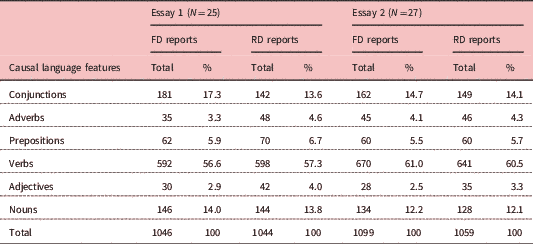
The effect of ACDET feedback on improving learners’ causal explanations within essays was first investigated by analyzing causal language features in learners’ first draft AWE feedback reports and revised draft AWE feedback reports in both Essay 1 and Essay 2. Table 2 summarizes frequency counts of causal language features in six categories in total numbers and percentages.
Frequencies of causal language features in first and revised drafts
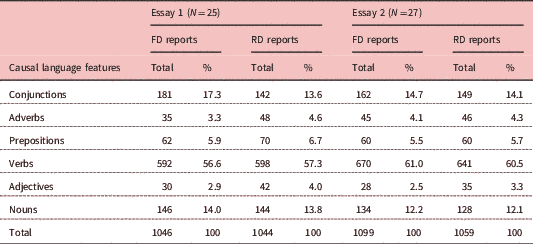
Note. FD reports=first draft AWE feedback reports; RD reports=revised draft AWE feedback reports.
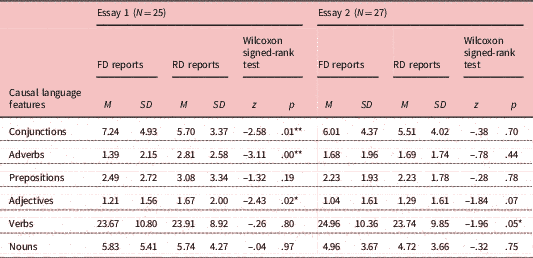
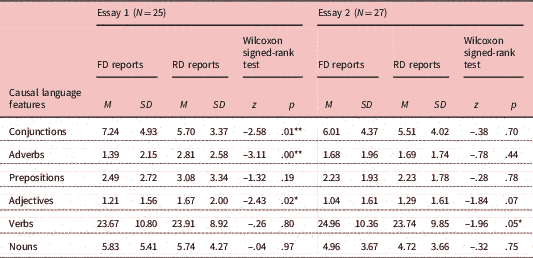
For both essays, frequency counts of causal language features display changes from first drafts to revised drafts after participants used ACDET. The changes are also observed in the descriptive statistics results presented in Table 3.
Causal language features in first and revised drafts
Note. FD reports=first draft AWE feedback reports; RD reports=revised draft AWE feedback reports.
The Wilcoxon signed-rank test results of Essay 1 revealed a statistically significant decrease in the means of conjunctions (Z=‒2.58, p=.01) from the first to the revised drafts and an increase in the means of adverbs (Z=‒3.11, p=.00) and adjectives (Z=‒2.43, p=.02). In Essay 2, the mean of causal verbs significantly decreased from the first draft to the revised draft (Z=‒1.96, p=.05).
The present study found that automated feedback from ACDET led to a statistically significant reduction in the number of causal conjunctions and an increase in the number of adverbs and adjectives in learners’ first cause-and-effect essays. Given that conjunctions and adverbs are more congruent causal expressions and adjectives are less congruent than causal conjunctions and adverbs, the decrease in the number of causal conjunctions and adverbs and the increase in the number of adjectives are positive. ACDET’s feedback was able to create changes in learners’ causal explanations within essays in line with the causal developmental path. Immediate changes in particular structures in learners’ output as a result of feedback being associated with learning by interaction researchers (Gass & Mackey, Reference Gass and Mackey2015), learners’ modifications in causal explanations in this study could indicate the potential of ACDET to improve learners’ written causal explanations. The modifications might be the consequence of learners’ noticing causal form, although this claim cannot be substantiated due to the lack of qualitative data explaining students’ decisions of causal modifications.
In Essay 2, there were no statistically significant changes in causal language features from the first draft to the revised draft that would indicate improvement even though students made several causal modifications. These findings might point to a possible novelty effect: the innovative look of the AWE tool may have excited learners (Phakiti, Reference Phakiti2014).
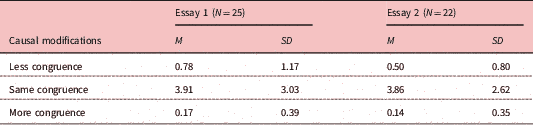
Improvement in learners’ causal explanations within essays was also evaluated for congruence by analyzing data from the screen-capturing recordings of students’ causal modifications. Table 4 presents the descriptive statistics of learners’ modifications with less, same, and more congruence.
Descriptive statistics for causal modifications in Essay 1 and 2
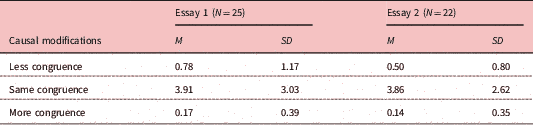
In both essays, students made more causal modifications that did not change the congruence than the modifications with less congruence or more congruence. These findings demonstrate the capacity of ACDET for interactions with learners. However, in the majority of these modifications, students mostly substituted certain causal words or phrases with others from the same category. For example, they changed effect to consequence or because to since. This suggests that learners might have focused more on the numerical feedback than the revision suggestions offered by ACDET. Such tendency was also observed by Cotos (Reference Cotos2012) in her study on the impact of automated feedback on the rhetorical quality of learners’ research article drafts. Cotos (Reference Cotos2012: 103) concluded that the impact was “likely to be negative when learners relied only on numerical feedback” because such focus decreases cognitive involvement. As emphasized in IH, the interaction between the learner and the computer program is supposed to facilitate the individual cognitive processes of the learner for learning to occur, which is less likely when the learner’s focus is on numerical feedback.
5.2 Improvement in causal explanations across pre- and post-tests
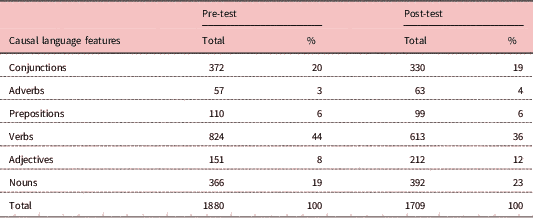
Learners’ causal language improvement pre- and post-tests was investigated by analyzing their pre- and post-test drafts. Frequencies of causal language features in pre- and post-test drafts were counted for each student. Means and standard deviations of each causal feature category were calculated for group findings and compared across pre- and post-test drafts. Table 5 presents frequencies of causal language features in pre- and post-tests.
Frequencies of causal language features in pre- and post-tests (N=31)
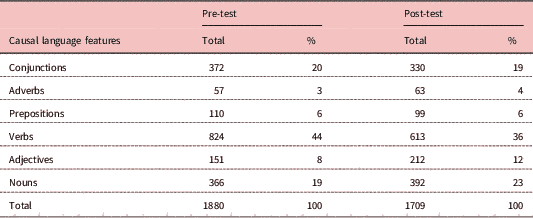
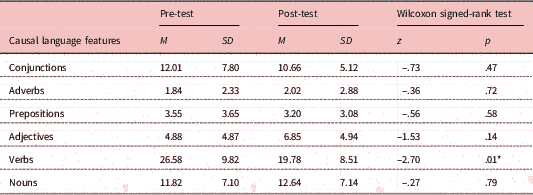
Table 6 provides descriptive statistics of causal language features in pre- and post-tests. Even though the findings demonstrate a slight decrease in causal conjunctions and verbs from pre-test to post-test and a slight increase in adverbs, adjectives, and nouns, the Wilcoxon signed-rank test results presented in Table 6 yielded statistical significance for only causal verbs (Z=‒2.70, p=.01).
Causal language features in pre- and post-tests (N=31)
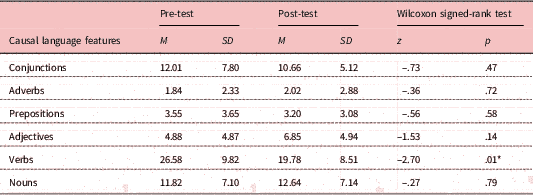
Although the results illustrate ACDET’s potential for helping learners revise their causal explanations, no development was observed across pre- and post-tests. The number of causal verbs decreased significantly from the pre-test to the post-test, but there was no significant increase in the number of causal nouns. The lack of transfer of immediate outcomes to long-term learning benefits is in line with other studies on automated feedback, which show no or very limited long-term learning gains compared to immediate learning outcomes (e.g. Li, Feng & Saricaoglu, Reference Li, Feng and Saricaoglu2017). Referring back to the important role of cognitive processes involved in language learning (Long, Reference Long1996), the fact that the effect of ACDET feedback did not extend from immediate improvement in learners’ written products to learning in the long run is not surprising. However, evidence from qualitative data is needed for further insights into why there are no long-term effects.
6. Conclusion
This study was an attempt to address the need for automated formative assessment of learners’ written causal explanations. As Slater and Mohan (Reference Slater and Mohan2010) point out, learners need feedback on their causal writing, for which AWE tools can be helpful. There is, however, not enough evidence in the AWE literature showing that automated feedback leads to improved discourse as opposed to the evidence showing its positive effect on improving accuracy. Addressing the gaps in both areas, this study investigated to what extent automated formative feedback provided by ACDET led to improvement of ESL learners’ written causal explanations (a) within essays and (b) across pre- and post-tests. Opposed to the common practice of using AWE for error correction in the early stages of a writing process, “freeing the teacher up to concentrate on higher-level meaning-oriented, genre-oriented and audience-oriented aspects of writing” (Stevenson, Reference Stevenson2016: 12), this study attempted to use AWE in a later stage in writing to address genre-oriented aspects of writing.
The results of this study revealed limited improvement within essays and no improvement across pre- and post-tests. Although revision at the desired level was not observed, the fact that students revised is alone pleasing given the findings of previous AWE studies that showed lack of student revision. The important question is how ACDET feedback can stimulate students to revise for less congruence, whose answer might lie in the way ACDET is pedagogically used. As Stevenson (Reference Stevenson2016: 13) argues, “it is not sufficient to … consider the effects of AWE systems on students’ writing without considering their contexts of use.” Given that how AWE is integrated into classroom instruction affects students’ perceptions and reaction to AWE feedback, it is important to pay equal attention to classroom instruction as to the capabilities of AWE alone. In this study, AWE feedback on explanations was used alone without further teacher feedback, which is not students’ preference as was found by Chen and Cheng (Reference Chen and Cheng2008). Chapelle and Voss (Reference Chapelle and Voss2016: 121) add that “feedback from the system along with human guidance and feedback based on a sound pedagogical foundation shows the most promise to support the assessment of and for learning.” In their study, Li et al. (Reference Li, Link and Hegelheimer2015) found that students’ positive perceptions of the AWE tool were closely related to the manner the instructors used the tool. The lack of data from student views of their experiences with ACDET is a major limitation in this study, thus it is difficult to explain the lack of desired revision in relation to the context of use. Further research could look into the ways different teachers integrate ACDET in classroom instruction and how different integrations affect students’ use and perceptions of ACDET and reactions to ACDET feedback.
The results of this study support the fact that it is difficult for learners to modify their causal explanations using grammatical metaphor. “[The teacher] suggests moving to a less congruent causal statement, but it is too difficult for [the student]” wrote Mohan and Beckett (Reference Mohan and Beckett2003: 428) based on their observations during teacher–student interactions of grammatical scaffolding of learners’ causal explanations. Considering the amount of time it takes children to move from congruence to incongruence, the difficulty that ESL students have in educational settings is understandable. When compared to learners who complete the causal developmental path in around seven years in natural language acquisition settings (Christie & Derewianka, Reference Christie and Derewianka2008), it is very normal for ESL students to have difficulty learning grammatical metaphor of causal explanations in classroom settings. Students need more time, more feedback, and repeated practice; the more consistent integration of AWE in classroom instruction leads to more revisions by the students (Li et al., Reference Li, Link and Hegelheimer2015). Students’ AWE access and use in this study was restricted to two different revisions in class, each limited to 50 minutes. As expressed by Steinhart (Reference Steinhart2001), students should have unlimited access to AWE after being trained on how to use it.
Although it is clear that ACDET feedback stimulated causal revision at the same level of congruence, it is unclear why it did not lead to revision towards less congruence. Did students not revise because they did not understand the text-level feedback or because they did not know how to revise, as it was found in a study by Steinhart (Reference Steinhart2001)? Follow-up data from stimulated recalls would be reflective of learners’ responses to the feedback. This could also provide insights into the weaknesses and strengths of the AWE tool and would be informative for the further refinement of the tool.
The results of this study have implications for automated discourse-specific formative feedback. As the feedback that students receive has to be correct, the accuracy of automated writing evaluation systems has been among the primary concerns of researchers: How well does the automated system identify the target errors or features (e.g. Lavolette et al., 2014)? Although performance of ACDET (precision .93, recall .71, and F-score .81) is considered to be good for automated systems, it should be noted that .71 recall means there were causal language features in students’ essays that ACDET was not able to identify and generate feedback on. If students received more feedback, this would, as a result, lead to more interactions with the tool and more revisions to their writing. Increasing ACDET’s recall up to .90 or higher would be ideal for obtaining better learning outcomes with more written explanations identified.
ACDET’s text-level feedback was indirect in that it provided learners with numerical feedback on their causal language features and general suggestions for improvement. The fact that students responded to the feedback in the form of causal modifications that actually led to limited improvement implies that numerical feedback draws more attention than improvement feedback. On the contrary, automated feedback needs to be presented to learners in a way that will stimulate more cognitive involvement and focus on the meaning and form at the same time.
Another explanation for the limited improvement might be related to the proficiency level of the participants. Because learners in this study were in the same level of academic writing class and were considered to have the same level of language proficiency, differences in causal language improvement according to proficiency levels were not investigated. Further research is needed to find out how ACDET feedback works with students from different proficiency levels. Learners, in particular with lower level language proficiency, might have had difficulty in responding to the feedback in the way it was desired (Ferris & Hedgcock, Reference Ferris and Hedgcock2005). Making discourse-level revisions focusing on the causal meaning requires more cognitive involvement and is probably more difficult for learners than making grammatical or mechanical revisions. Referring to the studies that have demonstrated the effectiveness of direct feedback on writing, especially in the long term (e.g. Bitchener & Knoch, Reference Bitchener and Knoch2010), ESL learners might also benefit more from direct feedback on causal explanations than indirect feedback as of ACDET’s.
Although this study has yielded important information regarding automated formative assessment of causal explanations, more studies on the effectiveness of ACDET are needed. Whether direct text-level feedback rather than indirect text-level feedback would increase ACDET’s potential in helping learners improve their written causal explanations could be studied in future research. The study of students’ use of ACDET in two essays, in a total period of eight weeks during which they used ACDET twice, was helpful in gaining some understanding of ACDET’s potential for improving causal explanations. However, longer studies in which students have more exposure to ACDET might yield more findings on whether or not ACDET feedback has a lasting effect.
Acknowledgements
I would like to thank Dr Evgeny Chukharev-Hudilainen, Dr Ruslan Suvorov, and the anonymous reviewers for their constructive feedback on the earlier drafts of this manuscript.
Author ORCID
Aysel Saricaoglu, http://orcid.org/0000-0002-5315-018X.
Ethical statement
I declare that I have no conflict of interest. This work is entirely original and it has cited others’ work appropriately. Institutional requirements were followed in data collection procedures, and informed consent was obtained from the participants.
About the author
Aysel Saricaoglu (PhD, Applied Linguistics and Technology, Iowa State University) is an assistant professor in English Language Education, TED University, Ankara, Turkey. She investigates academic writing, automated formative assessment, corpus linguistics, telecollaborative learning, and project-based learning. Her work has appeared in journals such as CALL and CALICO.