1 Introduction
To respond to a national shortage of qualified second language (L2) teachers (Modern Language Association, 2007), in 2008 the foreign language education (FLED) and Teaching English as a Second Language (TESL) programs at one institution of higher education (IHE) in the southeastern United States expanded their course offerings to include online instruction. This movement toward online delivery of L2 teacher preparation coursework has been reflected throughout the country (National Center for Education Statistics, 2009). Hall and Knox (Reference Hall and Knox2009) reported that in the past fifteen years online L2 teacher education programs have experienced a fivefold increase in number.
This growth has been accompanied by concern within the L2 teaching community. While numerous studies comparing student learning outcomes in face-to-face (F2F) and online settings have found no significant differences across methods (Means, Toyama, Murphy, Bakia, & Jones, Reference Means, Toyama, Murphy, Bakia and Jones2009; Moore, Reference Moore1994), few have focused on online instruction in teacher education programs, and even fewer have looked specifically at online L2 teacher preparation. Some studies that have compared instructional modes in teacher preparation programs have suggested that a fully online delivery is not appropriate for certain teacher education coursework. For example, in their study of the effects of an online methodology class on the planning skills of aspiring math teachers, Alexander, Lignugaris-Kraft, and Forbush (Reference Alexander, Lignugaris-Kraft and Forbush2007: 214) concluded that “some teacher preparation courses are not suited for an online format”.
More recent research investigating online instruction in teacher education programs has called into question its impact on teacher candidate self-efficacy. Self-efficacy relates to an individual’s confidence or perceived ability to successfully complete tasks (Bandura, Reference Bandura1986). Several studies have found there to be a significant relationship between self-efficacy and motivation (Harter, Reference Harter1978; James, Reference James1996). People who believe they have the ability to achieve their goals are more likely to put forth the required effort to reach these goals than those who do not believe they are able. Youngs and Youngs (Reference Youngs and Youngs1999) reported that a lack of self-efficacy among L2 teachers often resulted in low and self-fulfilling expectations for their students.
The results of the above-mentioned research are troubling given the findings of Kissau (Reference Kissau2011). In his study investigating the impact of online and F2F L2 methodology instruction on teacher candidate self-efficacy, Kissau (Reference Kissau2011) reported significantly higher self-efficacy scores for candidates in the F2F sections than for their peers who completed the same course in an online setting. Unable to witness the demonstration of instructional strategies, Kissau found that online course completers reported lower self-efficacy in regard to their abilities to apply the course content than did their peers in the F2F sections. Providing direction for the present study, Kissau urged the implementation of hybridized methodology courses that offer a combination of online and F2F instruction. According to the researcher, in a hybrid methodology course candidates could be exposed to information in a convenient online format that allowed for reflection and debate in discusson forums. This online instruction could then be complemented by F2F meetings where the instructor has the opportunity to model instructional strategies and show students how the knowledge they gained online is applied in a F2F classroom. By combining the strengths of both modes of instructional delivery, Kissau hypothesized that hybridized L2 methodology instruction would address the limitations of fully online instruction and would have no detrimental effects on teacher candidate self-efficacy to teach L2 learners. To test this hypothesis, the researchers investigated the impact of hybridized methodology instruction on the sense of efficacy of L2 teacher candidates.
2 Literature review
The growth in online course delivery has spawned multiple studies investigating the impact of computer-mediated instruction on student outcomes. Studies comparing student outcomes in online and traditional, F2F classrooms have consistently found no significant differences (Aragon, Johnson, & Shaik, Reference Aragon, Johnson and Shaik2002; Kirtman, Reference Kirtman2009). In their meta-analysis of more than 1,000 related studies, Means et al. (Reference Means, Toyama, Murphy, Bakia and Jones2009) reported that learning outcomes of students of online instruction were not statistically different from those of their F2F peers. Studies comparing student outcomes in teacher training programs have also reported no significant differences between students taking online or F2F coursework (Jang, Reference Jang2008; Kirtman, Reference Kirtman2009). In a study comparing the outcomes of 64 student teachers in a traditional F2F setting with those of 72 of their online peers, Jang (Reference Jang2008) found that both groups were equally satisfied with the instruction, demonstrated similar degrees of content knowledge, and were equally motivated to learn. While few in number, studies that have focused on L2 teacher training have also reported no significant differences when comparing outcomes of online and F2F instruction. Kissau (Reference Kissau2014), for example, found no significant differences when comparing the performance outcomes of 23 aspriring L2 teachers who completed online methodology training with 28 of their peers who completed the same instruction F2F. While acknowledging that studies have consistently shown that online instruction does not lead to inferior learning when compared with its F2F equivalent, as demonstrated below, many have suggested that each mode of instructional delivery has its strengths and weaknesses.
2.1 Face-to-face instruction
Research has suggested that in some situations traditional, F2F instruction is advantageous over its online counterpart (Dede, Ketelhut, Whitehouse, Breit, & McCloskey2009). While studies have indicated that online instruction may be a viable instructional approach when transmitting course content (Kissau, Reference Kissau2011), it has been shown to be less effective in comparison with F2F instruction when it comes to applying that content. For example, participants in the study by Delfino and Persico (Reference Delfino and Persico2007) wanted a F2F component to their online course that offered more opportunity to practice the content. Similar benefits were reported by Kissau (Reference Kissau2011). In his study, teacher participants reported being more confident in their ability to apply teaching strategies after participating in demonstrations than did their online peers who had to rely on visualization to imagine what strategies looked like. The ability to observe and participate in F2F classroom instruction has also been reported to have classroom management benefits. In the study by Kissau, the participants in the F2F classes stated that interaction between instructor and teacher candidates allowed them to see how to run a classroom, manage instructional time, deal with behavioral issues, and develop rapport with students.
Related to relationship building, Garrison and Kanuka (Reference Garrison and Kanuka2004) found that F2F instruction was superior to online instruction in building a sense of classroom community. Face-to-face instruction may support the development of strong relationships with classmates and colleagues that may later facilitate job-hunting. A teacher candidate in Kissau’s study (2011) reported that online instruction impeded his ability to network with classmates and as a result his ability to secure a teaching position.
2.2 Online instruction
The convenience of online instruction has been widely documented. Students and instructors have reported enjoying the flexibility of being able to log in at their convenience and from any location. Citing such issues as traveling time, traffic, parking fees, and work schedules, participants in numerous studies have reported to appreciate not having to physically attend class (Delfino & Persico, Reference Delfino and Persico2007; Garrison & Kanuka, Reference Garrison and Kanuka2004).
Access to instructional resources and materials via the click of a mouse has also been cited as a benefit of online instruction. This feature was reported by Delfino and Persico (Reference Delfino and Persico2007) to be greatly appreciated by students, particularly when reviewing for exams. Teacher candidates in Kissau’s study (2011) liked being able to go back and reference materials and discussion forums prior to their exam.
Online discussion forums have also been mentioned as beneficial in that they give students time to reflect before responding, and thus allow for more meaningful discussion (Kissau, Reference Kissau2011). A related benefit of online discussion is that is causes less anxiety among students than does immediate F2F discussion and thus provides greater oppounities for shy students to express themselves (Dede et al., Reference Dede, Ketelhut, Whitehouse, Breit and McCloskey2009).
2.3 Hybridized instruction
Research on hybridized instruction has suggested that it incorporates the strengths of online and F2F instruction, while avoiding their limitations. Garrison and Kanuka (Reference Garrison and Kanuka2004) reported that in a hybridized course an initial F2F class is helpful in developing a sense of community among students, and that later course participation in online discussion forums allowed for reflection about course content. Gedik, Kiraz, and Özden (Reference Gedik, Kiraz and Özden2012) reported that hybridized instruction provides students with opportunity to reinforce the instruction they receive F2F by reviewing instructional materials available online. Kocoglu, Ozek, and Kesli (Reference Kocoglu, Ozek and Kesli2011) added that hybridized learning offers the possibility of preparing teacher candidates to implement both F2F and technology-based resources into their instruction, and thus prepares them to teach in 21st century classrooms.
Understanding the potential benefits of hybridized instruction, researchers have been calling for further implementation of such courses in place of strictly online or F2F instruction. To familiarize L2 teacher candidates with different technologies that they may later find useful in their L2 classrooms, while still providing F2F classroom experience, Hoven (Reference Hoven2007) urged design and delivery of hybrid L2 methodology courses where both online and F2F instructional strategies could be modeled.
2.4 Need for research
While recognizing the potential benefits of hybridized teacher training, it should be acknowledged that little research has been conducted on the effectiveness of this mode of instructional delivery in teacher education programs (Young & Lewis, Reference Young and Lewis2008). Dede et al. (Reference Dede, Ketelhut, Whitehouse, Breit and McCloskey2009) stated that while hybridized teacher training programs are growing rapidly, little is known about their effectiveness in preparing candidates to teach. The few studies that have looked at hybridized teacher training have focused on candidate attitudes toward the learning environment. Research needs to investigate the effectiveness of this method of delivery in preparing aspiring teachers. In reponse to this call for research, the researchers evaluated the impact of hybridized methodology instruction on the self-efficacy of L2 teacher candidates. Adding to the data previously collected by Kissau (Reference Kissau2011), a three-way comparison of delivery modes was conducted (F2F, online, hybrid) to address the following research question: To what extent does the method of instructional delivery affect L2 teacher candidate self-efficacy?
3 Method
The purpose of this research was to compare efficacy ratings for teacher candidates completing L2 methodology instruction in one of three different delivery modes (F2F, online, and hybrid). A mixed method approach was used. In the spring and fall semesters, quantitative data were collected via pre- and post-surveys from all teacher candidates enrolled in one of two hybridized methodology courses for aspiring L2 teachers. One course was required for all foreign language teacher candidates and the other was designed for those in the TESL program. The researchers then compared the quantitative data collected from the hybrid course completers with data previously collected from L2 teacher candidates who completed one of the same two L2 methodology courses either F2F or in a completely online environment (see Kissau, Reference Kissau2011). To build upon the extant survey data, qualitative data were also collected from a group of L2 teacher candidates in the hybrid sections of the two L2 methodology courses who were selected to participate in individual, follow-up interviews. The interview data obtained from the hybrid course completers were also analyzed and compared with interview data collected by Kissau (Reference Kissau2011) from L2 teacher candidates who completed one of the two L2 methodology courses in a fully online or F2F section.
3.1 Participants
All teacher candidates taking an L2 methodology course for aspiring ESL or foreign language teachers in the spring or fall of 2012 were invited to participate in the study. The candidates were being trained to teach children in primary and secondary school settings, where all instruction is traditionally F2F. During this time period the two methodology courses were only offered in a hybridized setting. When combined with the data previously collected by Kissau (Reference Kissau2011), the study analyzed survey data from 117 L2 teacher candidates. Thirty-eight of these participants (32%) were enrolled in a F2F section, 24 (21%) were in an online section, and 55 (47%) were in a hybridized section. Approximately 59% of the participants were current or aspiring ESL teachers and the remaining 41% were seeking their license to teach a foreign language. Most participants were females (83.2%), and about half of all participants (52.8%) were currently employed as L2 teachers.Footnote 1 Gender (X 2=0.38, df=2, p>0.05), type of course (ESL vs. Foreign Language, X 2=2.55, df=2, p>0.05), and current L2 teaching position (X 2=1.55, df=2, p>0.05), were similarly represented across instructional delivery modes.
From the 55 participants in the hybrid sections, eight (four ESL and four foreign language) were selected to participate in interviews. Selective random sampling was used to ensure that a variety of perspectives was provided. The data gathered from the eight candidates were then compared with the data collected in Kissau (Reference Kissau2011) from eight participants who completed the same two methodology courses in a F2F or online setting. In total, the study considered interview data gathered from sixteen teacher candidates (four F2F, four online, eight hybrid). Eight of the interview participants were working as L2 teachers at the time of the study, but had not yet completed their teaching credentials. These practicing teachers were equally distributed among the three modes of instruction (two F2F, two online, four hybrid).
3.2 Modes of instructional delivery
3.2.1 Face-to-face
The F2F sections of both L2 methodology courses were offered twice over two fifteen-week semesters in 2010. Although one course was designed for foreign language teachers and the other for teachers of English as a second language (ESL), they contained common content that was relevant to all L2 teachers. For example, in both courses teacher candidates were familiarized with theories and methods of L2 teaching, factors influencing L2 acquisition, types of L2 programs, national standards for L2 teaching, effective lesson and unit plan design, classroom management strategies, and a variety of teaching strategies to both motivate their L2 students and enhance their L2 literacy skills.
In addition to sharing similar content, this content was presented in the same sequence. Foundational information related to schools of thought, theories of L2 acquisition, methods of L2 teaching, and factors that influence L2 learning were discussed at the beginning of the semester, followed in later weeks by content addressing lesson and unit plan design, and more specific teaching strategies to enhance all four language skills. Each of the fifteen F2F class sessions for both courses was structured in a similar fashion. Both were taught by the same instructor, a licensed and experienced foreign language and ESL teacher, who was also one of the researchers involved in the study. In order to model effective lesson plan design and a variety of different resources, the instructor began each class session with a warm-up activity that was intended to get the teacher candidates interested in the lesson’s topic and to activate prior knowledge. Following the warm-up, the instructor stated the goal of the lesson and provided the teacher modeling component. This component typically involved a brief lecture that was often supported by a PowerPoint presentation or instructional video, or the demonstration of a particular teaching strategy. The next step in the each lesson involved guided practice. Teacher candidates were provided the opportunity to discuss the lesson’s topic or practice the targeted teaching strategy with a partner or in a small group. Once completed, teacher candidates were given an independent task to demonstrate their understanding of the skill. The end of each lesson consisted of a brief closing activity that served to summarize the lesson’s content.
Assessments were also very similar. In both courses teacher candidates were expected to complete a number of hours observing in ESL or foreign language classrooms and to write a reflection about what they learned from the experience. Both courses also contained a very similar unit plan assignment and concluded with a final exam.
3.2.2 Online
The online sections of both courses were taught by the same instructor of the F2F courses. The online sections were offered simultaneously with their F2F equivalents in 2010 and were intended to mirror those sections. Fifteen online modules were developed that paralleled the content that was covered in the fifteen F2F classes. The instructor modeled the same characteristics and components of an L2 lesson that were modeled in the F2F course. He began each lesson with a warm-up activity that often involved the use of an online polling site, online game, or virtual word wall that had the students reflect upon the lesson’s topic. Following the warm-up, teacher modeling was provided via narrated PowerPoint presentations, online readings, and video clips. Online course completers were then given the chance to interact with classmates via online discussion forums. Toward the end of each module, teacher candidates in the online sections were asked to demonstrate their comprehension of the lesson’s topic by completing online quizzes, uploading independent assignments, and posting their responses to questions and case studies. The assessment of the online course completers also mirrored that offered in the F2F sections. All online instruction was delivered asynchronously.
3.2.3 Hybridized
The hybrid sections of both courses were launched in the spring of 2012. Both courses were developed and taught by the same instructor who taught the F2F and fully online sections. Hybrid sections were also taught during fifteen-week semesters and addressed the same course content as their F2F and online equivalents. Further mirroring the previously mentioned modes of delivery, the hybrid sections presented course content in the same order, and followed the same instructional practices that candidates would be expected to implement in their own classrooms. Online modules were delivered asynchronously, and were incorporated at the beginning of the hybrid sections when students were being introduced to foundational information related to theories and methods of L2 teaching, factors influencing L2 acquisition, and types of L2 programs. This online delivery was then followed by F2F class sessions in order to give the teacher candidates the opportunity to witness demonstrations of specific strategies. To help teacher candidates keep track of whether a class session was online or F2F, the instructor used an online calendar, posted the course schedule in the online syllabus, and sent weekly email reminders. A total of seven of the class sessions in each hybrid section were taught online and the remaining eight were delivered F2F. In regard to assessment, the same tasks were required of teacher candidates who completed the hybrid sections as were required of their F2F or online counterparts.
3.3 Instrumentation
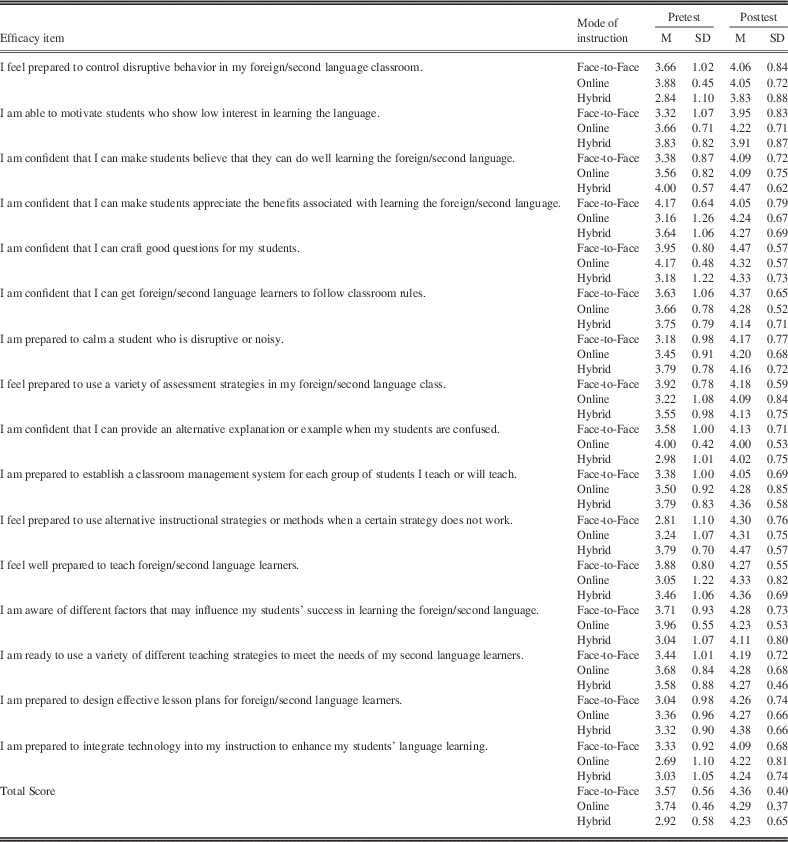
The study involved the same data collection instrument that was used in Kissau’s (Reference Kissau2011) study. This survey was adapted from the Tschannen-Moran and Woolfolk Hoy (Reference Tschannen-Moran and Woolfolk Hoy2001) Teacher Efficacy Scale. The scale was reported to have a construct validity established by factor analysis and reliability ranging from 0.92 to 0.95 (Tschannen-Moran & Woolfolk Hoy, Reference Tschannen-Moran and Woolfolk Hoy2001). In regard to all sixteen survey items (see Table 1), the participants were asked to select a number on a five-point Likert scale. A response of 5 indicated strong agreement and a response of 1 indicated strong disagreement.
Pretest and posttest self-efficacy ratings across mode of instruction

The survey was administered twice over the course of each semester of data collection. Teacher candidates in all sections completed the survey at the beginning of the semester to gauge their initial confidence to teach L2 learners and then again at the end of the semester to measure any change that occurred as a result of completing the L2 methodology course.
Pre-test internal consistency reliability estimates for the survey were high for the total group (r xx=0.86), as well as for the F2F (r xx=0.83), online (r xx=0.83), and hybrid (r xx=0.76) subgroups. In comparison with the pre-test reliability estimates, the post-test internal consistency reliability estimates for the survey were somewhat higher for the total group (r xx=0.94) and for the F2F (r xx=0.89), online (r xx=0.90), and hybrid (r xx=0.97) subgroups.
Aligning with the principles of Bandura’s (Reference Bandura1986) Self-efficacy Theory, interview questions elicited information from participants in regard to the impact of various elements of their methodology instruction on their self-efficacy to teach L2 learners. Participants were asked to describe their experience taking their respective methodology course and the effect it had on their level of confidence to teach L2 learners. They were asked to describe what they perceived to be the strengths and weaknesses of the course, in regard to enhancing their confidence, how they thought it could be improved, and if they would prefer to take future L2 methodology training F2F, online, or in a hybrid setting, and to explain their reasoning. In addition, participants were asked to comment upon their confidence to apply what they learned in their methodology coursework. The interviews lasted approximately fifteen minutes and were conducted individually by the course instructor. To encourage participants to speak freely the interviews took place at the end of the semester once grades had been posted.
3.4 Design and data analysis
A causal-comparative design was used to evaluate the effect of F2F, online, and hybrid instruction on teacher candidate self-efficacy. A two-factor analysis of variance procedure was used to examine sense of efficacy scores at the beginning and end of the course for teacher candidates participating in the F2F, online, or hybrid course instruction.
The qualitative phase of the data analysis considered comments generated during the interviews of the eight hybrid course completers as well as those gathered from the eight participants (four online and four F2F) from Kissau’s earlier study. Following the principles of grounded-theory, and using Bandura’s (Reference Bandura1986) Self-efficacy Theory as a framework for analysis, the interview data were examined looking for themes that helped to explain the impact of mode of instructional delivery on teacher candidate self-efficacy. When analyzing the interview data the researchers followed guidelines set forth by Emerson, Fretz, and Shaw (Reference Emerson, Fretz and Shaw1995). After transcribing the audio-recorded interviews, the researchers coded the data. This process involved carefully reading the interview transcripts and using the comment function in Microsoft Word to make notes that later assisted in the organization of data into themes. These themes were then compressed into broader themes and summarized.
4 Results
4.1 Quantitative results
Means and standard deviations for pretest and posttest efficacy ratings across mode of instruction are provided in Table 1. In general, analysis of variance outcomes for total efficacy were statistically significant for mode of instruction (F 2,211=17.46, p<0.05, occasion, F 1,211=176.53, p<0.05), and mode of instruction  $$\times$$
occasion interaction effects (F 2,211=9.56, p<0.05). Follow-up analyses indicated that pretest ratings were significantly lower for hybrid (M=2.92) than for F2F (M=3.57) and online (M=3.74) modes of instruction. Posttest ratings, however, were found to be similar (M=4.23, 4.36, and 4.29, respectively). Statistically significant improvements were evident across groups. The interaction effect is illustrated in Figure 1 and was reflected in ratings for all sixteen survey items.
Attitude change for students participating in three instructional delivery modes
To summarize, despite having significantly lower self-efficacy scores at the beginning of their instruction, in comparison with their peers in the online and F2F sections, impressive gains made over the course of the semester resulted in the hybrid course completers being as confident in their abilities to teach L2 learners as their online and F2F counterparts by the end of the semester. In fact, the teacher candidates in the hybrid course experienced significantly greater gains in self-efficacy during their hybridized methodology instruction than did their peers who completed the same instruction in a F2F or online setting.
4.2 Qualitative Results
When analyzing interview responses from hybrid course completers and comparing them with responses from their online and F2F counterparts five themes emerged. Comments from all three cohorts frequently related to teacher candidate self-efficacy with respect to course content, use of various teaching strategies, and classroom management. Comments also often addresed the notion of classroom community and how it can effect candidate confidence. Finally, participants made multiple references to the convenience-related advantages and disadvantages of the various modes of instruction.
4.2.1 Course content
With respect to addressing course content, the data collected from the sixteen interview participants suggested that all three modes of instruction are equally effective at developing teacher candidate self-efficacy. One participant mentioned that she learned a lot about theories, methods of teaching, and factors that influence L2 acquisition in her F2F class. Similar comments were voiced by colleagues in the online and hybrid sections. Take for example the following statement from an ESL teacher candidate in a F2F section: “I learned some new methods for teaching English … and about the Affective Filter … some theories (Kissau, Reference Kissau2011: 12).”
Interesting perspectives emerged, however, from hybrid course completers who had the opportunity to learn about course content through both F2F and online instruction. Their responses suggested that to optimize teacher-efficacy, more challenging course content, or content that is critical to a teacher’s success should be addressed F2F. Consider the following comment from an aspiring French teacher:
There were some components … I was fine doing them online, but when we did the standards, I don't think I could have figured it out on my own at home. So in that sense, face-to-face instruction was just perfect for that class.
Multiple comments from hybrid course completers supported the notion that F2F instruction offered greater opportunity to address misconceptions and was necessary when dealing with important topics. Based on comments from a female ESL teacher candidate in a hybrid section, lesson planning is one of those topics. She commented, “I knew how to make a lesson, but the scaffolding was not really clear to me, and after the lesson planning class it clicked … I don’t think it would have if I had just read the component online.”
On the other hand, introduction of course content in an online manner was reported to offer some content-related benefits. Teacher candidates who completed fully online instruction reported that the online setting allowed time for reflection and analysis that would not be possible within the confines of a F2F class. While acknowledging that online instruction may be more time-consuming, participants from online and hybrid sections felt that this extra time resulted in greater understanding and confidence. Consider the following remark from an aspiring ESL teacher in a hybrid section:
Yeah, it took a lot of time, but at the same time, it was very helpful for me to build the concept, because I feel like when I struggle with learning, I learn more.
4.2.2 Teaching strategies
Online instruction was found to be as effective as F2F instruction at building candidate self-efficacy in regard to factual course content, but less effective with respect to ability to implement instructional strategies. Online course completers, particularly those without teaching experience, reported to resort to visualization while reading about how to implement strategies. A German teacher candidate who completed her methodology instruction F2F offered this perspective: “You show activities, how to do it, how to set up, you know. I think that we should really experience it. In an online class, like we sit at home and just read it (Kissau, Reference Kissau2011: 13).” Having experienced both online and F2F instruction, the insights provided by the hybrid course completers helped to confirm that lessons involving strategy instruction are best done F2F. An aspiring French teacher from a hybrid section elaborated:
The online was perfect for things like types of second language programs. I didn’t really need to attend a face-to-face class to get information about that … but the foldables, the games, the class on how to use music would have been difficult online.
Although the hybrid course completers provided confirmation of Kissau’s Reference Kissau2011 findings that online instruction lacks the modeling of strategies essential in a methodology course, they added an interesting dimension. A theme that permeated responses from participants in the hybrid sections was that they learned a lot about strategies in their F2F meetings, but they would feel more confident in their abilities to use them had they had the opportunity to apply the strategies in a classroom of young L2 learners. An ESL teacher candidate who was not teaching at the time explained, “I got lots of practical ideas, but it’s hard to feel confident because I don’t have my own class and can’t really test them out.” When asked if she felt confident to apply what she had learned in her hybrid class a Spanish teacher candidate replied, “No, because I need to have hands-on experience with the actual students, but that didn’t happen. This semester I created a lesson, but wasn’t able to teach it.”
4.2.3 Classroom management strategies
Similar results surfaced in regard to classroom management. While students in the F2F and hybrid sections felt that the interaction with their instructor and peers in F2F meetings gave them an advantage over their online counterparts when it came to classroom management, they still lacked confidence. This again appeared to stem from their inability to apply strategies in primary or secondary school classrooms. Explaining why the strategies that were modeled in her hybrid course left her still unsure of her classroom management skills, one female Spanish teacher candidate stated, “The way we interact with you is professional, and I feel like that’s not necessarily the case when you’re in a secondary school. The way that the students act is going to be different.”
4.2.4 Community
The concensus among the sixteen participants was that online instruction is an impediment to developing a sense of classroom community. Teacher candidates from all three modes of instruction mentioned that they enjoyed interacting and networking with other teachers of the same subject and that this is more challenging in an online environment. Making the connection between classroom community and teacher candidate self-efficacy, one aspiring Spanish teacher in an online section commented that online instruction has the potential to adversely affect classroom community, and as a result, candidate confidence to successfully complete coursework. She explained:
I find that I’m playing catch up. It seems a little more detached than when face-to-face, because I’m not as aware of what’s going on. I think it has to deal with the lack of interaction with students. Before class you get to ask classmates, “Have you worked on this thing? Or how do you feel about that?” That aspect is missing from the online class. I worry that I’m missing assignments and deadlines.
While the participants agreed that F2F instruction was ideal for developing a sense of community, the teacher candidates in the hybrid sections did not feel disadvantaged. According to one aspiring teacher in a hybrid section, the eight F2F class meetings were just enough to allow her to build ties with the other teacher candidates in her class. Another teacher candidate in the same section stated that while she preferred online instruction, the hybrid model forced her to come out of her shell and engage with other people. An aspiring Spanish teacher added that the sequencing of multiple, consecutive F2F class meetings in her hybrid class facilitated the development of personal ties between students. She explained:
But I did notice that the face-to-face classes were back-to-back, and it made it easier. It wasn’t like you come to class one week and then you don’t come the other week. I like the fact that the first few classes were online and then we were meeting face-to-face for three of four times in a row. If we had met every other week, I probably still wouldn’t know some students.
4.2.5 Convenience
While not directly related to self-efficacy, convenience was an undeniable theme that emerged in the data. Candidates in the online sections acknowledged that despite the confidence-related drawbacks associated with online instruction, they were willing to accept these limitations if it meant they could work from home, avoid long commutes, parking fees, and finding babysitters. Teacher candidates in the F2F sections, while aware of the benefits of F2F instruction were, nevertheless, tempted by the convenience of online classes. In this respect, the hybrid model appeared to represent an acceptable compromise. Students in the hybrid sections reported to enjoy the weeks where they could work from home, but also appreciated being able to network with classmates in F2F meetings and participate in demonstrations of various teaching strategies. A French teacher candidate stated:
So, I really liked the hybrid aspect because it was as if I had the best of both worlds. I could be in my office, working, and reading and, at the same time, I enjoyed the face-to-face classes because it made it easier to digest the material because you broke it down. We were interacting with other students. It made it easier to understand, because when you're on your own at home, if you don't understand it, you have to reread it, and try to dissect it, and try to understand it on your own.
5 Discussion
The results demonstrated that all three modes of instructional delivery can be equally effective at increasing teacher candidate self-efficacy. Survey results indicated that all three cohorts were equally confident in their abilities to teach L2 learners upon completion of instruction. Further, interview results indicated that the groups enjoyed their coursework and were better prepared to teach L2 learners because of it. The study also reiterated earlier findings (Aragon et al., Reference Aragon, Johnson and Shaik2002; Kirtman, Reference Kirtman2009) that both online and F2F instruction have their strengths and weaknesses.
Building upon previous research, the study offered evidence to suggest that hybridized L2 methodology instruction may address the reported strengths and weaknesses of online and F2F instruction. Teacher candidates in the hybrid sections reported to appreciate the convenience of the online sessions and the time to delve deeply into online course content, while still benefitting from the interactive nature of F2F sessions that helped to demonstrate strategies, clarify misunderstandings, and build classroom community. While the hybrid cohort did not report higher self-efficacy scores at the end of the course than did the online or F2F group, it did experience significantly greater growth in self-efficacy over the course of the semester.
Perhaps the most intriguing of the study’s findings is that while they support earlier research (Alexander et al., Reference Alexander, Lignugaris-Kraft and Forbush2007; Kissau, Reference Kissau2011) reporting F2F instruction to be advantageous in clarifying instructional strategies, they also suggest that it may not be sufficient to ensure confidence in applying these strategies. Teacher candidates repeatedly mentioned that while F2F instruction was beneficial, practicing teaching strategies among motivated, adult teacher candidates is not the same as doing so in a classroom with young language learners. The same finding applied to classroom management strategies. While observing the instructor’s time management skills and interactions with students was reported to be helpful in both the F2F and hybrid sections, the context was said to be significantly different from what would be encountered in a primary or secondary school setting where students are often less mature and less motivated to learn. As a result, teacher candidates in these sections still reported to lack confidence. This was particularly the case among teacher candidates who were not already teaching in their own classrooms and thus had little opportunity to practice these strategies.
Implications for Improvement of Practice
Faculties considering development and instruction of hybridized methodology coursework should consider the study’s results. While the hybrid model was successful at increasing teacher candidate self-efficacy to teach L2 learners, simply developing a hybrid course does not ensure success. Course design plays an important role. In this respect, the following recommended best practices for developing hybridized coursework that emerged from the data represent an important contribution to the body of related research. Offering suggested best practices is particularly beneficial given that many universities offer no formal training or mentoring to instructors in online course development (Allen & Seaman, Reference Allen and Seaman2009). Although the study demonstrated that either mode of instructional delivery (F2F or online) can be equally effective at conveying course content, hybrid course developers may be wise to offer instruction of challenging and critical topics in a F2F setting, rather than online. Hybrid course completers mentioned that when dealing with important topics like standards for L2 teaching and lesson plan design, F2F instruction offers greater opportunity for clarification. Likewise, topics that would benefit from interaction and demonstrations should also be assigned to F2F class meetings.
The qualitative data also suggested that attention to the design of online modules can mitigate some of the challenges experienced by students who prefer F2F instruction. To address students who may lack the discipline to complete online work, online and hybrid course designers may wish to increase synchronous components that require students to participate online at a specified time and day. They should also consider beginning online modules with activities that grab student attention and get them interested in the topic, so that they want to proceed and learn more. Take for instance the comment from an ESL teacher candidate in a hybrid section:
I didn’t think I could do the online part, not because of computer skills, but because of discipline … I need due dates. I need people asking, “Have you done this?” … but it was actually interesting, because I started with the warm-up and that made me interested in the next activity.
For students who need regular F2F interaction with classmates and instructors to remain on track, providing additional support and reminders in online modules can also be beneficial. Several participants from the online and hybrid sections expressed initial concern that they lacked organization and feared they would miss assignments or confuse dates. These same participants reported, however, that the checklists, online calendar, weekly email reminders, and an overview of each online module’s requirements were helpful in keeping them on track.
Another suggestion related to course design that emerged from the interview data pertained to module sequencing. Three of the eight hybrid participants stated that having multiple F2F sessions in consecutive weeks allowed them to get to know each other better than if the class had met F2F every other week. To further address the classroom community limitations of online instruction course designers may have the option of offering hybridized or online courses near the end of their respective programs. Some participants reported that because they had previously taken F2F courses with their classmates, they had already come to know them, and as a result, did not feel as though their relationships suffered due to the online instruction.
The implications of the study extend beyond hybridized and online course designers to include instructors in all teacher education programs, as well as their primary and secondary school partners. The results of the study speak to the importance of quality clinical experiences in all teacher training coursework. While the chance to view the demonstration of strategies was reported by participants from all cohorts to be an advantage of F2F sessions, it was not enough. Teacher candidates from all three cohorts felt that they needed greater opportunity to apply what they learned outside the confines of the post-secondary environment. They craved the chance to practice in classrooms with young language learners. Acknowledging that it is common practice in teacher training programs to require that candidates spend numerous hours observing practicing teachers, it is not sufficient to simply observe during clinical experiences. It is telling that the teacher participants in the study who were teaching in their own classrooms and had the opportunity to apply what they learned in their methodology coursework reported to be confident in their abilities. This finding held true for practicing teachers in all three modes of instruction. While allowing teacher candidates opportunities to work with students in primary and secondary schools is challenging due to increasing accountability placed on teachers, school districts and teacher education programs must address this challenge. The teacher candidates who graduate from teacher education programs will one day be hired by districts and teaching in their schools. It is in the best interest of both parties to ensure that these aspiring teachers get the best training possible. The need for quality clinical experiences in all teacher licensure programs is also reflected in the recently adopted standards by the national accrediting body for teacher education programs in the United States, the Council for the Accreditation of Educator Preparation (CAEP). According to Standard 2 (CAEP, 2013: 6), teacher preparation programs must ensure that “effective partnerships and high-quality clinical practice are central to preparation so that candidates develop the knowledge, skills, and professional dispositions” necessary to be effective teachers. Establishing quality clinical experiences in primary and secondary school classrooms is no longer a luxury. It has become a necessity for all licensure programs that wish to give their teacher candidates the best training possible and that wish to be nationally recognized by CAEP.
6 Conclusion
The results of the study demonstrated that well-designed methodology coursework, whether F2F, online, or hybridized can lead to increased teacher candidate self-efficacy. The participants from all three modes of instruction reported similar degrees of self-efficacy to teach L2 learners after completing their methodology coursework. While no significant differences were reported among the three cohorts, the study did highlight the potential of hybridized instruction to address the limitations of online and F2F instruction, while still including their strengths. Candidates in the hybrid sections enjoyed the convenience and extra time to reflect on course content that are offered via online modules. They also appreciated the opportunity to participate in strategy demonstrations and interact with classmates in F2F sessions. The perceived benefits of this learning environment may help to explain why the candidates in the hybrid sections experienced significantly greater gains in self-efficacy during their methodology instruction than did their peers who completed the same instruction F2F or fully online.
Although the qualitative data collected from the 16 interview participants suggested that a F2F component of L2 methodology instruction is helpful in clarifying teaching strategies, it was not reported to be sufficient. Participants from all three cohorts, and particularly those who were not currently teaching, were still unsure of their ability to apply what they learned. Data suggested that viewing and participating in demonstrations in a post-secondary setting was not enough to ensure teacher candidate self-efficacy. To feel confident the candidates wanted greater opportunity to apply what they learned in primary or secondary school classrooms. These results speak to the importance of quality clinical experiences in all teacher training programs.
While acknowledging the possible self-efficacy-related benefits of hybridized instruction, the researchers caution that simply developing hybrid courses does not ensure confident L2 teacher candidates. Course designers and instructors are encouraged to consider the components and characteristics of the hybrid courses in this study that were described by the participating teacher candidates as beneficial to their self-efficacy.