1 Introduction
Studies on the language-acquisition value of computer-mediated tasks have proliferated since the early 1990s (Beauvois, Reference Beauvois1992; Kern, Reference Kern1995; Smith, Reference Smith2005). A glance at the topic archive of journals such as Computer Assisted Language Learning, Language Learning and Technology, ReCALL, System, and Technology and Second Language LearningL annual conferences shows that previous studies have addressed such issues as distance learning (Liang, Reference Liang2010; Qian & McCormic, Reference Qian and McCormic2014), collaborative learning and social context provided (Bradley, Lindström & Rystedt, Reference Bradley, Lindström and Rystedt2010; Elola & Oskoz, Reference Elola and Oskoz2010), and students or instructors’ attitudes (Geluso & Yamaguchi, Reference Geluso and Yamaguchi2014; Wiebe & Kabata, Reference Wiebe and Kabata2010) with a focus on different language skills (reading, writing, listening, speaking, vocabulary, and grammar). In addition, a number of researchers have pointed to the effect of individual differences on learning with multimedia, such as working memory and learning style (Chun & Payne, Reference Chun and Payne2004; Payne & Ross, Reference Payne and Ross2005), and motivation (Vinther, Reference Vinther2011, on enhancing motivation with cultural narration; and a recent attempt by Jauregi, de Graff, van den Bergh and Kritz, Reference Jauregi, de Graaff., van den Bergh and Kriz2012, on enhancing motivation through video-web communication). However, the role of emotions, as one of the individual difference factors – and more specifically, the role of emotional intelligence in computer-mediated foreign language learning – has been a somewhat neglected area of enquiry.
The term “emotional intelligence” was first used in the pioneering work of Salovey and Mayer (Reference Salovey and Mayer1990), who later defined it as “the ability to perceive emotions, to access and generate emotions so as to assist thought, to understand emotions and emotional knowledge, and to reflectively regulate emotions so as to promote emotional and intellectual growth” (Salovey & Mayer, 1997: 5). This concept was in essence consistent with Gardner’s (Reference Gardner1993) intrapersonal and interpersonal intelligences, and it was Goleman who brought it into the academic performance mainstream with the publication of his 1995 book Emotional intelligence: Why it can matter more than IQ. Goleman (Reference Goleman1995) believes that success in life is 20% influenced by IQ and 80% by various factors that constitute a person’s character and personality, or their emotional intelligence. Following Goleman, a number of studies showed that social and emotional skills play a central role in one’s academic, social, and personal life above and beyond general intelligence (Parker, Summerfeldt, Hogan & Majeski , Reference Parker, Summerfeldt, Hogan and Majeski2004; Song, Huang, Peng, Law, Wong & Chen, Reference Song, Huang, Peng, Law, Wong and Chen2010; Stottlemayer, Reference Stottlemayer2002).
The relationship between emotional intelligence and foreign language learning has recently attracted researchers’ attention (e.g., Dewaele, Petrides & Furnham, Reference Dewaele, Petrides and Furnham2008), and the possibility of developing this relationship in an EFL context has been investigated in Abdolrezapour and Tavakoli (Reference Abdolrezapour and Tavakoli2012), who focused on learners’ reading achievement. However, their intervention was exclusively designed for the EFL classroom and was highly contingent upon the teacher and his/her agency. In addition, the possibility of enhancing EFL learners’ EI through technology which can be used both individually (through using the software at home) and collaboratively (through engaging in activities in the classroom context) has not yet been investigated. The present study aims to fill this gap by examining how computer-mediated activities with emotional load affect second/foreign language (L2) learners’ oral fluency. More specifically, the study attempts to test the possibility of enhancing EI through technology with the hypothesis that the resultant enhancement would transfer to learners’ L2 oral fluency. This article first provides a brief review of the relevant literature and then describes the EI program implemented for the purpose of this study. It concludes with a report and discussion of the results of the study itself.
2 Literature review
2.1 Technology and language learning
In the post-modern, high-tech era, the usefulness of computers as tools to nurture and foster language learning has been confirmed by a growing body of literature. Computer-assisted language learning (CALL), i.e., the “study of applications of the computer in language teaching and learning” (Levy, Reference Levy1997: 1), can be traced back to as early as the 1960s. In this approach, a computer can be used as a facilitative tool in all phases of language learning and teaching – from the very first stages of presentation and practice to the final stages of assessment and evaluation. Warschauer and Healey (Reference Warschauer and Healey1998) identified three historical phases of CALL, each phase being influenced by the theoretical climate of that particular era. CALL was used for the first time in the zeitgeist of behaviorism, in the form of presenting a stimulus to the learner and receiving a textual response by means of keyboards with discrete error analysis and feedback. In the second phase – communicative CALL – the focus was on using the language for communicative purposes with grammar being taught implicitly. The third phase was accompanied by role-playing games and interactive tasks and was accordingly labeled “integrative CALL”.
Following Warschauer and Healey (Reference Warschauer and Healey1998), Bax (Reference Bax2003) proposed three general approaches. The first phase, i.e. restricted CALL, is similar to the behaviorist view of Warschauer and Healey (Reference Warschauer and Healey1998) with the difference that it refers both to the underlying theory of learning and to the actual software and tasks in use at the time. The current approach, or open CALL, according to Bax (Reference Bax2003), is more open to using computers. And the third approach, toward which we are moving, is integrated CALL, which implies normalization and “refers to the stage when the technology becomes invisible, embedded in everyday practice” (Bax, Reference Bax2003: 24).
This work has been informed by the integrated view toward CALL and by the interactionist theories of second language acquisition (SLA) whereby the interaction might occur both interpersonally, i.e. among individual learners (or between an individual and the computer) and intrapersonally, i.e. within one’s mind. In the interactionist approach, more attention has been devoted to the cognitive and social aspects of L2 learning. Research has shown that successful implementation of computer-based, interactive, communicative tasks can yield numerous benefits to L2 learners (Beauvois, Reference Beauvois1992; Kern, Reference Kern1995; Smith, Reference Smith2005). With regard to L2 oral performance, Yanguas (Reference Yanguas2010) pointed to the possible differences between oral computer-mediated communication (OCMC) modes and traditional face-to-face communication, was in line with previous studies (Lee, Reference Lee2007; Sykes, Reference Sykes2005) which investigated synchronous OCMC in the classroom as a means to develop L2 proficiency. Furthermore, there is some empirical support for the positive effects of computer-based interactional exchanges on accuracy and complexity of the language produced (Stockwell & Harrington, Reference Stockwell and Harrington2003). Skehan (Reference Skehan2003: 394) also added that “interactive tasks produce markedly more accuracy and complexity”.
On the other hand, some studies have demonstrated that individual differences such as learning style and aptitude could play a role in learning with multimedia (Chun & Payne, Reference Chun and Payne2004; Payne & Ross, Reference Payne and Ross2005). Nevertheless, the problem with most of the current language tasks in CALL programs is that they simply ignore emotions as a potential individual difference factor. Cognitive load theory (Sweller, Reference Sweller2005), as one of the components of the cognitive theory of multimedia learning (Mayer, Reference Mayer2005), claims that as a consequence of the cognitive overload of a task – caused by, among other things, processing tasks which are irrelevant for learning – the learner faces difficulties in information processing. Thus tasks of lower cognitive load, which will be ascertained using animated movies in the present study, provide support for the learner’s mental processing of the content and it becomes less difficult for learners to process and retain the information. With this theory in mind and considering the inseparability of cognition and emotion in SLA (Swain, Reference Swain2013) along with Dӧrnyei’s claim that “the process of learning an L2 is known to be emotionally highly loaded” (Reference Dӧrnyei2009: 184), there is a need for learning programs which incorporate social and emotional tasks that seem more motivating for learners. Before going into detail about the proposed computer-mediated program, I provide an overview of the EI theory and discuss its importance with reference to one’s personal, social and academic life: the possibility of enhancing one’s EI through technology will also be briefly addressed.
2.2 Emotional intelligence
The idea of emotional intelligence is a deep-rooted one, traceable as far back as Platonic dialogues, as can be seen from Plato’s written records: “All learning has an emotional base” (cited in Sharp, Reference Sharp2001: 8). The impetus for the increasing interest in EI, however, began with two seminal articles in 1990 (Mayer, CiPaolo & Salovey Reference Mayer, DiPaolo and Salovey1990; Salovey & Mayer, Reference Salovey and Mayer1990). Mayer and Salovey (Reference Mayer and Salovey1997) enhanced the skill-based model – a theoretical model according to which EI consists of emotional abilities – which was later contrasted with trait-based models, suggesting that EI encompasses a variety of emotional skills, including aspects of personality (Petrides & Furnham, Reference Petrides and Furnham2001). The EI programs proposed in this study are anchored in this latter orientation toward EI skills. It conceives of EI as a multifaceted construct entailing thirteen to fifteen (depending on the model) emotion-related behavioral dispositions which are thought to affect the ways in which an individual would cope with demands and pressures. In addition, the trait EI models measure EI through personality-like questionnaires rather than intelligence-like tests, the ones used in ability models.
The two faculties related to socio-emotional competence – i.e. interpersonal and intrapersonal intelligences, as proposed by Gardner (Reference Gardner1993) – are in line with Goleman’s conceptualization of the notion of EI, according to which emotional intelligence is a combination of five characteristics: (1) knowing one’s emotion, (2) managing one’s emotion (i.e., handling fear, anxiety), (3) motivating oneself (emotional control, the ability to delay gratification), (4) recognizing emotions in others, and (5) handling relationships. Goleman’s main idea is that it is possible to enhance one’s emotional intelligence at any time during one’s life’s span.
It has been claimed that EI plays a significant role in determining real-life outcomes and its role has been considered to be as important as (if not more important than) the contribution of general intellectual ability and personality factors (Goleman, Reference Goleman1995). In addition, it is asserted that EI is positively correlated with academic achievement, occupational success and satisfaction, and emotional health and adjustment (Elias, Zins, Weissberg, Frey, Greenberg, Haynes, Kessler, Schwab-Stone & Shriver Reference Elias, Zins, Weissberg, Frey, Greenberg, Haynes, Kessler, Schwab-Stone and Shriver1997; Hawkins, Smith & Catalano, Reference Hawkins, Smith and Catalano2004; Parker et al., Reference Parker, Summerfeldt, Hogan and Majeski2004; Song et al., Reference Song, Huang, Peng, Law, Wong and Chen2010; Stottlemayer, Reference Stottlemayer2002). According to Greenberg, Kusche and Riggs (Reference Greenberg, Kusche and Riggs2004), social and emotional skills may be as critical for the basic knowledge repertoire of all children as reading, writing, and arithmetic. Furthermore, it is thought that, compared to their less emotionally intelligent counterparts, students with high levels of EI might also be more motivated and be high achievers in the classroom (Zins, Payton, Weissberg & O’Brien, Reference Zins, Payton, Weissberg and O’Brien2007).
2.3 Technology and EI
One of the main underlying assumptions of the notion of EI, as proposed by Salovey and Mayer (Reference Salovey and Mayer1990), Gardner (Reference Gardner1993) and Goleman (Reference Goleman1995), is that it is malleable and can be taught and nurtured by specific activities which focus on its constituent skills (i.e., the five key aspects proposed by Goleman, or Gardner’s two socio-emotional faculties). As the focus of this study is on the application of computers to foster EI, the studies discussed here are limited to those which focused on computer-facilitated development of EI or its components.
Among the studies which provide support for the application of interactive video to social skills training, a prime example is the one conducted by Thorkildsen, Allard and Reid (Reference Thorkildsen, Allard and Reid1983), who devised a program to teach social skills, and in particular cooperative interaction skills related to being involved in situations with others. They found that interactive video can facilitate the acquisition of social skills – a finding which was further confirmed by Carrol, Bain and Rystedt (1994). In a study on 72 children with attentional disorders, Carrol et al. (Reference Carrol, Bain and Houghton1994) found a significantly higher level of attention to the videos in an interactive video condition (as compared to a linear video), and there was an increase in the comprehension of the social behaviors being modeled, including initiating interpersonal interaction in classrooms and responding to interpersonal social interactions. In their follow-up study, Bain, Houghton and Carrol (Reference Bain, Houghton and Carrol1995) demonstrated the possibility of nurturing two other emotional skills, i.e., self-awareness of one’s emotion and recognition of the appropriate social response in a given situation, by asking subjects to choose, from the interactive video examples, behaviors which most closely approximated their own behaviors, and then asking which behavior among the examples would have been the most appropriate.
The possibility of developing interpersonal skills was investigated in Holsbrink-Engels’s (Reference Holsbrink-Engels1997) study through what he called computer-based role-playing. She attempted to simplify role-playing with the help of a computer-based tool by practicing the use of a conversational model and offering opportunities for reflection. Goldsworthy’s (Reference Goldsworthy2002) study provides a comprehensive overview of the literature of EI development via technology, and argues that technology can be used to foster learners’ social and social problem-solving skills as they are engaged in tasks at the computer. He also presents the Emotional Intelligence Framework, which guides intervention and prevention efforts in the socio-emotional domain and provides a means for designers, developers, and reviewers to systematically address areas of socio-emotional competence. His STAR project (standing for stop, think, act, reflect) further addresses several key areas of the EI framework. Goldsworthy, Schwartz, Barab and Landa (Reference Goldsworthy, Schwartz, Barab and Landa2007) evaluated the STAR streams curricula and found that it had a statistically significant effect on measures of emotional intelligence in the form of social problem-solving skills, self-efficacy toward conflict resolution, and perceived value and satisfaction with the materials. Therefore, there seems to be good reason to believe that computer-mediated emotional activities may be appropriate tools for raising learners’ emotional intelligence.
2.4 EI and oral fluency
In L2 teaching research, one of the first studies addressing the relationship between emotional intelligence and L2 learning was Aki (Reference Aki2006). He considered EI – i.e., having the ability to recognize, employ, comprehend, and manage emotions – to be more important in language learning than possessing high intelligence, and his findings lend support to the positive effects of enhancing emotional intelligence on SLA, where the enhancement of emotional intelligence was operationalized as stimulating the imagination, humor, and creativity in young language learners. In another attempt, Dewaele et al. (Reference Dewaele, Petrides and Furnham2008) found a negative relationship between trait EI and foreign language anxiety (FLA), defined as “the feeling of tension and apprehension specifically associated with L2 contexts, including speaking, listening, and learning” (MacIntyre & Gardner, Reference MacIntyre and Gardner1994: 284). The authors also found that self-perceived oral proficiency was inversely linked with levels of FLA. In another investigative attempt, Brown and White (Reference Brown and White2010) studied the ways students experienced emotion in learning another language and their approaches to emotion regulation through qualitative case studies, and highlighted the situation-specificity of emotions. Their subjects pointed to different approaches to emotion regulation, from applying productive strategies to sacrificing their language learning to cope with negative feelings experienced in their face-to-face interactions with their language instructor. Méndez López (Reference Méndez López2011), in a qualitative study of students’ emotional experiences in instructed language learning, suggested five main sources for students’ emotions – “their insecurity about their speaking ability, the teachers’ attitudes, comparisons with peers, the classroom atmosphere, and the type of learning activities” (p. 43).
More recently, Abdolrezapour and Tavakoli (Reference Abdolrezapour and Tavakoli2012) found a high positive correlation between achievement in reading comprehension and EI. In addition, greater achievement in reading comprehension was found for those who had been through literature response activities which were used to foster their emotional intelligence. With regard to spoken fluency in L2, Dewaele (Reference Dewaele2002) attempted to investigate the relationship between individual differences and L2 fluency. He conducted a study to find the possible neurobiological causes for synchronic variation in the fluency of L2 production. He argued that this variation might be intra-individual (differing from one situation to another) or inter-individual (differing between users who have been through a similar learning process in a formal setting). His results showed that introverted and anxious L2 users are likely to produce less fluent speech. So, Dewaele pointed that individual differences would affect L2 speech fluency. At the time of writing this article, no study has addressed the relationship between EI and L2 learners’ oral fluency, which can be defined as “the capacity to produce speech at normal rate and without interruption” (Skehan, Reference Skehan2009: 510) or as “the production of language in real time without undue pausing or hesitation” (Ellis & Barkhuizen, Reference Ellis and Barkhuizen2005: 139). Moreover, previous studies testing the effect of EI on L2 were highly contingent upon the teacher and his/her agency, and did not explore the integration of technology into the instructional activities; there is thus a clear need for studies that investigate the role of EI in relation to technology-mediated L2 production.
This study follows two main objectives: (a) to investigate whether EI can be enhanced through computer-mediated activities and whether it has any effects on learners’ L2 oral fluency, and (b) to determine whether the learners’ EI at the start and end of the experiment correlates with their L2 oral fluency.
3 Research questions
Considering the theoretical and empirical issues discussed above, the following research questions and the corresponding hypotheses are posed:
-
1. Do computer-mediated emotional activities enhance EI? Based on the theoretical and empirical evidence that supported the development of different socio-emotional skills via technology (e.g., Carrol et al., Reference Carrol, Bain and Houghton1994; Goldsworthy, Reference Goldsworthy2002; Goldsworthy et al., Reference Goldsworthy, Schwartz, Barab and Landa2007; Thorkildsen et al., Reference Thorkildsen, Allard and Reid1983), it was hypothesized that technological emotional activities would promote EI.
-
2. Does exposing learners to emotional activities have any significant effect on their L2 oral fluency? Following Abdolrezapour and Tavakoli (Reference Abdolrezapour and Tavakoli2012), who pointed to the benefits of exposing learners to emotional activities and its positive effect on their reading achievement, it was predicted that emotional activities exposing learners to interesting tasks would positively affect their L2 oral fluency.
-
3. Is there any relationship between EI and L2 oral fluency? Based on the theoretical and empirical evidence that supports the link between EI and foreign language learning (Aki, Reference Aki2006; Brown & White, Reference Brown and White2010) as well as individual differences and L2 fluency (Dewaele, Reference Dewaele2002), it was hypothesized that there is a positive relationship between EI and L2 oral fluency.
4 Method
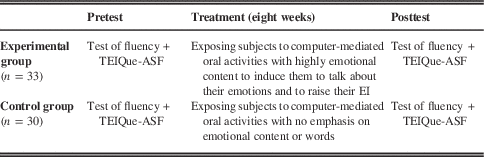
This study employed a quasi-experimental pretest-treatment-posttest design involving intact EFL classes serving as an experimental group (n=33) and a control group (n=30) (see Table 1).
Design of the study

The population under study comprised EFL learners enrolled in a language center in Iran, a total of 63 students studying using the Interchange 2 course book (Richards, Hull & Proctor, Reference Richards, Hull and Proctor2005). Native speakers of Farsi, they had been taking English courses for three to four years, but none had additional exposure to the English language apart from the normal TV programs and the Internet, which are almost impossible to control. Our participants were in two intact classes taught by the same instructor: one class was taken as the experimental group with 33 students, the other as the control group with 30 students. All participants were female and varied in age from 15 to 18.
4.1 Instruments
For the purposes of the present study, a number of instruments were used, which will be described in order. First, to assess oral fluency prior to and after the experiment, a fluency test was administered; this was very similar to the activities during the treatment period. Participants were required to watch a four-minute video (which was the same for the experimental and control groups but differed from the ones they watched in the treatment period) and were then asked to narrate the story of the video. To ensure the suitability of the narrative task for these participants and for our research purposes, experienced teachers and researchers were consulted. Then, following previous studies on oral fluency (Ahmadian, Reference Ahmadian2011; Ahmadian & Tavakoli, Reference Ahmadian and Tavakoli2011; Ellis &Yuan, Reference Ellis and Yuan2004; Yuan & Ellis, Reference Yuan and Ellis2003), the following measures were used:
-
∙ Rate A (number of syllables produced per minute of speech): the number of syllables within each narrative, divided by the number of seconds used to complete the task and multiplied by 60
-
∙ Rate B (number of meaningful syllables per minute of speech): as for Rate A, but excluding all syllables, words or phrases that were repeated, reformulated, or replaced.
Second, as mentioned before, this study focuses on trait EI. Trait EI, assessed by self-report, is regarded as an emotion-related dispositional trait which is a lower-level component of personality (Petrides, Pita & Kokkinaki, Reference Petrides, Pita and Kokkinaki2007). In this study, the short form of the TEIQue (Petrides et al., Reference Petrides, Sangareau, Furnham and Frederickson2006), consisting of 30 items, was used to measure students’ emotional intelligence before and after the experiment. TEIQue-ASF is a simplified version, in terms of wording and syntactic complexity, of the adult short form of the TEIQue developed for use with adolescents aged 12–18 years. All items are sampled from the fifteen subscales of the adult trait EI sampling domain (two items per subscale). The test yields scores on four factors, namely well-being (covering self-esteem, happiness, and optimism), self-control (covering low impulsiveness, stress management, and emotion regulation), emotionality (covering emotion expression, relationships, empathy, and emotion perception), and sociability (covering assertiveness, emotion management, and social awareness), in addition to global trait EI. Example items include “‘I can control my anger when I want to”, “I’m happy with my life”, and “I’m good at getting along with my classmates”. Higher scores on the TEIQue-ASF indicated higher levels of trait EI. We opted for the short version with a ten-minute completion time because we had time limitations and there was a concern that the participants might not be able to complete the longer version as reading a large number of test items may have added unintended cognitive load and may have exposed them to reading difficulties. Subjects responded on a 7-point Likert scale from (1) completely disagree to (7) completely agree. The reliability of the test was found to be relatively high (Cronbach’s α=0.89); factor analyses also provide some support for the construct validity of the questionnaire.Footnote 1
4.2 Instructional intervention
The instructional treatment for both experimental and control groups took place over an eight-week period, with the primary difference being the type of the focus of the program. To ensure consistent and parallel instruction for all participants, the same instructor taught both groups. The technology-mediated tasks in this study provided the opportunity of performing oral activities by language learners while interacting with the computer as well as with their peers. In this program, first there is a screen with some items (including tasks and movie names) and an on-screen voice which guides the learners through the tasks. Initially, the voice asks them to choose the name of the movie (which differed for experimental and control groups with regard to the story; each is three to five minutes long). Then the movie is shown and subsequently there are some questions regarding the story. The interaction between the learner and the computer happens when the computer asks them to be engaged in the story (as further explained in the experimental or control group activities) or gives them feedback based on the answers they provide or when the learner clicks to move forward, or when he/she requests additional information such as word definitions. The interaction with peers or the teacher is in the form of opinions about the movie or when the program asks them to discuss the answer with peers. Participants of both groups had about nine hours of English per week – three hours for speaking activities, and six hours for reading, listening and writing. There were 24 sessions between the pre- and posttests.
For both groups, the speaking activities followed the same format. This involved watching the movie and answering the follow-up questions, going through the vocabulary review activities provided in the program in which the words and their definitions were displayed on the screen in scrambled order and the students were asked to put them in order, and finally 30 minutes of teacher-led discussion that was related to the theme of the movie and the vocabulary items. At the end of the term (eight weeks), the same test of oral fluency and TEIQue-ASF were administered to subjects of both groups (see Table 1).
4.3 Procedures
Tests of oral fluency and TEIQue-ASF (Petrides, Sangareau, Furnham & Frederickson, Reference Petrides, Sangareau, Furnham and Frederickson2006) were administered to check the equality of the experimental and control groups in terms of trait EI and oral fluency. Learners then went through the eight-week treatment. Since, in this study, the focus is on oral fluency, the tasks needed to be designed in such a way as to highlight the importance of communication and conveyance of the meaning. Subjects in the experimental group were exposed to the EI program to induce them to talk about their emotions and to raise their emotional intelligence.
In the EI program, which sought to educate learners about EI and Goleman’s framework as well as to foster their oral fluency, video clips (as described above) were provided for learners, followed by texts and images in which they were asked to work individually (when they had to provide the answer for the computer by typing or clicking on an item) or collaboratively (when they had to find the answer by discussing it in a group, or when they were asked to work on interpersonal tasks such as finding emotions in others) to find answers which mainly involved emotional background. Four short animated videos were used for the experimental group, all three to five minutes long and silent: Geri’s Game [1997]; Boundin’ [2003]; For the Birds [2000] and One-Man Band [2005]. The idea for applying silent episodes was taken from Ahmadian and Tavakoli (Reference Ahmadian and Tavakoli2011) in which they claimed that using a silent film prevents “‘learners from taking advantage of the immediate exposure to authentic language” (p. 45).
More information about the ways the program introduced Goleman’s EI framework to learners of the experimental group is provided below:
-
1. Knowing one’s emotions: to make learners aware of their emotions, the program re-showed them some parts of the movie in which the character was feeling an emotion and asked them to find what caused that particular emotion. They were then asked to think about similar situations and their feelings, guided by the instructor, who made it possible for the learners to interact with their peers. In this way they improved their self-understanding. Then they were asked to talk about different emotions and their causes.
-
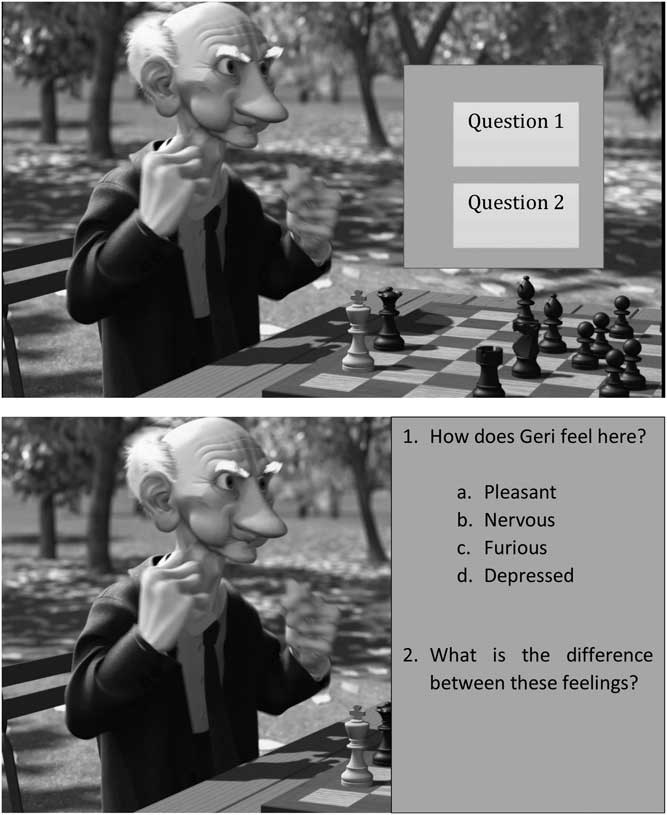
2. Recognizing emotions in others: to improve learners’ levels of empathy, the program encouraged them to pay attention to the body language of characters in the movie. In the final stage, parts of the movie which could help learners gain a better understanding of others’ emotions were displayed again. Figure 1 shows two screen shots of the activities and tasks regarding this step. In the first one the on-screen voice asks students to choose the first question. When learners answer question 1, the on-screen voice gives them feedback on their answers. If the learner provides the correct answer s/he can move to the second question, otherwise there will be another question in which the wrong answer provided for the first question is the target answer. For example, in Figure 1 if the learner chooses “depressed” as the correct answer, the next image shows the time the character is depressed and asks the learner to answer this question; then learners are asked to discuss the difference between these two emotions.
-
3. Managing one’s emotions: to help learners learn how to manage their emotions, there was a pause on a part of movie where the character felt an emotion (e.g., sadness or anger) and then learners were asked to find the cause of that emotion (i.e., what triggered it). They were then asked to watch the rest of the movie and find how that emotion was dealt with and how that strategy influenced their friends and people around them. When the movie ended, a message was shown to learners which asked them to discuss the possible ways of managing that emotion more effectively.
-
4. Handling relationships: to make students aware of the fourth characteristic of Goleman’s theory, learners were invited to watch parts of the movie again which showed interactions between characters. They were then asked to think about themselves in characters’ positions and to say what their friends could have done to make the character feel better.
-
5. Motivating oneself: to raise learners’ level of self-motivation, some parts of the movie where characters experienced a positive feeling were shown again and the learners were asked to talk about the ways the characters could change their negative feelings to positive ones. Subsequently, the participants were asked about their feelings in the classroom, what they wanted to accomplish, and the reasons they had for learning the language. Then some general questions about their experiences in learning an L2 were provided to make them aware that some difficulties are common to all students and to prepare them for tackling such difficulties:
-
a. Make some brief notes of your typical thoughts and feelings when you have to learn something you think you are not capable of.
-
b. How do you respond when learning is difficult and you have to do it?
-
c. How do you respond when learning is difficult and you don’t have to do it?
-
d. How can others help you to manage such difficulties?
Two screen-shots on the tasks given for recognizing emotions in others.
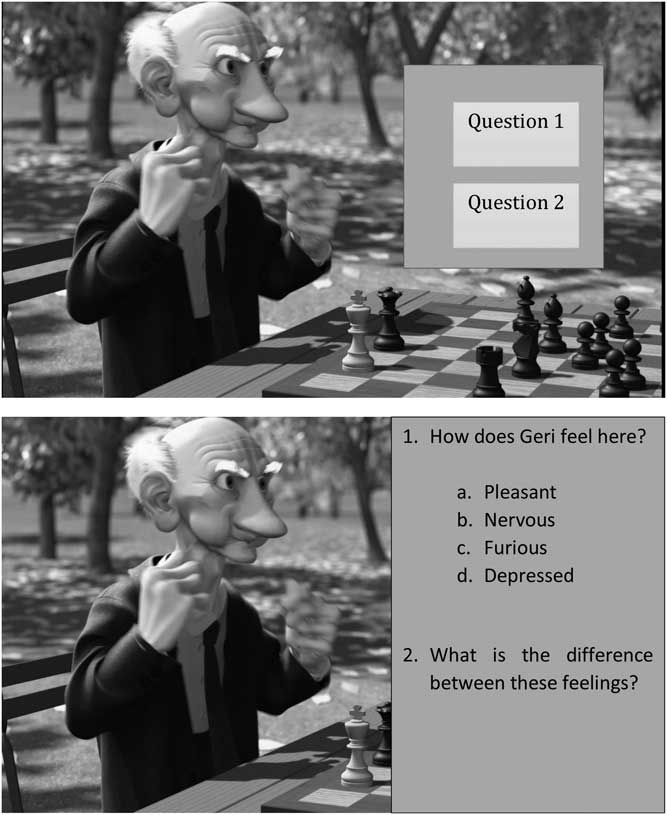
It was assumed that performing such activities and answering these questions would enable learners to become increasingly aware of their emotional states.
As noted above, movies shown to the subjects in the control group were void of emotional themes (for this group we had four other short animated videos: Red’s Dream [1987]; Tin Toy [1988]; Mike’s New Car [2002] and Lifted [2006]; each three to five minutes long). They were asked to watch the movies and narrate the story just like the experimental group, but their program differed in that Goleman’s EI framework was not introduced to them and that they were asked to pay attention to the story rather than characters’ feelings. Moreover, these learners were taught under the ordinary procedures in which no explicit emphasis was placed on emotions during oral communication activities.
4.4 Data collection and data analysis
All participants took a pretest of oral fluency and EI before the instructional period and a posttest after it. All narrations produced by the learners during the oral test were audio-recorded on a PC using a headset microphone and then transcribed by the researcher and two expert research colleagues. The data were then coded for fluency measures (Rates A and B). A sample of 10% of the data transcripts was rated by a second researcher, and an inter-coder reliability mean score of 95% was achieved on all measures. The data obtained through narrations and EI questionnaires were analyzed using the statistical package for social sciences (SPSS) to provide plausible answers to the research questions given earlier. First, descriptive statistics were used and the scores were checked in terms of the normality of distribution using such indices as Kurtosis and Skewness. Then, independent sample t-tests and Pearson Product correlation procedures were performed.
5 Results
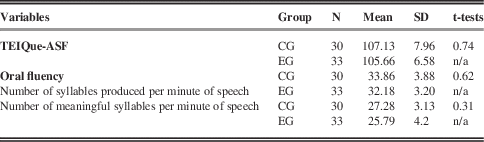
Table 2 shows the descriptive statistics (mean scores and standard deviations) and results of t-tests for the scores obtained from subjects’ TEIQue-ASF and oral fluency measures, i.e., the total number of syllables produced per minute of speech (Rate A) and the total number of meaningful syllables (Rate B), on pretests. As shown in the table, the experimental and control groups were fairly similar in terms of both measures prior to the treatment and results of the independent-sample t-tests confirm that there were no statistically significant differences between the two groups in terms of TEIQue-ASF (p=0.74) or oral fluency measures (p=0.62 and p=0.21).
Descriptive and inferential statistics on pretests

Level of significance is 0.008.
Note. Since multiple t-tests were run in this study, Bonferroni correction was applied to reduce the risks of committing Type 1 Error, such that the normal α value (0.05) was divided by the number of comparisons we were going to make (i.e., 6). So, the new α value (0.008) was considered as the cut-off for determining the level of significance.
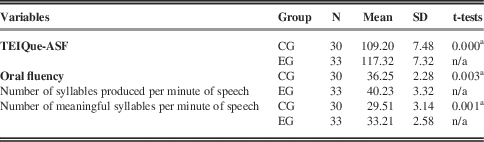
In order to see whether the positive effects of exposing learners to emotional activities transferred to their EI, the mean scores of EI were compared between the two groups after the two-month period. The results of the inferential statistics displayed in Table 3 point to a statistically significant difference between the experimental and control groups in terms of TEIQue-ASF (p<0.008). Thus subjects’ engagement in the computer-mediated emotional activities, which was used as the treatment given to the experimental group, has positively impacted their EI scores on the posttest.
Descriptive and inferential statistics on posttests

a Shows the existence of the significant difference at the level of 0.008.
To provide a plausible answer to the second research question, two measures were used: the total number of syllables produced per minute of speech (Rate A) and the total number of meaningful syllables (Rate B). Descriptive statistics for these two measures (see Table 3) indicate that participants in the experimental group (EG) produced more syllables per minute than those in the control group (CG). Independent-sample t-tests point to statistically significant differences between these two groups in terms of measures of oral fluency. There is therefore good evidence to suggest that exposing EFL learners to emotional activities has a positive effect on the fluency of oral production, in answer to our second research question.
The incentive behind the third research question was to see whether or not there is a correlation between learners’ EI and their oral fluency. To this end, experimental and CG learners’ EI scores and means of measures of fluency, i.e., the total number of syllables produced per minute of speech (Rate A) and the total number of meaningful syllables (Rate B), were submitted to Pearson Product correlation. The pattern of correlations was generally consistent with expectations. Overall, the results suggest that high EI was related to greater fluency (r=0.518, p=0.01 ≤0.05).
6 Discussion
The aims of this study were threefold: (a) to investigate the possibility of enhancing learners’ emotional intelligence through computer-mediated emotional activities; (b) to find out whether there is a significant difference between the oral fluency of those exposed to emotional activities and those instructed under the researched institution’s normal procedures; and (c) to ascertain whether emotional intelligence correlates with oral fluency. In this section, the results of the study will be discussed in light of the theoretical and empirical issues.
6.1 Enhancing emotional intelligence via technology
One interesting finding of the current study is the enhancement of the EI scores of those who were exposed to computer-mediated emotional activities. In the light of previous findings (Carrol et al., Reference Carrol, Bain and Houghton1994; Goldsworthy, Reference Goldsworthy2002; Goldsworthy et al., Reference Goldsworthy, Schwartz, Barab and Landa2007), the significant difference observed between the EI scores of experimental and CGs could be attributed to the influence of the technology-mediated activities with its numerous opportunities for direct exposure to emotional tasks. A question may arise as to why participants’ EI, which is part of their personalities, rose so much in such a short period of time. The question might be answered considering two important issues: (1) although the treatment period was relatively short, participants had quite an intensive exposure to computer-mediated activities; and (2) despite the commonsensical belief that personality traits do not change over time, there is now ample evidence in support of the fact that many traits can be changed if the individual is motivated enough (Haslam, Bastian, Fox & Whelan, Reference Haslam, Bastian, Fox and Whelan2007; Helson, Kwan, John & Jones, Reference Helson, Kwan, John and Jones2002). Therefore, one of the possible contributions of this study is that it provides further empirical support for the arguments put forth in the literature vis-à-vis the possibility of raising one’s EI via technology (e.g. Bain et al., Reference Bain, Houghton and Carrol1995; Goldsworthy, Reference Goldsworthy2002; Goldsworthy et al., Reference Goldsworthy, Schwartz, Barab and Landa2007; Thorkildsen et al., Reference Thorkildsen, Allard and Reid1983).
6.2 Improving one’s oral fluency via exposure to emotional activities
Results from the oral fluency test showed that there is a significant difference between the CG and those who underwent emotional activities. A plausible interpretation for this difference is that participants in the EG, through their extensive exposure to emotional activities, became more motivatedFootnote 2 (in Goleman’s Reference Goleman1995 model, motivation is one of the five characteristics that constitute emotional intelligence) and this motivation, in turn, positively influenced their academic performance. This finding is consistent with our prediction and provides further empirical support for Abdolrezapour and Tavakoli’s (Reference Abdolrezapour and Tavakoli2012) findings, which pointed to the possibility of enhancing one’s mastery in a skill in L2 through exposure to emotional activities. Few studies have examined the influence of one’s emotion on oral fluency within the realm of SLA. Among those that do, Dewaele (Reference Dewaele2002) found that there is a relationship between individual differences and L2 speech fluency; and Dewaele et al. (Reference Dewaele, Petrides and Furnham2008) found a negative relationship between trait EI and FLA, which was in turn conversely related to self-perceived oral proficiency. Findings of this part of the study seem to run in accordance with the idea that emotional activities influence performance and more generally the idea that “there are almost constant interactions between cognition and emotion in everyday life” (Eysenck, Reference Eysenck2006: 407). Furthermore, the increase observed in oral fluency scores adds a new dimension to previous studies (Skehan, Reference Skehan2003; Stockwell & Harrington, Reference Stockwell and Harrington2003; Yanguas, Reference Yanguas2010) regarding the effectiveness of technology in enhancing oral performance.
Of course, it should be pointed out that the intervention of EI involves far more than promoting oral fluency; in effect, it has the potential to help learners become more socially competent and offers them access to a range of knowledge and abilities which might enable better performance in an academic context and in their social life. This, however, cannot be supported by the data obtained in the present study, and thus needs to be tested in further research.
6.3 The relationship between EI and oral fluency
The stand-out result of this study is the relationship found between oral fluency and emotional intelligence. A number of studies have documented empirical evidence in support of the positive relationships between EI and academic success (Parker et al., Reference Parker, Summerfeldt, Hogan and Majeski2004; Song et al., Reference Song, Huang, Peng, Law, Wong and Chen2010; Stottlemayer, Reference Stottlemayer2002), and there is some evidence indicating that EI and L2 performance are positively related (Aki, Reference Aki2006; Brown & White, Reference Brown and White2010). In this regard, then, this study complements and contributes to the existing body of evidence confirming the impact of EI on academic success in general, and on one specific aspect of L2 learning (i.e., oral fluency) in particular. It was found that emotions influence oral performance to a great extent, and from this point of view it is important that this aspect of individual difference be addressed in the EFL context.
The subjects in the EG were all interested in the experiment and were enthusiastic about using the program in class and even at home. They claimed that they had never thought about their emotions in a language class, and when the findings of the study were shared with them, they were excited to hear that this program positively impacted their EI and their oral fluency. Two expert research colleagues were asked to participate in the final sessions and give their opinions about such an experiment. Farzaneh, an experienced member of the group noted:
I’ve taught this book before, but I had never thought of students’ emotions and the possible effect of engaging them in emotional activities on their oral performance. This group performed quite differently from the other group, which was of the same level, though their instructor was the same and they had the same book and the same oral activities. I was pretty pleased with how they tried to be engaged in the emotional activities. They worked really hard and their performance was pretty good.
Reza, the other experienced teacher of the institute, noted that:
I had never thought of emotional intelligence and its relation to second language learning. This program was quite interesting for me and I’m sure it will be helpful for both teachers and learners and help them to work collaboratively in the class. In addition, the teacher can give learners hints and suggestions of what to do next and ask them to work individually at home.
Sarah, one of the students in the EG, commented that:
I was almost excited when our teacher told us that we were going to have animated videos and I was more interested when I realized that we were asked to talk about our emotions. I enjoyed hearing about others’ emotions and I liked sharing my feelings with them
Shirin, another student in the EG, said:
Before this class I thought my English wouldn’t be good even in 4 terms but now I think there is nothing more to be afraid of. This program encouraged me to talk and I think it had a good impact on my speaking.
In traditional classrooms based on face-to-face human interactions, teachers can perceive nonverbal student cues, modify materials and methods, and give feedback to learners. In the current era where online learning, which lacks face-to-face human interaction, is becoming widespread, there is a need for innovative technologies which pay attention to learners’ characteristics. These innovations should motivate learners and give them emotional support. The program suggested in this study can be helpful in motivating L2 learners and assisting them in tackling learning difficulties by making them familiar with their emotions.
7 Conclusion
The present study added a new dimension to empirical research (e.g., Parker et al., Reference Parker, Summerfeldt, Hogan and Majeski2004; Song et al., Reference Song, Huang, Peng, Law, Wong and Chen2010; Stottlemayer, Reference Stottlemayer2002) on the relationship between EI and academic performance in general, and the acquisition of one specific aspect of language (e.g., Abdolrezapour and Tavakoli, Reference Abdolrezapour and Tavakoli2012) in particular. Moreover, the role of technology as a valuable tool to enhance both EI and oral fluency and to ameliorate their relationship was confirmed. As for the pedagogical implications, this study provides evidence that emotions can be successfully exploited in EFL classrooms for young learners at beginners’ level and are effective in improving oral fluency. Hence, one implication of this study is that tasks designed for EFL classrooms might address the needs and preferences of certain students, taking into account their individual differences – and more importantly their emotions – resulting in more motivating tasks. In addition, these tasks can help them face their emotional problems and become more able to handle their relationships. There is thus an argument for integrating the emotional programs proposed in this study into existing curricula, which would require backing from the institution’s principal, parents and teachers.
Despite the abovementioned positive findings, some limitations need to be acknowledged. First, the participant sample was a small group of intermediate learners and composed only of females, which might reduce the generalizability of the findings. It is obvious that studies with ESL and EFL learners of lower English proficiency are likely to show different results. In this light, our understanding would benefit from research replicating these studies with learner groups of different levels of proficiency, different age groups and from both sexes. Second, the study was conducted over a two-month period during which participants were exposed to intensive emotional activities and language input and instruction from various sources. This being the case, the internal validity of the study might be questioned; but, given the existence of a similar CG with the same instructor, the same amount of time devoted to oral communication activities, etc., this criticism may in part be overcome. Nevertheless, there is a need for future extended and methodologically rigorous investigations to further explore and (re)examine the role of emotional intelligence and its subscales in L2 learning and on other language skills.