1. Introduction
In recent years, distance and web-based academic language courses have attracted an increasing number of students at Swedish universities (see Högskoleverket, 2011: 21). However, despite this development, how students learn languages in virtual environments is still a new field of discovery that must be explored in more detail using sophisticated methods (see Lamy & Hampel, Reference Lamy and Hampel2007:17). Many researchers approach web-based language learning using concepts originating in sociocultural theory, namely mediation through social interaction and collaboration within an interconnected community (see Goodyear, Banks, Hodgson & McConnell, Reference Goodyear, Banks, Hodgson and McConnell2004: 2). According to this view, the dialogical interaction with other learners or experts (native speakers or the teacher) is supposed to enable learners to perform new functions through the process of scaffolding, i.e., when speakers support each other linguistically and cognitively in interaction. Collaboration involves problem-solving activities and leads, according to Swain’s (Reference Swain2000) definition of a ‘collaborative dialogue’, to new knowledge as learners use their L2 to solve a problem and reflect on it in their responses (Ellis, Reference Ellis2008: 527–28).
A question which is of crucial interest for virtual environments, where language students and native speakers work on collaborative tasks, is how interaction and collaboration are influenced by the interlocutors’ language expertise and linguistic background (see Ellis, Reference Ellis2008: 198). Does the interaction with a native or more competent speaker promote learners’ knowledge development, as Vygotsky (Reference Vygotsky1978) suggested in his notion of the zone of proximal development (ZPD), or does the learners’ lack of L2 knowledge and consequently inferior position lead to less participation and a restricted use of speech acts, as suggested by Ellis (Reference Ellis2008: 198)?
This study addresses the following questions:
1) What influence does group formation have on opportunities for participation for L2 German intermediate-level students and their production of complex utterances?
2) When and to what extent do they find opportunities for self-repair and direct or indirect corrective feedback from their interlocutors?
This article is based on a sample of 35 chat logs from 30 students who participated in four text-based online seminars on a German literature course during the first term of web-based academic German studies at a Swedish university. The author/researcher gathered the data in collaboration with the course teacher in the autumn of 2011. This online course attracts both Swedish students and native speakers of German, who work collaboratively towards their degrees. For the purpose of this study, language background (L1) and proficiency in German were investigated at the start of the course using a questionnaire. Of the students, eight were native speakers of German living in Sweden (NS), fourteen were intermediate-level Swedish students of L2 German (INNS), and eight were advanced-level Swedish students of L2 German (ANNS). The four text-based seminars belong to a series of eight online seminars that took place with an interval of two weeks. They were structured using open-ended questions about the literature the students had read. These questions were handed out two weeks before each seminar and had to be prepared in advance. As it is the objective of the course to develop the students’ basic knowledge of modern German literature as well as their academic language skills in German, the students were engaged in activities where they could apply their acquired course knowledge. They worked in small groups to discuss their answers. Each session began with a main meeting in the multimodal environment Adobe Connect, where the teacher held an oral introduction to the topic and organized the student group formations. The author had arranged these formations in advance as a means to gathering INNS language data from equal and unequal formations in terms of the students’ language backgrounds and L2 proficiency (length of studies). Students were advised to use MSN or the chat function in Adobe Connect, and to turn off their cameras and microphones. The first chat at the beginning of the term in late August 2011 was an introduction to the course, based on questions about the students’ favorite books and reading experiences. The second chat was in October on Brussig’s Am anderen Ende der Sonnenallee, the third in November on Vanderbeke’s Das Muschelessen, and the last in January on Kafka’s Die Verwandlung. The students were not informed about the aim of this study, as it was intended to collect a sample of data representative for this institutional learning context. They were told to save the chat logs and upload them in a Word file on Fronter, the learning platform used by the university. The students knew that the chat logs were being assessed by the teacher. The researcher and the teacher did not participate in any discussions.
The answer to question (1) is mainly based on the quantitative analysis of the INNSs’ data in equal and unequal triads (22 chat logs). To answer question (2), I apply both quantitative and qualitative approaches to investigate the discourse features related to self-corrections and corrective feedback in all formations (35 chat logs).
2. Research on chat
Synchronous written chat as a web-based language learning environment has been investigated by a number of researchers since the mid-1990s, mainly with the objective of finding its potential for L2 acquisition in comparison with oral speech (see Lamy & Hampel, Reference Lamy and Hampel2007: 12–15). Two aspects, which aroused the interest of researchers at an early stage are learners’ participation and the development of syntactic complexity. Regarding participation, there is strong evidence from a number of studies that chat increases learner activity (Chun, Reference Chun1994; Kelm, Reference Kelm1992; Kern, Reference Kern1995; Sullivan & Pratt, Reference Sullivan and Pratt1996; Warschauer, Reference Warschauer1996). Sotillo (Reference Sotillo2000) has shown that students not only employed the same types of discourse functions in synchronous written computer-mediated communication (CMC) as found in face-to-face-conversation, but also used a greater variety of functions than in asynchronous CMC, thus facilitating comprehension and learner output. On the other hand, syntactic complexity was higher in the asynchronous mode, which according to Sotillo is due to the delayed nature of asynchronous discussions. In contrast to Sotillo’s findings, the development of syntactic complexity in synchronous chat was confirmed by Warschauer (Reference Warschauer1996), Sullivan and Pratt (Reference Sullivan and Pratt1996), and in a recent study by Sauro and Smith (Reference Sauro and Smith2010). Warschauer considers the written mode as an important factor for the development of more complex grammar and lexis, and Sullivan and Pratt for the development of writing skills. Sauro and Smith (Reference Sauro and Smith2010) have shown that learners’ access to online planning in chat helps them develop syntactic complexity and lexical diversity. Further support comes from Pellettieri (Reference Pellettieri2000), who found evidence that learners developed their grammatical competence through the negotiations they employed in written chat. Negotiations seem to arise particularly when communication problems are caused by lexical problems (Pellettieri, Reference Pellettieri2000; Blake, Reference Blake2000; Cheon, Reference Cheon2003). However, there is also support for learners’ increasing attention to form when task complexity is decreased through the implementation of pre-task language activities and task structure (Alwi, Adams & Newton, Reference Alwi, Adams and Newton2012). Pre-task focus on language is supposed to promote form-related negotiations (Alwi et al., Reference Alwi, Adams and Newton2012; Leeser, Reference Leeser2004; Fortune, Reference Fortune2005). However, Alwi et al. (Reference Alwi, Adams and Newton2012) found a relatively low occurrence of LREs (language related episodes, Swain & Lapkin, Reference Swain and Lapkin1998), which they related to the fact that chat transcripts failed to capture off-line data, e.g., learners’ self-corrections and reflections on language in the composing process (Alwi et al., Reference Alwi, Adams and Newton2012: 34). There is also, meanwhile, evidence from other research that the output modality in chat has a decreasing effect on collaborative interaction between learners, thus leading to many “missed opportunities” for learning (Oskoz, Reference Oskoz2009; Kim, Reference Kim2014). Kim (Reference Kim2014: 36) suggests that establishing referents and a topic is more difficult in chat than in face-to-face interaction due to overlapping and split turns. Several studies (Lee, Reference Lee2006, Reference Lee2008) have shown that prior instruction to NSs to help NNSs focus on form has a positive effect on the negotiation of corrective feedback.
With regard to the impact of NSs on learners’ participation in text-based interaction, several studies reveal that NSs dominate the conversation (Lee, Reference Lee2004: 94–95; Blake, Reference Blake2000: 128). Blake reports that NSs had a reducing effect on L2 learners’ negotiations in chat conversations, suggesting that learners were probably less likely to acknowledge communication problems because of the native speakers’ control over the conversation in unequal constellations. Lee (Reference Lee2004) found in her data that linguistically weak NNSs perceived NSs to be leading the conversation since they asked questions, thus placing NNSs in a passive role. Those learners report a loss of self-confidence and negative attitudes towards collaborative activities with NSs.
3. Theoretical framework
We know from SLA research on oral speech that language learning is closely related to the learners’ interaction (Long, Reference Long1983), the negotiation of meaning, and the mental activities involved in processing input and output in the target language (TL) (Krashen, Reference Krashen1981; Swain, Reference Swain1985). This research is directed at the learning of individuals and has mainly been undertaken by researchers who follow a cognitive approach to L2 acquisition (Ellis, Reference Ellis2008: 241). Researchers who work within a sociocultural framework conceptualize learning as a mediated process which is strongly determined by the social interaction between individuals and the mediational tools involved (Lamy & Hampel, Reference Lamy and Hampel2007: 32). Scaffolding is supposed to develop linguistic and cognitive skills, and in accordance with Vygotsky’s (Reference Vygotsky1978) view, experts are supposed to guide NNSs to produce language above their actual level by offering them authentic language close to their ZPD. However, there is a lack of evidence in sociocultural studies to show that the language used in social interaction through co-construction finally becomes part of a learner’s persisting knowledge.
It is obvious that both approaches offer explanations for Second Language Acquisition (SLA) as they refer to the external and internal factors that are assumed to be involved in L2 learning. Instead of keeping them separate, my attempt is to build a bridge between the cognitive and sociocultural theories which I feel can be justified by the argument that even sociocultural theory is a cognitive one, because it explains L2 acquisition on the basis of the inter-mental and intra-mental processes involved in learning (see Ellis, Reference Ellis2008: 517–518). The theoretical framework for this article is a socio-cognitive approach (see Atkinson, Reference Atkinson2002), based on a language processing model that Fredriksson (Reference Fredriksson2006) has developed to explain developmental patterns in L2 German. This model has been developed based on connectionism (Rumelhart & McClelland, Reference Rumelhart and McClelland1986), information processing (McLaughlin, Rossman & McLeod, Reference McLaughlin, Rossman and McLeod1983), and variability theories (Tarone, Reference Tarone1983, Reference Tarone1988). Its basic assumptions are that what a learner pays attention to in his/her input and output and what becomes intake depends on the situational context and kind of activity involved in the learner’s interaction. It is the external context which influences the learner’s choice of strategies (on a continuum between abstract form-orientated and concrete meaning-orientated strategies) and finally on the kind of form-function mappings a learner makes in his/her mind.
In CMC, language learning is mediated by the interaction of the participants, the technology that is used, and the tasks the participants are working on. These tools are interrelated and, as they are mediated by language, they also influence language learning (see Lamy & Hampel, Reference Lamy and Hampel2007: 33–34). When using synchronous written CMC (chat), the technology provides for an exchange of messages between the participants in real time, which makes interaction in chat very similar to oral speech in terms of time structure, but there is a difference concerning the simultaneity of speech production and reception (Dürscheid & Brommer, Reference Dürscheid and Brommer2009). In many of the existing chat programs (e.g., MSN/Skype/Adobe Connect), a message first has to be sent before it can be read by the receiver. This leads to a delay in information exchange and influences the organization of contributions and the coherence of the discourse (Kenning, Reference Kenning2010:8). Because of the written mode of language, participants get more time in chat for planning output and monitoring speech. The conversation can also be followed on the screen, which helps to structure interaction (Lamy & Hampel, Reference Lamy and Hampel2007: 41). We can expect that these special affordances with chat have consequences for the learners’ interaction and language use, i.e., the complexity of their utterances (see Foster & Skehan, Reference Foster and Skehan1996).
4. Methodology
The analysis of the students’ written chat conversation is based on a model which was developed by Henrici (Reference Henrici1995) to analyze the relationship between interaction and L2 acquisition in oral language discourse. This model combines discourse analysis and conversation analysis, which implies a qualitative analysis of the language data. In terms of discourse repair, Henrici (Reference Henrici1995: 40–41) suggests the following steps in an interactional sequence: (1) Manifestation of a misunderstanding, caused by a lack of language knowledge or knowledge about facts, (2) Processing, (3) Solution, and (4) Reaction to the solution. The last step, when both interlocutors have agreed on the solution and the language item has been used in the learners’ further discourse, is, according to Henrici, an indicator for short-term acquisition.
In this study, both quantitative and qualitative methods were chosen to investigate the students’ interaction. Without a quantification of the data, general patterns of interaction related to the learners’ formal and functional practising (Bialystok, Reference Bialystok1978) of the L2 cannot be found. This, from a psycholinguistic point of view, would mean that an important aspect of L2 acquisition remains unconsidered. Qualitative analysis has been favoured by some researchers of computer-mediated communication for language learning (CMCL) (Levy, Reference Levy2000; Hubbard, Reference Hubbard2005; Bax, Reference Bax2003) because, on the one hand, they expect a better understanding of the complex interplay between different variables in human interaction, and on the other hand, they believe it necessary for theory building (see Lamy & Hampel, Reference Lamy and Hampel2007: 17).
As the study is conducted within the students’ regular studies, some compromises had to be made regarding the chat tools and the group constellations. Some students preferred to stay in Adobe Connect after the teacher’s oral introduction because they disliked or had problems with MSN. To create conditions similar to those of MSN, they switched off the camera and microphone, and used only the chat function.
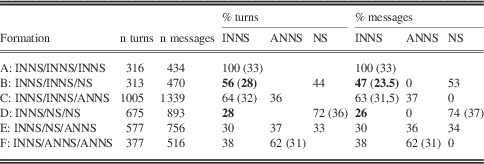
Because triads are the most common constellations in this literature course, the students were allocated to these formations (22 out of 35 from the whole class) so that I could investigate the social variables on the INNS’ participation and modifications of their input and output. However, because some students dropped the course before the end of the term, the compared formations vary in size (see number of chat logs and INNS in parenthesis in Figure 1), and not all INNSs participated in all types of formations. This must be taken into consideration in the quantitative analysis of the students’ cross-sectional data. The triads shown in Figure 1 were compared, with a focus on the data from the intermediate-level learners (INNS).
Formations and student types.

The analysis of the students’ corrective behaviour is based on the data from all 35 chat logs because, overall, overt reflections on language occurred only randomly. As a first step, all chat logs were listed in Microsoft Access and encoded in terms of different parameters so that I could investigate the effects of group formation on participation and corrective behaviour. The students were given pseudonyms with S* as the initial letter for the intermediate level students, D* for the German native speakers, and C* for the advanced learners. The students’ participation was ascertained by measuring the percentage of turns and messages in proportion to the different student types (INNS/NS/ANNS) per formation. Turns are defined as the transitions of the right to speak between interlocutors, whereas a message is defined as the speech unit which is sent at a single time. The messages were analyzed in terms of language complexity.
Researchers have used different definitions and methods to analyze language complexity (see Ellis, Reference Ellis2008: 491). Hunt (Reference Hunt1970) has shaped the term t-unit for the analysis of syntactical complexity in children’s discourse. He defines t-units as “the shortest units into which a piece of discourse can be cut without leaving any sentence fragments as residue” (op. cit.: 189). Syntactic complexity is calculated by frequency and length of t-units. Bardovi-Harlig and Bofman (Reference Bardovi-Harlig and Bofman1988) find t-units an unsuitable measurement for the analysis of the language of the more advanced learner, because they exclude complex structures like subordinated and coordinated clauses. To measure learners’ linguistic knowledge, they suggest an analysis on the basis of a coordination index, i.e., “the number of independent-clause coordinations present in the language sample divided by the number of combined clauses” (op. cit.: 10). The coordination index is multiplied by 100 and “gives the percentage of syntactic complexity achieved by independent-clause coordination”. The number of combined clauses is calculated by subtracting the total number of sentences from the total number of clauses (main, subordinated, and coordinated):
 $${\rm Coordination}\,{\rm index}:{\rm Coordinations}/{\rm Combinations }\,\left( {={\rm clauses}-{\rm sentences}} \right){\times}{\rm 1}00.$$
With this procedure, only multi-clausal sentences are taken into account, and the coordination index gives the frequency of coordination relative to the total number of combinations in the sample.
In line with these authors, I calculated a coordination index as a means of analyzing language complexity in this study. Furthermore, I calculated a rate for subordinated and coordinated clauses by dividing the total number of subordinated and coordinated clauses by the total number of clauses. This rate reflects the frequency with which subordination and coordination are used in relation to simple main clauses. Complexity is further measured by the INNSs’ average rates of clauses per message and chat. For the analysis of the rate of clauses, I used the following categories: Q 0=no clause, Q 1=one clause, Q 2_4=two to four clauses, Q 5_7=five to seven clauses, Q >7=more than seven clauses. Accuracy may be an important indication of the kind of knowledge learners draw on (Skehan Reference Skehan1989). For this reason I also calculated accuracy rates, dividing the total number of clauses by the number of error-free clauses.
As language used in interaction is supposed to be fragmentary or elliptical, I also ascertained the average rate of words per message and chat using the following categories: empty=no words, 1 to 3 words, 4 to 10 words, 11 to 30 words, and 31 to 100 and more words. Personal names and exact copies of the original questions from the task paper are excluded from the analysis of language complexity and counted as empty messages (they are not considered as representative of learners’ L2 knowledge).
The qualitative analysis mainly examines the interactional modifications that the participants make on input in order to support the development of the INNSs’ linguistic and metalinguistic knowledge, i.e., the students’ post-production monitoring, evident in their self-corrections of errors in orthography, grammar, lexis, and content, and their requests for corrective feedback or explanations, i.e., their strategies of discourse repair. Another discourse strategy on which the analysis focuses is adjustments from the interlocutors, i.e., direct and indirect corrective feedback.
5. Results
5.1. Quantitative data
5.1.1. Participation
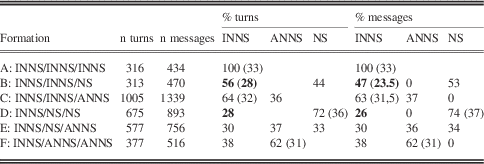
The results for the INNSs’, ANNSs’, and NSs’ contributions (see turns and messages in section 4) in the various formations (A, B, C, D, E and F) are shown in Table 1 (low rates of turns and messages of the INNSs are marked in bold). Overall, the NNSs tend to contribute less when they participate in NS-formations (B, D) than in NNS-formations (A, C, F) or the mixed formations (E). Although they are in the majority in formation B, their NS interlocutors proportionally have most turns (44%) and messages (53%). In interaction with two NSs (formation D), the INNSs contribute with only 28 percent of all turns and 26 percent of all messages. In contrast to these findings, in ANNS-formations (C and F), the INNSs show higher participation by means of turn-taking (32% in C, 38% in F) and the frequency of their messages. Interestingly, in the mixed INNS-NS-ANNS formation (formation E), the ANNSs exceed not only the INNSs in participation, but also the NSs (37% of turns, 36% of messages).
Rate of turns and messages in different formations
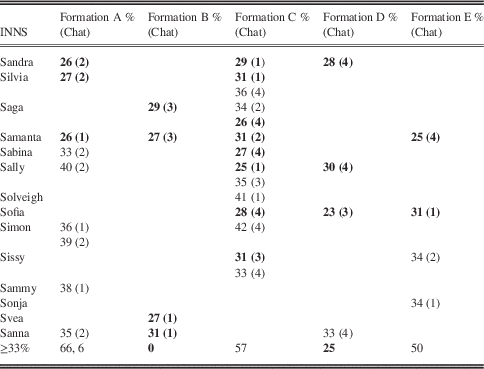
In Table 2 the percentage of turns for the individual INNSs is listed under the various formations (A to E). Values under 33% are marked in bold. Formation F is omitted because it is limited to only one individual INNS student and two chats. The numbers in parenthesis refer to the chat session (Chat 1 to Chat 4). The last row illustrates the percentage at which rates of 33% and above were achieved in the different formations. This is most often (66%) in equal formations (A), followed by the ANNS-formations (C) (57%), and the mixed INNS-NS-ANNS formations (E) (50%). In NS-formations (B and D), the INNSs take considerably fewer turns than their interlocutors.
Individual rates of turns in different formations and chat sessions
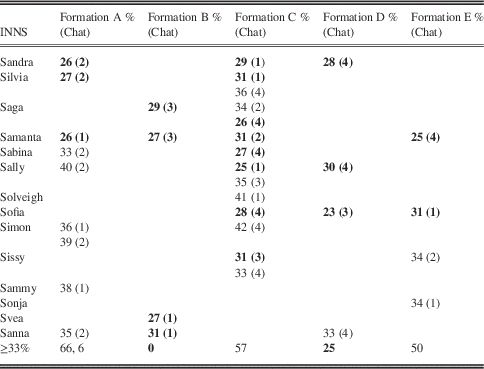
As shown in Table 2, there is also a great amount of individual variation regarding how INNSs’ participation is affected by group formation. We can assume that there are many factors which, over and above language background and proficiency, have influenced the students’ activity, e.g., the participants’ personalities, their interest in the literature, the difficulty of the task, and the technology. This general pattern of the learners’ turn-taking does not allow for any conclusions as to how learner activity provides opportunities for practising language in communication. In the following section we will look at the learners’ language with regard to the length and complexity of their utterances.
5.1.2. Language complexity
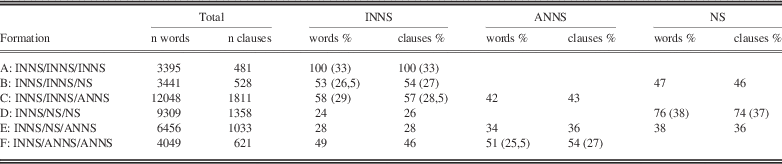
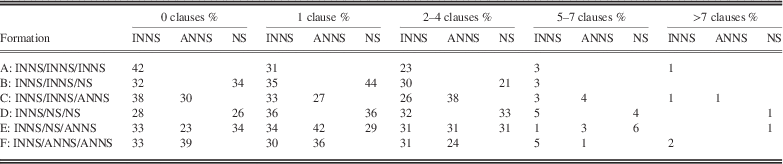
Table 3 reveals the percentage of words and clauses for the INNSs, ANNSs, and NSs in the different formations. Overall, in relation to the ANNSs and NSs, the INNSs produce fewer words and clauses in all formations, except for in formation F, where the INNSs produce almost as many words and clauses as the ANNS-interlocutors put together.
Total amount of words and clauses used by INNSs, ANNSs, and NSs in different formations
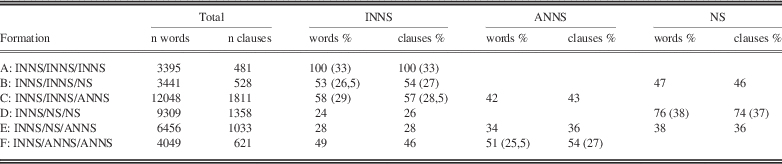
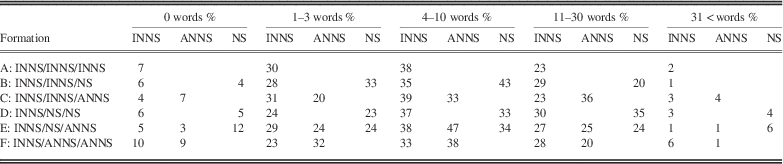
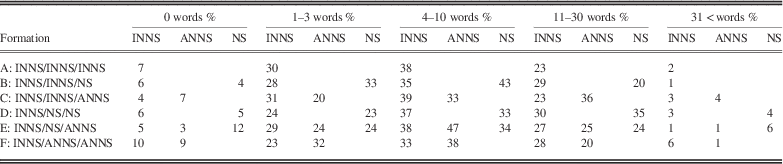
Table 4 presents, from left to right, the percentage of messages containing no words, 1 to 3 words, 4 to 10 words, 11 to 30 words, and 31 and more words in the INNSs’, ANNSs’, and NSs’ data in the different formations to express the length of the students’ utterances. In general the INNSs make more use of messages containing 11 to 30 words in the NS-formations B (29%) and D (30%) than in the NNS-formations A and C (23%) or the mixed formations E (27%). Most common in all formations and for all student types are messages containing 4 to 10 words. In the INNSs’ data, the majority (582/956) of these short 4- to 10-word replies consist of simple main clauses, e.g., “ich mag ein gutes Ende” (I like happy endings) or “traurig kann auch gut sein” (Sad can also be good) (Silvia, Chat 1, formation C). Less frequent are sentences with subordinated or coordinated clauses, e.g., “ja, klar, aber was ‘gut’ ist, ist persönlich” (Yes sure, but what is ‘good’ is personal) (157/956) and fragments (152/956), where the subject or finite verb is omitted, e.g., “Deutsche Literatur: schwer, ernst …” (German literature: heavy, serious…) (Sanna, Chat 1, formation B). Interestingly, this kind of message is more frequent in formations A, C, E, and F, i.e., when the Swedish NNSs are in the majority. This can be taken as an indication that learners tend to draw on their informal style when they have the same language background, probably using lexicalized material which has been internalized as formulas, i.e., as unanalyzed form-function mappings. From this comparison we can assume that interactions with a native speaker push the learner to produce more language, probably because, due to the NS dominance, he/she is forced to accommodate language by activating words and forms from a more formal style.
Length of messages in the productions of INNSs, ANNSs, and NSs
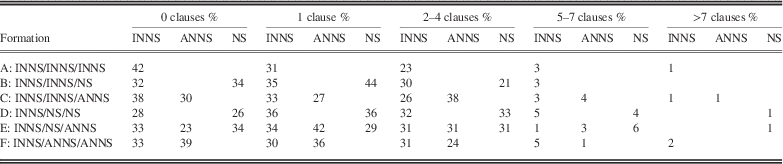
With regard to the INNSs’ use of clauses and sentences, a similar pattern arises as was shown above for words. Table 5 presents, from left to right, the percentage of messages containing no clause, 1 clause, between 2 and 4 clauses, between 5 and 7 clauses, and more than 7 clauses. In formations where the INNSs are in the majority, they produce more messages containing between 2 and 4 clauses in the NS-formation B (30%) than in the NNS-formations A (23%) and C (26%), and their messages more often contain at least one clause (35%). On the other hand, in formation A, messages without complete clauses are most prevalent (42%). In formations where the INNSs are in the minority, they make more frequent use of messages containing 2 and 4 clauses (32% in D, 31% in E and F). Interestingly, in the NS-formation D, they also produce more messages containing one clause and fewer messages containing incomplete clauses (28%). This indicates that interaction with NSs in general has a positive impact on the learners’ choice of strategy, i.e., their functional practising by using the existing L2 knowledge and extending it to new functions.
Complexity of messages in the productions of INNSs, ANNSs, and NSs
A closer look at the longer messages (2 to 4 clauses) reveals that the INNSs use their language resources more creatively in those constructions, which means that they use forms and structures they know in new combinations. As a consequence, they seem to make more errors (30% of the messages containing 2 to 4 clauses are deviant). In one-clause messages, the error rate is lower at 25%. An illustrative example is the sequence in Figure 2, taken from Saga.
Example 1, formation B.
The sequence in Figure 2 consists of one sentence structured with one coordination and three subordinations, and is extremely complex in terms of Skehan’s (Reference Skehan1996, 22) definition of complexity: “[It] concerns the elaboration or ambition of the language that is produced”. However, though Saga seems to have the ambition to produce complex language, she does not complete the main clause “Und der Sohn, der…,” after the relative clause; she therefore violates both word-order rules and morphological rules (errors are marked in bold). Presumably she drews on her formal style, thus activating more analyzed form-function mappings but has not yet learnt all the functions.
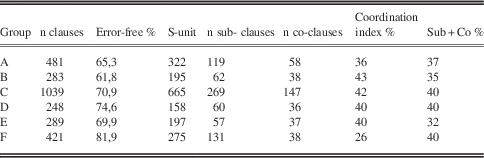
The last part of this section reveals the syntactic structure and accuracy of the sentences the INNSs used in the different formations. Table 6 presents, from left to right, the total number of clauses, the rate of error-free clauses, the frequency of complete sentences (S-units), the number of subordinations and coordinations, the percentage of independent-clause coordination, and, finally, the percentage of complex clauses (subordinations and coordinations).
Syntactic complexity and accuracy in the INNSs’ data in different formations
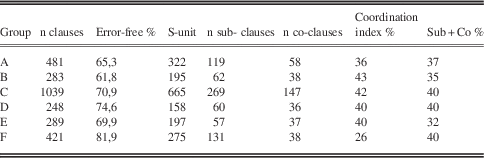
Regarding syntactic complexity, the coordination index reveals that the INNSs make frequent use of subordination in all formations, but especially in formations A and F, where the index is lower than in the other formations. The fact that the rate for subordination and coordination (last column on the right in Table 6) is also low in A demonstrates that messages most often contain one simple main clause or one sentence with a subordination. In formation B, subordinations and coordinations are also less frequent (35%), but syntactic complexity is more often achieved by coordination (43%). This means that messages are constructed by listing simple main clauses and by linking main clauses. This is at the expense of accuracy, which is the lowest in this formation (61.8%). In formation D, the length of messages is related to the INNSs’ more frequent use of combinations, as both the coordination index and the rate for subordination and coordination is high. The example in Figure 3 illustrates how the student Samanta produces a complex message by using subordination and coordination, and by linking short main clauses with a comma. At the same time, she is violating word-order rules and morphological rules (errors are marked in bold):
Example 2, formation B.
To summarize, this section about language complexity has shown that NS-interaction seems to encourage the INNSs to produce longer messages by using more words and clauses. Syntactic complexity is mainly achieved through subordination but in NS-formations to a greater extent through coordination. The INNSs are supposed to draw on their formal style and use their existing knowledge creatively to express new meanings. The forms and structures they activate are relatively often deviant, reflecting the kind of form-function mappings they have internalized at that stage of their learning process.
5.1.3. Post-production monitoring and corrective feedback
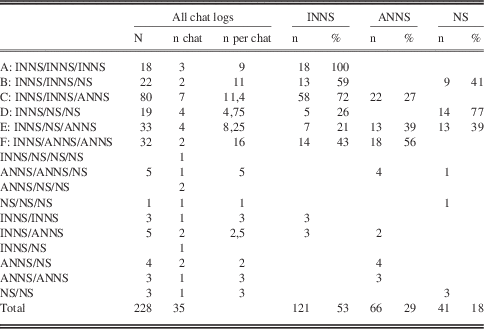
In this section, we shall consider the students’ modifications of their input and output, i.e., their self-corrections, and their requests for clarification and corrective feedback, before we finally have a closer look at some excerpts from the students’ chat logs. A general tendency is that the frequency with which the students modify their own or their interlocutors’ output seems to be very low, as only 228 out of 6534 messages (3%) can be related to strategies where attention was raised with regard to orthographical, grammatical, lexical, or content issues, and led to modifications.
Table 7 presents the distribution of modifications in the various triads (A-F) and other formations and the percentage of modifications in the data of the INNSs, ANNSs, and NSs. Because of the differences in the total number of chat logs/formations, the average number of modifications is calculated for each chat/formation. Overall, modifications tend to occur more frequently in the triads (A-F) and to a higher degree in formations B, C, and F. The INNSs most often make use of them (53%) and to a greater extent in formations B and C, followed by the ANNSs (29 %) and the NSs (18%).
Modifications in the various formations
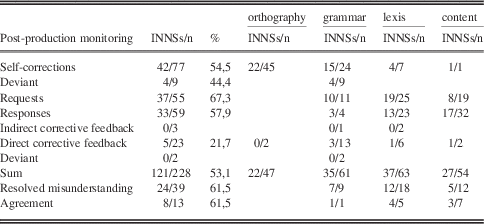
Table 8 presents, in the upper section, the distribution of different strategies in the students’ data. The INNSs’ values are shown in proportion to the total number of strategies (INNSs/n). Self-corrections often concern orthography and grammar, and requests particularly relate to lexis and content. If we compare the frequency of those requests with the responses, we see that questions about grammar are seldom answered, but lexis and content to a much higher degree, which means that they are negotiated. Feedback is given in the form of direct feedback, mainly on grammar.
Post-production monitoring and corrective feedback
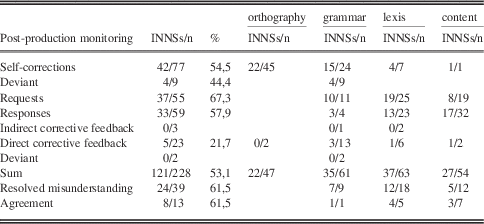
It is striking that students very seldom seem to negotiate meaning because of a misunderstanding (see resolved misunderstanding). However, when problems with grammar, lexis, or facts are negotiated (in total 39 interactional sequences), only 13 of them lead to a reaction by the first speaker or another interlocutor as an indication that there is common agreement that an acceptable solution has been found (see Henrici’s step 4 in section 4). Corrections are for the most part self-initiated, and even if an INNSs asks for a response, his/her request is seldom answered by a partner. As a consequence, false hypotheses about L2 grammar and lexis are not corrected.
It is surprising that the use of strategies (monitoring as cognitive, and corrective feedback as discourse strategy) which are thought to be essential for L2 acquisition seem to be so limited in the students’ data, especially when we consider the amount of deviant forms and structures in the INNSs’ utterances (see section 5.1.2).
5.2. Qualitative data
5.2.1
In this part, the students’ interaction concerning post-production monitoring and corrective feedback will be illustrated by the following excerpts from the students’ chat logs. Example 3 in Figure 4 is taken from chat three between the INNSs, Sally and Sissy and the ANNS, Cindy. It is illustrative of INNSs’ self-corrections.
Example 3, focus on form, self-correction, formation C.
Sally produces a form in 3rd person singular *nimmt ‘takes’ instead of the plural form nehmen ‘take’. In her next message, she reformulates this form and replaces it with another deviant form in 1st person singular *nehme. Finally, in turn 170, her post-production monitoring leads to the correct target plural form nehmen. By marking these self-corrections with an asterisk, she even makes it explicit to her interlocutors that she is focused on form. It is symptomatic of the students’ chats that messages overlap at the expense of discourse coherence, as in Cindy’s turn 169. Self-corrections of this kind occur in side-sequences, while the other participants continue in the main sequence, in this case with a question on the content of the conversation. But, to keep the discourse going, students obviously have to go back to former messages. This can be an essential strategy that supports L2 learning.
In example 4, Figure 5, the INNS Solveig has monitored the form of the verb ausgeloggt in her ANNS-interlocutor Cindy’s output (Turn 55) as she repeats it in her request about its use in turn 58. In the next turn, her request is confirmed by Cindy. Thus their negotiation of the form has led to common agreement.
Example 4, focus on form, negotiation, and common agreement on the solution, formation C.
Example 5 in Figure 6 reveals a communication problem which arises because Sammy does not know the German word Charakter ‘character’ and uses the wrong word Zeichen ‘sign’, which is certainly the result of translation from his L1 karaktär. This becomes clear when he uses the Swedish word (turn 23) to answer Simon’s request for clarification (turn 22). However, although the communication problem is solved, a fact obvious from Simon’s reaction, negotiation does not lead to the filling of the lexical gap.
Example 5, focus on meaning, negotiation, common agreement, no solution, formation A.
In example 6, Figure 7, a communication problem is negotiated which arises because the INNS Saga leaves the main mode of the discourse and gives her attention to language in a mode side-sequence. Her request for clarification in turn 53 ehregeiz oder wie heisst es? ‘ambition or how do you say it’ is not answered directly, but Dina repeats the word ehrgeiz and offers the target model in the next turn. However, instead of a reaction to her response, Saga is still monitoring her output from turn 53 and asks for clarification of in der Gesellschaft ‘in society’ in turn 55: or is it an accusative object - in die Gesellschaft? This causes a misunderstanding by Samanta da AO? because she has not noticed the shift from the main discussion. By giving her an explanation in turn 57, the communication problem is resolved; however, the language problem is not negotiated in the further discussion, although Saga gives an incorrect explanation in turn 57.
Example 6, focus on meaning and form, no negotiation, formation B.
In example 7, Figure 8, negotiation of form arises because the INNS Sally overuses the reflexive pronoun sich ‘himself’, which leads to direct corrective feedback from the NS Dina in turns 162 and 164, when Sally is still in the main mode of discourse, commenting on Daniela’s statement. In the following turns (164–166), the NSs negotiate the form by using metalinguistic explanations (Turn 164) and paraphrases (Turns 165, 166). When Sally is responding in turn 167, it is obvious that she is threatened by the NS-dominance, because she uses irony to overcome the communication problem. A common agreement that the problem is solved is achieved by Dina’s joke, but there is still no agreement that the specific language problem is solved.
Example 7, focus on form, direct corrective feedback, negotiation, formation D.
6. Discussion and conclusion
This paper has shown the influence of group formation on web-based interactions between students with different linguistic backgrounds and L2 proficiency levels in an academic online course in German. With regard to the first research question (What influence does group formation have on opportunities for participation for L2 German intermediate-level students and their production of complex utterances?), the results indicate that interaction with NSs (Formations B and D) leads to a lower activity of the INNSs in terms of frequency of turns and messages. This finding corroborates the results from other studies (see Blake, Reference Blake2000; Lee, Reference Lee2004). It can be assumed that the INNSs perceived some inequality in terms of language skills, and were thus less motivated to contribute to the discourse, which is also reported by Lee (Reference Lee2004: 88). With regard to the situational context in this study, where NNSs and NSs were being assessed regarding participation, the quality of the discussions about literature and language accuracy, the NSs might have felt responsible for the conversation. This might also explain why the ANNSs participated to a higher degree in Formation E. Because of the ANNSs’ high language proficiency, the NSs were able to share responsibility for the discourse and leave more control to the Swedish NNSs, which in the end shifted power relations and increased participation from the INNSs. Interestingly, the data show that interaction with NSs seemed to induce the INNSs to produce longer messages by using more words and clauses and combining them through coordination. One possible explanation for this is that they used their careful style and monitored their utterances to a higher degree (which is confirmed with regard to Formation B and the rate of modifications there, see Table 7). This is also supported by Lee (Reference Lee2004: 94), who found that linguistically weak students composed their messages carefully in interactions with an NS. Another explanation is the choice of topic, as the NSs might have forced the INNSs to focus on the task, and thus use less informal language. This finding reveals the necessity to look not only at students’ activity but also at the quality of their language. An important issue for further research is to investigate how learners extract L2 knowledge from this kind of interaction, which means that the language exchanged between speakers has to be analyzed in relation to interactional moves.
Research question (2) asked when and to what extent the INNSs find opportunities for self-repair, and direct or indirect corrective feedback by their interlocutors. From the quantitative data, it becomes clear that problems with language and/or content were seldom negotiated and that modifications of formal issues most often took the form of learner-initiated self-corrections. The finding that interaction in triads has led to more modifications than in dyads makes group formation an important issue from a pedagogical point of view. Further research should shed more light on how the number of participants influences the use of discourse strategies and modifications.
Because interaction is analyzed in retrospect on the basis of the students’ conversation, post-production monitoring could only be grasped by the self-corrections occurring in the students’ texts or their requests for explanations. However, it is likely that the subjects also reflected on language and revised it while writing a message or even afterwards, before sending it to an interlocutor, as planning time in chat offers this opportunity (see Sauro & Smith, Reference Sauro and Smith2010). However, to gather such information about online planning requires technical equipment that allows for the recording of student interaction in real time. This cannot be achieved on the basis of the written data (see Alwi et al., Reference Alwi, Adams and Newton2012). Other possible explanations for the low frequency of input and output modifications in the data might be that misunderstandings did not occur because the INNSs were able to express themselves and comprehend their partners at this L2 level. It should not be forgotten either that the task had a clear focus on meaning. This might explain why negotiations were primarily on meaning (request and responses on lexis and content) and to a much lower extent on grammar.
The findings that language-related questions were often not answered and errors not corrected by the interlocutors (corrective feedback) can be explained by the students’ focus on the task. They were probably aware of being in an institutional setting and were thus focused on answering the questions, spending, therefore, little time on language-related issues in their partners’ output. This gives rise to the question as to what extent, if any, their interaction had the form of a ‘collaborative dialogue’ (see Swain, Reference Swain2000) and has to be considered in further research. On the other hand, little focus on form is reported in other studies (Ware & O´Dowd, Reference Ware and O'Dowd2008; Alwi et al., Reference Alwi, Adams and Newton2012), and can be explained by the students’ need for instruction in discourse strategies and the use of them in interaction. This is certainly of importance with regard to fossilization. Finally, it must also be taken into account that interactional modifications to solve misunderstandings might not be a sufficient learning condition (see Lee, Reference Lee2004: 84). Further attention has to be paid to the strategies students employ in social interaction, e.g., imitation and elaboration.
The findings of this study give weak support for more beneficial opportunities for L2 acquisition for INNSs in the NS-formations (B and D), but also in NNS-formations with more proficient partners (C and F). By using language more creatively, the INNSs are involved in functional practising (see Bialystok, Reference Bialystok1978), which is a necessary condition to internalize and automatize new forms and structures. However, I am aware of the limitations of this study due to group size and the absence of a more detailed analysis of the students’ interaction patterns. Furthermore, this study focused on triads because of their prevalence in this educational context. This leaves it open to research other formations. Future research should also consider both online and offline data, and in addition even students’ reflections on their interactional behaviour, e.g., how task design, awareness of assessment, and the status of interlocutors can influence participation and negotiation.