1 Introduction
The study of different strategies for enhancing the effectiveness of professional development attempts has long been the focus of research across various disciplines, including computer-assisted language learning (CALL) teacher preparation. Discussion lists are among the highly advocated online spaces for asynchronous interaction that have been incorporated into teacher education courses to promote such preparation (Arnold & Ducate, Reference Arnold and Ducate2006; Arnold, Ducate, Lomicka & Lord, Reference Arnold, Ducate, Lomicka and Lord2009; Meskill & Sadykova, Reference Meskill and Sadykova2011). Electronic discussion lists “promote interactive learning … central to the professional development of future and current educators” (Arnold & Ducate, Reference Arnold and Ducate2006: 42) by situating teachers in venues where they can experience critical thinking and problem-solving beyond the time/space limitations of the physical classrooms (Arnold et al., Reference Arnold, Ducate, Lomicka and Lord2009). The learning that arises from the dialogue and knowledge sharing in these communities positively promotes critical inquiry and the acquisition of new insights (Attard, Reference Attard2012).
As evidence grows on the potential of these lists for teacher preparation (e.g. Arnold et al., Reference Arnold, Ducate, Lomicka and Lord2009), more professional development courses and programs turn to online venues as part of their instructional design. A careful review of related studies indicates that, by and large, they depend on self-report data, which, according to Fuchs (Reference Fuchs2006), does not clearly specify the nature of interaction. As Hull and Saxon (Reference Hull and Saxon2009: 627) acknowledge, although online interaction has been the subject of different studies, “little research has established an empirical link between measures of learning and online learning environments that support interaction.” Listing top research priorities for educational technology in the upcoming decade, Pollard and Pollard (Reference Pollard and Pollard2004) similarly highlight the essence of exploring the nature of online interaction. Furthermore, despite the abundance of research in this regard across other disciplines (e.g. Hawkes & Romiszowski, Reference Hawkes and Romiszowski2001; Hull & Saxon, Reference Hull and Saxon2009), studies that explore the potential of discussion lists for promoting asynchronous interactions and the nature of such exchanges in the context of CALL teacher preparation remain scant (e.g. Wang, Chen & Levy, Reference Wang, Chen and Levy2010).
This study aims at contributing to the growing body of research in this regard by focusing on a discussion list that was incorporated into a CALL teacher education course and the nature of teacher interaction in the space. Five female in-service teachers were observed as they exchanged ideas about technology/CALL in a discussion list during a five-month period. Our perspective in this study is grounded in Vygotskian theory (1978), taking social interaction as a cornerstone for effective learning, Gee’s (Reference Gee2003) theory of distributed knowledge, and Garrison, Anderson and Archer’s (Reference Garrison, Anderson and Archer2000) community of inquiry (CoI) model. The next section discusses the theoretical underpinnings and is followed by a review of the literature on asynchronous interaction in professional development and CALL teacher education research.
1.1 Theoretical considerations
Today, interaction is regarded as an essential component of teacher development (Ernest et al., Reference Ernest, Catasús, Hampel, Heiser, Hopkins, Murphy and Stickler2013). The rationale grounding this widespread advocacy is the Vygotskian (1978) notion of social constructivism in which knowledge construction is considered a social process that stems from dialogue (Hull & Saxon, Reference Hull and Saxon2009). Building on this assumption, Gee (Reference Gee2003: 177) suggests that, as an inherently dialogic and social process, learning is “distributed, and part and parcel of … people, tools, technologies … all interconnected together.” Implicit here is the idea that learning should embrace communication (Arnold et al., Reference Arnold, Ducate, Lomicka and Lord2009) and draw on the potentials of technology. It is the active interchange between individual experience and the social world that results in learning (Wenger, Reference Wenger1998).
Hence, a learning environment that provides opportunities for learners to co-construct knowledge, through exchanging viewpoints, has the potential to promote interactive learning (Ernest et al., Reference Ernest, Catasús, Hampel, Heiser, Hopkins, Murphy and Stickler2013). In their CoI model, Garrison et al. (Reference Garrison, Anderson and Archer2000) identify the structural components of such a learning environment. Inspired by collaborative constructivist principles, Garrison et al. (Reference Garrison, Anderson and Archer2000) suggest that sustained purposeful learning in an online community takes place through the interaction of three core elements: cognitive, social, and teaching presence.
Cognitive presence reflects “the extent to which the participants in any particular configuration of a community of inquiry are able to construct meaning through sustained communication” (Garrison et al., Reference Garrison, Anderson and Archer2000: 89). Collaboration is considered as a necessary condition for cognitive development. Joint effort provides learners with an opportunity to evaluate, refine, and develop their understanding to address the problems, which are less likely to be solved if approached individually (Arnold & Ducate, Reference Arnold and Ducate2006). In these exchanges, which usually engage learners in a process of problem-posing/solving, certain pieces of information are made explicit and a knowledge base is built up as individuals try to achieve solutions for the posed problems. Furthermore, through problem-solving with more capable peers, learners find the opportunity to achieve a potential level of development (Vygotsky, Reference Vygotsky1978).
This experience not only contributes to the internalization of knowledge (Meskill & Anthony, Reference Meskill and Anthony2007) and the consistency of learning, but also helps participants “identify[ ] with the community, communicat[e] purposefully … and develop[ ] interpersonal relationships” (Garrison, Anderson & Archer, Reference Garrison, Anderson and Archer2010: 7). Referred to as social presence, this quality supports cognitive presence, indirectly enhancing the critical thinking that is taking place in the community (Garrison et al., Reference Garrison, Anderson and Archer2000). While socially shaped and cognitively sustained interactions are essential for an online learning environment, they might not lead to meaningful learning without being effectively designed, facilitated, and directed. Conceptualized this way, teaching presence enhances the cognitive and social presence through designing, integrating, and facilitating the educational experience in the learning environment (Garrison et al., Reference Garrison, Anderson and Archer2000). These functions can be performed by either the teacher or any one of the members (peer instruction) within the CoI.
1.2 Interaction and professional development
Interaction is not foreign to professional development research. It is often linked to peer mentoring and collaborative learning due to common qualities such as reciprocity, knowledge co-construction, and peer support. Kennedy (Reference Kennedy2011), for instance, applies the term collaborative professional development for unstructured learning stimulated by working with peers or within communities of enquiry. In this study, the term includes what Topping (Reference Topping2005) calls peer mentoring as knowledge development through generating/receiving feedback from equal status peers as well as Ernest et al.’s (Reference Ernest, Catasús, Hampel, Heiser, Hopkins, Murphy and Stickler2013) collaborative learning as a process of viewpoint exchange among individuals.
Similar to collaboration, interaction is essentially dialogic. It situates the interlocutors in a social context that requires cohesive articulation of ideas. This process of articulation helps learners to clarify their perspective and evaluate the newly constructed knowledge. Given the social nature of the learning process, teacher learning is respectively social and collegial (Kennedy, Reference Kennedy2011). Professional development is a process of understanding how to operationalize what is learned via exchanging viewpoints with a community of peers. Thus, if teacher education is to result in sustained professional growth, interaction with peers is crucial (Ernest et al., Reference Ernest, Catasús, Hampel, Heiser, Hopkins, Murphy and Stickler2013). When social learning becomes a part of the pedagogy of teacher education, professional development is more likely to bring about promising results (Pawan, Paulus, Yalcin & Chang, Reference Pawan, Paulus, Yalcin and Chang2003). This is by no means to imply the superiority of interaction over more individualized learning strategies, but rather to highlight its potential as what Kennedy (Reference Kennedy2011) calls a complementary approach in professional development. That is, social learning should be acknowledged alongside other learning strategies.
1.3 Discussion lists for asynchronous interaction and professional growth
Many online environments are considered apt venues for interactive learning, as they afford the nature of the learning advocated in social constructivism and provide an increased opportunity for professional dialogue (Comas-Quinn, Reference Comas-Quinn2011; Koh, Herring & Hew, Reference Koh, Herring and Hew2010) by presenting users with multiple perspectives and the time needed for contemplation (Arnold et al., Reference Arnold, Ducate, Lomicka and Lord2009; Hawkes & Romiszowski, Reference Hawkes and Romiszowski2001). Online discussion lists that promote asynchronous interaction transform teacher learning by building a new knowledge base through exchanging ideas and reflective practice. Meskill (Reference Meskill2009) concurs, arguing that human-to-human dialogue in web-based environments offers significant educational potentials for students and those preparing to teach them.
Having access to a shared repository of ideas, interlocutors can build on each other’s knowledge. As spaces that promote interaction and exchange of ideas, discussion forums and lists hold the promise of learning through reflection, critical thinking, and problem-posing/solving, which are crucial for the effective preparation of pre- and in-service teachers (Arnold & Ducate, Reference Arnold and Ducate2006). Computer-mediated communication (CMC) represents further advantages when it is in asynchronous mode, as “the temporal extension of dialogue permits participants to be more reflective in their responses” (Hull & Saxon, Reference Hull and Saxon2009: 625). The time/space independence in asynchronous interaction not only extends the reflection time but also enables distance users to communicate in a virtual space. Furthermore, by creating technology-enhanced environments, such environments set the ground for acquiring professional knowledge through technology (Chapelle, Reference Chapelle2003).
Although the lack of immediate feedback in such spaces is widely perceived as a drawback, in practice, it may lead users to comment in a concise and clear manner to effectively convey the message (Johnson, Reference Johnson2006). Having adequate time to engage in discussions and access to an archived repository of information maximize the thinking opportunity during the process of knowledge construction (Hawkes & Romiszowski, Reference Hawkes and Romiszowski2001). Seen in this light, asynchronous interaction provides pre- and in-service teachers with promising opportunities for professional growth, which is the focus of this study.
1.4 Asynchronous interaction in CALL teacher education
The above-mentioned functionalities have brought a phenomenal popularity for discussion lists and forums as an integral part of teacher education across various disciplines, such as foreign languages (e.g. Arnold & Ducate, Reference Arnold and Ducate2006; Pawan et al., Reference Pawan, Paulus, Yalcin and Chang2003), school-level professional development (e.g. Attard, Reference Attard2012; Hawkes & Romiszowski, Reference Hawkes and Romiszowski2001), and math (e.g. Hull & Saxon, Reference Hull and Saxon2009). Although asynchronous interaction has received a considerable amount of empirical attention in professional development research, only recently has its role in CALL teacher preparation begun to be explored (e.g. Ernest et al., Reference Ernest, Catasús, Hampel, Heiser, Hopkins, Murphy and Stickler2013; Kamhi-Stein, Reference Kamhi‐Stein2000; Meskill & Anthony, Reference Meskill and Anthony2007; Son, Reference Son2006; Wang et al., Reference Wang, Chen and Levy2010).
Comparing students’ participation in web-based bulletin-board discussions with face-to-face whole class ones in a TESOL teacher education course, Kamhi-Stein (Reference Kamhi‐Stein2000) found that online messages were primarily exchanged between students and reflected a high degree of peer support and collaboration. Similarly, exploring the patterns of interactions generated in an online discussion group for a CALL course, Son (Reference Son2006) observed that the messages, largely task-focused, were exchanged mainly for sharing opinions and expressing support. Son (Reference Son2006) concludes that CMC provides opportunities for in-service teachers to collaborate and share ideas with peers. Meskill and Anthony (Reference Meskill and Anthony2007) explored the impact of online asynchronous faculty development on English as a foreign language (EFL) teachers’ knowledge of different roles of technology. The asynchronous online course served as a medium for two groups of in-service teachers to receive instruction and take part in simulated discussions with peers regarding the course readings and issues related to web-based materials development. Analyzing participants’ discussions, Meskill and Anthony (Reference Meskill and Anthony2007) observe that engagement in asynchronous exchanges increases teachers’ knowledge of the structure of effective online instructional discussions and encourages them to integrate CMC into their teaching.
Wang et al. (Reference Wang, Chen and Levy2010) included collaboration as one of the components of their e-teacher training model for a cyber face-to-face learning environment. Eight experienced language teachers from three Australian universities contributed to a discussion list, which was applied as a built-in feature of the learning platform. Exploring participants’ posts, the researchers observed that collaborative learning enabled teachers to reflect on and share their knowledge of and experience in technology-enhanced online teaching. In another study, Ernest et al. (Reference Ernest, Catasús, Hampel, Heiser, Hopkins, Murphy and Stickler2013) explored 20 language teachers’ online learning in a small-scale professional development program at two distance universities. The project aimed at improving teachers’ awareness of the contributing skills for effective collaborative learning to fully use the potentials of technology for language instruction. Analyzing the self-report data obtained from interviews and questionnaires, Ernest et al. (Reference Ernest, Catasús, Hampel, Heiser, Hopkins, Murphy and Stickler2013) documented participants’ positive perceptions towards this mode of learning, concluding that teachers should interact to learn about the de/merits of technology.
Despite the abundance of research on the use of asynchronous text-based CMC tools in teacher education courses, including studies on the structure of online exchanges in discussion boards and users’ perceptions (e.g. Arnold & Ducate, Reference Arnold and Ducate2006; Kamhi-Stein, Reference Kamhi‐Stein2000), research on the nature, type, and quality of such exchanges and the possible relation between the use of such environments in teacher preparation courses and teacher learning is still scant (Hull & Saxon, Reference Hull and Saxon2009; Pollard & Pollard, Reference Pollard and Pollard2004). Design and implementation of this study reflect an attempt to shed more light into the aforementioned gap and to respond to the call for more effective CALL teacher preparation across different research contexts. The present study was undertaken to provide a detailed account of teachers’ asynchronous exchanges in a discussion list. The list was the initiative of the researchers to provide participants with an environment for asynchronous interaction to extend learning time beyond the weekly meetings. The research questions addressed in this study are as follows:
1. What patterns of interaction can be identified in teachers’ discussion list exchanges?
2. What types of cognitive, social, and teaching presence moves characterize teachers’ discussion list exchanges?
2 Methodology
2.1 Participants
This study was a part of a larger PhD research project conducted during the spring and summer of 2014. Five female teachers from different universities, high schools, and private language institutes in Tehran, Iran, participated in the study. The course was advertised through the mailing list of the Teaching English Language and Literature Society of Iran (TELLSI), calling in-service EFL teachers to register for a hybrid CALL teacher education course. A poster was attached to the email providing information on the number of the sessions, mode of delivery, and registration fee. The volunteers were asked to contact the first author for further queries and registration. Teachers were informed that their asynchronous exchanges in the discussion list would serve research purposes and that participation in the course would result in a certificate of course completion.
Participants varied in their technology-related competencies and teaching experiences (5–15 years). During the first session, the most experienced teacher (T1), with 15 years of teaching experience at a state university, introduced herself as a “novice technology user who has often relied on husband and children’s assistance.” T2, with 11 years of teaching experience, believed she was a “technology-savvy user.” The third most experienced participant (T3), who was teaching at private language institutes for eight years, considered herself a novice technology user. T4, with about five years of teaching experience at high school, was “an average, nonprofessional computer and internet user.” T5 was teaching to advanced-level learners for five years and found her technological competency a bit above average. Participants’ teaching experience was not controlled, and there were no particular technology skill requirements, “with the intent of having varied perspectives imported into the team” to “further promote discussion” (Attard, Reference Attard2012: 200) in the list.
2.2 Course specifications
The course was devised to be run in 13 (seven face-to-face and six online) two-hour sessions. Face-to-face meetings took place in the computer lab of the university. A desktop computer, an overhead projector, and broadband Internet connection were available and participants used their personal laptops. To familiarize participants with audio-, text-, and video-based online forums, the online sessions were held in an AnyMeeting live session hall, a Yahoo Messenger conference room, and WizIQ, respectively. “Technology in English Language Instruction (TiELI2014)” was not a teacher education course that already existed in the university, but one that was specifically designed to develop teachers’ knowledge of CALL. Tasks such as discussing technology/CALL in a discussion list set out to provide participants with an opportunity to interact and pose/solve problems in a professional community. A Yahoo Group was created with a file to include the course readings and a discussion list. Considering that all participants had Yahoo accounts and preferred to use a discussion list, which was accessible right from their Yahoo mail inbox, Yahoo Group’s discussion list was adopted from among different text-based asynchronous interaction tools.
In the first session, participants received a detailed account of the course requirements. In the meantime, they activated their Yahoo Group membership to access the discussion list and the files section and practiced sending messages for about one hour. During each session, the instructor provided orientations on how to use a number of technology tools. Participants navigated through and explored using the tools, discussing their potentials for language instruction. Furthermore, each teacher was supposed to review a number of technology tools at home and share the results in audio-, video-, or text-based reports. Alongside these tasks, which were mostly accomplished individually, participants were asked to contribute to the discussion list.
2.3 Asynchronous interaction in the discussion list
While in-class interactions were partly promoted through a set of questions highlighted in the syllabus, out-of-class asynchronous exchanges were totally unplanned. Although the importance of training and providing a conceptual map for users in technology settings has been widely highlighted in CALL and teacher education research (e.g. Heiser, Stickler & Furnborough, Reference Heiser, Stickler and Furnborough2013; Rott & Weber, Reference Rott and Weber2013), participants in this study were set free to contribute to the list as they saw fit to ensure the flexibility of the space and to help them use it to suit their learning needs.
Although the number and type of the posts were not preset, participants were informed that contribution to the list formed part of the course requirement. When presented as optional, technology-supported activities are less likely to receive due attention from the learners as they usually allocate more time to the tasks that are perceived to be more valuable (Comas-Quinn, Reference Comas-Quinn2011). Participants were expected to identify their learning needs to adequately address them through the process of interaction. It was hoped that dialogic exchanges with colleagues of varied background knowledge/experience in teaching and technology would be fruitful for teachers’ professional growth. The interaction took place out of the classroom time and the posts were automatically archived.
2.4 Role of the instructor
The first author took part in the study as the course designer, the instructor, and the participant observer in the discussion list. As the course instructor, she provided classroom orientations on the topics highlighted in the syllabus and facilitated participants’ hands-on experience with technology during the classroom meetings. However, her intervention in the discussion list as the ready-to-comment expert voice was kept to a minimum to allow peer interaction to develop (Nami & Marandi, Reference Nami and Marandi2014). The instructor was not in the business of guiding the discussions towards a specific direction or making participants pose a particular question or offer a specific response. Following Attard (Reference Attard2012), such an attitude aimed at encouraging participants to talk about what they considered significant.
2.5 Data collection and analysis
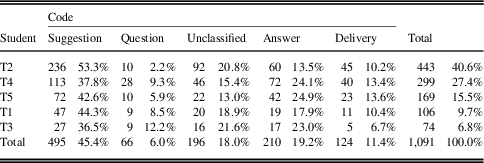
The study reported in this paper followed a mixed-method research design. Data were extracted from an overall corpus collected for the purposes of a doctoral dissertation, after obtaining participants’ consent. Since the discussion list remained active three months after the completion of the two-month course, the data set comprised the archived log of the posts collected over a five-month period. The instructor took the role of a facilitator in the discussion list, trying to keep the pace of collaboration and involving all participants by comments such as: “What do you mean exactly? Would you please clarify? How?” or “What is your opinion about [Participant’s] comment?” Hence, only students’ exchanges were included in the analysis. To identify the patterns of teachers’ asynchronous exchanges, a content analysis was conducted on a total of 1,091 student posts, using Oriogun and Cave’s (Reference Oriogun and Cave2008) SQUAD approach (see Table 1). SQUAD appeared to be more amenable to the purpose of this study, as it directly relates to the analysis of asynchronous small group CMC.
The frequency and percentage of SQUAD categories

Oriogun and Cave (Reference Oriogun and Cave2008) divide asynchronous exchanges into five categories: suggestion, question, unclassified, answer, and delivery. Category S included thank you and/or engaging comments that warm up the discussion by recognizing the capacities of others through expressing gratitude (Oriogun & Cave, Reference Oriogun and Cave2008). Comments that aimed at eliciting information on technology/CALL were labeled as questions (category Q). The messages that did not relate to the topic of the course or the task at hand were grouped as unclassified (U). The comments in which students replied to the posed questions or commented on peers’ messages or shared projects were classified as answers (category A). Finally, the posts in which teachers shared the technology-enhanced artifacts they produced or introduced technology tools were taken as delivery messages (category D).
The messages in each group were then scrutinized and reflected upon by the first author, following constant comparison method of analysis (Charmaz, Reference Charmaz2006) to identify the type of the exchange, using descriptive open coding strategy. In this strategy, themes emerge from pieces of texts and words that are extracted directly from the data. Once identified, the themes were grouped under related categories. Afterwards, the categories were compared and collapsed if necessary. To illustrate their focus, the finalized categories were then given names with reference to Ertmer and Ottenbreit-Leftwich’s (Reference Ertmer and Ottenbreit-Leftwich2010) pedagogical knowledge of CALL as the knowledge of technology tools, their affordances and constraints, computer-assisted materials development and/or selection, classroom management, and testing/assessment.
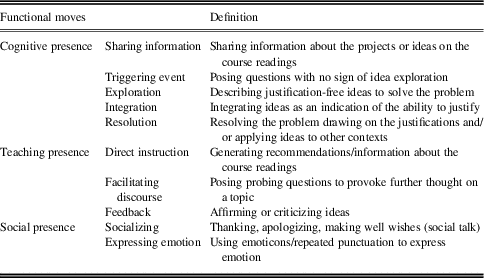
To explore the type of teachers’ asynchronous exchanges, a computer-mediated discourse analysis approach (Herring, Reference Herring2004) was used. Herring (Reference Herring2004) takes functional moves, or the thematic units with different communicative functions in computer-mediated discourse, as the main unit of analysis. Each message was divided into its comprising functional moves. The moves were then categorized into cognitive, teaching, and social presence, following Garrison et al.’s (Reference Garrison, Anderson and Archer2000) CoI model. The component moves of cognitive presence were developed drawing on Garrison, Anderson and Archer (Reference Garrison, Anderson and Archer2001). However, as Koh et al. (Reference Koh, Herring and Hew2010) note, this four-stage categorization does not cater to the information students share about their projects and ideas about the course readings. Following Koh et al. (Reference Koh, Herring and Hew2010), a new functional move, that is, Level 0 (information sharing), was added to the coding protocol.
Consistent with the CoI model, Koh et al. (Reference Koh, Herring and Hew2010) draw a distinction between the teaching discourse of the instructor and students’ peer instruction. Three categories of teaching moves were defined for student discourse: direct instruction, facilitating discourse, and feedback. Social interaction category was divided into socializing and emotion moves. The definition and coding scheme of each functional move are listed in Table 2.
The coding scheme and definition of the functional moves

The quantitative analyses included the calculation of the descriptive statistics (frequency and percentages) of the messages falling into each SQUAD category and the functional moves, along with the estimation of the Cronbach’s alpha to check the reliability of the coding scheme using SPSS software (Version 18). The data were rated twice and the intra-rater correlation coefficient was calculated for SQUAD categories (average = 0.90) and the functional moves (average = 0.79) coding protocols. The content and computer-mediated discourse analyses coding processes were carried out by the first author.
2.6 Validity of data
In an attempt to safeguard against possible bias being introduced into the analysis due to the first author’s several roles, the preliminary results were further triangulated by the two other researchers as the project supervisors. Data analysis was iterative, taking place in parallel with data collection. This empowered the researchers to make better clarifications and adjustments when required (Wright & Wilson, Reference Wright and Wilson2005). The trustworthiness of the data collection and analysis procedures was further preserved through compliance with the principles of confirmability, methodic-ness, and credibility.
To address confirmability, the data are made available to the reader in the form of descriptive statistics and direct quotations to allow ideas to emerge clearly (Richards, Reference Richards2009). To ensure transparency, the research procedure is described and documented (Yin, Reference Yin2011). In addition, samples of the data are made available for readers’ inspection. To further ensure the reliability and to protect data against projection (Wood, Mueller, Willoughby, Specht & Deyoung, Reference Wood, Mueller, Willoughby, Specht and Deyoung2005), explicit thematic categories, including labels and definitions, are developed and used as the reference for coding the data.
To check the methodic-ness (Yin, Reference Yin2011), an orderly set of research procedures was followed to reduce the possibility of whimsical research or careless work “for which there is not a good ‘scientific’ reason to believe that something of value will be learnt as an outcome” (Denscombe, Reference Denscombe2010: 336). Furthermore, the data and procedures were cross-checked to establish a sense of completeness. To build the credibility and further credence of the findings, special attention was dedicated to ethical issues. The anonymity of participants was protected through the use of pseudonyms. The following sections offer a detailed account of the main findings, researchers’ preliminary conclusions, and implications for further research.
3 Results and discussion
Of the 1,091 participant messages, 814 (74.6%) were posted during and 277 (25.4%) were generated within the three-month period after course completion. The average posting was 218.2, with 443 and 299 posts for the most enthusiastic and 74 for the least contributing teachers. An uneven distribution pattern was observed in the contributions. Ernest et al. (Reference Ernest, Catasús, Hampel, Heiser, Hopkins, Murphy and Stickler2013) attribute this to teachers’ prior experience in using such environments, with more experienced participants generating more comments than the less experienced ones. Likewise, the least active teachers in the list in our study (T3 and T1) were also less technologically competent compared to T2, T4, and T5. In addition, as Hanson-Smith (Reference Hanson-Smith2006: 304) notes, teachers might selectively take part in the discussions “as determined by their own needs … level of domain knowledge, the time available to them, and their own highly individualized interests in technology.” The unevenness of contributions does not necessarily indicate the inefficiency of interaction, but may illustrate participants’ lurking, which is a legitimate feature of an authentic online community (Lave & Wenger, Reference Lave and Wenger1991).
Furthermore, the contribution pattern appeared consistent for all teachers in this study, implying that they used the space to contribute, rather than merely reading peers’ messages (Ernest et al., Reference Ernest, Catasús, Hampel, Heiser, Hopkins, Murphy and Stickler2013). Teachers’ contribution may have been boosted by not imposing previously set topics for discussion (Attard, Reference Attard2012). Moreover, the teachers were interested in CALL, and also the first members of the discussion list may have promoted more interaction by increasing their sense of freedom for expressing viewpoints in a private space. Finally, in a hybridized model of teacher education, teachers have the opportunity to build the face-to-face relationships required to connect with peers in an online platform (Kissau, Reference Kissau2012).
3.1 Patterns of interaction in teachers’ discussion list exchanges
It is worth mentioning that the teacher comments were verbatim in English and the errors in the quotes are verbatim from the participants.
3.1.1 Category S messages
As the most recurrent comment type comprising 45.4% of the total messages (see Table 1), these posts demonstrated participants’ appreciations, well wishes, and positive feedback on peers’ shared hyperlinks/projects. This is reflected in T2’s positive feedback on T4’s website: “I’ve been exploring your amazing website … as a CALL teacher, having such a perfect website is mandatory.” Although participants were not assigned to any particular role, T2 and T4 took the lead with 236 and 113 category S messages, comprising 53.3% and 37.8% of their total postings, respectively. These participants seemed to be trying to promote a sense of community by positively motivating peers to take part in the discussion list.
The high frequency of these exchanges contradicts Doering and Beach’s (Reference Doering and Beach2002) argument that, as a cool medium, online interaction does not embrace the exchange of feelings commonly observed in face-to-face interactions. The absence of hierarchical relations in the present study may have resulted in a more relaxed environment for discussion. While comments of praise do not indicate learning, they reflect that interaction is in fact taking place in the community (Arnold & Ducate, Reference Arnold and Ducate2006). As Akyol, Garrison and Ozden (Reference Akyol, Garrison and Ozden2009) state, such exchanges are essential components of a critical discourse as they facilitate the realization of the cognitive goals by promoting critical thinking in a learning community (see also Garrison & Anderson, Reference Garrison and Anderson2003). Acting as icebreakers, these comments encourage list members to respond, further interact, and learn from peers by initiating a process of meaning negotiation and thus setting the ground for learning to occur (Paz Dennen, Reference Paz Dennen2008).
3.1.2 Category Q messages
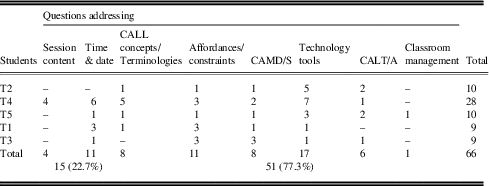
These messages acted as triggering events, usually containing a problem or question on a topic, and aimed at evoking a response or eliciting information to solve the problem. They should be distinguished from the probing and rhetorical questions that aimed at facilitating discourse and promoting further reflection without seeking a particular response. Following constant comparative method of analysis, it was observed that participants’ questions related to the time/date of the course projects, session content, CALL concepts/terminologies, constraints/affordances of technology/CALL, computer-assisted materials development and/or selection (CAMD/S), technology tools, computer-assisted language testing/assessment (CALT/A), and technology-related classroom management. Except for the first two themes, the remaining six categories directly related to CALL (see Table 3).
The frequency and total percentage of category Q messages

The following excerpt contains T4’s question regarding the assignments for one of the virtual sessions: “I don’t know if we should go through any particular assignment for tomorrow … please let me know if we should do something except for the regular materials.” Preparing her final term project, T5 asked peers to comment on her suggested time and date: “I was thinking of Friday morning ... Would you please tell me if it’s OK with you all?” In another question, T4 described her problem in converting file formats: “I made a screencast … the size is very big. I changed the format but the quality dropped ... Can anyone tell me what to do?” Reviewing T2’s slides, T5 posed a question addressing both CALT/A and technology-related classroom management: “How did you encourage those who were not that willing to use tech? How did you manage the classroom time?” There were also questions that highlighted some CALL concepts and terminologies: “Which one is more logical? To be careful not to be monkeyed around on the Internet … or to respect the collective wisdom” (T4).
This finding partly corroborates Ernest et al.’s (Reference Ernest, Catasús, Hampel, Heiser, Hopkins, Murphy and Stickler2013) claim that teachers use the space to talk about the course content. It also reflects the transformational power of questions as triggers for meaning negotiation and feedback generation. As the type and nature of the questions largely reflect teachers’ technology/CALL knowledge and considering the heterogeneity of participants in this regard, it was quite natural to have questions with different CALL foci.
3.1.3 Category U messages
The third group of messages that comprised 18% (196) of the total posts ranged from introductory comments and greeting messages to apologies and responses to peers’ category U questions. The introductory posts and greetings (e.g. “Hi everyone! It is great to be hear :-)” or “Hey dear, so you managed to join; I am glad you did”) were left during the first few weeks of the course and aimed at establishing a context for interaction through gaining attention. There were also messages containing participants’ apologies, which were usually reciprocated:
T4: I should apologize for cluttering you inbox. I just sent a circulation twice.
T2: It’s ok honey, I am sure it’s happened to all of us at least once.
As the above examples illustrate, such discourse aimed at presenting or keeping the space cooperative and friendly to the list members, and thereby appeared to be effective for showing presence in the space. The last group of messages in this category, notifications, included system-generated posts that notified the participants of the uploading of content.
3.1.4 Category A messages
Of a total of 1,091 posts, 210 (19.2%) were answers. Category A posts were of two types: the comments initiated in response to a tech/CALL-related question and the comments on peers’ shared works.
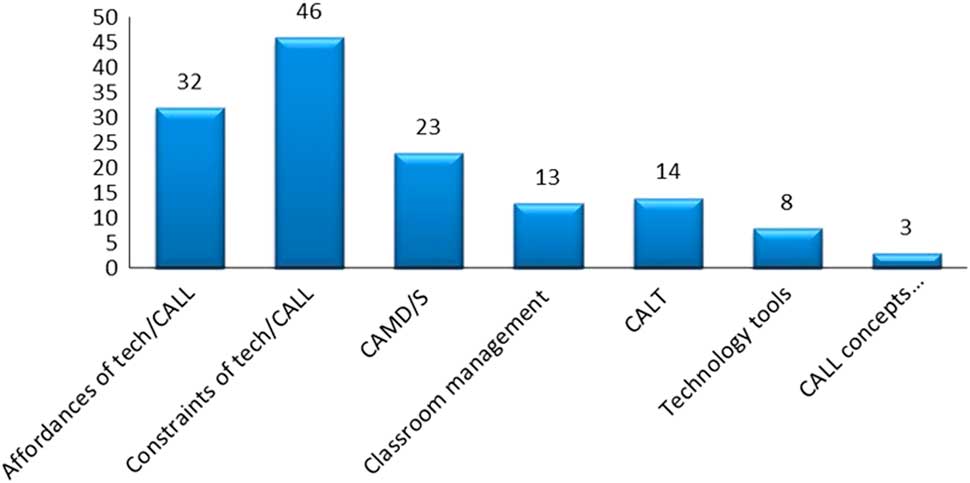
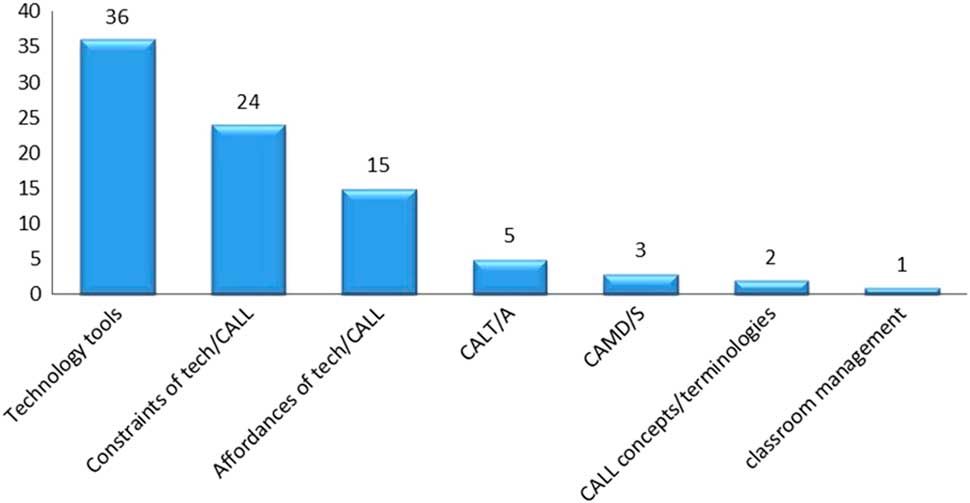
Responses to questions: Of the 139 thematic categories identified in these messages (see Figure 1), responses that addressed constraints and affordances of technology/CALL were the first two most frequent messages, followed by the posts about CAMD/S, classroom management, CALT/A, and technology tools. This may be attributed to the difference in the focus of the questions initiating responses. In the following exchange, for instance, participants’ responses to T2’s question on test-making software address CALT/A and CAMD/S:
T2: Reviewing Quia and Hotpotatoes, Alm (Reference Alm2006) observes that they roughly follow behaviorist principles. How can a teacher with a constructivist view use them?
T4: The tests made in these sites are at the service of teachers with different approaches. The tests I constructed are not merely one-correct-answer tasks. Essay type questions leave room for teachers to issue their judgment. Non/graded questions in Quia leave space for creative answers …
T5: I do agree that it is the teacher who gives the test a constructivist flavor; however, an MC item can never be scored based on constructivism … The use of weblogs, peer- and performance-based assessment adds more constructivist flavor to our assessments.
The distribution of the thematic categories in responses to questions

A characteristic feature of interactive learning environments is the engagement of interlocutors in meaning-focused social exchanges (Meskill, Reference Meskill2009) through which responses are generated, aiming to achieve a common goal or to solve a problem. T4’s message not only indicates her knowledge of CALT/A but also contains an account of her ability to develop technology-enhanced materials. T5’s response, similarly, demonstrates her knowledge of CALT/A as she recounts her suggested strategies for constructivist assessment through technology.
Consistent with a Vygostkian (Reference Vygotsky1978) constructivist view, exposing learners to multiple perspectives promotes further learning by helping the learners to acquire the flexible and useful aspects of the information from peers’ viewpoints in a distributed learning environment (see also Gee, Reference Gee2003). This type of interaction is also fruitful for those who answer the questions, providing them with opportunities to see peers’ teaching dilemmas and probably re-examine their own experiences (Danielowich, Reference Danielowich2012).
Comments on peers’ shared artifacts and/or introduced technologies: The second group of information-eliciting and reflection-provoking comments focused on the hyperlinks, embedded codes, CALL projects, or the educational technologies shared and/or introduced by peers:
T5: You can watch my webcast on two audio and text-based communication tools. I really look forward to your kind comments.
T4: I routinely use GTalk … Given constraints like connection speed … it may not be accessible to all students. Regarding necessity of practicality of a medium for users, compared to more accessible platforms like WizIQ, AnyMeeting.com, I was wondering if you’d elaborate on the pedagogical benefits of GTalk.
T3: What I really found interesting was that Vocaroo can be used for assigning “speaking tasks” and that one month limitation that you mentioned as one of its demerits might not really be a problem …
As echoed in this discussion and in line with Meskill (Reference Meskill2009), one comment sparked the ideas of other members by engaging teachers in two-way collaboration in which both feedback generator and receptor will benefit.
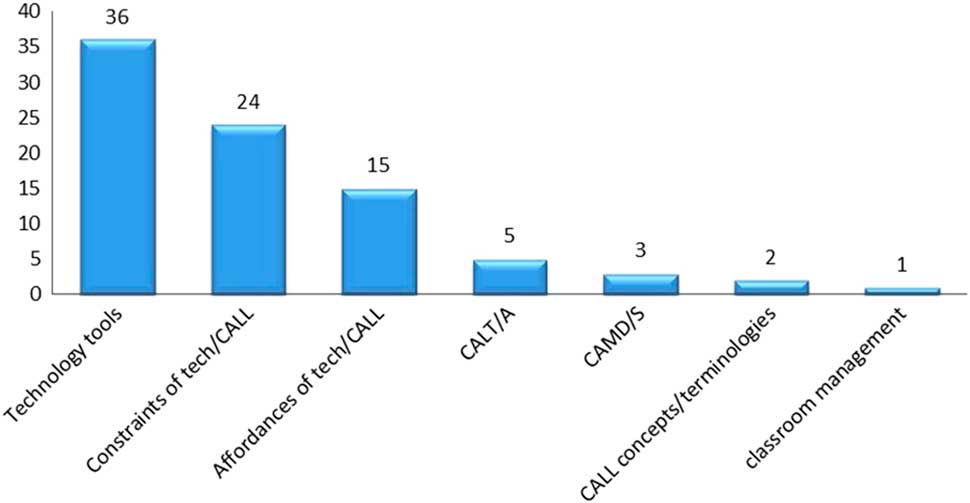
Of the 81 thematic units identified in these posts (see Figure 2), 36 (44.4%) addressed different technology tools. The next most recurring theme related to the messages that addressed the constraints (29.6%) and affordances (18.5%) of technology/CALL. The remaining 7.5% of the themes addressed CALT/A, CAMD/S, CALL concepts and terminologies, and classroom management. The prevalence of comments on technology tools and their constraints/affordances reflects Ernest et al.’s (Reference Ernest, Catasús, Hampel, Heiser, Hopkins, Murphy and Stickler2013) assumption that experiencing interactive learning helps teachers learn about the de/merits of technology. It is also possible that the essence of gaining mastery of multiple technology tools over a very short time period has led participants to focus more on the immediate problems and/or application of the tools than on other pedagogical considerations in using technology for language instruction (see Comas-Quinn, Reference Comas-Quinn2011).
The distribution of the thematic categories in responses to peers’ shared works
3.1.5 Category D messages
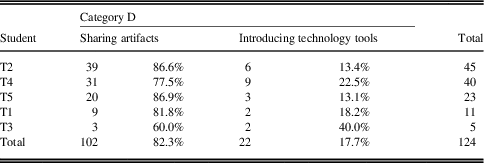
Delivery messages either included hyperlinks, embedded codes, and/or participants’ CALL-related project files or introduced new technology tools, software, and websites. As indicated in Table 4, the former type of category D messages was more frequent, comprising 82.3% of the total posts. This might be attributed to the fact that creating technology-related artifacts formed part of the course requirement. The number of category D posts largely varied from one individual to another, with T2 and T4 having the highest number of delivery messages. T3 was in the habit of directly uploading her works in the files section of the Yahoo Group, which might account for the limited number of her category D messages. These posts are significant because they acted as triggers, engaging participants in professional dialogue. Furthermore, the presence of these messages, according to Baskerville (Reference Baskerville2012), is illustrative of participants’ knowledge of using different technologies to produce technology-related artifacts.
The frequency and percentage of category D messages

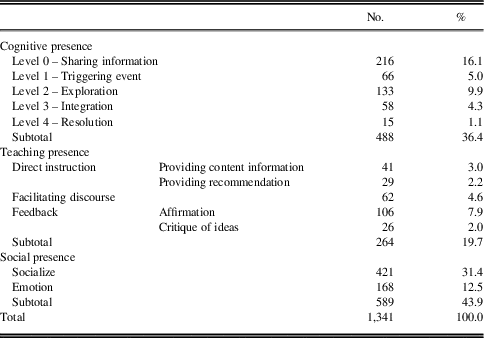
Of a total of 1,341 functional moves identified in discussion list exchanges, 36.4% were of a cognitive type, 19.7% were teaching moves, and 43.9% were social interaction (see Table 5). As facilitators of knowledge construction (Koh et al., Reference Koh, Herring and Hew2010), teaching presence and social interaction moves together comprised 63.6% of the functional moves identified in the data. The unbalanced involvement of participants with online discussions, according to Kamhi-Stein (Reference Kamhi‐Stein2000), indicates that teachers attend to discussion list messages selectively as driven by their own learning needs and interests.
The frequency and percentage of functional moves

3.2 Types of cognitive, social, and teaching presence moves characterizing discussion list exchanges
Participants’ socializing and use of emotions (as indicators of social presence) were the most frequent functional moves in the data, comprising 757 out of 1,341 moves (e.g. “Thank you all so much for sharing your thoughtful ideas … Wish you all the best and success and just keep going on”). Given the text-based nature of interaction in the medium and the absence of non-verbal communication conventions, a learning community or CoI cannot be established in the absence of social presence (Garrison et al., Reference Garrison, Anderson and Archer2000; Shea & Bidjerano, Reference Shea and Bidjerano2009). Emotionally projecting themselves as real people within the community, members nurture the educational aspect of the transaction through helping the other participants feel more comfortable in relating to each other (Garrison et al., Reference Garrison, Anderson and Archer2000), establishing rapport, and signaling a tendency for being a part of the community.
About half of the teaching presence moves (N = 132) were affirmations and/or critique of ideas (i.e. feedback); for example, “I agree that what is spread through blogs, wikis, twitter, Facebook … represent individuals’ creativity and taste” or “I totally agree with you on the constraints, but with regard to reflection we may disagree.” Participants also provided direct instruction for peers (N = 70) and used probing questions (facilitating discourse; N = 62) to evoke further reflection on a particular topic. In the following extract, for instance, T4 uses the facilitating discourse to probe list members’ thinking about the inadequacy of the idea presented in one of the course readings on the potential of tweeting for learning vocabulary: “What about other skills? What about other aspects of ELT?” Although not directly related to technology/CALL, such icebreakers and direct instruction facilitate interaction and knowledge construction by building a sense of community among the teachers (Ernest et al., Reference Ernest, Catasús, Hampel, Heiser, Hopkins, Murphy and Stickler2013; Garrison et al., Reference Garrison, Anderson and Archer2000).
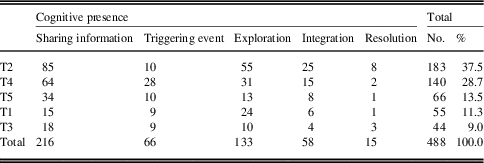
The analysis of cognitive moves indicated an uneven pattern of distribution; sharing information, triggering, and exploration moves combined (N = 415; 85%) was substantially greater than the integration and resolution moves (N = 83; 15%) (see Table 6). Furthermore, information sharing (e.g. “I found this link which introduces 5 ways for making your own homepage”) and exploration (e.g. “VLE can help students get to gain knowledge through a computer or the internet while Web conferencing is just internet-based”) were respectively the most frequent functional moves in participants’ discourse. Information sharing moves were more often observed when participants shared the links or the content of their CALL-related projects.
The distribution of cognitive presence moves across in participants’ discourse

The overwhelmingly large number of these moves may be attributed to the design and practice of the CALL teacher education course in this study, which required each participant to carry out different technology-related projects and report the results to peers. According to Koh et al. (Reference Koh, Herring and Hew2010), these posts, which make reference to projects or personal ideas on a topic, are indicative of cognitive presence. Comparing the levels of knowledge construction in project- and non-project CMC, Koh et al. (Reference Koh, Herring and Hew2010: 289) found that “higher levels of Knowledge Construction moves would be demonstrated during project-based learning,” as this type of learning “by its very nature … calls for integration, resolution, and application.” In the absence of projects that require students to achieve a resolution for the preset problems, it appears natural for the participants to demonstrate more Level 0, 1, and 2 than Level 3 (integration) and 4 (resolution) moves.
Exploration moves, on the other hand, often appeared after a triggering event or a question that addressed a problem or topic on CALL/technology (see Garrison et al., Reference Garrison, Anderson and Archer2000, Reference Garrison, Anderson and Archer2001). This usually engaged participants in several rounds of justification-free idea sharing to solve the problem (exploration) before the ideas were integrated and/or resolved to apply the newly constructed knowledge to a specific context. This might count for the considerably higher frequency of resolution moves compared to those of integration and resolution. According to Garrison and Arbaugh (Reference Garrison and Arbaugh2007), when a relevant problem is identified for further inquiry through a triggering event, it enables the students to make a progressive development to the higher levels of knowledge construction, namely exploration, integration, and resolution (see Koh et al., Reference Koh, Herring and Hew2010). This is echoed in the following comment circle:
T3: How can a CALL teacher make sure that the listening materials … on the internet are at the right level of difficulty for students and that they are listening to them? [Triggering event]
T1: I would give my students the choice to pick up the material from the internet … obviously their initial choices will be problematic; but I will be there to guide them. [Exploration] This way they could (a) choose the topic that they like and this way be motivated, (b) this diversity would create a lively environment in class, (c) they will automatically go for the material which is at the right level for them. [Integration]
T2: I think it’s not a good idea to let learners pick up the materials based on their own interest … [Critique of ideas] it may cause a chaos in the classroom context! [Exploration] If we let them do so, then how we can assess them? [Facilitating discourse] I do agree that sometimes subjectivity might be good, but not all the time … [Affirmation] But it might be good if we let them sometimes do and surf the net for finding sth. Pertinent to their course and their level and share them in the class as a sort of project or weekly activity but not as a material for teaching! [Exploration]
T4: May I intrude? [Facilitating discourse] Devising and operating the appropriate task in the class would reinforce the learning process. BTW, we don’t mean to catch the poor learners off guard. Let them share the content with each other. [Exploration]
T3: I think it lowers the cognitive load and affective barriers of confronting new listening tracks in the classroom. [Integration] I think T2 is quite on the right track. [Affirmation]
T5: So if we want to make sure that “real learning” happens in our classes, not only for listening skill, but also for all the other skills and sub-skills our tasks should be productive, e.g. an audio file, it must be followed by some related tasks to see if they follow us or learn sth.! We should devise productive tasks and dynamically assess each one. [Resolution]
Through engagement in a process of reading, reflecting, and generating feedback, participants built on each other’s knowledge by approaching the topic from different perspectives. This, according to Garrison et al. (Reference Garrison, Anderson and Archer2000, Reference Garrison, Anderson and Archer2001) and Koh et al. (Reference Koh, Herring and Hew2010), demonstrates Level 2 cognitive presence referred to as exploration. In these exchanges, different forms of experience are privileged, with participants’ comments acting as guides and knowledge enhancements.
In the above chain of exchange, for instance, all participants are engaged in a discussion triggered by T3’s question about the practicality of listening materials in language classes. T1 describes the essence of engaging students in the process of material selection in fact under teacher’s guidance and justifies her position by listing three possible advantages. T2 partly rejects T1’s justification. Instead, she suggests that the materials selected by the students be used for designing classroom activities and projects rather than for classroom instruction. This idea is further reflected upon and expanded by T4 and later T3, who justify the potential of the proposed strategy for lowering “the cognitive load and affective barriers.” The discussion is resolved by T5’s proposed solution; that is, designing productive tasks with the materials found and shared by the students from the web.
Taking part in situated interactive exchanges, teachers became sources of orientations for peers by offering their knowledge, which gradually developed into a distributed knowledge base (Gee, Reference Gee2003). In other words, the question prompted the list members to articulate their ideas and solutions in depth, thus demonstrating more exploration moves, which gradually helped them come up with a resolution. Through engagement in a process of problem-posing/solving in a social learning environment, participants had direct experience with the social constructivist notion of knowledge co-construction (Vygotsky, Reference Vygotsky1978). As Garrison et al. (Reference Garrison, Anderson and Archer2001) put it, when deep and new understandings are observed in students’ computer-mediated discourse, it can be concluded that knowledge is in fact being constructed in such exchanges.
The presence of interactive exchanges in the discussion list runs counter with Henri’s (Reference Henri1995) claim regarding the dominance of serial monologues in discussion lists where participants leave posts on their personal teaching experiences without attending to the contributions of others. It is also in contrast with Hawkes and Romiszowski (Reference Hawkes and Romiszowski2001), who argue that teachers’ asynchronous computer-mediated communication appears to be less interactive but more reflective. The presence of question/answer circles, in other words, indicates that the interactions in the space were not what Arnold and Ducate (Reference Arnold and Ducate2006) call one-way contributions that hinder the co-construction of meaning. This socially mediated group dialogue is also reflective of Danielowich’s (Reference Danielowich2012) claim regarding the potential of discussion lists as safe places for teachers to address dilemmas they encounter in their teaching practice and to internalize knowledge (see also Hull & Saxon, Reference Hull and Saxon2009).
Furthermore, the presence of feedback (affirmation and critique of ideas) and facilitating or probing discourse in messages is indicative of the teaching presence, which, according to Garrison et al. (Reference Garrison, Anderson and Archer2000), facilitates knowledge construction. As Koh et al. (Reference Koh, Herring and Hew2010) note, affirmation and/or critique of peers ideas not only facilitates cognitive presence but also further establishes social relations in the space and hence acts as a component of teaching presence.
It is important to keep in mind that the presence of individual resolutions indicates that such asynchronous interactive exchanges resulted in knowledge construction in a CALL course. This would have been difficult to achieve in a synchronous or face-to-face CALL teacher education course whose focus on introducing new technologies necessitates practicing how to use technology over reflecting on its educational values.
The findings are consistent with the common themes in the literature and provide implications for practice that can be noted. As the limited training and practice hours in a CALL preparation course might not adequately prepare in-service teachers – with the limited experience in using technology for educational purposes – the presence of an environment for extending classroom discussions, problem-posing/solving, information sharing, and interactive reflection becomes crucial. It is suggested that online environments for asynchronous exchanges should be integrated into CALL teacher education courses as promising spaces to help teacher educators re-evaluate the common teacher preparation attempts in order to facilitate teachers’ preparation in CALL. In other words, discussion lists can be integrated into CALL teacher education courses to systematically move pre-service teachers from the theoretical and technical knowledge of technology to collective information sharing, problem-solving, and evaluation of their coursework, which can further improve their understanding by exposing them to multiple perspectives on CALL and technology.
Furthermore, the high degree of information sharing moves, some of which triggered questions and resulted in peer exploration and resolution, highlight the potential of the space for engaging in-service teachers in project-based and collaborative tasks. By exposing in-service teachers to peers’ experiences and questions, asynchronous exchanges not only enable individuals to broaden their own experiences but also prompt their reflectivity (see Kamhi-Stein, Reference Kamhi‐Stein2000). This can be of particular significance for communities with a more individualistic culture, like Iran (see Nami, Marandi, & Sotoudehnama, 2016), in which individuals typically work and study alone.
It should be noted that the above suggestions should not be seen as rigid blueprints that would be effective for all CALL preparation contexts. Rather, it is to imply that an increased understanding of these points is needed if better quality teacher education in CALL is expected.
4 Conclusion
The present study has a number of limitations that should be acknowledged. In addition to the very small scale of this study, participants were already interested in CALL and contribution to the space was part of their course requirement; points that may have resulted in the high number of postings in the discussion list. Furthermore, this study relied exclusively on participants’ messages as the only source of data, and participants were all experienced in-service teachers. Different results might have been obtained if there was a more diverse data source. Although participants received orientations on how to use the list, it might be possible that the lack of adequate experience has affected their practice. According to Heiser et al. (Reference Heiser, Stickler and Furnborough2013: 231), effective online communication practice requires explicit information and communication technology training, as “digital competence cannot be taken for granted” (see also Rott & Weber, Reference Rott and Weber2013). Thereby, if a discussion list is to be applied to its full potential, more time should be dedicated to preparing teachers to use the space. Even though the analysis of participants’ exchanges in the discussion list illustrated participants’ engagement in interactive learning, the design of this study did not allow for exploring teachers’ perception of the experience.
Considering the fact that the number and choice of online discussion topics were not preset in this study, more research is needed to explore the way setting discussion topics may influence the nature of interaction and the type of functional moves (social, cognitive, and teaching presence) in the space. This study focused on the nature of interaction and the cognitive, social, and teaching moves manifested in participant teachers’ texts. However, according to Schallert, Reed, and the D-Team (Reference Schallert and Reed2003), learning in a discussion list stems not only from peers’ posting and contributing to the space but also from reading teachers’ comments.
The limitations of this study in conjunction with the issues raised in the results highlight several implications for future research under the same theme. First, further research with a more heterogeneous population of teachers would be required to gain a more consolidated picture of text-based asynchronous interaction and its possible role in teachers’ professional growth. Second, it would be essential to explore the way lack of authority and liberation may influence the type and degree of contribution to the space when participation in the online discussions is not a graded component. The way online discussions may contribute to pre-service teachers’ CALL preparation should also be considered. Fourth, it would be fruitful to analyze the extent to which teachers value online discussion for their professional growth. By the same token, it would be essential to conduct longitudinal studies that explore how the technology-enhanced knowledge construction opportunity is integrated into teachers’ classroom instruction. Finally, possible changes in participants’ understanding of CALL and related concepts should be compared to those who took part in a similar teacher education course without having the opportunity to contribute to a discussion list, to gain a deeper understanding of how online discussion may contribute to teacher learning.
As text-based asynchronous communication tools, including discussion lists, continue to be used for teacher preparation across various disciplines including CALL, understanding the nature of interaction, which takes place in these spaces, becomes increasingly important. Given the context of the present project, asynchronous interaction is a viable activity to promote learning. The incorporation of asynchronous interaction into CALL teacher education may not necessarily ensure the success of the preparation but can provide opportunities for teachers to co-construct a professional knowledge base through exchanging ideas and interacting with peers.
Acknowledgements
We are deeply grateful to the reviewers whose constructive comments on the previous versions of this paper significantly improved it in structure and content. We are also thankful to the anonymous participants in this study.
About the Authors
Fatemeh Nami is an assistant professor in the Department of Foreign Languages at Amirkabir University of Technology (Tehran Polytechnic) and the director of the Educational Technology center at Iran Language Institute (ILI). Her research focuses on CALL, teacher education, academic writing, learning management systems, and SCORM-based materials development on which she has published different articles.
(Seyyedeh) Susan Marandi holds a PhD degree in TEFL from the University of Tehran, and is currently an associate professor in the English Department of Alzahra University, where she has established a TEFL PhD program, teaches various undergraduate, graduate, and postgraduate classes, and established the first CALL course in Iran. Some of her current interests are language (e)assessment and CALL.
Elaheh Sotoudehnama is a full professor in the English Department of Alzahra University where she has been teaching for more than 20 years. Her areas of interest include teaching skills in general and language learning strategies, culture, and motivation in particular.