





1. Introduction
Digital technologies and artificial intelligence (AI) are reshaping what teachers are expected to know and do. In particular, English language teachers face growing pressures as their practice now depends on digital platforms, multimodal materials, and AI-supported feedback, all of which demand not just tool familiarity but the capacity to design, adapt, and evaluate digital resources. Recognizing this shift, UNESCO (2024) has proposed an AI competency framework for teachers, while acknowledging that implementation at the national level remains limited.
This implementation gap is felt most acutely by pre-service teachers, many of whom enter teacher education with limited experience of digital work and considerable anxiety about unfamiliar interfaces and technical problem-solving (Bennedsen & Caspersen, Reference Bennedsen and Caspersen2012). Even when technology-focused courses are included in teacher preparation, they may still treat digital tools as add-ons rather than as components of pedagogical design. More broadly, preparation remains insufficient and focused too narrowly on tools. Teachers report dissatisfaction with both the type and amount of training (Kessler, Reference Kessler, Hubbard and Levy2006), while many initiatives stress one-off platform adoption rather than design-oriented preparation (Hörmann et al., Reference Hörmann, Kuka, Schmidthaler and Sabitzer2024). What is needed instead is modelling, integrated practice, and opportunities for teachers to transform tools into meaningful resources.
Effective digital preparation, however, depends on a clearer understanding of what digital competence actually involves. Digital competence encompasses digital literacy as a capacity for critical and creative engagement with digital tools. These skills matter more as digital literacy becomes part of primary and secondary curricula worldwide (Choi, Reference Choi2025; Ekin & Balaman, Reference Ekin and Balaman2024; Jacob et al., Reference Jacob, Parker, Warschauer, Ottenbreit-Leftwich and Yadav2022; Lye & Koh, Reference Lye and Koh2014). There is also evidence that scaffolded, project-based work can shift teachers away from this tool-centric, add-on approach. Low-threshold coding, seen as an instructional medium (Kafai & Burke, Reference Kafai and Burke2014), offers a pathway for framing digital competence development as learning by designing, helping future English teachers shift towards digital creation. Accordingly, teachers who build, test, and revise their own instructional apps begin moving towards the highest level of the UNESCO (2024) AI competency framework.
This kind of design-oriented engagement involves something more than developing digital skills. Pedagogical authorship, as used in this paper, describes teachers’ capacity to make principled design decisions in response to learner needs, producing classroom-ready tools rather than merely adopting existing applications. This is particularly relevant because English teachers routinely work with texts, tasks, feedback, and multimodal input, all of which can be redesigned through technology. When teachers build even simple instructional apps, they may begin to see themselves not only as users of educational technology but also as authors of pedagogical experiences.
Despite the promise of this approach, relatively little is known about how English teachers respond to design-oriented coding courses, particularly when coding is introduced through structured templates, not through formal instruction. How such experiences differ between pre-service undergraduates and primarily in-service graduates also remains underexplored, as the two groups may interpret app development quite differently in relation to their classroom contexts.
To address this gap, this study examined a 15-week course in which pre- and in-service English teachers designed and built instructional apps for language teaching using Python-based tools, engaging in iterative design thinking rather than formal coding training. This kind of low-threshold coding means reading, modifying, and extending Python-based scripts from structured templates with AI assistance, producing small, functional instructional tools with no prior coding required.
Two research questions guided the study:
RQ1. How does participation in a coding-mediated, design-oriented course influence pre- and in-service English teachers’ digital confidence, perceived instructional benefit, and engagement and motivation?
RQ2. How does reflective writing demonstrate pedagogical authorship among participants, and how do these patterns differ between the undergraduate pre-service group and the primarily in-service graduate group?
2. Literature review
2.1 The evolving nature of digital competence in education
Over the past 25 years, conceptions of digital competence have shifted from functional tool operation and information retrieval towards frameworks emphasizing critical evaluation, ethical participation, and creative production (Falloon, Reference Falloon2020; Gilster, Reference Gilster1997; Ma & Ismail, Reference Ma and Ismail2025; Masoumi & Noroozi, Reference Masoumi and Noroozi2025). Meaningful technology use continues to require explicit instruction and scaffolding regardless of generational familiarity (Kirschner & De Bruyckere, Reference Kirschner and De Bruyckere2017; Ma & Ismail, Reference Ma and Ismail2025). Policy frameworks reflect this evolution. Whereas first-generation European guidance stressed ICT tool mastery, recent documents emphasize critical awareness, creative authorship, and responsible participation in networked societies (European Commission, 2019). Most recently, UNESCO (2024) proposed an AI competency framework with three progressive levels – from basic AI literacy, through pedagogical integration, to creating tools for learning – underscoring that digital competence is a developmental trajectory rather than a fixed skill set.
Recent teacher education scholarship reflects this shift. Nagel et al. (Reference Nagel, Guðmundsdóttir and Afdal2023) identify transformative dimensions of digital competence that go beyond tool use. Tondeur et al. (Reference Tondeur, Trevisan, Howard and van Braak2025) similarly update established models to include digital identity, affective readiness, and AI. Together, these developments signal a move towards preparation that foregrounds design, reflection, and agency rather than technical tool mastery.
2.2 The imperative for digital competence training in English teacher education
Without structured preparation, pre-service teachers may continue to treat digital technology as an add-on to teaching rather than as a medium through which pedagogical decisions are designed, tested, and refined (Choi, Reference Choi2025; Li et al., Reference Li, Lau, Liang and Chai2024). Survey evidence confirms that pre-service teachers recognize digital literacy as increasingly important yet report significant gaps in confidence and preparation (Kim & Lee, Reference Kim and Lee2024). Course-based interventions show more promising outcomes, with prior work documenting growing awareness of digital literacy’s role in pedagogical design (Kim & Nam, Reference Kim and Nam2023) and a manageable learning curve alongside shifts in pedagogical thinking (Kim, Reference Kim2025). Such outcomes align with evidence from ReCALL and CALL-related studies, which indicate that effective digital preparation depends less on the technology used than on how it is embedded in pedagogical design (Balaman, Reference Balaman2025; Choi et al., Reference Choi, Kim and Chung2025; Hafour, Reference Hafour2022; Lee & Wu, Reference Lee and Wu2024; Wu et al., Reference Wu, Chun and Lan2026).
Computational thinking (CT) may help explain why design-oriented preparation works. Rather than treating CT as a computer science construct, scholarship now frames it as a set of transferable design habits, including abstraction, decomposition, and algorithmic thinking, that support pedagogical planning (Hsu et al., Reference Hsu, Chang and Hung2018; Wing, Reference Wing2006). In language arts contexts, English learners can develop CT dispositions by drawing on their existing language and literacy resources, suggesting that CT and language competence are mutually reinforcing (Hsu & Liang, Reference Hsu and Liang2021; Jacob et al., Reference Jacob, Nguyen, Tofel-Grehl, Richardson and Warschauer2018; Parsazadeh et al., Reference Parsazadeh, Cheng, Wu and Huang2021). Jacob et al. (Reference Jacob, Parker, Warschauer, Ottenbreit-Leftwich and Yadav2022) showed that teachers could build on familiar literacy practices within coding activities to design interactive learning tasks for multilingual learners. A meta-analysis further confirms that coding yields its largest cognitive gains in higher-order thinking, including problem-solving and creative reasoning (Montuori et al., Reference Montuori, Gambarota, Altoè and Arfè2024).
Training structure also matters. Pre-service modules embedded in coursework improve definitional clarity and build confidence that design-oriented problem-solving can be enacted across subjects (Listiaji & Molnár, Reference Listiaji and Molnár2025; Yukselturk & Altiok, Reference Yukselturk and Altiok2017). Further evidence confirms that direct instruction alone is insufficient; digital competence is better supported when combined with integrated practice and modelling of technology use (Momdjian et al., Reference Momdjian, Manegre and Gutiérrez-Colón2025; Tondeur et al., Reference Tondeur, Trevisan, Howard and van Braak2025).
2.3 Towards an integrated, design-oriented approach: Identifying the gap
Despite growing evidence for design-oriented approaches, coding-mediated training within English language teacher education remains underexplored. Systematic reviews confirm that educators’ perspectives are underrepresented in AI and digital education research more broadly, with most work driven by computer science and STEM disciplines rather than pedagogical concerns (Zawacki-Richter et al., Reference Zawacki-Richter, Marín, Bond and Gouverneur2019). Broader research confirms that hands-on training produces meaningful shifts in confidence and practice (Amemasor et al., Reference Amemasor, Oppong, Ghansah, Benuwa and Essel2025), while empirical Generative AI (GenAI) research is still moving from exploratory attitudes towards implementation and integration (Li et al., Reference Li, Tan, Wang and Lowell2025). Research on coding-mediated app development in English teacher preparation is therefore limited, despite its natural relevance to a field already centred on designing and adapting materials for learners.
What remains underexplored is how pre- and in-service English teachers with limited coding experience respond to a course that moves them from tool use to app creation. In particular, little is known about how quantitative changes in digital confidence relate to qualitative patterns in pedagogical reflection, and how these differ across groups with varying teaching experience and course delivery contexts. This study addresses that gap, guided by the two research questions stated in the Introduction.
3. Method
3.1 Participants
This study was conducted in two university courses in South Korea as part of digital competence training for pre-service and in-service English teachers. Course A was a 2-credit, in-person elective for second-year English education majors at a regional university; Course B was a 2-credit, online course for TESOL graduate students at a separate institution. Only students who consented to research participation were included: undergraduates, n = 18 (two male, 16 female), and graduates, n = 16 (four male, 12 female). Undergraduates had no prior English teaching experience and were early in their major sequence; most graduate students were current or former teachers in public or private institutes, and the group included one native English speaker.
The lead researcher, affiliated with the English education department as a linguist with expertise in language education, served as the course instructor for both offerings. She had developed her coding literacy collaboratively, motivated by the importance of digital literacy in teacher education rather than prior programming expertise. Data analysis was conducted on anonymized datasets, with interpretive claims cross-checked across the research team. Academic level and delivery mode are fully confounded by design, and the implications are revisited in Sections 4.4 and 5.6.
3.2 Context and course design
Both course offerings followed the same 15-week scaffolded curriculum delivered in the same semester. The curriculum positioned students as teacher-designers, moving from foundational coding through exploration of digital and AI tools to building, testing, and revising small instructional language learning apps. The course operated as an English-medium instruction course, with all materials and submissions in English, consistent with the professional development goals of pre-service English teachers. Supplementary materials were provided for coding concepts and digital tools to support students who needed clarification, particularly during the initial technical stages.
Learning took place in Google Colab with Python, with Gradio and Streamlit used to build browser-accessible instructional tools. Materials, including starter notebooks, sample apps, and rubrics, were distributed via GitHub, supporting collaboration and version tracking. Feedback was continuous through peer review and instructor comments. GenAI assistants were actively encouraged for drafting code snippets, debugging, and iterating on design ideas, while pedagogical decisions remained with students. The course thus differed from GenAI-only language teacher education interventions by requiring participants to use AI support within a broader design cycle of coding, testing, revising, and pedagogical justification (Mishra et al., Reference Mishra, Warr and Islam2023; Moorhouse et al., Reference Moorhouse, Wan, Wu, Kohnke, Ho and Kwong2024).
The graduate section was offered online as an evening session at a separate institution. This reflected the geographic distance between institutions, the screen-based nature of the course, and the evening-only schedules of most graduate participants. The instructor also produced demonstration videos on coding processes and app development, which students could watch, pause, and replay as needed. These proved especially useful for the online graduate group, who had less access to real-time troubleshooting support.
Coursework was organized into short build–test–revise cycles, with most activities conducted in groups scaffolded from pairs to groups of four, consistent with a project-based learning approach. For each cycle, groups collaboratively maintained a GitHub Markdown document combining runnable code with structured prose documentation, making design reasoning visible and reproducible. The documentation addressed three aspects: (a) a design rationale linking app features to learner needs and lesson objectives, (b) a feedback plan for evaluating the app’s effectiveness, and (c) an update plan for future revisions.
Figure 1 presents the course structure across five stages: Stage I (Weeks 1–4) introduced basic Python for educators; Stage II (Weeks 5–6) explored digital and AI tools; Stage III (Weeks 7–9) involved analysing ELT applications and preparing project briefs; Stage IV (Weeks 10–13) consisted of iterative design–build–revise cycles in groups; and Stage V (Weeks 14–15) finished with app-based lesson demonstrations within their teaching context and reflective writing.
Course structure and pedagogical emphasis across five stages.

3.3 Survey instruments and procedure
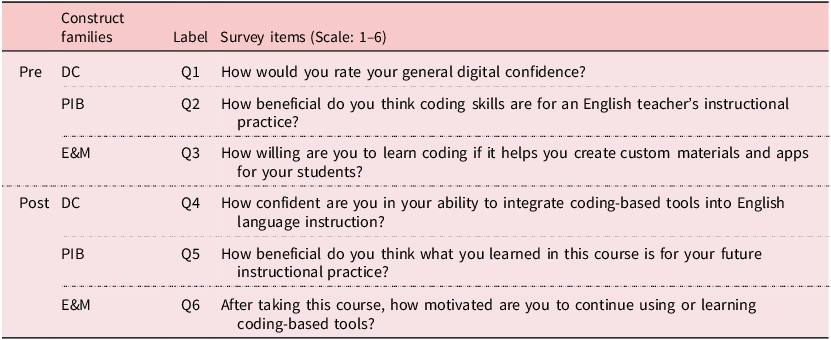
Pre- and post-course surveys assessed change across three construct families: digital confidence, perceived instructional benefit, and engagement and motivation. Six single items were rated on a 6-point Likert-type scale (1–6), which removes the neutral midpoint and encourages more considered responses. Items were formulated as questions rather than assertions to encourage more honest responses and avoid the tendency to simply agree with positively worded statements (Dörnyei & Taguchi, Reference Dörnyei and Taguchi2022). Table 1 provides the exact item wording for all six questions. The post-survey also included two open-ended prompts on factors needed to sustain use and on how they planned to use digital apps in their teaching. Demographic items recorded year of study and prior coding experience (yes/no).
Survey constructs and associated items

Table 1. Long description
A table with three columns: Construct families, Label, and Survey items. The table has six rows divided into pre- and post-course sections. The pre-course section includes rows for digital confidence (Q1), perceived instructional benefit (Q2), and engagement and motivation (Q3). The post-course section includes rows for digital confidence (Q4), perceived instructional benefit (Q5), and engagement and motivation (Q6). Each row lists the construct family, label, and corresponding survey item rated on a 1-6 scale.
Note. DC = digital confidence; PIB = perceived instructional benefit; E&M = engagement and motivation.
Given the exploratory scope of this study and the small sample sizes involved, single-item indicators were used as preliminary measures rather than validated scales. While this limits internal consistency estimation, it is appropriate for an initial investigation of this kind. For narrowly defined constructs measuring perceptions in exploratory studies with small samples, a single item is known to provide adequate validity (Nagy, Reference Nagy2002; Wanous et al., Reference Wanous, Reichers and Hudy1997).
Pre- and post-course items were designed to be conceptually aligned rather than identical. Pre-course Q1 assessed general digital confidence, whereas post-course Q4 focused specifically on the ability to integrate coding-based tools into instruction. Reported changes should therefore be interpreted as directional indicators rather than exact before-and-after comparisons. The pre-survey was administered in Week 1 and the post-survey in Week 15, following final presentations. Both were completed online outside scheduled class time. Responses were linked across time points using consent-based identifiers.
3.4 Data analysis
All analyses were conducted on matched, consented cases using Python for statistical computation and figure generation. Given the 6-point Likert format and small samples (undergraduates, n = 18; graduates, n = 16), items were treated as ordinal. Medians (interquartile range) and Wilcoxon signed-rank tests with exact p values are reported. Means (SD) are reported descriptively.
3.4.1 Pre–post change
Analyses were performed separately for undergraduates and graduates on three paired contrasts: digital confidence (Q1 vs. Q4), perceived instructional benefit (Q2 vs. Q5), and engagement and motivation (Q3 vs. Q6). Pre–post differences were tested with the Wilcoxon signed-rank test (two-sided), an appropriate nonparametric procedure for paired ordinal outcomes with small n. Exact p values were used where available. Effect size is reported as the rank-biserial correlation, calculated from the Wilcoxon statistic. Ninety-five percent confidence intervals were estimated by bootstrap resampling (k = 5,000 iterations, seed = 42). Given the exploratory scope and small number of planned contrasts, no multiplicity adjustment was applied. Results are interpreted cautiously considering distributional summaries.
3.4.2 Reflection essays: Automated lexical analysis and cluster interpretation
Reflection essays from the 34 students who consented to research participation were included in the analysis.Footnote 1 Their length ranged from 280 to 950 words (M = 510, SD = 190), consistent with the one-page minimum set for the task. All analyses were conducted using Python 3.11, scikit-learn 1.5.1, and spaCy 3.7 for lemmatization.
TF–IDF (term frequency–inverse document frequency) is a computational method for identifying terms that are both frequent within individual documents and distinctive across a corpus. Here, it was applied to identify salient keywords across the 34 essays using scikit-learn’s TfidfVectorizer (min_df = 2, max_df = 0.90; English stop words removed). For unsupervised structure discovery, k-means clustering was applied to the TF–IDF matrix using k-means++ initialization with a fixed random_state for reproducibility, with principal components analysis (PCA) used solely for 2D visualization of the resulting clusters. A four-cluster solution was selected based on elbow inspection of within-cluster sum of squares for k = 3–5. Cluster labels are interpretive descriptors applied post hoc, not qualitative themes in the sense of Braun and Clarke (Reference Braun and Clarke2006).
3.4.3 Between-group lexical comparison
To address the second part of RQ2 on group differences, between-group TF–IDF contrasts were computed. For each term, the mean TF–IDF weight in undergraduate essays was subtracted from that in graduate essays, and the 30 terms with the largest absolute mean differences were retained for inspection. Because group membership was fully confounded with delivery mode (in-person undergraduate vs. online graduate), these contrasts are reported as illustrative lexical tendencies rather than as comparative inference and are read together within the cluster-level summaries in Section 4.3.
4. Results
4.1 Pre- vs. post-survey results
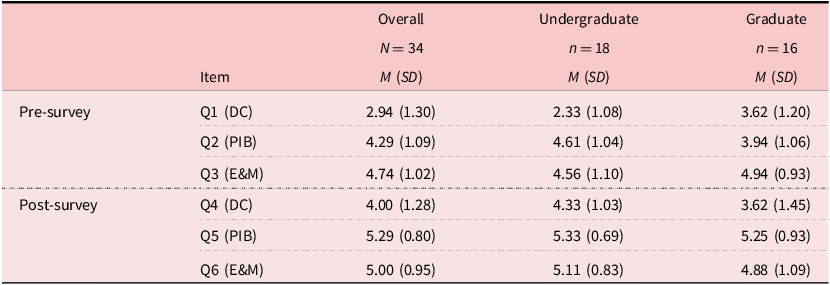
Table 2 summarizes descriptive statistics for pre- and post-survey responses overall and by group. Given the small sample sizes and ordinal scale, results are presented as means (SD) for descriptive purposes, with inferential comparisons based on medians and Wilcoxon signed-rank tests reported below.
Descriptive statistics for pre- and post-survey: Overall and by group

Table 2. Long description
A table with descriptive statistics for pre- and post-survey responses overall and by group. The table has 34 overall responses, 18 undergraduate responses, and 16 graduate responses. It includes means and standard deviations for six items across pre- and post-survey categories. Row 1: Pre-survey, Q1 (DC), Overall: 2.94 (1.30), Undergraduate: 2.33 (1.08), Graduate: 3.62 (1.20). Row 2: Pre-survey, Q2 (PIB), Overall: 4.29 (1.09), Undergraduate: 4.61 (1.04), Graduate: 3.94 (1.06). Row 3: Pre-survey, Q3 (E&M), Overall: 4.74 (1.02), Undergraduate: 4.56 (1.10), Graduate: 4.94 (0.93). Row 4: Post-survey, Q4 (DC), Overall: 4.00 (1.28), Undergraduate: 4.33 (1.03), Graduate: 3.62 (1.45). Row 5: Post-survey, Q5 (PIB), Overall: 5.29 (0.80), Undergraduate: 5.33 (0.69), Graduate: 5.25 (0.93). Row 6: Post-survey, Q6 (E&M), Overall: 5.00 (0.95), Undergraduate: 5.11 (0.83), Graduate: 4.88 (1.09).
Note. DC = digital confidence; PIB = perceived instructional benefit; E&M = engagement and motivation.
Across both groups, the strongest shift occurred in perceived instructional benefit (Q2 to Q5). Participants moved from viewing coding as abstractly useful to valuing it for their own classroom practice. This pattern reflects how the course emphasized classroom tasks: when participants could identify concrete use cases, perceived benefit increased regardless of technical fluency.
Among undergraduates, Wilcoxon tests indicated significant pre–post gains in digital confidence (Q1 to Q4; W = 2, p =.001, r =.97, 95% CI [.85, 1.00]) and perceived instructional benefit (Q2 to Q5; W = 10, p =.017, r =.74, 95% CI [.29, 1.00]), with a non-significant positive trend for engagement and motivation (Q3 to Q6; W = 13.5, p =.102, r =.59, 95% CI [.09, 1.00]). Among graduates, perceived instructional benefit increased significantly (Q2 to Q5; W = 8.5, p =.009, r =.81, 95% CI [.38, 1.00]); digital confidence showed a slight, non-significant decline (W = 23.5, p =.770); and engagement and motivation remained stable (W = 26.5, p = 1.000).
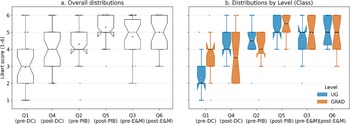
Figure 2 compares overall and by-group distributions. For undergraduates, digital confidence rose substantially (median 2 to 4), suggesting that the scaffolded design may help students move from initial hesitation towards greater digital confidence. For graduate students, the effect was narrower: perceived instructional benefit increased while digital confidence remained stable and engagement and motivation showed a slight, non-significant decline (pre: M = 4.94, SD = 0.93; post: M = 4.88, SD = 1.09). Although graduates entered the course already highly motivated, the absence of measurable gains in either construct may reflect the steeper learning curve of shifting from tool use to creation and limited real-time troubleshooting support in the online format (see also Figure 3).
Boxplots of Likert scores on pre- and post-surveys: Overall and by academic level.

Changes in student responses across three constructs (pre vs. post, with 95% CI).

4.2 Lexical clustering of reflection essays
Lexical patterns were analysed using TF–IDF weights to identify salient terms across the 34 essays. Frequently weighted terms such as app, course, and tool point to shared technical engagement, while unevenly distributed terms like create, felt, and understand highlight individualized emotional and cognitive experiences.
To move beyond frequency patterns, k-means clustering was applied to the TF–IDF matrix (described in Section 3.4.2), with PCA used solely for 2D visualization. Figure 4 shows how terms group into four clusters based on shared patterns across essays. Variance explained was modest (PCA 1 = 8.03%, PCA 2 = 5.32%; cumulative = 13.35%), which is typical for sparse text data. A four-cluster solution was retained based on elbow inspection.
Clustering of reflection terms using PCA-reduced k-means.

Figure 4. Long description
A scatter plot representing the clustering of reflection terms using PCA-reduced k-means. The plot includes four clusters, each represented by different colors: Cluster 1 in blue, Cluster 2 in orange, Cluster 3 in green, and Cluster 4 in red. The horizontal axis is labeled PCA 1 (8.03 percent variance) and the vertical axis is labeled PCA 2 (5.32 percent variance). Each cluster contains several terms connected by convex hulls. Cluster 1 includes terms like ‘create’, ‘understand’, ‘group’, and ‘felt’. Cluster 2 includes terms like ‘language’, ‘learning’, ‘experience’, and ‘education’. Cluster 3 includes terms like ‘tool’, ‘digital’, ‘app’, and ‘class’. Cluster 4 includes terms like ‘require’, ‘material’, ‘begin’, and ‘change’. The plot shows the distribution of these terms in a two-dimensional space based on their principal component analysis scores.
The following labels are interpretive descriptors applied post hoc to each lexical cluster. While high-frequency terms such as app, course, and tool confirm topical engagement with the course content, the analytically informative signal lies in the unevenly distributed terms – felt, create, professor, understand – which are not predictable from the topic alone and carry attitudinal and affective meaning:
-
• Cluster 1 (Emotional journey, reflection, and growth): Terms such as create, AI, like, felt, understand, group, and make highlight students’ personal learning experiences, emotional responses, and moments of collaborative engagement.
-
• Cluster 2 (Pedagogical insight and conceptual application): Keywords such as application, language, education, help, project, experience, and learning indicate students’ focus on instructional design and reflection on how course activities informed their future teaching practices.
-
• Cluster 3 (Conceptualization of teaching and learning design): Terms such as lesson, teacher, tool, app, class, think, and digital reflect the integration of technological tools with classroom practices.
-
• Cluster 4 (Learning shaped by materials and delivery): Terms such as material, require, begin, video, change, clear, and based point to students’ reflections on instructional content, delivery methods, and scaffolding.
The clusters were derived computationally from TF–IDF features using k-means, and their labels were generated interpretively. Given the small corpus (N = 34) and partial machine translation from Korean to English, these clusters are presented as computationally derived lexical neighbourhoods rather than qualitative themes.
4.3 Cluster interpretations
The following summaries present a targeted interpretive reading of each lexical cluster, guided by the study’s research questions rather than constituting a full thematic analysis. In relation to RQ2, Clusters 2 and 3 capture pedagogical insight through instructional reasoning and lesson design, while Clusters 1 and 4 reveal the conditions under which such insight emerges.
4.3.1 Cluster 1: Emotional journey, reflection, and growth
This cluster captures students’ affective paths from early uncertainty through persistence to a growing sense of agency, marked by terms such as create, felt, understand, group, and make.
While developing the education tool, I felt a strong sense of fulfilment knowing that the tool could provide practical help to both students and teachers … I achieved growth not only in technical skills but also in collaboration, creativity, and problem-solving ability. (Undergraduate 01)
Notably, the skills this student identifies – collaboration, creativity, and problem-solving – are exactly the broader professional capacities valued in teacher education (Kafai & Burke, Reference Kafai and Burke2014).
I once regretted enrolling in this course because it was too hard to understand anything during the first few weeks. It took me nearly a month to get the hang of coding and begin to take interest in it. But as in any learning process, I was reminded that the more time and effort we invest, the more interested and skilled we can become … Now I believe that with enough time, effort, and curiosity, anyone can find coding rewarding by modifying and running code successfully. (Graduate 04)
Together, the two reflections suggest that this emotional trajectory, from uncertainty through persistence to growing confidence, was shared across both groups, even if the specific challenges differed.
4.3.2 Cluster 2: Pedagogical insight and conceptual application
Here, students extend technical work into instructional reasoning, reflected in keywords such as application, language, education, project, and learning. Coding is framed as a means to design interactive, goal-aligned learning experiences.
After working on the project, I realized that designing an app not only improved my coding skills but also pushed me to think more like a teacher. I now see how digital applications can make lessons more interactive and engaging. (Undergraduate 02)
The process of developing our project allowed me to connect theory with practice. It demonstrated that integrating technology into language education can foster deeper learning and provide innovative ways to deliver content. (Graduate 02)
Undergraduates emphasize immediate classroom payoffs; graduates stress strategic fit and theory–practice links. Both patterns indicate a rising perceived instructional benefit, reflecting the practical framing needed for transfer.
4.3.3 Cluster 3: Conceptualization of teaching and learning design
This cluster centres on assembling tools into coherent lesson flows (keywords: lesson, teacher, tool, app, class, digital). Reflections describe moving from discrete features to classroom-ready sequences.
Throughout the semester, I learned and applied various functions and apps … Our group designed a lesson using Gradio and games like hangman and quizzes on a Colab Page to support vocabulary, grammar, and comprehension. (Undergraduate 08)
When I conduct online classes, especially for elementary school students, login issues are one of the biggest challenges … through this course, I was very glad to learn that platforms like Hugging Face can be used in various ways during lessons without requiring login … I think the app we made for vocabulary or sentence memorization could be used right away in class with only minor revisions. (Graduate 07)
Students explicitly connect technical possibilities to practical classroom use, showing growing digital confidence and strengthening perceived instructional benefit through classroom-ready designs.
4.3.4 Cluster 4: Learning shaped by materials and delivery
This cluster highlights the role of materials, task instructions, and delivery format in lowering barriers (keywords: material, begin, video, clear, require, based). Students credit the instructor’s demonstration videos, peer collaboration, and step-by-step guides as the main reasons they could make progress.
I had to begin by learning the basics … Even when using an AI tool like ChatGPT, we had to describe in detail what kind of tool we wanted to build … Thanks to my teammates, I was able to gain a clearer understanding of how the application’s code and functions work. (Undergraduate 15)
The professor’s approach in class allowed us to deeply feel her sincerity in helping us understand the theoretical content through videos, and then move on to the practical application using Colab and GitHub. Watching, pausing, and replaying the demonstration videos uploaded for each session helped me try again on my own more effectively than simply following the class in real time. (Graduate 04)
Clarity, sequencing, and accessible supports appear pivotal for converting initial unfamiliarity into steady gains, though how students responded to these scaffolds differed noticeably between the two groups.
Taken together, the four clusters reflect CT research that treats coding-mediated activities as transferable design habits (Hsu et al., Reference Hsu, Chang and Hung2018; Montuori et al., Reference Montuori, Gambarota, Altoè and Arfè2024), with emotional growth, pedagogical insight, design conceptualization, and scaffolding reliance as related dimensions of participants’ course experience.
4.4 Group differences in reflective essays
As an exploratory complement to the cluster analysis, between-group TF–IDF contrasts were examined to identify lexical tendencies that appeared more prominent in one group’s essays than the other. Given the small group sizes and the design constraints, these patterns are presented as illustrative rather than comparative evidence. As with the cluster analysis, interpretations are grounded in lexical tendencies rather than contextualized meaning and should be read together with the interpretive summaries in Section 4.3. Figure 5 presents the top 30 keywords showing the largest mean TF–IDF differences. Positive values (right-side bars) indicate higher weighting among undergraduates; negative values (left-side bars) indicate higher prominence in graduate reflections.
Top keyword differences between undergraduate (A) and graduate (B) reflections.

Undergraduates more frequently used terms such as think, exam, know, digital literacy, class, page, felt, error, team, ChatGPT, communication, computer, presentation, able, major, GitHub, and realize. These terms reflect a focus on their own learning processes, emotional responses, and technical challenges, consistent with early-stage growth in digital confidence.
Graduates, by contrast, emphasized app, language, integrate, learning, teaching, challenge, learner, educator, provide, design, and classroom. These keywords reflect a pedagogically oriented mindset focused on applying technical knowledge to instructional practice, aligning with stronger perceived instructional benefit and motivation expressed through forward-looking classroom use.
This lexical divergence reflects different priorities. Undergraduate reflections centre on discovery, struggle, and adaptation; graduate reflections are more outward-facing, emphasizing instructional purpose and classroom transfer. Given that group membership was tied to delivery mode, these differences reflect a blend of academic level and instructional format and cannot be attributed solely to either factor. These patterns point to two distinct but converging trajectories, affective growth among undergraduates and pedagogical alignment among graduates, directly addressing RQ2.
5. Discussion
The discussion combines both the survey findings and the four lexical clusters to examine how participants developed digital confidence and pedagogical authorship, situating these patterns within broader literature on digital competence, CT, and language teacher education.
5.1 Emotional engagement and growing confidence
Results suggest a shift from digital hesitation towards more confident teacher practice. Among undergraduates, initial digital confidence was low (median = 2) but rose significantly by the end (median = 4, W = 2, p =.001, r =.97; see Figure 2), underscoring the role of scaffolding in digital literacy training. This challenges the “digital native” assumption, which conflates frequent digital tool use with pedagogical readiness (Kirschner & De Bruyckere, Reference Kirschner and De Bruyckere2017). It also aligns with recent evidence that digital competence development requires attention to affective dimensions and structured design opportunities, not just digital familiarity (Momdjian et al., Reference Momdjian, Manegre and Gutiérrez-Colón2025; Rezai et al., Reference Rezai, Soyoof and Reynolds2024; Tondeur et al., Reference Tondeur, Trevisan, Howard and van Braak2025).
This trajectory was reflected in Cluster 1, marked by terms such as felt, understand, and make, consistent with prior research on design-based learning in teacher education (Kim, Reference Kim2025; Kim & Lee, Reference Kim and Lee2024; Kim & Nam, Reference Kim and Nam2023; Lo & Clarke, Reference Lo, Clarke, Pullen and Cole2010). Undergraduates, despite their lower starting point, adapted more readily to coding as a learning process. Graduate students, most with prior teaching experience, rated themselves higher initially but struggled more when transitioning from tool use to design. Once instructional modelling was provided, they generated more concrete applications, connecting coding with instructional intent, though the initial adjustment was steeper.
The emotional trajectory documented in Cluster 1 is not incidental to learning but central to it. The experience of regret, confusion, and eventual progress described by both groups is consistent with what Kapur (Reference Kapur2014) terms productive struggle, in which appropriately scaffolded difficulty prompts deeper conceptual reorganization rather than mere skill acquisition. Structured templates, demonstration videos, and group collaboration reduced cognitive load and shared the uncertainty of an unfamiliar medium. These conditions created a space where struggle led to growth, not withdrawal. Undergraduates entered with lower confidence yet showed greater gains, suggesting willingness to engage with difficulty may matter more than prior knowledge. This helps explain why initial discomfort eventually gave way to confidence rather than giving up.
5.2 Prior experience and course structure
The two groups adapted noticeably differently, reflecting a well-documented gap between proficient tool use and pedagogical integration. Recent research suggests that even experienced practitioners may struggle to move beyond using technology for basic delivery towards more creative, pedagogically purposeful approaches (Nagel et al., Reference Nagel, Guðmundsdóttir and Afdal2023). Our graduate participants reflected this tendency, initially struggling to shift from consumption to creation. Exposure to concrete models of coding-based instructional design eventually enabled them to apply their pedagogical knowledge in building classroom-ready applications. Undergraduates, by contrast, entered with fewer existing views about classroom technology and readily engaged in exploratory coding.
Cluster 4 identifies the scaffolds that enabled this shift. Terms like require, material, video, and clear point to the impact of accessible demonstration videos, step-by-step guides, and transparent task framing. The frequent co-occurrence of terms like professor, create, and help shows how encouragement and procedural clarity sustained confidence. This learning environment bridged initial hesitation and creative application, suggesting that digital confidence grows not from tool access alone but from intentional pacing, guidance, and emotional support. This aligns with Tondeur et al.’s (Reference Tondeur, Trevisan, Howard and van Braak2025) updated SQD model, which highlights affect, pedagogical reasoning, AI, and modelling.
The graduate experience illustrates a paradox familiar in professional learning. Prior expertise can function as both a resource and a constraint. Graduate students entered with established frameworks for thinking about classroom technology as a delivery tool, which initially made it harder to conceptualize coding as a design medium. Such a pattern aligns with Momdjian et al.’s (Reference Momdjian, Manegre and Gutiérrez-Colón2025) finding that digital competence develops most effectively when direct instruction is combined with integrated practice and teacher educator modelling. In this course, modelling played that role, helping graduate participants move from established tool-use frameworks towards design-oriented thinking.
5.3 Coding as a medium for pedagogical thinking
Participants came to view coding as an integral element of teaching design rather than an isolated technical exercise. This shift was particularly evident among graduate students, who maintained strong perceived instructional benefit and frequently used terms like educator, design, integrate, and classroom (Figures 3 and 5). This pattern fits the TPACK framework (Mishra & Koehler, Reference Mishra and Koehler2006), in which technological, pedagogical, and content knowledge are meaningfully integrated. In this study, English teachers used AI-assisted coding not simply to obtain solutions but to specify, revise, and refine their designs in line with pedagogical goals (Mishra et al., Reference Mishra, Warr and Islam2023).
Literacy practices and computational design habits share the same underlying cognitive moves, such as drafting, revising, and attending to textual patterns, which make their integration particularly productive in English language education contexts (Jacob et al., Reference Jacob, Parker, Warschauer, Ottenbreit-Leftwich and Yadav2022). Hsu and Liang (Reference Hsu and Liang2021) further confirmed this bidirectional view, showing that CT instruction simultaneously improved EFL learners’ language proficiency and CT. In this respect, the course did not require an entirely new way of thinking. It extended the revision and design work that English teachers already do to include building instructional apps.
By designing and refining instructional apps, participants exercised what this study terms pedagogical authorship: the capacity to design, adapt, and evaluate digital resources in response to learner needs (Chen, Reference Chen2022; Nagel et al., Reference Nagel, Guðmundsdóttir and Afdal2023). This aligns with the highest level of the UNESCO (2024) AI competency framework and is reflected in the positive shifts in perceived instructional benefit and the lexical patterns of Cluster 2 and Cluster 3. This study contributes to recent work on GenAI competence, chatbot integration, and CALL competence (Choi et al., Reference Choi, Kim and Chung2025; Ma et al., Reference Ma, Lee, Gao and Chai2024; Moorhouse et al., Reference Moorhouse, Wan, Wu, Kohnke, Ho and Kwong2024; Wu et al., Reference Wu, Chun and Lan2026) by examining coding-mediated app creation as an accessible pathway towards pedagogical authorship.
5.4 Group differences and course design implications
Undergraduate reflections revealed an affect-driven trajectory (Cluster 1), with terms like exam, felt, error, and realize marking moments of personal progress and assessment-related anxiety. Their significant gains in digital confidence (median 2 to 4) coincided with emerging insights into how coding could support lesson planning and student engagement. This pattern suggests the value of scaffolded, emotionally supportive instruction for novices. Clear materials, step-by-step guidance, and frequent feedback helped students move past initial hesitation and begin to see how coding could serve their teaching.
Graduate students required more open-ended, theoretically demanding challenges to sustain growth. The course design, optimized for first-time engagement, may not have pushed participants with established pedagogical frameworks far enough. Future iterations might therefore introduce pedagogical challenge, meaning tasks that require experienced teachers to apply domain knowledge in new ways, such as critiquing existing ELT apps against pedagogical criteria, designing workflows that use learner data, or planning evidence-based assessments of app effectiveness. These challenges would raise the conceptual demands without increasing unnecessary coding complexity. Such differentiation aligns with TPACK-oriented research showing that effective integration requires context-sensitive alignment rather than uniform exposure (Li et al., Reference Li, Lau, Liang and Chai2024; Wu et al., Reference Wu, Chun and Lan2026).
The group differences highlighted in Figure 5 reinforce this differentiation, showing how undergraduates and graduates weighted affective versus pedagogical terms differently. These divergent pathways suggest that digital literacy instruction cannot adopt a uniform model. Therefore, course design should be differentiated from the start. Undergraduates benefit from affective scaffolds, gradual skill-building, and visible progress markers, while graduates benefit from context-rich design problems that disrupt existing frameworks and require synthesis of technical and instructional knowledge.
5.5 Synthesis of findings
The findings trace a shift from tentative digital confidence towards emerging pedagogical authorship. Scaffolding served as the bridge between basic confidence and deeper engagement, freeing attention from technical concerns so that pedagogical decisions could emerge. This shift opened space for pedagogical authorship. Students began producing artefacts that reflected their identity as future teachers, with lexical patterns across clusters confirming a dual orientation towards tool use and teaching vision.
What the four clusters together reveal is not simply that students learned to code, but that coding drove a broader shift in how participants saw themselves as teachers. Cluster 1 shows that emotional engagement and productive struggle were prerequisites, and that students who moved through uncertainty towards confidence were those with the clearest pedagogical vision. Once that confidence took hold, Clusters 2 and 3 document the substance of that vision, showing that participants began thinking and writing like designers rather than consumers, framing digital tools in terms of learner needs, lesson objectives, and classroom feasibility. Underlying all of this, Cluster 4 reveals the conditions that made such development possible, pointing to accessible scaffolding, demonstration videos, and collaborative group work that shared the demands of an unfamiliar medium.
The same training yielded divergent orientations, with some participants adapting pragmatically and others experimenting more creatively, reflecting digital literacy as a complex, individual construct rather than a uniform skill set. Undergraduates moved primarily along a confidence-building axis, while graduates moved primarily along a pedagogical integration axis. The two trajectories converged, however, as participants in both groups moved from tool consumption towards instructional design, suggesting that the course worked not by building technical skills but by creating structured opportunities to exercise pedagogical judgement in a new medium. Coding functioned not as an intervention but as a medium through which participants exercised authorship, drawing on existing pedagogical knowledge.
5.6 Limitations and suggestions
This study has several limitations worth noting. The sample was small and context-bound (N = 34), limiting generalizability. Measures were single-item indicators, and pre- and post-course items were conceptually aligned but not strictly parallel, limiting direct comparability. Group membership was tied to delivery mode, so observed differences reflect a blend of academic level and instructional format rather than either factor alone. Reflection-essay analysis relied on TF–IDF features over a small, linguistically mixed corpus. The computational approach, chosen for transparency and reproducibility, cannot capture contextual meaning in the way systematic qualitative coding would. Outcomes were collected immediately after instruction, so durability of effects and classroom practice remain unknown.
Future work should address these limitations on several fronts. Measurement could be strengthened through validated scales such as the DigCompEdu framework (Redecker & Punie, Reference Redecker and Punie2017) or TPACK-based instruments (Mishra & Koehler, Reference Mishra and Koehler2006), and extended to include CT skills (Tsai et al., Reference Tsai, Liang and Hsu2021). Balancing delivery modes would help disentangle group and format effects. Longitudinal follow-up could track classroom uptake and progression along the UNESCO (2024) AI competency trajectory towards the “Create” level.
6. Conclusion
Design-oriented engagement, supported by low-threshold app development activities, may foster perceived digital competence and pedagogical authorship in English teacher education. Undergraduates, beginning with modest digital confidence, learned through scaffolded practice to design vocabulary drills, cloze tasks, and interactive quizzes tailored to classroom needs, turning the technical work from a challenge into a form of pedagogical authorship. Graduate students faced a steeper transition from tool use to creation but applied their pedagogical expertise through concrete modelling and reported gains primarily in perceived instructional benefit. The course positioned app development not as a technical endpoint but as a medium through which future teachers exercised professional judgement.
Course design may also have played a meaningful role in enabling these outcomes. Group collaboration, scaffolded from paired work to teams of four, was particularly central, distributing cognitive load, normalizing struggle, and allowing students to pool technical and pedagogical knowledge. Other structural features also contributed. Short build–test–revise cycles helped contain technical anxiety, demonstration videos enabled independent practice, and GenAI assistance made the technical work more accessible without taking over the design decisions students made themselves.
The question for English teacher education is not whether app development belongs in the curriculum, but how it is framed. Framed as a technical skill, it risks becoming another item on an already overcrowded preparation agenda. As a medium for pedagogical design, however, it becomes more significant, developing a more creative and flexible relationship with digital tools. How teachers develop this design capacity will change as AI changes the tools available. The specific approach used here may need to evolve. What should not change is the expectation that teachers engage with digital tools as designers rather than passive users. As AI continues to reshape what it means to communicate, create, and educate, the capacity to design rather than merely consume digital resources may prove to be one of the most transferable and enduring competences teacher education can develop.
Data availability statement
The data supporting the findings of this study are available from the corresponding authors upon reasonable request.
Authorship contribution statement
Miran Kim: Conceptualization-Equal, Formal analysis-Equal, Software-Equal, Visualization-Equal, Writing - original draft-Equal, Writing - review & editing-Equal; Junkyu Lee: Conceptualization-Equal, Methodology-Equal, Resources-Equal, Validation-Equal, Writing - original draft-Equal, Writing - review & editing-Equal; Hosung Nam: Conceptualization-Equal, Methodology-Equal, Software-Equal, Visualization-Equal, Writing - original draft-Equal, Writing - review & editing-Equal.
Funding disclosure statement
This work was supported, in part, by Hankuk University of Foreign Studies Research Fund, awarded to Junkyu Lee.
Competing interests statement
The authors declare no competing interests.
Ethical statement
All participants took part voluntarily, provided informed consent prior to participation, and were assured of anonymity and confidentiality. No vulnerable populations were involved.
GenAI use disclosure statement
Generative AI tools, including Claude and ChatGPT (OpenAI, GPT-5), were used for minor language editing. No proprietary or participant data were shared, and all content was reviewed and verified by the authors.
About the authors
Miran Kim is a professor in the Department of English Education at Gyeongsang National University. Her research focuses on phonetics and phonology, pronunciation teaching, and the pedagogical use of digital technology and AI in language teacher education.
Junkyu Lee is a professor in the Graduate School of Education at Hankuk University of Foreign Studies. His research interests include SLA and research methodology. His work has been published in Applied Linguistics, Studies in Second Language Acquisition, and Language Learning.
Hosung Nam is a professor in the Department of English Language and Literature at Korea University. His work in language engineering focuses on digital signal processing (DSP), large language models (LLMs), and natural language processing (NLP).



 Open access

