1. Introduction
Mobile-technology-assisted learning, including social network applications (e.g. WeChat, Facebook and Twitter), has long been deemed to be an impetus for language learners to develop autonomy (Kondo et al., Reference Kondo, Ishikawa, Smith, Sakamoto, Shimomura and Wada2012; Rambe & Bere, Reference Rambe and Bere2013) and sustain ubiquitous learning persistently and actively (Jarvis & Achilleos, Reference Jarvis and Achilleos2013; Lawanto, Santoso, Goodridge & Lawanto, Reference Lawanto, Santoso, Goodridge and Lawanto2014; Stockwell & Liu, Reference Stockwell and Liu2015). The educational benefits of mobile technology have been widely identified including sustaining learning anytime, anywhere (Crescente & Lee, Reference Crescente and Lee2011; Kukulska-Hulme & Viberg, Reference Kukulska-Hulme and Viberg2018; Shadiev, Hwang & Huang, Reference Shadiev, Hwang and Huang2017), facilitating language development in reading (Chang & Hsu, Reference Chang and Hsu2011), writing (Hwang, Chen, Shadiev, Huang & Chen, Reference Hwang, Chen, Shadiev, Huang and Chen2014), listening (Chen & Chang, Reference Chen and Chang2011), speaking (Hwang, Shih, Ma, Shadiev & Chen, Reference Hwang, Shih, Ma, Shadiev and Chen2016; Liu & Chu, Reference Liu and Chu2010) and vocabulary (Başoǧlu & Akdemir, Reference Başoǧlu and Akdemir2010; Cavus & Ibrahim, Reference Cavus and Ibrahim2009; Zhang, Song & Burston, Reference Zhang, Song and Burston2011). Although mobile technology seems to be similar to computers at its early inception in terms of learning content delivery and establishment of virtual learning platforms, its usefulness has since gone far beyond owing to the increased mobility and portability, which facilitate development of a range of innovative learning strategies (Persson & Nouri, Reference Persson and Nouri2018).
In a traditional teacher-led classroom, learners’ use of memory, cognitive and metacognitive strategies (see Oxford, Reference Oxford1990, for strategy categorization) accounts for a larger percentage compared with other learning strategies (e.g. social and affective strategies) (Dmitrenko, Reference Dmitrenko2017; Li, Reference Li2014). Learners these days, as the Net Generation, are keen on social networking via digital media, engaging in a variety of activities for self-expression, individual/group learning and negotiation of meaning (Hazaea & Alzubi, Reference Hazaea and Alzubi2016; Jarvis & Achilleos, Reference Jarvis and Achilleos2013; Shen, Yuan & Ewing, Reference Shen, Yuan and Ewing2015). This may have affected their preferred choices of learning strategies. However, research on language learning strategies used in the mobile-technology-assisted context remains insufficient, particularly in English as a foreign language (EFL) learning in China, which has more than six hundred million mobile users (China Internet Network Information Center [CNNIC], 2016). A search with the keywords “learning strategy” and “mobile technology” within a time span of five years (2014–2018) was conducted in ERIC (Educational Resources Information Center) and less than 50 studies were shown.
The aims of this research, therefore, are threefold: (1) to map in general the strategies that are frequently used by Chinese EFL learners in a mobile-technology-assisted environment; (2) to identify differences between the frequency of strategies used in a mobile-technology-assisted learning setting and a teacher-led classroom, and factors contributing to the differences; and (3) to spell out implications for curriculum and instructional design as well as technology-induced pedagogy for learners to develop appropriate strategies. Dörnyei’s (Reference Dörnyei2005) framework of categories of learning strategies was drawn upon to inform the research design and data analysis.
2. Literature review
2.1 M-Learning
Research on mobile-technology-assisted language learning covers learning assisted by a wide range of mobile technologies including tablet PC (personal computer)/PDA (personal digital assistant) (Chang & Hsu, Reference Chang and Hsu2011; Chen & Chang, Reference Chen and Chang2011), iPod (Abdous, Camarena & Facer, Reference Abdous, Camarena and Facer2009) and smartphone (Golonka, Bowles, Frank, Richardson & Freynik, Reference Golonka, Bowles, Frank, Richardson and Freynik2014; Shadiev et al., Reference Shadiev, Hwang and Huang2017). In the last decade, mobile-assisted language learning (MALL) research has tended to focus on vocabulary learning, mobile technology usability and teacher/learner perceptions (Duman, Orhon & Gedik, Reference Duman, Orhon and Gedik2015). Due to an increasing ownership of smartphones and their accessibility to the Internet, smartphones and mobile social network applications have recently gained a growing attention from language researchers (Kukulska-Hulme & Viberg, Reference Kukulska-Hulme and Viberg2018; Şad & Göktaş, Reference Şad and Göktaş2014) due to the usefulness and effectiveness of their multiple functionalities including the “push mechanism” in supporting language learning (providing learners with learning content via SMS, email or social network apps) (Başoǧlu & Akdemir, Reference Başoǧlu and Akdemir2010; Stockwell, Reference Stockwell, In Hubbard, Schulz and Smith2013).
Learners, who are engaged in smartphone-assisted learning, have been frequently found to outperform those in a traditional teacher-led learning environment (Hwang et al., Reference Hwang, Chen, Shadiev, Huang and Chen2014; Martin & Ertzberger, Reference Martin and Ertzberger2013; Zhang et al., Reference Zhang, Song and Burston2011). However, mobile-assisted learning tasks and pedagogies have remained a replica of those originally designed and conceptualized for pen and paper (Stockwell & Hubbard, Reference Stockwell and Hubbard2013). Tasks designed for mobile learning are predominantly form focused and exam oriented, aiming at discrete language elements (e.g. gap filling, vocabulary drills, flashcards, etc.) (Burston, Reference Burston2014). Research has also found that the issue of procrastination, a common difficulty confronting EFL learners in a traditional computer-assisted environment, is still observable in a MALL context (e.g. Thornton & Houser, Reference Thornton and Houser2005).
It appears that “technocentricity” cannot be singled out as responsible for curricular and pedagogical innovations in MALL (Burston, Reference Burston2014). Many MALL study findings have attributed learners’ learning gains to the technological sophistication of mobile technology, a determinant factor, instead of a range of other factors to examine how the technology has been manipulated, or the learning settings have been reconfigured to improve learning behaviors (e.g. strategies and interactional patterns) and effectiveness (Burston, Reference Burston2015). Nevertheless, learners’ high levels of engagement and motivation in mobile learning have been widely identified in research (Berns, Isla-Montes, Palomo-Duarte & Dodero, Reference Berns, Isla-Montes, Palomo-Duarte and Dodero2016; Hazaea & Alzubi, Reference Hazaea and Alzubi2016; Hwang et al., Reference Hwang, Shih, Ma, Shadiev and Chen2016; Kukulska-Hulme & Viberg, Reference Kukulska-Hulme and Viberg2018; Stockwell & Liu, Reference Stockwell and Liu2015). The specificity of such new learning contexts appears to have had an impact on the level of learner autonomy (“the ability to take charge of one’s own learning”; Holec, Reference Holec1981, p. 3), as well as on learning strategy development, of which the latter is the focus of this study.
However, there always seems to be a disparity existing in language learners between their learning behaviors observed in research and actual language learning. For example, in Stockwell and Liu’s (Reference Stockwell and Liu2015) study, a group of Japanese EFL learners showed their increased commitment to learning in a mobile-assisted compulsory vocabulary activity, but their usage of mobile phones for autonomous learning remained limited. Given learner agency or self-regulation as a priority in the design of MALL studies (Kukulska-Hulme & Viberg, Reference Kukulska-Hulme and Viberg2018; Lin, Reference Lin2014), a simple shift to a mobile-technology-assisted learning environment cannot necessarily ensure that learners would automatically initiate learning in accordance with their own choices and preferred strategies (Stockwell & Hubbard, Reference Stockwell and Hubbard2013).
2.2 Learning strategies
Mobile technology, overcoming space, mobility and resource challenges, has been found to have an impact on the change of learners’ use of learning strategies (Hwang, Lai & Wang, Reference Hwang, Lai and Wang2015). In an experimental study with a group of first-year university students at Kyoto University, Kondo et al. (Reference Kondo, Ishikawa, Smith, Sakamoto, Shimomura and Wada2012) found that a Nintendo DS mobile learning platform helped foster a form of self-regulated learning strategies without teacher intervention, and develop learners’ awareness of their own responsibilities to maintain motivation and reflect on strategic learning plans. The accessibility of online resources and peer interactive collaboration facilitated by mobile technology freed learners by reducing the cognitive load arising from teacher-led instructions, and enabled them to deploy more metacognitive strategies to engage in self-regulated learning. However, the role of mobile technology in reducing cognitive load remains controversial since Rambe and Bere (Reference Rambe and Bere2013) reported students’ ambivalence about WhatsApp-supported learning beyond the classroom. WhatsApp’s wide-scale roll-out after hours increased students’ additional responsibilities to engage in interaction and was considered disruptive to their study routines.
The extent of learners’ involvement in mobile-technology-assisted learning appears to be largely dependent on specifically tailored educational programs and pedagogical solutions based on learners’ preferred learning styles and strategies (Hwang et al., Reference Hwang, Lai and Wang2015; Martin & Ertzberger, Reference Martin and Ertzberger2013). For example, as part of the International Research-Intensive Center of Excellence Program (Norwegian University of Science and Technology), Hwang et al. (Reference Hwang, Shih, Ma, Shadiev and Chen2016) developed a mobile system with a view to engaging senior high school students through situational game-based learning tasks. The participants in the experimental group significantly outperformed those in the control group in a speaking post-test. Another study (Rambe & Bere, Reference Rambe and Bere2013) conducted at a South African university, integrated mobile instant messaging services and WhatsApp into an information technology (IT) course. In this case study, third-year IT students showed an increased teacher–student and peer participation in WhatsApp-based discussion. However, the findings are not conclusive as to whether learning strategies reported in these studies would be employed by learners in non-experimental learning contexts. In a number of cases (e.g. Kondo et al., Reference Kondo, Ishikawa, Smith, Sakamoto, Shimomura and Wada2012; Lin, Zhang & Zheng, Reference Lin, Zhang and Zheng2017), the design of the experimental studies did not differ markedly from traditional teacher-led instructions that focus more on assessment than the learning process.
Another strand of research on learning strategies in traditional language learning contexts is largely focused on learners’ language output and vocabulary acquisition (Seker, Reference Seker2016; Tseng & Schmitt, Reference Tseng and Schmitt2008; Zhang, Lin, Zhang & Choi, Reference Zhang, Lin, Zhang and Choi2017). Cognitive and compensation (environmental control) strategies have been found to be the most frequently used strategies in an examination-oriented and teacher-led learning environment (Dmitrenko, Reference Dmitrenko2017; Li, Reference Li2014). In research on learning strategies supported by technologies, the usefulness of different technologies has been consistently reported (e.g. computer, Chen, Wang & Chen, Reference Chen, Wang and Chen2014; mobile, Zheng, Li & Chen, Reference Zheng, Li and Chen2018; web, Kuo, Chu & Huang, Reference Kuo, Chu and Huang2015) in reducing learners’ cognitive load and improving learning performance. However, all these studies failed to examine how learners’ preferences for learning strategies may have changed with a shift of learning environments.
2.3 Research on Chinese EFL learners
Although Chinese learners generally showed positive attitudes toward the use of computer technology in classroom teaching and learning (Hu & McGrath, Reference Hu and McGrath2011), most EFL classrooms remain as only “technologized” classrooms (Shen et al., Reference Shen, Yuan and Ewing2015). In such classrooms, the computer is simply used as a tool to present examination-oriented learning materials by teachers, who are believed to be the custodians of knowledge (Watkins & Biggs, Reference Watkins and Biggs2001). Chinese EFL learners’ test orientation was also identified in research into the effectiveness of mobile messaging technology in vocabulary learning (Zhang et al., Reference Zhang, Song and Burston2011). It was found that participants were highly motivated to learn vocabulary via mobile phones, but a preference for rote learning was still observable in a number of participants’ comments (e.g. “I copied the words in the messages in a book”; Zhang et al., Reference Zhang, Song and Burston2011: 210).
There have been few studies conducted in the Chinese context examining how EFL learners interact in a mobile-technology-assisted environment, and even fewer with a particular focus on the types of learning strategies adopted in such an environment. In response to a call for researchers to explore context-specific learner actions (Rose, Reference Rose2012), it is believed that learning strategies can be individualistic and context specific (Takeuchi, Griffiths & Coyle, Reference Takeuchi, Griffiths, Coyle, Cohen and Macaro2007; Woodrow, Reference Woodrow2005), even context induced as argued by this study of learning in a mobile-technology-assisted context. The paucity of Chinese context-specific research on learning strategies in technology-assisted environments is disproportional to 0.63 billion mobile phone users in China, with 83.4% having access to the Internet (CNNIC, 2016). The disparity has been much enlarged in the context of government initiatives for integrating technology into language classrooms (Chinese College English Education and Supervisory Committee, 2007; Jin & Cortazzi, Reference Jin and Cortazzi2006).
To fill this gap by way of examining strategies employed by Chinese EFL learners in a mobile-technology-assisted environment, this research specifically addresses the following three research questions:
-
1. What kind of learning strategies did Chinese EFL learners utilize in a mobile-technology-assisted environment?
-
2. In what order of preferences did Chinese EFL learners employ those strategies?
-
3. To what extent did these strategies adopted in the mobile-technology-assisted environment differ from those in a teacher-led and examination-oriented context?
3. Analytical framework
This research adopts Dörnyei’s (Reference Dörnyei2005) categories of learning strategies as the conceptual framework. The specifics are as follows:
-
1. Commitment control strategies for helping to preserve or increase the learners’ original goal commitment (e.g. keeping in mind expectations).
-
2. Metacognitive control strategies for monitoring and controlling concentration, and for curtailing unnecessary procrastination (e.g. identifying distractions and developing defensive routines).
-
3. Satiation control strategies for eliminating boredom and adding extra attraction or interest to the task (e.g. adding entertaining elements into tasks).
-
4. Emotion control strategies for managing disruptive emotional states or moods, and for generating emotions that are conducive to implementing one’s intentions (e.g. using self-encouragement techniques).
-
5. Environmental control strategies for eliminating negative environmental influences and exploiting positive environmental influences by making the environment an ally in the pursuit of a difficult goal (e.g. eliminating distractions; seeking external help) (Dörnyei, Reference Dörnyei2005: 113).
Dörnyei’s framework was constructed and developed based on a synthesis of research on motivation, which is conceptualized as “a dynamic, continuously changing resultant of a variety of internal and external forces” (Dörnyei, Reference Dörnyei2005: 90). Such a process-oriented model focuses on, in its idealization, making learners aware of their responsibilities in taking regulatory control of their motivation and passing the ownership of motivation from teachers to learners themselves. Guided by this framework, this research looks at any difference in learners’ strategy use and preferences in a mobile-technology-assisted environment, compared with a traditional teacher-fronted classroom to highlight the changes that are induced by the new learning context.
4. Research setting and participants
A second-tier comprehensive university in central China was chosen for data collection. The sample involved 75 Chinese postgraduate students (62 males and 13 females) in architecture, who were studying a second-year mandatory advanced English program. The entry-level English proficiency to enter this program was College English Test 4 (CET-4) (equivalent to IELTS 6.0). Prior to the commencement of this research, it had been confirmed that all participants, who consented to complete the questionnaire, possessed at least one type of mobile device (e.g. smartphone; iPad).
5. Methodology and data collection
Data collection for this single case study involved a questionnaire with 5-point Likert-scale questions (see Appendix A) and a follow-up semi-structured interview (see Appendix B for interview questions). The interview was used as a supplement and reinforcement for the quantitative data to identify with more accuracy learners’ actual use of learning strategies (Rose, Reference Rose2012). The questionnaire items and interview questions were based on previous research into self-regulated and technology-assisted learning strategies (Chang & Hsu, Reference Chang and Hsu2011; Dörnyei & Taguchi, Reference Dörnyei and Taguchi2010; Jarvis & Achilleos, Reference Jarvis and Achilleos2013; Shen et al., Reference Shen, Yuan and Ewing2015; Tseng, Dörnyei & Schmitt, Reference Tseng, Dörnyei and Schmitt2006) and adapted for the purposes of the current study. The changes in the adapted questionnaire items and interview questions were minor in nature (e.g. reworded to be more specific or accessible to Chinese EFL learners).
Research (Jiang & Smith, Reference Jiang and Smith2009; Li, Reference Li2014) on Chinese EFL learners’ strategies showed that emotion and satiation strategies (affective and social strategies in Oxford’s, Reference Oxford1990, terms) were least applied by Chinese learners in a traditional teacher-fronted classroom. Given that one of the aims of this research is to identify differences of Chinese EFL learners’ strategy use between a teacher-fronted classroom and a mobile-technology-assisted learning setting, emotion and satiation control strategies in Dörnyei’s (Reference Dörnyei2005) framework were left out of the questionnaire item design. The research focus was more on metacognitive, commitment, and environmental control strategies to see if the new learning context may impact Chinese learners’ preferences for the type of strategies more reflective of the teacher-led and examination-oriented classroom context as reported in previous studies (Li, Reference Li2014).
Ninety-seven hard copies of the questionnaire were sent out to students (architecture) in an English class. A total of 74 questionnaires were returned with 17 excluded due to incompletion and invalidity. The questionnaire data were computed and analyzed through SPSS (Statistical Package for the Social Sciences, Version 22). Five participants volunteered to participate in a 15-minute follow-up semi-structured interview. The interview was conducted in Mandarin Chinese, the mother tongue of the five interviewees, which could make it easier for them to express ideas in case they lacked sufficient English vocabulary (Yin, Reference Yin2009). Interview recordings were first transcribed and then translated into English. Both the qualitative and quantitative data gained from these two instruments were cross-checked in a detailed discussion and interpretation of salient research findings.
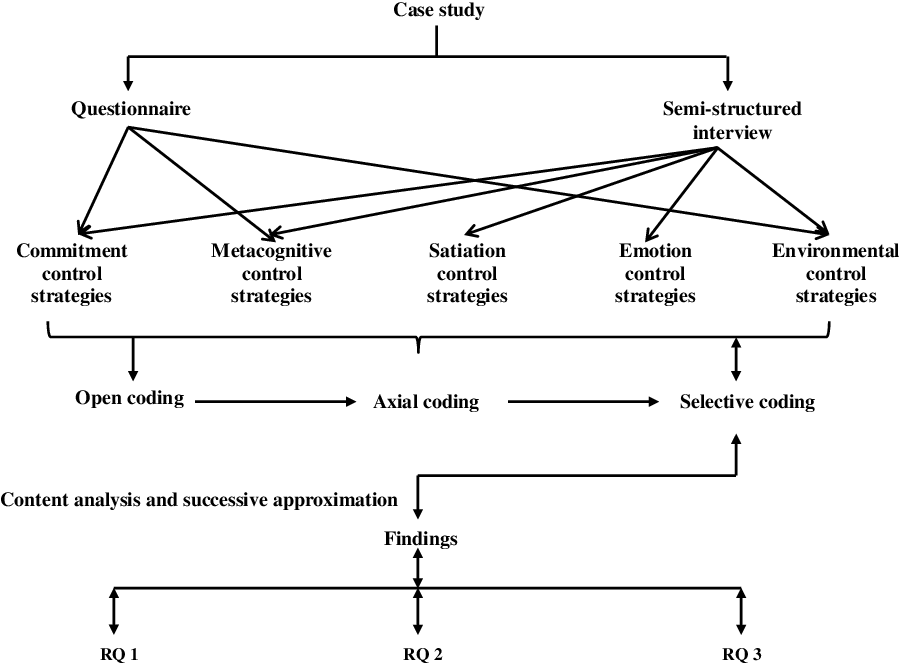
The qualitative data from the interview transcripts were organized based on the conceptual themes of Dörnyei’s (Reference Dörnyei2005) five categories of learning strategies, following open, axial and selective coding (Strauss, Reference Strauss1987). The coded data were analyzed through content analysis and successive approximation (Neuman, Reference Neuman2014). The process of data collection and analysis is presented in Figure 1.
The process of data collection and analysis

6. Data analysis and findings
6.1 Quantitative data
An initial reliability analysis of the questionnaire data was performed and the reliability α was 0.798. An independent sample t-test was followed to identify whether all the questionnaire items showed statistical significance. The total points that each student had given for all 25 questionnaire items were individually summed up and then arranged in descending order. Twenty-five percent (Qin, Reference Qin2004) of the total number of the participants (i.e. 14 participants) were respectively chosen from two ends of the ranking and identified as Group A (participants with higher points) and Group B (participants with lower points). A t-test was conducted to examine the statistical variances between Group A and Group B on each item. It was decided that some items (8, 13, 14, 18, 19 and 25) were to be excluded from the data analysis, as they not only showed a high p value (p > 0.001) but also conveyed the value 0 in their 95% confidence interval. The data after deduction showed the reliability at a more acceptable level (α = 0.808) to provide valid research evidence. Alpha (if item deleted) of each item ranged from 0.791 to 0.807, which showed that each individual item had approximately the same influence on the reliability of the questionnaire.
It is worth noting that among the deducted items, several mobile-assisted English learning strategies were frequently used by participants, including searching for writing examples (item 13, M = 3.19), taking photos of lecture slides (item 14, M = 3.12), and assisting learning in class (item 18, M = 3.47). Participants also showed their preferences for textbooks (item 8, M = 2.57) and traditional classroom activities (item 25, M = 2.78) when comparing to mobile-assisted learning.
Factor analysis was then employed to identify clusters of items that were influential on participants’ learning in a mobile-technology-assisted environment. Prior to the factor analysis, the correlation matrix showed that the correlation of each item was beyond 0.30. The Kaiser–Meyer–Olkin measure of sampling adequacy was 0.641 and Bartlett’s test of sphericity was significant (sig. = 0.000), which indicated that the data were suitable for a factor analysis. Principal component analysis and varimax were individually used as extraction and rotation methods to simplify the data in the factor analysis. The factor loading structure was clearly shown in the fourth analysis, which yielded three clusters of items with eigenvalue greater than 1.000 explaining 61.519% of the variances.
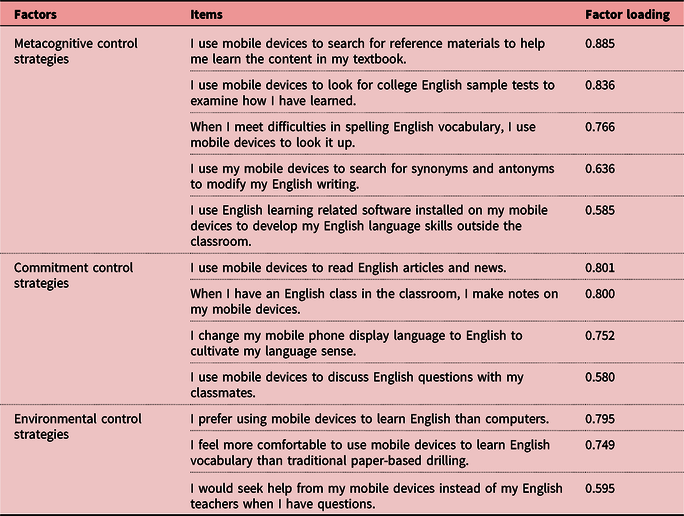
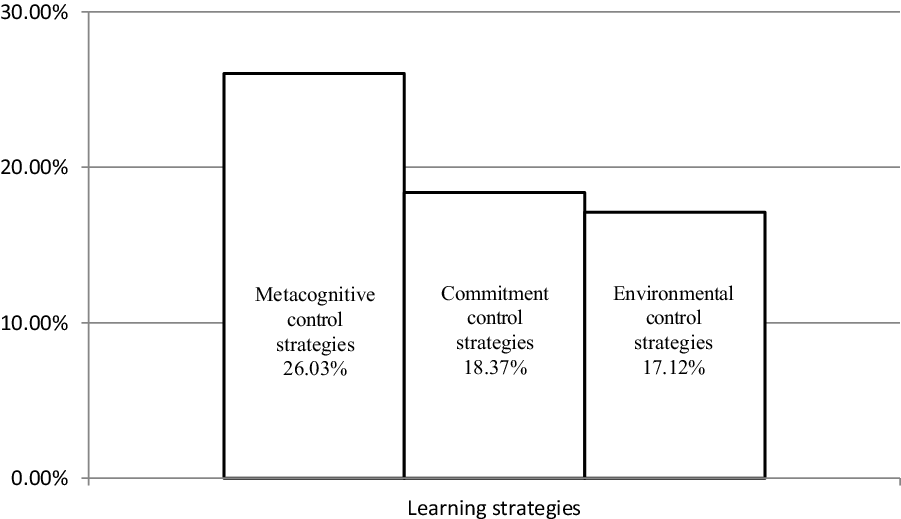
Based on the content of each item, the emerged three clusters of items were individually labeled as metacognitive control strategies, commitment control strategies and environmental control strategies (Dörnyei, Reference Dörnyei2005), as presented in Table 1. Drawn on the factor loading structure, the ranking of these three types of strategies and the influential percentage that each type accounted for are shown in Figure 2.
Factor loading structure

Ranking of three types of strategies

As shown in Figure 2, metacognitive strategies were found to be the most influential type of strategies used by the participants, accounting for 26.03% in the factor loading. Commitment and environmental strategies were rated as the second and the third, respectively accounting for 18.37% and 17.12%. This was a significant finding as the overall high percentage (three clusters explaining up to 61.519% of the variances) in these three types of strategies used by the participants in the mobile-technology-assisted environment, particularly metacognitive control strategies (ranked first), showed a possibility for EFL learners to use or develop a set of strategies, which are less observable or utilized in a teacher-led and examination-oriented classroom (Li, Reference Li2014).
In addition, Pearson correlation analysis was used to examine the extent to which these three clusters of items were correlated to each other. Simple scatter plots of three clusters were examined to identify the basic linear correlation of the three clusters. Results showed that metacognitive and commitment control strategies did not have an obvious linear relation with each other, while both metacognitive (r = 0.382, p = 0.003) and commitment (r = 0.243, p = 0.069) control strategies were positively correlated to environmental control strategies.
6.2 Qualitative data
During the interview, all five participants reported their use of metacognitive control strategies, though limited to looking up vocabulary to understand the English text in the course book, as shown in the following response from Student 1:
I have a couple of English learning related apps installed on my smartphone, including Youdao dictionary [for vocabulary learning] and Qupeiyin [dubbing movie clips to practice oral English]. At most times, I use the dictionary on my smartphone to look up the vocabulary that I do not understand in my English textbooks. I have to learn them to pass exams. I frequently use Qupeiyin to practice my pronunciation. I like to watch English movies. You can dub English movie clips or videos by using the app with your own voice in English.
Apart from metacognitive strategies, Student 1’s use of satiation control strategies was also observed in her response: “I frequently use Qupeiyin to … dub English movie clips … with [my] own voice.” It seems that she tried to seek a varied learning experience to reduce the level of boredom in learning English. The act of dubbing English movie clips contributed to her frequent commitment to improving her English pronunciation.
The use of commitment control strategies of learning English was also documented in a number of participants’ responses regarding mobile-technology-assisted English learning activities. For example, Student 2 recalled:
I read China Daily on my mobile phone. I also downloaded some English movies or videos on my mobile devices to watch. I can look at them when I am free and no matter where I am. I like to listen to English songs when I am on my way to classes. I like the beats and rhythm, which are different from Chinese songs. I can also sing a little bit after listening to them for many times.
Student 3 added:
I put a lot of English videos and songs into my iPad. I also like to watch English movies to practice my listening and speaking skills. At most times, I read the Chinese subtitles, as I hardly understand the plots without the subtitles. However, sometimes I may come across some vocabulary and sentences I have just learned in my English class. I would memorize them better as I can recall them by picturing the movie scenario in which they are used.
There is no doubt that mobile devices provided Students 2 and 3 with convenience to proactively commit themselves to learning activities including reading English articles, watching English movies and listening to English songs without the constraints of time and space. Student 2 attributed her growing capacity in singing English songs to repeated exposure to English lyrics, and Student 3 shared her experience in recalling certain language items from movie plots. Obviously, watching English movies and listening to English songs were more than a leisure pursuit in their cases as these activities had helped reinforce classroom language learning for Students 2 and 3.
Student 2’s use of emotion control strategies (managing disruptive moods) was largely shown in her engagement in intercultural communication through QQ and WeChat (popular China-based mobile social network apps):
I met some foreign exchange students at school parties, but I didn’t know what to say to them in person. I wanted to practice my English, so I added them on QQ or WeChat. Sometimes, I use English to chat with them on my mobile phone. It is much easier to text them on QQ or WeChat, because I have a lot of time to think.
Mobile technology appeared to help reduce Student 2’s embarrassment and nervousness, which would occur in face-to-face intercultural communication. Mobile social network apps allowed more time for her to use English for communication purposes. This revealed, in a way, Student 2’s conscious use of metacognitive control strategies (“… I have a lot of time to think”) to select appropriate words when communicating with international students.
Two interviewees were observed to use or be aware of environmental control strategies when comparing their preferences for smartphones and the teacher in learning, though from different perspectives. Student 4 reported:
Sometimes, I realize that the information I come across on the Internet with the support of my mobile phone, is easier to understand. I can also find a lot of examples of same language items as those learned in class, so that I can practice a lot. I always highlight the language items that I can’t understand in my English textbook in English classes, but I tend to look it up by myself using my mobile phone instead of seeking help from my English teacher.
Student 5 argued:
I do not use my mobile phone to learn English often, because I don’t know how to do it. In class, I have my English teacher to teach me. After class, I can’t teach myself. I do not trust my mobile phone. It provides too much information. It is very difficult for me to choose the one that I need and is correct. I would like to ask my English teacher. She is patient and I can remember the language items very well every time she teaches me herself.
As the data above showed, Student 5 was not as positive as Student 4 regarding learning in the mobile-technology-assisted environment in that Student 5 felt more comfortable to learn English under the guidance of a teacher. Although Student 5 tried to learn in the new environment, he remained teacher dependent. However, Student 4 was extremely positive about the new learning environment supported by mobile devices, which provided her with a range of useful resources and the convenience to highlight key language items.
7. Discussion
Both quantitative and qualitative data showed participants’ frequent use of metacognitive control strategies (accounting for 26.03% in factor loading) to learn English in a mobile-technology-assisted environment. The use of metacognitive control strategies helped participants enhance vocabulary learning and comprehension of textbook-based materials (e.g. Student 1 “[used] the dictionary on [her] smartphone to look up vocabulary that [she did] not understand in English textbooks”). This is consistent with previous research findings regarding the effectiveness of mobile technology in facilitating English vocabulary learning within and beyond the classroom (Başoǧlu & Akdemir, Reference Başoǧlu and Akdemir2010). However, participants’ largely test-oriented approaches to learning (items 16 and 17 rated as the two most influential factors) may curtail their natural motivation and interest in learning even in a less controlled environment. This also provides an explanation for the high level of passive learning and procrastination observed in Japanese students in Thornton and Houser’s (Reference Thornton and Houser2005) research on smartphone-supported English vocabulary learning.
A mobile-technology-assisted learning environment seems to have afforded participants a range of commitment control strategies induced by the new technology. This was evident in Student 2’s high interest in watching English movies (“no matter where”) and listening to English songs (“on [her] way to classes”). However, it is likely that participants’ development of language skills was only confined to the level of lexical recognition (e.g. recall of vocabulary from movie scenarios; recognition of words in lyrics). Nevertheless, this cannot devalue the effectiveness of mobile technology in facilitating the development of English language skills (Chang & Hsu, Reference Chang and Hsu2011; Chen & Chang, Reference Chen and Chang2011), as participants in this case study were not involved in any experiment or treatment. This highlights the need to design learning programs to optimize the features of mobile technology and set up instructions to guide learners for the development of strategies and language proficiency.
The use of environmental control strategies in this technology-assisted learning context led to participants’ mixed perspectives on the use of mobile technology (e.g. Student 4 being positive and Student 5 being negative). For example, Student 5 questioned the validity of the information provided on the Internet and complained that there was “too much information.” The deeply rooted tradition of teacher-centered pedagogy (Watkins & Biggs, Reference Watkins and Biggs2001) may have contributed to participants’ reluctance and refusal to take initiatives in learning. The test-oriented and information-based online curriculum in China also seems ineffective to provide learning instructions and scaffolding. Chinese learners frequently reported a high level of frustration when being bombarded by an explosive amount of online examination-oriented learning content, and often they had no clue of where to set off (Shen et al., Reference Shen, Yuan and Ewing2015). This creates challenges not only for classroom practitioners to minimize their dominant role in teaching, but also for web designers and content curators to control the authenticity of learning materials and the usability of learning websites.
Participants’ general lack of the use of satiation and emotion control strategies may reflect an ingrained conception that English language is perceived as a formal course rather than a language for communication and leisure (Zhang et al., Reference Zhang, Song and Burston2011). It corroborates the finding that affective and social strategies were least applied by Chinese EFL learners in English learning (Li, Reference Li2014). Instead of sustaining communicative interest and being motivated, learners may only learn the language to obtain higher scores in English tests to gain a competitive edge (Yuan, Reference Yuan2014). This explains why most of the mobile-technology-assisted learning strategies reported in the interview were related to vocabulary learning (e.g. Student 3 “using Youdao mobile dictionary to look up vocabulary”). It is a typical language learning strategy for Chinese EFL learners, who have been accustomed to learning discrete elements of English, and the level of language proficiency is often judged by the number and size of the vocabulary in command.
Participants’ centralized attention to vocabulary learning may have contributed to a non-linear relation between their use of metacognitive and commitment control strategies, although the use of metacognitive control strategies (positively correlated to environmental control strategies, r = 0.382, p = 0.003) seems to be largely helpful in keeping participants aware of their control of learning environments. However, it should be noted that there was use of satiation control strategies observed, though limited (Students 1 and 2 using Qupeiyin and WeChat), as reported in the interview. It appears that mobile technology has had an impact on Chinese EFL learners’ use of strategies, implying a shift in their preferences to adopt a certain type of or a new strategy not commonly seen in a traditional classroom-based learning environment. Further research on Chinese EFL learners in a mobile-technology-assisted learning environment will yield more empirical evidence of learners’ deployment of less frequently used strategies such as emotion control strategies, which were not observed in this study.
A change in learner preferences for strategy choices as reported in this study was more noticeable when the findings of this research were compared with those obtained in Li’s study (Reference Li2014) on Chinese EFL learners’ use of strategies in an oversized (40 to 60 students in one class), teacher-fronted classroom. These two studies are comparable based on the following evidence: (1) Li conducted his research in a key national university in China with 119 university non-English major students (in sciences and humanities), while the current research was conducted in a Chinese multidisciplinary university with 57 architecture students; (2) Li’s participants had their Chinese Tertiary Entry Examination scores for first-tier university admission (English proficiency equivalent to IELTS 6.0–6.5), while the participants in this research had passed Chinese CET-4 (equivalent to IELTS 6.0) prior to research; and (3) participants from both studies were involved in Chinese college compulsory English courses, which were delivered in teacher-led and exam-oriented classrooms.
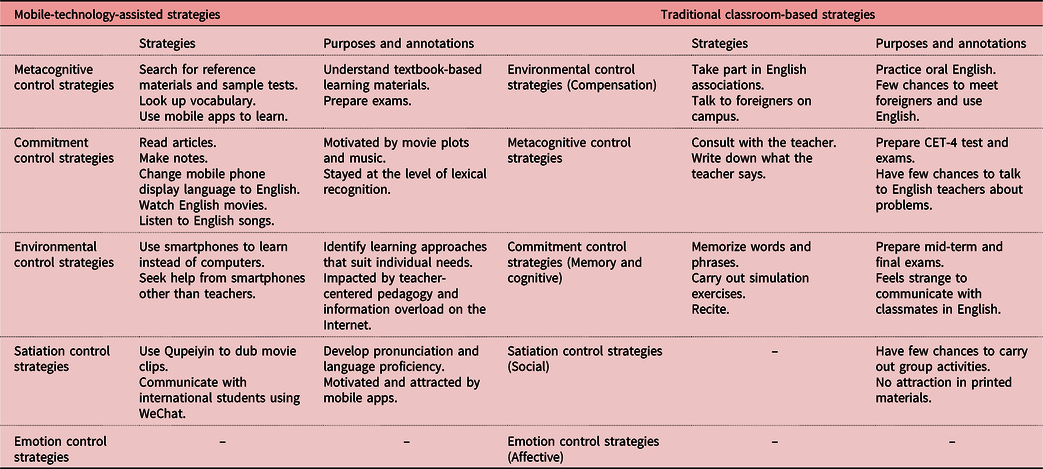
Table 2 presents the categories of strategies in a descending order in terms of frequency, and types of strategies identified in the two different learning contexts.
Comparisons of Chinese EFL learners’ strategies in mobile-technology-assisted and traditional classroom-based learning environments

As shown in Table 2, metacognitive strategies, which ranked second in Li’s (Reference Li2014) study, moved ahead to the first place and overtook both commitment and environmental control strategies in the current study. Environmental control strategies that ranked at the top in Li’s study fell to third place in this study and turned into the least preferred category of strategies applied by learners in a mobile-technology-assisted environment (among the most popular strategies in a traditional learning setting: metacognitive, commitment and environmental strategies). Although participants’ emotional display (e.g. feeling strange) was identified in Li’s study, this was presented more as a display of a type of emotion than an emotion control strategy.
Although these Chinese EFL students in the current study were largely supportive of using mobile-technology-assisted learning strategies to facilitate English language learning, there were also participants (e.g. Student 5) who preferred a more traditional approach to learning and were still dependent on teachers. It mirrors the déjà vu findings of the paradoxical usefulness of computers reported in previous studies. There is always a disparity between the high expectation toward the technology use and the practical integration to transfer technologized and teacher-dominated language classrooms (Zhong & Shen, Reference Zhong and Shen2002). It is perhaps necessary, as discussed in the first place for computer-technology-assisted language learning (Benson, Reference Benson, In Benson and Reinders2011; Sims, Reference Sims2008; Trilling & Fadel, Reference Trilling and Fadel2009), to consider ways to foster autonomous learning by designing and selecting in a systematic way mobile-technology-assisted learning materials and tasks. There is also a need to change the perception toward the role of the teacher and learner, as well as the nature of teaching and learning.
8. Conclusion
There is no doubt that a mobile-technology-assisted environment helped effect changes in Chinese EFL learners’ ways of adopting a set of learning strategies, which differed in kind and frequency from those typical of a teacher-led and examination-oriented language classroom. In this study in a mobile-technology-assisted learning environment, participants’ use of four types of strategies were identified (metacognitive, commitment, environmental and satiation control strategies; Dörnyei, Reference Dörnyei2005). Metacognitive and commitment control strategies were most frequently used by the participants, and the frequency of their use of metacognitive strategies moved ahead of commitment and environmental control strategies. Environmental control strategies that ranked at the top in a traditional teacher-led classroom (Li, Reference Li2014) dropped to third place in this study of learning facilitated by mobile technology. Satiation control strategies, rarely used by Chinese students in a teacher-fronted language classroom, were also observable, though limited, in a mobile-technology-assisted environment. Participants’ lack of the use of emotion control strategies was argued to be attributed to their exam orientation, resulting in their frequent commitment to vocabulary learning. These findings have implications for the understanding and designing of mobile-technology-assisted learning for EFL learners to develop appropriate strategies for autonomous learning.
However, current examination-oriented classroom curriculum and pedagogy in the Chinese context may remain a hindrance for Chinese EFL learners to develop an awareness of the issue and capacity to take control over their own learning. Learners’ enhanced use of metacognitive and commitment control strategies in a mobile-technology-assisted environment highlights the usefulness of mobile-technology-induced tasks and learning process in facilitating autonomous learning and learner strategy development. It appears that the way Chinese EFL learners learn, and the strategies they employ, could be changed in an emerging learning environment as language learning supported by mobile technology has already afforded participants in this study with a learning experience, not observed in a teacher-fronted classroom. Yet changes that would assist learners to develop autonomous learning and related learner strategies will not happen until after major structural changes take place in the education system that focus more on the learning process than assessment. This may also, at the conceptual and curriculum level, require a change of both teacher and learner perceptions of the nature of learning, the role of the teacher and learner, as well as pedagogical innovations in material and task design (mobile technology assisted and learner self-regulated) for learning strategy development.
Data
The interview transcripts in this study are available in the research data management system of The University of Sydney and can be accessed upon request.
Ethical statement
The current study has obtained human ethics approval through The University of Sydney Human Research Ethics Committees. Participants were informed of the study and consent was obtained prior to the commencement of the research. Participants were also informed of their rights to withdraw from the research for any reason at any time. No detriment was predicted during the research, as the current study investigated learners’ learning strategies through a questionnaire and an interview. Participants’ data are de-identifiable and have been stored securely and treated confidentially. Participants have received a copy of the research findings arising from their participation via email.
Appendix A
Questionnaire
Instructions: Twenty-five statements are given below, which people may use to describe the strategies they use in a mobile-technology-assisted English learning environment. Please read each statement and indicate the extent to which the statement suits you by circling the corresponding number. Choose 1 (Never), 2 (Sometimes), 3 (Often), 4 (Usually) and 5 (Always).

Appendix B
Interview questions
An opening remark
Welcome to this interview. Thank you for agreeing to participate. You will be asked some questions regarding your experiences in learning English supported by mobile devices. Please be free to give your answers and interact with other participants.
-
1. Do you use mobile devices to learn English language? How do you use mobile devices to learn English? Do you think it is effective or not? Why?
-
2. Do you prefer learning with mobile devices or learning in a traditional classroom? Why?
-
3. What do you think are the advantages of using mobile devices to support English learning and what are the disadvantages?
-
4. Do mobile-assisted activities increase your learning interest? How?
-
5. How are the strategies you use with your mobile devices different from those you use in a traditional classroom environment?
-
6. How do you perceive the teacher’s role in a mobile-technology-assisted learning?
About the authors
Chuan Gao is undertaking his PhD in education at The University of Sydney and has a particular interest in mobile-assisted English language pedagogy and curriculum development. Chuan also works as a research assistant and a tutor at The University of Sydney. His roles include creating teaching materials, devising assessments and teaching in the technology-assisted classroom.
Dr Hui-zhong Shen is an associate professor in Sydney School of Education and Social Work, The University of Sydney, where he has served a range of senior roles including Associate Dean and Director of China Education Centre. Dr Shen’s research areas include cross-cultural pedagogies and technology-supported language learning.
Author ORCIDs
Chuan Gao, https://orcid.org/0000-0002-7106-7777
Hui-zhong Shen, https://orcid.org/0000-0003-2011-1616