1 Introduction
This studyFootnote 1 investigates how a Chinese-American novice teacher (hereafter, Joshua; a pseudonym chosen by the teacher) engaged telecollaboratively with student teachers (STs) of English as a second/foreign language (ESL/EFL) enrolled in a language teaching methods course (taught by Author A) at a private graduate school in the USA. The STs co-designed communicative classroom tasks with Joshua for the EFL learners he was teaching in China. We use the term “novice teacher” for Joshua rather than “student teacher” because he had officially been hired as an EFL teacher by the Chinese school. This term was chosen even though Joshua’s status in relation to the STs was that of peer or colleague (he knew some of them from his previous classes, and some of the STs had more teaching experience than he did).
The term “telecollaboration” was chosen because the principle of reciprocity (Egbert & Hanson-Smith, Reference Egbert and Hanson-Smith2007) was fulfilled in that the American STs designed the EFL tasks for Joshua’s students. In return, Joshua provided feedback on the STs’ tasks, and his EFL learners acted as an authentic audience for the tasks, being evaluated on their task performance by both Joshua and the STs. The EFL learners were considered authentic because they had enrolled in Joshua’s English classes independent of the telecollaboration. It should be noted here that we consider the classroom authentic in itself since learners congregate there for the purpose of language learning (Breen & Candlin, Reference Breen and Candlin1980).
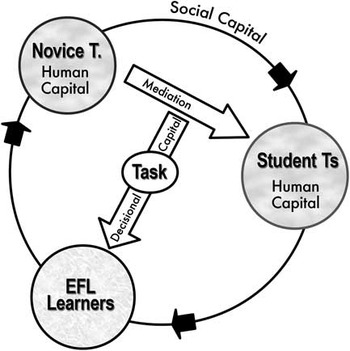
The goal of the study was to learn how Joshua used his personal, cultural, linguistic, institutional, and technical knowledge to mediate the task design process, how he perceived his roles in the telecollaboration, and how he experienced changes in his roles as mediator through the three stages of task design, implementation, and assessment (see Figure 1). We argue that the goals of preparing STs for lifelong learning and working within different contexts can be facilitated by honing their professional capital (Hargreaves & Fullan, Reference Hargreaves and Fullan2012) within the context of telecollaborative learning experiences. In the following, we develop the concept of professional capital before providing an overview of relevant research on telecollaboration and further specifying the mediational aspect of task design in this context.
Developmental cycle

1.1 Professional capital in telecollaborative teacher education
According to Breen (Reference Breen2006), teacher education is shaped by globalization, which requires re-contextualization of local understandings and making knowledge accessible to a wider range of fellow professionals. In our study, knowledge was recontextualized and redistributed in that the expert or mediation role for the task design did not lie with Author A (as the instructor of the course) but with Joshua, who was aware of his role as the more capable peer in terms of his knowledge of the context and his prior telecollaborative experience. Hargreaves and Fullan (Reference Hargreaves and Fullan2012: xv) have defined the notion of professional capital as “the systematic development and integration of three kinds of capital – human, social, decisional – into the teaching profession.” The underlying principle was for participants to benefit from each other’s professional expertise through the “collaborative task” (O’Dowd & Ware, Reference O’Dowd and Ware2009: 178) of jointly designing EFL tasks for a specific context. More specifically, Joshua was enabled to co-conduct a telecollaboration with the STs, a concept he had learned about previously in Author A’s technology elective. By the same token, STs would learn from Joshua’s feedback on their task design about institutional constraints and affordances in China. Figure 1 illustrates how Joshua’s mediating role in this telecollaboration facilitated achieving the goal of optimizing participants’ development through forming social capital beyond their physical classroom walls.
As seen in Figure 1, fostering social capital supports the development of human capital: interaction, feedback, and establishing professional relationships promotes learning and the development of self-efficacy, which ultimately support effective teaching and successful learning (Day & Gu, Reference Day and Gu2010). Moreover, according to Hargreaves and Fullan (Reference Hargreaves and Fullan2012), translating professional capital into practice means that institutions need to make long-term investments in the work, capacity, and effectiveness of their teachers. In this study, investment involved connecting Joshua, the Chinese-American novice teacher, with the STs to collaborate on designing language learning tasks for Joshua’s context.
Decisional capital, the third dimension of professional capital, is also essential to development. Hargreaves and Fullan (Reference Hargreaves and Fullan2012: 5) argue that decision-making in complex situations is central to professionalism, involving “collective responsibility, openness to feedback, and willing transparency.” Through the decision-making process, development can become “a persistent collective enterprise” (p. 3) supporting real change.
The nature of our telecollaboration thus supports the notion that groups, teams, and communities are more powerful than the individual, and that human capital needs to be complemented by social and decisional capital with student learning placed at the center for long-term impact. Joshua’s presence at the university in China enabled the STs to gain insight into the constraints and affordances of an Asian EFL-teaching context and allow them to put into practice what they had learned about task design. The relationship between Joshua, who assisted the STs with task design for his context in China, and the STs, who provided him with tasks for feedback and implementation, illustrates the reciprocal relationship of social capital. Joshua played a crucial role in the curriculum and project design since Author A was unfamiliar with his specific context. Similarly, Joshua saw telecollaboration as a way of going beyond teaching to the test by providing access to culturally “authentic tasks and audience” to his learners in China (“teachers as cultural workers” – Breen, Reference Breen2006: 218). At the same time, he emphasized the degree of decisional freedom which he was afforded to run the telecollaboration independently, which may have resulted in a feeling of confidence and empowerment. The developmental cycle seems to come full circle when social capital and decisional capital have an enabling impact on the human capital.
1.2 Telecollaboration and teacher education
Over two decades of telecollaboration (Warschauer, Reference Warschauer1996) have generated a robust body of research outlining its affordances and constraints such as language and intercultural learning in language instruction (e.g., Belz, Reference Belz2003), online literacies (Guth & Helm, Reference Guth and Helm2010), intercultural communicative competence (Hauck, Reference Hauck2010; Müller-Hartmann, Reference Müller-Hartmann2005), and autonomy and multiliteracy skills (Fuchs, Hauck & Müller-Hartmann, Reference Fuchs, Hauck and Müller-Hartmann2012) in teacher education.
The novelty of this particular collaboration was that it was mediated by Joshua as cross-cultural mediator. While it can be argued that this telecollaboration was not a collaboration among peers, we felt that the interactions between Joshua and the STs were peer-to-peer. Some of the STs knew Joshua because they had been in the same classes before Joshua went on leave. According to Joshua, they considered him a colleague or an in-service peer teacher – not a teacher in a supervisor role. Moreover, a number of the STs already had teaching experience – in contrast to Joshua.
Since it has been suggested that teachers participating in telecollaborations need a range of competences (i.e., organizational, pedagogical, ICT/digital, intercultural, and socio-affective) to be effective telecollaborative teachers (O’Dowd, Reference O’Dowd2013), our study was intended to provide a venue for Joshua and the STs to experience telecollaborative practices so they could acquire some of these competences. By the same token, we wanted to enhance teachers’ reflection on their practice, encourage critical thinking, help teachers to feel less isolated, and provide them with support for exchanging ideas, opinions, and experiences (Dooly & Sadler, Reference Dooly and Sadler2013; see also Arnold, Ducate, Lomicka & Lord, Reference Arnold, Ducate, Lomicka and Lord2005).
We describe in the following section the mediational nature of this telecollaboration in more detail.
1.3 Mediated telecollaborative learning experiences
In this study, in addition to the mediation through cultural artifacts such as asynchronous computer-mediated communication (CMC) tools and language, Joshua mediated the task design in an effort to minimize challenges regarding technology, institutional constraints, and possible (intercultural) miscommunications. This is in line with Hampel and Hauck (Reference Hampel and Hauck2006), who have highlighted the mediating role of technology, i.e., the effect of digital and multimedia tools and applications, which results in a re-evaluation of learning contexts. Furthermore, there is a need to focus on the “socio-affective aspects of learning” in contexts where students primarily communicate online through asynchronous tools (Hampel, Reference Hampel2010: 151). In order to evaluate the mediational quality of such interactions, it is important to detect the transformation produced by the intention of the stimulus or event to be mediated (Feuerstein & Feuerstein, Reference Feuerstein and Feuerstein1999). In our study, this meant investigating the role of Joshua vis-à-vis the STs in the process of task design and his experience of this process. We use the term “mediation” rather than “scaffolding” because Joshua fulfilled two key requirements – intentionality and reciprocity – inasmuch as he was deliberately attempting to make the mediation of the task design explicit in his exchanges with the STs.
In a Vygotskian sense, mediation within the zone of proximal development has as its ultimate goal the support of potential or future development and is not outcome-oriented (Poehner & Lantolf, Reference Poehner and Lantolf2005). By contrast, scaffolding does not necessarily lead to development because it is product-oriented with the focus on an end point. Scaffolding primarily aims to help the learner achieve a task with novice and expert co-constructing a product (Poehner & Lantolf, Reference Poehner and Lantolf2005). Wells (Reference Wells1998), in fact, has questioned the notion of scaffolding in peer-assisted second language (L2) learning because he believes there is most likely no major discrepancy in expertise, nor a learner assuming the role of the teacher. There are numerous opportunities for learning with and from co-participants; such scaffolded learning is a result of task completion but does not constitute the object of the actual activity – in contrast to mediated learning experiences (MLEs) (Feuerstein & Feuerstein, Reference Feuerstein and Feuerstein1999).
Intentionality and reciprocity “are the main conditions of an MLE interaction”; the specific content of the interactive process “is shaped by the intention to mediate to the mediatee, not only the particular stimuli, activity, or relationship, but also to share this intention with the mediatee” (Feuerstein & Feuerstein, Reference Feuerstein and Feuerstein1999: 17; original emphasis). For instance, Joshua commented that he “offered suggestions and feedback throughout the [task design] process” and that he was “the mediator throughout” (Joshua, Interview, February 25, 2011, hereafter Interview). He further subdivided his mediating role for each stage of the task design process in terms of the jobs he performed. The nature of this telecollaboration was also reciprocal (Egbert & Hanson-Smith, Reference Egbert and Hanson-Smith2007) in that the American STs designed the EFL tasks for Joshua’s students, Joshua provided context-specific task feedback, and the STs and Joshua separately graded the learners on their performance. In light of the multifaceted nature of the novice teacher’s mediating role, the research questions were as follows:
-
1. How did Joshua use different types of knowledge to mediate the task design?
-
2. How did Joshua perceive his multiple roles in the telecollaboration?
2 Research design
2.1 Methodological approaches
Within a sociocultural framework for telecollaboration studies (Dooly & O’Dowd, Reference Dooly and O’Dowd2012; Reinhardt, Reference Reinhardt2012), our exploratory case study shares characteristics of ethnography such as emic and holistic principles (van Lier, Reference van Lier1988), action research (Müller-Hartmann, Reference Müller-Hartmann2012; Nunan & Bailey, Reference Nunan and Bailey2009), and narrative inquiry (Connelly & Clandinin, Reference Connelly and Clandinin1990). These methodological approaches will be explained in more detail below.
2.2 Participants and context
Participants in this telecollaboration included the Chinese-American novice teacher Joshua (as task mediator), 20 STs in the USA (who were instrumental in designing the tasks for Joshua’s EFL learners in China), 90–100 intermediate to advanced English learners majoring in Telecommunications at a public research university in China in a total of five classes taught by Joshua.
Joshua had a BA in English and had returned to school to pursue teaching after a decade of work experience in the technology field as a network engineer. His expertise was based on his knowledge of the Chinese context and on having participated in a prior language teaching and technology elective course with Author A, which involved telecollaboration with teaching English as Foreign Language majors in Taiwan. His EFL learners provided an authentic audience for the task design, implementation, and assessment of initial feasibility of the tasks and task outcomes.
Prior to the start of the Fall 2010 term, Joshua approached Author A about possible telecollaboration with the STs enrolled in her Classroom Practices course in the USA and his EFL students in China. “My main reason for approaching her was to put what I had learned in her class into practice” (Interview). His goal was to provide the EFL learners in China with “lessons based on authentic tasks and audiences” (Joshua, Narrative, 13 August 2011, hereafter Narrative). Author A and Joshua collaborated on designing guidelines for the STs. For the STs in the required Classroom Practices course, this task design component was part of their regular course requirement and made up 30% of their final grade. In groups, they were required to design a technology-based reading and writing task for a target student population of their choice (adults/children, ESL/EFL). In this task, STs had to focus on using technology to enhance the development of their literacy skills. Joshua then mediated the STs’ task design before implementing these tasks in his EFL courses in China. To this end, Joshua provided STs with feedback and suggestion for each of their tasks regarding which parts might or might not work due to contextual constraints.
2.3 Task phases
Our goal was to gain insight into the mediation of the tasks. This is why we adopted a pedagogy-based approach to task design, in which task-as-workplan comprises a range of tasks within a communicative language teaching context. Breen (Reference Breen1987: 23) defines a pedagogical task in rather broad terms as “any structured language learning endeavor, which has a particular objective, appropriate content, a specified working procedure, and a range of outcomes for those who undertake the task.” Dooly (Reference Dooly2011: 86) has argued that:
The way in which both learners and teachers interpret and engage with tasks (as plans and as outcomes) may reveal new learning opportunities in these processes, especially as new opportunities such as telecollaboration are introduced into language teaching.
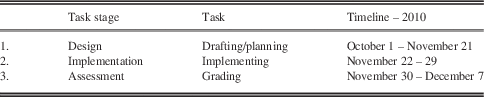
As can be seen in Table 1, stage 1 (Design) involved the drafting and planning of the tasks. In this collaborative task, Joshua and the STs jointly designed technology-based reading and writing tasks for Joshua’s EFL learners. Joshua provided input and mediated each group’s task design throughout the telecollaboration.
Task stages and timeline

In stage 2 (Implementation), Joshua implemented the STs’ tasks in his EFL classes in China. Lastly, in stage 3 (Assessment), the EFL learners’ performance on the tasks were graded separately by both the STs and Joshua.
Prior to the Design stage, the 20 STs divided up into six groups and designed the following tasks for the EFL learners:
Group 1: Travel/Lonely Planet (used as replacement for the IKEA task)
Group 2: Campus Neighborhood
Group 3: Statement of Purpose
Group 4: Museum Exhibit
Group 5: Chinese Cooking
Group 6: Statement of Purpose
For example, in the two-phased Travel/Lonely Planet task, learners wrote formal emails to travel agents specifying desired destination and activities for the holidays; travel agents then researched the Lonely Planet travel site and wrote informal blog posts with a detailed itinerary for the client. Here, blogs were added because STs wanted to familiarize the EFL learners with a writing tool other than email. The Campus Neighborhood task (also two-phased), asked learners to write a description of their favorite campus “hot spot” on a blog; each learner posted comments to other blog posts as peer feedback. The Statement of Purpose tasks involved writing a personal statement for graduate school application; however, only learners interested in studying abroad after graduation selected this task since the term “statement of purpose” is not commonly used in the Chinese context. The STs also developed grading rubrics for their tasks to evaluate the EFL learners.
2.4 Data collection and analysis
Data for this study consisted of CMC data (Google Groups, emails) and the two elicitation instruments: the semi-structured interview with Author B and Joshua’s reflective narrative. The CMC data were produced throughout the collaboration in the Fall 2010 term, the semi-structured interview was carried out via Skype on February 25, 2011, and initial questions included the following: What were your reasons for wanting to do something like this? What had you learned in class, and how did you think you would be able to put it into practice? What sort of things that you had learned were on your mind as things to try to implement? The retrospective narrative was conducted on August 13, 2011, in which Joshua reflected on his mediating roles. Prompts for the narrative included a history of his involvement with the project and a description of context and his knowledge of the institution.
In contrast to an etic perspective, which focuses first and foremost on the researcher’s point of view, an emic perspective includes conceptual schemes and categories considered meaningful by participants in the situation being studied – in this case, Joshua and his experiences in the research (e.g., Lett, Reference Lett1987). Because the holistic principle of ethnographic research implies trying to understand the phenomenon under investigation in a contextualized rather than an isolated or disconnected way (van Lier, Reference van Lier1988), Author A and Joshua acted as participant observers (Denzin, Reference Denzin1989) and co-designed the telecollaboration. Participant data was triangulated through different instruments: narrative, interview, and CMC interactions with the STs (e.g., Müller-Hartmann, Reference Müller-Hartmann2012). Additionally, Author B, an American teacher-educator/researcher in Japan, was instrumental in the data collection and analysis to provide the external perspective. More specifically, Author B conducted the interview and provided guiding questions for the narrative.
In line with Nunan and Bailey’s (Reference Nunan and Bailey2009) circular conception of Action Research, Author A identified the multifaceted role of cross-cultural mediators which had been investigated in a previous telecollaboration iteration in the same Classroom Practices course, i.e., in a collaboration between her class and in-service teachers in South Africa and Cyprus in the first half of the same fall semester between September and October 2010. This first iteration was mediated by two teaching assistants (TAs) from South Africa and Cyprus.
This study was the second telecollaborative iteration and took place between the USA and China between October and December 2010. With the assistance of Joshua, Author A problematized the issue of the mediator role by co-designing the telecollaboration around the novice teacher and his instructional context. Next, along with Author B, she identified and assessed the apparent task outcomes by collecting and analyzing Joshua’s reflective narrative and interview. To this end, in our “watching” and “asking/doing” approach, we employed the semi-structured interview and retrospective narrative in which Joshua reflected on his roles and added value to the telecollaboration as the main elicitation instruments (van Lier, Reference van Lier1988: 57). The reason for combining both interview and narrative inquiry was based on a previous telecollaborative iteration carried out by Authors A and B, in which two TAs mentioned that the narrative and the interview process gave them greater insight into the breadth of their own mediating roles in the project than they had previously realized (Fuchs, Snyder, Bishop & Charalambous, Reference Fuchs, Snyder, Bishop and Charalambous2012). Finally, Authors A and B reflected and theorized on the effects Joshua’s knowledge might have had on the outcomes of the task design. Author B had access to the previously gathered CMC data, and an understanding of the overall goals of the project, and used these to shape a semi-structured interview that focused on Joshua’s role in the project, in particular how his multiple roles across contexts helped him in the implementation of the tasks. The post-hoc narrative helped us to account for Joshua as an exemplary of “storytelling organisms,” i.e., a character in his own and other’s stories (Connelly & Clandinin, Reference Connelly and Clandinin1990: 2).
To analyze the interview and narrative data, Authors A and B developed codes and categories as they emerged from the data without initially trying to force them into categories in the existing literature. Not applying such “borrowed concepts” to one’s data is important so as not to impede developing one’s own categories (Strauss & Corbin, Reference Strauss and Corbin1998: 115). First, the coders performed open coding (i.e., line-by-line or applied to sentences, paragraphs, or the entire answers) and then categorized the codes by grouping them around themes in the data (Braun & Clarke, Reference Braun and Clarke2006) that were related to:
-
1. Instances in which Joshua acted consciously on his different types of knowledge (e.g., information on instructional context, stressing technological constraints) in order to mediate the task design
-
2. Instances in which Joshua reflected on his roles in the process of mediating task design in the telecollaboration (e.g., shifting role throughout the project).
The overall goal of coding in qualitative inquiry can be described as breaking down and understanding texts, developing categories (i.e., concepts representing phenomena), and putting them into an order over the course of time.
In this study, Authors A and B isolated theme-related in vivo codes (Strauss & Corbin, Reference Strauss and Corbin1998) taken from Joshua and grouped them into categories (e.g., Harry, Sturges & Klingner, Reference Harry, Sturges and Klingner2005; Lewins & Silver, Reference Lewins and Silver2007; see also Saldaña, Reference Saldaña2009). For instance, language teacher, field observer, facilitator, and mediator were grouped under the category Multiple Roles of Mediator (“my unique position as the language teacher and the field observer,” “During and after the task, I took on the added role of a facilitator and mediator,” Narrative, italics added). Lastly, the researchers related their themes back to the professional capital elements in the developmental cycle (Figure 1). All names are pseudonyms. Data are cited verbatim.
3 Findings and discussion
3.1 The mediator’s use of different types of knowledge during task stages
In order to explore research question 1 (How did Joshua use different types of knowledge to mediate the task design?), this section looks at the novice teacher’s use of different types of knowledge in the different task stages.
3.1.1 Design stage: Setting up the USA-China telecollaboration and initial task negotiation
In preparation for designing tasks to be completed by Joshua’s learners in China, STs in the USA interacted with him through the course’s Google Groups, occasionally mediated by Author A, who would relay email to Joshua when access to Google Groups was unavailable. Other groups emailed Joshua directly through personal email accounts because one of the American sections had difficulties accessing Google Groups. The purpose of these discussions was to allow the STs to ask questions, and for Joshua to provide information that he deemed necessary in order for the STs to design tasks which could be successfully implemented in his Chinese institutional context. According to Joshua, “in our project, the telecollaboration was in the task designing, not the implementation” (Interview); in other words, in this phase the STs were not directly interacting with the EFL learners in China but with Joshua. This set-up was preferable because of his institutional constraints – large class sizes and technical limitations such as lack of access to Google.
Instructional-contextual knowledge
Joshua’s responses not only addressed task design but also provided the STs with information on the instructional context (institutional and national constraints that he felt the STs could not be fully aware of) and insights into the student population that he worked with, sometimes including his own perspectives on what he thought was pedagogically appropriate, including his own time limits:
1. One project per class, and each class has eighteen – nineteen students. 2. I can devote two weeks of class time (two 45-minute periods per week) plus homework assignment. (Email, October 25)
Regarding the classrooms Joshua worked in, he clarified that while Internet access was unavailable, he and his students would have access to a computer, and a PowerPoint presentation could be incorporated in task designs. However, there were other technological limitations that had to be considered:
There are no copying machines for teachers to use, so I will need to print out a copy of the student instructions to give to each class monitor (class president) to make copies for everyone. (email, November 24)
Other information provided by Joshua regarding contextual constraints was more routine, such as the weekly schedule (from Wednesday to Tuesday) and the timing of midterms to facilitate the STs in their planning.
Pedagogical knowledge
When negotiating the actual task design, one of the groups asked Joshua if they could design a task that would have students write a statement of purpose, employ peer review, and get feedback from the designers in the USA. Joshua suggested that while the topic was good for those students who might consider studying abroad after graduation, the task designers would have to think about how to make the task “interesting and relevant” for “those not going abroad.”
Additionally, Joshua informed them that, while peer review/correction was not commonly used in China, it would be good practice and should be included in the task: “Peer review won’t be a problem. In fact, it’ll be a good exercise for them to try” (Email to Author A, October 7). He further pointed out that rather than having learners do the peer review during a class session, the STs’ tasks should allow students to do the peer review online, outside of class hours, so that the STs could have easy access for grading and evaluation.
Technical knowledge
Joshua provided the STs with unprompted information about technological constraints on task design arising from his context. He wrote via Author A about the blocking of popular Internet-based sites in China, advising against the use of these in task designs:
YouTube and popular social networking sites like Facebook are all blocked. Even though many of my students are software majors, and probably have ways around the firewall, I wouldn’t want to make these sites as part of the task. (Email to Author A, October 7)
Moreover, Joshua proactively established an account on an equivalent China-based blogging site to allow the use of an activity, advising that it was easy to use and that students would find it more accessible than the alternative outside China:
I think blogger.com is blocked or partially blocked, but there’s a Chinese version for China. I went through the signup process tonight, and it’s a cinch. (Email to all STs, October 20)
Additionally, Joshua was certain that his learners would be able to work constructively with blogs:
They’re also familiar with blogs (although not necessarily with Blogger or specific blog sites you have in mind), so they’d be able to focus on producing the content rather than struggling with the technology medium. (Email, November 2)
Joshua also pointed to potential authorship/ownership issues with regard to editing after the STs had assigned the same log-ins for his students. This prompted him to suggest creating new accounts for the last learner group:
Correct me if I’m wrong, but my understanding is that everyone uses the same account to log in to post their [blog] entries. This means everyone has the account owner rights and potentially can edit or delete entries by others. This may or may not be an issue, but it’s just something I noticed. [...] Lastly, should the second group (Class 2B) use the same account for their posts, or should we create a new account for them? (Email to Group 1, November 30).
Filtering knowledge
Joshua had been instrumental in co-designing the telecollaboration with Author A and the task guidelines for the STs based on her course requirements, which enabled the STs to engage in mediated task design for a real-world EFL context. The decision-making process on Joshua’s end was two-phased: first, he introduced initial task ideas to his EFL learners for feedback. This phase served as a filter to ensure relevance for students. Second, he negotiated the design with the STs prior to implementing them. Regarding the effects of Joshua’s contextual knowledge on the designing process, Joshua mediated the STs’ task design by providing specific feedback to them, such as which websites were accessible and which were blocked by the firewall.
3.1.2 Implementation stage: Appropriating the tasks for the Chinese EFL context
During the Implementation stage, Joshua started out providing instructional-procedural, technical, and linguistic input for the STs after they had received guidelines for the tasks from Author A based on her course requirements. He refers to himself as “assessor” in assessing task feasibility, and then as mediator in negotiating the tasks with the STs before implementing them:
The assessments were provided to the [American] student teachers through [Author A] by email, with a period of direct Q&A email exchanges that followed to clarify the details. Task feasibilities were explored by the STs with inputs from [Author A, two TAs], and myself. Once the curriculum design was completed by the [STs] and the lesson plans submitted for implementation, my role shifted from assessor and mediator to implementer and field observer as I provided immediate feedback to [the STs] for task evaluation. (Narrative)
Instructional-procedural knowledge
Joshua appropriated the tasks in a way that was most relevant for his learners. As a result, the STs were able to learn more about constraints and affordances of an institutional context abroad (e.g., partial blocking of Blogger, irrelevance of descriptive writing genre for Telecommunications majors in the IKEA task). Mediation between Joshua and the STs also fulfilled the telecollaborative principles of reciprocity and interacting with an authentic audience (Egbert & Hanson-Smith, Reference Egbert and Hanson-Smith2007). For example, he recommended the following for Group 1:
For Session 2 – Activity 3, perhaps a list of possible situations of when students might apply business letter writing skills should be provided for [Teacher]” (Email to Group 1, November 24).
Furthermore, he edited task instructions to avoid any potential confusion: “Also, it wasn’t clear which section they should post in (diary, comments, etc.), so I created an intro remark in the comments section for them” (Email to Group 1, November 30). Some of his mediation had to do with methodological issues that needed to be clarified due to the online/blended nature of the collaboration. By the same token, he had to culturally appropriate the tasks by ensuring relevance for his students (as in the Statement of Purpose task, for instance).
Filtering knowledge
Despite Joshua’s initial filtering of tasks based on his learners’ feedback, some tasks were received with more positive reactions than others. Joshua reused the two most successful tasks (Group 1’s Travel/Lonely Planet, Group 2’s Campus Neighborhood) the subsequent semester. Joshua labeled only one out of six tasks, the IKEA task, as being “unsuccessful.” He felt that the topic of furniture and descriptive writing in marketing were unappealing for IT/Telecommunications majors in China; furthermore, the polldaddy site was more difficult to use than anticipated. Consequently, he decided to replace the IKEA task midway through the Implementation stage with Group 1’s Travel task. This example illustrates the reciprocity of social capital since Joshua would have not generated the same tasks by himself nor would he have been able to make an informed decision on which ones to reuse and appropriate had he not reflected on the task implementation and outcome based on his learners’ feedback.
In his role as mediator, Joshua used his human capital in the form of the specific knowledge of both institutions involved – not only to operate in each but also to link them. His mediation of the STs enabled both sides to draw on their decisional capital to maximize task outcomes. More specifically, he exercised his “judgments and decisions with collective responsibility, openness to feedback, and willing transparency” (Hargreaves & Fullan, Reference Hargreaves and Fullan2012: 5) when deciding to appropriate tasks for his context and to recycle the ones he deemed successful while discarding the others. In his feedback for the STs, he provided a rationale for operational success or failure in the Implementation stage.
3.1.3 Assessment stage: Evaluating EFL learner performance
In this stage, Joshua’s assessor role was twofold in that he evaluated both the STs’ tasks for further use and his EFL learners’ final products for grading.
Instructional-procedural knowledge
Joshua first presented the task ideas to his students for feedback and then made recommendations to the STs on the feasibility of the tasks. He then gave instructional design feedback to each group based on the experience of teaching their task and its success or failure:
Today’s project launch was much smoother for the following reasons: [...]
-
∙ The lesson plan was well thought out and easy to follow without needing any modification.
-
∙ I was better prepared and more familiar with the lesson plan.
-
∙ Each handout was made into a PowerPoint slide for a clearer presentation.
In-class activities:
-
∙ Warm up went well. Students shared their travel experiences from last summer (ranging from a spiritual journey in Tibet to a shopping spree in Hong Kong).
-
∙ Activity 1 well received. The contest winning letter to introduce the project was a nice hook. (Email to Group 1, November 24)
Institutional knowledge
The STs graded Joshua’s students based on a rubric they had generated for their task, and Joshua separately graded his EFL learners. According to Joshua, in their informal feedback for him on the STs’ tasks, the
EFL learners felt flattered that STs at an Ivy League school were not only designing tasks especially for them but that they were also grading them on their performance. (Interview)
He also explicitly stated this in his message to Group 1 in the Assessment stage:
Class 5B met this morning, and everyone was excited when they heard all their letters were forwarded to [city of US graduate institution] to be graded by teachers at [the US graduate institution].Footnote 2 Your PowerPoint slides were quite helpful for summarizing the issues they needed to work on. (Email to Group 1, November 30)
In the end, Joshua had the final say in grading but he gave his students both sets of feedback.
3.2 The mediator’s perception of his roles in the telecollaboration
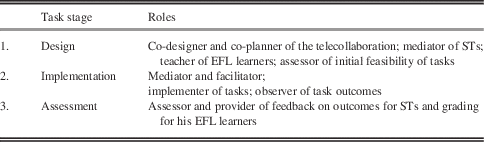
Regarding research question 2 (How did Joshua perceive his multiple roles in the telecollaboration?), Table 2 shows the roles that Joshua self-ascribed for the three different stages – Design, Implementation, and Assessment. His reflections on his own learning and self-assigned roles will be presented below.
Mediator roles during task stages

Note: Based on Joshua, Narrative, August 13, 2011.
According to Table 2, Joshua distinguished his roles in the different phases of the three stages in that he felt a shift across them, with Implementation separating stages where he played the role of assessor and mediator for the STs in different ways. This section looks in more detail at how he perceived his role in each stage.
3.2.1 Co-Designer
In the Design stage, Joshua began by linking the participating institutions. He was further instrumental in co-designing the telecollaboration and the curriculum with Author A. Early specification for his class included his learners’ proficiency levels (from intermediate to advanced, with the majority in the advanced-intermediate category for speaking and advanced for reading and writing skills) and information on technical constraints. Since his learners did not have Internet access in the classroom, those tasks would have to be assigned as homework. According to Joshua’s institutional knowledge, freshmen were not allowed computers in their dorm rooms, but they had access in the libraries and Internet cafés. Moreover, Joshua stipulated a minimum of one week for implementing the tasks.
He felt that his “first-hand knowledge of the institution and assessment of the EFL learners” provided information that “underscored the authenticity of the task and audience for the [STs] throughout the brainstorming and curriculum designing processes.” More specifically, Joshua made his human capital explicit when providing contextual background in his Narrative including these items: learner profiles (“freshmen in the International College with undeclared majors”), their language proficiency (“intermediate to low-advanced levels”), academic interest (“two-thirds in telecommunication/IT and one-third in English, with about 10–20% interested in pursuing graduate studies abroad”), his course name (“Intercultural Communication”), course goal (“improving language & cultural knowledge to interact with Westerners”), classroom setting (“availability of computer projector and PowerPoint”), and Internet access (“the lack of connectivity in the classrooms and student dormitories”). Gradually, the role of Joshua shifted to that of facilitator/mediator, which was due to his knowledge of both the American and the Chinese contexts.
3.2.2 Facilitator and mediator
In the Implementation stage, Joshua administered the tasks and observed the outcomes. In this phase, Joshua described his role as facilitator and mediator with regard to grading his EFL learners’ task performance:
During and after the task, I took on the added role of a facilitator and mediator similar to the [American TAs] while I engaged in direct communication with the [STs] regarding learners’ performance review. (Narrative)
He mediated the STs in their task design for his EFL learners by setting the parameters for the tasks (for example, Google tools such as Blogger would be undesirable because of the firewall in China), and responding to each draft. Joshua presented the task topics and ideas to his learners for feedback, and then, based on their input, he made recommendations to the STs regarding the feasibility of the tasks. In other words, the decisional dimension happened in two phases, first with the EFL learners, then with the STs.
3.2.3 Assessor
Lastly, in the Assessment stage, Joshua acted as assessor in providing feedback for the STs and his EFL learners on the final task outcomes. When asked about how much of his ability to provide feedback to the STs was a function of having taken the telecollaboration class before, rather than one of shared American culture, Joshua replied:
I believe both played a role, shared culture and certainly as [U.S. graduate school] students. […] I respected and accepted the [STs’] grading, but in some cases I modifed as needed based on the students’ overal progress throughout the semester up to that point. […] In fact, I believe the [U.S. graduate school] culture actually played a larger role, since many of the [U.S. graduate school] students were international students. (Interview)
In his reflections, Joshua emphasized his “unique position” in this collaboration, which provided “direct supervision and active participation” for the American institution:
China […] added a new dimension to the relational roles of the study participants primarily due to my unique position as the language teacher and the field observer, which enabled [the STs] to have direct supervision and active participation in the end-to-end process. (Narrative)
More specifically, Joshua offered suggestions and feedback to the STs throughout the task design process, and perceived himself as the mediator throughout the process – except for the grading, where the STs used their own rubric and provided direct feedback and grades to Joshua’s students.
In terms of Joshua’s own learners, his bicultural identity gave him a unique status with his students as both a “foreign teacher” (or “cultural worker” – Breen, Reference Breen2006) and “one of them,” which helped him better guide his learners. He felt ESL learners had an advantage over EFL learners because of “the authentic task opportunities” presented in their daily lives, and he viewed telecollaboration as a way of providing access to “authentic tasks and audience, which was hard to come by” for his EFL students in China:
The foreign teacher plays a crucial role in providing the necessary scaffold before the tasks, and in guiding the students during the tasks. […] The local teachers lack the cultural knowledge needed for these tasks. […] EFL learners, especially in China, are conditioned to learn for exams, not for practical use […] Foreign teachers are crucial in providing the culturally authentic task experience. (Interview)
In brief, Joshua saw his intermediary roles as necessary to the success of the telecollaboration.
4 Conclusion and implications
In sum, Joshua’s previous experience with Author A and her telecollaboration encouraged him to put his knowledge into practice and explore telecollaboration from the instructor’s perspective. This experience enabled him to approach Author A about setting up a new telecollaboration that could take advantage of their international connection (social capital) and to put into practice what he had learned, which suggests that he felt highly committed and prepared to use his capabilities and experience (Hargreaves & Fullan, Reference Hargreaves and Fullan2012). Collaborating with Author A provided a safe environment for him to experiment with this new format.
Joshua was able to manage his institutional, pedagogical, technical, and filtering knowledge and competences effectively. In the Design stage, he acted as co-project designer for Author A, and as mediator for the STs’ task design. Moreover, he was a more experienced technology collaborator to the STs and an indispensable informant about the Chinese cultural and institutional context in decision-making. The ways in which his knowledge and competences allowed him to engage in multiple roles as co-designer, facilitator and mediator, and assessor in the telecollaboration process seem to have had a positive impact on how he viewed his professional development (Breen, Reference Breen2006).
In the Implementation stage, Joshua implemented tasks for his concrete context that could only be designed through the social capital of the telecollaboration; however, the STs had to invent an audience to a certain degree in the absence of specifics regarding the EFL learners’ characteristics. This simulation has raised additional issues such as the difference in the level of familiarity of the target student population with regard to task design and learning outcome, Joshua’s actual learning in terms of task design for his future position, the contribution of this telecollaboration to advancing collegial development (Breen, Reference Breen2006), the levels of task reflection displayed (Raith & Hegelheimer, Reference Raith and Hegelheimer2010), and the added value of including the mediator for the STs.
With regard to the Assessment stage, there were different levels of feedback, with the main focus on Joshua’s input on and assessment after implementing the STs’ tasks and recycling the ones he considered the most appropriate or successful. By the same token, Joshua and the STs separately graded the EFL students’ task performance (with Joshua deciding on the final grades). Thus one would also need to look at the actual task outcomes to see what made some tasks more successful than others (i.e., the actual implementation in Joshua’s classroom – “task as process”; Breen, Reference Breen1987) and the task assessments by Joshua and the STs (i.e., whether grades diverged given the different level of familiarity with the instructional context and the EFL learners). It also remains unclear what exactly the EFL learners thought of or learned through the tasks other than what Joshua relayed in the interview and narrative.
Finally, it is not clear that Joshua’s previous training in telecollaborative processes, which allowed him to facilitate the telecollaboration at each of the three stages, would be sufficient to carry out a mediating role effectively. Just as there is a need for learner training in any aspect of the use of educational technology (Hubbard, Reference Hubbard2004), it is likely that dedicated training will produce more effective mediators. Nonetheless, the exact nature of what this training might be is yet to be explored, especially since human capital needs to be complemented by social capital in order to be distributed. In other words, an individual mediator’s capital may not be sufficient for a complex undertaking such as telecollaboration (Hargreaves & Fullan, Reference Hargreaves and Fullan2012).
With regard to how Joshua perceived his role as mediator, he felt that his ability to provide feedback in advance based on proper assessment of learner competency and interest contributed to the success of the task designing process. When his role shifted from assessor and mediator to implementer and field observer, Joshua was then able to adjust tasks as needed during the implementation without having to confer with the STs. Joshua’s critical assessment of his roles in both institutional contexts points to an enhanced reflectivity with regard to his growth and development as a teacher.
Acknowledgements
We wish to thank all participants in this telecollaboration. Additionally, we are grateful to Mirjam Hauck, Senem Yildiz, and two anonymous reviewers for their invaluable feedback on previous drafts, and we are indebted to René Groth for the visual representation.