1 Introduction
An awareness of the importance of reading for successful language learning has inspired extensive research on understanding the complex processes involved in reading. Considerable attention has been paid to the strategies that L1 and L2 skilled readers use and under what circumstances they use them (Block, Reference Block1992; Kern, Reference Kern1989; Mokhtari, Reichard & Sheorey, Reference Mokhtari, Reichard and Sheorey2008). This line of research is particularly useful for L2 readers because their development of effective reading strategies will contribute to better reading comprehension and language learning (Sheorey & Mokhtari, Reference Sheorey and Mokhtari2001). L2 reading literature has generated a number of paper-reading strategies to help students read more efficiently (Pressley & Afflerbach, Reference Pressley and Afflerbach1995; Sheorey & Mokhtari, Reference Sheorey and Mokhtari2001). As technology has advanced, however, the concept of text has changed from paper to multimodal reading experiences, such as pictures, audio, and video (Larson, Reference Larson2009; Leu, Kinzer, Coiro & Cammack, Reference Leu, Kinzer, Coiro and Cammack2004). These developments have transformed our literacy practice and pedagogy (Coiro & Dobler, Reference Coiro and Dobler2007; Warschauer, Grant, Del Read & Rousseau, Reference Warschauer, Grant, Del Read and Rousseau2004). The need for more studies on L2 online reading strategies (Chang, Reference Chang2005; Huang, Reference Huang2006; Park & Kim, Reference Park and Kim2011) and for EFL teachers to use web-based reading instruction effectively (Singhal, Reference Singhal2004; Yang, Reference Yang2010) has therefore become urgent. To meet the demands of these new literacies on EFL learners in Taiwan, teachers need to have sufficient knowledge of computer-assisted reading and its underlying pedagogical issues to be able to teach strategies to maximum effect in the reading class.
The purposes of this study are twofold. The first purpose is to integrate L2 reading theories into the design of a web-based reading strategy training program. The second purpose is to investigate students’ use of this computer-assisted reading strategy program and to examine teachers’ and students’ perceptions of it. Understanding the weaknesses and strengths of this program from both teachers’ and students’ perspectives will improve future online reading program design. In addition, the results of strategy instruction will enable teachers to focus on training their students to use effective strategies to develop fluency in the target language. This study poses four major research questions:
1. What are college EFL teachers’ perceptions of this program's reading strategy function keys, interface design, and learning effects?
2. What are students’ perceptions of this program's reading strategy function keys, interface design, and learning effects?
3. What are the differences between teachers’ and students’ perceptions of this program's strengths and weaknesses and their suggestions for its improvement?
4. Which strategies do students use most often, and how does this strategy use compare with their reported perceptions?
2 Literature review
2.1 How technology facilitates Grabe's six essential L2 reading skills
Grabe (Reference Grabe1991: 379) identified six component skills essential to reading fluency among L2 readers, and modern technology can facilitate their acquisition (Butler-Pascoe & Wiburg, Reference Butler-Pascoe and Wiburg2003).
First, essential automatic perceptual/identification skills can be strengthened through automatic access to lexical items and speed reading lessons (Grabe & Stoller, Reference Grabe and Stoller2002). Speed reading monitoring and acoustic forms of texts provided by text-to-speech software can raise readers’ phonemic awareness and make input more comprehensible (Chen, 2004, Reference Chen2011; Chun, Reference Chun2001). Second, multimedia glosses enhance vocabulary knowledge and structure knowledge (Mohsen & Balakumar, Reference Mohsen and Balakumar2011), with visual annotations often preferred to text and video (Chun & Plass, Reference Chun and Plass1996), and easily accessible online grammar resources, such as the Guide to Grammar and Writing (http://grammar.ccc.commnet.edu/grammar/), can help learners understand language structures. Third, readers can enhance what Grabe (Reference Grabe1991) describes as understanding of the structure of formal discourse by drawing semantic maps to visualize their thoughts (Lin & Chen, Reference Lin and Chen2007). Computer-assisted concept mapping, with its flexible approach to organizing texts in a hierarchical order, facilitates comprehension, especially for lower level EFL college students (Liu, Chen & Chang, Reference Liu, Chen and Chang2010). Fourth, research has shown that activating readers’ prior knowledge and their awareness of the content's cultural aspects can result in better reading comprehension (Koda, Reference Koda2005); technology helps students improve what Grabe (Reference Grabe1991) describes as essential content and world background knowledge by reading online articles about their own culture and exchanging their cultural views online with speakers of the target culture (Liaw, Reference Liaw2006). Fifth, hypermedia provide an ideal environment for developing what Grabe (Reference Grabe1991) describes as synthesis and evaluation skills because readers need to critically evaluate and sift through a labyrinth of hyperlinks to make sense of the text (Leu et al.; Coiro & Dobler, Reference Coiro and Dobler2007). Sixth, modern technology facilitates the development of what Grabe (Reference Grabe1991) describes as metacognitive knowledge and skills monitoring by enabling readers to easily monitor their reading speed and comprehension progress through an educational software database (Bickel & Truscello, Reference Bickel and Truscello1996).
2.2 Second language reading strategies and web-based reading programs
Several recent L2 studies have focused on measuring the use of metacognitive strategies among L2 readers with the Metacognitive Awareness of Reading Strategy Inventories (MARSI) (Mokhtari & Sheorey, Reference Mokhtari and Sheorey2002) and its ESL adapted version, the Survey of Reading Strategies (Mokhtari & Reichard, Reference Mokhtari and Reichard2002). These two inventories present three types of reading strategies: global, problem-solving, and support strategies. Global strategies are intentional; learners carefully plan them to monitor their reading. Such strategies include having a purpose in mind, previewing the text, checking how the text's content fits its purpose, noting the text's length and organization, and predicting or guessing its meaning. Problem-solving strategies relate to how readers deal with difficult texts directly, such as guessing the meaning of unknown words, adjusting one's reading rate, visualizing the information, resolving conflicting information, and rereading the text to improve comprehension. Support strategies are localized actions readers take to aid comprehension, such as highlighting, checking dictionaries, taking notes, or translating from one's mother tongue to the target language. These three strategy types, plus the addition of socio-affective strategies described by O'Malley & Chamot (Reference O'Malley and Chamot1990), formed the basis for this study's design of the reading strategy website.
Several web-based reading programs inspired and influenced this website's design (Cobb, Reference Cobb2006; Chen, 2004; Sun, Reference Sun2003; Yang, Reference Yang2010). In Chen's (2004) Technology-Enhanced Self-Access Reading Program and Sun's (2003) Extensive Reading Online Center (ERO), mechanisms to assist reading included online dictionaries, text-to-speech technologies, translation services, prediction prompts, skimming training, and summary writing. Yang (Reference Yang2010) designed an online remedial reading program with reciprocal teaching strategies. A dialogue box asked students what they thought might happen next (predicting); a chat room enabled clarification of new words or concepts (clarifying); a discussion forum allowed students to post questions and receive answers from teachers and peers (questioning); and an annotation tool enabled students to take notes and archive keywords and sentences for composing a summary (summarizing). Cobb (Reference Cobb2006) developed the research-based Compleat Lexical Tutor (http://www.lextutor.ca/hypertext), a resource-assisted reading tutor that integrated text-to-speech, concordances, and learner dictionaries. Teachers and learners input articles that interested them and generated a full resource hypertext. They could click once on any word or phrase to access pronunciation; click twice for concordances and collocations; and click on a concordance line's keyword for a more contextual usage. Links in the concordances made multiple language dictionaries available. Students could ask for dictations and quizzes on words and phrases they selected.
These reading strategy programs and their multiple reading aids have served as models for the design of this study's web-based reading program, English Reading Online.
3 Research methodology
This study was conducted in two phases: (1) the design of a technology-enhanced reading strategy program; and (2) the implementation of this reading program and the analysis of students’ use of its functions and of EFL teachers’ and students’ views of the program.
3.1 The design of a technology-enhanced reading strategy program
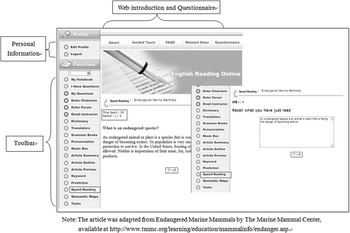
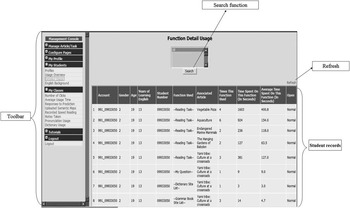
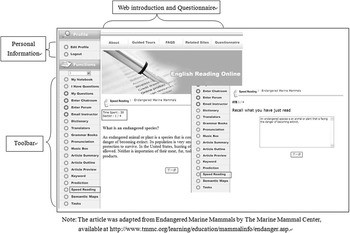
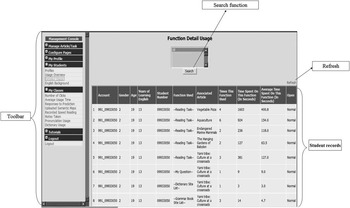
The technology-enhanced reading strategy training site, English Reading Online, includes a student interface (available at http://eng.iem.sju.edu.tw, see Figure 1) and a teacher interface (http://eng.iem.sju.edu.tw/admin, see Figure 2). The student interface has 15 clickable strategy function keys grouped under four strategy types (Global, Problem-solving, Support, and Socio-affective); each function key represents a particular strategy that teachers can use to train students in an online reading environment. As for the teacher interface, teachers can track students’ reading progress in terms of the number of articles read, the number of strategy function keys accessed, the time spent reading each article, and the time spent using each function. This program has been developed and improved from Huang's (2006) and Huang, Chern and Lin's (Reference Huang, Chern and Lin2009) earlier reading strategy programFootnote 1. This new program enables registered teachers to input their own lessons, whereas the old version could only display the articles chosen by the researcher. This new version has also significantly improved the supportive reading aids and made the interfaces more interactive.
A screenshot of English Reading Online's student interface.
A screenshot of English Reading Online's teacher interface.
The Global strategy buttons deal with four intentional reading techniques: Keyword, Preview, Prediction, and Outline. Keyword lists provide both Chinese and English definitions and examples; Preview gives an overview of the text to arouse the reader's interest; Prediction prompts students to predict the text's conclusions or outcomes on the basis of pictures or video clips in the text; and Outline presents a hyperlinked outline to show the text's organization.
The Problem-solving strategy buttons offer four strategies for navigating the text: Summary, Pronunciation, Speed Reading, and Semantic Mapping. Summary allows students to read a shorter version of the text using the Automatic Text Summarizer (http://swesum.nada.kth.se/index-eng.html), and Pronunciation reads the text aloud through the Microsoft Speech Recognition Engine (http://www.msagentring.org/setup.aspx). Speed reading shows the text in chunks and calculates the time spent reading each chunk; students have the option of writing what they remember before they are led to the next chunk. Semantic Mapping allows students to visualize information from the text by drawing online semantic maps using Text2mindmap (http://www.text2mindmap.com/).
The five Support strategy buttons offer basic support mechanisms: Dictionary, Grammar, Translation, Highlighting, and Notebook. Dictionary provides online bilingual (i.e., Yahoo dictionary at http://tw.dictionary.yahoo.com/) and monolingual dictionaries (i.e., Cambridge Online Dictionary (http://dictionary.cambridge.org/); Grammar provides a link to Guide to Grammar and Writing (http://www.ccc.commnet.edu/grammar/); and Translation accesses Altavista (http://babelfish.altavista.com) for translations to the mother tongue or vice versa. Highlighting enables students to annotate the text's vocabulary, grammar, or problematic sections; these notes are automatically archived and available when students click the Notebook strategy button.
The fourth strategy group, Socio-affective strategies, provides a Music Box and My Questions. The Music Box offers lists of online radio or music programs for students to listen along to as they read, and the My Questions button incorporates mechanisms for discussion boards, chat rooms, and email so that students can interact with their peers or teachers when they have questions about the text.
3.2 Evaluative studies: What teachers think and what students do
The evaluation studies were carried out in two stages. First, the researcher invited 40 in-service teachers in Taiwan to experience this online reading platform and to give feedback. Forty in-service teachers were recruited from a teacher training workshop offered by the researcher. They all had TESOL backgrounds with three to fifteen years of teaching experience. During this one-day workshop, the researcher familiarized teachers with the program by first demonstrating each strategy function and then allowing plenty of time for hands-on practice. The teachers then filled out a post-task survey that included written reflections on the program's design.
The 24-item, five-point Likert scale survey asked for feedback on the fifteen strategy buttons, the program's web-based features, and its interface and learning effects. It also asked open-ended questions about which strategy functions they preferred and why, their views of the program's strengths and weaknesses, and their suggestions for future technology integration in their EFL classrooms.
As for the evaluative study of the students, 32 participants were drawn from a freshman English class at a national university in Taiwan. They had all studied English for at least six years prior to this experiment; their proficiency level was intermediate. The students were aquaculture or food science majors. Prior to the experiment, students took a sample TOEIC test to identify their reading proficiency. Students received an average score of 259 out of a maximum possible score of 495 (Mean = 258.91, SD = 64.84). The experiment was conducted during regular once-a-week, two-hour class meetings for six weeks. At the first meeting, the researcher as instructor demonstrated the reading strategy functions and encouraged students to try them out. Students could decide, however, whether or not to use these reading aids in the following weeks. During the second to fifth weeks, students read one article per week, starting from the easiest to the most difficult, each with an average of 1060 words and a Flesh-Kincaid 11.3 grade level. The topics were local aboriginal cultures, ancient history, endangered marine mammals, and business and industry. In each reading session, students could use any or all of the program's strategy functions to assist their reading. When they finished the article, they wrote what they recalled of the text to show their understanding of it. The program tracked their use of the strategy functions. In the last week of the experiment, the students took a sample TOEIC test as a post-test to ascertain possible reading proficiency progress. Students filled out the same post-task survey that the in-service teachers had filled out. They also wrote a reflection piece describing which strategy functions they found the most and least useful and why and offering their suggestions for how to improve the program's design.
4 Results
Research Question 1: What are college EFL teachers’ perceptions of this program's reading strategy function keys, interface design, and learning effects?
4.1 Teachers’ perceptions of the program's design, functions, and learning effects
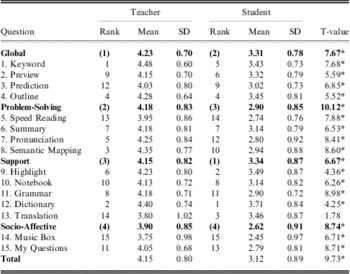
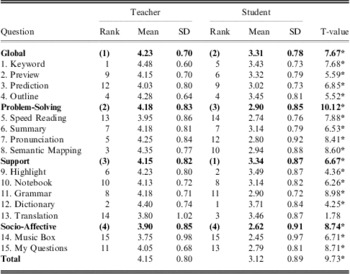
Teachers filled out a post-task survey that solicited their views of the program. Their responses were ranked from Strongly agree (a rating of 5) to Strongly disagree (a rating of 1). Ratings over 3 indicated a favorable response. Table 1 compares teachers’ and students’ feedback on the fifteen strategy buttons. The teachers’ overall assessment of this website's strategy functions was positive (M = 4.15, SD = 0.80). Table 1 shows that teachers favored Keyword (M = 4.48, SD = 0.60), Dictionary (M = 4.40, SD = 0.74), and Semantic Mapping (M = 4.35, SD = 0.77) the most. Their three least favored functions were Music Box (M = 3.75, SD = 0.98), Translation (M = 3.80, SD = 1.02), and Speed reading (M = 3.95, SD = 0.86). In their answers to the open-ended questions, teachers indicated that they gave Keyword a high rating because previewing keywords could help students gain a better understanding of the text. Most teachers felt that the Semantic mapping tool for visualizing texts would prompt students to re-examine their understanding of the content. Teachers’ lower ratings for Music Box were the belief that it would divert students’ attention, and most teachers felt that the Translation function would not facilitate reading comprehension because students should process the text in the new language and not rely on the mother tongue. Teachers also considered the Speed Reading function less useful because they felt that it did not adequately assess comprehension and the counting clock would exert undue pressure.
Teachers’ and students’ feedback on the strategy functions
Note. *p < 0.001
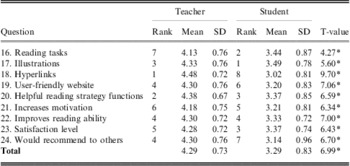
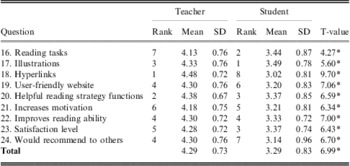
Table 2 shows teachers’ and students’ views of the interface design and learning effects of English Reading Online. Overall, both teachers (M = 4.29, SD = 0.73) and students (M = 3.29, SD = 0.83) gave positive feedback. Teachers valued the hyperlinking feature in this site the most (M = 4.48, SD = 0.72), followed by the strategy functions (M = 4.38, SD = 0.67) and the illustrations (M = 4.33, SD = 0.76). Teachers considered the website user-friendly (M = 4.30, SD = 0.76), capable of improving students’ reading ability (M = 4.30, SD = 0.72), and worth recommending to other teachers (M = 4.30 SD = 0.76). Teachers were satisfied with the site's design (M = 4.28, SD = 0.72), especially its ability to motivate students (M = 4.18, SD = 0.75) and provide reading tasks that improve comprehension (M = 4.13, SD = 0.76).
Teachers’ and students’ perceptions of this program's interface design and learning effects
Note. *p < 0.001
Further statistical analyses were used to determine whether teachers with more or less teaching experience differed in the extent of their appreciation of this program's tools. Results showed teachers with the most experience—more than fifteen years—appreciated this system the most (M = 4.28, SD = 0.38), followed by teachers who had taught 6–10 years (M = 4.15, SD = 0.58), who were followed by those with less than five years’ experience (M = 3.93, SD = 0.57) and those who had taught 11–15 years (M = 3.67, SD = 0.35). That the most experienced teachers appreciated this program more than the others suggests that experienced teachers feel more keenly the need to integrate technology into their traditional classes and that this program can help them realize this goal.
Research Question 2: What are students’ perceptions of this program's reading strategy function keys, interface design, and learning effects?
4.2 Students’ perceptions of the program's design, functions, and learning effects
Table 1 shows that the students also gave the overall design of this website's strategy functions a positive assessment (M = 3.12, SD = 0.89). In contrast to the teachers, however, students favored Support strategies, such as Dictionary (M = 3.71, SD = 0.84), Highlight (M = 3.49, SD = 0.87), and Translation (M = 3.46, SD = 0.87), which are basic mechanisms for sustaining reading. Their three least favored strategy functions were Music Box (M = 2.45, SD = 0.97), Speed Reading (M = 2.74, SD = 0.76), and My Questions (M = 2.79, SD = 0.81). A comparison of the teachers’ and students’ favored strategies reveals that Semantic Mapping, one of the problem-solving strategies, was rated highly by teachers but was considered one of the least useful by students. In contrast, Translation, one of the support reading strategies, was highly appreciated by students but was regarded as less useful by teachers.
An independent-samples t test for teachers and students was conducted to compare their overall evaluation of the 15 strategy functions. The results showed that there was a significant difference between the overall evaluations of teachers (M = 4.15, SD = 0.80) and students (M = 3.12, SD = 0.89) in that teachers valued this site more highly than the students did (t (70) = 9.73; p < 0.001) (see Table 1). It could be interpreted that the teachers’ professional training in TESOL meant that they understood and appreciated the theoretical foundations of this online reading strategy program's design, whereas students who were accustomed to reading for grammar and vocabulary and were not familiar enough with the strategies presented in the training modules needed more time and training before they could fully integrate these functions into their actual reading process.
Like the teachers, the students gave positive feedback on the interface design and the site's learning effects but with somewhat less enthusiasm (see Table 2). Students most appreciated the incorporation of illustrations (M = 3.49, SD = 0.78) and reading tasks (M = 3.44, SD = 0.87) to help their reading comprehension. Comparison of the overall 24-item survey ratings across teachers and students using a one-way ANOVA revealed that teachers’ overall evaluations of this online reading program (M = 4.20, SD = 0.50) were significantly higher than those of students (M = 3.18, SD = 0.40; F (1,70) = 88.27, p < .001).
Research Question 3: What are the differences between teachers’ and students’ perceptions of this program's strengths and weaknesses and their suggestions for its improvement?
4.3 Strengths of English Reading Online
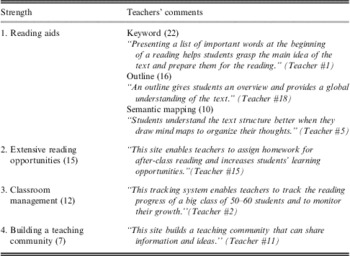
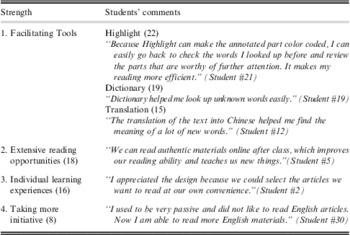
To triangulate the data, an analysis of the teachers’ and students’ written reflections and answers to open-ended questions was conducted to ascertain whether and in what ways teachers and students might have different opinions about the features of this site. Table 3 outlines the teachers’ and Table 4 the students’ evaluations of the program's strengths. Each table summarizes their comments, with the numbers in parentheses indicating how many mentioned that feature. The left column lists the qualities mentioned, and the right column provides examples of typical comments.
Teachers’ comments on this program's strengths

Students’ comments on the site's strengths
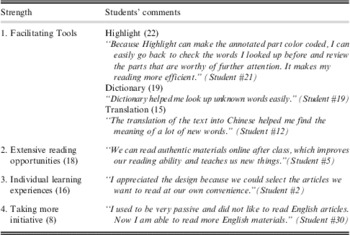
In summary, both groups felt that the program's strengths are that it provides extensive reading opportunities and fosters independent learning. Teachers, however, favored such Global strategies as Keyword and Outline, whereas most students took a more local approach to texts and considered Highlight and Dictionary more useful.
4.4 Weaknesses and suggestions for improvement
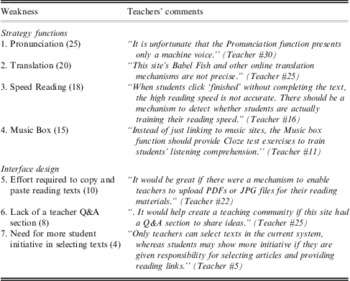
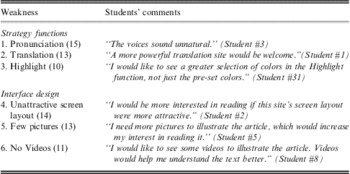
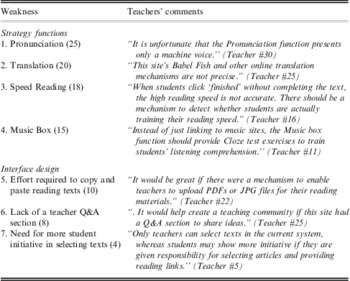
In addition to describing its strengths, teachers (see Table 5) and students (see Table 6) also pointed out some of the program's weaknesses in terms of its strategy functions and interface design.
Teachers’ comments on this program's weaknesses
Students’ comments on the site's weaknesses
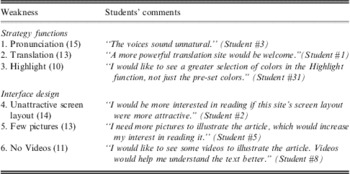
Both teachers and students made suggestions for improving this program's functions. They all desired a more sophisticated Translation mechanism and more human-like voices installed in Pronunciation. The teachers, however, who had years of teaching experience and training in TESOL, focused more on the pedagogical functions of the sites: (1) how to use this site to create more initiatives for students’ learning, as shown by the teachers’ suggestion to allow students to input articles; (2) how to strengthen the links among the site's teachers so that they can share their teaching experience, as shown in the teachers’ suggestion to have a Q&A section; (3) improving the Speed Reading function by ensuring students have comprehended what they read; and (4) creating comprehension exercises in the Music box. Students, on the other hand, were more concerned with issues related to the interface and suggested providing more colors in the Highlight function, making larger fonts available for reading the texts, including more pictures and videos, and designing a more attractive interface.
Research Question 4: Which strategies do students use most often, and how does this strategy use compare with their reported perceptions?
4.5 Students’ actual use of this program
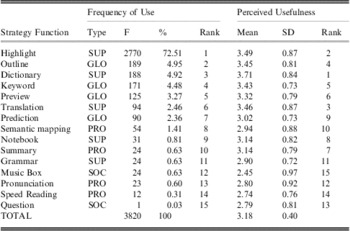
The program's tracking of students’ strategy use revealed that students used the Highlight strategy functions the most (N = 2770), followed by Outline (N = 189) and Dictionary (N = 188) (see Table 7). Highlight was the overwhelming favorite (72.51%). Highlight's popularity might be attributed to its ability to annotate problems that the text presents to its readers, such as new words, perplexing grammar, or points that require further clarification. Unlike the other functions, Highlight has three sub-functions (annotating vocabulary, grammar notes, and questions for discussion), so the number of Highlight uses was exceptionally high. In addition, once students learned how to annotate texts and acquired the habit of using that function, the number of Highlight uses accumulated even more. The heavy use of Highlight echoed students’ positive feedback on this function in the survey results.
The relationship between frequency of strategy use and satisfaction ratings
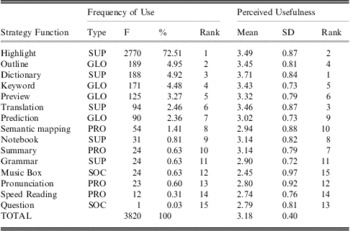
Note. GLO = Global strategies; PRO = Problem-solving strategies; SUP = Support strategies; SOC = Socio-affective strategy
This connection between usage and perception prompted the researcher to further investigate the relationship between students’ perceived usefulness of the strategy function and their actual usage. Indeed, the most frequently used strategies—Highlight (N = 2770), Outline (N = 189), and Dictionary (N = 188)—were also ranked as the second (M = 3.49, SD = 0.87), fourth (M = 3.45, SD = 0.81), and top favorite strategy buttons (M = 3.71, SD = 0.84) respectively by students in the post-task survey. The least used strategies were My Questions (N = 1), Speed Reading (N = 12), and Pronunciation (N = 23). These strategy functions were also regarded as less than satisfactory, with post-task survey ratings all below 3.0. One possible explanation is that within each class meeting, students had to both finish a reading task, while using the relatively unfamiliar strategy functions, and then complete a written recall. Within the span of a two-hour class meeting, students might not have had the chance to explore and use some functions and would therefore have regarded them as less useful.
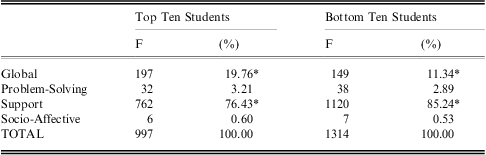
Another focus of this exploration of students’ strategy use was to ascertain whether students with different proficiency levels tended to use different strategy functions. A comparison was made between the ten students with the highest TOEIC scores (M = 331.10, SD = 33.34) and the ten students with the lowest scores (M = 187.40, SD = 27.76). These two groups fell into distinct groups in terms of their TOEIC scores (t (18) = 10.48, p < 0.001). Chi-square analyses showed that the two groups used different strategies (χ2 = 32.5, df = 3, p < 0.001). A further z-test for two proportions (Test of Homogeneity of Proportions) revealed that the percentage of those in the top group using Global strategies (19.76%) was greater than that of the bottom group (11.34%) and that the percentage of those in the bottom group using Support strategies (85.24%) was greater than that of the top group (76.43%) (see Table 8). It appears that the high- proficiency students used such strategies as Keyword, Prediction, and Outline to gain an overall understanding of the texts, whereas the low-proficiency students sought to arrive at the text's meaning by using local strategies, such as Highlight and Dictionary. It is noteworthy that the high group's preference for using Global strategies echoed the teachers’ preference for teaching Global strategies.
Strategy use of top ten and bottom ten students
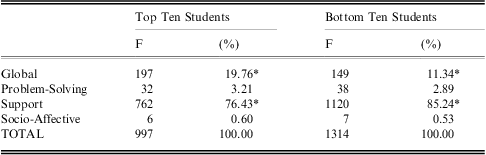
*p < 0.001
Did this strategy program improve students’ reading skills? To evaluate the learning effects of this program, sample TOEIC reading tests were used as pre- and post-tests. An independent-samples t test was conducted to find out whether students’ reading skills had improved after using this online reading strategy program. The results showed that there was a significant difference between the scores of the pre-test (Mean = 258.91, SD = 64.84) and post-test (Mean = 266.81, SD = 64.41; t (31) = −7.98; p < 0.001). Students clearly improved their reading skills after participating in this online reading strategy program.
5 Discussion
5.1 Reading strategy functions and interface design
In their evaluations of the program's reading strategy functions, teachers and students expressed different points of view about which strategies they favored. Teachers considered the Global strategies the most useful. These strategies encourage students to guess meaning from the context and provide background knowledge before students start to read. In contrast, students most favored the Support strategies, among which Dictionary, Highlight, and Translation were the top three favorites. It seems that students’ primary concern was to gain access to support mechanisms that could be quickly and easily employed to aid reading comprehension. The instant L1 equivalents provided by Translation and the L1 word definitions in Dictionary show students’ concern for immediacy in selecting strategies (Leu et al., Reference Leu, Kinzer, Coiro and Cammack2004). As for the exceptionally frequent usage of Highlight, students’ written reflections showed that being able to mark new words, make grammatical notes, and pose questions for clarification has positive effects on learning. Highlight appeared to allow students to focus on the parts they did not understand and to mark parts that could be easily located for further review.
In addition to opposite views on the value of the Translation function, teachers and students also held opposite views of Pronunciation and Semantic Mapping. From the teachers’ perspective, despite its need for more natural voices, the Pronunciation key provides aural input that enhances reading comprehension, a view that is consistent with Chun's (2001) finding that an audio narration of the text is essential to reading comprehension. This view also supports previous studies that the provision of the acoustic form of the text can raise readers’ phonemic awareness and make the text more comprehensible (Chen, 2004). Students, however, were put off by the unnatural voice and did not think highly of Pronunciation.
Semantic Mapping provides another contrast. Teachers gave positive feedback on Semantic Mapping because of its power to visualize information. Teachers believe that when students can organize their thoughts in a hierarchical order, they can monitor their own reading process more effectively and thus improve their reading comprehension. Students, however, found drawing semantic maps both difficult and time-consuming.
There appears to be a gap between what teachers think and what students do, but when we look at the data more closely, we find that the gap does not apply universally. The data comparing high-proficiency with low-proficiency students showed that the high-proficiency group used more Global strategies and fewer Support strategies than the low-proficiency group did. This finding is consistent with previous studies that proficient readers use more Global strategies for overall understanding of the texts (Huang et al., Reference Huang, Chern and Lin2009). The contrast in how the high- and low-proficiency students used the strategy functions leads to the realization that the apparent difference between what teachers think and what students do stems primarily from the lower level students’ over-reliance on local strategies. Teachers’ preference for Global strategies is not different from the high-proficiency students’ tendency to use them. This discovery helps us understand the importance of encouraging students to use more Global strategies for overall understanding rather than merely relying on such local mechanisms as Highlight and Dictionary.
The differences between what teachers want to teach and what students want from their instruction also suggest that careful, step-by-step reading strategy training is needed to overcome the gap where it exists. The results showed that the most frequently used strategies tended to receive students’ most positive feedback, which makes it imperative that students need more time to adapt to a new online strategy training system such as English Reading Online. An explicit demonstration of each function is also needed to ensure that students know how to operate each strategy mechanism and how each strategy use can contribute to their reading comprehension. In addition, teachers need to raise students’ awareness of the rich repertoire of strategies that can facilitate reading. Teachers need to teach students how to monitor their reading, plan their strategies, adjust their reading efforts, and evaluate their ongoing strategies to understand the text (Carrell, Pharis & Liberto, Reference Carrell, Pharis and Liberto1989). Students’ reading comprehension and enjoyment will benefit from this explicit strategy training.
5.2 Comparison of teachers’ and students’ perspectives on this site's strengths and weaknesses and their suggestions for its improvement
Both teachers and students valued this site for its extensive reading opportunities. Students are exposed to authentic reading materials that have been selected by teachers as suitable for individual reading. In this way, they can expand their knowledge on topics not available in textbooks. The authentic materials that this online reading site is able to archive can help L2 readers access information. In Taiwan's typical mandatory Freshman English as a Foreign Language curriculum, class hours are usually limited to two hours per week, so this site can help students and teachers keep in touch with one another outside of class and encourage students’ voluntary reading after class hours. Students can read at their own pace anywhere and at any time with the help of this site's reading aids. Such extensive reading helps to develop learner autonomy and to sustain vocabulary growth (Day & Bamford, Reference Day and Bamford1998).
As for this program's pedagogical implications, teachers appreciated the potential of the site's database management system for monitoring students’ reading progress. Students’ patterns of strategy use can help teachers differentiate instruction for different proficiency levels and strategy preferences (Sheorey & Mokhtari, Reference Sheorey and Mokhtari2001). Teachers’ positive feedback on the strategy functions reinforces the recent emphasis on the need to develop a new set of reading strategies for digital texts (Larson, Reference Larson2009).
Teachers and students made several suggestions for the site's improvement. Both were unhappy with the Pronunciation function's mechanical voice. Incorporating more advanced text-to-speech software with human voices, such as AT&T's software, would improve this function, a suggestion also made by Chen (Reference Chen2011) for his oral skills training site. Teachers recommended developing ways to check comprehension through student recalls in the Speed Reading function; they also suggested setting up comprehension checks in Music Box, which can be achieved through Hot Potato quizzes. The teachers’ suggestion to strengthen the online teaching community by adding a teachers’ Q&A section can be achieved by creating a function for shared experiences and trouble-shooting. The technology for online learning and teaching is evolving quickly, so collaborative dialogues among teachers will sustain teachers’ motivation and their efforts in online teaching (Comas-Quinn, Reference Comas-Quinn2011; Meskill & Sadykova, Reference Meskill and Sadykova2011).
Quite different from the teachers’ focus on pedagogy, students expressed more concern with usability issues, especially on how to make user interfaces easier to use (Nielsen, Reference Nielsen1997). For future improvement, a personal interface with a Highlight function that includes more color options will meet students’ concern. As for students’ comments on adding more pictures and videos to facilitate text comprehension, the future program's design will create a section in the main text to display links to related pictures and videos. The Preview and Prediction functions will also include more pictures and videos related to the text's topic. As technologies evolve, there are greater possibilities for video and image publishing (Godwin-Jones, Reference Godwin-Jones2012), and teachers can take advantage of these new technologies to use videos and images to provide more comprehensible input for L2 readers.
6 Conclusion
In contrast to the traditional EFL classroom, where students have limited exposure to authentic materials, this online reading strategy site offers teachers ready-to-use mechanisms for selecting authentic online texts as course materials, introducing reading strategies that strengthen L2 reading processes, and monitoring students’ reading performance. The differences between what teachers think and what students do can alert teachers and researchers to the importance of incorporating diverse strategies in their program design, of allowing more time for explicit strategy training of students, and of raising students’ awareness of the various strategies that can facilitate reading. As successful as this program was in increasing students’ skills in this six-week experiment, the program will be even more successful after responding to the teachers’ and students’ suggestions, making the appropriate improvements, and providing students with more time and training in the use of the strategies and in understanding the value of using Global strategies. Future studies can further investigate the effect of this reading strategy program on students with different learning styles to ascertain how strategies can be varied to accommodate individual differences.