1. Introduction
The past few decades have witnessed rapid integrations and advances in the field of computer-assisted language learning (CALL) (Colpaert, Reference Colpaert2012, Reference Colpaert2016). Motivated by the possibility of creating rich, multimodal, and engaging CALL learning environments, “an immersive, supportive, constructive and participatory learning environment” (Wang, Chen, Tai & Zhang, Reference Wang, Chen, Tai and Zhang2021: 300) could be established to facilitate foreign language learners’ performance with active learning approaches (Gruba & Hinkelman, Reference Gruba and Hinkelman2012). Blended learning is one of the many active learning approaches that appeared as a result of integrating both online synchronous-asynchronous learning and offline face-to-face (f2f) instruction (Cuesta Medina, Reference Cuesta Medina2018; Spring & Graham, Reference Spring and Graham2017). Blended learning has gained popularity among educational practitioners (e.g. instructors, researchers, administrators, and institutional leaders, etc.) from various disciplines, such as nursing (Smyth, Houghton, Cooney & Casey, Reference Smyth, Houghton, Cooney and Casey2012), engineering (Méndez & González, Reference Méndez and González2010), mathematics (Owston, Sinclair & Wideman, Reference Owston, Sinclair and Wideman2008), and physical therapy (Milanese, Grimmer-Somers, Souvlis, Innes-Walker & Chipchase, Reference Milanese, Grimmer-Somers, Souvlis, Innes-Walker and Chipchase2014). In addition, an emergent body of studies (Gruba & Hinkelman, Reference Gruba and Hinkelman2012; Huang, Reference Huang2019; Wang et al., Reference Wang, Chen, Tai and Zhang2021; Zibin & Altakhaineh, Reference Zibin and Altakhaineh2019) has used blended learning to facilitate language learning and teaching as it supports student-centered learning and enables autonomy (Fresen, Reference Fresen2018; Smyth et al., Reference Smyth, Houghton, Cooney and Casey2012; Turan & Akdag-Cimen, Reference Turan and Akdag-Cimen2020). To obtain a panoramic vision of blended learning, researchers have also realized the importance of synthesizing its advantages and applications (e.g. Cuesta Medina, Reference Cuesta Medina2018; Drysdale, Graham, Spring & Halverson, Reference Drysdale, Graham, Spring and Halverson2013; Fresen, Reference Fresen2018; Spring & Graham, Reference Spring and Graham2017).
In the past decade, several bibliometric studies of blended learning have been conducted. For instance, Fresen (Reference Fresen2018) summarized many of the advantages of blended learning, such as easy access to learning materials, interactive activities, assessment, and the use of communication tools. Likewise, based on the most frequently cited blended learning articles, Spring and Graham (Reference Spring and Graham2017) demonstrated publication patterns and networks of blended learning around the world. Drawing on complex adaptive systems theory, Wang, Han and Yang (Reference Wang, Han and Yang2015) added a comprehensive understanding of blended learning. With the exception of these bibliometric studies on blended learning, relatively little research has focused on providing an overview of blended language learning over the past two decades. To our knowledge, only Grgurović (Reference Grgurović, Chapelle and Sauro2017) has reviewed a small number of blended language learning studies (based on 26 articles), analyzing relatively few dimensions. Thus, it is necessary to conduct a bibliometric analysis that investigates the research trends in blended language learning by expanding the dimensions under analysis.
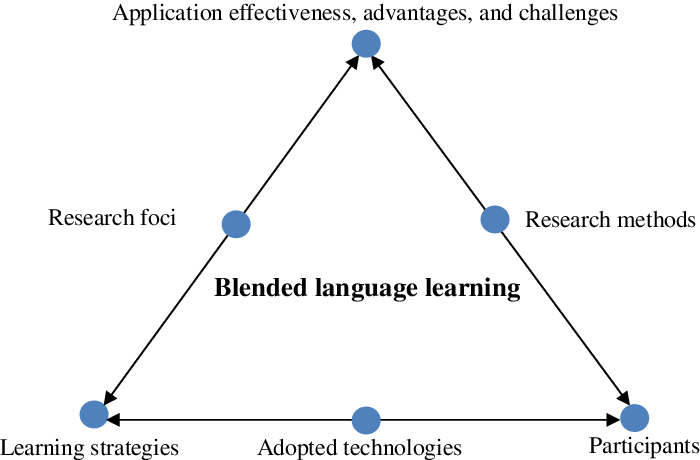
Some existing bibliometric studies (e.g. Chung, Lai & Hwang, Reference Chung, Lai and Hwang2021; Lin & Hwang, Reference Lin and Hwang2019; Turan & Akdag-Cimen, Reference Turan and Akdag-Cimen2020) have indicated that the revised technology-based learning model based on Hsu and colleagues (Reference Hsu, Ho, Tsai, Hwang, Chu, Wang and Chen2012) includes the following six categories: participants, learning strategies, research methods, research foci, adopted technologies, and application issues (Figure 1). Among those categories in the model, participants, strategies, and application issues are core elements, while research foci, research methods, and adopted technologies can be seen as relevant factors (Chung et al., Reference Chung, Lai and Hwang2021). For instance, based on this comprehensive framework, Chung et al. (Reference Chung, Lai and Hwang2021) and Lin and Hwang (Reference Lin and Hwang2019) reviewed research trends of flipped classrooms in nursing and medical education, respectively. Likewise, drawing on the insights from the model, Turan and Akdag-Cimen (Reference Turan and Akdag-Cimen2020) also carried out a systematic review of foreign language flipped classrooms. The revised technology-based learning model was adopted as a framework for the coding in this study for two reasons. On the one hand, the model has been proposed and validated in a number of previous technology-based bibliometric articles, which might also shed some light on this study since blended language learning per se covers the integration of CALL technologies and f2f instruction (Hinkelman, Reference Hinkelman2018). On the other hand, comprehensive components of the model could also provide a holistic picture of blended language learning. As shown in Figure 1, the model includes participants, learning strategies, research methods, research foci, adopted technologies, and application effectiveness, advantages, and challenges (adapted from Lin & Hwang, Reference Lin and Hwang2019).
Revised technology-based learning model for blended language learning

Following the aforementioned model, this study aims to address the following research questions:
-
1. What are the numbers of articles on blended language learning published in the selected journals?
-
2. Who are the participants in the blended language learning articles published in the selected journals?
-
3. What are the learning strategies in the blended language learning articles published in the selected journals?
-
4. What are the research methods in the blended language learning articles published in the selected journals?
-
5. What are the research foci in the blended language learning articles published in the selected journals?
-
6. What are the adopted technologies in the blended language learning articles published in the selected journals?
-
7. What are the application effectiveness, advantages, and challenges in the blended language learning articles published in the selected journals?
2. Methodology
2.1 Data collection
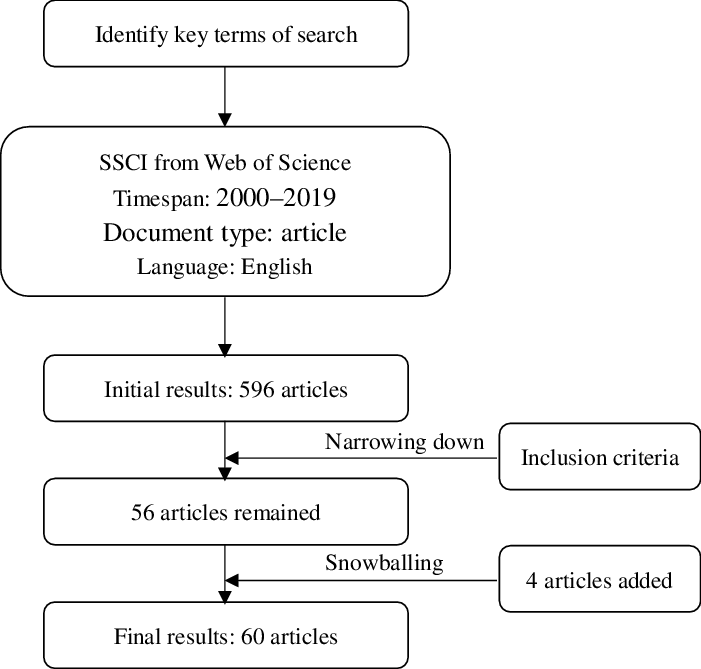
According to existing studies (Duman, Orhon & Gedik, Reference Duman, Orhon and Gedik2015; Hwang & Fu, Reference Hwang and Fu2019; Hwang & Tsai, Reference Hwang and Tsai2011; Xie, Chu, Hwang & Wang, Reference Xie, Chu, Hwang and Wang2019), it is of paramount importance to synthesize articles published in Social Science Citation Index (SSCI) journals, since they were subject to stringent review criteria and had an impact on the field. For instance, Fu and Hwang (Reference Fu and Hwang2018) adopted a Boolean search method to retrieve SSCI-indexed journal articles from the Web of Science data set. As shown in Figure 2, in this study, data from the Web of Science data set were searched as it had been done in some previous studies (e.g. Fresen, Reference Fresen2018; Grgurović, Reference Grgurović, Chapelle and Sauro2017; Spring & Graham, Reference Spring and Graham2017). The following Boolean expressions and truncation of key terms were used: “(((SU=(Education & Education Research OR Linguistics) AND TS=(blend* language learning OR blend* language course* OR blend* class* OR hybrid language learning AND language AND proficien*)))) AND Languages: (English) AND Document types: (Article)”, along with “Timespan=2000-2019 Indexes=SSCI”. First, data in Education & Education Research or Linguistics were included in order to specify the research subjects. Second, truncation and combinations of key terms, such as “blend/blending/blended language learning”, “blend/blending/blended language course/courses”, “blend/blending/blended class/classes/classroom”, “hybrid language learning”, and “language/language proficiency/proficiencies”, were considered. Third, full-length articles written in the English language were included. Data were further restrained to the SSCI index during the 2000–2019 period. As a result of the search, 596 articles were initially collected.
Data search and collection process

To further exclude irrelevant literature, two researchers independently and manually narrowed down the search to cover the articles that were related only to blended language learning based on the following inclusion criteria:
-
1. The literature should involve the use of educational technologies.
-
2. The educational technologies should involve only language learning content, and those from various disciplines, such as social sciences, arts, design, mathematics, and natural sciences, should be excluded.
-
3. The literature should involve the combination of hybrid or blended instructional methods – that is, traditional f2f instruction and online instruction.
By strictly observing the criteria, studies unrelated to blended language learning, such as technology adoption, were excluded, resulting in 56 remaining articles. To avoid excluding relevant literature, a further step using a “snowballing technique” (Biernacki & Waldorf, Reference Biernacki and Waldorf1981) was adopted, resulting in another four related articles being selected. As a result, a total of 60 articles (see supplementary material) on blended language learning formed the data set for the coding and analysis.
2.2 Coding scheme
To understand the trends in blended language learning over the two decades, all the 60 selected SSCI-indexed journal articles were coded under the revised technology-based learning model, including the following major categories:
(1) Participants. Participants’ demographic information includes three coding items: target languages, educational levels, and sample sizes. Target languages refer to the target language learned by the participants, consisting of six content items: English as a foreign language (EFL), Spanish as a foreign language (SFL), Korean as a foreign language (KFL), Chinese as a foreign language (CFL), mixed, and not specified, where “mixed” involved at least two foreign languages, and “not specified” referred to no report of specified foreign language(s) involved. Based on Hwang and Fu (Reference Hwang and Fu2019), educational levels include six items, namely preschool or kindergarten, elementary school, higher education, graduate education, adult education, and teacher training. The first four items look at the students’ levels of education, whereas “adult education” and “teacher training” are associated with adult education and pre- or in-service teacher education. Sample sizes involved five categories: small (fewer than 30 learners), medium (30–50 learners), medium to large (50–100 learners), large (over 100 learners), and not specified (Hwang & Fu, Reference Hwang and Fu2019).
(2) Learning strategies. Learning strategies include the specific strategies adopted in learning, including discussions, practices/exercises, collaborative learning strategies, problem-based learning, inquiry-based learning, peer assessment, gamification, flipped classrooms, and not specified (Chang, Lai & Hwang, Reference Chang, Lai and Hwang2018; Lin & Hwang, Reference Lin and Hwang2019).
(3) Research methods. Research methods consist of general research methods and specific research methods. General research methods include quantitative, qualitative, mixed methods, and reviews (Chung et al., Reference Chung, Lai and Hwang2021; Lin & Hwang, Reference Lin and Hwang2019). “Mixed methods” refer to the integration of quantitative and qualitative methods in a study. “Reviews” refer to the review article. Specific research methods include questionnaires, (pseudo-) experimental designs, action research, interviews, case studies, tests, content analysis, system development/evaluation, questionnaires + open-ended questions, interviews + questionnaires + usage logs, tests + interviews, and not specified. The first eight specific methods involve only one method, whereas the last three specific methods include mixed research methods.
(4) Research foci. Two main coding items of research foci are selected: language skills and language perceptions. For the former, 11 items are considered: listening, speaking, reading, writing, vocabulary, grammar, general language skills, interpretation/translation, content knowledge, literacy knowledge, and not specified. For the latter, 13 coding items are covered: satisfaction, attitude, perceived usefulness, motivation, self-regulation, autonomy, social presence, critical thinking, satisfaction + perceived needs + anxiety, autonomy + motivation, social presence + teaching presence + cognitive presence, higher-order thinking + deeper information processing + cohesive interactional patterns, and not specified. The first eight items involve only one “perception” in an article, whereas the remaining items include mixed perceptions.
(5) Adopted technologies. Based on the CALL technologies reported in the selected articles, 14 coding items are examined: web-based applications, computer-based applications, computer-mediated communication (CMC), virtual platforms, wiki, bulletin boards, forum + blog + wiki, Google Docs, learning management system (LMS; including Blackboard, Moodle, and others), video-based blogs, Lexia Reading Core5, PowerPoint (PPT) + video clips, Twitter, and not specified.
(6) Application effectiveness, advantages, and challenges. Based on Turan and Akdag-Cimen (Reference Turan and Akdag-Cimen2020), the effectiveness, advantages, and challenges have been assessed by analyzing the results, discussion, and other sections of the selected articles. More specifically, application effectiveness, referring to the effectiveness of CALL technologies, includes four coding items: positive effect, negative effect, no effect, and not specified. Application advantages and challenges of CALL technologies were summarized from the selected articles.
2.3 Coding procedure
After the code scheme was developed, the coding procedure was observed as follows. First, two coders negotiated with each other to ensure the consistent understanding of each content item. Second, they independently coded the items and recorded the data with SPSS Version 20.0. Lastly, the discrepancies were resolved by consensus through discussions, along with any necessary reviews of the existing coding scheme.
3. Results and discussion
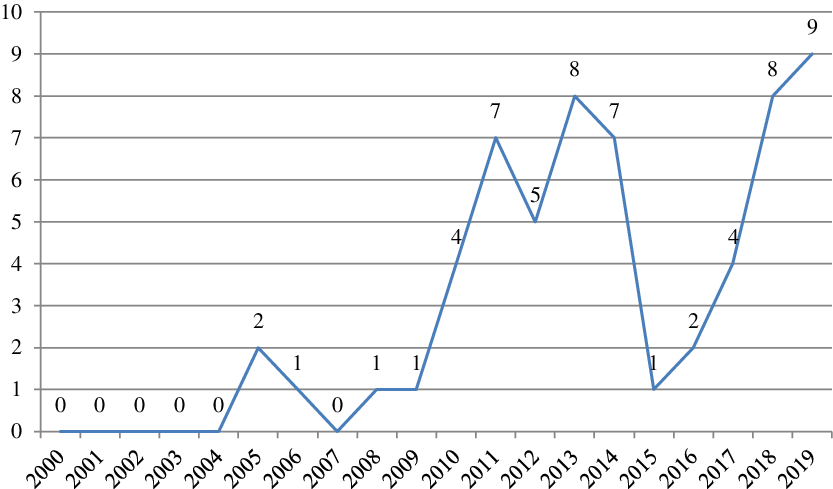
3.1 Number of articles published by year
Figure 3 shows the number of annual publications on blended language learning over the past two decades. Annual publications were scarce in the first decade (from 2000 to 2009), whereas the annual publications increased rapidly in the second decade (from 2010 to 2019), indicating researchers’ growing interest and sustained focus on blending language learning over the last two decades, especially in the second decade. This is in line with studies (Grgurović, Reference Grgurović, Chapelle and Sauro2017; Güzer & Caner, Reference Güzer and Caner2014) stating that blended learning appeared around the year 2000 (Adair-Hauck, Willingham-McLain & Youngs, Reference Adair-Hauck, Willingham-McLain and Youngs2000) and flourished after the earlier stage, which Güzer and Caner (Reference Güzer and Caner2014) labeled as First Attempts (2000–2002) and Definition Period (2003–2006). This might be partly attributed to the technological advancements of the last decade.
Publication trend by year

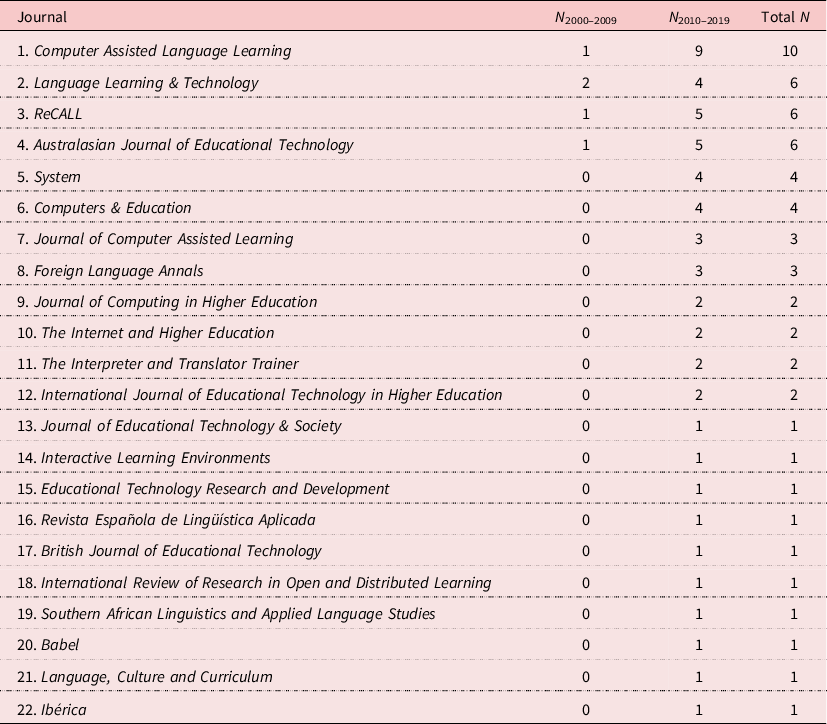
Additionally, Table 1 shows the number of publications on blended language learning over two decades in the 22 SSCI-indexed journals. Most articles were published in six journals, but only four journals were published in the first decade. The other journals were published in the second decade. More specifically, most articles were published in four world-renowned SSCI-indexed CALL journals (Computer Assisted Language Learning, n = 10; Language Learning & Technology, n = 6; ReCALL, n = 6; and System, n = 4), in five educational technology journals (Australasian Journal of Educational Technology, n = 6; Computers & Education, n = 4; Journal of Computer Assisted Learning, n = 3; The Internet and Higher Education, n = 2; and Journal of Computing in Higher Education, n = 2), and in two applied linguistic journals (Foreign Language Annals, n = 3; and The Interpreter and Translator Trainer, n = 2). This result could be attributed to the interdisciplinary nature of blended language learning studies, which covered such disciplines as CALL, educational technology, and applied linguistics alike (Gruba & Hinkelman, Reference Gruba and Hinkelman2012).
Publications on blended language learning during the first (2000–2009) and second (2010–2019) decades in the 22 SSCI-indexed journals

3.2 Results of participants
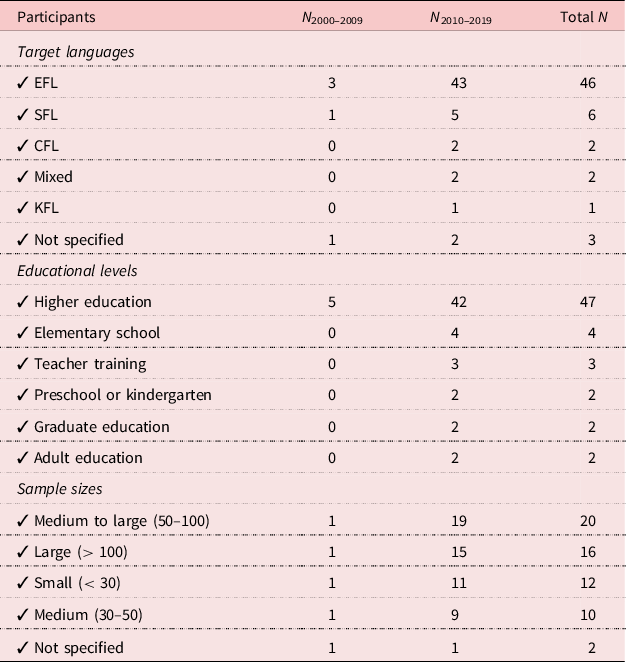
Table 2 presents the distribution of participants’ target languages, educational levels, and sample sizes during the first (2000–2009) and second (2010–2019) decades.
Participants’ target languages, educational levels, and sample sizes during the first (2000–2009) and second (2010–2019) decades

There is a predominant focus on EFL (n total = 46), which is especially true in the second decade (n = 43), followed by SFL (n total = 6), CFL (n total = 2), mixed (n total = 2), and KFL (n total = 1). The findings show that blended language learning was applied to a wide range of foreign languages, including English, Spanish, Chinese, and Korean. EFL received the most attention. English, as a global language, is the most popular foreign language worldwide (Li, Reference Li2021a; Pan, Reference Pan2015).
The most common educational level is higher education (n total = 47), followed by elementary school (n total = 4), teacher training (n total = 3), preschool or kindergarten (n total = 2), graduate education (n total = 2), and adult education (n total = 2), respectively. One way to explain this is that, in contrast to other educational levels, researchers of blended language learning select college students as their participants (Hwang & Fu, Reference Hwang and Fu2019). Moreover, compared to other levels, as digital natives, college students would have a higher level of digital literacy to accept the combination of f2f and online learning (Li, Reference Li2021a; Ng, Reference Ng2012)
It is noteworthy that, compared to the small size of the first decade, the sample sizes of all levels – that is, medium to large (n total = 20), large (n total = 16), small (n total = 12), and medium (n total = 10) – increased in the second decade. This suggests that researchers have realized that research quality is closely related to sample sizes (Cook & Hatala, Reference Cook and Hatala2015). It is thus of great importance to “have a larger sample size to keep the statistic power at or above researchers’ expectations” (Hwang & Fu, Reference Hwang and Fu2019: 578–579).
Based on the findings, we suggest that other issues should be considered by researchers. First, although most studies on blended language learning focus on EFL, it remains uncertain whether the results of EFL studies are generalizable to other foreign languages. Second, despite the increasing attention being paid to college students, attention to primary and secondary settings has been almost non-existent. As such, there is an urgent need to analyze those settings and examine whether the use of blended language learning could improve students’ language performance and perceptions (Li, Reference Li2021a, Reference Li2021b). Importantly, concerning the limited access to high-quality foreign language learning resources in the rural areas of developing countries, how can blended language learning be implemented among primary and secondary school students in those settings? Third, considering that the highest total number of sample sizes is medium to large, researchers also need to increase sample sizes to improve the precision of future research on blended language learning.
3.3 Results of learning strategies
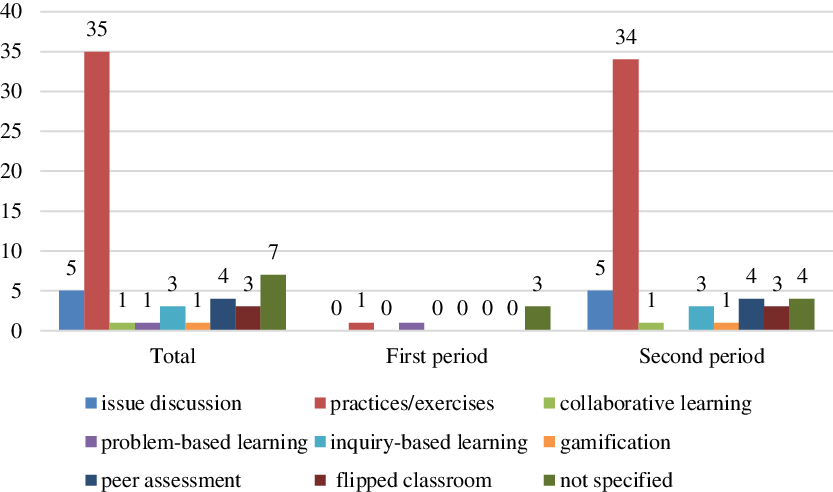
Figure 4 indicates the distribution of learning strategies during the first (2000–2009) and second (2010–2019) decades. On the one hand, most studies focus on the strategy of practice or exercises (n total = 35) in order to practice learners’ language skills. For instance, Zibin and Altakhaineh (Reference Zibin and Altakhaineh2019) adopted a quasi-experimental method to examine the effect of blended language learning on Jordanian EFL learners’ acquisition of written discourse. Results showed that the experimental group with technological devices to practice clausal structures in a writing task outperformed the control group, suggesting that blended language learning enhances learners’ attitudes and discourse knowledge. Similarly, Huang (Reference Huang2019) compared how EFL learners perceived teacher roles in f2f and online learning in a blended language learning course that offered learners a wide range of resources. Results indicated that learners tended to believe that teachers in the f2f learning mode had a higher impact than those in online learning. The reason why the strategy of practice or exercises received the most attention might lie in the fact that multimodal (e.g. pictorial or audiovisual) learning resources or other kinds of learning exercises (listening, speaking, reading, and writing) could be prepared and uploaded online in blended language learning as a compensation for some weaknesses in f2f instruction. In a blended learning environment, students could obtain a flexible learning experience and learning materials anywhere and at any time (Smyth et al., Reference Smyth, Houghton, Cooney and Casey2012), given that blended language learning could remove the spatial and temporal barriers with low-cost and high-quality personalized education (Xu et al., Reference Xu, Glick, Rodriguez, Cung, Li and Warschauer2020). Moreover, they could also actively engage in learning activities in a self-paced or collaborative way (Wang et al., Reference Wang, Han and Yang2015).
Learning strategies during the first (2000–2009) and second (2010–2019) decades

On the other hand, compared to the few strategies used in the first decade, the last decade has witnessed a shift from practice or exercises to other newly emerged strategies, such as gamification, collaborative learning, inquiry-based learning, peer assessment, and flipped classrooms. As Hinkelman (Reference Hinkelman2018) puts it, there might be manifold reasons to explain the aforementioned results, the first of which is the resurgence of newly interactive CALL technologies. Aside from the earlier blended language learning studies that only emphasized the integration of CALL technologies into f2f instruction, recent studies have also attempted to include interactive elements (e.g. collaborative learning, peer assessment, and flipped classrooms) into f2f sessions with newly interactive CALL tools or technologies. Second, there has been a paradigm shift in language learning theory from computational metaphors (input + output) to ecological metaphors (environments + collective relations). The applications of flipped learning or gamification have changed language learning environments, resulting in promoting EFL learners’ efficiency and learning incentives. Third, there has been a focus on task-based learning. As long as the newly interactive technologies and newly emerged strategies (e.g. flipped classrooms, game-based learning, and others) are well integrated, facilitative effects of language tasks on pedagogical outcomes can be obtained.
For future studies, we suggest that the learning strategies of blended language learning should not be constrained to merely practice or exercises, but should also cover a wider range of other strategies, such as problem-based learning, peer assessment, inquiry-based learning, collaborative learning, game-based learning, and flipped classrooms. On the other hand, as Garrett (Reference Garrett2009: 720) posits, “technology, theory and pedagogy are inseparably interwoven”, so future studies should focus not only on how the integration of CALL tools can achieve the task but also on what pedagogic effects the task might have on foreign language learning outcomes.
3.4 Results of research methods
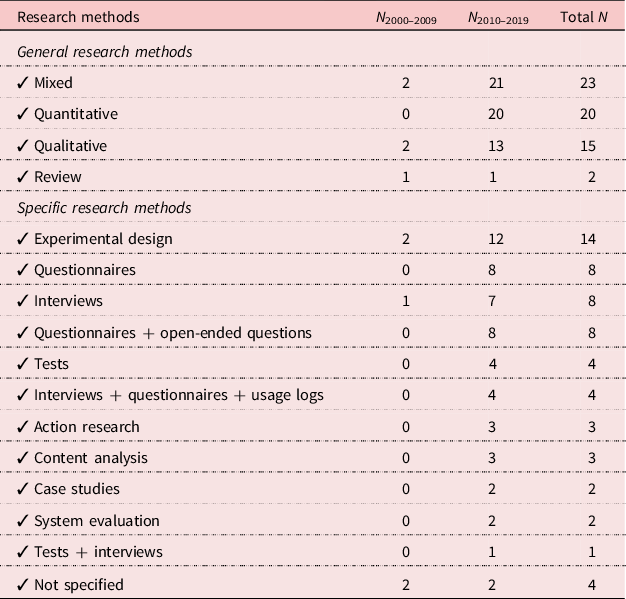
Table 3 shows the distribution of general and specific research methods during the first (2000–2009) and the second (2010–2019) decades. Most studies adopted mixed-methods designs (n total = 23), followed by quantitative (n total = 20), qualitative (n total = 15), or review (n total = 2) methods. More specifically, in most studies that adopted mixed-methods designs, researchers tended to seek multiple (quantitative and qualitative) data sources, such as questionnaires + open-ended interview questions, questionnaires + open-ended interview questions + apps usage logs, and language tests + interviews, to triangulate and consolidate their findings. For quantitative methods, “between-and-control group” experimental design, questionnaires, and tests were frequently applied to examine the effects of blended language learning on students’ language performance. In qualitative methodologies, researchers would use action research, structured or semi-structured open-ended interviews, case studies, content analysis, and system evaluation to test the effectiveness of blended language learning.
Research methods during the first (2000–2009) and second (2010–2019) decades

Our results show that few studies explored learners’ behavioral responses (e.g. engagement, frequencies, or durations of feedback, participation or dropout rates, etc.) with data mining methods. To address this issue, we suggest that researchers of future blended language learning research adopt learner analytics to collect behavioral data from which students’ behavioral responses can be analyzed (Hinkelman, Reference Hinkelman2018). In addition, our results also show that the most frequently adopted research methods were mainly offline methods, which might fail to disclose the moment-by-moment cognitive processes lying behind the use of blended language learning (Li, Zhang & Ni, Reference Li, Zhang and Ni2017). We suggest that researchers should adopt newly developed tools (eye tracking, event-related potentials, and fMRI, etc.) in the future to collect students’ online psycho-physiological data. For instance, eye-movement tracking techniques can help disclose students’ ongoing learning states (e.g. gaze durations and total reading times indexing cognition, engagement, and participation, etc.) and affective perceptions (e.g. pupil sizes indexing emotional rehearsal), which can improve not only the precision of the data analysis with solid evidence but also the generalizability of the results applicable to a more extensive population (Li et al., Reference Li, Zhang, Ni, Xiao, Wei and Dai2018).
3.5 Results of research foci
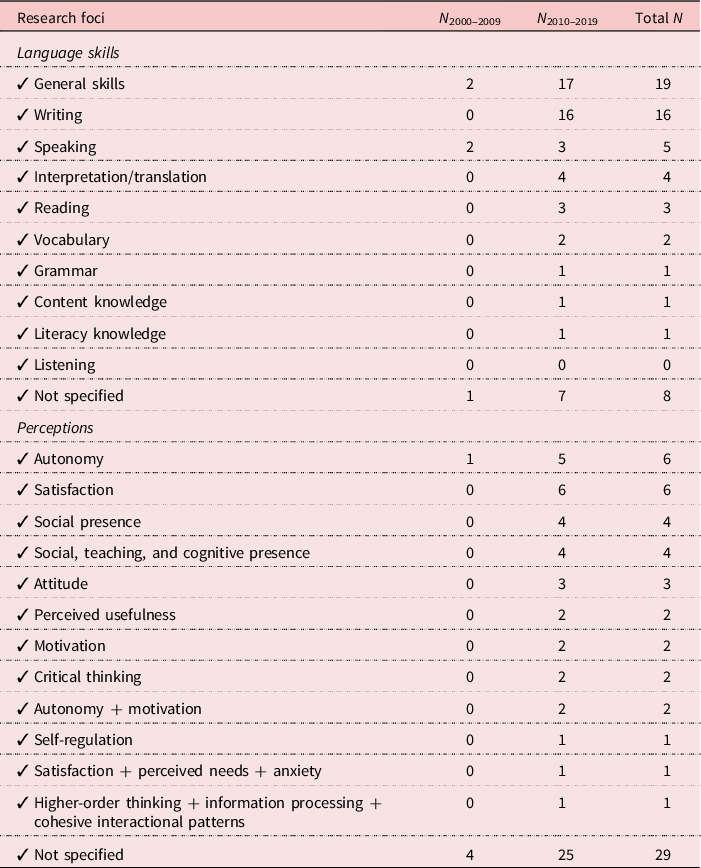
Table 4 shows the distribution of research foci during the first (2000–2009) and second (2010–2019) decades. The most common research foci were language skills and learners’ perceptions when using blended language learning.
Research foci during the first (2000–2009) and second (2010–2019) decades

Most studies explored students’ general language skills (n total = 19), writing skills (n total = 16), speaking skills (n total = 5), interpretation or translation skills (n total = 4), reading skills (n total = 3), vocabulary acquisition (n total = 2), grammar (n total = 1), content knowledge (n total = 1), and literacy knowledge (n total = 1). Blended language learning was more frequently adopted for the development of productive language skills (e.g. general language skills, writing, speaking, and interpretation/translation) rather than working on receptive skills (e.g. listening and reading), since blended language learning might be more beneficial for the productive skills that were likely to demand higher cognitive loads and resources (Lee & Muncie, Reference Lee and Muncie2006). Moreover, as required by the job market, general language skills, writing, speaking, and interpretation/translation skills that fall at the communicative ends are also more welcome in the competitive occupational market (Harmer, Reference Harmer2007).
On the other hand, most studies on blended language learning focused on students’ perceptions, such as autonomy (n total = 6); satisfaction (n total = 6); social presence (n total = 4); social, teaching, and cognitive presence (n total = 4); attitude (n total = 3); perceived usefulness (n total = 2); motivation (n total = 2); critical thinking (n total = 2); autonomy and motivation (n total = 2); self-regulation (n total = 1); satisfaction, perceived needs, and anxiety (n total = 1); and higher-order thinking, information processing, and cohesive interactive patterns (n total = 1). Our results show that blended language learning was perceived by students as improving their autonomy, satisfaction, and motivation, and so on, which could not only triangulate the data from different sources but also add to our understanding of the effectiveness of blended language learning on students’ language performance, consistent with the results of blended learning studies that were well documented to enhance students’ academic performance (Vo, Zhu & Diep, Reference Vo, Zhu and Diep2017), engagement and self-determination (De George-Walker & Keeffe, Reference De George-Walker and Keeffe2010), perceptions of collaborative learning, social presence, and satisfaction (So & Brush, Reference So and Brush2008), and meaningful learning experiences (Cheung & Wang, Reference Cheung and Wang2019).
We suggest that researchers of future studies should consider investigating other issues, such as the effects of blended language learning on students’ listening skills and literacy skills. Simultaneously, the longitudinal effects of blended language learning on students’ language skills and learning perceptions altogether should also be examined over a longer period.
3.6 Results of adopted technologies
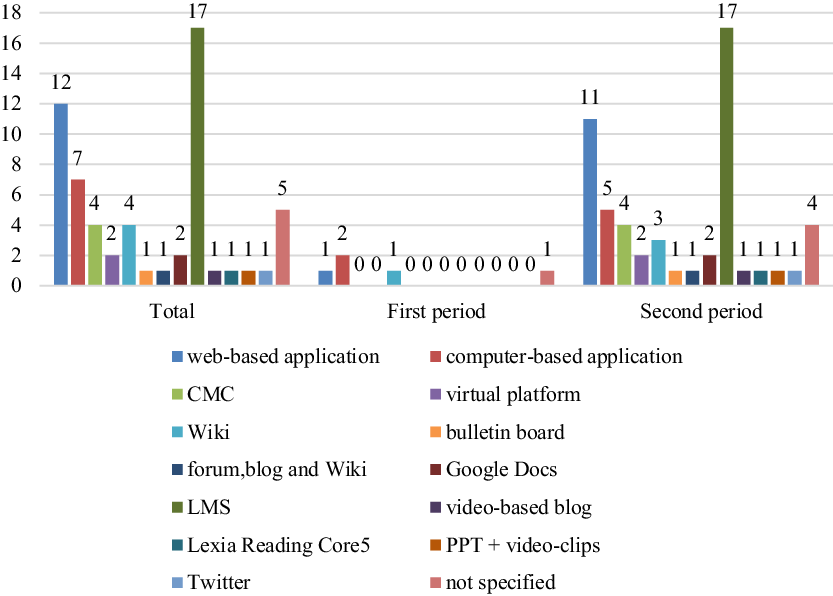
Figure 5 shows the distribution of the adopted technologies during the first (2000–2009) and second (2010–2019) decades. The most frequently adopted technologies were LMS (n total = 17), followed by web-based applications (n total = 12), computer-based applications (n total = 7), CMC (n total = 4), wiki (n total = 4), Google Docs (n total = 2), virtual platforms (n total = 2), bulletin board (n total = 1), forum + blog + wiki (n total = 1), video-based blog (n total = 1), Lexia Reading Core5 (n total = 1), PPT + video clips (n total = 1), and Twitter (n total = 1). Computer-based and web-based applications were most favored by students, which is partly due to larger screen devices (e.g. computer or tablets) helping students to learn foreign languages more effectively and enjoyably when adopting blended language learning approaches (Kim & Kim, Reference Kim and Kim2012; Li, Meng, Tian, Zhang & Xiao, Reference Li, Meng, Tian, Zhang and Xiao2021). Furthermore, LMSs were frequently applied as well (Hinkelman & Gruba, Reference Hinkelman and Gruba2012), which might be attributed to the facilitative effects of blended learning environments and LMS on students’ language learning performance (Hinkelman, Reference Hinkelman2018; Hinkelman & Gruba, Reference Hinkelman and Gruba2012). Lastly, our results also indicated that other digital technologies were used in blended language learning in the recent decade, such as virtual cloud technology (e.g. Google Docs and virtual platform), CMC (e.g. instant messaging tools, WeChat, and WhatsApp), along with multimodal resources (e.g. PPT, video-based blog, and video clips), which could be explained by the fact that the design of CALL and blended language learning activities should be in alignment with the development of newly emerged educational technologies (Shadiev, Hwang & Huang, Reference Shadiev, Hwang and Huang2017).
Adopted technologies during the first (2000–2009) and second (2010–2019) decades

We suggest that future research should consider other technologies as well. For instance, because the fifth-generation (5G) mobile network for the IoT (Internet of Things) has, in recent years, been reported to revolutionize and connect the global world through seamless connectivity (Akpakwu, Silva, Hancke & Abu-Mahfouz, Reference Akpakwu, Silva, Hancke and Abu-Mahfouz2018), will 5G network-based blended language learning have a beneficial effect on students’ language skills and learning perceptions among other educational forms, such as pre-service teacher training and adult lifelong learning? Furthermore, since “blended learning is a transformational force in education” (Dziuban, Hartman & Mehaffy, Reference Dziuban, Hartman, Mehaffy, Picciano, Dziuban and Graham2014: 328) and “‘blended learning’ … stands from the viewpoint of pedagogy” (Hinkelman, Reference Hinkelman2018: xiii), researchers should not only take full advantage of the pedagogical affordances of CALL technologies but also consider carefully their integration in blended learning curriculums depending on educational needs and purposes (Garrison, Reference Garrison, Rogers, Berg, Boettcher, Howard, Justice and Schenk2009).
3.7 Results of application effectiveness, advantages, and challenges
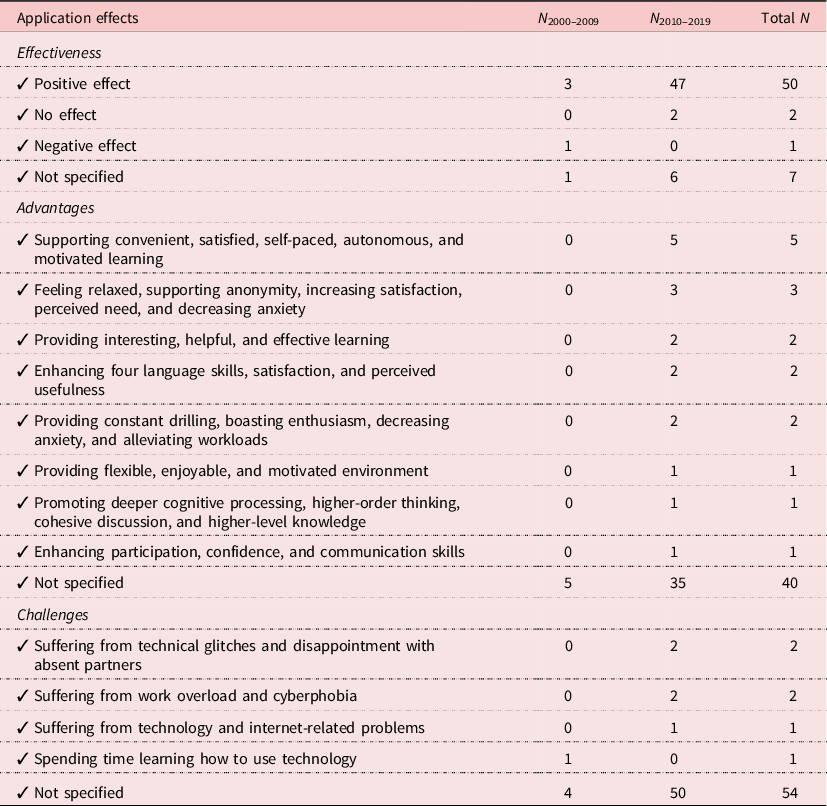
Table 5 illustrates the distribution of application effectiveness, advantages, and challenges during the first (2000–2009) and second (2010–2019) decades. Most reviewed studies obtained a positive effect (n total = 50), whereas only a few studies yielded no effect (n total = 2) or a negative effect (n total = 1). By and large, our results demonstrate that the effectiveness of blended language learning was supported by most studies.
Application effectiveness, advantages, and challenges during the first (2000–2009) and second (2010–2019) decades

The most commonly mentioned advantages included supporting convenient, satisfied, self-paced, autonomous, and motivated learning (n total = 5); feeling relaxed, supporting anonymity, increasing satisfaction, perceived need, and decreasing anxiety (n total = 3); providing interesting, helpful, and effective learning (n total = 2); enhancing four language skills, satisfaction, and perceived usefulness (n total = 2); providing constant drilling, boasting enthusiasm, decreasing anxiety, and alleviating workloads (n total = 2); providing flexible, enjoyable, and motivated environment (n total = 1); promoting deeper cognitive processing, higher-order thinking, cohesive discussion, and higher-level knowledge (n total = 1); and enhancing participation, confidence, and communication skills (n total = 1).
The most commonly reported challenges included suffering from technical glitches and disappointment with absent partners (n total = 2), suffering from work overload and cyberphobia (n total = 2), suffering from technology and internet-related problems (n total = 1), and spending time learning how to use technology (n total = 1).
Based on the results, tentative suggestions for researchers, educational practitioners, and CALL producers in the future can be made. First, researchers should clarify the effects of information literacy on students’ blended language learning performance, as the lack of information literacy skills might cause technology and internet-related problems (Probert, Reference Probert2009). Second, educational practitioners should not only help students develop their information literacy (Probert, Reference Probert2009) but also assist them in selecting appropriate CALL technologies (Li et al., Reference Li, Meng, Tian, Zhang, Ni and Xiao2019; Li et al., Reference Li, Meng, Tian, Zhang and Xiao2021). Third, considering the challenge of students’ disappointment with absent partners, CALL producers or providers should intensively design the interface and functionalities of blended language learning apps with a particular eye on feedback from both the synchronous peer-peer and tutor-learner to maintain their continued concentration on the learning tasks (Li et al., Reference Li, Meng, Tian, Zhang and Xiao2021).
4. Limitations
Some limitations should be addressed. First, to ensure the high quality of retrieved publications under stringent peer-review processes, in this paper, only SSCI-indexed journal articles were synthesized, and other influential journals (e.g. CALICO Journal) are not included in the review. For future studies, researchers should consider extending the search to other journals, data sets, or publications (e.g. conference reports, books, book chapters, and PhD dissertations) in interdisciplinary research subjects. Second, although we consulted many existing studies regarding the search terms and used Boolean search methods, this study is still unavoidably constrained by the limited search terms and time span. Future research should consider involving more search terms and enlarging the time span to gain a more panoramic view of blended language learning. Third, although the revised technology-based learning model is used as a valid framework to synthesize technology-based learning tools, its feasibility for other CALL tools remains open for debate, warranting more systematic research.
5. Conclusion
This study used the revised technology-based learning model as a framework to synthesize research trends of blended language learning over the last two decades. Several results were obtained: the most common target language was EFL, and the most common learners were college students. In most studies, technologies were mainly used for the purposes of practice or exercises. Compared to the few strategies used in the first decade, the most recent decade has witnessed a shift of trends in foreign language learning from practice or exercises to other numerous newly emerged strategies, such as gamification, collaborative learning, inquiry-based learning, peer assessment, and flipped classrooms. Mixed, quantitative, and qualitative methods were frequently adopted, with a particular eye on experimental design, questionnaires, and other specific methods, in the most recent 10 years. Productive language skills (e.g. general language skills, writing, speaking, and interpretation/translation), along with autonomy, satisfaction, and motivation, were the major research foci. LMSs and computer-based and web-based applications with larger screens for display were frequently adopted technologies. The most commonly mentioned advantages included supporting convenient, satisfied, self-paced, autonomous, and motivated learning, and feeling relaxed, supporting anonymity, increasing satisfaction, perceived need, and decreasing anxiety. The most commonly mentioned challenges were suffering from technical glitches, technology and internet-related problems, work overload and cyberphobia, and spending time learning how to use technology.
These findings may contribute to advancing our understanding of blended language learning from the revised technology-based learning model in particular. Further, they may provide meaningful insights into how CALL technologies are blended into language learning and teaching in general.
Supplementary material
To view supplementary material referred to in this article, please visit https://doi.org/10.1017/S0958344021000343
Acknowledgements
This research was supported by the Social Science Foundation of Hunan Province (grant number 20ZDB005). The author would like to thank two anonymous reviewers, Professor Jozef Colpaert and Professor Pascual Pérez-Paredes, for their constructive and insightful comments and suggestions.
Ethical statement and competing interests
There is no conflict of interest. This work is entirely original and others’ work has been cited appropriately. Institutional requirements were followed in data collection procedures.
About the author
Rui Li is a full professor, also serving as a doctoral and post-doctoral supervisor at the School of Foreign Languages, Hunan University, China. His research interests include CALL, applied linguistics, and psycholinguistics. His recent publications appear in Computer Assisted Language Learning, ReCALL, Educational Technology & Society, Reading and Writing, RELC Journal, Journal of Psycholinguistic Research, Frontiers in Psychology, Porta Linguarum, and SAGE Open, among others. He also works as an anonymous reviewer for nearly 20 highly ranked SSCI-indexed journals in CALL, applied linguistics, and psycholinguistics.