1 Introduction
Unlike traditional forms of linear narrative, such as those commonly found in books and film, the digital narratives of a 3D video game must first be configured through player activity before they can be interpreted as a meaningful story (Aarseth, Reference Aarseth2004; Moulthrop, Reference Moulthrop2004; Ryan, Reference Ryan2009). An artifact of players iteratively feeling their way through the contours of a game world on a physical, mental, and emotional level, the stories that emerge from this activity are as unique as the players themselves and represent a highly personalized form of situated activity and knowing (Winn, Reference Winn2003; Rambusch, Reference Rambusch2010). The mixed-methods study reported here describes how the process of configuring digital narratives in a 3D digital game-based language learning (3D-DGBLL) environment apparently helped learners to co-configure “story maps”, which in turn were used to structure second language production (Nitsche, Reference Nitsche2008). Specifically, the study examines the way in which these story maps expressed themselves in the written L2 narratives that participants in the experimental group produced to describe an imagined situation closely resembling the gameplay of the 3D-DGBLL environment. Expanding on work done by Neville (Reference Neville2010), who articulates an object-oriented instructional design approach for inserting measurable learning objectives into open-ended 3D-DGBLL environments, the study works toward building an evidence-based theory for applying story maps generated by gameplay in these environments toward L2 development.
2 Background
Several recent studies explore how immersive 3D video game environments – including massively multiplayer online games (MMOGs), massively multiplayer online role-playing games (MMORPGs), synthetic immersive environments (SIEs), and virtual worlds – can be beneficial for second language development. The majority of these studies examine in-game language production from a sociocultural perspective of second language acquisition. Thorne, Fischer & Lu (Reference Thorne, Fischer and Lu2012) present descriptive research assessing the semiotic ecology and linguistic complexity of game-generated and player produced texts in a MMOG. The authors found that these texts, which were “sophisticated, complex, and with direct and event-driven use-value to players” (op. cit.: 298), emerged from the goal-directed activity of the players in the virtual environment and provided them with rich opportunities for situated communicative activity. Zheng, Newgarden, & Young (Reference Zheng, Newgarden and Young2012), investigating the coordinating and languaging activities that emerged during a brief period of play in a MMOG, found that the communicative activities and projects that constitute the game are inextricably connected to the manner in which “players integrated language and action to pursue a variety of individual and collective goals... both in the context of their current gameplay and within other overarching timescales” (op. cit: 355). Noting that this game-based communicative activity would be difficult to replicate in a classroom environment, the authors conclude that the affordances of MMOGs would lend themselves well to teaching coactive and values-realizing second language activities. Finally, in his study of learner interaction in a MMORPG, Peterson (Reference Peterson2012) reports that players utilized a range of strategies to manage the development of their sociolinguistic competence, and that these strategies were beneficial in developing collaborative interpersonal relationships, social interaction, and target language co-construction. These strategies were additionally found to help maintain states of intersubjectivity between players.
Other studies, although also describing potential in-game benefits for second language learners, nevertheless suggest that instructional gains may not be easily transferable to real-world settings. Analyzing the affordances of MMOGs for second language learning and socialization, Rama, Black, van Es, & Warschauer (Reference Rama, Black, van Es and Warschauer2012) note that these types of games provide second language learners with numerous opportunities for engaging in authentic communication in all language modalities with a wide range of interlocutors. They further observe that the goal-directed and collaborative action facilitated by these games could also be beneficial for increasing students' confidence and perceived competence. The authors caution, however, that the pragmatics of MMOGs may not be transferable to a real-world setting and that the language encountered in these virtual game worlds cannot be graded or controlled in terms of language ability. In their examination of situated activity within a virtual world, Milton, Jonsen, Hirst, & Lindenburn (Reference Milton, Jonsen, Hirst and Lindenburn2012) found that the speed of language interaction and fluency among learners increased with prolonged immersion in the environment, as did uptake in targeted vocabulary-learning exercises. Although the learners manifested good vocabulary-related gains, the authors also observed that the lexical environment of the virtual world was inadequate for growing a lexicon on the scale necessary for high levels of competence. Examining the flexibility and built-in complexity of SIEs, Sykes, Oskoz, & Thorne (Reference Sykes, Oskoz and Thorne2008) note that the simulated roles and identities, emotional connection, and low-risk practice that these environments afford can be leveraged to instruct the more complex aspects of a second language including pragmalinguistic and sociopragmatic skills. The greatest potential disadvantage of a SIE, the authors warn, is that learners immersed in this type of environment will learn the pragmatics of its virtual spaces and not necessarily the skills of the second language itself. Some transfer between in-game experience and a real-world setting, however, seems possible in the form of contextualized verbal and prosodic imitation. In their analysis of repetition in collaborative gameplay, Piirainen-Marsh & Taino (Reference Piirainen-Marsh and Tainio2009) observed that focused repetition of embedded game narrative helped players to focus their attention on the analysis of the linguistic details of the game, and served as valuable resources for repeating and imitating meaningful chunks of a second language. The authors found that repeating and imitating these language chunks allowed the players “to adopt them into their own repertoire so that the patterns may become available for recycling in other contexts” (op. cit: 165).
Focusing primarily on the collaborative and social aspects of gameplay associated with 3D video games, the studies outlined above do not examine how the process of configuring digital narratives within these environments may also generate story maps that help to structure L2 production. For the purpose of the study described here, digital narratives are understood to be the product of player activity that configures the “unique sequence of events, mental states, [and] happenings” (Bruner, Reference Bruner1990, p. 43) encountered in a 3D video game into a unified and cohesive whole forming the raw material for a story. These game-based digital narratives become meaningful stories when the act of configuring them is coupled with goal-directed thought, situational awareness, and personal reflection. According to Bruner (Reference Bruner1986), a story constructs two landscapes simultaneously, the first being the “landscape of action, where the constituents are the arguments of action: agent, intention or goal, situation, instrument, something corresponding to a 'story grammar'” and the second being the “landscape of consciousness: what those involved in the action know, think, or feel, or do not know, think, or feel” (op. cit: 14). Story mapping, therefore, is the process of configuring digital narratives in a 3D video game so that they are imbued with personal significance, but with the specific intent of mapping the product of this process onto the virtual spaces of the game in order to bestow them with meaning:
To discuss the players' comprehension, we return to the notion of the cognitive map. As discussed earlier, players' navigation in a 3D virtual world depends on the creation of a cognitive map of the space just as it does in the physical world. A story map is the result of this reading of the game space in combination with the directed evocative narrative elements encountered along the way. The game space, the events it includes, and the position of the player in relation to them are dramatized and contextualized. The narrative evocative elements at work do their best to affect the cognitive map. The result is the story map that consists of a form of cognitive map grown from the interplay of presentation and functionality, guidance and player positioning. Ultimately, every story map is a cognitive map that has been heavily influenced by evocative narrative elements as the player experienced them in the game space (Nitsche, Reference Nitsche2008: 227).
For the purpose of the study here, a story map, which Neville (Reference Neville2010: 448) terms a “narrative trace”, will be understood as the mental artifact emerging from a complex process of situated knowledge production that occurs when players make sense of the events, resources, goals, and spaces of a 3D video game and use this knowledge to become more encultured within its virtual spaces and to develop increasing competence with its practice-specific narratives (Lave & Wenger, Reference Lave and Wenger1991; Wenger, Reference Wenger1998). This definition will be further augmented by Grodal (Reference Grodal2003), who suggests that the stories generated in 3D video games are held as prelinguistic structures in consciousness, helping players to shape “ideas of future possibilities” and informing “prolonged action patterns” (op. cit.: 132).
The story maps that are created in 3D video games are important for second language and culture development in several important ways. First, they are player-generated artifacts that emerge out of negotiation between the individual and the global, between instances of local knowledge and the larger communities of practice. Story maps are, therefore, critical in the formation of the player's identity as they assist in opening up a “third space” in the game that allows for personal experimentation and interpretation (Kücklich, Reference Kücklich2003). The idea of a third space also informs sociocultural approaches to second language and culture acquisition by suggesting that learner identities are constantly negotiated and reevaluated at the intersection of multiple and competing communities of practice (Pavlenko & Lantolf, Reference Pavlenko and Lantolf2000; Kramsch, Reference Kramsch2009). 3D video games, therefore, could be seen as facilitating and augmenting the process of identity refashioning by drawing the attention of learners to nuances of their assumed identity that emerge only when it is played within a simulated real-world setting. Indeed, Schwienhorst (Reference Schwienhorst1998) notes that the third spaces found in the 3D spaces of video games “provide not only a necessary interface, but an environment that is neutral yet potentially controllable by both partners and that offers the necessary tools, resources and activities that provide incentives and support for language learning” (op. cit.: 122).
Second, story maps represent a form of situational knowledge that, because of their prelingusitic nature, may allow for easy transfer between the simulated sociocultural contexts of the game and their real-world counterparts. That is to say, provided that the virtual spaces of a game world closely resemble those of the real world, learners who have been immersed in the game world should theoretically be better prepared for actual immersion abroad as the story maps that could assist in the enculturation process are already in place. Such virtual spaces would, in the words of Gee (Reference Gee2013), generate an experience that has the potential to connect language with place: “If a person can associate images, action, experiences, goals, interactive dialogue with words, that person has situated meaning for those words. If a person can only associate other words (definitions, paraphrases) with words, then that person has only verbal meaning for those words, not situated meanings” (op. cit.: 64). However, if story maps are indeed prelinguistic in nature, best instructional practices will need to be formulated for grounding these story maps in linguistic structures. We will, as Gee (Reference Gee2013) describes in his discussion of the digital participation gap, need to figure out how best to translate the activity of 3D gameplay into meaningful second language production: “So technology-rich learning is always and also language-rich learning. We cannot close the digital gap without closing the literacy gap, and we must close them together” (op. cit.: 65).
Finally, a story map is a mental representation of how a site-specific activity system functions. Human activity, according to Engeström (Reference Engeström1999), never occurs within a vacuum, but instead must be contextualized within an interconnected system of available tools and artifacts, the surrounding community and its understood rules, and the division of labor in these communities (see Figure 1).
Components of an activity system

Although activity systems can be studied statically, dynamic experimentation with these systems is more revealing as the modification of one system variable can lead to changes throughout the entire system, potentially altering the interactivity of the system. Systems-based learning, therefore, stresses the process of knowledge construction and asserts that learning emerges from activity, not as a precursor to it. Accordingly, 3D video games that simulate real-world activity systems are extremely useful for learners as these environments allow them to experiment in real-time with system variables, evaluate feedback generated by this experimentation, and adapt their activity to changes in the system. Based on their ability to simulate the activity of real-world systems, 3D-DGBLL environments, more so than traditional text-based approaches, may prove essential in the near future for teaching the systems thinking necessary to understand and navigate the interconnected spatial and linguistic narratives that produce a target culture (Lefebvre, Reference Lefebvre1991).
3 Method
The primary objective of the mixed-methods study reported here is to determine whether immersion in a 3D-DGBLL environment assisted learners in producing written L2 narratives that describe an imagined situation closely resembling the gameplay of the 3D-DGBLL environment. By linking the environment to the written narratives, the study seeks to articulate the influence that gameplay has on the way learners configure story maps about the sociocultural and linguistic practices embedded as instruction in the environment, and whether learners subsequently accessed these maps outside of the environment in order to structure the written narratives. As the virtual spaces of the game environment were modeled on the real-world space of a German pedestrian zone (Fußgängerzone), an implicit objective of the study was to determine whether 3D-DGBLL environments could be useful in preparing learners for immersion in comparable real-world environments.
3.1 Materials
The study utilized a custom-built 3D-DGBLL environment, employing a first-person player interface to teach German recycling and waste management practices within the grammar context of two-way prepositions. A custom-built environment was required as no commercial off-the-shelf (COTS) game is currently available for teaching these topics. Creating the environment from scratch allowed for tighter curricular integration, the development of more effective workflow patterns, and granted a closer examination of the affordances and limitations of these environments. To keep development costs to a minimum, the environment was created using primarily open source software, freeware, digital repositories of Creative Commons licensed audio samples and images, and collaborative databases of royalty-free music. Models for the 3D-DGBLL environment were developed, rigged, and UV mapped in Blender 2.49b (http://www.blender.org), with GIMP 2.6.8 (http://www.gimp.org) being used to create the model texture maps. All 3D models were based on images of real-world objects and structures found on online image hosting websites (e.g., Flickr) and through web searches (e.g., Google). Completed models were imported into Unity 2.6 (http://unity3d.com), which provided the authoring tools for creating and editing the 3D-DGBLL environment as well as the underlying game engine. Game programming was done in the C# programming language using Microsoft Visual Studio Express 2010 (http://www.microsoft.com/visualstudio). All audio editing and mixing was done in Audacity 1.2.6 (http://audacity.sourceforge.net). Instructional materials for the game were created in OpenOffice 3.1.1 (http://www.openoffice.org) and Microsoft PowerPoint 2007 (http://office.microsoft.com/en-us/powerpoint). The object-oriented instructional design rubric described by Neville (Reference Neville2010) and, utilized in the creation of the 3D-DGBLL environment, helped to ensure that the resources designed for the game were closely aligned with the instructional goals of the study. In addition to screen capture videos and notes describing the development process, all game models, source code, and instructional materials, as well as the playable game in Mac and PC formats, are available under a Creative Common Attribution-NonCommercial-ShareAlike license for free download, modification, and research use at the project blog (http://digibahn.blogspot.com).
3.2 Participants
The study was conducted in two second-semester introductory German language courses at a middle-sized private liberal arts university in the Southeast United States in March 2012. All study participants were monolingual university students between the ages of eighteen and 23 with varying backgrounds and proficiency in the German language. There were 26 males and sixteen females in the study; nine participants withdrew from the study prior to its completion (two from the control group, seven from the experimental group) and one participant from the experimental group was excluded from the study based on an incomplete submission of the assessment instrument. The study did not filter participants based on prior experience with game-based learning environments or 3D video games. Both courses were taught by one instructor, a near-native speaker of German with a background in instructional design and development, who was also the primary investigator of the study.
3.3 Procedure
Study participants were randomly assigned to a control group (N=19) and an experimental group (N=13). Participants in each group attended class for 75 minutes, with time in class being divided into three consecutive instructional phases. The first phase reviewed German two-way prepositions, which had been introduced in the previous lesson two days prior. The second phase introduced the German recycling and waste management systems and specialized vocabulary associated with these systems. The third phase attempted to synthesize the first two phases by means of small group exercises. Review of German two-way prepositions was accomplished by means of image- and text-based PowerPoint slides. The recycling and waste management systems were also introduced by means of similar slides, which superimposed specialized vocabulary over images depicting elements of these systems and presented questions for general class discussion. Upon completing the lecture and class discussion, participants were randomly divided into small groups for focused practice in vocabulary and grammar development, as well as for practice to develop proficiency with the German recycling and waste management systems. A short handout consisting of two written exercises formed the instructional backbone of the final in-class phase: (1) an exercise requiring participants to cross out vocabulary words that do not belong under a given rubric; and (2) an exercise requiring participants to complete short, unrelated sentences describing recycling and waste management habits by providing the correct form of a definite article following a two-way preposition. All in-class and homework exercises were based on exercises commonly used in the 6th edition of Deutsch:Na Klar! (Di Donato et al., Reference Di Donato, Clyde and Vansant2012) to ensure their compatibility with the curricular structure of the course.
Before coming to the next class in two days, all study participants were required to complete a short homework assignment meant to expand their knowledge of the German recycling and waste management systems, to increase their familiarity with the specialized vocabulary associated with these systems, to develop their proficiency with German two-way prepositions, and to prepare them to write a short personal narrative. Participants were not required to do the homework at any specific time between the class periods and no time limit was imposed for its completion, The homework assignment consisted of four exercises requiring the participants: (1) to read a short narrative in German consisting of around 300 words describing the recycling and waste management systems in greater detail; (2) to match ten specialized vocabulary words with their English translation; (3) to organize vocabulary words of recyclable materials and trash under the appropriate rubric; and (4) to complete a longer text by supplying vocabulary words and the correct form of a definite article following a two-way preposition. Upon completing the fourth exercise, which described people cleaning up a pedestrian zone in Germany, and which was meant to serve as a model for their own personal narratives, participants in the control group immediately began to write a narrative detailing what they would do to help clean up the pedestrian zone of an imagined German town they were visiting. In the narratives participants were required to explain how they would properly dispose of three glass bottles (brown, green and clear glass), a paper cup, and a wrapper for a Döner Kebab (a Turkish dish made of roasted meat cooked on a vertical spit).
Before writing their personal narrative, participants in the experimental group were required to accomplish a series of tasks in a 3D-DGBLL environment that closely resembled the problem space they would encounter in the written narrative assignment. The purpose of including the 3D-DGBLL environment at this juncture of the study, therefore, was to determine how its virtual spaces and goal-oriented gameplay would function as an additional form of instruction for helping participants to synthesize linguistic and sociocultural knowledge in a simulated real-world environment. It was theorized that immersion in the 3D-DGBLL environment would help participants in the experimental group configure story maps, which they would then access in order to structure their written narratives. The virtual environment, loosely based on the architecture of the Hessian town of Bad Camberg, consisted of a medieval stone tower, a museum made of exposed timber work (Fachwerk), and objects normally found in a German pedestrian zone such as planters with trees, benches, recycling containers, trash cans, and a city map. The town in the virtual environment was given the improbable name of Bad Oberdinkelheim. Upon insertion into the environment, participants were assigned the task of cleaning up the pedestrian zone, which had become littered with glass bottles, paper cups, and Döner Kebab wrappers. Information regarding the game state, which included money, health units, game points, remaining tasks, and performance feedback, was provided by means of a minimal graphical user interface (GUI) superimposed over the first-person perspective of the game (see Figure 2). In-game performance feedback combined German two-way prepositions with specialized vocabulary, usually in a sequence that underscored the transition from an accusative form of the two-way preposition to a dative form. By making an explicit connection between game-based activity, virtual objects, and the construal of the spatial situation expressed by the two-way prepositions, the 3D-DGBLL environment attempted to underscore the situated nature of linguistic activity while simultaneously helping participants to draft story maps that could potentially be useful in navigating and managing similar contexts. Participants earned full game points by correctly disposing of the trash and recyclable items, partial points for incorrectly disposing of these items, and would be penalized for improper behavior (e.g., jumping into the fountain). Finally, participants could earn extra money and health units by exploring the environment and interacting with hidden game features (e.g., picking up a 50 Euro note). Participants in the experimental group were immersed in the 3D-DGBLL environment for an average of 11 minutes and 47 seconds.
Screen shot of gameplay and graphical user interface (GUI) superimposed over the first-person perspective of the game
The written narratives generated by participants were first transcribed into a standard Windows text file (.txt) using Apache OpenOffice (http://www.openoffice.org) before measuring total word count. The text files were then imported into the Computer Aided Textual Markup and Analysis (CATMA) tool (http://www.catma.de) for narrative coding and data generation. Analysis of study data was conducted by independent sample t-tests in the open source statistical analysis package PSPP (http://www.gnu.org/software/pspp). The study theorized that, based on their prior interaction with the virtual spaces in the 3D-DGBLL environment, participants in the experimental group would most likely generate written L2 narratives containing more instances of physical presence and immersion than participants in the control group, potentially indicating the use of story maps to structure these narratives.
4 Findings
Analysis of the written narratives revealed distinct patterns of how participants in the experimental group situated their narratives within specific activity systems and spatial contexts found in the 3D-DGBLL environment. The analysis of the written narratives was informed by the methodology described in grounded theory, a qualitative approach to textual and discourse analysis that generates or discovers a theory through a systematic close reading of data (Corbin & Strauss, Reference Corbin and Strauss1990; Strauss & Corbin, Reference Strauss and Corbin1998; Charmaz, Reference Charmaz2006; Birks & Mills, Reference Birks and Mills2011). Low-level textual indicators describing similar phenomena are coded as representing the same concept, which Corbin & Strauss (Reference Corbin and Strauss1990) identify as the basic unit of organization and analysis: “Only by comparing incidents and naming the like phenomena with the same conceptual term can a theorist accumulate the basic units for a theory. These concepts in the grounded theory approach become more numerous and more abstract as the analysis continues” (op. cit.: 420). In turn, the authors continue, a concept can be developed into a category “in terms of its properties and dimensions, the conditions that give rise to it, the action/interaction by which it is expressed, and the consequences that result” (op. cit.: 420). Although comparison of categories over time gives rise to an overarching theory, the current study is in its initial stages and will focus primarily on low-level textual indicators and organizing concepts. Further research into the narratives generated by 3D-DGBLL environments may expand these concepts into categories and a theory that can be used to guide the development of language and culture instruction in these environments.
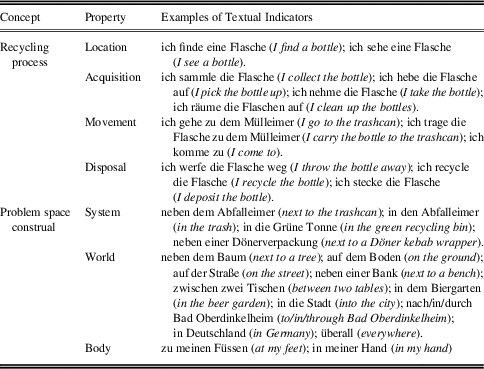
A close reading of the written narratives generated by study participants reveal the emergence of two general concepts, each of which had several qualifying properties. The first concept, Recycling process, describes the procedure of correctly recycling or disposing of objects found in the problem space, and therefore could possibly be interpreted as the ability of the participants to see themselves as subjected to – as well as subjectified by – the rules, instruments, roles, and objectives that constituted the activity system of this space. This concept is further qualified by four properties: (1) Location, which describes the process of finding an object that needs to be recycled or discarded; (2) Acquisition, which describes the process of obtaining the object; (3) Movement, which describes the process of transporting the object to a place where the participant could recycle or discard it; and (4) Disposal, which describes the process of the participant recycling or discarding the object. The second concept, Problem space construal, describes the manner in which study participants used language, including two-way prepositions, to describe and structure the problem space. This concept is further qualified by three properties: (1) System, which describes how components of the recycling and waste management systems are spatially situated with regard to each other; (2) World, which contextualizes the systems within a larger real-world context; and (3) Body, which organizes the problem space in relationship to the participant's body. A complete list of the textual indicators and organizing concepts used in the study can be found in Table 1.
The list of the textual indicators and organizing concepts used in the study
The narratives generated by the control group manifested slightly fewer instances of language to express locating an object for disposal or recycling (M=0.95, SD=0.91) than the narratives of the experimental group (M=1.23, SD=0.83); t(30)=−0.89, p=0.38. A statistically significant difference between the narratives, however, emerges when they are read for language expressing the acquisition of an object. The narratives produced by the control group (M=0.32, SD=0.48) evidenced substantially fewer instances of language for acquiring an object than those produced by the experimental group (M=1.15, SD=1.07); t(30)=−3.02, p=0.01, showing that this stage of the recycling and waste management process was a significant feature of the story maps relied upon by participants in the experimental group to structure their written narratives. Although language expressing movement was not frequently used in the narrative of either group, again there was an emerging trend that the narrative produced by the control group (M=0.11, SD=0.32) had slightly fewer textual instances verbalizing movement than the experimental group (M=0.15, SD=0.38); t(30)=−0.4, p=0.69. Only when the narratives were read for language expressing the disposal of an object did the control group (M=3.32, SD=2.08) outperform the experimental group (M=2.54, SD=1.76); t(30)=1.10, p=0.28. A graphic representation comparing the narrative concepts generated by both groups to express the recycling and waste management activity system can be found in Figure 3.
The graphic representation comparing how both groups constructed the activity stages of the written narrative
An examination of the manner in which the problem space was construed reveals further interesting patterns. On the whole, narratives generated by the control group showed more instances of language used to express relationships between components of the waste management and recycling systems (M=4.16, SD=1.83), whereas the narrative produced by the experimental group displayed slightly fewer instances (M=3.46, SD=1.76); t(30)=1.07, p=0.29. Although the experimental group was less likely than the control group to describe the problem space in terms of these components, it was, however, more likely to frame this problem space within other important contexts. The narrative produced by the control group manifested substantially fewer – albeit statistically less significant – instances of language situating the waste management and recycling systems within larger real-world contexts (M=0.89, SD=1.05) than narrative produced by the experimental group (M=1.46, SD=1.27); t(30)=−1.38, p=0.18. That is to say, although the experimental group employed language that, like the control group, described the relationship of objects within the waste management and recycling systems, it was more likely to use language that would anchor these systems within the lived spaces of day-to-day experience. And, unlike participants in the control group (M=0.00, SD=0.00), participants in the experimental group also tended toward using language describing the relation of their embodied condition to this system (M=0.08, SD=0.28); t(30)=−1.22, p=0.23. A graphic representation comparing how both groups construed the problem space can be found in Figure 4.
The graphic representation comparing how both groups constructed the problem space of the written narrative
5 Discussion
Study findings suggest, therefore, that immersion in a 3D-DGBLL environment probably helped participants in the experimental group to configure story maps, which they then referenced in order to construct and organize a written L2 narrative describing an imagined situation that approximated the gameplay found in the 3D-DGBLL environment. Indeed, a few participants in the experimental group mentioned that the game assisted them in formulating ideas for the written narrative and helped them to structure the story. Discussing how the game and written homework assignments functioned together, one participant wrote: “ The video game helped a lot with writing my assignment as well as the second exercise. These two generated the majority of my ideas.” Another participant even seemed to prefer the experiential nature of the game to the static text: “I felt the game helped more than reading. I felt it somewhat helped to write the story.” Generally, participants in the experimental group were excited about the new instructional format provided by the game and felt that it added variety to the curriculum. One participant even felt that the game was an added source of motivation: “The idea of the game got me more interested in the work.” Data gathered on a 9-point Likert scale measuring the apparent difficulty of producing the written narrative indicate, however, that the control group found the writing process tended towards being slightly difficult (M=5.84, SD=1.61), with the experimental group reporting an only somewhat greater amount of difficulty (M=5.92, SD=1.61); t(30)=−0.14, p=0.89. These findings differ from those reported by Neville, Shelton, & McInnis (Reference Neville, Shelton and McInnis2009), who found that the difficulty of producing a written L2 narrative was significantly less for study participants who had played a text-based interactive fiction (IF) game than those who had not. Considered in light of the IF game study, these findings suggest that participants immersed in the 3D-DGBLL environment may have experienced difficulty in translating between visual image and written text, whereas participants who played the IF game could move more fluidly between the text-based environment of the game and the subsequent written assignments. The apparent difficulty participants in the experimental group had in translating their story maps into written narratives, however, seems to suggest that story maps are not grounded in linguistic structures, but rather are based in an embodied and context-specific form of knowing that precedes and ultimately shapes linguistic expression. As suggested by DeKeyser (Reference DeKeyser2008) in his discussion of skill acquisition theory for second language learning, transfer between 3D-DGBLL environments and other educational contexts may in the future be encouraged through instruction that specifically targets both procedural and declarative knowledge: “The implication for training is that two kinds of knowledge need to be fostered, both highly specific procedural knowledge, highly automated for efficient use in the situations that the learner is most likely to confront in the immediate future, and also solid abstract declarative knowledge that can be called upon to be integrated into much broader, more abstract procedural rules, which are indispensable when confronting new contexts of use” (op. cit.: 100).
A comparison of the written narratives produced by the control and experimental groups revealed a marked difference in the way that both groups structured and interpreted the activity of their imagined personal experience. The written narratives produced by the control group generally seemed to place most emphasis on the final stage of the activity system, the disposal of an object in the appropriate recycling or waste management container, and, although usually well-written with minimal grammatical errors, tended to give the appearance of being a static literary exercise:
Die Grüne Tonne ist für Glasflaschen. Das Grüneglas geht in eine Tonne. Das Braunglas geht in eine andere Tonne. Und das Weißglas geht in eine andere Tonne. Der Pappbecher geht in den Abfalleimer. Auch die Dönerverpackung geht in den Abfalleimer. Es ist nicht schwer zu recyceln!
[The yellow container is for glass bottles. Green glass goes into a container. Brown glass goes into another container. And clear glass goes into another container. The paper cup goes into the trash can. Also the döner kebab wrapper goes into the trash can. It is not difficult to recycle!]
In this instance, the participant focused exclusively on the disposal stage of the recycling and waste management systems, using the verb geht [“goes”] repeatedly to describe imagined activity in the problem space.
Written narratives generated by the experimental group, on the other hand, tended to pay more attention to all stages of the systems, with significant attention being paid to the acquisition stage. Given that a core mechanic of the 3D-DGBLL environment was locating and gathering objects for appropriate disposal, it is not surprising to find this mechanic predominantly displayed in the narratives of those who were immersed in the environment. The increased attention that participants in the experimental group gave to the locating, acquisition, and movement stages of their narratives produced accounts that were generally much more authentic in terms of physical realism:
Der Pappbecher liegt auf dem Boden. Ich werfe ihn in den Abfalleimer. Ich finde eine Weißglasflasche. Ich werfe sie in den Weißglaseimer. Eine Braunglasflasche liegt neben einer Bank. Ich werfe sie in den Braunglaseimer. Ich sehe eine Dönerverpackung unter dem Abfalleimer. Ich nehme sie und werfe sie in den Abfalleimer. Ich sammle die Grünglasflasche von dem Boden. Ich werfe sie in den Grünglaseimer.
[The paper cup is lying on the ground. I throw it into the trashcan. I find a clear glass bottle. I throw it into the bin for white glass. A brown glass bottle is lying next to a bench. I throw it into the bin for brown glass. I see a döner kebab wrapper under the trash can. I pick it up and throw it into the trashcan. I collect the green glass bottle from the ground. I throw it into the bin for green glass.]
In this instance, the participant utilized most aspects of the activities associated with recycling and waste management systems in close proximity: locating (finde [“find”], sehe [“see”]); acquisition (nehme [“take”], sammle [“collect”]); and disposal (werfe [“throw”]). Other participants in the experimental group also included narrative descriptions of movement within these systems. For example, one participant wrote: ich trage die Dönerverpackung zu der Gelben Tonne und werfe sie weg [“I carry the döner kebab wrapper to the yellow recycling bin and throw it away”]. Although sometimes unpolished and lacking in attention to grammatical detail, written narratives produced by the experimental group generally gave the impression of relating a dynamic lived experience in a real-world space.
Finally, more subtle differences emerged in the way that both groups construed the problem space of their imagined personal experience. The written narratives generated by the control group tended to describe the problem space primarily in terms of objects found solely in the the recycling and waste management systems. Although factually correct, these narratives described a problem space that was oddly devoid of other objects that could potentially serve to situate these systems within a broader real-world context. On the other hand, the written narratives generated by the experimental group tended to frame the problem space within broader real-world contexts as depicted in the 3D-DGBLL environment: neben dem Baum [“next to the tree”]; auf der Bank [“on the bench”]; auf dem Boden [“on the ground”]; auf dem Boden neben dem Abfalleimer [“on the ground next to the trashcan”]; neben einer Bank [“next to a bench”]; unter dem Abfalleimer [“under the trashcan”]; and unter der Bank [“under the bench”]. Some written narratives in the experimental group even began to adopt the perspective of the first-person player interface from the environment. For example, one participant wrote: Ich sehe einen Pappbecher unter meinem Fuß [“I see a paper cup under my foot”]. In sum, the experimental group tended to produce written narratives of the imagined space that were not contextually isolated and disembodied, as did the control group, but rather physically situated within a simulated real-world setting of a German pedestrian zone.
6 Conclusion
The connectivity demonstrated in this study between written L2 narratives and 3D gameplay, and the story maps that may connect the two, have important implications for the second language and culture classroom. Study findings show that goal-directed player activity in carefully designed 3D-DGBLL environments seems to provide learners of a second language and culture with a more nuanced view of the activity systems that constitute a target culture, and also apparently influences how learners invoke and structure language in order to describe these systems. Indeed, the the experimental group considered the ability to experiment in real-time with simulations of an activity system to be of great instructional worth. Data gathered on a 9-point Likert scale measuring the utility of the instruction for teaching the German recycling and waste management systems reveal that the control group found its text-based instruction to be slightly less than moderately helpful (M=6.95, SD=1.08), whereas the experimental group, which used the 3D-DGBLL environment in addition to text-based instruction, found its instruction to be between moderately and very helpful (M=7.54, SD=0.97); t(30)=-1.59, p=0.12. These types of environments, therefore, may prove in the near future to be essential for teaching the spatial genres associated with transportation hubs (e.g., train stations), civic sites (e.g., pedestrian zones), economic centers (e.g., market place), or any other sociocultural site where physical space and activity systems are closely interconnected.
There is an interesting tension, however, between the realism of the written narratives produced by the experimental group and their unpolished grammatical presentation, which suggests a change that could possibly be made to the curricular implementation of the 3D-DGBLL environment. As described above, the environment was inserted between the text-based homework and the written L2 narrative as a capstone experience for synthesizing grammar and information on the recycling and waste management systems presented in the homework. A more fruitful approach may be to immerse learners in the 3D-DGBLL environment at the beginning of an instructional sequence, thereby allowing the early configuration of story maps that can be given more substantive linguistic form in exercises designed specifically around the activity systems of the 3D-DGBLL environment. At the heart of the implementation redesign suggested here is the proposition that current forms of second language instruction may be fundamentally at odds with the iterative and goal-directed activity systems characteristic of digital game-based learning. It becomes a question, therefore, of not how best to insert the game into the second language curriculum, which was attempted in this study, but rather of how to adapt and modify the curriculum so that the full capabilities of game-based learning can be fully leveraged for evidence-based instructional gain. Such an approach aligns with the suggestion made by Zheng & Newgarden (Reference Zheng and Newgarden2011), who rethink second language acquisition by grounding it in the ecological psychology concepts of perception-action, values-realizing, coaction, and languaging. In any case, more research needs to be done in order to construct a methodology for 3D game-based learning and curricular design in second language acquisition.
It should be noted that the 3D-DGBLL environment was not so much a true 3D video game as a thinly veiled computer simulation with a minimal ludic overlay. Reasons for this were the difficulties inherent in creating realistic game elements, such as non-player characters (NPCs), that could have been used to underpin more complex and meaningful gameplay and player interactivity. Accordingly, the environment did not represent a full activity system (see Figure 1) as key elements – immersion in a virtual community and division of labor in the game space – were notably absent from gameplay. The absence of these elements may have had an influence on the perception held by participants in the experimental group that the 3D-DGBL environment was less relevant to their study of German culture. The control group found their text-based instruction tended towards being very relevant (M=7.63, SD=1.30) for their study of German culture, whereas the experimental group was under the impression that their form of instruction was only moderately relevant (M=7.08, SD=1.19); t(30)=1.23, p=0.23. The question, therefore, is whether the inclusion of pedagogical agents in the form of NPCs would have provided an increased sense of cultural immersion for study participants and enhanced the development of more culturally-specific story maps (Kim & Baylor, Reference Kim and Baylor2006, Reference Kim and Baylor2007). More research needs to be done on formulating best practices to include pedagogical agents as more capable linguistic and sociocultural peers in 3D-DGBLL environments.
Finally, it is a moderately difficult and time-consuming process to design a 3D-DGBLL environment. As the gameplay this environment fosters is more structured and predictable than in virtual worlds, however, it can be implemented in a level-appropriate manner in support of an activity-based second language curriculum. An open source effort to design these 3D-DGBLL environments and supporting curricular materials would help to facilitate the design process, and would also benefit the widest range of students, instructors, and researchers. As 3D game programming and development will certainly become easier and more ubiquitous in the coming decade, it would behove us as a profession to leverage the instructional affordances of these environments in order to remain relevant and vibrant in the 21st century.
Acknowledgments
Funding for the study was made possible by grants from the Center for the Advancement of Teaching and Learning (CATL) at Elon University and the CATL Scholar Program.