1 Introduction: CALL and phraseology at the crossroads
Computer-assisted language learning (CALL) is concerned with the use of computer technology in second language learning, thereby attempting to provide computer-based resources to improve language learning and teaching practices. But to what extent may CALL contribute to students’ learning of phraseological units, that is, lexico-grammatical clusters or ‘chunks’ incorporating everyday experience? By and large, phraseology is concerned with the study of those chunks which, be they collocations or idioms, constitute some crucial cognitive, textual and pragmatic tools to be mastered by the language learner. As Sokolik (Reference Sokolik2001: 487) underlines in her overview of CALL, “corpus linguistics and concordancing can help provide the data and tools that students and instructors need to make sense out of usage”. CALL applications and phraseology may thus provide invaluable resources for the student’s knowledge of multiword units such as de-lexicalized verbs which often function differently from stretched or support verbs. Prior to undertaking a detailed case study exploring this phenomenon and its implications for language learning, some remarks will be made on CALL, phraseology and their interface. As described in more detail below, this paper will thus examine the potential of CALL resources for improving foreign language learners’ phraseological knowledge.
1.1 CALL
No-one would dispute nowadays that multimedia and the Internet have an incredible potential to make a huge impact on language teaching. For the moment, however, both technologies present challenges which are every bit as great as the opportunities they open up. Experienced teachers know that they are very demanding in terms of time: a good CD-ROM can take hours to explore. Likewise, the riches of the Internet, especially since the advent of the Worldwide Web, can lead users into hours of ‘surfing’ with very little concrete material to show at the end of it. CALL has thus become a new, but well-established, scholarly domain researching the pedagogical possibilities provided by computers and the Internet for increasing language learners’ communicative skills (Warschauer & Kern, Reference Warschauer and Kern2000; Warschauer, Reference Warschauer2001; Blake, Reference Blake2001; Davies, Reference Davies2002; Godwin-Jones, Reference Godwin-Jones2005; Oster, Ruiz Madrid & Sanz Gil, Reference Oster, Ruiz Madrid and Sanz Gil2006). CALL may be broadly defined as “any process in which a learner uses a computer and, as a result, improves his or her language” (Beatty, Reference Beatty2003: 248). Evolving from more technical approaches to and definitions of the term CALL, such as Levy’s (Reference Levy1997), to the emphasis on its pedagogical implications (Egbert, Reference Egbert2005), the notion of CALL has come to be “used to describe the introduction of computers into the field of L2 learning and teaching” (Ruiz-Madrid, Reference Ruiz-Madrid2007: 64). As Sokolik (Reference Sokolik2001: 486) stresses in her examination of the forms and functions of computer technology in language learning, “it is clear that computers are providing instructors and students alike with a new battery of tools with which language can be learned more effectively”. Work by Hanson-Smith (Reference Hanson-Smith2000), Warschauer and Kern (Reference Warschauer and Kern2000), Chapelle (Reference Chapelle2001), Godwin-Jones (Reference Godwin-Jones2000), Jeong-Bae (Reference Jeong-Bae2004), Szendeffy (Reference Szendeffy2005), Smith and Baber (Reference Smith and Baber2005) or Kern (Reference Kern2006), just to quote a few examples, evidences the potential of computers for language learning and teaching having shaped CALL as a vibrant academic field. In particular, concordancing, and other corpus-related activities based on electronic corpora – which is closely related to the case study conducted in this contribution – “lends itself to a range of classroom activities […] particularly as large-scale corpora become generally available, together with the techniques for analyzing them through corpus linguistics” (Johnson & Johnson, Reference Johnson and Johnson1999: 83), thereby substantiating the potential of corpora for classroom activities in language learning and teaching.
Bearing this context in mind, it is obvious that CALL education is growing fast as the learning of languages is linked with technology competence. This paper is focused on project-based learning (Beckett & Millers, Reference Beckett and Millers2006) exploring how collocational competence may be integrated into English language programs in both the Technical University of Madrid and the University of Castilla-la Mancha, Spain, by developing a multiword unit dictionary which will enhance the collocational competence of students. We also focus on a specific type of collocation, give + noun, in the two languages, in order to ascertain the points of contact and departure.
1.2 Phraseology: definitions, contrastive analysis and use
Phraseology has now come of age. For a long time, both linguists and psychologists have paid attention to multi-word units as syntagmatic patterns (Firth, 1951: 190–215; Cowie, Reference Cowie2004: 37–52) and tried to analyze how they are represented in the lexicon. They have noticed that language is acquired in cohesive lexico-grammatical clusters or ‘chunks’ which capture everyday experiences and constitute crucial cognitive, textual and pragmatic tools to be mastered. Many authors have highlighted the enormous difficulty in clearly defining and delimiting this complex of features that interact in various, often untidy, ways and represent a broad continuum between non-compositional – or idiomatic – and compositional groups of words (Moon, Reference Moon1998: 6). This author calls them fixed expressions and idioms (FEIs).
These FEIs or chunks are usually examples of formulaic language (Nattinger & de Carrico, Reference Nattinger and de Carrico1992; Wray, Reference Wray2002), in which word strings occurring together tend to convey holistic meanings that are either more than the sum of the individual parts or else diverge significantly from a literal, or word-for-word meaning, and operate as a single semantic unit. Gries (Reference Gries2008: 4 and ff.) identifies a set of parameters worthy of attention that are typically implicated in phraseological studies:
i. the nature of the elements involved in the phraseologism;
ii. the number of elements involved in a phraseologism;
iii. the number of times which an expression must be observed before it counts as a phraseologism;
iv. the permissible distance between the elements involved in a phraseologism;
v. the degree of lexical and syntactic flexibility of the elements involved;
vi. the role that semantic unity and semantic non-compositionality/non-predictability play in the definition.
He then defines what a phraseologism is (op. cit., 2008: 6), a definition accepted in this study: “the co-occurrence of a form or lemma of a lexical item and one or more additional linguistic elements of various kinds which functions as one semantic unit in a clause or sentence and whose frequency of co-occurrence is larger than expected on the basis of chance”.
1.3 Bridging the gap between CALL and phraseology
An exploration of the literature on the subject reveals that work in CALL has focused on various topics related to lexicography such as on-line dictionaries and the introduction of their use as part of CALL (Campoy, Reference Campoy2004: 47–72); use of audio files in computer mediated dictionaries (Sobkowiak, Reference Sobkowiak1999: 246 ff.); dictionary usage guidance in paper dictionaries versus online dictionaries (López & Campoy, Reference López and Campoy2003); user typology (de Schryver, Reference de Schryver2003: 151); or simultaneous look-up in dictionaries with the same information (Luzón, Reference Luzón1999), to quote a few relevant examples. Given the emphasis of this article on phraseology, it is to be noted that, in addition to grammar and vocabulary practice computer programs, the use of concordance programs has been discussed as another means for vocabulary and grammar practice where “the students can view many examples of usage and compare them to their own writing without having to search manually through many pages of text” (Hanson-Smith, Reference Hanson-Smith2004: 111) as well as on-line concordancers which help students use search engines to find typical collocations and grammatical or rhetorical items on the internet (Mills, Reference Mills2000). However, no work has been done so far on specific types of collocation that support verb constructions, which are frequent in oral and written genres. Our examples in English and Spanish reveal that these flexible collocations are widely used in discourse simply because they are adaptable to a wide range of situations. However, we have noticed that non-native speakers tend to underuse these de-lexicalized collocations. Therefore, CALL is a useful means of paying attention to them, enhancing the students’ production and understanding of these phrasemes as well as improving their communicative competence in general.
1.4 Scope, purposes and methodology
The studies in L2 raise an awareness that a significant proportion of the language that we produce is made up of collocations and idioms, labelled as formulaic sequences or phrasal units by other authors (Sinclair, Reference Sinclair1997: 82). If this is the case for native speakers, a logical consequence is that learners of English will also find these formulaic sequences very important and useful. Keeping this context in mind, it is fairly obvious that teachers should try to increase the acquisition of these sequences by learners, and design teaching materials highlighting the similarities and differences between English and Spanish. In section 2 of this article, through a detailed case study exploring phraseological units from a contrastive perspective, we report on current research (DUFIE, see footnote 1) on multiword units taken from a contrastive approach in English and Spanish. Section 3 focuses on a subgroup of these collocations known as de-lexicalized, light, empty, thin, stretched or support verbs (Jespersen, Reference Jespersen1942; Mel’čuk, Reference Mel’čuk1993; Allerton, Reference Allerton2002). In particular, the overall aim and the subsequent methodology of this paper is two-fold:
Firstly, to present on-going research (DUFIE) into contrastive multiword units in English and Spanish. The main tenets of collocations from a contrastive perspective – and the points of contact and departure between both languages in this specific type of collocation – are accordingly examined though a case study which considers the pedagogical implications of phraseology usage within a broader CALL.
Secondly, to analyze these collocational structures in the subsequent sections, with a focus on the commonest types of verb + noun combinations, and especially on what is known as de-lexicalized, light, empty, thin, stretched or support verbs (Jespersen, Reference Jespersen1942; Mel’- čuk, 1993; Allerton, Reference Allerton2002), such as give one’s approval for. The analysis in the case study may also serve as an example of the CALL implications of collocational usage by foreign language learners.
More specifically, we want to determine the weight of dar in the most widely accessed on-line Spanish corpus, that is, the Corpus de Referencia del Español Actual (CREA) and of its English equivalent support verb constructions (i.e., give access, etc.) in the British National Corpus (BNC). Both corpora have over a 100 million words, are linguistically representative and easy to access. The aim of this study based on empirical data is to provide relevant insights for more accurate translations and to enhance the collocational competence of L2 students (Bahns, Reference Bahns1993), who tend to avoid these constructions in favour of full verb forms (i.e., to access, account, etc). Examples from our teaching experience show that the translation of collocations is difficult for non-native speakers. They also prove that many collocation translations are idiosyncratic in the sense that they are unpredictable by syntactic or semantic features. Taking a broader pedagogical perspective drawing upon the implications of corpora for language learning and teaching, we aim to demonstrate that combined and integrative use of phraseology and CALL may thus provide most helpful insights not only for contrastive collocational analyses across languages but, more importantly, for foreign language learners and teachers who need to acquire collocational knowledge and competence. Arguably, quantitative and qualitative comparisons of collocations based on electronic corpora are greatly needed to highlight the similarities and, more importantly, the lexical and typological differences between both languages for a more fruitful use by English as a Second Language (ESL) learners. With a view to facilitating lexical and cultural acquisition in the L2, all these findings are to be reflected in an electronic translation-oriented electronic dictionary of collocations and idioms for advanced learners of English which may be employed as an invaluable CALL instrument.
2 Background to the study: the DUFIE project
This project started from a strong conviction that the collocational needs of students learning English are not adequately met by the range of bilingual or monolingual collocation dictionaries available. Collocations (e.g., horse riding), proverbs (e.g., you can lead a horse to water but you can’t make it drink) and idioms (e.g., eat like a horse) are grouped indiscriminately along with other phraseological units. From a translation perspective, three facts are to be taken into account for translating multiword units as accurately as possible:
a) Literal translation of the constituents should be avoided because phraseological units only rarely have the same form in the TL, leading to an ‘unnatural’ equivalent at best (e.g., a severe winter > *“un invierno severo”). The adjectives inclemente or crudo are better options here, with three tokens and seven respectively in the Spanish Royal Academy Corpus, CREA(Corpus de Referencia del Español Actual). Literal translation may also lead to a mistranslation at worst, which is totally meaningless for a non-native speaker (e.g., no querer alhajas con dientes > *“not to want jewels with teeth”). The latter Spanish expression means “to reject a valuable present such as a jewel (alhaja) because it is not a real gift in fact”.
b) The starting point for the rendering of the phraseological unit should be its meaning, rather than considering it as a unit of form. Moreover, as phraseological units can be polysemous, it is the meaning in context that must be rendered. Thus, the meaning of estar chungo is different in the sentence María está chunga (i.e., “María is in a bad way, out of sorts”) and the sentence La cosa está chunga (i.e., “Things aren’t too good”).
c) The meaning of the SL phraseological unit can be rendered in one of three ways:
• by an equivalent phraseological unit in the TL, if one exists: al pan, pan y al vino, vino >“to call a spade a spade”;
• by a single word (in order to > “para”);
• by a paraphrase (nobody took a blind bit of notice > “nadie le hizo ni pizca de caso”).
The problems that learners face while translating or trying to produce acceptable collocational patterns in their speech, writing, and translation show a certain regularity. We were concerned by the similarities in this research but, above all, by the diversity in the meaning, structure and use of set phrases in the two languages, bearing in mind that these set phrases constitute a major aspect of any language and become a frequent difficulty in translation courses, a fact which has been proven empirically by Tirkkonen-Condit (Reference Tirkkonen-Condit2002) in her study of translation errors hampering the target texts.
The aforementioned arguments substantiate the need to produce a better phraseological dictionary for advanced learners of English, to improve their performance in translation in particular and enhance their collocation skills in general. Selecting the most significant FEIs proved a difficult task, as we were struck by the significant diatopic, lexical and even grammatical variation in their use. These variations have been included whenever possible.
So, the aim of this lexicographical project is to include updated general English collocations, idioms and multiword units with their translation equivalents into Spanish. If there is not an equivalent multiword unit, we look for a functional equivalent. At the first stage, the most significant 10,000 multiword units from the Bank of English and the BNC were included, explaining relevant cultural information with usage notes when necessary. We have included terminological collocations as well, as many disciplines or technical domains create their own set phrases and multiword terms. At the second stage, the most relevant English multiword units have been translated into Spanish, including examples of real usage following Cowie’s taxonomy (Cowie & Mackin, Reference Cowie and Mackin1993: xii–xiii).
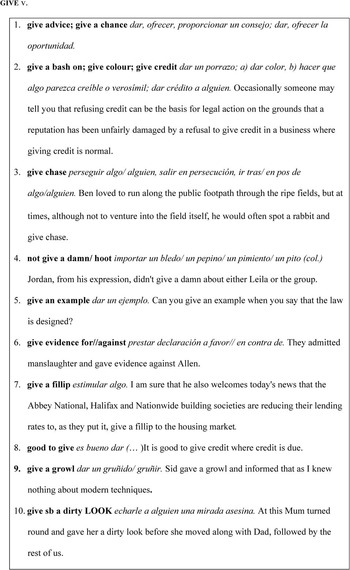
Figure 1 includes just a few examples of a DUFIE entry with the word give with its 59 most frequent collocates. One example of real usage from the BNC, the Bank of English or the Internet is included in each multiword unit. Hyperlinks with other entries are marked in yellow. Collocations or idioms that take on different meanings in different contexts are indicated in translation separated by slashes offering different alternatives as in example 4. Last but not least, the reader gets information on whether the multiword unit is typical of British or American English – blow your own trumpet (BrE)/blow your own horn (AmE) – whether it is more common in oral English, and register indicators (colloquial, slang, etc.).
Examples of multiword units with give as a key word.

This dictionary focuses on lexical collocations, which do not normally comprise prepositions, infinitives or clauses as grammatical clusters. The prototypical structure of lexical collocations is usually formed by substantives, adjectives, verbs and adverbs. The electronic dictionary will help to identify these specific subgroups of collocations such as support verb constructions made up by verb + noun, as in section 3 of the paper.
3 Case study: contrastive analysis of support verb constructions with give/dar in two comparable corpora using the BNC and the CREA
A light verb, such as give, take, or make, is combined with a wide range of complements from different syntactic categories to form a new predicate called a light verb construction or support verb construction (LVC/SVC). From a semantic perspective, these constructions consist of a predicative noun and a support verb. The fundamental idea of a SVC is the realization of the arguments (i.e., the semantic actants) of the predicative noun as syntactic actants of the support verb. Prototypical support verb constructions are semi-compositional structures consisting of a semantically transparently used noun and a verb that is semantically reduced and adapted to the construction.
These expressions form a cline of idiomaticity from ‘clearly idiomatic expressions’ (e.g., take time, have a look) to ‘relatively idiomatic expressions’ such as have a chance, take a walk, make a statement, where the meaning of individual words is retained up to a certain extent and there are expressions that retain the core meaning of these verbs at the other extreme (Biber, Johansson, Leech, Conrad & Finegan, Reference Biber, Johansson, Leech, Conrad and Finegan1999: 1027): e.g., you can take a snack in your pocket, he made a sandwich. These support verbs (e.g., do, make, get, give, do, take and have) are, according to corpus research, some of the most frequently used words in the English language. Some people also call them ‘empty’ verbs because they usually have very little meaning. They are also particularly important for speakers of Latin languages because students avoid or do not even feel the need to use them as there is normally a one word translation between their L1 and English. However, when speaking, learners can sound odd or strange to the native speaker as their choice of language is different.
We decided to analyze support verb constructions with give, which is halfway between full lexical verbs and auxiliary verbs, in the BNC, and wanted to compare them with their Spanish homologues in the CREA, as the literature on this topic points out that in languages such as French, Italian, Spanish and English, support verb constructions are semi-productive (Wierzbicka, Reference Wierzbicka1982; Alba-Salas, Reference Alba-Salas2002; Kearns, Reference Kearns2002). Both corpora are considered comparable in corpora studies (Hornero, Luzón & Murillo, Reference Hornero, Luzón and Murillo2006) as they are both over 100 million words, despite the fact that there are differences in the way they have been compiled.
Hence, the data in this paper consist of twenty-four support verb collocations in English with give and their Spanish translation, dar, in most cases attested in bilingual dictionaries and bilingual translated texts from the EU website. We have chosen noun collocates with a high frequency in both languages. Our references in Spanish are Ueda (Reference Ueda1989), who selected the most common nominal collocates (2,727) and the dictionary Diccionario de Uso del Español (Dictionary of Spanish Usage) by Moliner (Reference Moliner2000), as it indicates the verb collocates that usually go with the de-lexicalized base. In English the raw frequencies of the infinitives comprise occurrences in all the BNC subcorpora and in Spanish we have followed the same criterion with the CREA. We have excluded tense and number variation but we have included lexical variation to check whether the support verb construction with give/dar was more usual or not.
3.1 English
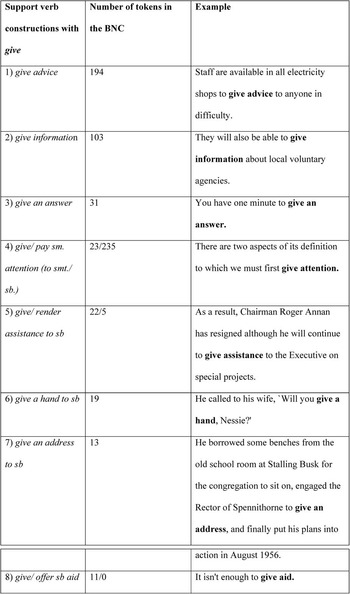
Twenty-four noun phrases combining with give in the infinitive form were selected using concordances. It is imperative to notice that most nouns are abstract (e.g., gives a speech) in comparison with common collocations in the oral register with other support verb constructions such as have a baby etc. However, there are examples such as give someone a present, give money, give a book which have literal meaning and the noun is concrete. Light verb usages of give constitute a continuum of meaning from literal uses at the core to figurative ones located at the periphery such as give a push, give a kick (see Figure 2).
Support verb constructions with give in the BNC.

(continued)

Other give collocates have been barred such as give somebody a present, give up one’s seat because its core meaning – ‘pass good news to owner’ – is rare in this use. There are also other core meanings of give such as ‘allow/permit/grant freedom to act’ as in give somebody access, give somebody admission, give somebody authority which are not so common either according to Allerton (Reference Allerton2002: 180) and, consequently, have been excluded from the analysis as well.
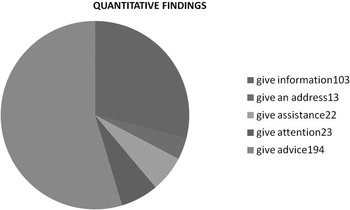
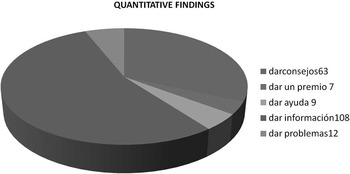
Attention is paid instead to the commonest core meaning – perform a service for others – as exemplified by give somebody aid, give somebody an answer, give somebody an appointment, etc. In most cases, give as a thin verb is used for action that is beneficial to the speaker, performing a service for them, with some exceptions: give somebody a beating or give somebody one’s attention is not necessarily of benefit to the recipient. The nouns that collocate with give in our data are in line with its sub-meanings: what is given is usually a right or permission to act (i.e., give access, admission, etc.). The thing given can also be information (give an answer, give assurance) or a different kind of general service (give aid, applause, attention, etc.), or a particular one, according to Allerton (Reference Allerton2002: 181) such as give an appointment, a bath, etc. This also seems to be the case with the Spanish counterparts. See graph 1 for the five most common uses in our data.
Graph 1

In our corpus-based approach, the collocational patterning of give collocates with words with pleasant connotations such as advice, assistance, hand. If the starting point is the lexical item, one may find a range of verbs which collocate with the noun. Such is the case with attention, which not only collocates with give* but also with pay*. Concordancing these two verbs shows that give is associated with informative texts and pay has a more positive semantic prosody, as in the following examples:
(1) There are two aspects of its definition to which we must first give attention.
(2) After visitors have departed, nurses should pay attention to a patient’s non-verbal behaviour as well as to what is said.
It is also important to point out that give tends to appear interpersonally marked with modal verbs such as must or need to, which provide subjective meaning with a deontic value as in:
(3) Although it is often claimed that the camera does not lie, when using old photographs for historical purposes pupils need to give attention to the processes involved in choosing a subject and taking a photograph.
Another point of interest is that pay appears in imperative forms:
(4) Pay attention to contrasting colours, [[…]].
After examining the highest collocation in our corpus, give attention, the collocational patterning of give information was examined. Its 103 examples in the BNC show that this support construction is frequently encountered and accessed in English. From the ideational standpoint, this collocation is used to provide objective and fact-driven data as in the following example: Europe wants shops to give information on the efficiency of all white goods, televisions and hi-fis, computers, ovens, lights and other household appliances down to the smallest toaster. It is fairly obvious, however, that language is multifunctional and the interpersonal function is also prevalent in many instances of this collocation. Lexical markers such as adjectives and adverbs are often stance markers evaluating the content of utterances as in: So there’s a kind of critical period here that we have got a lot of information about.
Give an answer is the third highest collocation. The key concept is ‘answer’ and falls under the suasion function (Wilkins, Reference Wilkins1976: 46), specifically used to persuade, suggest, advise, advocate, etc., that is, affecting the behavior of others. A recommended course of action is put forward to solve an existing problem, as in the following news report:
(5) A Northern Ireland nurse has condemned local maternity hospitals for failing to give information useful to expectant mums.
Last but not least, it is to be noted that there is a dispersion of results in the remaining collocations with give indicating different types of verbal processes. Give recommendations is found in the Introductions as many as three times in the present simple active:
(6) The manual’s sections take each aspect of a hotel operation in turn and give recommendations for action.
Interpersonality is lacking in the three examples and this SVC is normally used cataphorically as in the former example. However, many of these give collocates may be related to the interpersonal function and tend to have positive semantic prosodies and occupy Rheme position, e.g., Provide paints and give a prize for the best-decorated egg.
As a conclusion to the analysis of the BNC data, our findings of the lexico-grammatical patterns of give + noun reveal three additional phenomena:
a) Texts strongly favour full lexical verbs to verbalize phenomena and processes in the BNC instead of support verb constructions, as the raw frequency of tokens of assist/give assistance attest: assist (2512) vs. give assistance (22). The Spanish support verb constructions with dar clearly show this preference as well: gruñir (49) versus dar un gruñido (2).
b) Give as a thin verb in our data suggests action that is beneficial in the sense of facilitating action by other people, informing or performing a service for them.
c) Lexical variation should be taken into account: there are 23 instances of give attention in our corpus versus 235 of pay attention. Corpus analysts should therefore analyze not only the verbs but also the nouns as a starting point in order to get the full range of verb collocates.
By and large, the work herein presented may be regarded as a step towards a better understanding of collocational links of support verb constructions for the purpose of learning and Natural Language Processing (NLP). As stated above, phrases with these types of verbs are fairly frequent in English and pose serious problems for learners and translators alike. It must be borne in mind that the support verb cannot be translated by the default equivalent of the ‘heavy’ sense of the verb. It is incorrect to translate give evidence into Spanish as * “dar declaración”, as the appropriate collocation is “prestar declaración”. Point 3.2 discusses how give + noun collocates behave in Spanish.
3.2 Theoretical underpinnings and quantitative/qualitative analysis of light verb constructions in the Spanish data
Koike (Reference Koike2001) has studied lexical collocations in general, but has also paid attention to support verb constructions which he terms general functional verbs (2001: 69), and sheds light on the dar+noun support construction, which is highly productive in his frequency lists. He comments that the verb dar [“to give”] is transitive and loses its original semantic meaning when it is used in de-lexicalized verb constructions such as dar una bofeta [“to slap somebody in the face”]. In very general terms, he also states that dar can be used with either concrete or abstract nouns such dar un regalo [“give a present”] or dar información [“give information”] respectively. Dar admits synonymy in certain constructions (e.g., dar/pegar una paliza; dar/emitir una opinión; dar/causar/producir vergüenza) and diatopic variation (e.g., dar una bofetada in Peninsular Spanish versus fletar una bofetada in Chile and Peru).
Furthermore, Koike notices five other important facts about dar as a support verb construction:
a) Verbs related morphologically to nouns which appear in these support verb collocations do not show a tendency to form collocations themselves. Thus, the verb aconsejar does not collocate as the noun consejo [“advice”] does with the verb dar in the delexicalized verb constructions dar un consejo [“give advice”].
b) Action, motion and sound nouns are compatible with dar such as (i) nouns related to blows: dar(se) un golpe > “to hit/ bang” (your head, etc.), dar una torta > “to hit somebody”; and (ii) nouns related to sounds: dar un aullido > “to give a howl”. There are also other animal sounds using dar + noun construction not commented upon here for brevity’s sake (see Koike, Reference Koike2001: 111 for a full account).
c) dar + se, the impersonal pronoun, has mostly negative semantic prosodies: darse un atracón > to gorge or stuff oneself, darse un batacazo > to fall over and bang your arm, leg, etc., darse una paliza > to work one’s butt off (AmE)/ to slog one’s guts out (BrE) or darse un susto > give him/her a fright. Nevertheless, some are neutral: darse una ducha > to take/have a shower; darse maquillaje > to put one’s make-up on.
d) Some constructions have a causative value arising from the noun phrase: dar alegría > make sb happy, dar angustia > cause great anguish or distress.
e) Koike (Reference Koike2001: 85) points out that the support verb construction dar + substantive is the most common light verb collocation, followed by tener (to have + noun). The former is a common lexical collocation with different processes:
• Processes of communication > dar respuesta, dar consejos.
• Processes of cognition and decision-making > dar la aprobación, dar ayuda.
• Processes of change of state > dar un premio.
• Dynamic durative verbs (taking place over a period of time) such as activities performed by animate agents: dar articulación.
• State of emotion or attitude verbs: dar un gruñido.
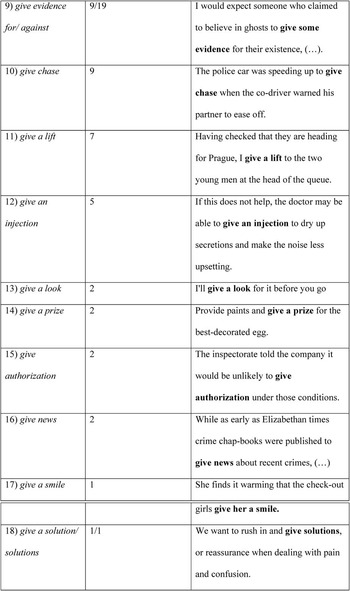
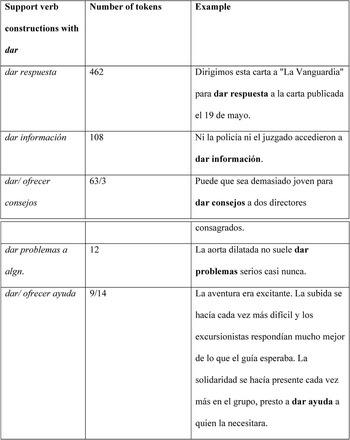
We have studied the equivalent phraseological units whenever possible in the Spanish corpus with dar. There are sometimes several possible translations into Spanish as stated above (give information > dar/proporcionar información), but we have worked mainly with the direct translation to see the quantitative differences between languages (see Figure 3). Ten tokens of dar + noun are shown in box 2. No tokens have been found of dar un gruñido [“give a growl”] or dar articulación [“give articulation to smt.”], exactly the same as in English. Their past tense forms are also practically negligible: 2 and 0 tokens in that order.
Graph 2shows the 5 most common occurrences of SVC dar + noun.
Support verb constructions with dar in CREA.

Graph 2

Our way of looking at collocation is to start with the verb and then move to the noun, which raises the question of a word’s semantic prosody. Dar collocates with words with both unpleasant connotations e.g., dar un gruñido [“to give a growl”] and positive semantic prosody such as consejo [“advice”] or premio [“award”]. At a later stage we decided to study the noun to check with concordances with which verbs an item frequently collocates. This second procedure also sheds light on a range of verbs which collocate with the nouns such as dar/ofrecer consejos [“give advice”].
There are 462 tokens in total for respuesta [“answer”] which coupled with dar proposes a solution to different problems. It is the most significant collocation in the Spanish corpus as can be seen in graph 2, followed by dar información, dar consejos, dar problemas and dar ayuda. The analysis will focus on the three most common collocates, so that the quantitative results of the most common collocates in both languages will be discussed.
Looking at the 35 tokens in the technical texts genre, the active voice patterning of dar respuesta has a cataphoric function indicating the content of the answer as in the example below:
(7) Los empresarios, agricultores y campesinos, deben dar respuestaa la demanda de los consumidores sobre**
However, when this construction occurs in the past tense, it has an intertextual function as it makes reference to a previous solution or lack of it as in the following example:
(8) ¿No le hablaron? EVA. Sí, señor, pero no dio respuesta.
When we looked at this noun in the plural, unlike the tokens in the singular form, we realized that it patterned quite differently. Whereas the singular form does not collocate with adjectives, the plural shows a tendency to collocate with evaluative adjectives such as inmediate, clear, satisfactory (cf. Thompson & Hunston, Reference Thompson and Hunston2000: 6):
(9) Las explicaciones de coyuntura no bastan ya para dar respuestas satisfactorias.
Dar información is also a highly productive collocation in our corpus. Its occurrence is similar to English and is used overwhelmingly in the news genre (61 tokens out of 108). This finding is not very surprising as información is admittedly a keyword in the press genre. The remaining 47 tokens for dar información are scattered in different text types, predominantly in those with a strong ideational component: Politics and Economics (40 tokens), Science and Technology (12 tokens), etc.
Dar consejos contributes a notion of ‘abstract transfer’ as give advice in English, while in dar un gruñido, dar incorporates a nuance of ‘emission’. It is scattered in different genres and is related to the interpersonal function in oral texts, for example:
(10) Bueno, a mí no me gusta dar consejos a nadie, y menos en público, ¿no?.
It should also be noted that dar consejos falls into the category of ‘proposing/recommending a solution’ to different problems as well as dar/ofrecer ayuda [“give help”], which also appears in CREA with 9 and 14 tokens respectively.
Finally, seven SVC constructions with support verbs other than dar have been found. The figures of the full lexical verb have been included because they clearly indicate how Spanish speakers and writers strongly favour the use of the full lexical verbs with the notable exception of the first collocate, hacer público in 1 and soltar una carcajada in 5, which is preferred instead of the full lexical form:
1. Hacer público (163)/publicar (2510) [“give an airing to”]
2. prestarle ayuda (13)/ayudar (6442) [“give help”]
3. prestar atención (434)/atender (5150) [“give/pay attention”]
4. poner una inyección (12)/inyectar (299) [“to give an injection”]
5. soltar una carcajada (17)/carcajearse (11) [“to give a laugh”]
6. echar/lanzar una mirada a alguien [“to give a look”].
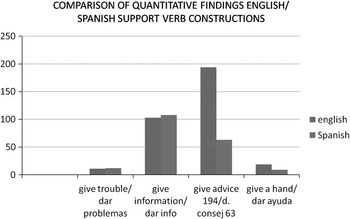
A final examination of graph 3, comparing the quantitative results, shows a similar use of the collocations give trouble, give information and give a hand in both languages. The only marked quantitative difference is give advice, with 194 tokens in English versus 63 tokens in Spanish. This difference may be due to the different compilation techniques in both corpora. Despite the fact that both have a similar number of words, the CREA corpus is strongly biased in favour of written texts, with just 10% of oral texts. As this particular collocation is more related to oral speech in both languages, this difference would be easily balanced if the oral component in both corpora were the same.
Graph 3

4 Conclusions
From a strictly phraseological viewpoint, the present paper has tried to offer an overview of the synchronic usage of multiword units in corpus data in English and Spanish, focusing on support verb constructions with give+noun collocations and showing that they are inherent to language use. The collocational patterns which we have studied are related to what is typically said, rather than what can be said, but they admit lexical, diatopical, register and tense variation. From a quantitative point of view, we expected to find more support verb constructions with give in English, as it is a frequent de-lexicalized verb according to the Collins Cobuild English Grammar (Sinclair, Reference Sinclair1990: 147). Nonetheless, its figures are fairly low with the exception of give advice and give information. The Spanish data show that the use of the dar + noun construction is significantly higher than in English. On the other hand, from a qualitative point of view, this bilingual comparison exercize of support verb collocations renders interesting insights about certain coincident phenomena in both languages. First of all, these support verb constructions are related mainly to abstract nouns, although it is also feasible to find some constructions with concrete nouns in Spanish. Secondly, the use of these clusters tends to portray a factual view of reality (give information/dar información). Thirdly, nouns play an important role in both English and Spanish collocations because they select the verb and its syntactic demands. This verb selection materializes in fixed expressions like hacer una excursión [“to go on an outing”] since we use the verb dar (literally, “to give”) with the noun paseo in the support verb collocation dar un paseo [“to go for a walk”].
Considering the overall CALL implications of a study like this, it seems to be clear that English as a second language (ESL) teachers should draw attention to these contrasts if they want their students to use collocations as native speakers do. Obviously, this requires explicit training in the use of collocations, through the use of corpora in class, and of de-lexicalized collocations in particular – in accordance with to CEF standards – to raise both an awareness of ideational, interpersonal and textual functions, and also of authorial and distributional factors at play in each genre. An electronic dictionary like DUFIE may be an invaluable resource in this respect and, more importantly, the analysis herein conducted may provide insights into the benefits and possibilities of CALL applications like this for language learning education in general, and collocational knowledge and proficiency in particular. McCarthy (Reference McCarthy1990: 12) stresses that “the relationship of collocation is fundamental in the study of vocabulary”, and thereby is a major area of concern for learners of EFL, which converts bilingual dictionaries of multi-word expressions into an invaluable resource for both learners of EFL and translators. Assuming that “all fluent and appropriate language use requires collocational knowledge” (Nation, Reference Nation2001: 318), electronic dictionaries like this may become a fundamental instrument for CALL-oriented educational practices.
The pedagogical implications of a study like this are clear. Indeed, the study herein conducted is just an example of the possibilities for foreign language education based on CALL resources. As it is, it is extremely important that students grasp not only the conventional grammar but also these support verb constructions (obviously with give but also with other verbs such as make, take, etc.) in connection with syntax, semantics, pragmatics and each respective culture. Furthermore, awareness of the collocational points of contact and divergence should be raised among teachers and students in order to facilitate acquisition by underscoring the potential lexical, genre and register differences. Our teaching experience over the years has proved that students learn English more naturally if encouraged to use and build collocation repertoires in the classroom. An electronic dictionary like this may be most useful in this respect. As substantiated by the case study herein presented, the use of corpora in class offers great potential for language teaching in general and for collocational knowledge in particular, which seems to be consistent with current trends in corpus linguistics applications of language teaching and learning (cf. Gabrielatos, Reference Gabrielatos2005; Aijmer, Reference Aijmer2009).
Apart from the examples studied in this paper, the DUFIE dictionary also offers standard and typical phraseology of other types, simultaneously available to language learners and translators with an on-line dictionary as a reference database identifying and translating multiword units in both English and Spanish. Although our primary data has been selected from corpora, the Internet is also playing an increasingly crucial role in sorting out the most recurrent and widely used grammatical and lexical collocations.