1 Introduction
A substantial body of research investigating negotiated interaction in face-to-face (F2F) settings has suggested that negotiation of form or meaning may facilitate foreign or second language (L2) development (e.g., Mackey, Oliver, & Leeman, Reference Mackey, Oliver and Leeman2003). In the past few decades, this area of research has been extended to include computer-mediated communication (CMC) for L2 learning as it provides learners with opportunities to initiate negotiation in the L2 either asynchronously or synchronously (e.g., Lee, Reference Lee2001). Social software tools such as Facebook have been shown to support student-centered learning (Blattner & Fiori, Reference Blattner and Fiori2009) and to increase students’ motivation or participation in learning an L2 (Kabilan, Ahmad, & Abidin, Reference Kabilan, Ahmad and Abidin2010). It would be interesting to examine whether the interactions in other CMC tools, such as wikis and MSN Messenger, can also be found on Facebook.
Despite the usefulness of the social software tool applied in L2 learning contexts, there is no research investigating learner factors that influence interactional patterns, such as proficiency levels or the presence of native speakers. The present study builds upon previous research in second language acquisition (SLA) on learners’ interaction to examine how those factors affect the negotiated interaction between native English speakers and learners and between learners at different proficiency levels on Facebook.
2 Negotiated interaction in SLA
Negotiated interaction in SLA has received considerable attention and been researched from different theoretical perspectives. Interactionist approaches to SLA underlie the assumption that learners benefit from negotiating with their conversational interlocutors regarding unknown words or expressions in order to increase the comprehensibility of the new linguistic items. In light of this, previous research in an F2F setting has revealed how such negotiation may facilitate SLA by assessing the interaction between interlocutors (Long, Reference Long1996; Varonis & Gass, Reference Varonis and Gass1985). In a similar vein, sociocultural theory assumes that cognitive developmental processes occur in collaborative interaction between interlocutors in a social environment (Lantolf & Thorne, Reference Lantolf and Thorne2006; Vygotsky, 1978) where learners negotiate with their conversational partners by clarifying and confirming each other’s utterances and correcting their own or others’ errors. The collaborative dialogue between the learners and their interlocutors entails problem-solving and knowledge-building activities, enabling linguistic knowledge internalization to occur (Swain, Reference Swain1995, Reference Swain2000).
2.1 Frequency of negotiated interaction between dyads
To date, interaction researchers have attempted to examine the effect of negotiated interaction between different types of dyads by looking at the frequency of the interactions. Some studies have confirmed that negotiation regarding feedback on learners’ non-target items occurs more frequently in NS-NNS adult dyads than in NNS-NNS adult dyads (Mackey et al., Reference Mackey, Oliver and Leeman2003). Others have reported that learners who interacted with their peers were more likely to engage in negotiation to produce modified output than those who interacted with native speakers (Dobao, Reference Dobao2012; Pica, Lincoln-Porter, Paninos, & Linnell, Reference Pica, Lincoln-Porter, Paninos and Linnell1996). For instance, Varonis and Gass (Reference Varonis and Gass1985) examined three types of interaction (NNS-NS, NS-NS, and NNS-NNS) in an attempt to determine the differences in modified interaction between the dyads. They reported that NNS-NNS interaction demonstrated non-understanding routines more frequently, which in turn resulted in more negotiation work or “pushdown” exchanges than NS-NNS or NS-NS interactions. The symmetric interaction in NNS-NNS dyads entailed learners who shared common ground and supported each other by being more actively and attentively involved in pushdown exchanges than those involved in the asymmetric NS-NNS interaction.
Previous research has often investigated learner proficiency, which influences the frequency of interaction between dyads. Leeser (Reference Leeser2004) examined the frequency of language-related-episodes (LREs) produced by three different types of dyads: higher proficiency-higher proficiency (H-H) learners, higher proficiency-lower proficiency (H-L) learners, and lower proficiency-lower proficiency (L-L) learners. H-H dyads were found to produce more LREs than H-L or L-L dyads, indicating that H-H pairs were likely to engage in grammatical LREs, while L-L ones paid more attention to lexical LREs. Conversely, the results of other studies (Dobao, Reference Dobao2012; Kim & McDonough, Reference Kim and McDonough2008; Storch & Aldosari, Reference Storch and Aldosari2012; Storch, Reference Storch2001; Watanabe & Swain, Reference Watanabe and Swain2007) have indicated that learner proficiency was unlikely to affect the frequency of negotiated interaction. Rather, the patterns of negotiation, such as collaborative and expert-novice dyads, impacted learners’ language production to a great extent. That is, collaborative or expert-novice dyads often produced more LREs than dominant-passive dyads did, as both expert and novice interlocutors in the former dyads worked collaboratively to seek resolutions and provide feedback when solving linguistic problems. That resulted in the expert and novice interlocutors extending each other’s turns and making an equal number of contributions towards task completion (Storch, Reference Storch2001; Watanabe & Swain, Reference Watanabe and Swain2007).
2.2 Frequency of (un)successfully resolved instances
Previous empirical studies of NNS-NNS interaction have shown that higher-proficiency learners had the advantage of achieving more successfully resolved instances than lower- proficiency ones (Williams, Reference Williams2001; Kim & McDonough, Reference Kim and McDonough2008). Similarly to those researchers interested in NNS-NNS interactions, Dobao (Reference Dobao2012) investigated collaborative dialogue in NNS-NNS and NNS-NS interactions, focusing on the extent to which the participants solved lexical difficulties. The results of the study revealed that successfully resolved LREs were more likely to occur in NNS-NS dyads than NNS-NNS dyads. Other studies reported that resolved instances occurred more successfully in collaborative dyads than in non-collaborative dyads (Storch & Aldosari, Reference Storch and Aldosari2012; Kim & McDonough, Reference Kim and McDonough2008; Leeser, Reference Leeser2004).
2.3 Interactional strategy use
Another strand of interaction research looks into interactional strategy use by interlocutor pairs coping with erroneous utterances so that the learners may repair their own errors (self-repair) in the course of negotiation. The notion of interactional strategy use in Rost and Ross’s (Reference Rost and Ross1991) early work refers to the cognitive processes that learners engage in to solve communication difficulties. Furthermore, the term “interactional strategy use” adopted in the current study involves the extent to which an interlocutor who signals any part of utterances that contain linguistic errors initiates corrective feedback moves that require self- or other-repair work. Commonly observed types of interactional strategy use or corrective feedback moves are evident in the taxonomies of Long (Reference Long1983), Lyster (Reference Lyster1998), and Lyster and Ranta (Reference Lyster and Ranta1997). Examples include confirming what is heard (confirmation checks; e.g., Did you say floor or flour?), clarifying an interlocutor’s preceding utterance (clarification requests; e.g., I don’t understand), and asking for help from an interlocutor (asking for assistance).
Fujii and Mackey (Reference Fujii and Mackey2009) observed NNS-NNS dyads employing various types of interactional strategies. They reported that clarification requests and confirmation checks were more effective than recasts (reformulating a learner’s incorrect form) for helping learners modify their output, although the frequencies of the interactional feedbacks on non-target-like utterances were low. McDonough’s (Reference McDonough2005) findings also suggest that interactants employ clarification requests more commonly than other types of strategies (e.g., recasts), impacting the accuracy of the target items. In Nakatani’s (Reference Nakatani2010) study, the relationship between negotiation strategy use and oral test scores was observed. The results indicate that high-proficiency learners are more likely than low-proficiency learners to be aware of strategy use, using fillers (e.g., um, uh, well) for communication gaps and confirming or clarifying each other’s utterances to enhance mutual understanding. Foster and Ohta (Reference Foster and Ohta2005) found that, compared to lower levels, higher-level learners were more likely to engage in the negotiation of meaning and to employ mutual assistance that allowed learners to continue their conversations and facilitated knowledge co-construction among them. However, overall communication strategy use, such as confirmation checks and clarification requests, occurred less frequently across two cohorts of English and Japanese L2 learners. According to the researchers, all the learners employed fewer strategies because they understood each other and, more importantly, they tried to avoid presenting threats or being discouraging by correcting others’ utterances.
3 Use of CMC/CALL for SLA
The use of CMC/CALL (computer-assisted language learning) potentially provides language learners with opportunities to practice using the target language, making form negotiation feasible in the given environment (Lee, Reference Lee2008) and facilitating the co-construction of knowledge (e.g., Shekary & Tahririan, Reference Shekary and Tahririan2006), as well as increasing their participation in the target language (Peterson, Reference Peterson2010). More specifically, the synchronous computer-mediated communication (SCMC) that the present study adopted involves “real-time interaction (usually written) between people in a networked environment” (Smith, Reference Smith2005: 34). Text-based interaction is advantageous as learners tend to generate linguistic complexity (they may use complex lexical items or expressions; e.g., a ferociously hungry lion instead of a hungry lion) and accuracy. This is because text communication allows learners to spend time reading others’ written messages and constructing their own written output (Lai & Zhao, Reference Lai and Zhao2006). According to a review article by Hew (Reference Hew2011) on using Facebook in educational contexts, academic faculty members and course tutors in the USA and the UK use Facebook to contact students with course guidelines and assignments; the students are able to access those materials through desktop computers or even cellphones to enrich their learning experiences.
3.1 Frequency of negotiated interaction in CMC/SCMC
CMC/SCMC research focusing on the NNS-NNS and/or NS-NNS interaction suggests that negotiated instances triggered by learners’ linguistic errors occur more frequently in NNS-NNS dyads than in NS-NNS dyads, indicating that the former advanced learners were more likely than the latter to orient themselves towards form negotiation (e.g., Sotillo, Reference Sotillo2005). However, in Bower and Kawaguchi’s (Reference Bower and Kawaguchi2011) study, which examined NS-NNS interaction involving English and Japanese, the results showed that the low frequency of negotiation turns triggered by learners’ linguistic errors occurred in the two languages. The researchers explained that, when working in an eTandem environment, the dyad participants were more likely to overcome communication difficulties than to correct others’ errors. Similar results from Reinhardt (Reference Reinhardt2008) revealed that a low percentage (5.6%) of negotiation sequences contributed to negotiation in the telecollaborative environment. That may have been because the advanced learners rarely encountered new words or, when they did, they were allowed to check them on the screen, helping them to infer meaning from the relevant contexts in the text chats.
3.2 Frequency of (un)successfully resolved instances
As with the results reported in F2F interaction studies mentioned elsewhere in this paper, successfully resolved instances occur more frequently in collaborative dyads than in non-collaborative dyads in CMC (Shekary & Tahririan, Reference Shekary and Tahririan2006) or in expert-novice interaction during feedback negotiation (Lee, Reference Lee2008), and in mixed-ability dyads (Lai & Zhao, Reference Lai and Zhao2006). As Lai and Zhao (Reference Lai and Zhao2006) explained, in comparison to F2F conversations, CMC text chats allowed learners to have longer processing times for reviewing and evaluating the linguistic forms they used in their output. Nevertheless, Smith’s (Reference Smith2005) investigation, which focused on the effect of learners’ language use on uptake (such as correctly using target-like items) in NNS-NNS interaction, reported a relatively low percentage of successful instances. In that study, there were only seven occurrences (out of 66 form negotiation moves), suggesting that learners are unlikely to attend to others’ utterances, and that this might have been the result of pressure from typing messages during text chat.
3.3 Interactional strategy use
Types of interactional strategies employed by learners have been observed in a number of previous studies. For example, Yuksel and Inan (Reference Yuksel and Inan2014) found that learner dyads tended to use clarification requests more frequently than comprehension or confirmation checks in SCMC, perhaps because the SCMC environment gave them more opportunities to clarify erroneous output than F2F would. Peterson (Reference Peterson2009) identified several types of strategies in NNS-NNS interaction. Of these, it was found that NNSs most frequently employed requests for assistance from peers to increase engagement and participation during the tasks. The participants in the study also exhibited a high occurrence of continuers (for a definition, see Table 2) to show their interest in others’ output and maintain the flow of interaction. Yilmaz (Reference Yilmaz2011) apparently observed such a request for assistance: this strategy use was distinct from that in Peterson (Reference Peterson2009), which involved a learner asking his or her interlocutor for help regarding correct linguistic items, such as spelling a word or giving a word’s meaning.
In NS-NNS interaction, Sotillo (Reference Sotillo2005) discovered that, to some extent, NSs preferred more indirect corrective feedback, such as confirmation checks and clarification. In comparison, NNSs tended to use direct corrective feedback (e.g., immediate explicit correction). By and large, NSs paid attention to learners’ messages rather than to grammar or linguistic form, and they attempted to be polite to their NNS partners. O’Rourke (Reference O’Rourke2005) reported that NSs and NNSs most frequently employed direct strategies (such as clarification requests) rather than indirect strategies (e.g., confirmation checks for summary or reformulation). A similar result from Bower and Kawaguchi (Reference Bower and Kawaguchi2011) suggests that in English chats both NSs and NNSs use more clarification requests than confirmation or comprehension checks. In Japanese chats NSs tended to employ clarification requests and confirmation checks more frequently than comprehension checks, whereas NNSs were likely to use confirmation checks more often than clarification requests.
In addition, previous research findings support the claim that certain repair moves or types of corrective feedback in CMC are conducive to learners’ modified output. Jepson’s (Reference Jepson2005) learners tended to employ clarification requests more frequently than comprehension checks or self-repetition. On the one hand, the former were more likely than the latter to engage learners in the process of elaboration on their own output; on the other, the latter were less likely to be used in chats as pedagogically oriented moves.
Notably, existing research studies investigating negotiated interaction have adopted many CMC tools, but none of them has ever used Facebook. Together with the research trends in F2F and CMC, the present study was designed to fill the gap and address three research questions:
-
1. What is the frequency of negotiated instances occurring in the NNS-NNS and NNS-NS dyads during text chats on Facebook?
-
2. What is the frequency of successfully resolved instances in NNS-NNS and NNS-NS dyads?
-
3. What are the interactional strategies that the NNS-NNS and NNS-NS dyads employ?
4 Method
4.1 Participants
In total, there were 20 dyads involving 30 EFL learners (4 men and 26 women) and 10 English NSs (6 men and 4 women) with a mean age of 25.3 years. The native speakers, from several English-speaking countries including the USA, UK and New Zealand, were recruited from a private language center and a bilingual school in Taiwan where they taught English to young and adult learners. None of them had ever used Facebook for learning or teaching purposes. Among the learners, fifteen students were assigned to the high-proficiency group and the other fifteen to the low-proficiency group. Five NNSs in each group were randomly paired with five NSs to form NNS-NS dyads (H-N=5 pairs, L-N=5 pairs), and the rest were randomly paired up to form NNS-NNS dyads (H-H=5 pairs, L-L=5 pairs). The participants in the high-proficiency group were sophomore students in Applied English at the chosen university as they had completed several core courses in the discipline over the previous two years of study. These included courses involving advanced levels of English writing and speaking. In the low-proficiency group, fifteen sophomores in Tourism were considered to be intermediate-level learners. A placement test was conducted to measure the Tourism majors’ English abilities before they were enroled in the program, leading to their placement into four levels: Beginner, Elementary, Intermediate, and Upper Intermediate.
4.2 Facebook
Facebook is a free online social networking site, which provides its users with a platform for sharing photographs and personal information, and forming groups of friends (Hew, Reference Hew2011). Like many other Web 2.0 tools, Facebook allows multiple users to interact with each other synchronously or asynchronously. Text-based communication within dyads was adopted and undertaken in chatrooms with participants typing messages in the environment. The researcher (also the author of the present paper) paired up the participants and informed them about when to start the tasks or who they would work with. She created a chatroom for each pair of participants to obtain the text chat files for analysis in this study.
4.3 Instruments and tasks
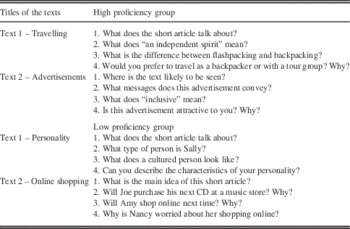
Five reading texts were made available for each proficiency group, each less than 300 words long. However, taking into consideration the completeness of the tasks that the dyads performed, two sets of log files containing two reading tasks for each group were chosen for further analyses in the current study. Table 1 shows post-reading questions based on the reading passages. Note that all reading articles were adapted from the participants’ textbooks: Mol’s (Reference Mol2008) English for tourism and hospitality and Wilson’s (Reference Wilson2011) Smart choice, which were used by high- and low-proficiency groups respectively.
List of post-reading questions for high and low proficiency groups

4.4 Procedure
Prior to the online discussions, the researcher contacted all participants in order to obtain their permission to conduct this research. Afterwards, a series of introductory sessions were organized; the NSs were individually informed through Facebook about how to discuss the given tasks with the participating students and how long it would take to complete one task. Similarly to the introductory sessions conducted for NSs, the sessions for NNSs were to inform them that they would be working with native speakers of English or their fellows. All participants were required to complete each task in no more than one hour and informed that they would be working with the same partners for all of the tasks. The participants undertook the learning tasks outside the classroom.
4.5 Coding scheme and data analysis
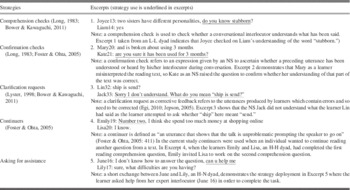
Participants’ language use was analyzed to calculate the number of turns, negotiated and successfully resolved instances, and interactional strategies. A turn here refers to a participant’s posting of a message in the chatroom (Bower & Kawaguchi, 2011). Following Lyster’s (Reference Lyster1998) classification, erroneous utterances in an F2F setting can be divided into categories, for example grammatical and lexical types. However, some features of errors that trigger negotiation need to be justified when applied to written text-based communication. The phonological errors in Lyster’s (Reference Lyster1998) classification were not included in this study; instead, misspelling was examined. Various interactional strategies used to cope with the linguistic errors identified in the data are illustrated in Table 2; all excerpts are taken from the present study.
Interactional strategy use

Data analysis in the current study consisted of both quantitative and qualitative approaches. The former, which was primarily adopted, involved performing non-parametric measures and calculating the frequencies and percentages of the instances. The qualitative data derived from the log files was used to supplement the quantitative data. The researcher coded all the data twice with a six-week interval and the intra-rater reliability achieved 90% for data agreement.
5 Results
There was a total of 786 learner turns. In NNS-NNS dyads, L-L generated far fewer turns (145, 18.5%) than H-H (343, 43.6%). On the other hand, in NNS-NS dyads, H-N produced fewer turns (122, 15.5%) than L-N (176, 22.4%). The comparison of turns and dyads showed that H-N produced the smallest number of turns, while H-H produced the most. Such results regarding the amount of production in the text-based environment indicated that learners in NNS-NNS dyads produced a greater number of entries than those in NNS-NS dyads.
5.1 Negotiated/repair instances
With a total of 426 errors, repair instances (N=104, 24.4%) occurred less frequently than unrepair (i.e., un-negotiated) instances (N=322, 75.6%), indicating that all the dyads preferred not to correct linguistic errors during the tasks. Percentages of repair and unrepair across the dyads were indicated in the brackets as follows: H-H (35.8%, 64.2%), L-L (2.8%, 97.2%), H-N (16.1%, 83.9%), and L-N (18%, 82%). This shows that L-L had the most unrepair moves (97.2%), whereas H-H had the fewest (64.2%), and H-N and L-N had similar percentages (of 83.9% and 82%).
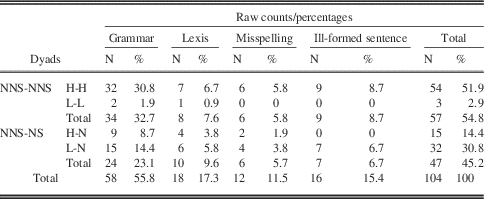
In Table 3, raw counts and percentages of negotiated instances are displayed across four types of dyads and errors. A total of 104 negotiated instances were found in the chat logs. NNS-NNS dyads (N=57, 54.8%) initiated negotiation more frequently than NNS-NS dyads (N=47, 45.2%). Of these, H-H pairs had the most counts (N=54, 51.9%), followed by L-N (N=32, 30.8%) and L-L (N=3, 2.9%).
Frequency and percentages of negotiated instances
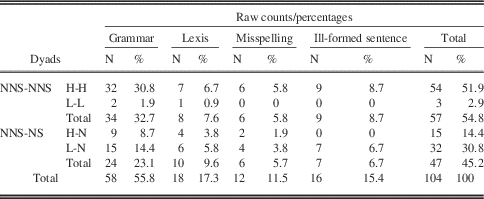
The differences in negotiated instances between the dyads were further examined. Excerpt 6 illustrates an information exchange between two high-proficiency learners (an H-H dyad), John and Ken, who negotiated a lexical error, challengable, which Ken used instead of challenging (in Ken28), triggering a lexical negotiation (in John29) to determine which word was meant. Ken then explicitly indicated that he had used an inaccurate form (Ken30).
Excerpt 6
Ken28:well, living alone is quite challengable
John29:do you mean challenging
Ken30:sorry for my mistake, challenging not challengable
John31: haha challengable is not a word
Ken32: ☺
The above exchange revolving around the lexis can be described as both learners working collaboratively to solve the linguistic problem. Another example illustrates negotiation between two high-proficiency learners (an H-H dyad), Jasmine and Wen (Excerpt 7). The two were engaged in collaborative dialogue, which resulted in the richness of modified interaction. Jasmine’s response in Jasmine23 was not satisfactory to her partner. He then made a few attempts to determine whether she preferred travelling as a backpacker or with a tour group (in Wen24, Wen25, and Wen29-31). In other words, her reply in Jasmine23, which was a personal opinion regarding her travel preference, allowed Wen to get a longer stretch of the text discourse.
Excerpt 7
Wen22: would you prefer to travel as a backpacker or with a tour group
Jasmine23: well, i prefer to travel with a small group of friends
Wen24: what if there’s nobody you know in the group
Wen25: would you still prefer to travel with a tour group (wait few seconds)
…
Jasmine28: ok, if i don’t anyone in a group, I would feel bored.
Wen29: if you have two options what would you do
Wen30: 1. would you go with a tour group but you dont know any one in the group
Wen31: 2. would you go along as a backpacker?
Jasmine32:that’s difficult to decide
Jasmine33: Id go along as a backpacker
Wen34: but you need to book flight, arrange hotel room
Jasmine35: yes i know, ok, I go by myself
Jasmine36: what about u, where would you go
Wen37: i always want to go to America by myself
Wen38: i like doing things by myself
Although some linguistic errors were ignored (e.g., the use of any one instead of anyone in Wen30, and go along instead of go alone in Wen31), the two learners made efforts to extend mutual turns by sharing personal feelings (e.g., i prefer to travel with a small group of friends in Jasmine23). Despite that, part of the chat (for instance, where would you go in Jasmine36) was off-task but sufficiently relevant and meaningful to enrich the communication.
In most cases, NSs were found to be unlikely to focus on form negotiation. In Excerpt 8, an exchange between a high-proficiency learner (Jane) and a native speaker (Sam), grammatical errors (Jane16) and ungrammatical sentence structures (Jane18 and 21) were not repaired. The error occurred in Jane16 as Jane provided an incorrect auxiliary verb (are) rather than the correct one (do) in response to her NS interlocutor’s previous turn. Instead of correcting the error, Sam invited her to continue discussing the next post-reading question (Sam17).
Excerpt 8
Sam15: Do you think they have more freedom?
Jane16: Yes, I think they are.
Sam17: In your opinion, do you prefer travelling as a backpacker or with a tour group? Why?
Jane18: It just not save for a alone girl travel as a backpacker. If I can gather some partner together, I would like as a backpacker.
Sam19: why
Sam20: what do you think are the advantages over a tour group
Jane21: The advantages over tour grounp, those are : I don’t need considered the accommodation, like food, hotel, transportation....
Sam22: I always prefer to travel without a tour group because then I can stay longer at a place I like. If I’m with a group I need to consider the other people.
Jane23: But, I want to be “flashpacking
Furthermore, in Jane18, Jane meant that it was not safe for a girl to travel alone but that, if she had other friends to travel with, she would travel as a backpacker. While the output was structured ungrammatically, Sam had made no attempt at meaning or form negotiation. As is evident, apart from correcting Jane’s linguistic errors, Sam attempted to share his opinion (Sam22) regarding his travel preference. Nevertheless, all Jane did was to respond to Sam’s questions (Sam15, Sam17, Sam19, and Sam20). She did not comment on what Sam had said in Sam22. Though the above exchange involved similar turns, it was more likely to entail teacher-led discourse than collaborative dialogue.
5.2 Successfully and unsuccessfully resolved instances
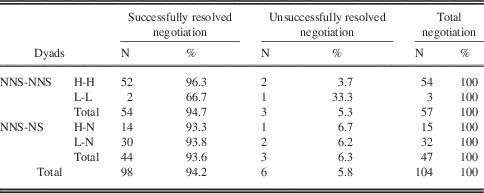
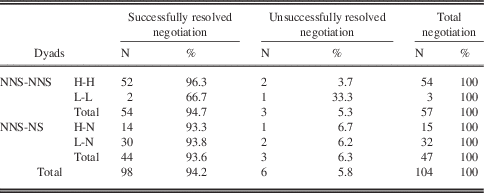
The results in Table 4 indicate 98 (94.2%) successfully resolved instances and only 6 (5.8%) unsuccessfully resolved instances. The comparison of the differences in successfully resolved negotiation between the NNS-NNS (N=54, 94.7%) and NNS-NS (N=44, 93.6%) pairs showed that the former outperformed the latter. The most successful resolved negotiation was associated with H-H dyads (N=52, 96.3%) while the least was with L-L dyads (N=2, 66.7%). H-N and L-N dyads had similar percentages of successful and unsuccessful negotiation. The results of the successfully resolved negotiation derived from the Kruskal-Wallis test differed significantly among the dyads (H (3)=14.94, p<.002). The mean rank scores for the dyads were 16.3 (H-H), 3.2 (L-L), 8.5 (H-N), and 14.0 (L-N).
Frequency and percentages of successfully and unsuccessfully resolved negotiation
In Excerpt 9, Jim and Bill, a low-proficiency learner and a native speaker, proceeded with negotiation for meaning and successfully resolved a problem. Despite Jim using ungrammatical sentences (turns 89–90), Bill understood them and provided him with the word’s meaning (to deliver in turn 91). Jim then responded to Bill with an ill-formed sentence (turn 94), which caused Bill uncertainty. This, in turn, led to another negotiated episode in which Bill initiated a clarification request. Jim finally gave a correct answer (she is getting fat) to the question in Bill95. Such an NNS-NS exchange depicts teacher-student interaction.
Excerpt 9
Jim89: <they were going to ship it> the means??
Jim90: it’s <ship it>means
Bill91: to deliver
Jim92: ok
Bill93: any more problems with this one?
Jim94: Because she do too much shopping online and spend a long time at stay home
Bill95: Ok. And what happened to her?
Jim96: she is getting fat
Bill97: Very good
An unsuccessfully resolved instance occurred in the interaction between low-proficiency learners (an L-L dyad), Josephine and Amy. The reading text was discussing a person who had bought a CD online which had arrived three months later, so he had decided to buy his next CD at a music store rather than at an online shop. However, in Excerpt 10, Josephine not only produced a couple of semantic and morphosyntactic errors in her turn (Josephine5), but also misinterpreted the text as meaning that the person had decided not to buy his next CD at the music store. In Amy6, her partner seemed to make an attempt to correct the misinterpretation of Josephine (No!) but did not have her intended meaning conveyed effectively because of the ill-formed sentence (The next CD…). Such modified negotiation is not considered to be satisfactorily resolved.
Excerpt 10
Josephine5: question 1: He wanted buy a new CD but he has to wait for three months. So he next CD will not buy at the music store.
Amy6: No! The next CD wait three months later at the music store! It too long!!!
Josephine7: The same ^v^
5.3 Interactional strategy use by the NNS-NNS and NNS-NS dyads in the text-based synchronous CMC
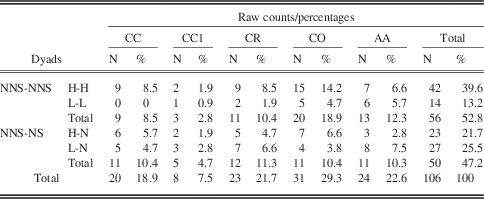
As Table 5 shows, interactional strategies were divided into five types: comprehension, confirmation checks, clarification requests, continuers, and asking for assistance. These yielded a total of 106 instances. NNS-NNS dyads produced slightly more interactional strategies (N=56, 52.8%) than NNS-NS dyads (N=50, 47.2%) did. The most frequent strategies were continuers (N=31, 29.3%), asking for assistance (N=24, 22.6%), and clarification requests (N=23, 21.7%). The least frequent were the confirmation checks (N=8, 7.5%).
Raw counts and percentages of interactional strategy use by the dyads
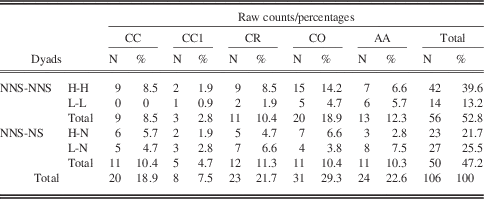
Note: CC=comprehension checks, CC1=confirmation checks, CR=clarification requests, CO=continuers, AA=ask for assistance
In NNS-NNS dyads, H-H employed a large number of strategies (N=42, 39.6%), whereas L-L used the fewest (N=14, 13.2%). In H-H, the most frequent were continuers (N=15, 14.2%), followed by both comprehension checks and clarification requests with the same frequency (N=9, 8.5%). In comparison, L-L used asking for assistance (N=6, 5.7%) and continuers (N=5, 4.7%) more frequently than other types of strategies. In NNS-NS dyads, L-N used more strategies (N=27, 25.5%) than H-N did (N=23, 21.7%). Learners in L-N dyads employed asking for assistance (N=8, 7.5%) more frequently than those in H-N dyads (N=3, 2.8%) did. The data was tested further using the Kruskal-Wallis test, which demonstrated a statistically significant difference in the frequency of strategy use by the dyads (H (3)=15.37, p<.002). The mean rank score for each dyad type was 17.7 (H-H), 12.4 (L-N), 7.9 (H-N), and 4.0 (L-L).
In Excerpt 11, the high-proficiency learners Kelly and Wendy worked collaboratively to co-construct a short text after resolving their differences in opinion regarding the meaning of the unfamiliar phrase, an independent spirit. In turn 11, Kelly sought a confirmation by rephrasing the statement in turn 10 because the lack of consistency where two personal pronouns (yourself and I) were concerned caused some confusion. After Wendy confirmed the statement by typing yes in turn 12, Kelly (turn 16) provided a definition that was different from Wendy’s and suggested consolidating their definitions in previous turns. Finally, Wendy used the continuer strategy to continue their discussion.
Excerpt 11
Wendy10: well i think an independent spirit means free, to be yourself. I am not limited by anything
Kelly11: you can do anything you want when you travel?
Wendy12: yes
Kelly13: my answer is different. I think it means you don’t need to depend on anyone else.
Kelly14: can we combine with our answers?
Wendy15: ok
Kelly16: so, the answer is when you travel, you feel free to be yourself and you don’t need to depend on anyone else, ok?
Wendy17: yup, next question
In Excerpt 12, Emily and Lisa were low-proficiency learners discussing a post-reading question (Will the person shop online next time? Why?). What Emily wished to state was that the person bought a bracelet at a store then found out that the same bracelet was cheaper online (in turn 23). However, she formed the turn inadequately which appeared to be an incoherent thought in the turn. In turn 24, though Lisa expressed her opinion, she did not correct the typo ound, nor did she initiate a repair move on the unclear statement in turn 23. Instead, she signaled the end of that discussion by using the continuer next question (turn 25). The interaction between Emily and Lisa was a non-collaborative move that resulted in insufficient exchanges. That is to say, the interaction failed to show their agreement or disagreement on what was discussed or to clarify the incoherent statement.
Excerpt 12
Emily23: I think he ound [found] the same bracelet online. And, it was cheaper! I spent too much time looking for it, and I paid too much
Lisa24: I think will probably shop online next time because it was more cheaper than shopping mall.
Lisa25: next question
6 Discussion
The present investigation explored the frequency of negotiated instances, successfully resolved instances, and interactional strategy use when learners worked with their peers or with native speakers on Facebook. This section will attempt to answer the three research questions that were addressed previously. The first research question examined the frequency of modified negotiation that NNS-NNS and NNS-NS dyads initiated during text chats on Facebook, indicating that negotiated instances were more common in NNS-NNS dyads than in NNS-NS dyads. These results parallel those in Pica et al. (Reference Pica, Lincoln-Porter, Paninos and Linnell1996), Sotillo (Reference Sotillo2005), and Varonis and Gass (Reference Varonis and Gass1985). However, they were different from those in Mackey et al. (Reference Mackey, Oliver and Leeman2003), where negotiation occurred more frequently in NS-NNS than in NNS-NNS adult dyads. The different proficiency levels of learners in NNS-NNS interactions made very different contributions to the negotiated occurrences as a larger number of negotiated instances occurred in H-H interactions than in L-L interactions. To some extent, high-proficiency learners were more capable of solving linguistic problems than low-proficiency learners were (Leeser, Reference Leeser2004). However, such results may be partially attributable to patterns of negotiation and not to learners’ proficiency levels, as other studies have suggested (e.g., Kim & McDonough, Reference Kim and McDonough2008; Storch, Reference Storch2001; Watanabe & Swain, Reference Watanabe and Swain2007). It happens to be the case that, in the present study, learners in H-H dyads were more likely than those in other dyads to collaborate with others by paying attention to the language and clarifying words that their peers used (see Excerpts 7 and 11). Exchanges akin to those in teacher-student situations (see Excerpts 8 and 9) were more likely to occur in dyads of native speakers and learners. It was found that H-H learners were more likely than H-N, L-N, or L-L learners to focus on form and meaning, and this generated more negotiated instances. Furthermore, text chats in CMC gave learners more opportunities to focus on form as the linguistic features in that context were more apparent than those in F2F situations. The work of researchers such as Lee (Reference Lee2008), O’Rourke (Reference O’Rourke2005), Shekary and Tahririan (Reference Shekary and Tahririan2006), and Warschauer (Reference Warschauer1996) supports this.
The second research question related to the frequency of successfully resolved instances in NNS-NNS dyads and NNS-NS dyads. The results revealed that H-N dyads and L-N dyads had similar numbers of successful occurrences, while H-H dyads had a much larger number of successful instances than L-L dyads. These results are consistent with other studies in F2F or CMC environments. For example, more capable learners resolved negotiated instances more successfully than less capable ones (Williams, Reference Williams2001; Kim & McDonough, Reference Kim and McDonough2008) and collaborative NS-NNS dyads had more successfully resolved instances than non-collaborative dyads (Shekary & Tahririan, Reference Shekary and Tahririan2006; Lee, Reference Lee2008; Lai & Zhao, Reference Lai and Zhao2006). However, the results of the present study found that NNS-NNS had more successful instances than NNS-NS dyads, unlike Dobao (Reference Dobao2012) in an F2F setting. Results such as these are supported by the claim that if learners talked more or produced more turns, they would have more opportunities to produce language-related problems (Lai & Zhao, Reference Lai and Zhao2006; Yilmaz & Granena, Reference Yilmaz and Granena2010). This also lends support to the view that engaging in more text chats in SCMC would give learners more opportunities to produce successful negotiation because the text chats would allow them sufficient time to review and respond to their peers’ comments.
The third research question concerned the frequency of the dyads’ interactional strategy use. When compared to NNS-NS dyads, NNS-NNS dyads were more actively engaged in the strategic processes to solve communication difficulties. H-H dyads employed the strategies more frequently than H-N, L-N, or L-L dyads. These results agree with those of Foster and Ohta (Reference Foster and Ohta2005) and Nakatani (Reference Nakatani2010), indicating that learners’ proficiency levels were associated with strategy use in which high-proficiency learners were more aware of strategy use than low-proficiency learners. A possible reason for such results was that largely due to their linguistic abilities the high-proficiency learners generated more turns or target-like turns and were more likely to follow non-target turns with interactional strategies such as comprehension checks. On the other hand, low-proficiency learners had fewer target-like turns and were less capable of initiating repair moves to convey their messages. Such results made it evident that using strategies (e.g., checking on others’ comprehension) to solve communication breakdowns or misunderstandings required learners’ linguistic resources. In comparison to those in other studies, the participants here used continuers very frequently, signaling to their partners that they should attend to the next comprehension questions and giving them encouragement to complete the given tasks. This supported previous findings by Peterson (Reference Peterson2009). Furthermore, H-H dyads were more likely to use clarification requests and comprehension checks, while H-N and L-N dyads preferred using confirmation and comprehension checks. The results were partly similar to those of other studies, with NSs preferring confirmation checks and clarification in Sotillo (Reference Sotillo2005), and both NNSs and NSs tending to use clarification requests in O’Rourke (Reference O’Rourke2005).
It is worth noting that the NSs were found to have fewer negotiated instances than NNSs (H-H). This led to the assumption that NSs would employ fewer interactional strategies. It might have been that the expert interlocutors in this study were trying to avoid the embarrassment that might have resulted if they had corrected the learners’ grammatical errors or misspellings in their messages (Foster & Ohta, Reference Foster and Ohta2005). Alternatively, the fact that text communication took time to type may have resulted in greater tolerance for linguistic errors in SCMC. On the other hand, NNS-NNS (H-H) dyads used more interactional strategies, perhaps because they felt they would not lose face and would not feel embarrassed carrying out repair moves by asking each other questions.
7 Conclusion
The present study built upon previous work to explore negotiated interaction between learners, and between learners and native English speakers working together on Facebook. It contributed to the understanding of the negotiated instances and strategy use that occurred when the participants attempted to complete the tasks. The results suggest that, compared to high- or low-proficiency learners in NNS-NS dyads, high-proficiency learners in NNS-NNS dyads who tended to work collaboratively had the highest counts of negotiations, successful interactions, and strategy use. One limitation of the present study was that the negotiated interaction was examined based on two levels of difficulty in reading texts for two proficiency-level groups. It should be taken into account that using the same reading articles to compare the effects of negotiated interaction in the dyads would have been ideal because differences in reading articles could have affected negotiated interaction. However, it might be more appropriate to use reading texts of different difficulty levels for learners at different proficiency levels. The texts used in this study were adapted from the learners’ textbooks, and the learners discussed the texts outside the classroom based on what they had learned (which seemed to be typical language classroom activities to enhance the understanding of the articles taught).
Moreover, the data analysis of the present study was limited to five types of interactional strategy use (for instance, clarification requests), and the study did not examine the frequency of strategy use reported in the learners’ first language. The fact was that the low-proficiency learners had difficulty expressing their thoughts in the target language but not in their first language. The findings of this study suggest that investigating other features of language, such as complexity and accuracy (Warschauer, Reference Warschauer1996), would contribute to a better understanding of whether learners with greater ability produced more complex syntactic structures than those with less ability in synchronous text-based communication. Such research would require further examination.
The study has a number of pedagogical implications. (1) The use of web tools such as Facebook (which this study adopted) enhances learning experiences and learners will hopefully transfer these skills to the classroom. (2) The results of the present study demonstrate to L2 teachers or language practitioners that teaching students interactional strategies is essential not only for the learners to overcome communication difficulties but also to foster problem-solving skills in the L2. (3) Facebook has been utilized in educational contexts and offers great potential for language learning. Approximately 6% of the world’s population are active users of Facebook, which is available in 70 languages (Facebook, 2010, cited in Reinhardt & Zander, Reference Reinhardt and Zander2011). In spite of this, most Facebook users use it for social purposes (e.g., chatting with friends) rather than for pedagogical purposes. This research provides empirical evidence that demonstrates the feasibility of pedagogical learning through the social software tool. That is, using Facebook chat for language learning helps to develop communicative competence, for instance, through language use in a sociocultural context (Blattner & Fiori, Reference Blattner and Fiori2009), and to promote incidental learning (Kabilan et al., Reference Kabilan, Ahmad and Abidin2010). This emphasizes that L2 learners can acquire linguistic knowledge by chatting with a friend or reading others’ posts in the target language outside the classroom. The accessibility of Facebook makes incidental learning, which encourages and motivates learners to formulate and test their hypotheses regarding formal structures in the target language, feasible.
Acknowledgements
This research has been financially supported by the Ministry of Science and Technology, Taiwan, under Grant # MOST 103-2511-S-424-004 and MOST 104-2511-S-424-003.