1 Introduction
For the past couple of decades, great attention has been drawn to corpus linguistics in the field of language learning and teaching (Daskalovska, Reference Daskalovska2015; Huang, Reference Huang2014; Lin & Lee, Reference Lin and Lee2015; Römer, Reference Römer2011; Smart, Reference Smart2014; Vyatkina, Reference Vyatkina2016a, Reference Vyatkina2016b). By virtue of the development of computer technology (Hunston, Reference Hunston2002), learners and instructors can now access “an enormous amount of authentic language input” (Liu & Jiang, Reference Liu and Jiang2009: 62) at the click of a mouse. The range of corpus applications in the field is wide, including developing curricula and materials, choosing syllabi, producing dictionaries, publishing references, and testing language (Oh, Reference Oh2004). Since the late 1990s, researchers have also begun to pay attention to learner corpora, which refer to “electronic collections of language data produced by L2 learners, that is, second or foreign-language learners” (Granger, Reference Granger2013: 3235). Research based on an analysis of learner corpora has provided valuable information on language used by particular groups of learners, including their patterns of overuse, underuse, and misuse of target linguistic features compared to a reference native speaker (NS) corpus (Braun, Reference Braun2007; Cotos, Reference Cotos2014; Smart, Reference Smart2014).
On the other hand, corpora can be applied to language teaching and learning in a more direct way, as a teaching methodology. This method is known as data-driven learning (DDL), in which learners explore authentic language data and discover useful information by identifying, classifying, and generalizing the data (Johns, Reference Johns1991). In their recent meta-analysis of 64 studies representing 88 unique samples, Boulton and Cobb (Reference Boulton and Cobb2017) found that DDL results in large overall effects in second language learning. Indeed, advantages of DDL as a teaching methodology have been highlighted by a number of studies conducted in various instructional contexts at tertiary (Boulton, Reference Boulton2009, Reference Boulton2010; Smith, Reference Smith2011) and secondary levels (Braun, Reference Braun2007; Hong & Oh, Reference Hong and Oh2008). Empirical implementations of DDL, however, have almost exclusively been based on NS, not learner, data (Gilquin, Granger & Paquot, Reference Gilquin, Granger and Paquot2007). It has been suggested that exploring and comparing learner corpora with NS data in DDL greatly helps learners to notice their own errors or patterns of language use that differ from NS uses (Nesselhauf, Reference Nesselhauf2004). Yet one obstacle to DDL is that some learners apparently find it overwhelming to navigate and analyze a large amount of L2 data using concordancing software by themselves. In such cases, instructors’ guided induction along with preselected paper-based DDL materials can scaffold learners to interact with corpora, reducing the cognitive burden, especially at low levels (Boulton, Reference Boulton2010; Mizumoto & Chujo, Reference Mizumoto and Chujo2016; Smart, Reference Smart2014). Despite the need for such research, studies of paper-based DDL with learner corpora have thus far been rare at secondary levels (Braun, Reference Braun2007), which has motivated the present study.
This study aims to investigate the effects of guided DDL grammar induction based on a comparison of NS and learner corpora of Korean middle school English learners. In addition, the study examines learners’ perceptions toward learning grammar by comparing NS data with their own. The learners’ affective aspects are included in the scope of the study because they are known to have an important influence on the effectiveness of general learning including grammar instruction (Green, Reference Green1993; Mantle-Bromley, Reference Mantle-Bromley1995; Schulz, Reference Schulz2001). With “overgenerated be” as the target grammar feature (see Section 3.1 for details), this study provides two learner groups with guided DDL and traditional instruction and collects their immediate and delayed post-writing samples. Comparison of these, alongside a feedback survey, demonstrates that EFL learners at the secondary level can not only benefit from this particular type of DDL, but also enjoy learning grammar in this way.
2 Data-driven learning comparing NS and learner corpora
DDL, a term first introduced by Johns (Reference Johns1991), allows learners to undertake the role of researcher or language detective and engage in autonomous and active learning while investigating and analyzing authentic data. In recognition of its benefits of fostering learner autonomy and raising language awareness in examining naturally occurring language and discovering patterns (Boulton, Reference Boulton2009), efforts have been made to implement DDL in actual instructional contexts. A considerable number of DDL studies targeting various linguistic features have reported the effectiveness of inductive instruction with corpus data in comparison with traditional teaching methods (Boulton & Cobb, Reference Boulton and Cobb2017). Not only were new vocabulary items learned more efficiently (Frankenberg-Garcia, Reference Frankenberg-Garcia2014; Stevens, Reference Stevens1991), but problematic linguistic items were better remedied as well (Boulton, Reference Boulton2010). In Huang’s (Reference Huang2014) usage-based learning, DDL showed positive effects upon learners’ understanding regarding the lexical collocations and prepositional colligations of five abstract nouns. Other linguistic items that have been dealt with in teaching practice applying DDL include linking adverbials (Boulton, Reference Boulton2009), passive voice (Smart, Reference Smart2014), and verb–preposition collocations (Vyatkina, Reference Vyatkina2016a).
Several studies, on the other hand, have focused primarily upon learners’ attitudes toward concordancing or experiences during DDL in writing. Most of these studies have dealt with undergraduate or graduate students, who overall displayed positive attitudes toward corpus-based learning or DDL. College ESL students at or above the intermediate level, for instance, evaluated the corpus use in their L2 writing positively (Yoon & Hirvela, Reference Yoon and Hirvela2004). Similarly, college students in Vyatkina’s (Reference Vyatkina2016b) study enjoyed corpus-based activities that provided useful information not given in dictionaries or other reference materials. Graduate learners’ positive perception of corpus consultation is reported in Sun (Reference Sun2007) and Yoon (Reference Yoon2008). In terms of the participants, Braun’s (Reference Braun2007) study is an exception in the sense that it zoomed in on the secondary level of education. Still, learners’ responses were not substantially different from those at the tertiary level, revealing satisfaction with the integration of diverse corpus-based activities, mostly related to grammar and lexical points, into their learning. One thing that needs to be pointed out, though, is that the studies discussed thus far have utilized NS corpora only in their implementation of corpus-based learning.
The current study pays special attention to the view that greater benefit can accrue from DDL utilizing a learner corpus alongside an NS corpus. Seidlhofer (Reference Seidlhofer2002) called this application of the learner corpus to language teaching the “learning-driven data approach.” Comparing parallel NS and learner concordance lines of error-prone items may encourage learners to notice otherwise fossilized negative evidence (Granger & Tribble, Reference Granger and Tribble1998) by making their problematic language uses more salient (Meunier, Reference Meunier2002). Such uses, in fact, are considered as features not only to be corrected, but also to be discovered by learners by analyzing and comparing them with the NS corpus (Fan, Greaves & Warren, Reference Fan, Greaves and Warren1999), which accelerates acquisition (Seidlhofer, Reference Seidlhofer2000). With appropriate follow-up communicative tasks and teachers’ guidance to consolidate proper uses, the potential of DDL based on NS and learner corpora may be maximized.
The NS-learner comparison model in the foreign language classroom was initially recommended by Tribble (Reference Tribble1990). Later, Granger and Tribble (Reference Granger and Tribble1998) presented form-focused instruction through classroom concordancing with the learner corpus, suggesting that providing negative feedback on learners’ fossilized patterns or forms (Granger, Reference Granger1996) acts as effective remedial work on their underuses, overuses, or misuses (e.g. the misuse of the infinitive after accept or possibility, or the overuse of the word important). In the same vein, Horváth (Reference Horváth2001) collected evidence of advanced Hungarian learners’ language uses from the Janus Pannonius University corpus and used the data for individual and classroom study guides in writing pedagogy. For instance, when learners’ overuse of the noun thing was detected, they were encouraged to replace it with more specific terms. The NS-learner corpus comparison can also be used as a valuable resource for classroom discussion (Ragan, Reference Ragan2001) or presentation (Lee & Swales, Reference Lee and Swales2006). Approaching learner-corpus-based DDL from a developmental perspective, Belz and Vyatkina (Reference Belz and Vyatkina2005, Reference Belz and Vyatkina2008) tracked learners’ developmental changes in using German modal particles. They showed that corpus-driven pedagogical interventions with an ongoing dynamic assessment of a learner corpus positively affect the accuracy as well as frequency of use of the target items. In Hsieh and Liou’s (Reference Hsieh and Liou2008) study, EFL graduate students perceived the comparison between the expert and novice corpora of research articles (along with online peer editing) to be helpful for reducing errors in academic writing. More recently, Cotos (Reference Cotos2014) brought together research and pedagogy of the learner corpus, first investigating learners’ uses of linking adverbials and then exploring DDL pedagogy combining NS and learner data. Although both groups of learners improved in the use of linkers, students with access to both corpus types revealed more frequent, diverse, and appropriate uses than those with just the NS corpus. It appears that particularly favorable reactions toward working on the texts of their own and those of their peers contributed to better cognitive processing.
Although the vast majority of learner-corpus-based DDL studies tend to consider tertiary education as their target level (Braun, Reference Braun2007), this heuristic approach has strong potential to extend its positive effects to secondary levels. These lower-level learners, however, may be unaccustomed to interacting directly with corpora (Smart, Reference Smart2014); the cognitive burden of using new technology (the concordancing software tool) during DDL may inhibit learning, thereby demotivating learners (Gavioli, Reference Gavioli2005). Thus, for learners of lower proficiency and age, a guided induction approach can be more beneficial than a pure inductive hands-on method, especially in terms of learning grammar (Haight, Herron & Cole, Reference Haight, Herron and Cole2007; Herron & Tomasello, Reference Herron and Tomasello1992), on the condition that Smart’s (Reference Smart2014: 186) two particular characteristics of DDL are shared:
-
1. Real language data are used as sources of language learning materials or reference resources.
-
2. Learning activities are student-centered and focus on language discovery.
Here, teachers’ co-constructing roles encouraging learners to achieve their aims by observing data, identifying patterns, solving problems, and completing follow-up activities are regarded as crucial (Mizumoto & Chujo, Reference Mizumoto and Chujo2016; Smart, Reference Smart2014).
In the light of this, the present study attempts to conduct learner-corpus-based guided DDL induction using paper-based materials with Korean middle school students, who tend to produce errors by overgeneralizing the use of be (see Section 3.1). The study will examine whether, compared to being taught using the traditional approach, learners can increase their grammar consciousness and extend learning more effectively while analyzing and comparing corpora of NS data and their own writing. It also aims to understand whether learners develop positive perceptions toward this particular type of DDL, which may have a strong influence on the efficacy of grammar learning with the new method (Green, Reference Green1993; Mantle-Bromley, Reference Mantle-Bromley1995; Schulz, Reference Schulz2001). The following two specific research questions are addressed in the study:
-
1. Which is more effective in unlearning overgenerated be: traditional grammar learning or DDL based on NS and learner corpora?
-
2. How do learners perceive grammar learning based upon DDL comparing NS and learner corpora?
3 The study
3.1 The target language feature
The target language feature of the current study was determined based on the analysis of learner data and the relevant literature. It has been widely reported that L2 learners of English (Ionin & Wexler, Reference Ionin and Wexler2002; Sasaki, Reference Sasaki1990; Starren, Reference Starren2006), including Korean learners (Hahn, Reference Hahn2000; Shin, Reference Shin2001; Yang, Reference Yang2002), often produce an additional be occurring before thematic verbs. Indeed, Korean middle school students, who constitute the participants of the current study, showed frequent overgeneralization of be, generating sentences such as He is dance very well and She is like swimming. As overgenerated be occurs predominantly in such a pattern in the current database – as well as in Shin’s (Reference Shin2001) investigation – the present study focuses on this particular structure, excluding less evident forms of overgenerated be in sentences such as He is test is good or I am not like milk.
Ongoing controversies exist regarding the syntactic properties of overgenerated be (Ionin & Wexler, Reference Ionin and Wexler2002), between a topic marker (Hahn, Reference Hahn2000; Sasaki, Reference Sasaki1990; Shin, Reference Shin2001) and a functional category of agreement, tense, or aspect (Ionin & Wexler, Reference Ionin and Wexler2002; Starren, Reference Starren2006; Yang, Reference Yang2002) – or both (Choi, Reference Choi2013; Kim, Reference Kim2011). Without subscribing to any particular view, this study focuses instead on the cognitive and affective effects of DDL on unlearning overgenerated be.
3.2 Participants
All 285 ninth-grade students (151 boys and 134 girls, aged 14) enrolled in a middle school in Seoul, Korea, in 2011 voluntarily participated in the compilation of the learner corpus. Most had completed four years of formal EFL instruction, for one hour per week, and their English proficiency was at a relatively elementary level. Of these, 191 students (101 boys and 90 girls) from six of the nine classes were randomly divided into a traditional learning (TL) or a DDL group, and the study was conducted during their regular school hours. Based upon the analyses of the learner corpus, approximately one quarter of the students from each group were selected as target participants. Excluded were those whose writing showed no thematic verb before which the overgenerated be could occur. The detailed information of the target participants is shown in Table 1, with the mean and standard deviation calculated on the final-term English test scores. A t-test was performed, and the result indicated no statistically significant difference of means (p=.990). Furthermore, the effect size of this non-significant relationship (d=0.06) was found to be smaller than Plonsky and Oswald’s (Reference Plonsky and Oswald2014) L2 research-specific criterion for a small effect size (d=0.40), confirming the comparability of the two groups in their English ability (Larson-Hall, Reference Larson-Hall2016).
Descriptive statistics of participants

3.3 The construction of NS and learner corpora
3.3.1 NS corpus
Despite the many benefits of providing authentic data in English language learning (Liu & Jiang, Reference Liu and Jiang2009), using an NS corpus in classrooms often results in a number of concerns, such as the difficulty and unfamiliarity of vocabulary and texts (Hunston, Reference Hunston2002). A common solution to this problem is to edit concordance lines, replacing difficult words with easier ones, reducing the length of the original sentences, deleting words not critical to understanding, and simplifying complex syntactic structures (Braun, Reference Braun2005). Editing concordance lines, however, runs counter to “the objective of exposure to naturally occurring language in use” (Adolphs, Reference Adolphs2006: 108). Another way of leveling language to the proficiency of learners is to limit the corpus to “limited and manageable” text sources (Gavioli & Aston, Reference Gavioli and Aston2001: 244), such as graded readers. Offering an acceptable approximation to natural language, graded reader texts seem sufficient to give input reflecting authentic language to learners, who will thus be less overwhelmed by the language and encouraged to draw conclusions from the data (Allan, Reference Allan2009).
The latter approach was adopted in the present study, and a small tailor-made corpus (Basanta & Martín, Reference Basanta and Martín2007), designed to be easier to manage and more useful for beginners, was compiled from online issues of Time for Kids (TFK) published from 2008 to 2011.Footnote 1 TFK was considered an ideal source for an NS corpus to be used by the participants of this study in terms of both content and language. Issued by TIME magazine, one of the best-selling weekly magazines, TFK covers a wide range of interesting topics on world and national events; its language is geared toward the proficiency of native English readers from grades K1 to K6. The NS corpus consisted of 269,649 words from 973 articles and is referred to as the Time for Kids’ Corpus (TFKC).
3.3.2 Learner corpus
Learner data collection began in the first week of the school year. After signing participation consent forms, the ninth graders from all nine classes were asked to write a one-page letter of self-introduction, the first writing trial (W1), in English during class time (45 minutes). A variety of sub-topics were covered, including family members, future dreams, favorite food or subjects, and mottos. The instructor did not allow learners to use dictionaries but helped them with any unknown words. Ultimately, 285 learner writings were collected (29,972 words), comprising the middle schoolers’ corpus (MSC). Subsequently, based on the analysis of the learner corpus, overgenerated be was selected as the target feature and learner-corpus-based DDL materials were developed. Table 2 displays the basic information about the NS and learner corpora used in the study.
Description of NS and learner corpora

3.4 Materials
3.4.1 Data-driven learning materials
Materials for DDL consisted of concordance lines extracted from both TFKC and MSC. Is, the most frequent form of be in both TFKC and MSC, was used as the keyword to generate concordances.Footnote 2 The concordance lines were carefully selected according to students’ levels and interests, and none of the sentences was cut off in the middle in order to enhance familiarity and comprehensibility. The materials were designed so that the learners could be prompted to unlearn the overgenerated be through guided induction while reviewing two main categories of the be verb, namely, copular and auxiliary functions (Greenbaum & Quirk, Reference Greenbaum and Quirk1990).Footnote 3 In the case of copular be, the three most common sub-categories (i.e. is + noun, is + adjective, and is + gerund) were included; for the function of auxiliary be, two sub-types (i.e. is + present participle and is + past participle) were dealt with. Part of the actual DDL materials is provided in Appendix A. The concordance lines were arranged in a way to help learners compare the two sets of language data. Learners were helped to explore and analyze the data interactively, filling out guide questions in their worksheet ranging from “What types of words are located before/after is?”, “Can we see any patterns?”, “How does is function in group #?”, “Shall we match groups in the NS data to ours?” to “Is there any group that does not have the corresponding group in the other data?” Noticing the additional category (i.e. overgenerated be) only in the learner concordances (f-1 to f-5), learners were scaffolded to correct their own and/or peers’ misuses of the be verb. For instance, learners correctly revised the original sentence He is dance very well to He dances very well. At the bottom of the materials, some space was provided for learners to write down their feelings or attitudes toward DDL based on the comparison of NS and learner data.
3.4.2 Traditional learning materials
Consulting the relevant grammar sections of the learners’ textbooks, the instructor developed conventional learning materials, in which the forms, meanings, and uses of be verbs were explained (see Appendix B). As in the DDL materials, five categories of copular and auxiliary be were included. In the case of overgenerated be, learners were explicitly informed that it is incorrect to put an additional be in front of the main verb. Practice activities included gap-filling, multiple-choice, and rewriting tasks. The critical difference from the DDL materials was the absence of a direct comparison about the occurrences of be verbs between NSs and learners, which was the key to the guided DDL induction.
3.5 Instructional treatments
With the separate learning materials, the instructional sessions were conducted for both DDL and TL groups (see Section 3.3). As the students were not acquainted with a “corpus,” getting them to experience what a corpus was and to understand why and how to use a corpus in learning was a prerequisite for the DDL instruction. One of the researchers, who was also the teacher, showed the DDL group sample concordance lines by visiting several websites, such as the British National Corpus and the Corpus of Contemporary American English.Footnote 4 In addition, the DDL group observed how their own texts could be analyzed using concordance tools like WordSmith (Scott, Reference Scott2008). This was essential to help the learners get acquainted with a “learner corpus” and realize that their own writings could be used as learning materials. Next, the DDL and TL groups participated in information-gap activities with two articles from the TFK, from which it was confirmed that the level of the language fitted the learners’ English proficiency.
Before the main instructional sessions, the DDL group had an introductory session of analyzing corpus data comparing the TFK concordances of interesting and interested, one of the typical errors in the MSC. Meanwhile, those in the TL group were given traditional instruction about the same linguistic features. Two class periods of the main sessions, approximately 45 minutes per session, were then conducted for each group. The instruction for the DDL group was based on Flowerdew’s (Reference Flowerdew2009) framework for corpus-based activities, namely the “4 Is”: illustration, interaction, intervention, and induction:Footnote 5
-
1. Step 1 (Illustration). Learners first looked at the teacher’s preselected paper-based data, focusing on the patterns of concordance lines including is.
-
2. Step 2 (Interaction). In pairs and groups, learners shared their observations and discussed opinions following guide questions in their worksheet.
-
3. Step 3 (Intervention). Moving away from presenting explicit rules, the teacher provided broader hints for induction where necessary. For the lower-level learners especially, the teacher helped them with any unknown words and narrowed their focus down to the target patterns, thereby offering clearer guidance on finding the gap between the NS and learner data.
-
4. Step 4 (Induction). Learners individually formed their hypotheses, shared their findings with the whole class and, when necessary, revised them according to the feedback from the class. They then applied the rules that they had discovered in productive exercises by rewriting incorrect sentences including the overgenerated be.
In addition, at the end of the instructional treatments, learners were asked to write down their perceptions about the particular type of learner-corpus-based instruction they had received.
In the TL group, the learners were taught in the traditional way, following the paradigm of the “three Ps” (presentation, practice, and production). By giving instructions about the form, meaning, and use of be verbs, the instructor clearly explained that the overgenerated be that is often used by the learners is an incorrect usage. Learners then practiced what they were taught with gap-filling and multiple-choice activities. Finally, they completed some productive activities, rewriting the sentences containing the overgenerated be.
After the main sessions, the students in both groups wrote a one-page letter of self-introduction (W2) to their native English-speaking teacher (NEST). In order to examine the retention of learning, the students were asked to produce the third writing (W3) after seven weeks. During the interim between W2 and W3, the NEST replied to each learner asking for more detailed information based on W2, which composed the topic of W3. Here students had to respond to the reply from the NEST, often answering unexpected or unfamiliar questions. The three writing tasks, which showed subtle differences, are summarized as follows:
W1: a self-introduction letter to the Korean English teacher
W2: a self-introduction letter to the NEST
W3: a reply to the NEST’s letter
Finally, the data were analyzed to examine the effects of each type of instruction on unlearning overgenerated be and the learners’ attitudes toward the learner-corpus-based grammar learning.
3.6 Data analysis
The first step in the data analysis was to identify all the instances of overgenerated be from the learners’ writings (W1, W2, and W3). In order to examine the immediate and delayed effects of DDL compared to TL, those who did not show any token of overgenerated be on W1 were excluded from further analysis, which yielded 45 target participants: 21 in the DDL and 24 in the TL group. Given the finding that overgenerated be typically occurs before thematic verbs bearing obligatory inflections (Shin, Reference Shin2001), such potential environments for overgenerated be were identified and counted in the writings of the two groups. The ratio of overgenerated be was then computed for each writing by dividing the number of overgenerated be by that of thematic verbs with obligatory inflections. Next, the means of those ratios were calculated and compared by groups and writing trials. A chi-square test was subsequently run (with the significance level set at .05) with the raw counts of overgenerated be in order to examine the immediate and delayed learning effects between groups.
The present study also examined how learners affectively perceived DDL based on a comparison of NS and learner corpora. To answer this research question, as survey results were open-ended, learners’ top five common responses were categorized and discussed.
4 Results and discussion
4.1 Effects of DDL on unlearning overgenerated be
The first research question was concerned with determining which instruction is more effective in unlearning overgenerated be between traditional grammar learning and guided DDL induction comparing NS and learner corpora. Table 3 presents the mean ratios and the numbers of overgenerated be for each group during the three writing trials (W1, W2, and W3). The mean ratios for W1 were similar (DDL=24.76, TL=24.37), meaning that they initially made comparable proportions of overgenerated be errors. For W2, however, the difference in mean ratios increased by 7.73 (DDL=4.91, TL=12.64), which indicates that the DDL group was more successful in unlearning overgenerated be. The gap narrowed to 5.86 for W3 (DDL=7.44, TL=13.30) but was still greater than for W1 (0.39). This finding suggests that, although both groups used overgenerated be more often during W3 than W2, the DDL group made many fewer errors on this feature than the TL group during both of the writing tasks.
Mean ratios and numbers of overgenerated be

However, it needs to be pointed out that the ratio of overgenerated be is greatly influenced by the number of inflected thematic verbs included in the writing. For example, if student A produced one overgenerated be out of four obligatory inflections, and student B produced one out of two, the same raw frequency (i.e. 1) would double up in ratio for student B (50%) compared to student A (25%). Taking this possibility into consideration, a chi-square test was run with the raw frequencies of overgenerated be. The results revealed significant differences between the two groups for both W2, X 2 (1, N=24)=4.167, p < .05, and W3, X 2 (1, N=42)=4.667, p < .05. The effects of the analyses were r=0.42 on W2 and r=0.33 on W3, which are near the L2 research-specific benchmark of 0.40 for a medium effect (Plonsky & Oswald, Reference Plonsky and Oswald2014).
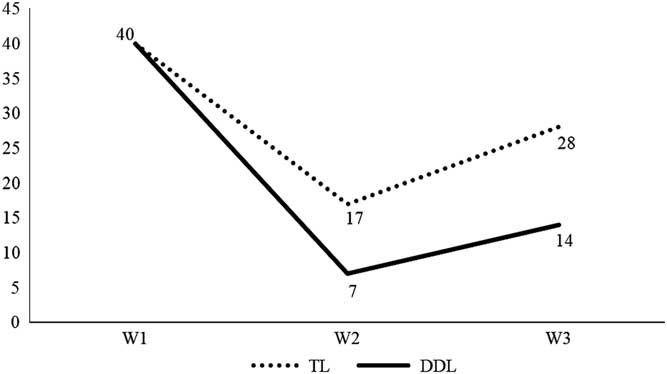
Figure 1 illustrates that the raw counts of overgenerated be prior to the instruction (i.e. 40) were significantly reduced in the two groups, but at different rates. The number of overgenerated be produced immediately after the instruction was 2.4 times greater in the TL group than in the DDL group. In terms of retention, the TL group produced twice as many overgenerated be during W3 than the DDL group. The raw count of 28 overgenerated be for the TL group during W3 was 70% of the initial count for W1 (40).
Changes in raw counts of overgenerated be

From the results of the current study, the positive effects of the guided DDL induction on unlearning overgenerated be and its retention seem quite clear. Learners in the DDL group appeared to increase their linguistic awareness through discovery by identifying, comparing, and learning linguistic patterns regarding the use of be in the NS and learner corpora and coming up with their own hypotheses (Aston, Reference Aston2001). These learners seemed to internalize the target feature by noticing “the necessary and sufficient condition for the conversion of input to intake for learning” (Schmidt, Reference Schmidt1994: 17), which prompted them to pay more attention and, accordingly, learn more. In particular, learning materials developed not only from NS but also from learner production enabled the participants to concentrate on negative evidence regarding the difference in use between NSs and themselves (Oh, Reference Oh2004). The positive pedagogical effects of negative evidence obtained through the investigation of learner corpora have been reported in several studies (Cotos, Reference Cotos2014; O’Sullivan & Chambers, Reference O’Sullivan and Chambers2006). Through this negative input enhancement (Sharwood Smith, Reference Sharwood Smith1993), learners could themselves notice that the given form (overgenerated be) is incorrect. Such negative evidence could not be as easily and/or effectively noticed or obtained by learners from the traditional resources of teachers’ deductive instruction or course books (O’Sullivan & Chambers, Reference O’Sullivan and Chambers2006). In contrast to the DDL group, learners in the TL group simply received the explicit information about overgenerated be through the teacher-centered conventional approach, where the explicit knowledge was weakly established (Takimoto, Reference Takimoto2008).
4.2 Learners’ perceptions toward DDL
It is generally believed that learners’ perceptions, such as attitudes, beliefs, or enjoyableness, significantly affect the efficacy of grammar learning in their classroom achievement (Green, Reference Green1993; Mantle-Bromley, Reference Mantle-Bromley1995; Schulz, Reference Schulz2001). In this regard, many studies have examined learners’ attitudes during their corpus uses, and most have reported positive learner responses (Braun, Reference Braun2007; Hsieh & Liou Reference Hsieh and Liou2008; Sun, Reference Sun2007; Vyatkina, Reference Vyatkina2016b; Yoon, Reference Yoon2008; Yoon & Hirvela, Reference Yoon and Hirvela2004). Yet there has been little exploration regarding secondary-level learners’ perceptions of learner-corpus-based activities, especially in grammar learning, one of the most challenging areas for EFL learners. Accordingly, the second research question focused on the affective responses of learners as they encounter DDL based on the comparison of NS and learner corpora.
Students in the DDL group responded to an open-ended survey regarding what they felt about the specific type of instruction that they received.Footnote 6 They were strongly encouraged to provide as free and honest responses as possible. The survey result indicates that the vast majority of the learners – 92% (n=87) – showed positive perceptions, with 5% (n=5) and 3% (n=3) answering negatively and “I don’t know,” respectively.
The learners’ positive reactions toward DDL may be grouped into five main categories. First, 48 learners (55%) answered that they were able to increase grammar consciousness and would actively try to avoid grammar errors in the future. Second, 47 students (54%) appreciated both the fun and pedagogical benefits of the DDL activities. Next, 35 (40%) were satisfied with the use of both NS and learner corpora in DDL; some wrote about the advantages of “authentic” data from the NS corpus, TFKC, while others mentioned that it was very interesting and amusing to see not only their own writing but also sentences written by their peers. Furthermore, 31 learners (36%) commented that grammar learning, which had previously seemed complicated and frustrating, became, through this new method, something that they eagerly anticipated. They gained confidence in grammar learning and became motivated to study grammar.
What is truly encouraging is the finding that 16 participants (18%), whose English proficiency was lower than the rest (as judged by the final-term test scores), responded that they tried to overcome difficulties in grammar learning through DDL instead of merely “giving up.” Indeed, these lower-level learners often got stuck trying to figure out the meanings of words and phrases included in the concordance lines. Nevertheless, they seemed to lower their affective filter (Krashen, Reference Krashen1981) and enjoyed learning while analyzing their own and/or their peers’ writing. Realizing that not only they but also their friends make similar errors may have exposed them to a positive affective atmosphere, indirectly facilitating grammar learning, which had previously been their least favorite learning subject. In a similar vein, Vyatkina (Reference Vyatkina2016b) reported that the lowest proficiency level learner in her study could enjoy the NS corpus-based collocation learning activities despite the difficulties arising from the limited L2 knowledge. Given the current finding, it is possible that making use of not only NS but also learner corpora in DDL may be more beneficial and effective for low-level learners. The clear positive influence that learner-corpus-based learning has on motivation, a key to learning (Dörnyei, Reference Dörnyei1998), offers important implications.
On the other hand, the learners who felt negatively about the DDL, no matter how few, should not be ignored. These learners tended to struggle with comprehending basic structures and meanings of sentences included in the concordance data. When such is the case, identifying the disparities between the NS language and their own would be a rather demanding task. Some of the learners also expressed their reluctance to use the new type of instruction, which is distinctly different from the typical and familiar class and resulted in general demotivation on their part. To maximize the positive effects of DDL, the scaffolding role of the teacher, previously undervalued, becomes essential as the teacher assists students in bridging the gap between their language and the NS model. Teachers, for instance, may try to grasp the nature of difficulties for each learner and provide personalized help while encouraging all learners to approach the novel task of data analysis with willingness and less anxiety. Learners’ differences, including diverse learning styles and strategies, should also be given special consideration (Mizumoto & Chujo, Reference Mizumoto and Chujo2016).
5 Conclusion
With a focus on the cognitive and affective effects of DDL based on learner as well as NS corpora, this study compared guided DDL induction with traditional grammar learning for the purpose of unlearning overgenerated be in secondary-level EFL classrooms. The results pointed to positive immediate and retention effects of DDL with regard to the target feature, confirming Boulton and Cobb’s (Reference Boulton and Cobb2017: 386) conclusion that “DDL works pretty well in almost any context where it has been extensively tried.” First, the mean ratios of overgenerated be dropped to a greater degree in the DDL group than with traditional teaching. Next, the number of overgenerated be decreased after instruction in both groups, but to a significantly greater extent with DDL for both subsequent writing tasks. It seems that – compared with the learners who received traditional instruction through the teacher-centered three Ps – learners in the DDL group actively observed, classified, and generalized (Johns, Reference Johns1994) the use of be in the NS and learner corpora, assisted by the teacher’s guidance. Noticing the differences between NS and learner corpora in this way may have stimulated deeper processing and, ultimately, improved subsequent retention (Craik & Lockhart, Reference Craik and Lockhart1972). Regarding learners’ perceptions of grammar learning based on NS and their own data, the findings showed that the vast majority of learners in the DDL group, especially at lower levels, were satisfied with this new instructional method. The benefits that they recognized include increased grammar consciousness, heightened motivation, and interest in learning. DDL based on a learner corpus encouraged them not to give up learning by helping them realize that their peers also make the same errors, thereby lowering their affective filters (Krashen, Reference Krashen1981).
From the findings of the current study, some pedagogical implications can be drawn. Above all, there is a call for data-driven grammar learning, especially based on both NS and learner corpora. A substantial amount of literature mentions positive effects of corpus-based research and its implications (Conrad, Reference Conrad2000; Yeh, Liou & Li, Reference Yeh, Liou and Li2007). Teachers, however, often face obstacles in the actual implementation of DDL for a variety of reasons, including its time-consuming nature (Yoon & Hirvela, Reference Yoon and Hirvela2004) and the lack of both teacher and student training (O’Keeffe & Farr, Reference O’Keeffe and Farr2003). DDL based not only on NS but also on learner corpora at the secondary level is especially rare. The present study demonstrates that secondary-level learners may not only learn better but also enjoy learning grammar once they are placed in the role of active language detectives (Johns, Reference Johns1991), rather than passive recipients of a detached set of rules. There appear to be innumerable benefits of using learner corpora in the EFL classrooms and, for this reason, it is important for researchers and educators to work together to overcome impediments in the classroom application. One thing to always remember is the significance of constructing and/or using both NS and learner corpora that are most appropriate and relevant in terms of language and content for local students. The target language features in DDL instruction may be successfully extended from lexis, the typical items in DDL, to other items, such as grammar, when they are determined on the basis of the instructor’s careful analysis of his or her students’ needs, as was the case in this study. In this regard, it is important to note the value of a corpus-based instruction on the part of not only learners but also educators. Building up and analyzing a local learner corpus itself helps teachers better diagnose and address the linguistic problems of their own students. Instruction based on such data may also help build a strong bond between the teacher and the students, as the material and the method of learning become more personalized.
The findings of the present study are based on a specific group of learners in Korea and need to be corroborated and/or challenged by studies conducted in various other contexts. Although the present learners examined paper-based DDL materials that the teacher had prepared, taking the form of guided induction, the range of application can be broadened toward direct corpus use with less guidance adapted to the local context. Given the paucity of empirical research despite the potential benefits and usefulness of applying DDL with both NS and learner corpora, future studies should focus more on how to enhance students’ motivation and autonomy through proper assistance and training according to learners’ learning styles and levels as well as target linguistic items. The current research will hopefully serve as a sound foundation for such future studies.
Appendix A
Example of DDL learning materials
Note: In the original materials, instructions were provided in the learners’ mother tongue (i.e. Korean) in consideration of their English proficiency levels.

Appendix B
Example of traditional learning materials
-
2. The Uses of Be Verbs
-
2.1 Nouns, adjectives, or gerunds come after be verbs to indicate state of being.
-
∙ My father is a businessman and my mother is a teacher.
-
∙ In Korea we have four seasons. The weather is beautiful.
-
∙ Spring begins in March. It is warm and pleasant.
-
∙ My hobby is drawing cartoons.
-
-
2.2 Be verbs are followed by a present participle or a past participle to express progressive or passive forms, respectively.
-
∙ Look at this picture. A koala is carrying its baby on its back.
-
∙ Lately a lot of work is done by volunteer workers.
-
-
-
★ Note that it is incorrect to use be verbs before the infinitive (or tensed) form of a verb.
-
∙ My sister is smart. She is go to university. [incorrect]
-
→ My sister is smart. She goes to university.
-
About the authors
Soyeon Moon teaches English as a foreign language at a public high school in Korea. She is also a PhD candidate in the Department of English Education at Seoul National University. Her main research interests include corpus-based language learning and teaching.
Sun-Young Oh received her doctoral degree in Applied Linguistics at the University of California, Los Angeles. Currently, she is a professor in the Department of English Education at Seoul National University, where she teaches courses in corpus linguistics, discourse analysis, and second/foreign language pedagogy.