1 Introduction
The impetus of this article is to report the outcomes of a “learning in doing” situation (Chaiklin & Lave, Reference Chaiklin and Lave1996), where student-teachers at the Autonomous University of Barcelona become immersed in a virtual setting and are required to work with transatlantic peers to achieve a joint task.
Network-based professional development is not common to the specific sociocultural context of teacher training. In this case, telecollaboration was not part of the formal TEFL curriculum, but a personal initiative of the university tutor, who intended to create a ‘virtual’ collaborative environment as an additional form of learning to the participants’ initial formation as primary education language teachers; it was an entirely new experience for the subjects involved and implied a type of “loss of a stable state” as a means of change in their existing practices (Schön, Reference Schön1973: 9). The instructional design addressed the need to provide the participants with situated network-based collaborative experiences not to learn about new ICT tools per se but as a way of fostering a conceptual understanding of the pedagogical value of network-based collaborative experiences, and motivating the student-teachers to transfer this knowledge into the classroom (Dooly, Reference Dooly2009).
This article looks at: (1) the challenges the student-teachers encountered during the activity; (2) how these challenges influenced the historicity (development) of the activity; and (3) the actual outcomes of the activity in relation to the intended outcomes.
A significant body of literature addresses challenges and breakdowns encountered in the implementation of telecollaborative projects for educational purposes. O’ Dowd and Ritter (Reference O’ Dowd and Ritter2006) present an inventory of factors reported by researchers as sources of dysfunction in telecollaborative intercultural exchanges for language learning. In this article, I draw on Activity Theory and the core concept of contradictions to investigate the challenges in a telecollaborative setting designed, not for language learning between intercultural partners as such, but for teacher learning involving student-teachers of EFL from different sociocultural and institutional backgrounds. Specifically, I use Activity Theory as a descriptive tool to understand the telecollaborative exchange as a complex activity system created through the interaction of individuals, their social surroundings and mediating artifacts, and as a means of theoretically conceptualizing underlying contradictions that resulted in disparity between original aims and final outcomes. For these purposes, I model the activity system on the activity triangle (Engeström, Reference Engeström1987) and apply Mwanza's decomposing idea (Reference Mwanza and Michitaka2001) as a methodological heuristic to locate the contradictions that arose in the course of the activity.
Research highlights Activity Theory's potential for understanding the complexity involved in practices carried out by multiple agencies working together towards the achievement of a shared object by means of various artifacts (Nardi, Reference Nardi1996; Basharina, Reference Basharina2007). The notion of contradictions has been extensively used to analyze Computer Mediated Communication (CMC).
1.1 Activity Theory
The genesis of Cultural-Historical Activity Theory (CHAT) derives from diverse philosophical sources, including Marxist writings and develops on the premises established by three generations of academics (Engeström & Miettinen, Reference Engeström, Miettinen, Engeström, Miettinen and Punamäki1999; Smagorinsky, Reference Smagorinsky, Ellis, Edwards and Smagorinsky2010). The theory began with the fundamental idea of social mediation in human cognitive development (Vygotsky, Reference Vygotsky1978; Reference Vygotsky, Reiber and Carton1987); it was advanced by Leont'ev (Reference Leont'ev1978; Reference Leont'ev1981) who conceptualized human cognitive development as emerging in collective activity and set the theoretical grounds for the development of activity theory. Engeström (Reference Engeström1987; Reference Engeström, Chaiklin and Lave1993) expanded the work of Leont'ev to illustrate the premises of CHAT on a complex activity system defined by its object.
The complex activity system describes human actions in terms of an individual or a group of subjects working on a shared object to obtain a desired outcome; human activity is mediated by various cultural artifacts, i.e., tools, rules, and division of labor (Thorne, Reference Thorne, Van Esch and St. John2004; Engeström, Reference Engeström2001). Engeström's version highlights the following essential features of activity systems: they are multivoiced formations encompassing multiple perspectives from the participants. They are historically-constructed and constantly evolve over time. The development of activity systems is driven by contradictions that lead subjects to find new solutions, which may include new rules, division of labor, new tools, and objects and results in transformation and the creation of new forms of activity (Engeström, Reference Engeström2001; Blin, Reference Blin2004).
In activity theory terms, contradictions are likely to emerge when elements of a “culturally more advanced” activity system interact with elements of the “dominant forms of activity” (Engeström, Reference Engeström1987: 44–45). This interaction creates contradictions or “misfits” (Kuutti, Reference Kuutti and Nardi1996: 34), which “come to light in the form of problems or breakdowns within and between activity systems” (Mwanza, Reference Mwanza and Michitaka2001: 6).
1.2 Activity Theory contradictions and Computer-Mediated Communication research
Contradiction analysis is particularly relevant for addressing the inconsistency between original designs and conceptions of a learning activity, and actual application. Multidisciplinary researchers have heavily drawn upon the CHAT notion of contradictions as the “driving force of development” to analyze tensions emerging during the implementation of technology-based designs and describe the resulting transformation of practices (Nardi, Reference Nardi1996; Blin, Reference Blin2004). Specifically, in educational research on CMC, Barab, Schatz and Scheckler (Reference Barab, Schatz and Scheckler2004) use Activity Theory to depict contradictions following the launching of an online community of teachers that sought to engage teachers at Indiana University in new culturally challenging practices. Their study shows how underlying tensions were translated into the subjects’ resistance to engage in this community and led to the transformation of the initial idea of online community into a Web-supported community of teachers. Thorne (Reference Thorne2003), within a CHAT framework, coins the term “cultures-of-use” to portray that the use of a tool is specific to communities who have historically formed activities related to the tool. He argues how mediating Internet communication tools are cultural artifacts and as such pose challenges to the development of online collaboration where different cultures-of-use are involved. Basharina (Reference Basharina2007) investigates the intra-cultural, inter-cultural, and technology-related contradictions that emerged in an international telecollaborative exchange between learners of English from three different cultural backgrounds for the purpose of improving language skills and raising intercultural awareness.
2 Methodology
2.1 Research context and participants
The study presented here investigates the second part of a virtual collaborative activity that took place between seven student-teachers studying at the Universitat Autònoma de Barcelona (UAB), Spain and ten student-teachers studying at the University of Illinois at Urbana-Champaign (UIUC), USA. They were all student-teachers of English, but at different levels. The UAB student-teachers were undergraduate students in their final year of Initial Teacher Education and specialized in English as a Foreign Language, while the UIUC groups were MA students specializing in CMC for teaching English as a Second Language. The UAB student-teachers had no experience in doing telecollaboration or using Second Life (SL) prior to this course. The UIUC participants were more experienced in technology, since the degree they were studying involved learning and using technology for language teaching.
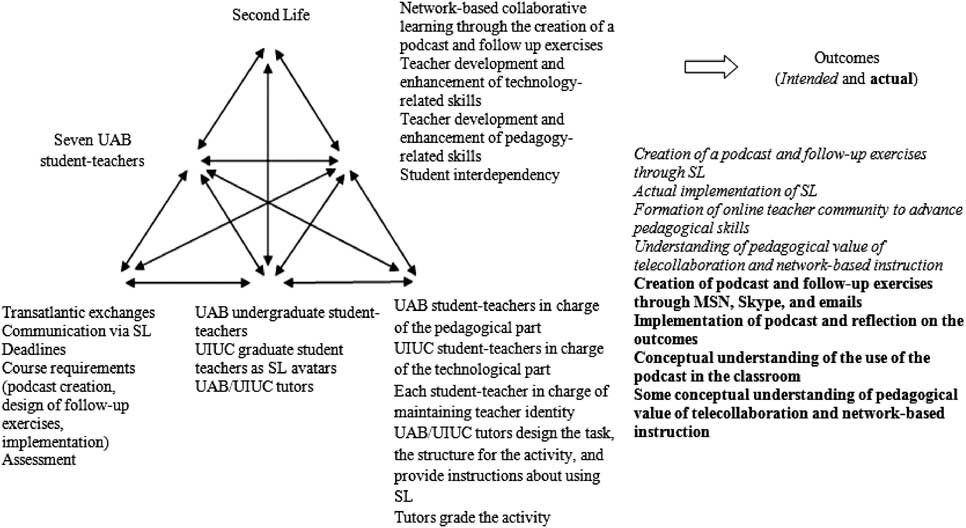
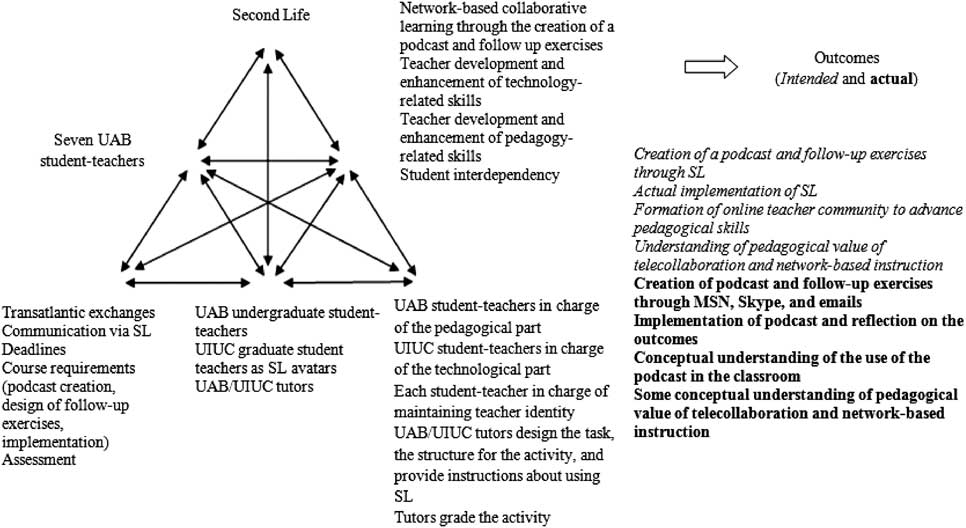
The overall objective of the activity discussed in this article was the enhancement of pedagogical skills and teaching competences through transatlantic exchanges via SL during which the participant groups were required to create a short podcast and follow-up exercises around a linguistic structure of their choice. The two university tutors planned this transatlantic exchange to allow student-teachers to experience collaborative learning through a virtual environment towards a task that required both pedagogical and technological knowledge. Thus it was hoped that the activity would be developmentally productive in three ways: (1) expand student-teachers’ actual pedagogical knowledge through social interaction with peers of different specializations and varied experience in language teaching, (2) promote a conceptual understanding of network-based instruction through a situated experience with Web 2.0 tools – in this case the SL platform, and (3) encourage student-teachers to develop a conceptual understanding of the pedagogical value of such tools.
A model of the complex activity system of this transatlantic exchange is facilitated by Engeström's triangle (see Figure 1).
The activity system of the transatlantic exchange (adapted from Engeström, Reference Engeström1987)
2.2 Activity integration into the university curriculum
The telecollaborative exchange was carried out in out-of-class time and counted on the participants’ own resources. All the participants had personal computers and home access to the Internet.
The UAB and UIUC assessment rubrics were adapted to allocate a percentage of the overall assessment to online participation. Nonetheless, the aims of the telecollaborative activity had to comply with the general aims of the respective programs the transatlantic partners were studying. Inevitably this implied certain differences in the way the two groups were assessed. Based on the underlying goal of fostering self-reflection and critical thinking, the UAB student-teachers were required to create and implement the podcast through follow-up exercises, whereas the UIUC student-teachers were evaluated for the creation of the podcast and quality, but did not have to implement the podcast exercises in teaching practice. The UAB student-teachers’ participation in the telecollaborative exchange was part of the overall continuous assessment which consisted of self-reflection (weekly journals and final report), peer assessment, using rubrics, and teacher assessment, again, with a competence-based rubric.
2.3 Data collection
The data was ethnographically collected for the purposes of an ongoing doctoral thesisFootnote 1 on teacher development, following the subjects’ written permission. The data used in this article was extracted from the overall data corpus and concerns the second semester of the practicum course (February-June 2010) at the UAB. This specific set of data comprises twenty hours of video/audio recordings of university sessions (university tutorials and microteachingFootnote 2 classes) transcribed using ELANFootnote 3, seven transcripts of online chats, and seven final reports in wiki format.
The ethnographic type of data allows for a historical investigation of the activity through its different phases of development: beginning (university tutorials), middle (online chats and tutorials) and end (tutorials, final wiki reports and microteaching sessions). Since this study is part of a thesis on the overall development of the UAB student-teachers, data other than the online chats was collected only from this participant group. For this reason the analysis and discussion mainly reflect the UAB point of view.
2.4 Validity of data
The trustworthiness of the research methods used for the data collection and analysis was preserved throughout the investigation in compliance with the criteria of credibility, transferability, dependability, and confirmability (Lincoln & Guba, Reference Lincoln and Guba1985).
The research problem emerged following a holistic description of the situation at hand through the overall data corpus. The findings reflect the phenomenon of interest through the participants’ eyes, based on an emic perspective, and account for the sociocultural and institutional context at the specific period of time the research was carried out, and the agency of the subjects involved. Therefore they do not imply replication in other contexts – different agencies and sociocultural structures – and do not suggest generalization.
During the year-long observation period I adopted a balanced participatory role in the course and made clear to the student-teachers that my purpose was purely research and that my work would have no reflection on their final grade. That said the credibility of the data relies on the participants’ honesty during the data collection period. Also, the findings were corroborated by convergence of data from multiple sources collected at different moments throughout the observation period: informal conversations with the subjects, extensive fieldnotes, and informal reports on the progress of telecollaborative activity.
One possible limitation related to the credibility of data may be implied by the assessed character of the student-teachers’ final reports on the telecollaborative exchange. The truth value of this data was contrasted with additional data collected after the assessment procedure was finalized. On this occasion, the UAB student-teachers presented a reflective oral account of their individual trajectory as teachers to their classmates and school teachers, who had been invited to join the session.
3 Data analysis
3.1 Data sampling and research questions
Scrutinizing the large data corpus I identified recurrent themes emerging from the transcribed university tutorials concerning the transatlantic exchange, the online chat transcripts, the UAB student-teachers’ final reports (assessed) and final class presentations (not assessed). These themes were initially grouped under two codes: reported tensions and positive outcomes indicating professional development. Then, similar concepts related to these codes were identified and specific categories were devised to fit the data (Glaser & Strauss, Reference Glaser and Strauss1967).
Next, I returned to Activity Theory and the construct of contradictions as theoretical backdrop to the analysis. Cole and Engeström (Reference Cole, Engeström and Salomon1993: 8) explain that in activity systems, “equilibrium is an exception and tensions, disturbances, and local innovations are the rule and the engine of change”. In other words, in every endeavor to incite transformation through mediating tools obstacles inevitably emerge; development occurs when the subjects become conscious of those contradictions and transform the object to integrate more possibilities. Hence, the relevance of the CHAT construct of contradictions to this study became visible as a means of understanding the emerging tensions and the transformation of the telecollaborative exchange.
Applying the Activity Theory lens to the preliminary findings I formulated the following research questions to guide this investigation.
1. What were the contradictions underlying the tensions the UAB student-teachers regarded as a hindrance to the achievement of the original aims of this activity?
2. How did these contradictions transform the original objects of the activity?
3. What were the learning outcomes of the activity in relation to the contradictions?
3.2 Locating the contradictions
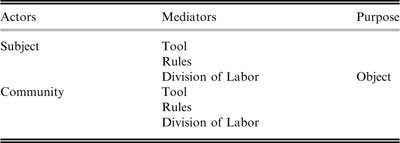
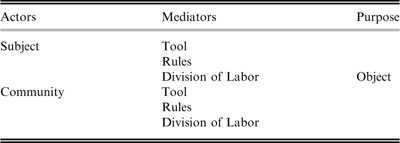
I used the decomposing idea proposed by Mwanza (Reference Mwanza and Michitaka2001) as a heuristic tool to designate the relationships reflected in the main activity system on smaller triangles based on the pattern ‘actors, mediators, purpose’ (Table 1), and to pinpoint the elements of the activity system the subjects associated with tensions and reported as hindering to the development of the object-oriented activity, i.e., tool, rules, and division of labor.
Adapted from Mwanza (Reference Mwanza and Michitaka2001)
The CHAT premise of historicity underlines that activity systems are not static but undergo constant development through time (Engeström, Reference Engeström1987; Reference Engeström, Engeström, Miettinen and Punamäki1999a; Reference Engeström, Engeström, Miettinen and Punamäki1999b; Reference Engeström2001). As Engeström (Reference Engeström2001: 137) explains, contradictions are “not the same as problems in the development of activities, but historically accumulating structural tensions within and between activity systems, that generate disturbances and conflicts, but also innovative attempts to change the activity”. Thus, the implication for investigating contradictions is not to look at contradictions as tensions encountered at a specific moment in time, but rather to understand these tensions in their transformative dimension.
In view of that, I present the contradictions in the form of tensions and challenges throughout the development of the activity, based on the following questions that derived from Mwanza's decomposition scheme:
1. How do the mediating entities, i.e., Tools, Rules and Division of Labor influence the way the Subjects work on the Object?
2. How do the mediating entities, i.e., Tools, Rules, and Division of Labor influence the way the Community achieves the Object?
4 Findings
The analysis identified three types of contradiction underlying the transatlantic exchange: intra-institutional contradictions that emerged prior to the participants’ actual engagement in the online community, technology-based and inter-institutional contradictions that emerged during the exchange and resulted in the transformation of the initial objects.
4.1 Intra-institutional contradictions
4.1.1 Telecollaboration offers an opportunity for learning but adds to the workload
When the tutor introduced the second part of the telecollaborative activity with the UIUC groups, the UAB student-teachers appeared to be ‘torn between two objects’ – obtaining a good final grade at the end of the course and trying out a new and interesting experience, which was also time-consuming and could compromise their final grade. The student-teachers revealed this inner contradiction in an oral discussion during the first university tutorial. In this instance, the UAB student-teachers commented:
ADR are you also aware that there is a sort of double view on this matter/Footnote 4
CAT why?
ADR because you you see it as an extra work and i spoke to some people from other groups/ and and they ENVY the things that we do and they say oh you are with americans and we are not you do this and we are not I would like to do this too you have more opportunities that we have
UT but it is more work people fr-
CAT yeah i like doing it but we do an effort to do this and
ADR i know it's more work but it's also more we have more positive things/
UT but she wants_
CAT i'm not saying i don't want to do this i want to do this but-
UT she wants recognition
CAT i do this and i spend more time doing extra work and i haven't got time to revise the what i write so i don't know
HAL yes it's XX time
CAT uh hm
HAL it's an opportunity but it's work it's work
UT it is it is extra work and you're absolutely right in you you have a valid point for bringing up the need for recognition
As indicated in the above excerpt, the student-teachers experienced contradictory feelings deriving from the fact that the online exchange was not a prerequisite of the formal curriculum and therefore not required in other practicum classes at the same university. The student-teachers acknowledged the privilege of having this opportunity; however, Caterina emphasized the challenges involved in having to carry out activities through new tools with which they were not familiar. She stated that she liked performing the activity, but at the same time she pointed out the need for recognition of this extra effort through additional credit on the final grade; more colleagues supported her arguments. The UAB tutor recognized the validity of their arguments and allocated a mutually-accepted percentage for online participation.
4.2 Technology-based contradictions
4.2.1 I haven't used SL before and I don't know what a podcast is
After the instructor introduced the task of creating a podcast in collaboration with American student-teachers in SL, most of the UAB student-teachers reported anxiety related to their limited ‘tech-savviness’ and inexperience with the implementation of technology for educational purposes. In her final report Alicia wrote:
When I first heard I had to do a podcast, I did not know what it was. It seemed a lot of work and the only thing I knew for sure was that it meant to work in collaboration with American students. I felt scared, that was my first sensation, because I thought students from the UIUC would have an excellent command of ICT, whereas I had not. Luckily, Melanie calmed us down by saying we were in charge of the pedagogical part of the podcast (pre & post activities) while students from Chicago were ICT experts. That sounded much better.
Alicia confirmed that she experienced anxiety when she and her fellow classmates were first introduced to the task because they, as she states, had no experience with the SL software and podcast technology, while their UIUC peers were ‘technological experts’. This contradiction added even further to their anxiety level.
Student-teachers’ level of anxiety appeared to be reduced when they were initiated into the concept and use of podcasts and the SL software, and acquired some background knowledge and practice on the tool. They first used SL to virtually meet with the UIUC tutor, who provided a brief tutorial about the SL software. Their tutor took the UAB student-teachers on a virtual tour around the CALICO/EUROCALL headquarters to introduce them to the pedagogical implementation of SL by education and professional organizations. He also gave them some tips on how to get their avatars to perform some basic functions and move around this 3D virtual space. They also had the opportunity to engage in a small ‘scavenger hunt’ activity where they were invited to work with their assigned peer groups to locate and report useful educational places in SL. During that meeting, they counted on the support of their tutors to guide them around the different spots of this new ‘world’. Next, the groups proceeded with the creation of the podcast and completion of follow-up exercises in SL.
4.2.2 SL is too difficult to handle
Soon after the first meetings in SL, most of the UAB student-teachers reported multiple technical problems while accessing or using SL, such as audio and visual difficulties, running certain software programs on their personal computers, and the need for more updated software related to 3D graphics. Most of the student-teachers confirmed that they had to find new solutions in order to maintain the telecollaborative exchanges with their peers. As a result, the groups either completely abandoned SL or adopted alternative platforms such as MSN, Skype text chat, and email exchanges that they had implemented in the past and felt more comfortable with. For example, Natalia who became the most disappointed with SL, mostly because of perceived technical deficiencies, commented in her final report:
Speaking about the second life experience, I have to admit it has not been a nice experience. I found it unnecessary as it was easier to organise ourselves by messenger or Skype than by second life. It is true that it is more personal but it is not worthy as is not a easy tool to deal with.
Natalia explained that for her, the SL software was not easy to handle and characterized it as “not necessary”. She confirmed that she preferred to use easier and more familiar platforms such as MSN or Skype.
Additionally, in her final report Maria indicated that she chose to use MSN and not SL to communicate with her peer. However, she moved beyond looking at technical difficulties as hampering to the adoption of the SL software to point out that the student-teachers’ insufficient background knowledge in using this tool was also restrictive. As she stated:
From my point of view, Second Life was not a success because when I had to talk with my Illinois partner we used messenger. For us it was a “waste of time” in sense that it is very funny, and the environment is like a party but our aim was talking about the podcast, how create it and information about the video. So, from my point of view SL was not necessary. It's true that it is a different way to communicate with others and the program has lots of resources and you can do many things (buying, travelling, flying, moving, changing your appearance, playing, etc). In addition, SL needs a “fast” computer because it is huge and not everybody could do the activity that Melanie and Raymond had prepared before our meeting. Some mates were lost in different worlds and had problems to find the clues that we need to do the task.
She acknowledged SL's potential in terms of providing users with opportunities to perform many actions, but conveyed a strong resistance to considering this software useful for professional purposes. She perceived it as a fun resource but not adequate for the establishment of well-grounded communication to plan and create the podcast. More importantly, she recognized that her own and her fellow classmates’ insufficient experience in using this technologically advanced and culturally new tool (for the Catalan context), and lack of adequate resources, was a hindrance to the construction of a solid infrastructure to support the emergence of a community between the transatlantic peers.
These technical difficulties were the focal points in the reports of the UAB groups involved in this exchange, for whom telecollaboration and Web 2.0 tools constituted a first-time experience. They seemed to consider them decisive in the overall development of the activity. Consequently, they perceived the SL software as an unreliable tool for synchronous communication and not a valuable pedagogical tool.
4.3 Inter-institutional contradictions
A recurrent theme emerging from subjects’ online chats and verified in the UAB student-teachers’ final reports suggested that they found it difficult to establish common ground with their peers, and acknowledged this difficulty as restraining to the endorsement of a collective effort to co-construct new knowledge.
4.3.1 They don't have experience in teaching primary school students
During the telecollaborative exchange, student-teachers in Spain persistently reported, in class, difficulties in establishing sufficient intersubjectivity with their UIUC counterparts because the majority of their American colleagues did not have experience in teaching primary school students. Maria was one of the student-teachers who commented on this difficulty in her final report. As she wrote:
Practicum sessions have been an opportunity to share ideas with my classmates and my partners in Illinois. On the one hand, I should comment that my experience with my American partner was not so successful as I preferred because she did not have experience teaching in Primary. Otherwise, my partner worked very hard to create a podcast with my indications. She showed interest and the result was brilliant. So I can say that I am very happy with the podcast (based on a story similar to “Brown Bear, Brown Bear what do you see?”) that she designed.
Maria attested that even though she was very pleased with her partner's efforts in making the podcast, and with the result, the fact that her partner did not have experience in teaching primary school students was constraining to the collaborative construction of knowledge and enhancement of pedagogical knowledge that she hoped for.
4.3.2 They don't have to implement the podcast like we do
The findings suggested that institutional rules requiring implementation and reflection only from the UAB student-teachers created different priorities for the groups, and reinforced distinct roles and individualized work.
For instance, Natalia asserted that she had to assume most of the responsibility for the pedagogical part of the assignment because she was the one who had to implement it. In her final report she commented:
On the other hand, as she had few time because of final exams, we could only met once to organise what to do, how to do it and do the presentation. So we did it very fast and not in an appropriate way. As we had only one day, I tried to be creative and find some interesting topic and activities to do the podcast. As I were the person that was going to implement the podcast and knew my students, I had the strongest responsibility to find something interesting to do. It was so stressed because I would like to reflect upon the topic and activities with more time, and see, after few days, if I already liked them. As we had no time, we send the first idea I had (with feedback and ideas from Eve's point of view) and we did it.
She remarked that, since her UIUC partner was only assessed on the general planning of the podcast and the final outcome she rushed to complete the planning and final video recording in order to concentrate on her final exams. The limited interaction with her partner did not allow her to discuss more topics for the podcast, which made her feel stressed and disappointed.
Caterina was very enthusiastic about her exchange with her peer. Her group used SL to carry out several meetings to discuss ideas, which Caterina relied on to plan a variety of exercises. However, she felt disappointed and frustrated when she realized that the podcast consisted of explicit grammar instruction. Two days after the submission of the final podcast and activities, Caterina reported her frustration to the researcher, right after a university tutorial:
..and we decide SHE told me can you do a powerpoint explaining why e:h_ how do we do_ present continuous/ be verb plus ing and model and i said i think for second graders/ we can't say be verb plus ing they even know in_ like modeling and orally and_ eh no and she said okay we are going to follow your instructions okay I do the powerpoint presentation explaining the activities because she wanted to add this to the_ podcast/ to the video/ she wanted to add like slides first/ and_ we say okay i do it i sent it at night and then she_ for next day/she sent me the podcast/ the final i open it was totally different because be verb plus ing/ you are a_ i am playing you are playing she is playing we are playing all and ing in red are in red and second graders won′t know- what is it′s totally different […] and in the_ transcriptions i said i don't think second graders we don't have to teach explicit- in an explicit way_ and i don't know i don't know if u:h_ i'll send an email to her or not because she said me it was nice to do ((laughing)) you know/ bye\ ((laughing)). (conversation after class)
Caterina firmly believed in applying the Communicative Approach in her teaching, but the final podcast came into direct contradiction with the teaching paradigm she was being trained by at the university, and restricted her from conducting her lesson the way she had initially planned.
The above contradictions emerging from the misalignment of the two study programs in terms of objects and rules guiding the assessment, and educational paradigms guiding the teacher training process in the two universities appeared to create a ‘gap’ between the partner groups. They felt they could not establish interdependency and could not consider themselves as members of a community to foster collaborative learning and social construction of pedagogical knowledge.
4.4 Outcomes
The contradictions identified in the overall activity were not all resolved. However, the student-teachers acknowledged rewarding outcomes from the telecollaborative experience – although not via SL – and generally perceived this experience as positive. Specifically, they all reported that this experience was ground-breaking since they were given the opportunity to participate in network-based activities for the first time and face the affordances and constraints this type of activities entail; they became acquainted with new tools such as SL and DropboxFootnote 5, and designed a teaching unit without the instructor's interference, which could not have been possible otherwise. They considered SL interesting and enjoyed implementing some of its basic functions. The telecollaborative activity also provided them with the opportunity to become acquainted with podcasts and, more importantly, to perceive the affordances of using podcasts in language teaching.
Student-teachers identified specific positive outcomes gained from their participation in the online exchange, and associated them with their own teaching. For instance, Alicia related these telecollaborative exchanges to Communicative Language Teaching (CLT) and conceptualized telecollaboration as a valuable tool for language learning through real communicative events and thus a motivating tool for students. In her microteaching course, Alicia presented the planning of an introductory session to a telecollaborative exchange between Catalan and Australian students using Voicethread, a tool which Alicia had used at the beginning of her telecollaborative experience to introduce herself to her UIUC peers. This is an extract from the microteaching class, where she communicated her planning to her classmates:
[…] so this is not this is not a topic-based activity/ but instead it's a_ we've tried to_ to give students a real purpose/ for the use of english/ that goes beyond the class/ u:h so we said them that they can see that the_ english is a powerful tool to communicate/ so they will have a real context and a real purpose okay the project is on countries/ so fifth-graders you will be fifth- graders/ u:m i'm going to get in touch with an australian school/ so during_throughout all the course/ they will get in touch via email via other multimedia resources/ so you as fifth graders/ you will have to activate your knowledge your background knowledge\.
Alicia acknowledged that this telecollaborative project between Spain and Australia involved challenges for the Catalan students to interact simultaneously with their counterparts, challenges comparable to those Alicia and her peers faced during their collaborative exchange. More specifically, Alicia's own experience with telecollaboration helped her appraise time difference as a concrete and not negligible source of breakdowns in online settings. To overcome these challenges, Alicia opted for asynchronous communication via emails as a mediating tool. In addition, she solicited her tutor's assistance in finding partners in Australia to set up her own telecollaboration project for her school students.
Despite her disappointment with the final product, Caterina wrote:
I am happy because I have experienced SL in a learning-teaching context and it may be useful for my future as a teacher. New technologies are very important nowadays and who knows if I will be in charge of an online collaborative task. In fact, I would like to. The times I talked to my UIUC peer I thought I would like to give a similar opportunity to my students, in which they could use English to communicate to English speakers (meaningful communicative events using target language with a real purpose). (Final wiki report)
As she confirmed, her hands-on experience with telecollaboration helped her develop a conceptual understanding of the pedagogical value of this tool and its potential for meaningful language teaching.
For Natalia, who posed as ‘technophobe’ from the beginning of the course and reluctant to exchange feedback with students she did not know, doing telecollaboration helped her overcome her resistance about using Web 2.0 applications, such as SL, Dropbox and Zoho wiki. Natalia also perceived feedback and collaborative work as affordances that guided her to improve her teaching practices. In her final report she stated:
I think I have improved a lot in this competence, as I have changed my attitude towards feedback. In the beginning of the year, I did not like to be given feedback or to give. With time I have realised that all the projects that I have been received feedback, they have improved a lot. When planning, you can see things very clear, but when explaining to other people, they can see things that you were not able to see. Moreover, the teachers (tutor, English teacher) and my partners have given great ideas to improve my teaching sequence, my Action Research and the podcast. This competence can be clearly shown in my powepoint of my journey as a teacher.
Activity Theory posits that there is an “incessant movement between the nodes of the activity and what initially appears as object may soon be transformed into an outcome, then turned into an instrument, and perhaps later into a rule” (see Center for Cultural-Historical Activity Theory and Developmental Work Research, University of Helsinki). In Alicia's case, telecollaboration started as an assessed object and an outcome of the course, which was then turned into an instrument for doing CLT in the school, while for Caterina, it became a potential object and instrument for the same purpose. Natalia perceived telecollaboration as an instrument that mediated the achievement of her personal object of learning to accept feedback during her initial teacher formation and discern the central role of feedback in improving practices.
5 Discussion and conclusions
The study showed the outcomes of an Internet-mediated collaborative activity emphasizing how the subjects worked through contradictions and reorganized the activity system through the adoption of new solutions that took the form of new rules, division of labor, tools and objects (Blin, Reference Blin2004). The findings highlight the interaction of multiple agencies and artifacts, and the role of artifacts, i.e., tools, rules, and division of labor, in both mediating and transforming the activity (Nardi, Reference Nardi1996; Basharina, Reference Basharina2007).
Most of the subjects tended to focus their final reflections on the challenges they faced during the online exchange. Student-teachers pointed at the technical difficulties encountered, and insufficient experience in using this tool, as a hindrance to the initial object of using and learning about SL. These difficulties inevitably constrained their chances of developing a conceptual understanding of the pedagogical value of this tool. Student-teachers also reported that the lack of solidarity and interdependency impeded the enhancement of pedagogical knowledge. In short, they perceived the online phase as the ‘weak link’ of their trajectory towards teacher development, in which they felt they gained less professional knowledge compared to the tutorials and school placement.
Activity theorists argue that contradictions are inevitable in real-life situations where individuals or groups engage in “an intertwined and connected web of activities” (Kuutti, Reference Kuutti and Nardi1996: 30) that aim at different and often contradictory objects. The participants in this telecollaborative exchange were involved in diverse activity systems operating in institutional and sociocultural contexts, for example, university, school, and online, which exposed intra-institutional, inter-institutional, and technology-based contradictions.
5.1 Different objects deriving from institutional activity systems
The UAB curriculum emphasized self-reflection, development of critical thinking, and teaching within a CLT paradigm rather than technology-mediated instruction. The UIUC curriculum focus was placed on technology-mediated ESL teaching. The online podcast activity and assessment criteria followed the overall institution-specific aims. Subsequently, UAB student-teachers were evaluated on the implementation of the podcast and the exercises, and the level of self-reflection and critical thinking they drew from the implementation; UIUC, on the other hand, were evaluated on technological competence in terms of producing quality high-tech tools for the language classroom.
Facing this contradiction of objects, the participants assumed an individualized division of labor and worked independently during most of the time, driven by different priorities. The UAB groups worked on the follow-up exercises aspiring to the productive implementation of podcasts and exercises in the classroom to foster constructive self-reflection and critical thinking. The UIUC groups were more concerned with the assessed parts of the activity, i.e., planning and presenting the idea of the podcast, the creation and submission of the final product, and their final exams.
The use of SL was not included in the assessment for either of the two institutions. This seemed to influence the way the student-teachers perceived its role in the activity. Most of them did not consider using the software as an object, and thus not relevant to the creation of the podcast and exercises. Student-teachers, like Natalia, perceived it as “unnecessary”, while Maria believed it was a “waste of time”.
Alicia's report of anxiety towards using SL prior to the activity, Maria's comment that SL was difficult to handle, Natalia's remark that SL was not an “easy tool to handle”, and generally the subjects’ resistance to using the tool represented another important contradiction between the participant groups’ uneven “cultures-of-use” (Thorne, Reference Thorne2003) in relation to SL. Thorne terms as cultures-of-use the historically constructed forms of activity correlated with the use of a tool in a specific community and considers it instrumental in analyzing CMC in culturally different learning environments. Thorne explains that “artifact or tool utilization necessarily implies cultural mediation and the routinized use of an artifact exhibits its temporally local as well as its historical constitution” (op. cit.: 40, italics added). In this context, working with SL was not a first time experience for the UIUC student-teachers who used the tool for educational and personal purposes. For the UAB student-teachers, on the other hand, it was an entirely new experience on both sociocultural and educational levels. All of the UAB participants were introduced to SL for the first time during the tutorials; thus they did not draw knowledge from habitual use of the software and felt highly constrained by the insufficient technical infrastructure available to support the use of the mediating tool.
5.2 Surrounding activity systems as contradictory to the online activity system
If we move beyond the institutional level to consider the broader sociocultural context and educational system this activity was embedded in, the contradiction between the objectives and regular practices of the schools in which the student-teachers were doing their teaching practice, and the objective of the online activity system to instigate change in existing practices through hands-on experience with telecollaboration and Web 2.0 tools, becomes relevant.
For example, some of the student-teachers, like Natalia and Maria, were teaching very young learners at the ages of four and five years, for whom telecollaboration did not form a common teaching format for language learning. As such, they did not consider telecollaboration as directly relevant to their main objective of professional training: to gain knowledge of effective methods for teaching very young learners. On the other hand, Alicia and Caterina were able to make connections between telecollaboration – although not via Web 2.0 tools and their objective of teaching language to their students, who ranged from the ages of ten and eleven years old. In her journal, Alicia even reported an experience with telecollaboration at her school via emails where she was able to observe the motivation it involved for the students.
The same principles could apply regarding the perception of SL as a pedagogical tool despite the technical deficiencies. Student-teachers’ general need for ‘know-how’ about this tool seemed to match the ‘non-routinized’ use of this tool in the wider school and university communities. Conversely, they all made connections between the use of the podcast, which was also a new tool for them in their teaching practices, and perceived it as an important and motivating tool for language teaching.
Overall, underlying contradictions that were not resolved appeared to deter student-teachers from directly associating the transatlantic exchange with their development as teachers, which, as Schön (Reference Schön1973) conceptualized, would count as “loss of stable state”. As a result, they did not engage in the online environment, as anticipated. As Barab et al. (Reference Barab, Schatz and Scheckler2004: 33) put it, they did not demonstrate substantial “ownership” by “accepting responsibility for building and maintaining a community” to advance professional development. While highlighting the positive impact of experiencing the potential of integrating technology and network-based instruction into their teaching, learning to use specific technology, meeting colleagues from different sociocultural, institutional and educational backgrounds, and becoming acquainted with different ideas about teaching more advanced levels of students, the participants seemed to remain attached to the contemplation of face-to-face tutoring as the dominant generator of learning in their trajectory towards becoming teachers.
5.3 Pedagogical implications
This study showed the contradictions student-teachers, novices in the practice of telecollaboration and technology-enhanced instruction, stumbled upon during a telecollaborative teacher training activity in a non-institutionally controlled environment, and describes the resulting transformation of objects.
Literature reveals that such contradictions are by no means rare in Internet-mediated educational settings. O'Dowd and Ritter (Reference O’ Dowd and Ritter2006) depict socioinstitutional and technology-related factors as very common sources of tension in telecollaborative implementations for language and intercultural learning. Basharina (Reference Basharina2007) reports different educational paradigms and computer tools as hindering mechanisms to the formation of a community between intercultural learners of English. She argues that contradictory elements are and will be inherent to the reality of international telecollaboration, given that it is impossible to attain full alignment of activities and study programs across different sociocultural contexts. In the present study, dissimilar program requirements entrenched in the activity, combined with the novelty of both the online tool and practice of telecollaboration in the Catalan sociocultural context embodied major impediments to the formation of an online community of teachers to develop pedagogical knowledge. Fully integrating telecollaboration in the teacher training course cannot ensure the alignment of study programs but can provide time and opportunities for participants to understand the particular sociocultural and educational settings they work in, and agree to respective teaching practices. Also, it can be a step towards allowing sufficient training to ascertain a minimum alignment of cultures-of-use regarding web technologies (Thorne, Reference Thorne2003; Basharina, Reference Basharina2007).
Additionally, the potential of engaging students in telecollaborative activities to foster positive learning outcomes is no less than compensative for the ‘thorny’ facets. One important implication of this study is that, despite the contradictions met, student-teachers expressed their intention to implement such activities in the classroom. The data was collected during an Initial Teacher Education program at the university; therefore this study cannot draw definite conclusions about the actual transfer of the practical and conceptual knowledge to the classroom. Nonetheless, the findings agree with the stance that engaging student-teachers in situated network-based activities during Initial Teacher Education fosters experience and necessary awareness about such learning practices and relevant tools. Current educational goals emphasize the need for teaching practitioners to be creative in using new technologies. They should be able to create rich social and material online conditions in order to promote authentic and purposeful language learning. The results suggest that technology-enhanced instruction – at early stages of teacher education – can be an important incentive. It can provide support for future professionals to conceptualize new generation technologies as a means of providing solid affordances for students’ learning, and to integrate experiential Internet-mediated environments into their teaching.
Acknowledgments
I sincerely thank the two groups of student-teachers and their instructors for granting me permission to collect the data for this study. I owe a very special thanks to my thesis advisor, Dr. Melinda Dooly, Dr. Stella Hadjistassou, and the two anonymous reviewers for their constructive feedback on earlier versions of this article.
Appendix
1The transcription was carried out using the conventions typically used by the Grup de Recerca en Ensenyament i Interacció Plurilingües (GREIP) operating at the Universitat Autònoma de Barcelona. Although complementary to the content, this transcription is not meant to provide an all-encompassing illustration of all aspects of verbal expression; more emphasis was given to what was said rather than the way it was said in order to investigate contradictions and learning outcomes. The transcription key represents the following: