


1. Introduction
Today, the ever-globalizing world is characterized by mobility, hybridity, discursively and physically porous borders, transmigration, transnationalism, deterritorialization, and super-diversity (Appadurai, Reference Appadurai1996; Vertovec, Reference Vertovec2007). As such, there are novel communicative conditions that language users must strategically navigate (Risager, Reference Risager2007). The increasing intercultural and global connections require language teachers to cultivate the skills of interculturality to effectively work with learners with diverse cultural and linguistic identities, and concurrently integrate the development of these skills into their instructional goals (Çiftçi & Savaş, Reference Çiftçi and Savaş2018; del Rosal, Conry & Wu, Reference del Rosal, Conry and Wu2017; O’Dowd, Reference O’Dowd2016). Teacher training courses, such as intercultural communication and multicultural education, help teachers develop these skills mostly through class readings and discussions in teacher training programs. However, actual interaction with people from different cultures and intercultural speakers’ critical engagement with otherness (Byram, Reference Byram, Byram and Zarate1997) have been found to more deeply influence teachers’ understanding of intercultural communication (Menard-Warwick, Heredia-Herrera & Palmer, Reference Menard-Warwick, Heredia-Herrera and Palmer2013).
University programs have instituted study-abroad excursions (including a set of various educational components) to support teacher trainees’ intercultural learning, but its costly nature limits its accessibility. Like in other realms of education, computer-mediated communication (CMC) has transformed the possibilities for teacher training as well. CMC has afforded novel activities for language learners and teachers to engage in intercultural communication with individuals from different cultures. One of these activities, telecollaboration (or online intercultural exchange), has become commonplace to connect language learners and teachers across the world and provide them with first-hand intercultural exposure (Çiftçi & Savaş, Reference Çiftçi and Savaş2018; O’Dowd, Reference O’Dowd2016). The existing research has provided insights into how telecollaboration contributes to language learners’ language awareness and development, intercultural communicative competence, and motivation (Angelova & Zhao, Reference Angelova and Zhao2016; Canto, Jauregi & van den Bergh, Reference Canto, Jauregi and van den Bergh2013; Chun, Reference Chun2011; Dooly, Reference Dooly2011; Hauck, Reference Hauck2007; Lee & Markey, Reference Lee and Markey2014; Liaw & Bunn-Le Master, Reference Liaw and Bunn-Le Master2010; Schenker, Reference Schenker2012; Ware & Kessler, Reference Ware and Kessler2016). However, more research is needed to explore and theorize the ways in which telecollaboration can promote teacher trainees’ intercultural competence (O’Dowd & Lewis, Reference O’Dowd and Lewis2016). Addressing this need, teacher educators from different cultural and linguistic contexts have integrated telecollaborative projects in their teacher training courses to enhance teacher trainees’ instructional competences (Dooly & Sadler, Reference Dooly and Sadler2013; Guichon & Wigham, Reference Guichon and Wigham2016) and establish their skills of interculturality (Antoniadou, Reference Antoniadou2011; Bueno-Alastuey & Kleban, Reference Bueno-Alastuey and Kleban2016; Dooly, Reference Dooly2011). Extending the growing CMC practices, the telecollaboration on which this paper reports brought together 48 teacher trainees from Turkey and the United States (USA). This intercultural exchange was similar to the earlier published projects by design, yet it was novel in two main aspects. First, it specifically led teacher trainees to engage in intercultural conversations (within groups of six) on “tough/hard” questions on religion, gender, language, and educational access in relation to their culture. These conversations were initially about visible practices but later went into critical discussions of social inequities through teacher trainees’ storied experiences. Second, to our knowledge, this telecollaboration is the first one between the two teacher education contexts, namely Turkey and the USA (Çiftçi & Savaş, Reference Çiftçi and Savaş2018).
The current study gleaned its data from this telecollaboration utilized in two teacher training courses taught by the first and second authors. Theoretically, the study drew on Byram’s (Reference Byram, Byram and Zarate1997) model of intercultural communicative competence (ICC) and explored the trainees’ emergent intercultural competence as they asynchronously discussed in their groups of six such topics as multicultural education, gender, religion and high-stakes assessment in their own sociocultural and political context.
2. Background research
2.1 Telecollaboration and intercultural communicative competence
Telecollaboration refers to “the practice of engaging classes of geographically dispersed learners in online intercultural exchange using Internet communication tools for the development of language and/or intercultural competence” (Helm, Reference Helm2015: 197). Communication in telecollaborative activities occurs synchronously or asynchronously (or blended) with various models and instruments (Guth & Helm, Reference Guth and Helm2010; O’Dowd & Lewis, Reference O’Dowd and Lewis2016). Gaining currency as a common practice to enhance language learners’ and teachers’ ICC, telecollaboration provides opportunities for the internationalization of curriculum and introduces learners to novel intercultural experiences, without the cost of travel (O’Dowd, Reference O’Dowd2016). However, it also poses varying challenges for teachers and teacher educators: individual (e.g. motivations and expectations), classroom (e.g. the task design), socio-institutional (e.g. organization of the students’ courses of study), and interaction (e.g. cultural differences in communication styles and behaviours) (Hauck, Reference Hauck2007; O’Dowd & Eberbach, Reference O’Dowd and Eberbach2004; O’Dowd & Ritter, Reference O’Dowd and Ritter2006).
Intercultural exchange projects through telecollaboration aim to promote participants’ ICC. Scholars have found Byram’s (Reference Byram, Byram and Zarate1997) framework of ICC instrumental when designing and analyzing such telecollaboration projects (e.g. Chun, Reference Chun2011; Lee & Markey, Reference Lee and Markey2014; O’Dowd & Eberbach, Reference O’Dowd and Eberbach2004; Ware & Kessler, Reference Ware and Kessler2016). His framework comprises five components (called “five savoirs” in French; see Figure 1): attitudes (savoir être), knowledge (savoir), skills of interpreting and relating (savoir comprendre), skills of discovery and interaction (savoir apprendre/faire), and critical cultural awareness (savoir s’engager).
Byram’s (Reference Byram, Byram and Zarate1997) framework for intercultural communicative competence
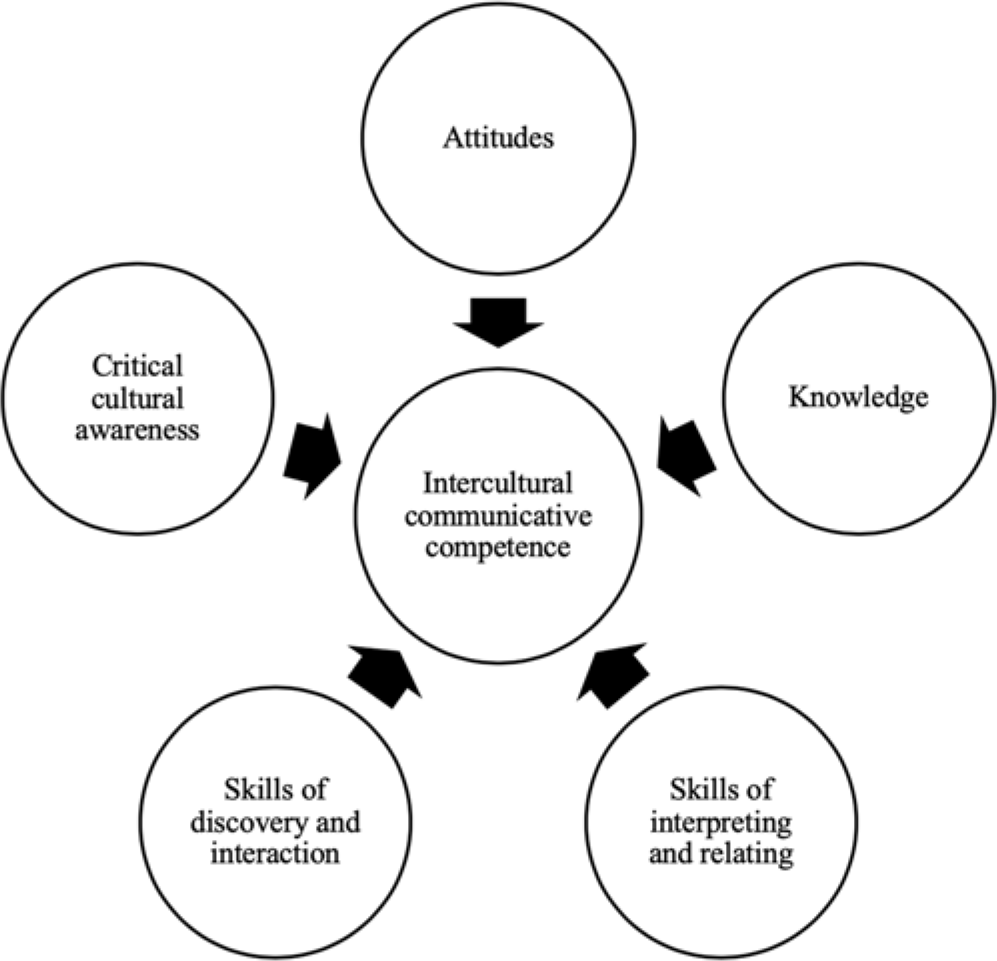
Attitudes provide the foundational component for ICC. Intercultural speakers should be ready to “suspend disbelief about other cultures and belief about [their] own” and willing to “relativise [their] own values, beliefs, and behaviours” without assuming “they are the only possible and naturally correct ones” (Byram, Gribkova & Starkey, Reference Byram, Gribkova and Starkey2002: 12). Additionally, interculturally competent speakers know the cultural products, practices, and processes of interaction in social groups in their own and other cultures and are aware of how other people may perceive these products and practices. Besides attitudes and knowledge, intercultural speakers have certain skills. They can interpret ideas, events, or documents from another culture, explain them, and relate them to those of their own culture. Thus, they can explain the reasons why the thoughts or actions of someone with a different cultural identity could be misconstrued in their own culture. Moreover, intercultural speakers can gain “new knowledge of a culture and cultural practices” and use their knowledge, attitudes, and skills when interacting with interlocutors from another culture. Lastly, they are aware of their own cultural values and the ways these values “influence their views of other people’s values,” and they critically evaluate social perspectives, practices, products and processes in their own culture and other cultures by using “explicit criteria” (Byram et al., Reference Byram, Gribkova and Starkey2002: 13). The development of these five areas is an ongoing process, and becoming interculturally competent is a complex task; “the road is long and strenuous” (Byram, Reference Byram2008: 83).
ICC affords individuals with a lens that helps them see their interlocutors’ complex and multifaceted social identities, as social interaction inevitably involves negotiation of identities. Cognizant of the heterogeneity of each culture and the multidimensional and fluid nature of identity, intercultural speakers can see cultural identities beyond the imagined borders of national identity. Avoiding the simplistic perception of others “through a single identity,” they view their interlocutors as individuals “whose qualities are to be discovered, rather than as a representative of an externally ascribed identity” (Byram et al., Reference Byram, Gribkova and Starkey2002: 9). From a critical perspective, the ICC lens seeks a conceptual shift from the stable, essentialist, normative, and monolithic notion of cultures and cultural identities, equated to rigid national identities (Dervin, Reference Dervin2016; Holliday, Reference Holliday2010), towards understanding “cultures as heterogeneous, dynamic, loosely bounded, and subjectively experienced” (Menard-Warwick, Reference Menard-Warwick2008: 619). Intercultural speakers approach each interaction critically and reflexively, problematizing “the normative assumptions” and “givens” (Pennycook, Reference Pennycook2001: 10) of their own and others’ perceptions of cultures. Thus they interrogate the essentialist views of culture that construct and perpetuate boundaries between cultures and attend to the ways intercultural communication is underpinned by peoples’ negotiation of ideologies, power relations, privilege, marginalization, and othering (Dervin, Reference Dervin2016; Holliday, Reference Holliday2010).
Language teachers utilize telecollaboration for intercultural exchange between language learners of different cultures to promote their language learning and intercultural awareness (e.g. Angelova & Zhao, Reference Angelova and Zhao2016; Belz, Reference Belz2001; Lee & Markey, Reference Lee and Markey2014; O’Dowd, Reference O’Dowd2016; O’Dowd & Eberbach, Reference O’Dowd and Eberbach2004), but the use of telecollaboration is relatively new in teacher training (Antoniadou, Reference Antoniadou2011; Bueno-Alastuey & Kleban, Reference Bueno-Alastuey and Kleban2016; Dooly, Reference Dooly2011). Antoniadou (Reference Antoniadou2011: 239) used activity theory to analyze telecollaboration between teacher trainees from Spain and the USA and found that teacher trainees encountered intra-institutional contradictions before starting telecollaboration and technology-related and inter-institutional contradictions during telecollaboration that “resulted in [a] transformation of the initial objects.” In another telecollaborative teacher training program between Spain and the USA, Dooly (Reference Dooly2011) explored teacher trainees’ ICC and construction of communities of practice. Teacher trainees’ interaction in this program was affected “by their previous knowledge, acceptance, experience and willingness to adapt to the different available communication channels and modes” (Dooly, Reference Dooly2011: 334).
Menard-Warwick et al. (Reference Menard-Warwick, Heredia-Herrera and Palmer2013) focused on the tutors’ discursive identities while leading online discussions that fostered Chilean trainees’ intercultural learning. Participants facilitated each other’s transnational identity construction and intercultural learning throughout the online exchange, by relativizing their cultural values and beliefs and considering them from an outsider’s perspective. Bueno-Alastuey and Kleban (Reference Bueno-Alastuey and Kleban2016) examined linguistic, intercultural, and techno-pedagogical skills in a telecollaboration between teacher trainees from Poland and Spain who used English as a lingua franca. Trainees’ differing perceptions and objectives in the project influenced their learning gains in terms of these skills. Lastly, Tanghe and Park (Reference Tanghe and Park2016) investigated the intercultural experiences of four teacher trainees in a semester-long telecollaboration by focusing on their acts of positioning vis-à-vis the contexts and course materials. The participants demonstrated “visible transformations” in their intercultural competence and “moved away from essentialized beliefs about one another, dismantled prejudices, and altered pre-conceived notions” (Tanghe & Park, Reference Tanghe and Park2016: 9).
These studies indicate the instrumentality of telecollaboration to promote teacher trainees’ ICC when interacting with their peers from another cultural context. However, it is still necessary to further explore how telecollaboration can support teacher trainees’ ICC development in teacher training programs across the world. Therefore, this study addressed the question: How do teacher trainees’ intercultural experiences in a telecollaboration contribute to their ICC development?
3. Method
Following the methodology of earlier telecollaboration studies (Angelova & Zhao, Reference Angelova and Zhao2016; Antoniadou, Reference Antoniadou2011; Canto et al., Reference Canto, Jauregi and van den Bergh2013; Dooly, Reference Dooly2011; Dooly & Sadler, Reference Dooly and Sadler2013; Schenker, Reference Schenker2012), this study adopted a qualitative inquiry approach with a naturalistic, interpretive paradigm (Lincoln & Guba, Reference Lincoln and Guba1985). Such an approach was instrumental for us because we were interested in capturing participants’ meanings and perspectives in the online setting of telecollaboration. More specifically, we relied on multiple sources of qualitative, descriptive data to understand how teacher trainees made sense of other cultural values and practices, reflected on their own, and experienced otherness as they interacted with their peers from another social, political, and cultural setting.
3.1 Context and participants
Drawn from two undergraduate teacher education classes offered in fall 2015, a total of 48 teacher trainees participated in this study. There were 22 participants (20 females, two males) at Central City University (CCU; pseudonym) in Central Texas, USA. CCU participants were in the third year of their program, spoke English as their first language, and were studying to become certified elementary and secondary school teachers in the state of Texas, with an additional state-mandated English as a second language (ESL) certification. The participants at Northern Anatolia University (NAU; pseudonym) included 26 participants (20 females, six males) and they were in the last year of their program. They spoke Turkish as their first language and English as their additional language, which they had learned through formal instruction since the first year of high school. They were studying to become English as a foreign language (EFL) teachers to work in K–12 public schools in Turkey. Although they had various ethnic backgrounds, they presented themselves as “Turkish” by their country of citizenship.
3.2 The telecollaborative project
The intensive six-week telecollaborative project was mediated on Edmodo between two teacher education classes: A “Multicultural Education” course taught by the first author as part of Texas ESL certification at CCU’s college of education, and a “Language and Culture” course taught by the second author as an elective at NAU’s English language teacher training program. For both groups, participation in this project was a course requirement. The experience provided trainees with a first-hand intercultural experience that they could apply to other course components. In this project, teacher trainees were tasked to explore multicultural education topics (see Supplementary Material) through online conversations with trainees in another sociocultural and political context, and reflect on the experience and potential implications for their future profession. Additionally, NAU participants intended to practice their English language skills through their exchanges with native English-speaking trainees.
The teacher trainees worked in groups of six (containing at least two trainees from each context) and completed six modules (one per week), each of which addressed a particular theme, such as multicultural education, religion, and gender (see Supplementary Material). Moderated on Edmodo, each module required participation in an asynchronous online discussion revolving around the weekly prompt. Each week, the prompt was posted on Edmodo at 8 a.m. on Monday (GMT+3) and trainees were asked to post their original entry by Thursday midnight (respective time zones) and to respond to at least two posts by their group peers by Sunday midnight (respective time zones). Trainees were responsible for facilitating the discussions on their own thread and responding to their partners when asked additional questions. Trainees went beyond these requirements and engaged in extended conversations in their groups, which continued even after the module was over, yielding discussion threads with multiple turns. Lastly, although the authors believe in the benefits of extended intercultural exchange, the project was limited to six weeks due to the limited semester overlap between the two universities. This institutional challenge is discussed in length elsewhere by O’Dowd and Ritter (Reference O’Dowd and Ritter2006).
3.3 Data collection and analysis
This study collected the following data generated by the participants: weekly online discussion board posts (DBP) within groups of six, and post-project reflections. When the online phase of the project ended, the researchers compiled the participants’ DBPs from their Edmodo group pages and archived discussion threads by group, discussion prompt, and individual participants. A week after the project, participants submitted post-project reflections to their respective course instructors. At CCU, these reflections took the form of an open-ended cultural diversity paper (CDP) guided by the reflection questions (see Supplementary Material), and trainees had the option of working individually or collaborating with classmates. In the CDPs, trainees discussed their intercultural experiences and learning during the six weeks of online discussion. At NAU, trainees’ reflections were collected in the form of a post-project survey (PPS), in which participants responded to the reflection questions online that inquired about their intercultural learning experiences in the telecollaboration. The trainees from NAU responded to these questions in Turkish, and their responses were translated into English by the researchers. During the data collection, the two researchers who were also the course instructors immersed themselves in the data as they read and graded the teacher trainees’ online posts and post-project reflections as course assignments.
When analyzing these qualitative data, the researchers followed grounded theory’s constant comparative analytic procedures (Corbin & Strauss, Reference Corbin and Strauss2014), namely the three stages of initial, axial, and theoretical coding (see Supplementary Material). In the initial coding, each researcher independently coded the data with descriptive phrases, “remain[ing] open to all possible theoretical directions” (Charmaz, 2006, cited in Saldaña, Reference Saldaña2013: 100), and all three researchers met to compare their codes and ensure they had a consensus on all the codes generated. In the axial coding, each researcher compared codes against each other, organized, and focused them into categories by identifying representative codes and accounting for redundancies. The researchers then co-constructed a joint list of categories through comparisons. In the theoretical coding, the researchers further organized and compared the categories to “pre-existing theories” (Saldaña, Reference Saldaña2013: 224), which included the five components of Byram’s ICC model (see Figure 1). Then, based on this comparison, the researchers collectively identified these emergent salient themes that consistently recurred across participants and data points: (1) awareness of heterogeneity, (2) nascent critical cultural awareness, and (3) curiosity about the other culture.
4. Results
4.1 Awareness of heterogeneity
The theme of awareness of heterogeneity corresponds to the components of “attitudes” and “knowledge” in Byram’s (Reference Byram, Byram and Zarate1997) ICC model. Teacher trainees’ telecollaborative interaction included instances in which they accepted the diverse cultural values, perspectives, and practices in their own context and wanted to gain more knowledge about the diversity in their peers’ culture. For example, although there were instances of broad generalizations about “American” and “Turkish” cultures, many teacher trainees seemed aware of cultural diversity in their own context. As a telling example, Aslı,Footnote 1 a trainee from NAU, described the cultural mosaic in Turkey by noting:
Aslı: Multiculturalism means that people who have different culture live in together. It’s variety of culture. In Turkey, we can see many examples of it because there are so many different people coming from varied backgrounds. There are Turks, Kurds, Pomaks,Footnote 2 Alevis, Sunni, etc. All of us have different customs, dialects, food, celebrations. Even if we sometimes face with some problems on account of multiculturalism, we try to live fraternally. We should respect our differences. We have to do it for living in peace […] Our perspectives, behaviors, even dialects are not the same […] Not just in school, we can see this variety in our hometown. The people live in our hometown may come from different backgrounds.
Lena: Hello Aslı! This was a great post! Respecting differences is such an important part of life, right on! You mentioned sometimes you face problems because of multiculturalism. What kind of problems and how do you deal with them?
Aslı: Hello Lena! As I said, there are so many kinds of backgrounds like Kurds, Pomaks, etc. One of them (Kurds) wants to establish its own country and most of the people in Turkey don’t want to allow it. So sometimes there is conflict between Kurds and Turks. For now, there is no permanent solution. In my opinion, we are under the one flag and we should live happily together. No division! We could be multicultural, but this doesn’t require having establishing a new country. On the other hand, we have problem about religion. Some people don’t respect the other’s religion and this creates problem in society. Even some statesmen sometimes humiliate the people who are different from their religion. It’s totally shame! We have no solution for it, too. The best solution is education, for me. Educating people solves these kinds of problems. I hope I see a new Turkey without discrimination in the next years. :) We are all human beings. If we don’t respect each other’s thoughts, beliefs; there will be chaos in the society as we are in. (DBP, Week 1)
From Aslı’s perspective, the society she is a part of is composed of various cultural communities, which differ from each other in terms of ethnicity, religion, and dialect, and she believes cultural background can explain the differences in people’s “perspectives” and “behaviors.” She shows an awareness of heterogeneity and expresses her respect for differences, yet her multicultural awareness is not equal across categories. When asked by Lena to unpack the problems faced “because of multiculturalism,” Aslı discusses the ethnic conflict and religious intolerance in Turkey. Although she advocates for the rights of marginalized religious minorities, she neglects the cultural and historical complexity regarding the Kurdish ethnic minority who wish to create “a new country.” Her portrayal reflects the dominant nationalist discourse in Turkey, which imagines a homogeneous nation state, ignores ethnic diversity, and disenfranchises Kurds who are reluctant to identify themselves within the “unified” national identity of “Turkishness.” This example also illustrates the complexities involved in ICC development, as Aslı displays her emerging, if imperfect, awareness of heterogeneity.
Darcy, a trainee from CCU discusses the cultural heterogeneity in Texas when explaining her definition of multiculturalism. She emphasizes her biographical and educational experiences as conducive to her current cultural identity and specifically expounds upon the diversity of cultures in her school setting. She remarked:
Darcy: I have been fortunate enough to be raised in neighborhoods and attend schools that were very multicultural. I also have a multicultural family. The neighborhood I was raised in, along with just about every other area in Texas, was a mix of African American, Hispanic, and Caucasian […] I learned a lot about Mexican culture from an early age, because although I’m Caucasian, I have step siblings that are Hispanic, and they have shared their culture with me over the years […] [CCU] is filled with people who have different ethnicities, political views, religious views, and sexual orientations. […] Some of my closest friends at this school have a different race than I do, and some of them are even from different countries. It is very encouraging to see such a diverse group of students and faculty communicate and relate to each other on such a personal level while adopting parts of each other’s unique cultures.
Adile: Darcy, you are so lucky to have grown up in such a multicultural environment. I think it presents an endless stream of opportunities for learning about new languages, cultures and social mores. You grew up in that environment, but what about your future children? Do you want to raise your future children in multicultural environment?
Darcy: I would most definitely want to raise them in a multicultural environment! Some of my favorite cities in America are places with a great amount of diversity, and some of my closest friends have come from very different cultural backgrounds than myself […] Because I know two languages, English and American Sign Language, and am currently trying to learn Spanish, I’ve had the opportunity to delve into many different cultures and learn to appreciate all of them. I can identify with the hearing community, the deaf community, and in a lot of ways I have been introduced to Hispanic culture as well. (DBP, Week 1)
Darcy’s understanding of culture seems to include ethnicity, language, political view, religion, sexual orientation, and race, which she observes contributing to the cultural heterogeneity in her context. She believes that diversity does not impede healthy communication and relationships on “a personal level” at CCU, but she views being open-minded and being eager to learn and experience new cultures necessary to have such communication and relationships. When asked what she plans for her future children’s cultural exposure, Darcy highlights the intersection between languages and cultural communities and incorporates the deaf community’s culture within the multicultural environment she envisions for her future children.
Both groups of trainees demonstrated an understanding of cultural complexity and heterogeneity within the context of their interlocutors. Interacting with peers from CCU, the trainees from NAU started questioning their preconceived notions about youth in the USA. For instance, Güldem and Yağmur shared:
I thought American students live an independent and comfortable life on their own, but it seems that these students are very much connected to their families and their customs. (Güldem, PPS, Question 3)
I was expecting them to be different from what was presented in [the USA-based] TV shows, and I was right. I was expecting them to be not as loyal to their culture, but on the contrary, they were loyal followers of their culture and traditions. I was expecting them to be less adherent to their religion, but most of them appeared to be religious. (Yağmur, PPS, Question 1)
The participants at NAU were mainly exposed to American culture through TV shows and English language learning experiences, and they had certain homogenizing generalizations about their peers from CCU before this telecollaboration. After engaging in online discussions with actual people from the USA, they began challenging these generalizations.
Although the participants at CCU did not share their prior beliefs about cultures and communities in Turkey, the intercultural exchange enabled them to see the diversity in their interlocutors’ values and beliefs. For example, Daphne and Danielle noted:
[This experience] has led to a major eye and mind opening within understanding their culture, particularly in their Religion, Education, Marriage and Gender Roles […] We have been able to relate aspects of our lives to theirs, and grow a broader understanding of the world. Interacting with different people from the Turkish society really helped us to suppress stereotypes about them and show their true nature and ways to us […] They showed some similarities between their views on education and religion, but when it came to gender roles they definitely showed huge differences based, not only on their values, but their families’ values and social life as well. (CDP)
These trainees recognized that cultural perspectives and values could vary at a personal level, which highlights cultural heterogeneity over a homogenizing conception of culture. They learned to suspend their (dis)beliefs about their interlocutors’ cultures and started moving towards dismantling stereotypes.
4.2 Nascent critical cultural awareness
This theme corresponds to the component of “critical cultural awareness” in Byram’s (Reference Byram, Byram and Zarate1997) model, but we described it as nascent because the instances were limited to the broad societal issues in trainees’ own cultural context, rather than critical evaluation of individual views and comparison of cultural contexts with a focus on differences. The trainees’ critical awareness was especially evident in the ways they questioned the systemic injustices in society, particularly with regard to education, religion, and politics. For instance, Claire, a trainee from CCU, commented on socially and culturally constructed gender roles:
Women in the United States unfortunately are commonly seen as weak, or not able-bodied to take care of themselves, while men are seen as the strong, powerful beings. In the current days, it is not uncommon to have a single-parent home where the mother and father work, or even to find a home in which the father stays at home and the mother is the one who is out doing the working day by day. I have personally seen this in my life when I have seen my uncle be more of a stay at home dad for my cousins whenever my aunt left the family to move back to California. He now works from home and takes care of my cousins and pays attention to their needs. (DBP, Week 4)
Specifically focusing on the deficit perception of women in the USA, Claire critiques the taken-for-granted roles assigned to each gender that define what men and women can and should be and do. Her example also points out how these roles and boundaries between the genders can be deconstructed at individual levels.
Similarly, Hayat, a trainee from NAU, describes and exemplifies gender discrimination in Turkey:
Hayat: In our society, there is still gender discrimination. Unfortunately, in some areas women have to stay at home, deal with the children and do housework and man have to work for winning bread. The role of man is more dominant in many families. Especially in the east of Turkey there are still little girls who are forced to stay at home. They have no right to go to school and when they become 15–16 years old, they are forced by their fathers to marry with a man who are 30–35 sometimes 50–60 years old […] Working female is very unusual thing in that areas. But in the west of Turkey the rate of such discrimination is lower than east. Girls have the chance of going to school, they marry whom they want to and they are working almost in every field of work […] My hometown is Van the city in the east […] In a village of Van, one of my mother’s uncle who is 60, he was married but 5 years ago he married again with a girl who is 16. He is about to die now, he had 3 little children. I wish that girl wouldn’t have been forced to have such a bad life.
Sam: When you said that it is different in the West and East, East being strict and the West having more freedom, why do you think that it is this way? Also, how do you feel about once living in the East which is strict, to now living in the West where you have freedom?
Hayat: I think the biggest reason is the education. The people in east mostly graduated from primary school. And also there are many people who have been illiterate. I have lived in east for a short time and I was very little. Now I am living in west. I think I am very lucky if I growed up there most probably I wouldn’t have the chance of going to university and maybe now I would be married and have children already. (DBP, Week 5)
Hayat critiques unequal relations between men and women that lead to girls dropping out of school and being forced by their family to marry at very young ages. She expresses her disagreement with and disapproval of cultural practices, which exist in some parts of the country, that negatively impact girls’ educational opportunities, stripping them of their agency to make decisions for their life. In his question, Sam chooses to ask about the East–West divide Hayat depicts in Turkey, and Hayat constructs Eastern and Western Turkey (not so clearly delineated in actuality) as two distinct, monolithic entities that are homogeneous in their cultural perspectives and practices. She does not elaborate on the reasons for a lack of literacy and education in her construction of Eastern Turkey.
Moreover, with a critical lens, Perry focuses on religion-based discrimination in the USA:
While Christianity is still the predominant religion, the amount of immigrants and an abundance of access to education and resources on other religions have had a tremendous impact on the faith of the American people […] although America is known for its religious tolerance and freedom, there is still a lot of discrimination and persecution that can take place for many religious groups. In a lot of ways, you are at a disadvantage if you say you don’t believe in a God. (DBP, Week 3)
Perry directs attention to the inequities that non-Christian, agnostic, and atheist people could be suffering from in US-American society. She seems to argue that the “religious tolerance and freedom” protected by law does not necessarily stop the discrimination against those who hold beliefs different from the “mainstream” Christians.
Lastly, almost all the trainees from NAU describe religion in their context as a topic that is “sensitive” and “delicate” (as do several of their interlocutors from CCU). They discuss the dominance of mainstream Sunni Islamic culture and teachings in the society and their schooling experiences, because students take a compulsory religion course from Grade 4 to Grade 12. Considering the minority religions and faith groups in Turkey, most of the participants highlighted the importance of personal choice in religion and faith and critiqued this course, as it was compulsory and its content predominantly covered Sunni Islam. For example, comments by Görkem, a self-identified deist, and Aysun, a self-identified Sunni Muslim, are very telling:
I think religion is more sensitive in here than other European countries, since our people (not all of them) have nothing but religion. […] When we grow up enough, government gives us religional courses in our schools. These courses are mainly about Islamic information. They teach us how to practice it in everywhere (in schools, home, Mosque). […] One can practice his religion freely in here. One can go to a Mosque, a Church or whereever you need to go. […] But I am a Deist. […] Even some members of my family show no respect to me. (Görkem, DBP, Week 3)
There are a lot of different religious cultures in Turkey like Sunni, [Alevi], etc. Generally, Sunni people have a high rate when we compare to another religious cultures in Turkey. I am also Sunni. […] [Alevi] people usually go to the “Cemevi” not a mosque. For [Alevi] people, “Cemevi” is a place of worship. […] I have been studying at [NAU] in Yenikent [pseudonym]. We can encounter with different religions at [NAU] because a lot of people come from different countries around the world. Erasmus [a student exchange program] is a good example of it. However, there is not a church or a cemevi but the mosques in Yenikent. Also, there are two mosques on campus. (Aysun, DBP, Week 3)
Holding a critical perspective, both participants describe the dominance of a certain religion in the society, which is usually taken for granted, especially in the provision of compulsory religion courses, and they stress the difficulties somebody may face if practicing a minority religion or faith in Turkey.
4.3 Curiosity about the other culture
The theme of curiosity about the other culture corresponds to the components of “skills of interpreting and relating” and “skills of discovery and interaction” in Byram’s (Reference Byram, Byram and Zarate1997) ICC model. Although such curiosity does not denote any skills, it supports the development of the ICC skills. Trainees from both contexts demonstrated openness to new ideas and willingness to learn more about the other culture. As they interacted with interlocutors from the other culture, they became more comfortable and reported that they had benefitted from this interaction tremendously. For example, Nedim, a self-identified introvert at NAU, responds to a survey question by noting, “It sounded like it’d be a nervous process to begin with and we’d never be able to understand each other. I never thought they’d be sincere” (PPS, Question 1). However, after learning from and about the trainees from CCU, Nedim remarks, “I became more willing to participate because they were so kind-hearted, endearing, and different from me. I could tell they, too, were very willing in this and enjoying the conversation” (PPS, Question 2). This experience became a memorable one for Nedim, as he comments, “I’ll remember this project as one of the most enjoyable moments of my life. I’ll do the same project with my students when I become a teacher” (PPS, Question 9).
Likewise, Perry, a trainee from CCU, reported that she was willing to broaden her cultural knowledge about the people in Turkey. She commented:
This experience has been truly enlightening, and I am so glad I had the opportunity to communicate with people in Turkey. It was great learning more about Turkish culture, because I had a pretty limited knowledge of the culture before, and it was great […] communicating with other college students my age in Turkey. This gave me the opportunity to go beyond simply learning facts about Turkey, and actually communicate with others around my age that are at the same point in their lives. I enjoyed this because I was able to talk to people, form relationships, and marvel in the differences of our cultures but also in the many similarities as well. (DBP, Week 6)
Perry highlights the distinction between factual knowledge about Turkey and the knowledge that emerged from communication with individuals from another culture. She thinks this actual communication expanded her knowledge about cultures in Turkey, and helped her build intercultural relationships, by discussing cultural differences and similarities. Her comment also implies the importance of getting to know people from other cultures through interaction at the individual level.
We observed the participants’ openness and willingness to learn about their interlocutors’ culture when they engaged in critical questioning of issues concerning gender, religion, and culture. Such questions created a space to unpack these topics and practice discussing them with members of another culture. For example, Yağmur asks Sam about his opinion on gender equality from his religious perspective:
Yağmur: Sam do you think women and men really equal in this world? As far as I learned from your posting you are also a religious person, and I just wonder your ideas according to your beliefs, are we really equal from the beginning of life?
Sam: I believe that in the world, no, we are not equal but in America we are starting to become more equal unlike before during the 20’s or 30’s. Regarding your second question, I believe that we are all equal from the beginning because we have yet to do anything for ourselves that depict who we are as a person. (DBP, Week 4)
Yağmur’s question led Sam to share his beliefs and expound upon gender by comparing past and present in his cultural context, yet he does not refer to his religious views as influential on these beliefs. Also, Danielle poses a question to Bilge after acknowledging her parents’ support:
Danielle: Wow that sound so amazing that your parents support you and your sister’s education. However, I would like to ask you when did you first notice that people treated males and females differently in your life?
Bilge: Actually I have no brothers so I realized this differences between woman and man long after. When I was in primary school I realized that my teacher loved the girls more than the boys. I thought it how much I was lucky. But when I have grown up I realized that I’m a girl I cannot behave like I want. (DBP, Week 4)
Responding to Danielle’s question, Bilge reflects on how she has experienced socially constructed gender differences through socialization as a female in her cultural context. Additionally, Adile inquires into the existence of culture by asking Shelby:
Adile: I wonder that all cultures have taken thousands of years to develop their understanding about the way people should live. Should people afraid of losing these understandings? Can cultures be lost?
Shelby: Adile, I don’t think people should be afraid of losing their understandings about the way people should live. Everyone is different, but being afraid isn’t necessary. We might distant from our understandings, but it’s up to the person to lose them. I do believe cultures can be lost. Any culture can be lost, I just hope we keep the world culturally and ethnically diverse because we are all different and come from different generations. (DBP, Week 1)
Replying to Adile, Shelby relies on her definition of culture as people’s understandings about the ways of living, and advocates for cultural diversity as a value to be maintained. All these questions demonstrate the participants’ openness to the cultural perspectives of their interlocutors and willingness to learn more about them and their cultures. Asking these questions, participants were more concerned about the intercultural exchange of ideas, knowledge, and perspectives than imposing their beliefs on the other (Jackson, Reference Jackson and Higgins2011). Such a concern implies that the participants engaged in attempts to relativize their own beliefs and values, without supposing that they are the only true ways to understand the world and themselves in relation to the world.
5. Discussion
The telecollaborative project afforded the teacher trainees with “a ‘liminal’ experience … at the boundaries between two views of the world [that] involve[d] a sudden grasp of difference and an instantaneous understanding of the relationship between self and other” (Kramsch, Reference Kramsch1993: 30). Engaging in this liminal experience, the trainees in this telecollaboration underwent “intercultural learning in the short run,” which is conducive to potential “long-term changes” in their ICC development (Menard-Warwick et al., Reference Menard-Warwick, Heredia-Herrera and Palmer2013: 971). Corroborating earlier studies (Bueno-Alastuey & Kleban, Reference Bueno-Alastuey and Kleban2016; del Rosal et al., Reference del Rosal, Conry and Wu2017; Dooly, Reference Dooly2011), the trainees’ intercultural learning during telecollaboration corresponded to five components of Byram’s (Reference Byram, Byram and Zarate1997) ICC development model (see Figure 1). Specifically, they demonstrated awareness of heterogeneity in their own culture and that of their interlocutors (attitudes and knowledge), critically evaluated the issues of social justice in their own culture (critical cultural awareness), and wanted to learn, construe, and relate the values, perspectives, and practices of other culture during their interaction (skills of interpreting and relating and skills of discovery and interaction). Additionally, their telecollaborative interaction afforded them space to create access points for mutuality (Jackson, Reference Jackson and Higgins2011), engagement with otherness (Byram, Reference Byram, Byram and Zarate1997), and a sense of transnational identification with trainees in another country (Porto, Houghton & Byram, Reference Porto, Houghton and Byram2018).
Even though the trainees from the two contexts mostly relied on the conceptualization of culture from a national paradigm (O’Dowd & Ritter, Reference O’Dowd and Ritter2006), they engaged in the discussion of topics and perspectives that cross the borders of nation states (Kumaravadivelu, Reference Kumaravadivelu2008; Porto et al., Reference Porto, Houghton and Byram2018; Risager, Reference Risager2007) in a “third space” where no cultural norms are dominant (Dooly, Reference Dooly2011). Their intercultural exchange of ideas about gender (e.g. male and female roles as social norms), freedom of faith (e.g. discrimination against minority religions), and educational problems (e.g. school funding and high-stakes assessment) involved the critical challenging and questioning of structural inequities in societies and the effects in their personal and professional lives. Sharing the problems in their own contexts, the participants treated and unpacked the inequities as issues that transcend the national borders, which was a move towards transnational understanding of culture (Risager, Reference Risager2007). Such discussions in an intercultural exchange are a preliminary step toward “global cultural consciousness” and contribute to “an individuals’ complex cultural growth” (Kumaravadivelu, Reference Kumaravadivelu2008: 6–7).
This telecollaborative project provided the participants with intercultural encounters that allowed them to dismantle stereotypes and prejudices about their interlocutors by revisiting and revising their preconceived notions of the other (del Rosal et al., Reference del Rosal, Conry and Wu2017; O’Dowd & Eberbach, Reference O’Dowd and Eberbach2004; Tanghe & Park, Reference Tanghe and Park2016). Negotiating their cultural learning through these encounters, many trainees were astounded by the fact that their interlocutors did not fit their preconceived image of the other. For many Turkish participants, exposure to English-speaking US-American culture had previously been limited to their formal language instruction and to what has been “imported” through written and audiovisual media. Prior to the telecollaboration, trainees from CCU had limited to no first-hand experiences with Turkish speakers and had not studied Turkish language or culture. When sharing their feelings and opinions about the telecollaboration after it ended, many participants noted changes in their perceptions and beliefs about the other. Participants from Turkey explicitly and repeatedly mentioned that their interlocutors from the USA (i.e. what they do, believe, and experience) were greatly different from their preconceptions. In the post-project reflections, trainees from the USA shared similar sentiments regarding a transformation in the way they see Turkish culture. We do not assert that this telecollaboration has completely transformed all prejudices and stereotypical understanding of culture, but it prompted participants to critically reevaluate their existing beliefs and become cognizant of the impact of the surrounding discourses. We believe this critical reevaluation is part of trainees’ development as intercultural speakers, as development occurs “in a spiral, passing through the same point at each revolution while advancing to a higher level” (Vygotsky, Reference Vygotsky1978: 56), and developing ICC is an arduous journey (Byram et al., Reference Byram, Gribkova and Starkey2002).
The participants’ curiosity about the other culture and willingness to learn fueled the intercultural exchange (Chen & Yang, Reference Chen and Yang2016). Trainees strategically asked questions to initiate and maintain conversations, and sought out further intercultural encounters. Some of these questions sought information (Ware & Kessler, Reference Ware and Kessler2016) about music, food, education, and customs, but others led to deeper critical cultural reflection (Chen & Yang, Reference Chen and Yang2016; Liaw & Bunn-Le Master, Reference Liaw and Bunn-Le Master2010). For example, Yağmur’s question to Sam opened the conversation further, to talk about the impact of Sam’s religious beliefs upon his views on gender equality. Also, Danielle’s question to Bilge about her experiences with gender inequality led her to reflect on how she learned that society would treat her, as a female, differently. Hinging on these and other examples in our data, we contend that curiosity and willingness in the form of questions created discursive spaces for the other (i.e. respondents) to contribute, and are essential components to facilitate intercultural exchanges in telecollaboration. The fact that participants attempted to create new spaces to converse, without express instruction, is also evidence of the participant-led intercultural learning that occurs in such exchanges.
6. Limitations of the study
Although developing ICC is an arduous and prolonged task (Byram, Reference Byram2008), the current study found that the teacher trainees’ experiences in this telecollaboration contributed to their emergent ICC. However, it had its limitations, which should be considered for future projects. First, participation in the telecollaboration was a required component of the course that factored into participants’ course grades. Although teacher trainees were encouraged to participate without worrying about their grades, the perception of participation as an assignment may have influenced their posts. Second, in order not to influence the teacher trainees’ participation, the instructors did not intervene in the online conversations between teacher trainees who were expected to facilitate the discussions in their groups. However, there were instances in which external intervention might have expanded the conversation or led it toward more fruitful directions, such as asking a follow-up question at a point that could open up a critical conversation. Third, in this telecollaboration, the asynchronous discussions had to be limited to six weeks only, because NAU and CCU had different semester schedules. Finally, participants’ post-project reflections were collected through a different format in each context due to different curricular requirements and existing assignment structures.
7. Suggestions for future research
Based on the aforementioned limitations, we provide some suggestions for future telecollaboration studies. First, future projects might benefit from adding facilitators (e.g., non-grading instructor aides) who could mediate the group discussions, for example, to encourage more participation and intervene in the conversation to invite participants to provide examples and unpack or clarify their arguments. Future telecollaborations restricted by semester scheduling might consider incorporating the same group of teacher trainees in telecollaboration in two subsequent semesters. One semester could be focused on ICC, and in the next semester, instructors could have participants collaboratively design a unit or lesson plan, construct multilingual storybooks for their future students, or create a video of a teacher’s typical day in their context. In future telecollaborations, project tasks could be coordinated at the institutional and curricular level, to achieve greater consistency across the data collection. In this study, only weekly prompts were used for discussions; however, future telecollaborations could incorporate newspaper articles, videos, posters, textbook excerpts, and Internet memes as discussion materials to which participants can respond, or participants could be asked to bring in relevant materials they have found. For example, teacher trainees could collaboratively analyze Internet memes or textbook excerpts from a critical cultural perspective, which could provide more in-depth data to capture their learning in a telecollaboration environment. Lastly, future telecollaboration studies could utilize additional qualitative data collection tools that could help researchers better capture participants’ intercultural learning. For example, future studies could consider interviewing participants before, during, and after their telecollaboration experiences or having them individually and collaboratively construct multimodal artifacts as part of their intercultural learning.
8. Conclusion
Both educational contexts, the USA and Turkey, are experiencing changes to the student population because of an influx of immigrants and refugees. Thus, as the classrooms rapidly become more diverse (linguistically and culturally), language teachers’ skills of interculturality are increasingly critical. Although teacher training practices have previously used study/student teach abroad for cultural immersion and cross-cultural encounters, telecollaboration proves to be a powerful and inexpensive alternative with impactful potential (Angelova & Zhao, Reference Angelova and Zhao2016; del Rosal et al., Reference del Rosal, Conry and Wu2017; O’Dowd, Reference O’Dowd2016). The current study found telecollaboration to be a valuable practice, enabling teacher trainees to relativize their cultural world to deliberate their own situatedness from others’ viewpoints. Through intercultural telecollaborative projects, trainees can cross national and cultural borders through concrete encounters with the other and renegotiate their identities as intercultural speakers.
Supplementary material
To view supplementary material for this article, please visit https://doi.org/10.1017/S0958344019000235
Ethical statement
The authors obtained written consent to use the class materials for research and teaching purposes from the teacher candidates in teacher education classes in both contexts. Participants’ names have been replaced with pseudonyms in the data.
About the authors
Babürhan Üzüm is an associate professor of bilingual education and ESL in the School of Teaching and Learning at Sam Houston State University. His research interests include language teacher education, intercultural competence, computer-mediated communication, telecollaboration, and sheltered instruction of English language learners.
Sedat Akayoglu is currently working as an assistant professor at the Department of Foreign Language Education, Bolu Abant İzzet Baysal University. He is working with pre-service EFL teachers, and his expertise includes computer-assisted language learning, computer-mediated communication, intercultural communication, and teacher education.
Bedrettin Yazan is an assistant professor of educational linguistics in the Department of Curriculum and Instruction at The University of Alabama. His research is focused on language teacher learning and identity, language policy and planning, world Englishes, and collaboration between ESL and content teachers.
Author ORCIDs
Babürhan Üzüm, https://orcid.org/0000-0003-4511-7985
Sedat Akayoglu, https://orcid.org/0000-0002-9865-2546
Bedrettin Yazan, https://orcid.org/0000-0002-1888-1120



