1 Introduction
In the past few years the CALL literature has shown increasing interest in the topic of teacher education (e.g., Hubbard & Levy, Reference Hubbard and Levy2006; Meskill, Reference Meskill2009; Dooly, Reference Dooly2009; Guichon, Reference Guichon2009; Hampel, Reference Hampel2009; Stockwell, Reference Stockwell2009; Cutrim Schmid, Reference Cutrim Schmid2010). As Stockwell (Reference Stockwell2009: 1) points out:
“This attention is indicative of greater recognition of the importance of CALL practitioners having sufficient grounding in CALL theory and practice, as well as knowledge of what technologies are available to them in order to be able to effectively implement CALL in their specific language learning environments”.
Special attention has been given to the investigation of the new competencies that language teachers need to acquire in order to be able to integrate new technologies in ways that improve student learning. Another pressing question that is currently being discussed is how these competencies can be developed through training. Several studies have focused on the skills needed for online teaching and computer mediated communication (CMC) (e.g., Guichon, Reference Guichon2009; Meskill, Reference Meskill2009; Hampel, Reference Hampel2009; Levy, Wang & Chenb, Reference Levy, Wang and Chenb2009) yet only a few (Cutrim Schmid, Reference Cutrim Schmid2010; Cutrim Schmid & Schimmack, Reference Cutrim Schmid, Schimmack, Thomas and Cutrim Schmid2010) have focused on classroom based technologies, such as interactive whiteboards (IWBs) and learner response systems (e.g., ACTIVote, Smartexpress).
Hampel (Reference Hampel2009) for instance, investigated the competencies that enable teachers to foster interaction and collaboration in online learning. She reports on two studies that have been conducted to inform a new generation of blended language courses at the Open University in the UK. These studies were motivated by previous research findings (Stickler et al., Reference Stickler, Batstone, Duensing and Heins2005) which indicate that, despite the call for learner autonomy and a transformed teacher role in online only or blended teaching and learning contexts, online classroom settings are often characterized by a teacher-centred approach. The projects identified a number of teacher competencies needed to support and scaffold online collaboration, which are organized in broad categories such as promoting community building, dealing with constraints and possibilities of the medium and designing tasks appropriate to the online environment.
While some studies have focused on how new competencies are developed during teacher training, others have looked at how newly acquired competencies have been transferred to teaching praxis (e.g. Dooly, Reference Dooly2009; Hong, Reference Hong2010). Dooly, for instance, investigated the long-term impact on the participants of a CALL teacher training course. Her findings have shown that although the participating teachers generally held a positive attitude toward technology integration, they faced many difficulties in developing their competencies further through practice due to the lack of situated training and peer and institutional support.
The growing interest in teacher training in the area of CALL has also led to an increase in teacher involvement in CALL research. This can be seen as a very positive and desired development, as it has often been argued in the literature that solid cooperation between researchers and teachers can improve the quality of CALL research. Egbert et al. (Reference Egbert, Huff, Levi, Preuss and Sellen2009), for example, discuss how research can be validated through the integration of teachers’ perspectives. After analyzing 850 empirical EFL CALL studies carried out between 2000 and 2008, they identified a number of problematic features of CALL research. One of the issues they point out is a general failure to consider the classroom context. They argue that one way to obtain a more accurate account of classroom context is by including teachers’ voices, observations and concerns.
In their attempt to investigate and understand teacher professional development in CALL, researchers have used a variety of methodologies. Some studies have only used quantitative research techniques and reported on findings based on the statistical analysis of questionnaire data (e.g., Mathews-Aydinli & Elaziz, Reference Mathews-Aydinlia and Elaziz2010). Most investigations, however, have either used a mixed method approach (e.g., Dooly, Reference Dooly2009) or a purely qualitative research design (e.g., Meskill et al., Reference Meskill, Anthony, Hilliker, Tseng, You, Hubbard and Levy2006). There has also been a great variety in data collection methods. Several studies have used more traditional methods, such as face-to-face interviews (e.g., Cutrim Schmid, Reference Cutrim Schmid2010) and classroom observations (Dooly, Reference Dooly2009), while others have employed more recent ones, such as logs of online interaction and teacher reflective logs (e.g., Hampel, Reference Hampel2009; Meskill, Reference Meskill2009), and video stimulated reflection (e.g., Guichon, Reference Guichon2009) as their main data source.
This paper will draw on a qualitative longitudinal study (2008–2011) to discuss the potential benefits of using a specific data collection method, namely video stimulated reflection (VSR), in CALL research. The next section, section 2, introduces the concept of VSR. Section 3 contextualizes the research by providing information on its motivation, setting, design and aims. In section 4 the main findings will be presented and discussed before the final section draws the article to a conclusion with a brief consideration of the potential impact of the findings on future research on teacher education in CALL and CMC-based language learning and teaching.
2 Video Stimulated Reflection (VSR)
A general concern among CALL researchers has been the use of data collection methods that would not only provide rich data on teachers’ perspectives and developmental paths, but that would also work as a professional development tool, by encouraging and supporting reflective practice in CALL. The use of VSR, for instance, has been advocated as an appropriate data collection method to investigate the values, beliefs, assumptions, theories and strategies that underlie teachers’ behaviour and their decisions (Borg, Reference Borg2006). In addition, literature has emphasized the potential of this method to be used as a professional development tool, since it helps teachers to gain a clear insight into their practices and their own and their students’ learning (Guichon, Reference Guichon2009; Cutrim Schmid, Reference Cutrim Schmid2010).
Borg (Reference Borg2006) notes that VSR started to be used in educational research in the 1950s; yet it was not until the 1970s that VSR started to be applied in the field of language teacher cognition research. He also points out that early video-stimulated interviews tended to follow a more structured approach pattern and that their main aim was to trigger the interviewee's memory of their thought patterns during the recorded scene. This is the reason why VSR is usually referred to as video-stimulated recall. However, as Borg (Reference Borg2006) observes, in teacher cognition research VSR has mostly been used to initiate and facilitate discussion about teachers’ actions and rationales and not necessarily to elicit their thoughts while delivering instruction in the classroom at particular points in the lesson. Hence, many VSRs result in more general debates on additional lessons, lesson planning and teachers’ beliefs and pedagogical principles.
Although widely used in the broad area of language teaching research (e.g. Andrews & McNeil, Reference Andrews, McNeil and Bartels2005; Johnson, Reference Johnson1992), there have not been many reports on the use of VSR in CALL research. Guichon (Reference Guichon2009) is one of the few studies in CALL that have used this method for data collection and training. He used video-stimulated reflective analysis to investigate the key competencies that language tutors need to develop in order to manage synchronous online teaching. In this study, the trainees watched their own practice and reflected on it, while they were investigated regarding the skills they had acquired.
The study reported in this article is another example of research in which VSR was used as both a data collection method and a professional development tool. The study investigated English teachers’ motivations, pedagogical needs and developmental paths as they integrated IWB technology into their language teaching.
3 The research project
3.1 Motivation
This investigation was motivated by the following observations: a) IWBs are becoming increasingly available in language classrooms worldwide (e.g., Cutrim Schmid, Reference Cutrim Schmid2008, Reference Cutrim Schmid2010; Gray, Reference Gray, Thomas and Cutrim Schmid2010; Mathews-Aydinli & Elaziz, Reference Mathews-Aydinlia and Elaziz2010)Footnote 1; b) there is a general concern among researchers and educationalists that IWBs may be used to enhance teachers’ control of the learning environment, thus reinforcing a transmission model of education (Dudeney, Reference Dudeney2006; Cutrim Schmid, Reference Cutrim Schmid2010); and c) teacher expertise and professional development remain under-researched.
Findings drawn from classroom-based research and surveys conducted with teachers and learners in different parts of the world indicate that FL teachers are still in the early stages of understanding the affordances and constraints of IWB technology for supporting language learning processes (Orr, Reference Orr2008; Gray, Reference Gray, Thomas and Cutrim Schmid2010; Mathews-Aydinli & Elaziz, Reference Mathews-Aydinlia and Elaziz2010). One of the reasons might be the fact that IWB integration is a relatively recent development in language teaching classrooms. Another decisive factor is the shortage of high quality subject-specific training on how to use this technology in accordance with current models of language teaching pedagogy.
Some research findings have shown that the IWB has mostly been used by language teachers to revert to traditional power relations in the classroom with the teacher being in charge. Thus, in Gray et al.'s (Reference Gray, Hagger-Vaughan, Pilkington and Tomkins2007) study, the technology was mostly used by the teachers to support stepwise knowledge building, mainly through the use of drill and practice exercises. Cutrim Schmid's (Reference Cutrim Schmid2008) findings have revealed that ease of access to multimedia resources may lead to the adoption of a show-and-tell teaching style, in which teachers design lessons that revolve around the IWB, leading to situations where the technology “dominates” their lessons.
The analysis of patterns of IWB use in language classrooms in many parts of the world clearly point to the need for professional development programmes that would prepare teachers with the necessary competencies to exploit the IWB in ways that are consistent with current models of language teaching methodology, which emphasize learner-centredness and collaboration. In order to tackle this challenge a longitudinal study with seven teachers was set up. The purpose of the study was twofold: investigating the key competencies required to use the technology in accordance with current models of language teaching methodology (e.g., task-based and project-based approaches) and trialling a model of IWB professional development programme incorporating a pedagogical framework based on a socio-cognitive approach to CALL. The central claims of this approach are summarized by Warschauer (Reference Warschauer, Warschauer and Kern2000) as follows:
“For electronic language learning activities to be most purposeful and effective, it would seem that they should (1) be learner-centred, with students having a fair amount of control over their planning and implementation, (2) be based on authentic communication in ways rhetorically appropriate for the medium, (3) be tied to making some real difference in the world or in the students’ place in it, and (4) provide students an opportunity to explore and express their evolving identity” (op. cit.: 57).
The investigation encompassed seven case studies with EFL teachers from secondary/vocational schools in Germany. In line with the purpose of the study two main research questions were formulated:
Research Question 1: What are the new competencies that English teachers need so that they can use the IWB to develop their practice towards a socio-cognitive approach to CALL?
Research Question 2: What are teachers’ developmental paths in the process of IWB technology integration?
3.2 Project set up and methodology
The research was conducted in two secondary schools and one vocational school in the South of Germany. The seven participant teachers were well-qualified English teachers who use a variety of language teaching approaches (from project-based to grammar-translation approaches). Their participation in the project was voluntary and motivated by a personal interest in advancing their own teaching skills with respect to the IWB technology and in progressing research in the area of CALL. They were informed of the overarching research questions that drove the study and were actively involved in addressing them throughout the research programme.
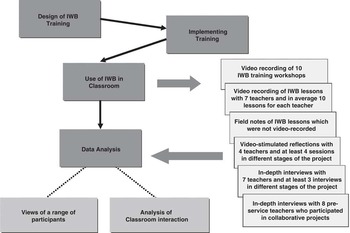
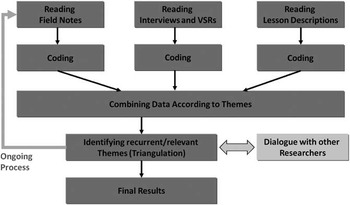
The methodology adopted in this study is part of a research tradition into teacher cognition in language teaching. Studies of language teacher cognition are those which investigate “what second and FL teachers think, know and believe and the relationships of these mental constructs to what teachers do in the language teaching classroom” (Borg, Reference Borg2006: 1). Data were collected via a variety of qualitative research instruments, including classroom observations and field notes, video recordings of school lessons and workshops, in-depth interviews with the teachers and VSR sessions. Thus a range of data-collection instruments and techniques were used in an attempt to maximize reliability through triangulation. Grounded theory (Glaser & Strauss, Reference Glaser and Strauss1967) was used for the qualitative analysis, i.e., the data were approached with relatively little preconception, as the researcher endeavoured to identify categories of meaning from the data. The qualitative analysis software tool MaxQDA supported the process of coding and categorization of the prominent themes that emerged from the various sources of data in response to the research questions. Figures 1 and 2 provide an overview of the data collection and data analysis procedures.
Overview of Research Process

Data Analysis Process

The process of data collection and data analysis was facilitated by eight university students, who worked in the framework of the project as “teaching assistants”. The students developed and evaluated collaborative mini-projects with the participating teachers and produced academic reports based on their findings. In this way the research design followed the recommendation by Meskill et al. (Reference Meskill, Anthony, Hilliker, Tseng, You, Hubbard and Levy2006), which encourages collaboration between in- and pre-service teachers:
“Matching novice technology-learning teachers with experienced classroom teachers therefore appears to be a ripe venue for constructive, collaborative and productive conversations about teaching and learning with technology” (op. cit.: 296).
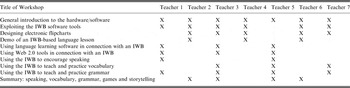
The professional development model was spread out over a one-and-a-half-year period. During this period, the teachers received technical and pedagogical support for their own exploration of the technology via a) IWB training workshops, b) individual consultancy with an academic expert, c) lessons designed and implemented by pre-service teachers, and d) VSR sessions. A total of ten IWB training workshops were designed and implemented by the researcher. Table 1 lists the titles of the IWB workshops and provides an overview of teacher attendance.
Title of Workshops and Teacher Attendance

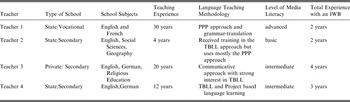
My initial intention to conduct VSR sessions with all participating teachers could not be fulfilled as three participants found it difficult to juggle their normal workload and could not find time to take part. In order to compensate for this situation, a greater number of in-depth interviews was carried out with these teachers at different stages of the project and more lessons were video-recorded than initially planned. Table 2 summarizes the profiles of the teachers who took part in the VSRs.
Participant Profile

As described above, each teacher underwent at least four VSR sessions at different stages during the project. All sessions followed the same pattern: The teacher was shown a videotape of a lesson in which s/he used the IWB. As soon as viable, the researcher and the teacher sat together and watched the videotape of that lesson. The teachers were then encouraged to take the initiative in identifying the aspects of their teaching they wanted to comment on, and provide unstructured commentaries on thoughts, decisions and reflections related to the chosen actions. The researcher also posed questions reflecting the issues that emerged during the VSRs. These questions were either related to specific incidents in the lessons or other more general questions about lesson planning and material design. For instance:
1. Do you think the students usually take fewer notes when you use the whiteboard? (VSR 5, T2)
2. If you didn't have such a nice group, for example, how could you involve the learners who are not… who are just watching, not doing anything at the board? (VSR 2, T3)
3. So, why, why would you use different colours, for example, in this case? How could it help your pupils’ learning? (VSR 1, T2)
Section 4 discusses the effect the VSR sessions had on teacher development in the context of the project.
4 Research findings
The research findings indicate that the VSRs provided the participants with effective opportunities to reflect on their reasons for using the technology, to evaluate the impact of IWB on classroom interaction, and to track their pedagogical development as IWB users. In what follows I present and discuss evidence that illustrates and supports these claims.
4.1 VSR as a professional development tool
4.1.1 Analysing underlying methodological motivations for using the IWB
“You want to use it – no matter how.” (Teacher 2, VSR 5)
This statement was made by T2 as she analysed an IWB-based activity focusing on listening comprehension. The aim of the activity was to check the students’ understanding of a story. While they listened to the text, they were asked to do a gap-filling exercise, which was shown on the IWB (see Figure 3).
“hide-and-reveal” technique

The teacher made use of a “hide-and-reveal” technique by covering some words with a rectangle annotation that could be dragged off the page, but was disappointed with the outcome of the activity. Asked whether she would implement the same kind of activity again, she gave the following answer:
“In general I would do it again, but I think perhaps it's better that they get the content. I don't know if it's good when they just listen for words, if they get the content. […] You just think, okay, that's good with the whiteboard, they can put away the words or write them down, but probably for the text understanding it's not the best thing” (Teacher 2, VSR 5).
She recognizes that putting the focus on the comprehension of individual words had not been useful in helping learners to understand the content of the story. Classroom observations conducted prior to the introduction of the IWB technology show that this teacher typically used a more holistic approach to implementing listening comprehension activities, considering the different phases (pre-, while- and post-listening), and designing exercises that ranged from listening for gist to listening for detailed information. In the discussion that followed the teacher made references to her theoretical and methodological knowledge and admitted that while planning the lessons and designing the materials, she had been more concerned about what she could do with the IWB, and not so much on how the IWB could be used to support her teaching goals. She then concluded:
“You forget them (the theories), because you focus on the whiteboard. And you want to use the whiteboard somehow” (Teacher 2, VSR 5).
This episode illustrates one of the main challenges that the participating teachers faced: In their attempt to fully exploit the multimodal capabilities of the new technology, they sometimes “fell into the trap” of designing technology-based activities without considering their methodological appropriateness. In the sequence above, as the teacher looked at her own practice with a fresh eye, she was able to consider more closely and reflect on her ‘wrong’ motivation for technology use.
The VSRs were also seen by the teachers as useful in helping them to evaluate which teaching goals are best achieved with the support of the IWB and which ones are best met by drawing on more traditional resources and methods. In the following excerpt, for instance, Teacher 3 questions her decision to use the IWB in a specific phase of the lesson:
“Yeah, but I think about…. is it necessary to have the whiteboard in that phase of the lesson? Or is it better to have them doing a writing task or something like that?” (Teacher 3, VSR 4).
Thus she used the VSR as an opportunity to rethink her decisions regarding technology use. The reflections that took place during the VSRs seemed to have helped her gain a better understanding of the ‘place’ of the IWB in her teaching, which will hopefully lead to an informed judgement about when to use the technology and when not to use it. In fact, a pattern noted in the video-recorded lessons was the teachers’ tendency to use the IWB in all phases of the lesson, especially in the early stages of technology integration.
This is in line with Gray (Reference Gray, Thomas and Cutrim Schmid2010) who points out that as teachers integrate the IWB into their teaching they sometimes forget the traditional repertoire they possess, for example the use of real objects, physical activity such as miming, role plays, pair and group work activities and genuine interpersonal communication. As Gray quite rightly notes, “certain aspects of pedagogical intent in MFL teaching and learning are best served without electronic support” (op. cit.: 75).
These findings indicate that the VSRs were used by the teachers as platforms for discussing and reflecting on the rationale for their methodological choices in relation to IWBs. On several occasions these reflections enabled them to gain insights which would lead to a better understanding of specific concepts related to IWB use, such as interactivity, multimodality, and cognitive load. In the lessons taught by T2, for example, the students were given many opportunities to write and manipulate digital objects on the board, which repeatedly caused difficulties with time management. When asked about her reasons for her strong emphasis on the use of the technology, she replied as follows:
“Because I think for this class it was important, or at this age and at the beginning it's important for them to go to the board and do something. Because that's the magic of the board […] For them whiteboard work is where you can do something with the whiteboard” (Teacher 2, VSR 1).
This response shows that T2's interpretation of students’ expectations was crucial in determining how she implemented this innovation. Since she used the IWB mainly as a motivation trigger, she wanted to give her students as many opportunities as possible to “interact” with the IWB because she thought it would lead to more active participation in her lessons. However, at that point of her development as an IWB user the teacher had not considered the various kinds (or levels) of interactivity that the technology affords. In fact, most of the IWB-based activities she designed during that phase of the study focused on the level of “physical interactivity” with the interface of the board (e.g., by clicking on an object to hear a sound or writing with the electronic pen), and there were only a few examples of activities in which “cognitive interactivity” (Aldrich et al., Reference Aldrich, Rogers and Scaife1998) or “pedagogic interactivity” (Beauchamp & Kennewell, Reference Beauchamp and Kennewell2010) were supported by the use of the technology. When challenged by the researcher to rethink her understanding of enhanced interactivity as “pupils’ physical manipulation of digital objects on the board”, she made the following comment:
“Perhaps we should then really try one lesson where the students cannot go to the whiteboard, I wonder how they react then, whether they are still fascinated and like the whiteboard” (Teacher 2, VSR 1).
This can be seen as a critical episode in the teacher's development because it triggered a process of reflection on her conceptualisation of “enhanced interactivity” in connection with IWB use. In a subsequent lesson the teacher decided to test her hypothesis that the students would lose their motivation if they were not allowed to go to the IWB. The students engaged with the activities presented on the board from their seats, by raising their hands and answering questions, and she wrote or manipulated the objects on the IWB for them. In one of the in-depth interviews that followed, she stated that she was surprised, after examining the video recordings, that the quality of pupil participation in that specific lesson was the same as in the previous ones. She also felt that there were more instances of pupil-pupil interaction in comparison with previous IWB-based lessons. This little experiment seems to have helped the teacher to grasp a better understanding of the concept of interactivity and in identifying the kind of interactivity that supports effective learning compared with the one that is largely superficial. In fact, in lessons that took place during later stages of the project, T2 started to encourage pupils’ use of the IWB at a different level, for sharing their knowledge by means of classroom presentations, for example, or for creating and implementing content-based quizzes with the use of IWB-based voting software. Thus, the prompts provided by the researcher during the VSR session seemed to have played a crucial role in directing teacher attention to key concepts and in causing a cognitive conflict that enabled change and led to transformative practice.
4.1.2 Evaluating the impact of IWB use on classroom interaction
The detailed analysis of the lessons during the reflective sessions also allowed the teachers to go beyond a superficial evaluation based mainly on their perceptions of students’ enhanced motivation and engagement during the lessons. T4, for instance, showed special interest in the examination of the impact of the technology on the interaction patterns in the classroom. In the following sequence, she notices that interaction during IWB-based activities generally followed the initiation-response-feedback (IRF) structure (Edwards & Mercer, Reference Edwards and Mercer1987):
“And it's… a little bit sad, I have to say to see myself teaching this way, because when I planned the lesson I thought there is a lot of change in it, but when I watch it, it's not, it's just that I feel: ok it's teacher-centred and … there is a change of media but not a change of social form. So every communication is teacher-pupil and pupil-teacher, ok there were some sequences some small ones with pupils between pupils but it's just too little” (Teacher 4, VSR 1).
T4 expresses her disappointment, as she had thought that the changes introduced by the use of IWB technology such as use of multimedia and interactive exercises would foster a more learner-centred environment. As she points out, “there was a change of media but not a change of social form”. On another occasion, the teacher discusses possible reasons for this and suggests strategies for stimulating learner engagement in IWB-based activities.
The impact of IWB use on classroom interaction was also a recurrent topic in the reflective sessions with T1. Most of the interactions in her IWB lessons also followed the IRF format. However, in contrast to T4, who noticed a mismatch between her beliefs and her practice, T1 purposefully used the IRF pattern in her teaching. Here, she explains the rationale for her approach:
“Of course, this lesson…I mean usually for beginners, I'm always in front of the class. […] I think with beginners, especially with this class, they come from the Hauptschule… If the teacher is not standing in front of the class, you can forget about it. They are good kids, but they really need guidance” (Teacher 1, VSR 2).
T1 justifies the necessity to remain firmly in control of the teaching and learning cycle by referring to the special needs of her students, who have obtained a lower secondary educationFootnote 2 (level 2 – according to the International Standard Classification of Education) and thus require more guidance and support in their language learning. Therefore, most of her IWB-based activities contained carefully planned steps to move students gradually from language recognition through practice to production. During the reflective sessions, this teacher made several self-initiated comments related to the topic of teacher-centredness, probably because she could notice a mismatch between her practice and the methodological principles underlying the IWB training programme, which emphasized learner-centredness and learner self-discovery. For the teaching of grammar, for instance, T1 used an “inductive approach”, in which students were guided by her into the discovery of grammar rules with the use of electronic flipchart pages that provided step-by-step scaffolding (e.g., through the use of drag and drop exercises, hide and reveal techniques, and leading questions). She admits that the approach could be considered “old-fashioned” but also reiterates that this is the kind of methodology that has shown to be effective in her specific context:
“That's the thing, that grammar is very teacher-centred, especially the difficult chapters and if I just give them some worksheets: well figure it out yourself, then I have 25 rules and no rule is correct… that is kind of a really old-fashioned way” (Teacher 1, VSR 2).
The excerpts above indicate that, as T1 reviewed her use of the IWB and examined the interaction patterns during her lessons, she felt the need to explain the reasons for her methodological choices. By doing so, she engaged in a process of re-evaluation of her beliefs and assumptions. Thus, the observation of her students’ reactions from a different perspective during the VSRs caused her to rethink this approach, since she could notice that an over-emphasis on whole class IWB-based work often created a situation in which only a few students were actually engaged and participating. In other parts of the data, the teacher admitted that most of the classroom activities tended to revolve around the IWB, therefore leading to situations where the technology “took over” her lessons. She explained that this approach was determined not only by internal factors, namely her own methodological preferences, but also by external factors related to technology access in her school:
“I think it's interesting… it also makes me realize again that next school year I want a room with an IWB so that I can have all my French lessons in that room and not like this… because it's very difficult for me to put the lessons together thinking: What can I do without the IWB?” (Teacher 1, VSR 2)
At this point of the VSR T1 was prompted to analyse the relevance of this data collection method in view of her development as an IWB user. She stated (in line 1) that the VSRs helped her to become more fully aware of the drawbacks and limitations of the approaches she had been using so far. She then went on to suggest that a more complete access to the technology would facilitate a more thoughtful and purposeful integration of the IWB into her teaching by allowing her to move away from her current approach, which tended to place an excessive focus on the IWB as a starting point for lesson planning and design. The opportunity to analyse classroom interaction from a different perspective during the VSR thus seemed to have caused the teacher to rethink her pedagogical approach to IWB use and to generate ideas that could lead to transformative changes in her practice.
4.1.3 Tracking their pedagogical development as IWB users
The findings have also shown that the VSRs were valued by the teachers as a “tracking tool” for their development as IWB users, literally from a different perspective. As they analysed their practice in more detail, it became easier for them to identify the competencies that they had already acquired and the ones that they still needed to develop. The following excerpt illustrates this specific use of the VSRs:
“You really realize it better when you watch the video and you see that they get bored and that you really should change something. I think that's a good thing because I couldn't remember that I did it that way and I think it was too teacher led, but now that I see it and it is very obvious. yeah, that you must change something with working with the board” (Teacher 2, VSR 2).
As has been shown in the sections above, the analysis of the structure and content of classroom interaction was a recurrent theme during the VSRs. This was certainly motivated by the fact that the concept of “interaction” was a central notion in the design and implementation of the IWB professional development programme. In fact, an essential competency to be developed by the participating teachers was the ability to exploit the IWB to support “dialectic and dialogic” forms of interaction (Beauchamp & Kennewell, Reference Beauchamp and Kennewell2010), which are those that “allow pupils to influence the course of the lesson through their own ideas and needs” (op. cit.: 762).
In the first VSRs most teachers expressed disappointment with the level of interaction in their lessons. They thought that the patterns of interaction in the observed classrooms were mainly teacher-centred, if not teacher-dominated, leaving little space for students’ spontaneous ideas and views to emerge. However, as the training programme progressed, some teachers could track their development towards a more learner-centred approach to IWB use.
T3's experience provides a good example of this specific value of the VSRs for the teachers. Drawing on the five evolutionary stages in technology development, i.e., entry, adoption, adaptation appropriation and invention, identified by Sandholtz, Ringstaff and Dwyer (Reference Sandholtz, Ringstaff and Dwyer1997), the findings indicate that T3 was the one who made the most significant progress towards the “invention stage” of technology integration, i.e., when the technology has a positive transformative impact on teachers’ classroom practice. The analysis of VSR data suggests that the teacher made effective use of the VSRs to both foster and monitor this transition.
T3's initial approach to technology use was very similar to that of T1 (see previous section). Most of the IWB-based activities she created had a focus on form and accuracy, as she mainly used the technology to introduce grammar and vocabulary and to support teacher-controlled practice of language forms. As a result, she felt that her IWB lessons tended to be slightly more teacher-centred than the lessons she implemented before the introduction of the technology. In the first VSR with T3 she analysed a 6th grade lesson entitled “At the doctor's” in which she introduced new words, useful phrases and language chunks that the students would need in order to perform a dialogue at a doctor's surgery. In her evaluation of this lesson, she makes the following comment:
“But I think, yeah…they are too little active for me. Yeah… So therefore I would change this with the laptop thing that I told you. Yes, this I would do… when they work in pair work, or maybe individual work… And then… then you can do that again together as a group [on the IWB]” (Teacher 3, VSR 1).
T3 clearly expresses her dissatisfaction with the transmission model of learning that she had employed in this lesson, which resulted in the students being “too little active”. She then refers to some practical strategies for changing this teaching approach which she had mentioned previously during this VSR. As she points out, in order to enhance active participation during her lessons, she would need to provide the students with more opportunities to work in pairs or individually (e.g., on their laptops) before engaging in whole class IWB-based activities.
T3 thus placed considerable emphasis on using the IWB to enhance student engagement and productivity in her lessons. She notices, among other things, that the availability of this technology raised pupils’ motivation to do classroom presentations, since they could draw on a great variety of multimedia resources. This encouraged her to design a range of student presentation projects, such as the “Welcome to the British Isles” project in the 6th grade, in which pupils were given plenty of opportunities to use the IWB to express themselves in multimodal formats and share their knowledge with their classmates.
T3 also demonstrated further development in her ability to use the IWB towards a more learner-centred approach through the design of a 9th grade project entitled “Into the World of Work”, which was implemented during a later stage of the research project. The aim was for the students to acquire the language necessary to design a CV and take part in a job interview. In five sessions, the students learned about various job options (vocabulary work), familiarized themselves with job ads and ways of responding to them, filled out and analysed personality quizzes, and designed and performed job interviews. T3 went on to use the IWB as a digital hub for the integration of a variety of multimedia materials (videos, websites, pictures, online texts), which added an element of authenticity to the lessons and provided support for the various tasks that the students needed to accomplish. In the following excerpt of a VSR related to this phase of the school project, the teacher had been asked whether she thought this specific IWB lesson had been more learner-centred compared to previous ones. She then replied:
“Yeah, I would say so. Because they had time… they had to find out things…and then they had to describe things and think about their own personality… it's a mixture. It was very exhausting for me, I had to prepare the material, it was a lot of work and I needed a lot of time. But later on they are…it's their turn, and this was my input” (Teacher 3, VSR 3).
As she reflected on the way she exploited the IWB in this specific lesson, T3 identified an important development in her practice. This becomes clear in the last line where she states: “it's their turn”, emphasising that, in contrast to previous lessons where students were conceived of as mere recipients of information, in this approach they were given stimulating and relevant input via the IWB which motivated them to engage with the task and provided opportunities for co-construction of knowledge. In lines 1 and 2 she defined students’ activities in terms of “finding out”, “describing” and “thinking”. Thus T3 gradually redirected her focus from the IWB affordances which “increase teacher control over the learning process to those affordances that open up the classroom to the outside world and to more flexible approaches” (Gray, Reference Gray, Thomas and Cutrim Schmid2010: 74). The VRS seemed to have supported her in identifying and reflecting on this aspect of her pedagogical development.
5 Conclusion
“It's just that I'm happy that I'm able to look at myself and even to have the courage to look at it because not everyone dares to look at herself or himself or oneself to… it's like you open your eyes” (Teacher 4, VSR 3).
This quote reflects the participants’ ambivalent attitudes towards the VSRs. The analysis of the interview data shows that, although the teachers found the VSRs extremely valuable for their professional development, they also emphasize their challenging and painful aspects. This points towards the inherent difficulties involved in getting engaged in self-reflection and self-evaluation, especially in collaboration with peers and/or trainers.
However, in spite of these challenges, all participating teachers underlined the key role played by the VSRs in fostering their learning journey throughout the research project. They were used by the teachers as effective opportunities to consider their motivation for using the technology, to evaluate the impact of IWB on classroom interaction, to better understand specific concepts related to IWB use and to track their pedagogical development as IWB users.
The data presented here also shows that the VSR is an effective method to gain access to teachers’ perspectives on technology integration, and if employed in longitudinal work, to gain a more detailed picture of their developmental paths as technology users. In fact, the longitudinal feature of the research design was seen by the participants as especially adequate as it provided them with scaffolded opportunities for developing their capacity for self-reflection and self-evaluation. Thus, the VSRs seem to have supported the teachers not only in acquiring new competencies for integrating the IWB technology into their teaching, but also in developing further expertise in the analysis and evaluation of technology enhanced language teaching and learning. In fact, as the project progressed, questions such as “am I harnessing the affordances of the technology while at the same time recognising its limitations?” or “are the technology tools being used to enhance language learning or just for the sake of making the lessons more interesting?” became much more frequent in their reflective discourse.
As mentioned at the beginning of this article, one of the problematic features of CALL research highlighted in the literature is a general failure to consider the classroom context (Egbert et al., Reference Egbert, Huff, Levi, Preuss and Sellen2009). Moreover, it has been argued that one way to obtain a more accurate account of classroom context is by including teachers’ voices, observations and concerns. The findings presented and discussed here point towards the potential of using VSR both as a research method to collect rich data on teachers’ perspectives and developmental paths and as a professional development tool that encourages and supports reflective practice in CALL.