1 Introduction
Throughout this research, a focus is placed on learners who, despite studying in contexts supportive of collaborative interaction in the classroom, have little opportunity to interact with partners when studying outside school (for example, when studying at home). In essence, therefore, these learners have to temporarily function as isolated learners in remote learning environments. In an attempt to alleviate this potentially inhibiting learning context, this current research is undertaken in a bid to identify a pedagogically beneficial way of promoting learner interaction between students in non-face-to-face learning environments. With these ideas in mind, the research comprises an investigation into (a) whether the introduction of computer-mediated Elaborative feedback before Knowledge of Correct Response (KCR) feedback better promotes quality interaction and comprehension of a web-based reading text and (b) whether computer-mediated communication (CMC) offers a suitable means for generating quality interaction between peers in remote locations. Firstly, however, the section below comprises a brief overview of interaction in L2 language learning with a focus on collaborative web-based reading activities.
2 Interaction in L2 language learning
Concentrating on the desirability of incorporating and promoting interaction in the learning process, González-Lloret (Reference González-Lloret2002) explains how studies focusing on student dyads have suggested that interaction facilitates comprehension better than conditions without the interaction component (Gass & Varonis, Reference Gass and Varonis1994; Loschky, Reference Loschky1994; Pica, Doughty & Young, Reference Pica, Doughty and Young1986; Polio & Gass, Reference Polio and Gass1998; Uribe, Klein & Sullivan, Reference Uribe, Klein and Sullivan2003). Furthermore, the advantages of paired reading methodologies for promoting both comprehension and fluency are also noted throughout previous research (Eldredge, Reference Eldredge1990; Eldredge & Butterfield, Reference Eldredge and Butterfield1986; Gorsuch & Taguchi, Reference Gorsuch and Taguchi2008; Koskinen & Blum, Reference Koskinen and Blum1986 and Nes, Reference Nes2003). Therefore, moving from face-to-face learning environments to those employing computer-assisted language learning (CALL) and CMC, it is also important to consider the interaction that is generated in computer-based tasks (Beatty, Reference Beatty2003; Murphy, Reference Murphy2007; O’Dowd, Reference O’Dowd2003; Stevens, Reference Stevens1992; Stockwell & Levy, Reference Stockwell and Levy2001), and the type of interaction that is desirable for promoting reading comprehension, learning and language acquisition around computers. Two key features are particularly desirable: learners need to be actively involved (Van den Branden, Reference Van den Branden2000) and learners need to produce “exploratory talk” in which partners engage critically and constructively with each other’s ideas (Mercer, Reference Mercer1995). Regarding the former, Mercer (Reference Mercer2004: 146) explains how it is helpful for the analyst to perceive the degree to which students in joint activities are “(a) behaving cooperatively or competitively and (b) engaging in the critical reflection or in the mutual acceptance of ideas”. As for promoting exploratory talk among learners, Wegerif, Mercer and Dawes (Reference Wegerif, Mercer and Dawes1998), having been influenced by findings of research into effective collaborative learning, summarized in Wegerif and Mercer (Reference Wegerif and Mercer1996), note the importance of sharing relevant information, reaching agreement, expecting reasons and challenges, discussing alternatives and encouraging peers. To give an example, Murphy’s (2007) results indicate that dyads who participated in a collaborative reading comprehension exercise not only outperformed students working individually, but also produced quality interaction (Fisher, Reference Fisher1992; Mercer, Reference Mercer1995; Wegerif et al., Reference Wegerif, Mercer and Dawes1998). When computer-mediated feedback was provided in more elaborative forms rather than just providing the correct answers, students exhibited positive attitudes toward both face-to-face pair work and web-based instruction. A key concern for research, therefore, is how quality interaction and reading comprehension can be promoted through computer-mediated activities (Chapelle, Reference Chapelle2005) in non-face-to-face environments.
3 Challenges and benefits of web-based learning
Numerous studies have been conducted on the topic of how technology can help students improve their L2 reading ability (Caverly & McConald, Reference Caverly and McConald1998; Chun, Reference Chun2006; Hong, Reference Hong1997; Jones & Wolf, Reference Jones and Wolf2001; Mikulecky, Reference Mikulecky1998; Murphy, Reference Murphy2007; Stakhnevich, Reference Stakhnevich2002; Williams & Williams, Reference Williams and Williams2000; Wood, Reference Wood2001), particularly as research shows that course effectiveness is determined by the pedagogy involved in using media, and not the medium itself (Rovai & Barnum, Reference Rovai and Barnum2003; Weasenforth, Meloni & Biesenbach-Lucas, Reference Weasenforth, Meloni and Biesenbach-Lucas2005). As Murphy and Coleman (Reference Murphy and Coleman2004) note, therefore, ongoing research is necessary to identify the benefits and challenges of the technology, and also the limitations and inconveniences experienced by learners in online asynchronous discussions. The sections below expand on these issues.
3.1 Challenges associated with computer-mediated communication
Notwithstanding an interactionist approach being a regular part of face-to-face learning environments, it is difficult to implement such a methodology with isolated students without the use of technology. Indeed, Guldberg and Pilkington (Reference Guldberg and Pilkington2007) note how overcoming the distance has been a real challenge, but argue that modern day mobile technology now provides a possible means for promoting collaborative interaction between individuals studying in remote locations through the use of CMC (Gabriel, Reference Gabriel2004; Murphy & Coleman, Reference Murphy and Coleman2004; Paran, Furneaux & Sumner, Reference Paran, Furneaux and Sumner2004; Tudini, Reference Tudini2005; Weasenforth et al., Reference Weasenforth, Meloni and Biesenbach-Lucas2005). Other challenges associated with CMC indicate that distance learning courses can be impersonal, superficial, misdirected, potentially dehumanizing and depressing, and they can also disrupt the interactions that create a productive learning community (Rovai & Barnum, Reference Rovai and Barnum2003). Negative feelings of exclusivity, discouragement and frustration can also arise, thereby resulting in a sterile and impersonal form of communication (Murphy & Coleman, Reference Murphy and Coleman2004). Furthermore, despite the potential for the medium to support more reflection, knowledge construction and critical thinking, these benefits are not necessarily guaranteed (ibid.). For example, Pawan, Paulus, Yalcin and Chang (Reference Pawan, Paulus, Yalcin and Chang2003) highlight how students were found to engage primarily in serial monologues without instructors’ explicit guidance and teaching presence (see also Card & Horton, Reference Card and Horton2000; Wang & Woo, Reference Wang and Woo2007). Additionally, the time commitment necessary to participate in CMC activities can also be problematic (Gabriel, Reference Gabriel2004; Meyer, Reference Meyer2003; Paran et al., Reference Paran, Furneaux and Sumner2004; Wiesenberg & Hutton, Reference Wiesenberg and Hutton1996). As can be seen, numerous challenges are associated with CMC; however, numerous advantages have also been identified. Some of the more pertinent are described below.
3.2 Advantages associated with computer-mediated communication
A plethora of CALL studies have examined the interaction of students engaged in CMC while “chatting” (in a written form) using a computer as the communication instrument in collaborative activities (Beauvois & Eledge, Reference Beauvois and Eledge1996; Blake, Reference Blake2000; González-Lloret, Reference González-Lloret2002; Kern, Reference Kern1995; Kitade, Reference Kitade2000; Warschauer, Reference Warschauer1996). With access to the Internet, students are no longer bound by time or place (Beldarrain, Reference Beldarrain2006; Murphy & Coleman, Reference Murphy and Coleman2004); there is now the option to break down what Moore (Reference Moore1991) terms the “transitional distance” between those who are interacting to overcome the possibly detrimental effects of separation (including spatial, temporal, social, cultural, situational and/or psychological) from their instructor(s) and/or peer(s) (Kanuka, Rourke & Laflamme, Reference Kanuka, Rourke and Laflamme2007). For example, research shows how students all have an equal chance to participate when studying online (Birch & Volkov, Reference Birch and Volkov2007; Hemphill & Hemphill, Reference Hemphill and Hemphill2007; Kumari, Reference Kumari2001; Ortega, Reference Ortega1997) due to what Murphy and Coleman (Reference Murphy and Coleman2004:1) call the “equalizing effect” of CMC with regard to issues such as race, gender, accent or status (see also Warschauer, Reference Warschauer1997). In effect, a bridge is built (Tudini, Reference Tudini2005) which enables students to negotiate meaning as occurs in face-to-face oral interaction. Such a learning environment encourages noticing of errors, negotiations and modified output, thereby providing an optimal setting for second language acquisition (SLA). Importantly, research shows that students can learn equally well in online and face-to-face learning environments (Aragon, Johnson & Shaik, Reference Aragon, Johnson and Shaik2002; Moore & Thompson, Reference Moore and Thompson1990; Verduin & Clark, Reference Verduin and Clark1991). Furthermore, when compared to face-to-face discussions in the classroom, certain research actually indicates that online discussions can lead to greater perceived learning and higher levels of learner satisfaction (Rovai & Barnum, Reference Rovai and Barnum2003), and higher levels of quality and quantity of the content. CMC has also been shown to afford students numerous opportunities for interaction and communication whether undertaken synchronously or asynchronously (Gabriel, Reference Gabriel2004; Lock, Reference Lock2002; Turcotte & Laferrière, Reference Turcotte and Laferrière2004). Students can also provide feedback to one another and clarify their ideas (Weasenforth, Biesenbach-Lucas & Meloni Reference Weasenforth, Biesenbach-Lucas and Meloni2002; Wilson & Stacey, Reference Wilson and Stacey2004), thereby providing support in a collaborative manner.
3.3 Faults and remediation
Foreign or second language learning can be problematic in many areas, and situations frequently arise in which some form of remediation is necessary. Expanding on Corder’s original (Reference Corder1967) work, James (Reference James1998) explains how identifying the origin of any faults arising from these problematic areas helps to determine the degree of remediation that may be necessary. Accordingly, faults can be sub-divided into the following three main categories which are listed in increasing degree of severity: slips, mistakes and errors. In response to these faults, three approaches can be used to foster the development of self-correction strategies by students (Ros I Solé & Truman, Reference Ros, Solé and Truman2005). Listed in increasing order of the degree of remediation that is necessary, the approaches are: feedback, correction and remediation. However, focusing specifically on studies involving computer-assisted language learning, the term feedback is typically used in a more general sense to refer to information that is supplied to students regarding their work. Focussing on this area in more detail, the following section comprises a description of the most common types of computer-mediated feedback.
3.3.1 Computer-mediated feedback
The development of both software and hardware in recent decades means that students are no longer forced to receive minimal feedback in the form of, for example, (a) Knowledge of Response feedback which states “right” or “wrong” or (b) Knowledge of Correct Response feedback which states the correct answer (this feedback replicates traditional paper-based answer sheets in that students are supplied with the correct answers). Instead, feedback can now be provided in more elaborative, adaptive and personalised forms (Clariana, Reference Clariana2000; Murphy, Reference Murphy2007). However, contradictory evidence is prevalent in previous research regarding the amount, type and timing of the feedback provided to students and whether these factors affect learning (Bangert-Drowns, Kulik, Kulik & Morgan, Reference Bangert-Drowns, Kulik, Kulik and Morgan1991; Brandl, Reference Brandl1995; Clariana, Reference Clariana1993, Reference Clariana2000; Clark & Dwyer, Reference Clark and Dwyer1998; Kulhavy & Wager, Reference Kulhavy and Wager1993; Merrill, Reference Merrill1987; Mory, Reference Mory1994; Nagata, Reference Nagata1996; Schimmel, Reference Schimmel1983; Van der Linden, Reference Van der Linden1993). Due to this lack of consensus, Mandernach (Reference Mandernach2005) believes that the challenge for educators is to identify the type of feedback that is most effective in specific educational settings. Mandernach also explains that one crucial problem associated with providing feedback is that students may not even read it, and, therefore, recommends that: “Future studies may want to examine the educational impact of the various forms of feedback-elaboration when the feedback is readily accessible for students to use at their own discretion” (op. cit. 2005:9).
4 Research questions
Having focused on CMC, web-based reading comprehension exercises, interaction, self-correction and computer-mediated feedback, the following research questions were formed:
(a) While communicating asynchronously with an anonymous and remote partner via CMC to complete a web-based multiple-choice reading comprehension exercise, will the introduction of computer-mediated Elaborative feedback before KCR feedback better promote quality interaction and comprehension of a reading text?
(b) Does computer-mediated communication (CMC) offer a suitable means for generating quality interaction between peers in remote locations?
The research methodology employed in attempting to answer these questions is detailed below.
5 Research methodology
5.1 Participants
The 425 participants were first-year university English as a foreign language (EFL) majors in Japan. Classes were streamed according to the Kanda English Proficiency Test (KEPT) (Bonk & Ockey, Reference Bonk and Ockey2003). However, for the purpose of this study, students were assigned to one of two levels: “higher level” or “lower level”. The web-based reading exercises were completed by all of the fifteen classes in the year group. As students worked in pairs with classmates, proficiency levels within pairings were homogeneous. Materials developed for this study were trialled with 86 of the 425 students, leaving 340 students for the main study. However, records for 72 of the remaining students were omitted from the data analysis for reasons such as absenteeism, tardiness, odd numbers, technical difficulties and scoring 100% on the first comprehension exercise on the first attempt (these students did not benefit from feedback to promote comprehension which was the focus of this research). The main study and the statistical analysis were therefore performed on the data from the remaining 267 students.
5.2 Materials: reading materials
Materials used in this study comprised one reading text (see Appendix 1 for an excerpt) and two multiple-choice comprehension exercises, each with six questions (see Appendix 2 for an example question from Comprehension Exercise 1 and Appendix 3 for an example question from Comprehension Exercise 2). Therefore, the maximum score on each exercise was six points. While the questions in the two comprehension exercises were different, the same content points were covered by corresponding questions. In addition to the text and comprehension questions, three rounds of hints for the Elaborative feedback were also written. All materials formed part of a password-protected website.
5.3 Materials: feedback treatment
Murphy’s (2007) model shows how reading comprehension can be promoted through the introduction of computer-mediated Elaborative feedback and interaction with a partner. Using this model, the current research also focuses on both computer-mediated feedback (Elaborative and KCR) and pair work; however, students communicate via written CMC rather than face to face. Details follow below.
5.4 Procedure
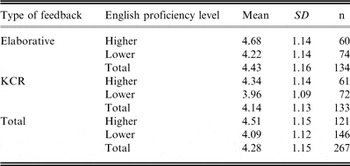
The procedure used in this research is described below (see Table 1 for the descriptive statistics):
Descriptive Statistics

(a) Students were divided into two levels of English proficiency. English proficiency level was thus the first independent variable.
(b) Type of feedback was the second independent variable; dyads were randomly chosen to receive either (i) KCR feedback only or (ii) up to three rounds of Elaborative feedback before KCR feedback. For the former condition, correct answers to all the comprehension questions were displayed when students submitted their answers to the first comprehension exercise for the first time. However, for the latter condition, computer-mediated Elaborative feedback was provided as follows:
• Having answered all questions and checked the answers on the first comprehension exercise for the first time, the first round of Elaborative feedback should encourage students to identify and correct incorrect answers by themselves. Therefore, Elaborative feedback is generated to direct students back to a key area in the text, for example: Please have a look at paragraph 6 again.
• If incorrect answers exist the second time students submit their answers for checking, Elaborative feedback should include a rephrased version of the question to help students identify and correct any mistakes/errors.
• If errors persist the third time students submit their answers, Elaborative feedback should include key information, sentences and/or phrases from the text, possibly in a paraphrased form.
• Finally, if errors persist following the fourth check of answers, the correct answers should be provided in the form of KCR feedback, and students should consult their teacher for further remediation.
It should be noted that the opportunity for random guessing is minimised by not initially identifying incorrect answers by question number. Instead, students are encouraged to read the feedback, re-engage with the materials, interact further with a partner, make any corrections as appropriate, and then recheck their answers. Furthermore, students are not supplied with the correct answers until they either receive the KCR feedback after the three rounds of Elaborative feedback or until they answer every question correctly.
(c) When participating in computer-mediated activities outside the classroom, numerous challenges can arise. These challenges may be related to studying without a teacher present, finding motivated partners at the right level for CMC, dealing with computer compatibility difficulties, overcoming any Internet availability, speed or bandwidth issues, and so on. In a conscious attempt to control for these factors so that any differences in comprehension scores could be attributed to the different types of computer-mediated feedback offered, this research was conducted in a computer-equipped classroom. However, in an attempt to also simulate remote locations, students were physically separated in the classrooms from their randomly assigned anonymous partners (Uribe et al., Reference Uribe, Klein and Sullivan2003).
(d) The first 25 minutes of the lesson for each of the fifteen classes was used for an introduction to the activity, which was given in both spoken English and written Japanese. All introductions were given by the researcher to maintain consistency. All students agreed to participate in the lesson. After listening to the instructions, students logged onto the online materials and then sent a message saying “Hello” to their partner on the pair’s pre-assigned bulletin board. After the introduction, students were given 50 minutes to read the text and complete the first multiple-choice comprehension exercise while interacting and collaborating with their partner through written messages using CMC. Students were next given a further ten minutes to complete the second comprehension exercise individually.
(e) To investigate the effects of ‘English proficiency level’ and ‘Type of feedback’ on all the dyads’ comprehension of the text during the first exercise, all students then individually completed the second comprehension exercise with KCR feedback only. The score on this second exercise was the dependent variable. All input data were stored in a database and analyzed quantitatively. Furthermore, transcripts of the interactions between students resulting from the CMC were then analyzed qualitatively. The results and their implications are discussed below.
6 Results
6.1 Quantitative results
Results from a two-way ANOVA indicate that the main effect of Type of feedback was statistically significant (F (1,263) = 4.64, p < .05). Therefore, students who had received Elaborative feedback before KCR feedback during the first comprehension exercise scored significantly higher on the second comprehension exercise (M = 4.43, SD = 1.16) than those who had received KCR feedback only (M = 4.14, SD = 1.13).
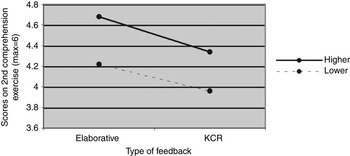
The quantitative analysis also shows that the main effect of the level of English proficiency was found to be statistically significant (F(1,263) = 9.47, p < .05). Higher proficiency students (M = 4.51, SD = 1.15) scored significantly higher than lower proficiency students (M = 4.09, SD = 1.12) on the second comprehension exercise. The interaction between Type of feedback and level of English proficiency was not found to be statistically significant (F(1,263) = 0.09, p > .05). However, it is pertinent to note that both higher level students (M = 4.68, SD = 1.14) and lower level students (M = 4.22, SD = 1.14) scored higher with Elaborative feedback than with KCR feedback (see Figure 1).
The effects of Type of feedback and English proficiency level on comprehension

6.2 Qualitative results
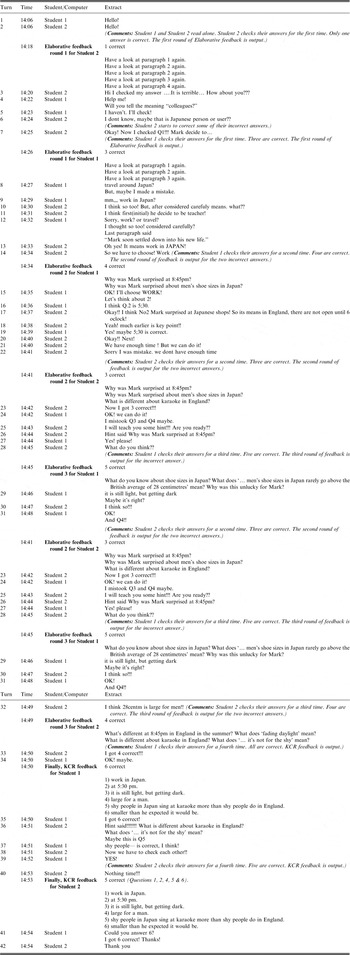
Extract 1 comprises an example of the interaction that can occur for students receiving Elaborative feedback. The researcher’s comments are included to identify the key areas of the exercise. Comments regarding the quality of interaction that was achieved follow afterwards.
An example of interaction with Elaborative feedback

Extract 1 comprises numerous examples of negotiating meaning, Exploratory talk and quality interaction. For example, in turns 3 and 4, both students ask their partner for help, thereby including their partner and encouraging them to speak. In turns 4 to 6, students share information as they to try to negotiate the meaning of the word “colleagues”. In turns 8 to 14, students interact to try to answer the first question. During this time, students share information and discuss alternatives (turn 12) as they try to reach agreement (turns 10 and 12) on the answer (turns 13 and 14). Students also negotiated the time that shops normally close in England (turns 16 to 19). There were also utterances which exemplified how students considered the activity and interaction to be a shared experience, for example, “we” (turns 14, 21 and 22) and “let’s” (turn 15). An example of how students shared information appears in turn 25 when Student 2 says: “I will teach you some hint!!! Are you ready??” Turn 28 includes an example of how students included each other in the decision-making and interaction: “What do you think??” In turn 29, Student 1 suggests an answer to another question and Student 2 agrees in turn 30. As can be seen, there were numerous examples of quality interaction.
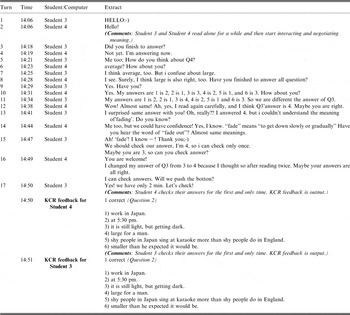
Extract 2 comprises an example of the interaction that can occur for students receiving KCR feedback. The researcher’s comments are once again included to identify the key areas of the exercise. Comments regarding the quality of interaction that was achieved follow afterwards.
An example of interaction with KCR feedback

Extract 2 also comprises examples of negotiating meaning, Exploratory talk and quality interaction. For example, in turn 5, Student 3 asks for help with Question 4. After the initial question, the students share information and opinions (turns 6 and 7) to come to an agreement. Later in the conversation, Student 3 asks about the meaning of “fading” (turn 13) and Student 4 then teaches them the meaning (turn 14). Once again, both partners are able to reach agreement about the answer to the question. One interesting point is that Student 4 explains how rereading the text was helpful for understanding the answer in turn 16. Having confirmed their answers with each other, and with consideration for the fact that they can only check their answers once with KCR feedback, both students then confirm that it is acceptable to their partner to check the answers in turns 15 to 17. Another significant aspect of the interaction is that both students participate actively and cooperatively, and they make an effort to include their partner in the shared experience with language such as: “Did you?”, “Me too”, “How about…?”, “Have you …?”, “We”, “Thank you” and “You’re welcome”.
7 Discussion
A quantitative data analysis of the results indicates that the main effects of English proficiency level and Type of feedback were both statistically significant. However, the interaction between Type of feedback and English proficiency level was not statistically significant. Some possible reasons for these results include:
(a) While trialling the materials, it was evident that interaction using CMC was not as efficient in online written mode as it was in face-to-face interaction. Despite this outcome, a great deal of quality interaction, negotiation of meaning and Exploratory talk were produced throughout the first reading comprehension exercise. Furthermore, with the statistically significant result for the main effect of Type of feedback, it appears that the affordances of the computer-mediated Elaborative feedback were particularly suited to promoting reading comprehension in this mode of study.
(b) In Murphy’s (2007) study, students completed two comprehension exercises each with fifteen multiple-choice questions. In this study, however, comprehension exercises only comprised six multiple-choice questions. The amount of material, therefore, that the students had to deal with in the two comprehension exercises together with the associated Elaborative feedback did not appear to have resulted in cognitive overload. In fact, the amount may have been especially suited to this learning environment and mode of study, hence the significant outcome for the main effect of Type of feedback.
(c) Apart from only five pairs, all other dyads engaged in interaction. It was noted earlier that one of the potential challenges involved in CMC is that two-way interaction is sometimes not achieved, and collaborative discussions break down into individual monologues; however, this situation did not arise in this research. In fact, on the contrary, the time to complete the first reading comprehension exercise seems to have been most appropriate for generating quality interaction in this context.
For a clearer understanding of how computer-mediated Elaborative feedback can be provided to promote reading comprehension, future research must address the issues above by comparing (a) how comprehension of a reading text is affected by differing numbers of questions and the amount of Elaborative feedback and (b) the efficiency of different modes of study for comprehension of the same amount of content.
One particularly interesting observation from the qualitative analysis of results was that students who received KCR feedback often finished the first comprehension exercise with feelings of disappointment due to a low score. However, the nature of KCR feedback means that students are not able to improve their score as it is only possible to check answers once (see Extract 2). In contrast, although some students receiving Elaborative feedback also received a low score after the first time they checked their answers, the nature of the multiple-try feedback methodology allows students the opportunity to self-correct any mistakes and improve their score before the second exercise (see Extract 1). The important difference is that students are given the opportunity to re-engage with the reading materials and to hopefully benefit from the Elaborative feedback as they actively attempt to make any corrections before the answers are supplied. Students reacted extremely well to this methodology and typically finished the first exercise in a positive manner. Elaborative feedback, therefore, was particularly beneficial in generating interaction.
8 Conclusions
Results from this research indicate that the introduction of computer-mediated Elaborative feedback can have a statistically significant beneficial effect on better promoting comprehension of a web-based reading text. Results also suggest that Elaborative feedback in conjunction with a multiple-try methodology is conducive to promoting interaction due to the opportunities afforded the students to re-engage with the reading materials and to interact with partners. Furthermore, despite the fact that interaction between partners may not generally be as time efficient in written mode as it is in face-to-face mode, results nonetheless indicate that CMC can be effective in generating quality interaction.
Whilst it is readily admitted that there are numerous unanswered questions regarding the time efficiency of written CMC, it is evident that this mode of communication affords students the opportunity to benefit considerably from the interaction generated as a result of the introduction of computer-mediated Elaborative feedback. For those studying alone in non-face-to-face educational environments, therefore, the inclusion of Elaborative feedback and CMC is highly recommended. If appropriate materials are created in this way, not only is it possible to generate quality interaction, but collaboration, cooperation and interdependence are also encouraged. Above all, however, students are offered both support and additional choices regarding the manner of their study, thereby providing them with more opportunities and choice regarding how to develop their reading comprehension skills.
APPENDICES
Appendix 1. An excerpt from the reading text

Appendix 2. Comprehension Exercise 1: an example question

Appendix 3. Comprehension Exercise 2: an example question