Introduction
Federal conservation programs
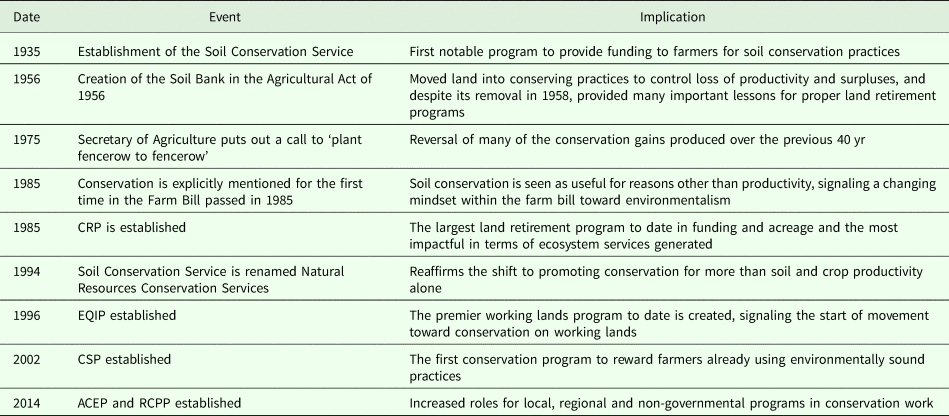
Conservation programs have long played an integral role in the USA in promoting environmental benefits on agricultural lands (Table 1). Prior to the 1980s, conservation policy focused primarily on controlling crop surpluses and reducing soil erosion. The movement toward true ‘conservation’ was established through the 1985 US Farm Bill, which explicitly stated the importance of conservation for purposes other than productivity gains. The bill established numerous conservation programs still present, most notably the Conservation Reserve Program (CRP; Cain and Lovejoy, Reference Cain and Lovejoy2004). The CRP gives farmers annual rental payments for removing land from production and implementing perennial cover to conserve highly erodible lands and promote beneficial biological services. The CRP has historically been the largest funded conservation program, receiving a budget of over $1.5 billion since 1988 (Osteen et al., Reference Osteen, Gottlieb and Vasavada2012).
Timeline of noteworthy events related to conservation policy and their implications for the functioning of conservation programs in the USA (Cain and Lovejoy, Reference Cain and Lovejoy2004)

ACEP, Agricultural Conservation Enhancement Program; CRP, Conservation Reserve Program; CSP, Conservation Stewardship Program; RCPP, Regional Conservation Partnership Program.
In 1996, the Environmental Quality Incentives Program (EQIP) was developed as the next substantial modern-day agricultural conservation program with a goal of targeting improvements on working lands to ‘maximize environmental benefits per dollar expended’ (Helms, Reference Helms2003, p.125). In 2002, the Conservation Service Program (CSP) was established to issue payments to farmers for achieving resource goals on the scale of the whole farm, rather than focusing on a set practice, as is the case with EQIP. The farm bill passed in 2014 created two new programs, the Agricultural Easement Conservation Program (ACEP) and the Regional Conservation Partnership Program (RCPP). The programs represent an effort by the federal government to delegate a more significant role in conservation planning to the private industry in coordination with the Natural Resource Conservation Service (NRCS) (Reimer, Reference Reimer2015).
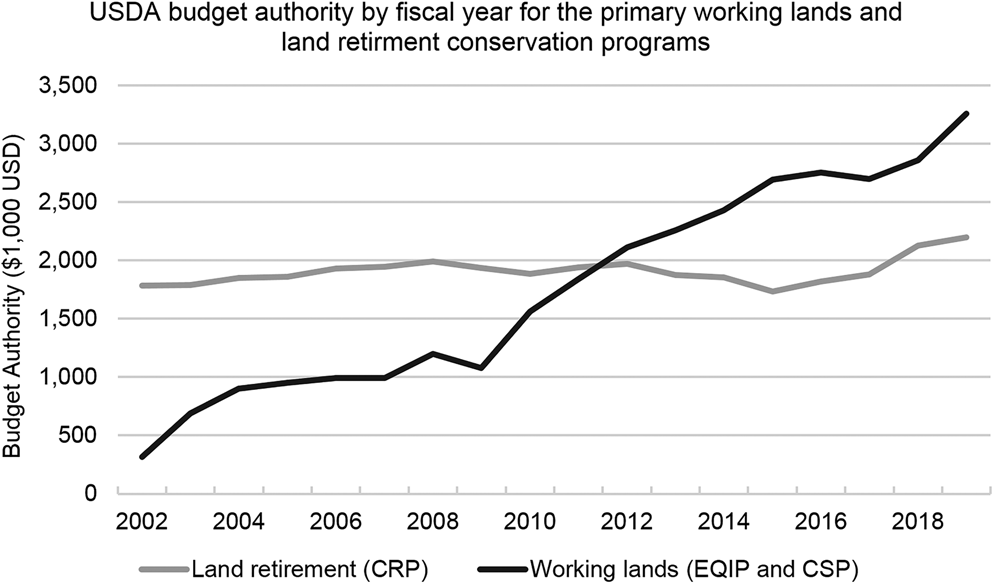
In the 21st century, support for conservation programs in the USA has remained relatively stable, but the manner in which programs are carried out is changing. Support has shifted away from land retirement programs, namely CRP, and begun to move toward working lands approaches, primarily EQIP and CSP. The CRP enrollment acreage cap has steadily declined—from 39.2 million acres in 2002 to 32 million acres in 2008 to 24 million acres in 2018 (Coppess, Reference Coppess2017). During that period, funding for working lands programs has gradually increased and now composes the majority of conservation funding, as shown in Figure 1. The 2018 US fiscal year budget included $5.6 billion for conservation programs, with $2.1 billion requested for CRP, $1.5 billion for EQIP and $1.3 billion for CSP (USDA 2017). The shift in policy toward a working lands approach can be attributed to the current expansion of cropland in the USA after decades of decline, following the trends in market prices for major grain crops (Lark et al., Reference Lark, Salmon and Gibbs2015). The rise and fall of acres enrolled in CRP displays the difficulty of preserving conservation benefits from long-term land retirement programs (Morefield et al., Reference Morefield, LeDuc, Clark and Iovanna2016).
The budget authority (committed funds of the federal treasury) for fiscal years 2002 through 2018 for the primary three conservation programs grouped by approach: working lands or land retirement (USDA 2017).

Conservation design and planning
Many of the obstacles to ensuring long-term benefits from conservation programs can be traced to their design process and implementation. The current approaches used in CRP and EQIP have been criticized as too complex and inflexible, suggesting a need for an updated multifunctional approach (Dosskey et al., Reference Dosskey, Wells, Bentrup and Wallace2012; Reimer and Prokopy, Reference Reimer and Prokopy2014). Both programs utilize a stepwise procedure having a conservationist or landowner identify a resource problem, after which a practice or suite of practices is suggested. There are currently 46 CRP practices listed by the Farm Service Agency (FSA) and 176 conservation practices listed by the NRCS (USDA FSA, 2018; USDA NRCS, 2018), although the number of practices available on a state level may be considerably smaller depending on funding, thus limiting the breadth of options available. The large number of practices present between the two agencies suggests that overlap in functions is likely, which can complicate the selection process for landowners and planners. Many practices, whether for CRP, EQIP or CSP, also aim to achieve a single goal and are criticized for not allowing flexibility in the design process to meet multiple objectives (Dosskey et al., Reference Dosskey, Wells, Bentrup and Wallace2012).
Researchers have suggested the use of various design and planning methods to build multiple ecosystem services into the landscape for conservation goals (Ahern, Reference Ahern, Tress, Tress, Fry and Opdam2006; Dosskey et al., Reference Dosskey, Wells, Bentrup and Wallace2012; Opdam et al., Reference Opdam, Nassauer, Wang, Albert, Bentrup, Castella, McAlpine, Liu, Sheppard and Swaffield2013; Landis, Reference Landis2017). One of the most common suggestions is using the US Department of Agriculture (USDA) NRCS National Planning Procedures; a robust, dynamic methodology for designing at numerous scales. The design process involves identifying the problems and resources available to the stakeholder, formulating and evaluating alternatives, and implementing and assessing the plan (USDA NRCS, 2014).
Sustainable landscape ecological planning (SLEP) has also been proposed as a promising methodology for conservation development (Ahern, Reference Ahern, Tress, Tress, Fry and Opdam2006). SLEP is the basis for many components of the NRCS planning procedures, but it additionally attempts to address multiple abiotic–biotic–cultural goals simultaneously using alternative future scenarios that link the present with the future (Dosskey et al., Reference Dosskey, Wells, Bentrup and Wallace2012). Final plans are adaptive in implementation, monitoring and education (Ahern, Reference Ahern, Tress, Tress, Fry and Opdam2006).
Multifunctionality in landscape design methods should also be considered for improving conservation approaches to provide a range of economic, environmental and social functions through a holistic landscape approach (Fry, Reference Fry2001; Lovell and Johnston, Reference Lovell and Johnston2009). Selman (Reference Selman2009) promotes the idea of multifunctionality by saying it is fundamental to planning and design through delivery of ‘joined-up policy at the landscape scale, where its core property of interconnectivity can be harnessed in ways that produce qualities valued by people’ (p.49). The multifunctional landscape framework, the USDA National planning procedures and SLEP all highlight the growing need to modernize decades-old procedures that promote monofunctional solutions for multifaceted issues.
Agroforestry for conservation and production
Conservation practices that combine production and conservation on working lands are poised to increase in popularity given the trends in the farm bills passed in 2002, 2008 and 2014. However, very few practices can provide conservation benefits without substantial tradeoffs in production. Of the multifunctional practices available to landowners, agroforestry may be one of the most promising in achieving these goals simultaneously. Agroforestry gives landowners the ability to produce fruit, nut, wood and timber crops within an existing agricultural system for both profit and conservation (Jose, Reference Jose2009; Lovell et al., Reference Lovell, Dupraz, Gold, Jose, Revord, Stanek and Wolz2018). The use of agroforestry produces a range of environmental benefits which includes improved soil and water quality, carbon sequestration, wildlife habitat and biodiversity (Jose, Reference Jose2009; Schoeneberger, Reference Schoeneberger2009; Udawatta and Jose, Reference Udawatta and Jose2012; Montagnini, Reference Montagnini2018).
Numerous agroforestry practices are listed in CRP, EQIP and CSP including alley cropping, multi-story cropping, riparian buffers and windbreaks (USDA FSA, 2018; USDA NRCS, 2018). CRP, EQIP and CSP have been fundamental for many landowners in implementing agroforestry practices on their farms, yet their use relative to other customary practices remains low (Moser and Bentrup, Reference Moser and Bentrup2017). Research has suggested that the inherent complexity in designing these systems and the lack of knowledge and information surrounding them have been significant barriers to their use (Atwell et al., Reference Atwell, Schulte and Westphal2010; Mattia et al., Reference Mattia, Lovell and Davis2018). The lack of support tools and information regarding working alongside end users in developing agroforestry systems can limit their expansion and use within federal conservation programs.
Aims of the study
This paper details landowner feedback from two interviews on the use of a collaborative design and planning process of agricultural conservation. We aimed to begin to understand landowners’ needs in the design process and their views of conservation programs to understand how programs may be improved. We hypothesized that direct collaboration with landowners to explore multiple design scenarios would supply them with an improved pathway for considering plausible future conservation practices for their property, as well as improving their likelihood of adopting such practices. Results from this study are to be used to help improve the conservation planning and design process with the goal to produce benefits more efficiently within both land retirement and working lands conservation programs.
Materials and methods
Study area
In this study, we worked with 15 landowners in the Upper Sangamon River Watershed (USRW) of central Illinois, an intensively cropped region of the US Corn Belt (Green et al., Reference Green, Kipka, David and McMaster2018). The region is dominated by corn and soybeans, totaling 79% land cover in 2017, while wetlands, forests and grasslands accounted for around 9% (USDA NASS, 2012). As a result, the USRW faces soil erosion and water quality concerns typical of those seen throughout the Corn Belt (Keefer and Bauer, Reference Keefer and Bauer2011).
Conservation programs in Illinois
In Illinois, CRP is the most widely used conservation program by acreage and budget. As of January 2017, a total of 43,598 Illinois farms with 895,814 acres were enrolled in a CRP contract, of which 51,294 acres were located in the USRW (USDA FSA, 2017b). The most common CRP practices in the USRW are grass filter strips (11,718 acres), followed by pollinator habitat (6338 acres) and wildlife habitat (4511 acres), all of which are primarily composed of herbaceous species. In 2017, around $162 million in annual rental payments were paid in Illinois (USDA FSA, 2017a). In comparison, EQIP receives significantly less funding in Illinois given it is a cost-share program with no annual rental payments, having totaled around $18 million in the 2016 fiscal year (USDA NRCS, 2016). Funding for Conservation Technical Assistance (CTA) in Illinois is also low, receiving a budget of $12.1 million in 2017, down from $17.35 million in 2005 (USDA NRCS, 2017).
Landowner participants
Fifteen participants were involved in the study. Five participants were aged 20–40, six were aged 40–60 and four were aged 60–80. Ten participants were male and five were female. The mean and median land acreage owned were 360 and 125, respectively, with one participant owning 2500 acres. Years of farming experience among the participants ranged from 0 to 44 yr. Five participants’ farms consisted of only corn and soybeans, while the others included a selection of other products such as fruits and nuts, flowers, vegetables, livestock and hay. Only five participants’ primary income was farming, but all were agricultural landowners in the USRW who had previously been identified by Mattia et al. (Reference Mattia, Lovell and Davis2018) as medium- to high-potential adopters of agroforestry and similar perennial-based conservation systems. We chose to work with high-potential adopters as they are likely to be the first to use such practices, and will then act as nodes of diffusion for other landowners interested in trying new conservation practices (Rogers, Reference Rogers2003).
Conservation design and interview process
The research methods used in this study were employed to understand design preferences for agroforestry in central Illinois as well as the design process and conservation programs as a whole. In this paper, we detail the latter, focusing directly on the design process and makeup of conservation programs, while the former is described by Stanek (Reference Stanek2018).
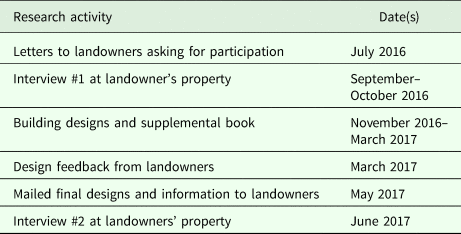
This study was conducted in two phases, adapted from Tress and Tress (Reference Tress and Tress2003), and is outlined in Table 2. In phase I, a researcher interviewed each participant to begin to build a working relationship, discuss the land and identify interests related to agroforestry design. Interviews, performed from September through October 2016, were semi-structured, 60–90 min long, and conducted at the landowners’ properties. The interviews were recorded with landowner permission using both a phone and laptop voice recorder. The interviews were transcribed within 48 h after completion. Researchers used the responses to create three future scenarios to guide conservation designs for landowners. The scenarios focused on production, conservation or cultural components as a means of covering all aspects of land use and needs indicated by landowners.
Timeline of research activities carried out with landowners for the design of conservation plans

In phase II of the study, the three scenarios guided the development of three unique designs for each participant's land using a stepwise planning and design process following the landscape ecological planning method described by Ahern (Reference Ahern, Tress, Tress, Fry and Opdam2006). To review the designs, participants were asked to give feedback by mail, and experts in ecology, crop science and forestry were consulted in person. Lastly, each design was visualized in the form of a photorealistic landscape plan. Designs were mailed to landowners with a supplemental book describing the costs, management, products, timeline, and cultural and environmental benefits of each practice in their designs.
The second interviews were performed in June 2017, from 2 to 6 weeks after landowners received their designs. The interviews, which lasted 90–120 min, were conducted in the same manner as the first set of interviews. Participants were asked a series of questions regarding the utility of the design process, current and previous experiences with conservation programs, the benefits and challenges of integrating conservation practices, and the state of US agriculture as a whole. Several prevalent, repeated themes emerged from landowner feedback in the two interviews and they are detailed in this paper. The entire design and interview process is described in detail by Stanek (Reference Stanek2018).
Data analysis
Data were analyzed concurrently with the development of each phase. Audio recordings of interviews were transferred into Audacity (Version 2.1.2), a digital audio editor, for cleaning of the audio files. Interviews were transcribed using Microsoft Word 2016, and transcriptions were transferred into Microsoft Excel 2016 for data cleaning and organization. Quantitative data regarding landowner preferences, motivators and barriers were tabulated and explored in Microsoft Excel 2016. Qualitative data were exported into NVivo 11 Pro, a qualitative data analysis software, for coding and analysis. Themes and landowner preferences regarding the design process and conservation programs were organized and coded using an iterative process. Contextual information about landowners gathered in the first set of interviews was coded; then emerging themes and patterns were coded for using an inductive approach (Thomas, Reference Thomas2006).
Results and discussion
The first and second set of interviews with landowners consisted largely of discussions on two topics: the conservation design process and conservation programs. The following sections explore these two topics and examine their relevance toward improving the design process, research objectives and conservation policies. The themes described here were identified as the most commonly occurring in the qualitative analysis and applicable to the scope of this paper; improving conservation design processes and consequently the conservation programs making use of them. These themes do not represent those of every landowner in the study or among the Midwest USA.
The design process
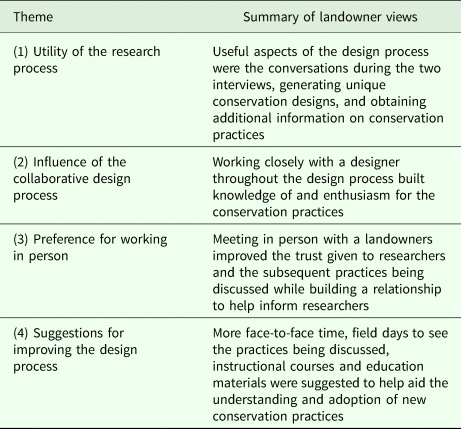
The design process was discussed with landowners through a series of semi-structured questions in the second interview. Of the themes that emerged, four were the most significant in relation to conservation design. These themes are displayed in Table 3 and discussed in detail in the upcoming section. Each offers insight into landowners’ values, thoughts and suggestions of when considering the makeup of a successful conservation design process.
Themes and subsequent findings regarding the design process from interviews with landowners

Utility of the design process
According to landowners, the most useful aspects of the participatory design process were the conversations during the two interviews and the generation of unique conservation designs. Seven of the 15 landowners found meeting with a research expert during the interviews to be the most useful aspect of the study because it provided a trustworthy source to answer potential design questions. One landowner addressed that opinion in saying the following:
‘When we talked the first time it was extremely useful because you were introducing me to the thoughts. Those thoughts never entered my mind. That was extremely helpful just to get my thought process going. Then when [the designs] followed behind…It was very self-explanatory because you had already talked about those things.’
Seven other landowners found the designs to be the most useful as the designs expanded their view of what was possible on their land. This was expressed by one landowner in saying, ‘This kind of feedback is valuable to us. We want it to look good, and we want it to produce something and to know that is the kind of trees that will do okay there.’ One landowner identified the supplemental book as most useful, although most participants acknowledged its importance in helping them understand the practices used in the designs.
Influence of the collaborative design process
The design process itself, regardless of the designs, had a notable impact on the exchange of knowledge between landowners and researchers. Landowners were asked about working with a landscape designer and how the process influenced their likelihood of using agroforestry. All 15 landowners stated that going through the entirety of the research design process increased the possibility of their using agroforestry practices. Despite the landowners already being determined to be high-potential adopters of such practices, they experienced increased enthusiasm and understanding for using the designs created in the study. Much of the enthusiasm can be traced to the relationship built between the researcher and the landowner throughout the process.
Several landowners emphasized the importance of meeting with someone experienced with agroforestry in helping them understand and accept the legitimacy of the practice. Repeated mentions were made of the value of an ‘expert’, and without their involvement, the systems ‘would be too overwhelming and daunting’ and landowners ‘would not have time to do the research (themselves)’. Other landowners said they simply would not have been interested without talking to an expert practitioner. In some instances, landowners may have lacked time or resources to learn about practices despite wanting to enroll in a conservation program. Working more directly with landowners serves multiple purposes. It represents a learning tool to expand landowner knowledge of a variety of practices and species that may have previously been unknown. It also gives conservation agents, planners and researchers an opportunity to broaden their views of how practices can be used and help them better understand the needs of landowners (Nassauer and Opdam, Reference Nassauer and Opdam2008; Oliver et al., Reference Oliver, Fish, Winter, Hodgson, Heathwaite and Chadwick2012).
The collaborative nature of this study sheds light on the promise of increasing the transdisciplinary quality of conservation work. The call for bringing together numerous parties with landowners in the conservation realm is not new but it has yet to be fully implemented in any programs (Liu et al., Reference Liu, Dietz, Carpenter, Alberti, Folke, Moran, Pell, Deadman, Kratz, Lubchenco, Ostrom, Ouyang, Provencher, Redman, Schneider and Taylor2007; Reimer, Reference Reimer2015). The likely reason is that it can be quite costly to invest more time into the conservation design and planning process. There are notable examples, though, of programs that have taken on the challenge of working with and educating landowners, conservationists and planners on multifunctional landscape planning using agroforestry. Two such programs that should be considered useful case studies relevant to this research are Australia's Master Tree Grower program (Bauer and Gordon, Reference Bauer and Gordon2003; Reid, Reference Reid2017) and the University of Missouri's Agroforestry Academy (Gold et al., Reference Gold, Cernusca and Jose2013).
Preference for working in person
Researchers built trust with landowners by taking the time to meet in person on multiple occasions, rather than conducting the experiment through the mail or electronically. Many landowners stated they would have ignored the study if not given the opportunity to meet with someone in person. Having a researcher visit their land with an open mind was a requirement for landowners, as described by one saying, ‘You could understand and implement what I was concerned with. You did not consider my ground a petri dish, and you actually were concerned with it.’ Various participants expressed how they are constantly receiving participation requests from research projects, surveys and related materials and they simply do not have time to do them all. Meeting face-to-face with researchers or conservationists is no longer the norm but is arguably now valued even more by landowners.
Previous studies working with farmers echo these sentiments in showing how conservation approaches that incorporate farmers views as ‘expert’ knowledge and develop collaborative relationships are essential for successful integrated approaches in agriculture (Pannell et al., Reference Pannell, Marshall, Barr, Curtis, Vanclay and Wilkinson2006; Oliver et al., Reference Oliver, Fish, Winter, Hodgson, Heathwaite and Chadwick2012; Williams and Brown, Reference Williams and Brown2014). Additionally, not only do researchers need to value the landowner and their contribution but so too does the broader community (Vanclay, Reference Vanclay2004). Public policy regarding conservation programs must actively attempt to work with landowners to avoid developing a mismatch between policy, implementation and impact.
Suggestions for improving the design process
Landowners offered several ideas for improving the conservation design process used in this study. First, they wanted more face-to-face time with other landowners interested in agroforestry or using it already. They felt meeting with people who had already established agroforestry would allow them to ask about management and feasibility of the systems. They suggested a field tour to show the practices before the design process took place and as a way to meet with other interested landowners. According to one landowner, ‘If we could do those tours beforehand, that would be extremely useful. Then when you are asking us stuff, we have actually seen it.’ Another landowner suggested that with all the new information, ‘[You] could almost make a class out of this. Spend more time being a teacher and me being a student.’ Yet another said they ‘[I] would have loved for you to have hosted a gathering of your fifteen people for the networking support.’
Echoing the findings of other studies (Valdivia et al., Reference Valdivia, Barbieri and Gold2012; Mattia et al., Reference Mattia, Lovell and Davis2018), these suggestions indicate landowners’ desire for more information and collaboration. The information needs described by landowners can be delivered through a variety of sources such as tours, classes and informational materials; they should be offered early in the learning process to help landowners decide the suitability and makeup of potential practices (Reid, Reference Reid2017). Providing these supports will require more resources and money dedicated to conservation, but the supports may pay for themselves. As the understanding of a practice increases, the better it can be managed; and in turn, a higher level of social and environmental benefits is potentially generated relative to using practices that are not understood or managed well.
Conservation programs
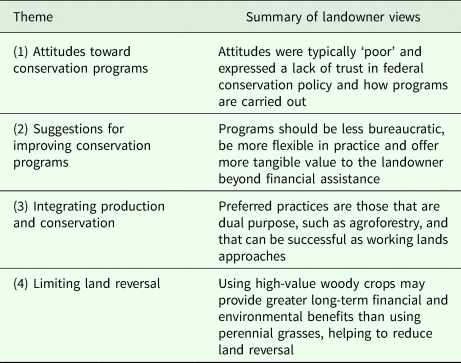
The topic of conservation programs comprised much of the conversation during interviews with landowners. The responses from the interview questions regarding federal conservation programs, specifically CRP and EQIP, are organized here into four most prevalent themes and outlined in Table 4. Each theme should be considered in light of how it may apply to the broader, national approach to conservation.
Themes and subsequent findings regarding conservation programs from interviews with landowners

Opinions of conservation programs
Landowner's views of federal conservation programs varied but most landowners expressed some level of dissatisfaction. About half had direct experience with at least one conservation program, typically CRP. Appreciation was expressed for the land rent received, but the value given to the practices on the land itself was usually low. Many saw the practices being implemented to be a ‘bunch of weeds’ with landowners having little to no interest. Landowner views were often shaped by a single example, or a small subset of nearby examples, of poorly managed CRP land. One landowner expressed the sentiment this way:
‘With some [CRPs] they plant them and just go away and then [the contract] just stops. That is a concern because then it goes back to weed again. Then we go back to spraying. Then we have everything with the soil again. To me, it would be more beneficial if we could have something there that would be useful and that people would take care of.’
Properly managing CRP land can be problematic in various ways. Landowners in previous studies have expressed their challenges, which include not living near their CRP lands, not having the ability or equipment to manage them and feeling the cost of management is too high (Allen and Vanderever, Reference Allen and Vanderever2003). These challenges were raised by landowners in this study as well and suggests a need for increased assistance or flexibility in the management of conservation land. It is important to note that landowners are required to establish a conservation plan to perform periodic management activities for CRP land, but the extent to which this is carried out likely varies.
Landowner views of conservation programs were also associated with a distrust of government involvement. Distrust in government programs and entities, for a variety of reasons, is not uncommon (Atwell et al., Reference Atwell, Schulte and Westphal2009; USDA NRCS, 2011) and trust can be rebuilt in time (Lebel et al., Reference Lebel, Anderies, Campbell, Folke, Hatfield-Dodds, Hughes and Wilson2006). However, this distrust may not be core to the behaviors of landowners. Arbuckle (Reference Arbuckle2013) explained how distrust of the government by farmers in Iowa is generally unfounded, as their research results demonstrated that farmers supported targeted conservation approaches on marginal lands when contacted by natural resource professionals. The targeted approaches were not seen as invasive or intrusive but instead were accepted as a practical approach to implementing conservation. Local and regional efforts carried out by new programs such as ACEP and RCPP may be useful in building more valued, targeted approaches that farmers’ trust.
Suggestions for improving conservation programs
Landowners suggested that conservation programs could be improved by being less bureaucratic and allowing for more flexibility, specifically with CRP. One landowner described their frustration with federal conservation programs in this way: ‘The bureaucracy end of it frustrates you…[such as] having to fit a cookie cutter model whenever things are not cookie cutter modeled.’ This type of sentiment is not uncommon; a movement toward flexibility has previously been found to be a significant factor in successful conservation policy (Schirmer et al., Reference Schirmer, Dovers and Clayton2012).
To improve program flexibility, conservationists would need the knowledge and technical skills to efficiently produce multifunctional goals, in contrast with the monofunctional objectives of many current practices (Selman, Reference Selman2009; Dosskey et al., Reference Dosskey, Wells, Bentrup and Wallace2012). Such a change will not be easily accomplished, as it requires substantial work to build new regulations, rules and resources, but is a worthwhile pathway to be considered. Added flexibility in the design process allows systems to be customized more closely to farmers’ functional needs creating a potential to increase adoption frequency and longevity of practices.
Another way to improve conservation programs mentioned by landowners was to add real economic value to the prescribed practices by allowing for more production components. Despite a potential reduction in ecosystem services from adding in some level of production (Morefield et al., Reference Morefield, LeDuc, Clark and Iovanna2016), landowners saw this approach as a route to building more sustainable conservation practices. One landowner explained, ‘I do not believe in taking public money to take land out of production…I believe in investing in private land with public money for the good of the public…We need to figure out how to keep in production, not take it out.’ These views are not uncommon. The importance of profitability in conservation adoption, whether direct or indirect, is well documented (Atwell et al., Reference Atwell, Schulte and Westphal2010; USDA NRCS, 2011). To reduce the long-term cost of conservation programs, suggestions have been made for supporting the establishment of practices that can meet conservation goals while being profitable at some point (Naidoo et al., Reference Naidoo, Balmford, Ferraro, Polasky, Ricketts and Rouget2006; Valdivia et al., Reference Valdivia, Barbieri and Gold2012).
Integrating production and conservation
Landowners saw agroforestry as one plausible approach to integrate production and conservation benefits, but they suggested that without changes to the current programs, such multifunctional goals were unlikely. One landowner illustrated this idea: ‘Why not harvest things that you can make money off of while still fulfilling an environmental role? It seems like such a no-brainer.’ The landowner was alluding to the potential to harvest crops from CRP lands, which the program currently prohibits to avoid a potential loss of ecosystem services and to prevent ‘double-dipping’ (making money off the land and rental payments simultaneously). While valid, this argument ignores the rapid rise of working lands approaches such as EQIP and CSP. The concerns for loss of services are mainly with practices using herbaceous species. Woody crops, especially food producing, may react very differently to harvesting, as it is often much less destructive and the level of ecosystem services provided may be unchanged or even improved, such as through increased rates of nutrient sequestration after biomass removal (Adegbidi et al., Reference Adegbidi, Volk, White, Abrahamson, Briggs and Bickelhaupt2001).
Researchers have begun to explore the plausibility of using low-input food producing woody crops on marginal lands for ecosystem services (Lovell et al., Reference Lovell, Dupraz, Gold, Jose, Revord, Stanek and Wolz2018) and initial results by Wolz et al. (Reference Wolz, Branham and DeLucia2018) show promise within central Illinois. Converting corn–soybean rotations to multi-species alley cropping systems reduced nitrate leaching by 82–91% and annual N2O fluxes reduced by 25–83%. The study did not compare their results to common land retirement practices though, which remains an under researched topic for woody food producing crops, given that the focus has been primarily on timber and grasses (Naidoo et al., Reference Naidoo, Balmford, Ferraro, Polasky, Ricketts and Rouget2006; Barraquand and Martinet, Reference Barraquand and Martinet2011). It is unclear if these types of approaches can entirely make up for the loss of CRP land, especially for wildlife habitat, which may be difficult to produce on working lands (Morefield et al., Reference Morefield, LeDuc, Clark and Iovanna2016).
Limiting land reversal
Promoting practices and specific species that discourage a farmer from reverting conservation land to production may help to improve the long-term benefits of conservation programs (Morefield et al., Reference Morefield, LeDuc, Clark and Iovanna2016). One landowner discussed this topic in this way: ‘Once you get these trees established, you cannot turn [the land] into tillable farmland easily.’ Land reversal is a serious concern in conservation programs, specifically CRP.
The most commonly used CRP practices are native and introduced grasses. In 2017, over 58% of the national CRP acreage consisted of some assemblage of grass species (USDA FSA, 2017b). Though grasses are extremely valuable to the environment (Johnson et al., Reference Johnson, Dalzell, Donahue, Gourevitch, Johnson, Karlovits, Keeler and Smith2016), practices using only grasses are the easiest to convert back to crop production. From 2010 to 2013, CRP land in the Midwest USA was converted back to intensive agriculture at an estimated rate of 30%, raising serious concerns about sustained ecosystem services in the region (Newton and Kuethe, Reference Newton and Kuethe2015; Morefield et al., Reference Morefield, LeDuc, Clark and Iovanna2016). CRP lands that are moved back into production cease to provide high levels of ecosystem services and many of the accumulated benefits are negated.
The long-term impacts of policies, beyond a 5 or 10 yr period as for CRP, should be considered when investing taxpayer money into farmland for public benefit. Financial assistance to support conservation practices may be better suited to being thought of as an investment in environmental capital. Investments that continue to generate value to the public beyond the initial time of investment should be favored over those with limited return.
Limitations
This study offers useful insights into the design process and implementation of conservation programs but has several limitations that should be considered. First, the participants in this study were concentrated in one region of central Illinois and were a unique subset of operators and landowners. Their ideas and preferences may not reflect those of landowners in different agricultural areas, but they may be an analog given that the USRW is very similar to much of the Midwest USA, where the most intensive agricultural production occurs. Secondly, the study itself was semi-structured to allow landowners a level of freedom in expressing their opinions and preferences for their land. It is not possible to draw statistically significant conclusions from this work: its use should rather be seen as exploratory, a necessary step toward understanding landowners’ challenges with conservation programs. Lastly, the design focus here was centered on agroforestry and its design for landowners in central Illinois. Though agroforestry represents only one tool for landowners looking to implement conservation practices, it may be one of the most important systems for implementing and sustaining the goals of working lands conservation. Additional practices and design processes should be considered when considering landowners who are not as willing to adopt innovative practices. No one practice or design process will suit the needs of all. Despite these limitations, the insights detailed by this study allow for future research and policy to consider alternative approaches to improving conservation programs.
Moving forward
The next steps for research on conservation design, especially regarding agroforestry, are to better understand how the conservation and production benefits of adapted design approaches integrating more user-focused systems compare to the practices typically prescribed by conservationists. We plan to expand the breadth of educational tools and training available to foster the development of landowner experts who can begin to employ the use of multifunctional conservation practices. Farmers who employ innovative conservation techniques may present researchers with excellent case study examples of how and why mutually beneficial practices can develop. Conservation practices established and managed without outside funding are ‘ideal’ as they require no public resources, and are likely to be better cared for given their connection and value to the landowner. Conservationists and researchers should continue to learn from farmers to accommodate the diverse, ever-changing portfolio of conservation needs.
Conclusions
Conservation design, implementation and funding are complex, multi-layered processes and are inextricably linked. They require a well-considered institutional framework for successful implementation and remain a substantial challenge for landowners and conservationists alike, especially when considering multifunctional landscapes. A single study cannot solve each of the challenges presented by conservation programs without risking oversimplifying the recommendations stemming from the investigation. For this reason, we focused primarily on the conservation design process to develop improved methods of meeting the growing need for working lands approaches, which appear poised to become the primary tool for delivering conservation benefits in the future.
The lessons learned here demonstrate how the design process in conservation programs can benefit from using a more individualized approach to build long-lasting practices, highly valued by landowners. Given the growing number of information tools available to designers and planners, it is no longer acceptable to promote programs that apply practices based strictly on predetermined designs, a method that can create disconnect between the implementation of a practice and its long-term impact. Spending additional time and money at the beginning of a design process to build systems that are valued by the landowner may help to preserve conservation practices on the land in the face of shifting policies and market prices that are currently challenging the sustainability of land retirement programs.
The feasibility of CRP land is challenged by high crop prices, increased demand for land and a cost-saving mentality on behalf of the federal government (Stubbs, Reference Stubbs2014) despite the plethora of ecosystem services they generate (Hansen, Reference Hansen2007; Johnson et al., Reference Johnson, Dalzell, Donahue, Gourevitch, Johnson, Karlovits, Keeler and Smith2016). The movement toward working lands approaches will likely persist given their apparent economic advantages and should be explored for the unique opportunities they can offer. Working lands conservation shifts much of the responsibility to provide environmental benefits onto the farmer, which may appear at first to be detrimental, but in actuality, could favor the development of genuinely sustainable multifunctional agricultural practices that integrate production goals with conservation goals. Our findings suggest landowners are open to and motivated by the development of design processes that foster these integrations, and they should be examined further to continue working towards solving the complex questions facing conservation design, implementation and funding in the USA.
Author ORCIDs
Erik Christian Stanek 0000-0001-5993-5001; Sarah Taylor Lovell 0000-0001-8857-409X
Acknowledgements
This material is based on work supported by the National Institute of Food and Agriculture, US Department of Agriculture, under Award Number 2014-68006-22041. The Illinois Nutrient Research and Education Council provided additional funding and support.
We owe so much to the cooperation and interest of all our participants in this study. Our work absolutely depended on our participants’ willingness to share their thoughts, insight and life goals.