1. Introduction
Human–robot interactions have enhanced the development of both hardware and software [Reference Fu, Yu, Guo, Zheng and Gan1]. Researchers aiming to ensure that robots can handle environmental variations have employed various end effectors, mission-planning strategies, control algorithms, and system design modes [Reference Stroppa, Majeed, Batiya, Baran and Sarac2]. Robotic gripper end effectors find many applications in automated production systems, agriculture, and daily life [Reference Rybak, Carbone, Mohan, Gaponenko, Malyshev and Voloshkin3]. Soft grippers, the fingers of which are fabricated from flexible materials that adaptively deform when encountering different objects, have attracted a great deal of attention because of their excellent gripping capacities and the safe nature of human–robot collaboration [Reference Shin, Park, Kim and Yoon4].
To expand the application range of robotic grippers and end effectors, researchers aim to ensure effective grasping at all times. The shape and mass of the object to be grasped, and the grasping force imparted by the gripper, must be considered [Reference Samadikhoshkho, Zareinia and Janabi-Sharifi5]. The gripping force must not damage or disrupt the object. Moreover, the individual finger gripping forces may differ as the grippers do not always grasp well-balanced symmetric objects with the stable posture of the same finger torque. Gripping position and posture may be limited due to the robot arm structure. The deformation and force control thus need to vary by object shape and grasping posture. Sometimes, the center of the mass of the object may vary, i.e., when gripping a container with liquid.
In some gripping scenarios, such as grasping an edge of unbalanced objects, the gripper fingers must possess two key capabilities to improve grasping stability, force control for moment resistance, and secure edge grasping. The gripper with moment resistances and edge-grasping capabilities can also handle objects such as a liquid container. When object tilting is prohibited and when object edges must be grasped without object deformation, it is essential to control the gripper moment applied to the object. Moreover, the use of force control to enable moment resistance and edge grasping ensures stable object gripping not only in certain situations but also maintains stable grasping after gripping the object.
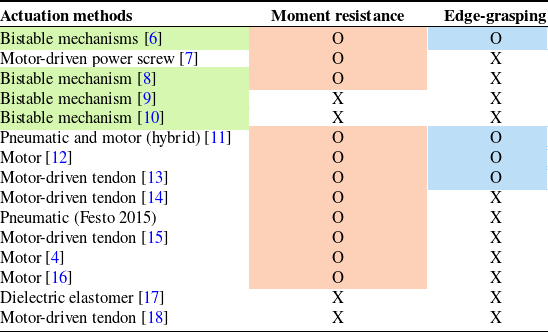
Table 1 shows the actuation methods, moment resistances, and edge-grasping capacities reported in 15 recent studies [Reference Shin, Park, Kim and Yoon4, Reference Hawkes, Jiang, Christensen, Han and Cutkosky6–Reference Odhner, Ma and Dollar18]. Various grippers that aim to control applied forces typically have pneumatic, hydraulic, or electric driving mechanisms [Reference Brown, Rodenberg, Amend, Mozeika, Steltz, Zakin, Lipson and Jaeger19, Reference Gu, Zhu, Zhu and Zhu20]. However, force control is often impossible or requires complex external control structures. For actuation, most grippers employ motors or motor-driven tendons, but some use the bistable structures that are color-coded (green) in Table 1. These structures could save actuation energy; the power supplied to compressors or motors does not need to be continuous [Reference Jo and Yoon21–Reference Lee and Yoon23]. The moment-resistance and edge-grasping capacities are also color-coded (orange and blue, respectively) in Table 1. Few grippers simultaneously manage moment resistance and edge grasping. Employing motors or motor-driven tendons actively control the force, sometimes combined with object imaging and force calculations. Passive structures generally use elastic membranes for edge grasping [Reference Zhu, Yang and Zhang14], but the required pneumatic pumps consume a lot of power.
Key features of existing grippers. Bistable mechanisms were marked green as an energy-efficient method, and moment resistance and edge-grasping capabilities were marked orange and blue, respectively.

Only one existing gripper has a drive that does not continuously consume energy but nonetheless achieves edge grasping. This gripper [Reference Hawkes, Jiang, Christensen, Han and Cutkosky6] engages in passive edge grasping by utilizing the micro-wedge-based shear friction of the surface in contact with the object, but friction surface fabrication is difficult and susceptible to contamination that degrades performance. When fully contaminated, the proposed micro-wedge-based surface exhibited a shear stress comparable to that of a conventionally textured silicon rubber. Effective edge grasping must be inexpensive and not reliant on energy-demanding actuators.
It is thus aimed to develop a gripper with a simple actuation mechanism capable of both moment resistance and edge grasping. The basic concept of sensing the object and providing the appropriate torque was suggested following the human hand. Sensing an object and providing gripping feedback enables hands to resist moments and grasp edges [Reference Nguyen, Dhyan, Mai, Han and Chow24] even when the object is not imaged. Still, a simple structure is required as the human hand has quite a complex structure for various other functionalities. Nevertheless, object sensing and torque control are key in many different manipulation scenarios. Thus, a gripper with a simple mechanism that senses objects and controls the finger-specific gripping forces (torques) was suggested for effective edge grasping without tilting; minimization of energy consumption is required.
The gripper was designed to detect the object via mechanical sensing and modulate finger torque concerning the object contact and tilt. Accordingly, the suggested gripper has a mechanical trigger that senses object contact and a variable torque joint that controls the torque based on the actuation angle. When the trigger senses an object during gripping, the fingers do not deploy further. The torque at that position is determined by the finger actuation angle measured by a cam within the variable torque joint. To ensure effective gripping, the torque profile, i.e., in terms of the actuation angle, was non-linearly defined via simple calculation. All required energy was delivered via a spring; the gripper does not require electric power, and most parts were easily 3D-printed.
The gripper demonstrates reliable grasping through mechanical object sensing and adaptive torque control, ensuring stable gripping even when the object has a moment. As a resistance moment is necessary for stable gripping, it is expected that this research will expand robot gripper applications, especially when grippers must be simple and lightweight, for example, in aerial robots.
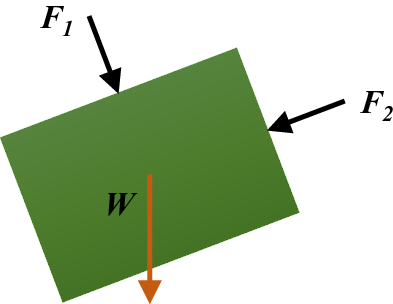
The static gripping scenario.

Gripper operation.

2. Materials and methods
2.1. Conceptual design
To stably grasp the edges of tilted objects, a gripper must apply different forces when pressing the surfaces adjacent to both edge sides (Figure 1). The gripper grasps the top right corner of an object, which is then held in place by the frictional forces triggered by the pressing forces
 $F_{1}$
and
 $F_{2}$
. The center of gravity of the object is to the left of the grasped edge; the weight of the object thus creates a counterclockwise moment. To ensure stable gripping,
 $F_{2}$
must be larger than
 $F_{1}$
; this creates a reactive torque. To cope with this scenario, the gripper fingers operate independently to generate a torque equivalent to the object moment. The joint delivers various torques to the finger dictated by the slope of the grasped surface (Figure 2). When an object contacts the central gripper trigger, two fingers that were initially open close toward the object. When an object touches the contact trigger at the end of a finger, that finger stops releasing, and the joint applies a torque determined by the finger’s angular position.
2.2. Detailed design
Figure 3 shows the variable torque joint powered by a torsion spring. The joint has a cam, a cam guide, a spring pawl, and a pawl lock. The cam guide is fixed to the gripper body, and the other components rotate with the finger. When the gripper finger is initially open and locked by the central trigger, the torsion spring is compressed between the spring pawl and the finger and locked in place by the pawl lock, thus delivering no torque at this time. When the center trigger is activated, the fingers are released and close toward the object. When the object contacts the trigger at the end of the pawl lock, the lock is released to deploy the spring pawl (Figure 4). Then, a spring force acts between the finger and the pawl; the force is determined by the angle between the finger and the deployed pawl. The cam restricts the angle of the deployed spring pawl and thus determines the torque (Figure 5). The cam guide translates rotational finger motion into linear cam motion; the cam moves toward the pawl as the finger rotates. As this process evolves, spring expansion is limited, increasing the spring torque.
Interior components of the variable torque joint.

Operation of the variable torque joint.

Spring restrictions at various finger angles.

At lower actuation angles, the extent of spring pawl release is greater, reducing the compression angle of the torsion spring and the torque delivered to the finger. At higher actuation angles, the cam further limits pawl release, and the spring thus delivers more torque at higher compression angles. Thus, the joint outputs different torques depending on the finger’s angular position. The detailed torque profile is determined by the cam and the cam guide.
Figure 6 shows a schematic in which a tilted object is gripped;
 $\theta _{1}$
and
 $\theta _{2}$
are the finger actuation angles, and
 $\phi$
is the angle at which the object is tilted. The top right corner of the object contacts the central gripper trigger. To create the maximum torque that counters object rotation, each finger must apply a different torque. For example, torques
 $T_{1}$
and
 $T_{2}$
are not the same; the difference (
 $| T_{1}-T_{2}|$
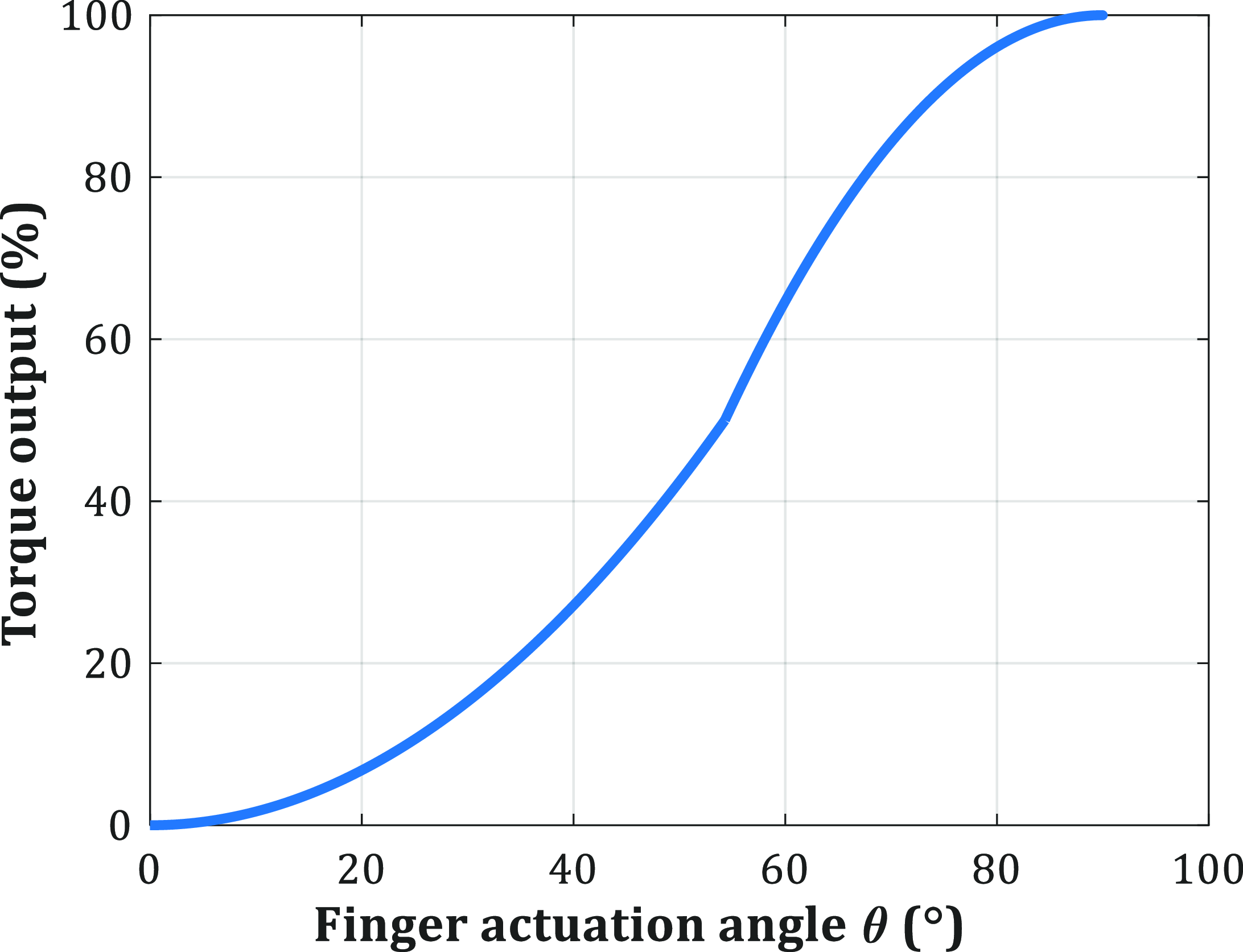
) is identical to the moment associated with object tilting. Figure 7 illustrates the designed output torque
 $T$
in terms of finger actuation angle
 $\theta$
. The friction at a rotating joint was not considered here. When the object is not tilted, or when
 $\phi$
= 45°, the finger actuation angle
 $\theta$
is about 54.3°. At that angle, all fingers apply the same torque to the object;
 $| T_{1}-T_{2}| =0$
. When
 $\theta$
exceeds 54.3°, one finger needs to apply more torque than the other fingers. For better gripping of tilted objects, the torque curve was drawn by reference to second-order polynomials (in forms presented in equations (1) and (2), both passing (54.3, 50)) with an inflection point at
 $\theta$
= 54.3° (Figure 7).
Schematic of the gripper and object during gripping.

Torque outputs of all fingers by the actuation angle.

 \begin{equation} y=f_{1}\left(x\right)=a_{1}x^{2} \end{equation}
 \begin{equation} y=f_{2}\left(x\right)=a_{2}\left(x-90\right)^{2}+100 \end{equation}
The output torque
 $| T_{1}-T_{2}|$
can then be written in terms of
 $\varphi$
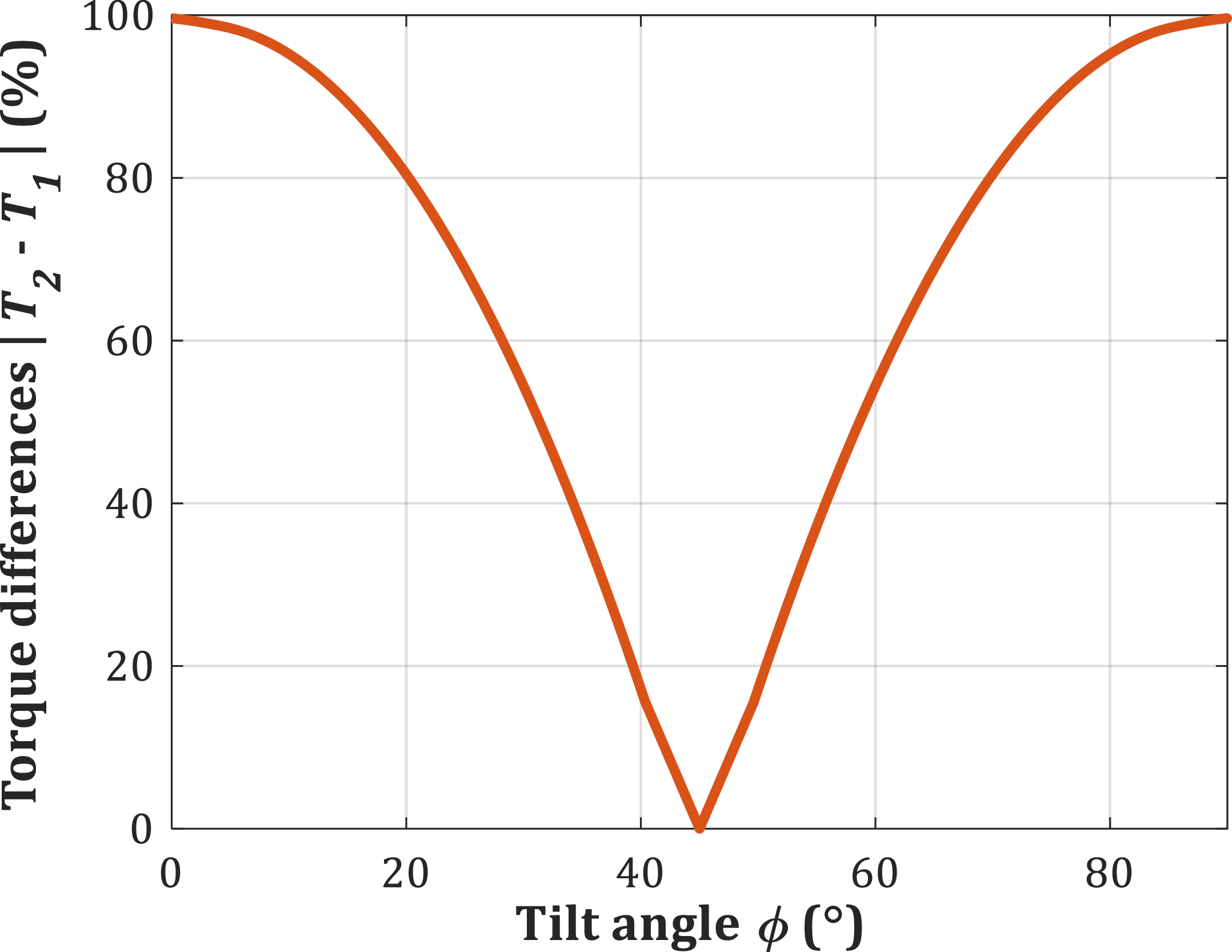
(Figure 8). At
 $\varphi$
= 45°, all fingers apply the same torque, so there is no moment. When
 $\varphi$
is either larger or smaller than this value, a more actuated finger applies more torque and a less actuated finger applies less torque, thus creating a reactive moment that maintains the current object posture. To maximize
 $| T_{1}-T_{2}|$
, the torque output (
 $T$
) needs to increase faster when
 $\theta$
exceeds 54.3° and decrease faster when
 $\theta$
is less than 54.3°. Thus, employing second-order polynomials was more beneficial than employing a simple linear line.
Torque difference (reactive moment) in terms of the object tilt angle.

The designed cam images.

To implement a torque profile reflecting the finger actuation angles, the cam profile was derived based on Figure 7. To enhance torque performance, the cam surface has height steps of 0.6 mm, given that the surfaces of 3D-printed parts are rough. Figure 9 shows the cam with the various steps of different areas that create the required torque profile. As the contact (the spring pawl) moves counterclockwise, the finger actuation angle
 $\theta$
increases. When the angle of the horizontal dashed line is set to 0° (for an
 $\theta$
of 54.3°), Figure 10 shows the positions of each step when creating the torque output curve in Figure 7. After the spring pawl is released, its final position is determined by the specific cam step at that time, and the required torques are then sent to the fingers.
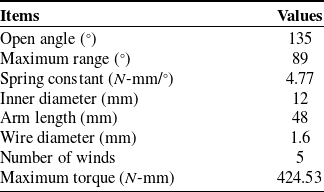
Torsion spring specifications.

The effective finger length (i.e., the grasping length) was 100 mm, based on the human hand. After the addition of the joint connection, the final finger length was 125 mm. The gripping force was about 4% of the average maximum force exerted by appression of the adult male thumb and index finger [Reference Nilsen, Hermann, Eriksen, Dagfinrud, Mowinckel and Kjeken25]. The distance between the fingers was 80 mm, and the fingertip force was 3.48 N. The torsion spring was selected by reference to these values. The maximum torque was the product of the finger length and the maximum fingertip force, i.e., 435 N-mm. Therefore, to deliver the required torque when a finger is fully actuated at 90°, the spring constant must exceed 4.83 N-mm/°. The spring radius was ca. 25 mm, i.e., the difference between the effective finger length (100 mm) and the overall length (125 mm). The torsion spring specifications are listed in Table 2.
Angular positions at each step.

Figure 11 shows a CAD model and the fabricated gripper. Most components were 3D-printed using a material extrusion method using polylactic acid (PLA). To minimize the friction, commercial pin-socket joints were used. The cam guide, which must be highly accurate and have low surface friction, was printed via VAT resin photopolymerization. A polymer pad was attached to each fingertip to enhance gripping by increasing friction. Each pad was fabricated by curing a flexible PDMS polymer (Sylgard 184 silicone elastomer; Dow Silicone Corporation, USA), which is widely used for its ease of application and has a high frictional coefficient due to its strong adhesion [Reference Kim, Lee, Lee and Kim26].
(a) A CAD model of the gripper and (b) the fabricated gripper.

3. Results and discussion
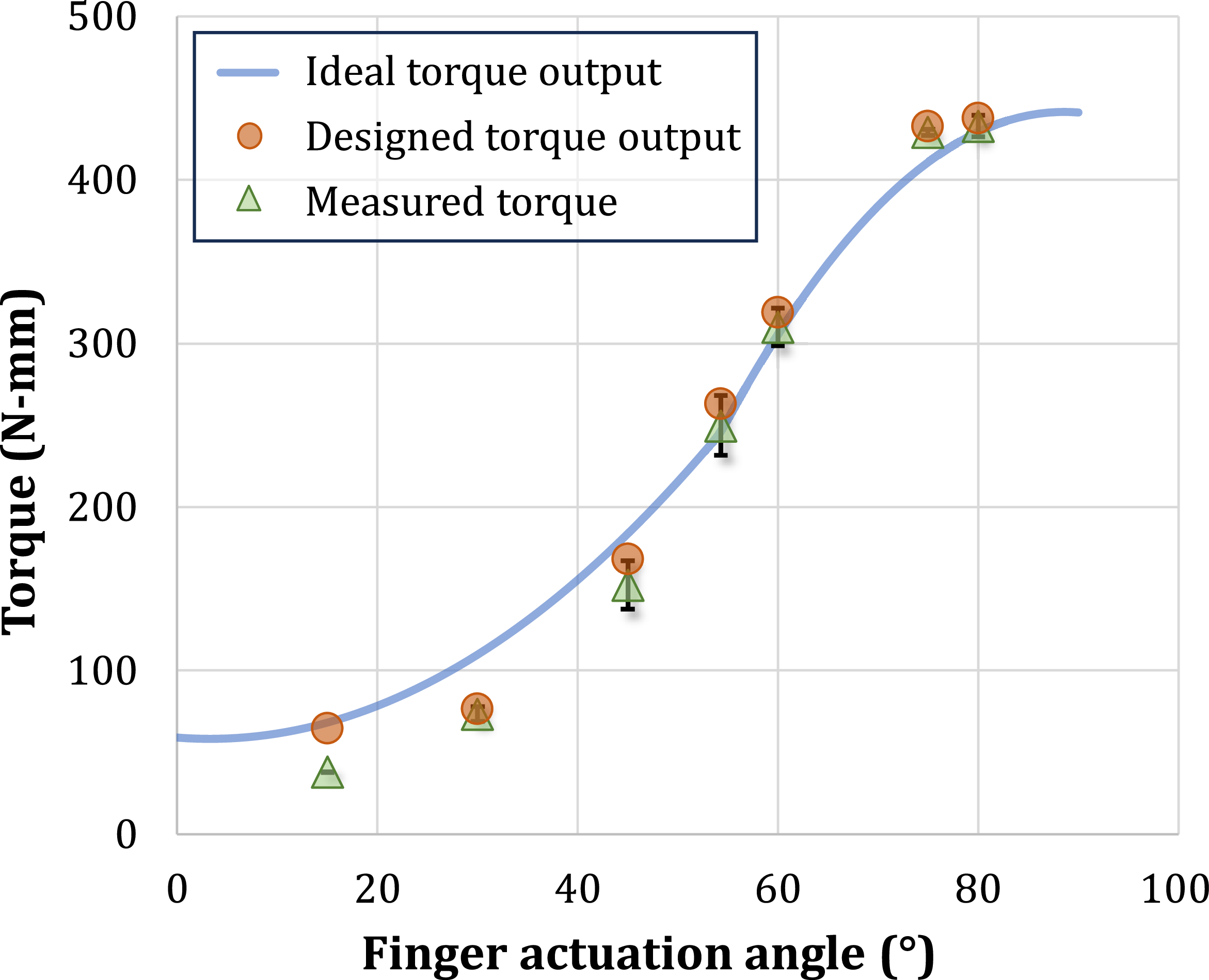
To assess the performance of the variable torque joint, the maximum torque that the joint could withstand was measured in terms of the finger actuation angle. Figure 12 shows the experimental setup for torque measurement. A horizontal cable was attached to each fingertip. Weights were then added to the cable to determine the maximum weight that the finger could withstand without damaging the gripper. The experiment was repeated three times for each actuation angle, and the calculated torques are shown in Figure 13. The blue line is the continuous target torque, and the orange dots and green triangles are the desired torques and the experimental results, respectively. Given the stepwise cam shape, the target torque profile, and the expected outputs differ. Nevertheless, as shown in Figure 13, the measured values are very close to the expected values, indicating that the cam and variable torque joint operate as intended.
Experimental setup used to measure torque.

A comparison of the designed and measured torque outputs with respect to the finger actuation angle.

The gripper can cope with various scenarios. Figure 14 shows the gripping capabilities when an object is not tilted. Given the soft pads at the ends of the fingers, grasping can be performed both by squeezing opposite sides of the object (Figure 14(a)) and by wrapping around the object (Figure 14(b)). The workable geometries may be narrower than those of highly adaptable soft fingers; nevertheless, the gripper can cope with various objects.
Grasping (a) by squeezing the opposite sides of an object and (b) by wrapping an object.

Figure 15 shows how the gripper achieves its purpose. The gripper senses an object using the mechanical trigger, deploys the fingers, creates reactive moments, and maintains its grip regardless of the object’s tilt angle. The gripper grasps edges and resists moments, as planned, when
 $\phi =45^{\circ}$
,
 $\phi =60^{\circ}$
, and
 $\phi =90^{\circ}$
. The video link [Reference Yoon27] shows the basic working principles of the gripper and gripping videos. Thus, object sensing and a variable torque output are possible without any electrical components.
Grasping the corner of an object and resisting the rotational moment.

The current gripper was designed with a relatively small gripping force compared to the human hand (about 4% of the average maximum force of the human finger); the maximum weight of the box shown in the video was about 350 g. But the workable mass can be improved by changing the torsion spring. Due to its simple mechanical structure, the gripper was able to maintain a secure grasp once an object was gripped. The 3D-printed gripper body also hinders the gripping capabilities due to its low strength, but it can be strengthened for higher gripping weights. Improvements in soft pads are also strongly believed to enhance the overall gripping capabilities. Currently, the soft pads have flat surfaces; however, the application of micro- and nano-patterning can further improve friction [Reference Kim and Yoon28], thereby contributing to an increase in the maximum gripping weight. Additional fabrication steps may be introduced as needed to implement such surface patterning. The current simple pads undergo a deformation of approximately 1 mm, providing good repeatability for the gripper, but further improvement can be achieved through geometric optimization of the pads.
According to the literature [Reference Kim, Lee and Kim29], although hot-plate, or oven-cured PDMS exhibits a higher wear rate than samples fabricated via ultrasonic heating, it maintains its frictional characteristics for up to 1,000 cycles [Reference Kim, Lee, Lee and Kim26]. The overall robustness of the gripper is likely determined more by the 3D-printed body than by the PDMS structure, as the fatigue strength of PLA has been reported to decrease after approximately hundreds of cycles [Reference Ezhe and Susmel30]. Nonetheless, the fabricated gripper successfully performed at least several dozen gripping tests.
As the gripper just applies the possible maximum torque by the torsion spring, the finger actuation may slightly change when the object moment exceeds the torque. But the torque difference is designed to increase either the tilt angle decreases, or increases (Figure 8), and the gripper finds the equilibrium state soon. In the movie, the finger actuation angle changed by about 8° from the initial grasping posture, yet it successfully maintained a stable tilted gripping. Also, if the object does not touch the central trigger, the gripper will not start gripping. The central trigger may need to be improved to cope with more varied objects.
The current gripper does not have a releasing mechanism or automatic restoration to the initial open state, and it is one of the drawbacks of the gripper, limiting the number of uses. It is thought that another trigger with tendons could resolve the issue by releasing the pawl lock and repositioning the fingers and central trigger. Tendons need to be connected to the tip of the finger, pawl lock, and central trigger, along with the implementation of a wire winding device. While tendons could be operated manually, the adoption of an electrical winding device, such as a motor, would consume power in the restoring state. However, the gripper still remains energy-efficient when compared to pneumatic, hydraulic, or electric driving mechanisms, as it does not continuously consume power during gripping. Even compared to a bistable mechanism, the suggested gripper would only consume power during restoring (releasing), not during gripping.
The developed gripper successfully proved its capabilities of both moment resistance and edge grasping with a simple energy-efficient mechanism. The gripper mechanically senses the object and provides torque feedback for effective grasping without any electrical sensors or wires, but with a novel joint design. Even considering the electrical restoration, it consumes negligible power when compared to other driving mechanisms. It is expected that simple design and minimal energy consumption will find many applications, i.e., grippers in aerial drones.
4. Conclusion
This study presented a gripper that resists moments and grasps edges to avoid tilting the object; the gripper grasps edges without completely enveloping the object. By creating a reactive moment, grasping is stable after gripping. To minimize energy use, the gripper has a mechanical trigger, a variable torque joint, and a non-linear cam. The torque varies with the finger actuation angle; torque increases at higher angles. Most gripper components were 3D-printed, and the torque was variable, as intended. The gripper resists moments and grasps edges without the need for any electrical sensors, wires, or batteries.
Edge grasping and maintenance of a stable grip are key if grippers are to be commercialized. Object sensing and torque control by each finger are essential. Many studies have used machine learning for image sensing, but contact-mediated object sensing remains key when developing grippers. This study showed that object sensing was associated with effective moment resistance and edge grasping in a purely mechanical system. The utility of object sensing and finger pressures will be further evaluated in various scenarios. It is expected that this research can contribute to the development of grippers with broad gripping capabilities.
Supplementary material
The supplementary material for this article can be found at https://doi.org/10.1017/S0263574725103081.
Data availability
The authors declare that the data supporting the findings of this study are available within the paper, its supplementary video is available in YouTube link.
Author contributions
J Park and H.-S. Yoon conceived and designed the study. J Park conducted design and fabrication of the gripper and gathered data. J Park and H.-S. Yoon wrote and reviewed the article. H.-S. Yoon supervised the project.
Financial support
This work was supported by the National Research Foundation of Korea (NRF) grant funded by the Korean government (Ministry of Science and ICT and Ministry of Education) (Nos. NRF-2022R1F1A1063896, and 5199990714521).
Competing interests
The authors declare that they have no known competing financial interests or personal relationships that could have appeared to influence the work reported in this paper.
Ethical approval
Not Applicable.
Generative AI and AI-assisted technologies in the writing process
During the preparation of this work the authors used ChatGPT-5.1 and Gemini 2.5 Flash only to improve readability by checking grammatical errors. After using this tool/service, the authors reviewed and edited the content as needed and take full responsibility for the content of the published article.